wheel FIAT MULTIPLA 2007 1.G User Guide
[x] Cancel search | Manufacturer: FIAT, Model Year: 2007, Model line: MULTIPLA, Model: FIAT MULTIPLA 2007 1.GPages: 266, PDF Size: 4.66 MB
Page 92 of 266
91
SAFETY
DEVICES
CORRECT USE
OF THE CAR
WARNING
LIGHTS AND
MESSAGES
IN AN
EMERGENCY
CAR
MAINTENANCE
TECHNICAL
SPECIFICATIONS
INDEX
DASHBOARD
AND CONTROLS
FAILURE WARNINGS
ABS failure
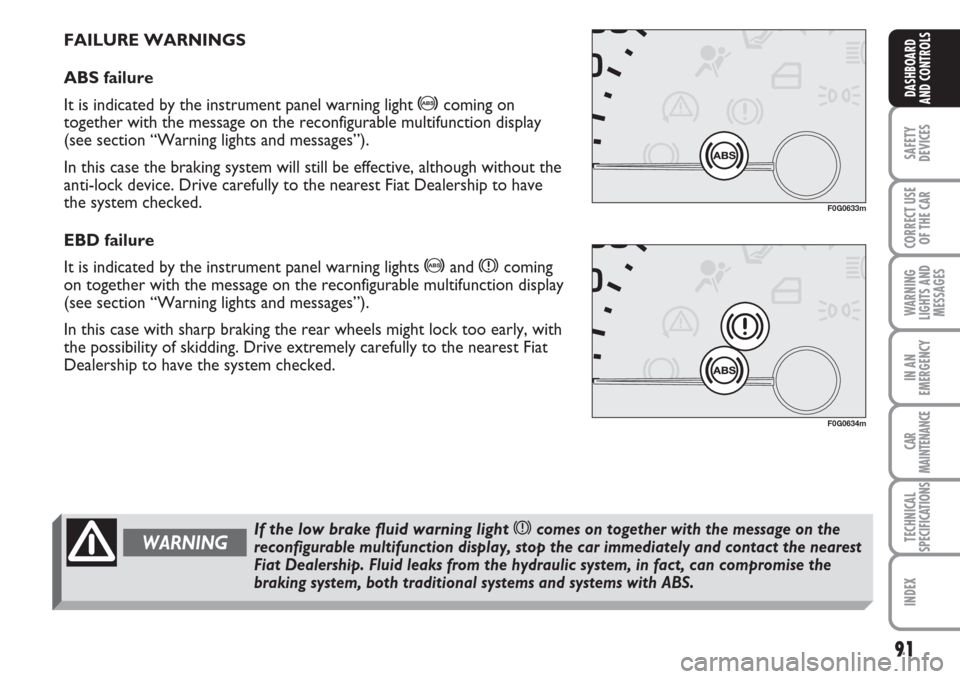
It is indicated by the instrument panel warning light
>coming on
together with the message on the reconfigurable multifunction display
(see section “Warning lights and messages”).
In this case the braking system will still be effective, although without the
anti-lock device. Drive carefully to the nearest Fiat Dealership to have
the system checked.
EBD failure
It is indicated by the instrument panel warning lights
>and xcoming
on together with the message on the reconfigurable multifunction display
(see section “Warning lights and messages”).
In this case with sharp braking the rear wheels might lock too early, with
the possibility of skidding. Drive extremely carefully to the nearest Fiat
Dealership to have the system checked.
F0G0633m
F0G0634m
WARNINGIf the low brake fluid warning light xcomes on together with the message on the
reconfigurable multifunction display, stop the car immediately and contact the nearest
Fiat Dealership. Fluid leaks from the hydraulic system, in fact, can compromise the
braking system, both traditional systems and systems with ABS.
Page 94 of 266
93
SAFETY
DEVICES
CORRECT USE
OF THE CAR
WARNING
LIGHTS AND
MESSAGES
IN AN
EMERGENCY
CAR
MAINTENANCE
TECHNICAL
SPECIFICATIONS
INDEX
DASHBOARD
AND CONTROLS
F0E0384m
FAILURE WARNINGS
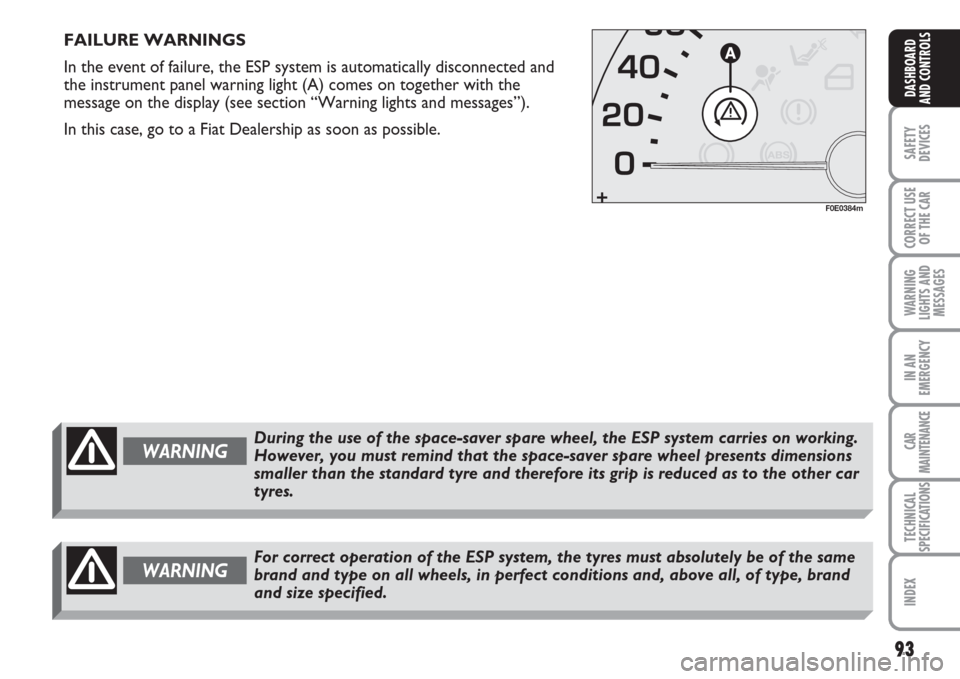
In the event of failure, the ESP system is automatically disconnected and
the instrument panel warning light (A) comes on together with the
message on the display (see section “Warning lights and messages”).
In this case, go to a Fiat Dealership as soon as possible.
WARNINGDuring the use of the space-saver spare wheel, the ESP system carries on working.
However, you must remind that the space-saver spare wheel presents dimensions
smaller than the standard tyre and therefore its grip is reduced as to the other car
tyres.
For correct operation of the ESP system, the tyres must absolutely be of the same
brand and type on all wheels, in perfect conditions and, above all, of type, brand
and size specified.WARNING
Page 95 of 266
94
SAFETY
DEVICES
CORRECT USE
OF THE CAR
WARNING
LIGHTS AND
MESSAGES
IN AN
EMERGENCY
CAR
MAINTENANCE
TECHNICAL
SPECIFICATIONS
INDEX
DASHBOARD
AND CONTROLS
ASR SYSTEM (Antislip Regulation)
The ASR system is an integral part of the ESP system that controls the
vehicle drive and cuts in automatically every time one or both driving
wheels slip.
In slipping conditions, two different control systems are activated:
❒if the slipping involves both the driving wheels, the ASR system
intervenes reducing the power transmitted by the engine;
❒if the slipping involves only one driving wheel, the ASR system cuts in
automatically braking the wheel that is slipping.
The action of the ASR is particularly helpful in the following
circumstances:
❒slipping of the inner wheel due to the effect of dynamic load changes
or excessive acceleration;
❒too much power transmitted to the wheels also in relation to the
conditions of the road surface;
❒acceleration on slippery, snowy or frozen surfaces;
❒in the case of loss of grip on a wet surface (aquaplaning).
Switching on/off of the ASR system
The ASR system switches on automatically each time the engine is
started.
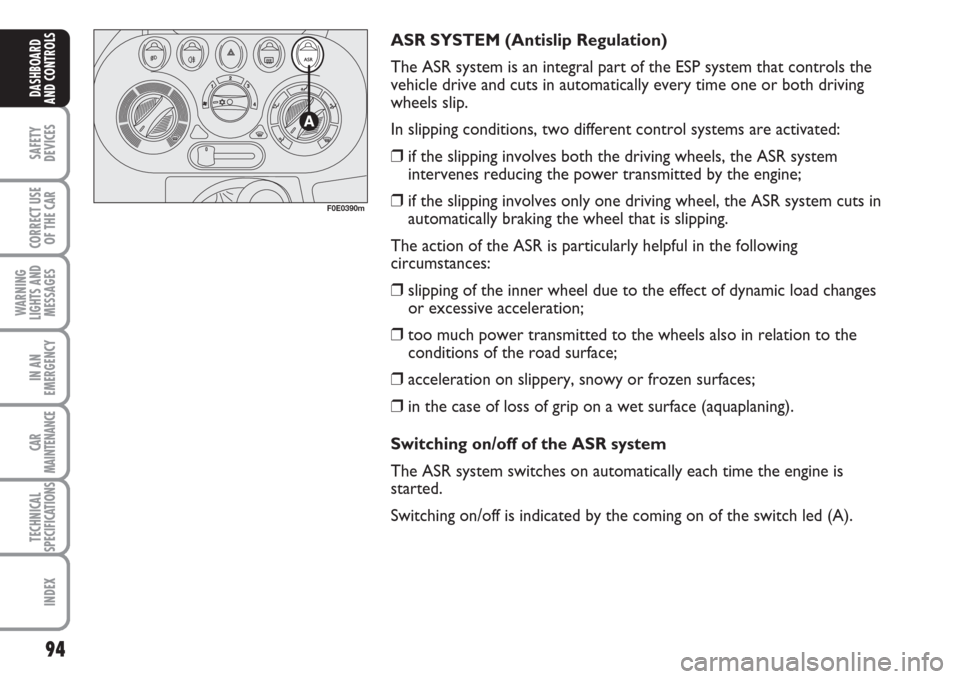
Switching on/off is indicated by the coming on of the switch led (A).
F0E0390m
Page 96 of 266
95
SAFETY
DEVICES
CORRECT USE
OF THE CAR
WARNING
LIGHTS AND
MESSAGES
IN AN
EMERGENCY
CAR
MAINTENANCE
TECHNICAL
SPECIFICATIONS
INDEX
DASHBOARD
AND CONTROLS
When travelling the ASR can be switched off and on
again pressing switch (A) on the centre console.
When the ASR is off this is shown by the lighting up of
the led on the switch.If the ASR is switched off when travelling, it will turn
on again automatically the next time the engine is
started.
When travelling on snow with snow chains, it may be
helpful to turn the ASR off: in fact, in these conditions,
slipping of the driving wheels when moving off makes it
possible to obtain better drive.
WARNINGThe performance of the system, in terms of active safety should not induce the
driver to take pointless and unnecessary risks. The style of driving must in any case
always be adapted to the conditions of the road surface, visibility an traffic. Road
safety is always the driver’s responsibility.
For correct operation of the ASR system, the tyres must absolutely be of the same
brand and type on all wheels, in perfect conditions and, above all, of type, brand
and size specified. WARNING
Page 130 of 266
129
CORRECT USE
OF THE CAR
WARNING
LIGHTS AND
MESSAGES
IN AN
EMERGENCY
CAR
MAINTENANCE
TECHNICAL
SPECIFICATIONS
INDEX
DASHBOARD
AND CONTROLS
SAFETY
DEVICES
FRONT AIR BAGS
The car is fitted with front airbags for driver and
passenger and front side airbags (side bag/window bag
as optional).
FRONT AIRBAGS
Front airbags (driver and passenger) have been
designed to protect the occupants in the event of
head-on crashes of medium-high severity, by placing
the cushion between the occupant and the steering
wheel or dashboard.
Front airbags are designed to protect car’s occupants
in front crashes and therefore non-activation in other
types of collisions (side collisions, rear shunts, roll-
overs, etc.) is not a system malfunction.
In case of crash, an electronic control unit, when
required, triggers the inflation of the cushion according
to the severity of the collision.
The cushion immediately inflates, placing itself as a
protection between the body of the front occupants
and the structure that could cause injuries.
Immediately after, the cushion deflates.The front airbag (driver and passenger) is not a
replacement of but complementary to the use of belts,
which should always be worn, as specified by law in
Europe and most non-European countries.
In case of crash, a person not wearing the seat belt
moves forward and may come into contact with the
cushion while it is still inflating. Under this
circumstance the protection offered by the airbag is
reduced.
Front airbags may not activate in the following
situations:
❒in collisions against highly deformable objects not
affecting the vehicle front surface(e.g. bumper
collision against guard rail);
❒car wedging under other vehicles or protective
barriers (for example under a truck or guard rail);
as it offers no additional protection compared with the
seat belts, consequently, it would be pointless.
Therefore, failure to come into action in the above
circumstances does not mean that the system is not
working properly.
WARNINGDo not apply stickers or other objects to the steering wheel or to the airbag cover
on the passenger’s side or on the side roof lining. Never apply objects on the
dashboard on passenger side since they could interfere with proper passenger’s
airbag inflation or cause injuries.
Page 131 of 266
130
CORRECT USE
OF THE CAR
WARNING
LIGHTS AND
MESSAGES
IN AN
EMERGENCY
CAR
MAINTENANCE
TECHNICAL
SPECIFICATIONS
INDEX
DASHBOARD
AND CONTROLS
SAFETY
DEVICES
Driver’s and passenger’s airbags have been designed and calibrated to
improve the protection of a person wearing seat belts.
At their maximum inflation, their volume fills most of the space between
the steering wheel and the driver and between the dashboard and the
passenger.
In minor front crashes (for which the restraining action of the seat belts
is sufficient), the airbags will not deploy. Also in this case it is of vital
importance to wear the seat belts since in case of front crash they
guarantee proper positioning of the car occupant.
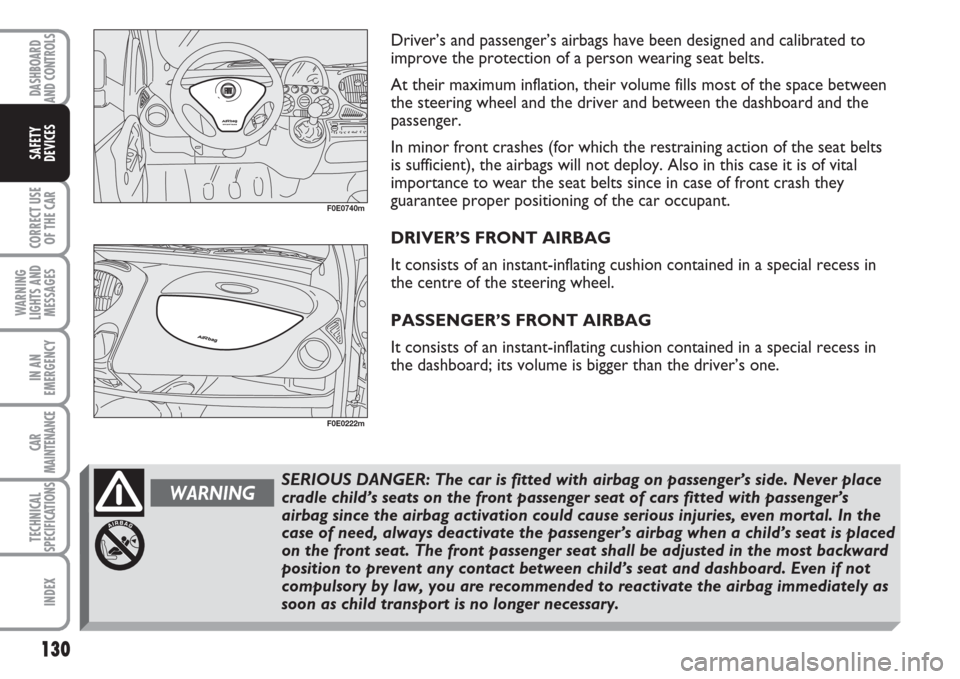
DRIVER’S FRONT AIRBAG
It consists of an instant-inflating cushion contained in a special recess in
the centre of the steering wheel.
PASSENGER’S FRONT AIRBAG
It consists of an instant-inflating cushion contained in a special recess in
the dashboard; its volume is bigger than the driver’s one.
WARNINGSERIOUS DANGER: The car is fitted with airbag on passenger’s side. Never place
cradle child’s seats on the front passenger seat of cars fitted with passenger’s
airbag since the airbag activation could cause serious injuries, even mortal. In the
case of need, always deactivate the passenger’s airbag when a child’s seat is placed
on the front seat. The front passenger seat shall be adjusted in the most backward
position to prevent any contact between child’s seat and dashboard. Even if not
compulsory by law, you are recommended to reactivate the airbag immediately as
soon as child transport is no longer necessary.
F0E0740m
F0E0222m
Page 135 of 266
134
CORRECT USE
OF THE CAR
WARNING
LIGHTS AND
MESSAGES
IN AN
EMERGENCY
CAR
MAINTENANCE
TECHNICAL
SPECIFICATIONS
INDEX
DASHBOARD
AND CONTROLS
SAFETY
DEVICES
GENERAL WARNINGS
WARNING
Never travel with objects on your lap, in front of your chest or with a pipe,
pencil, etc. between your lips; injury may result in the event of the air bag being
triggered.WARNING
Do not cover the backrest of front seats with trims or covers that are not suitable
to be used with side bags.
If the car has been stolen or an attempt to steal it has been made, if it has been
subjected to vandals or floods, have the air bag system checked by Fiat
Dealership.WARNING
WARNINGAlways keep your hands on the steering wheel rim when driving, so that if the air
bag is triggered, it can inflate without meeting any obstacles which could cause
serious harm to you. Do not drive with the body bent forwards, keep the seat back
rest in the erect position and lean your back well against it.
WARNINGIf when turning the ignition key to MAR, the warning light ¬does not turn on or if
it stays on when travelling there could be a failure in safety systems; in this event
air bags or pretensioners could not trigger in case of impact or, in a minor number
of cases, they could trigger accidentally. Contact Fiat Dealership immediately to
have the system checked.
Page 140 of 266
139
WARNING
LIGHTS AND
MESSAGES
IN AN
EMERGENCY
CAR
MAINTENANCE
TECHNICAL
SPECIFICATIONS
INDEX
DASHBOARD
AND CONTROLS
SAFETY
DEVICES
CORRECT USE
OF THE CAR
If the engine does not start at the first attempt, return
the ignition key to STOP before trying to start the
engine again.
If, when the ignition key is at MAR, warning light
¢
remains lit, turn the key to STOP and then back to
MAR; if the warning light remains on, try with the
other keys provided with the car.
If you still cannot start the engine, contact Fiat
Dealership.
IMPORTANT When the outside temperature is very
low, the use of a fluid oil facilitates cold starting.
During winter it is therefore recommended to
observe the specifications contained in section
“Technical specifications” at paragraph “Fluids and
lubricants”.
IMPORTANT Never leave the ignition key at MAR
when the engine is off.
HOW TO WARM UP THE ENGINE
AFTER IT HAS JUST STARTED
(petrol and diesel versions)
Proceed as follows:
❒drive off slowly, letting the engine turn at medium
revs. Do not accelerate abruptly.
❒do not drive at full performance for the initial
kilometres.
EMERGENCY START-UP
If the Fiat CODE system fails to recognise the code
transmitted by the ignition key (warning light
¢on
instrument panel lit with fixed light) you can start the
engine by following the emergency procedure using
the code written on the CODE card.
See section “In an emergency”.
Never bump start the engine by pushing, towing or coasting downhill as this could cause fuel to
flow into the catalytic exhaust system and damage it beyond repair.
Remember that the servobrake and power steering are not operational until the
engine has been started, therefore much effort than usual is required on the brake
pedal and steering wheel.WARNING
Page 141 of 266
140
WARNING
LIGHTS AND
MESSAGES
IN AN
EMERGENCY
CAR
MAINTENANCE
TECHNICAL
SPECIFICATIONS
INDEX
DASHBOARD
AND CONTROLS
SAFETY
DEVICES
CORRECT USE
OF THE CAR
STOPPING THE ENGINE
Turn the ignition to STOP while the engine is idling.
IMPORTANT After a taxing drive, you should allow
the engine to “catch its breath” before turning it off by
letting it idle to allow the temperature in the engine
compartment to fall.PARKING
Proceed as follows:
❒stop the engine and engage the handbrake;
❒engage a gear (first if the car is faced uphill or
reverse if it is faced downhill) and leave the wheels
steered.
Block the wheels with a wedge or a stone if the car is
parked on a steep slope.
Do not leave the ignition key at MAR to prevent
draining the battery. Always remove the key when you
leave the car.
Never leave children unattended in the car. Always
remove the ignition key when leaving the car and take
it out with you.
A quick burst on the accelerator before turning off the engine does not serve any practical purpose at
all. It wastes fuel and is damaging, particularly to turbo-charged engines.
Page 148 of 266
147
WARNING
LIGHTS AND
MESSAGES
IN AN
EMERGENCY
CAR
MAINTENANCE
TECHNICAL
SPECIFICATIONS
INDEX
DASHBOARD
AND CONTROLS
SAFETY
DEVICES
CORRECT USE
OF THE CAR
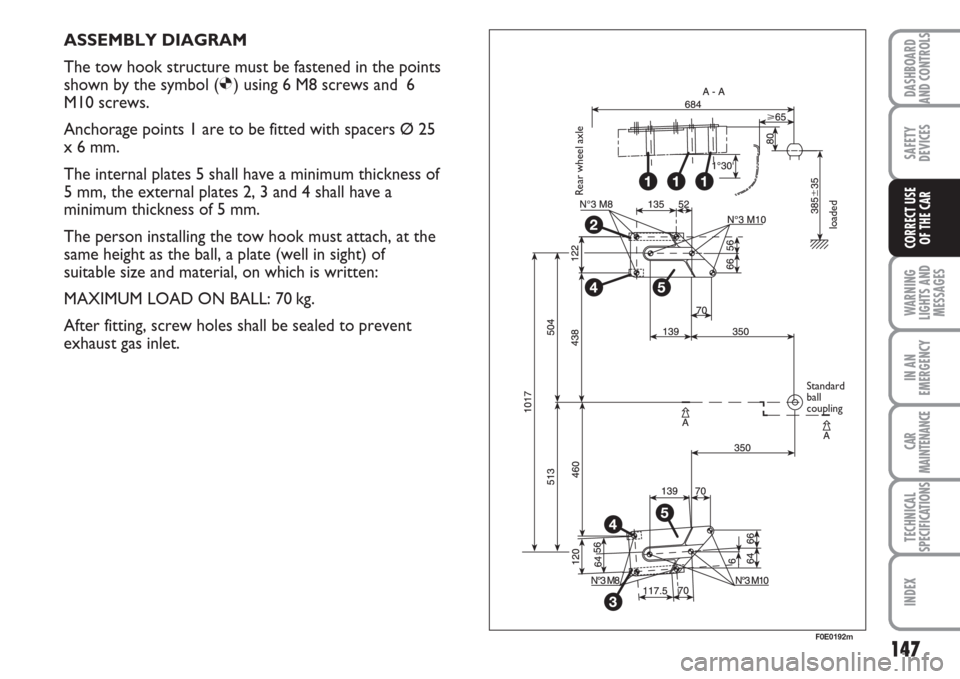
F0E0192m
ASSEMBLY DIAGRAM
The tow hook structure must be fastened in the points
shown by the symbol (
Ø) using 6 M8 screws and 6
M10 screws.
Anchorage points 1 are to be fitted with spacers Ø 25
x 6 mm.
The internal plates 5 shall have a minimum thickness of
5 mm, the external plates 2, 3 and 4 shall have a
minimum thickness of 5 mm.
The person installing the tow hook must attach, at the
same height as the ball, a plate (well in sight) of
suitable size and material, on which is written:
MAXIMUM LOAD ON BALL: 70 kg.
After fitting, screw holes shall be sealed to prevent
exhaust gas inlet.
Rear wheel axle
loaded
Standard
ball
coupling