engine FIAT MULTIPLA 2007 1.G Repair Manual
[x] Cancel search | Manufacturer: FIAT, Model Year: 2007, Model line: MULTIPLA, Model: FIAT MULTIPLA 2007 1.GPages: 266, PDF Size: 4.66 MB
Page 217 of 266
216
SAFETY
DEVICES
CORRECT USE
OF THE CAR
WARNING
LIGHTS AND
MESSAGES
IN AN
EMERGENCY
TECHNICAL
SPECIFICATIONS
INDEX
DASHBOARD
AND CONTROLS
CAR
MAINTENANCE
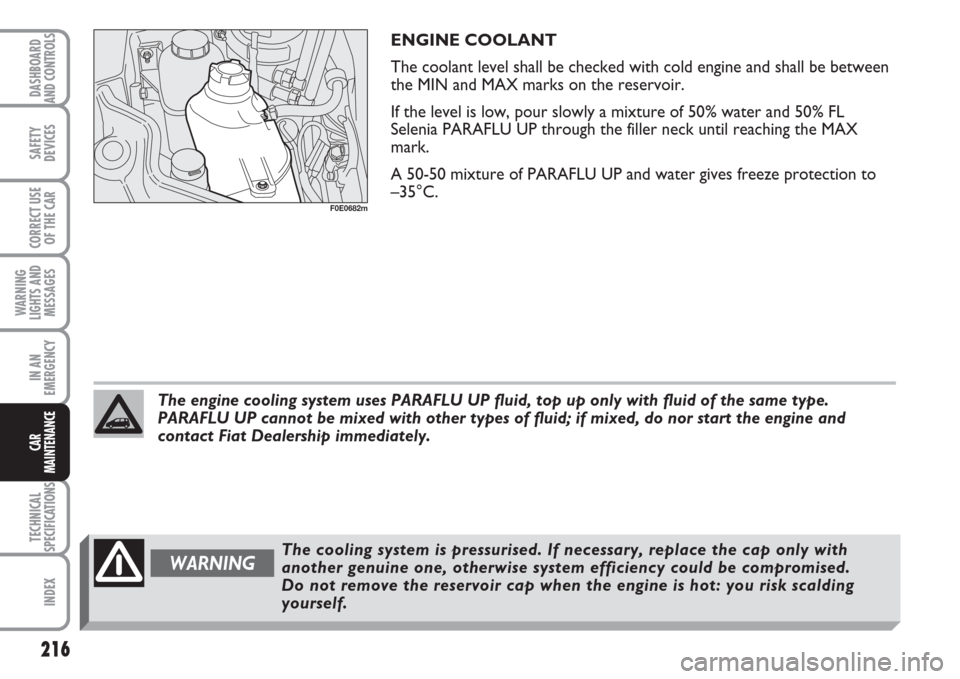
ENGINE COOLANT
The coolant level shall be checked with cold engine and shall be between
the MIN and MAX marks on the reservoir.
If the level is low, pour slowly a mixture of 50% water and 50% FL
Selenia PARAFLU UP through the filler neck until reaching the MAX
mark.
A 50-50 mixture of PARAFLU UP and water gives freeze protection to
–35°C.
F0E0682m
The engine cooling system uses PARAFLU UP fluid, top up only with fluid of the same type.
PARAFLU UP cannot be mixed with other types of fluid; if mixed, do nor start the engine and
contact Fiat Dealership immediately.
WARNINGThe cooling system is pressurised. If necessary, replace the cap only with
another genuine one, otherwise system efficiency could be compromised.
Do not remove the reservoir cap when the engine is hot: you risk scalding
yourself.
Page 218 of 266
217
SAFETY
DEVICES
CORRECT USE
OF THE CAR
WARNING
LIGHTS AND
MESSAGES
TECHNICAL
SPECIFICATIONS
INDEX
DASHBOARD
AND CONTROLS
IN AN
EMERGENCY
CAR
MAINTENANCE
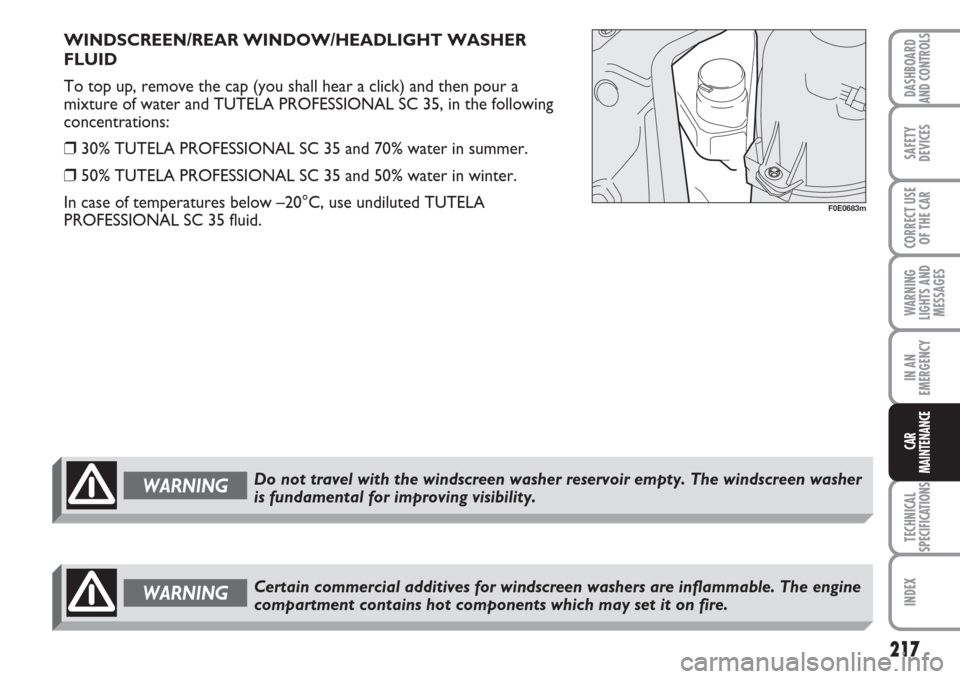
WINDSCREEN/REAR WINDOW/HEADLIGHT WASHER
FLUID
To top up, remove the cap (you shall hear a click) and then pour a
mixture of water and TUTELA PROFESSIONAL SC 35, in the following
concentrations:
❒30% TUTELA PROFESSIONAL SC 35 and 70% water in summer.
❒50% TUTELA PROFESSIONAL SC 35 and 50% water in winter.
In case of temperatures below –20°C, use undiluted TUTELA
PROFESSIONAL SC 35 fluid.
F0E0683m
WARNINGDo not travel with the windscreen washer reservoir empty. The windscreen washer
is fundamental for improving visibility.
WARNINGCertain commercial additives for windscreen washers are inflammable. The engine
compartment contains hot components which may set it on fire.
Page 219 of 266
218
SAFETY
DEVICES
CORRECT USE
OF THE CAR
WARNING
LIGHTS AND
MESSAGES
IN AN
EMERGENCY
TECHNICAL
SPECIFICATIONS
INDEX
DASHBOARD
AND CONTROLS
CAR
MAINTENANCE
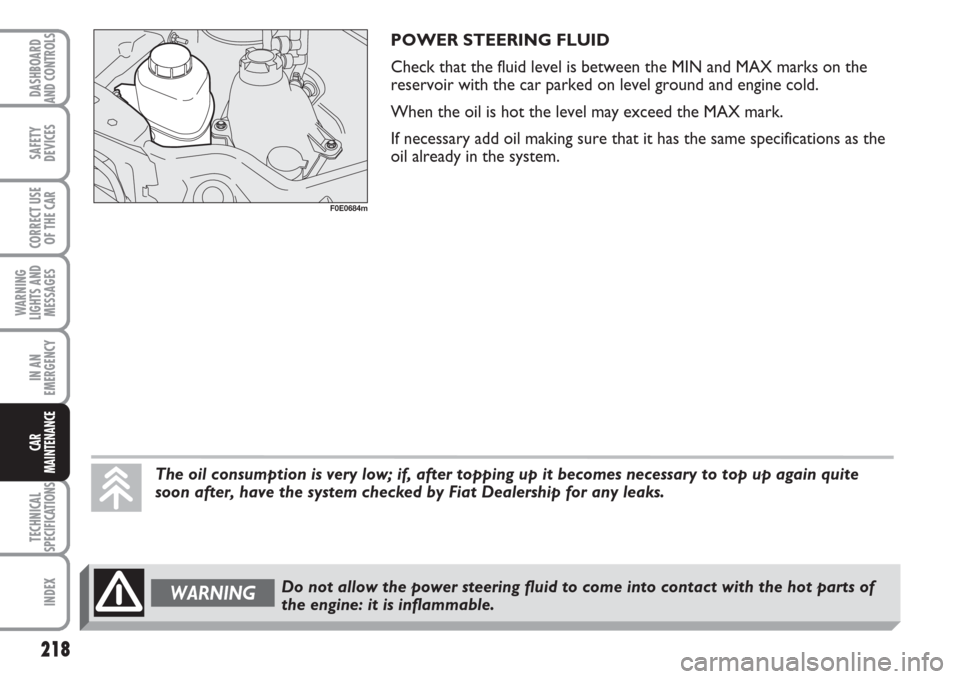
POWER STEERING FLUID
Check that the fluid level is between the MIN and MAX marks on the
reservoir with the car parked on level ground and engine cold.
When the oil is hot the level may exceed the MAX mark.
If necessary add oil making sure that it has the same specifications as the
oil already in the system.
F0E0684m
The oil consumption is very low; if, after topping up it becomes necessary to top up again quite
soon after, have the system checked by Fiat Dealership for any leaks.
WARNINGDo not allow the power steering fluid to come into contact with the hot parts of
the engine: it is inflammable.
Page 222 of 266
221
SAFETY
DEVICES
CORRECT USE
OF THE CAR
WARNING
LIGHTS AND
MESSAGES
TECHNICAL
SPECIFICATIONS
INDEX
DASHBOARD
AND CONTROLS
IN AN
EMERGENCY
CAR
MAINTENANCE
DIESEL FUEL FILTER
DRAINING THE CONDENSE (diesel versions)
IMPORTANT The presence of water in the fuel circuit
can severely damage the injection system and make
the engine misfire. If the warning light
cturns on,
contact a Fiat Dealership as soon as possible to have
the bleeding operation carried out.
If the warning light comes on immediately after
refuelling, water is probably present in the tank: turn
the engine off immediately and contact Fiat Dealership.
BATTERY
Fiat Multipla battery is of the “Limited maintenance”
type: under normal conditions of use it does not
require topping up with distilled water.
CHECKING THE BATTERY FLUID LEVEL
(electrolyte)
Check the electrolyte level (and top up if required) at
the intervals shown in the Service Schedule in this
section. Have this operation carried out at Fiat
Dealership.
Batteries contain substances that are very harmful for the environment. You are advised to have
the battery changed at a Fiat Dealership, which is properly equipped for disposing of used batteries
respecting nature and law.
The liquid in the battery is poisonous and corrosive. Avoid contact with eyes and
skin. Do not bring naked flames or possible sources of sparks near to the battery:
risk of fire and explosion.WARNING
Page 224 of 266
223
SAFETY
DEVICES
CORRECT USE
OF THE CAR
WARNING
LIGHTS AND
MESSAGES
TECHNICAL
SPECIFICATIONS
INDEX
DASHBOARD
AND CONTROLS
IN AN
EMERGENCY
CAR
MAINTENANCE
USEFUL ADVICE FOR LENGTHENING
THE LIFE OF YOUR BATTERY
To avoid draining your battery and lengthen its life,
observe the following indications:
❒when you park the car, ensure the doors, tailgate
and bonnet are closed properly. Passenger’s
compartment lights must be off;
❒ceiling lights must be off. The car is however
provided with an automatic system for switching off
internal lights;
❒do not keep accessories (e.g.: sound system, hazard
lights, etc.) switched on for a long time when the
engine is not running;
❒before performing any operation on the electrical
system, disconnect the battery negative cable;
❒battery terminals shall always be perfectly tightened.
IMPORTANT A battery which is kept at a charge of
less than 50% (optical indicator with dark colour
without green area in the middle) for any length of
time will be damaged by sulphation leading to a
reduction in cranking power.Moreover, this might lead to a higher risk of the
battery electrolyte freezing (this may even occur at -
10°C). If the car is inactive for a long period of time,
refer to “Storing the car”, in section “Driving your
car”.
If after buying the car, you want to install electric
accessories which require permanent electric supply
(alarm, etc.) contact Fiat Dealership whose qualified
personnel, in addition to suggesting the most suitable
devices, will evaluate the overall electric absorption,
checking whether the car’s electric system is capable
of withstanding the load required, or whether it
should be integrated with a more powerful battery.
In fact, since these devices continue absorbing energy
even when the ignition key is off, they gradually run
down the battery.
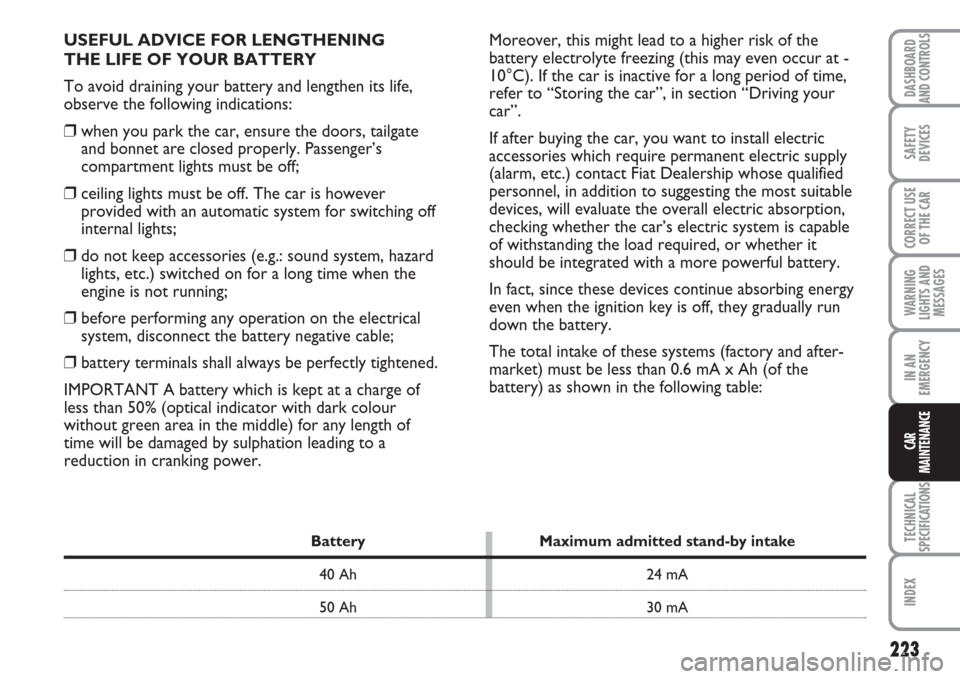
The total intake of these systems (factory and after-
market) must be less than 0.6 mA x Ah (of the
battery) as shown in the following table:
Battery Maximum admitted stand-by intake
40 Ah 24 mA
50 Ah 30 mA
Page 230 of 266
229
SAFETY
DEVICES
CORRECT USE
OF THE CAR
WARNING
LIGHTS AND
MESSAGES
TECHNICAL
SPECIFICATIONS
INDEX
DASHBOARD
AND CONTROLS
IN AN
EMERGENCY
CAR
MAINTENANCE
BODYWORK
PROTECTION FROM ATMOSPHERIC
AGENTS
The main causes of corrosion are:
❒atmospheric pollution;
❒salty air and humidity (coastal areas, or hot humid
climates);
❒seasonal environment conditions.
In addition, the abrasiveness of dust in the atmosphere
and sand carried by the wind as well as mud and
stones kicked up by other cars must not be
underestimated.
On your Fiat Multipla, Fiat implemented the best
manufacturing technologies to effectively protect the
bodywork against corrosion.These include:
❒painting products and systems which give the car
particular resistance to corrosion and abrasion;
❒use of galvanised (or pre-treated) steel sheets, with
high resistance to corrosion;
❒spraying the underbody, engine compartment,
wheelhouse internal parts and other parts with
highly protective wax products;
❒spraying of plastic parts, with a protective function,
in the most exposed points: underdoor, inner
fender parts, edges, etc.
❒use of “open” boxed sections to prevent
condensation and pockets of moisture from
triggering rust inside.
BODY AND UNDERBODY
WARRANTY
Your Fiat Multipla is covered by warranty against
perforation due to rust of any original element of the
structure or body.
For the general terms of this warranty, refer to Fiat
Warranty Booklet.
Page 231 of 266
230
SAFETY
DEVICES
CORRECT USE
OF THE CAR
WARNING
LIGHTS AND
MESSAGES
IN AN
EMERGENCY
TECHNICAL
SPECIFICATIONS
INDEX
DASHBOARD
AND CONTROLS
CAR
MAINTENANCE
ADVICE FOR PRESERVING
THE BODYWORK
Paint
Paintwork does not only serve an aesthetic purpose,
but also protects the underlying sheet metal.
In the case of deep scrapes or scores, you are advised
to have the necessary touching up carried out
immediately to avoid the formation of rust.
Only use original products when touching up the
paintwork (see section “Technical specifications”).
Ordinary paint maintenance consists in washing at
intervals depending on the conditions and environment
of use. For example, in highly polluted areas, or if the
roads are sprayed with salt, it is wise to wash the car
more frequently.
To wash the car properly:
❒remove the aerial from the roof to prevent damages
if the car is washed in an automatic carwash;
❒wash the body using a low pressure jet of water.
❒wipe a sponge with a slightly soapy solution over
the bodywork, frequently rinsing with the sponge.❒rinse well with water and dry with a jet of air or a
chamois leather.
When drying, take particular care with the less visible
parts like door frames, bonnet and around the
headlights where water may collect. The car should
not be taken to a closed area immediately, but left in
the open so that residual water can evaporate.
Do not wash the car after it has been left in the sun or
with the bonnet hot: this may alter the shine of the
paintwork.
Exterior plastic parts must be cleaned in the same way
as the rest of the car.
Where possible, do not park under trees; the resinous
substance many species release give the paint a dull
appearance and increase the possibility of triggering
rust processes.
IMPORTANT Bird droppings must be washed off
immediately and thoroughly as the acid they contain is
particularly aggressive.
Detergents cause water pollution. Therefore the engine compartment should be washed in areas
equipped for collecting and purifying the liquid used in the washing process.
Page 232 of 266
231
SAFETY
DEVICES
CORRECT USE
OF THE CAR
WARNING
LIGHTS AND
MESSAGES
TECHNICAL
SPECIFICATIONS
INDEX
DASHBOARD
AND CONTROLS
IN AN
EMERGENCY
CAR
MAINTENANCE
Windows
Use specific window cleaner products to clean cloths
to avoid scratching the glass or damaging the
transparency.
IMPORTANT The inside of the rear window should
be wiped gently with a cloth in the direction of the
filaments to avoid damaging the heating device.
Engine compartment
At the end of the winter the engine compartment
should be carefully washed, without directing the jet
against electronic control units. Contact a specialised
workshop to have this done.
IMPORTANT Wash with the engine cold and the
ignition key at STOP. After washing make sure that the
various protections (e.g. rubber caps and various
covers) have not been damaged or removed.
Front headlights
IMPORTANT Never use aromatic substances (e.g.:
petrol) or ketones (e.g.: acetone) for cleaning front
headlight plastic lens.
IMPORTANT Wash with the engine cold and the
ignition key at STOP. After washing make sure that the
various protections (e.g. rubber caps and various
covers) have not been damaged or removed.INTERIORS
Periodically check that water is not trapped under the
mats (due to water dripping off shoes, umbrellas, etc.)
which could cause oxidisation of the sheet metal.
CLEANING SEATS AND FABRIC/JERSEY
UPHOLSTERY
❒Use a soft brush or vacuum cleaner to remove dust.
❒Rub the seats with a sponge moistened with a
solution of water and neutral detergent.
PLASTIC PARTS INSIDE THE CAR
Clean the plastic parts inside the car with a cloth
moistened with a solution of water and non-abrasive
neutral detergent. To remove grease or hard stains,
use special solvent-free products designed not to alter
the appearance and colour of components.
IMPORTANT Do not use alcohol or petrol to clean
the instrument panel.
Detergents cause water pollution.
Therefore the engine compartment should
be washed in areas equipped for
collecting and purifying the liquid used in
the washing process.
Page 234 of 266
233
SAFETY
DEVICES
CORRECT USE
OF THE CAR
WARNING
LIGHTS AND
MESSAGES
CAR
MAINTENANCE
INDEX
DASHBOARD
AND CONTROLS
IN AN
EMERGENCY
TECHNICAL
SPECIFICATIONS
TT T
E E
C C
H H
N N
I I
C C
A A
L L
S S
P P
E E
C C
I I
F F
I I
C C
A A
T T
I I
O O
N N
S S
IDENTIFICATION DATA ................................................. 234
ENGINE CODES - BODYWORK VERSIONS .............. 236
ENGINE ................................................................................. 237
FUEL FEED/IGNITION ....................................................... 238
TRANSMISSION .................................................................. 238
BRAKES .................................................................................. 239
SUSPENSIONS ..................................................................... 239
STEERING ............................................................................. 239
WHEELS ................................................................................. 240
DIMENSIONS ....................................................................... 244
PERFORMANCE ................................................................... 246
WEIGHTS ............................................................................... 247
CAPACITIES ......................................................................... 249
FLUIDS AND LUBRICANTS ........................................... 250
FUEL CONSUMPTION ....................................................... 252
CO
2EMISSIONS .................................................................. 253
RADIOFREQUENCY REMOTE CONTROL
MINISTERIAL HOMOLOGATION ................................. 254
Page 235 of 266
234
SAFETY
DEVICES
CORRECT USE
OF THE CAR
WARNING
LIGHTS AND
MESSAGES
CAR
MAINTENANCE
INDEX
DASHBOARD
AND CONTROLS
IN AN
EMERGENCY
TECHNICAL
SPECIFICATIONS
IDENTIFICATION DATA
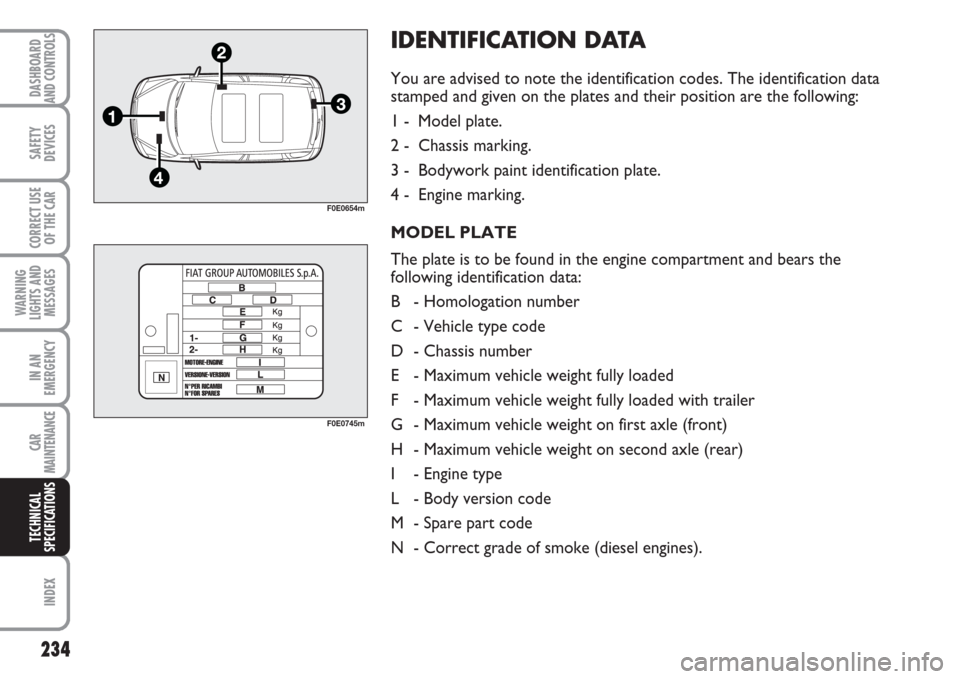
You are advised to note the identification codes. The identification data
stamped and given on the plates and their position are the following:
1 - Model plate.
2 - Chassis marking.
3 - Bodywork paint identification plate.
4 - Engine marking.
MODEL PLATE
The plate is to be found in the engine compartment and bears the
following identification data:
B - Homologation number
C - Vehicle type code
D - Chassis number
E - Maximum vehicle weight fully loaded
F - Maximum vehicle weight fully loaded with trailer
G - Maximum vehicle weight on first axle (front)
H - Maximum vehicle weight on second axle (rear)
I - Engine type
L - Body version code
M - Spare part code
N - Correct grade of smoke (diesel engines).
F0E0745m
F0E0654m