belt FIAT PALIO 2003 178 / 1.G India Version User Guide
[x] Cancel search | Manufacturer: FIAT, Model Year: 2003, Model line: PALIO, Model: FIAT PALIO 2003 178 / 1.GPages: 156, PDF Size: 6.27 MB
Page 30 of 156
29
TRANSPORTING
CHILDREN
IN SAFETY
For optimal protection in the event
of a crash, all passengers must be seat-
ed and wearing adequate restraint sys-
tems.
This is especially relevant for chil-
dren.
A child’s head is larger and heavier
than an adult’s head with respect to
their body weight. Moreover, a child’s
muscular and bone structure is not ful-
ly developed. For these reasons, chil-
dren require specific restraint systems,
different from those required by adult
passengers.
Child’s restraint systems are classi-
fied into the following four weight
groups,
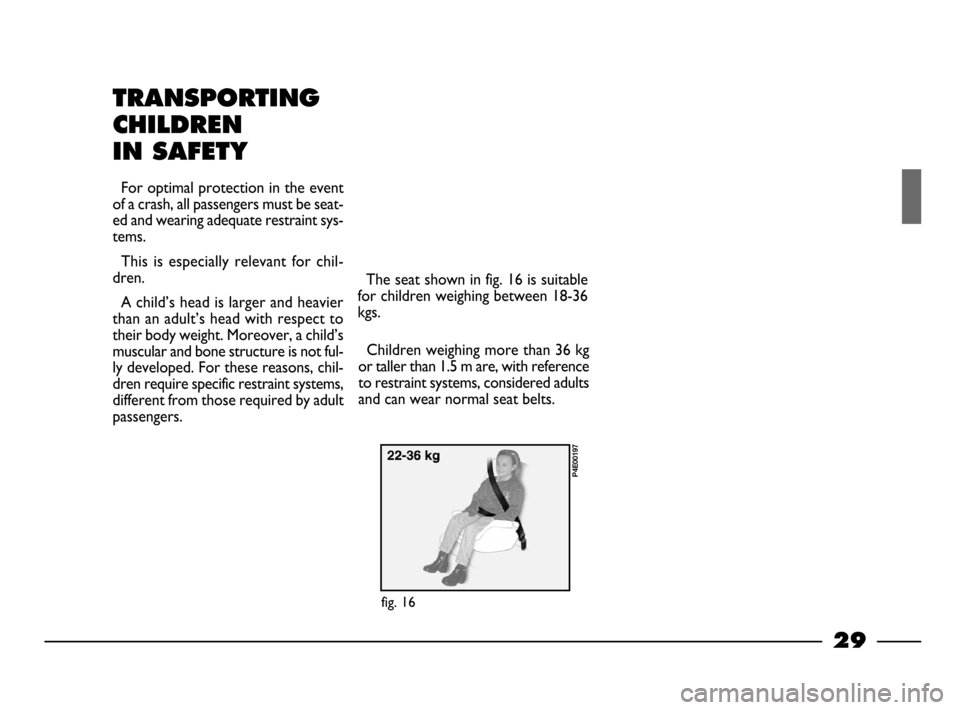
fig. 16:
Group 0 weight 0-10 kg
Group 0 weight 9-18 kg
Group 0 weight 15-25 kg
Group 3 22-36 weight kg.
The groups partially overlap. This is
because there are systems which cov-
er more than one weight group.
Children weighing more than 36 kg
or taller than 1.5 m are, with reference
to restraint systems, considered adults
and can wear normal seat belts.
fig. 16
P4E00197
The seat shown in fig. 16 is suitable
for children weighing between 18-36
kgs.
20-63 03/03/2003 06:02 PM Page 29
Page 31 of 156
30
There are child re-
straints for groups 0 and
1 which are fastened with
the car seat belts by means of an
attachment on the seat back. The
child is then secured to the seat
with specific straps. Due to their
weight, child seats can be dan-
gerous if they are fitted incor-
rectly with a cushion placed be-
tween the seat and the car seat
belts. Always attain carefully to
the specific installation instruc-
tions attached. We recommend seating
children on the rear seat.
This is the most protect-
ed position in the event of a
crash.
GROUP 0
Babies up to 10 Kg are to be seated
in a cot type seat supporting the child’s
head, facing backwards. This ensures
there is no stress on the child’s neck
in sudden decelerations.
The cot is secured with the seat
belts, as shown in
fig. 17. The child
must be strapped to the carrier with
its incorporated straps.
GROUP 1
Children from 9 kg are to be seated
facing forward in child seats with front
cushions. The seat belt secures both
seat and child
fig. 18.
fig. 17
P4E00198
fig. 18
P4E00199
The figure is only an ex-
ample. Follow the in-
structions for fastening
the specific child restraint
system you are using.
The figure is only an ex-
ample. Follow the in-
structions for fastening
the specific child restraint system
you are using.
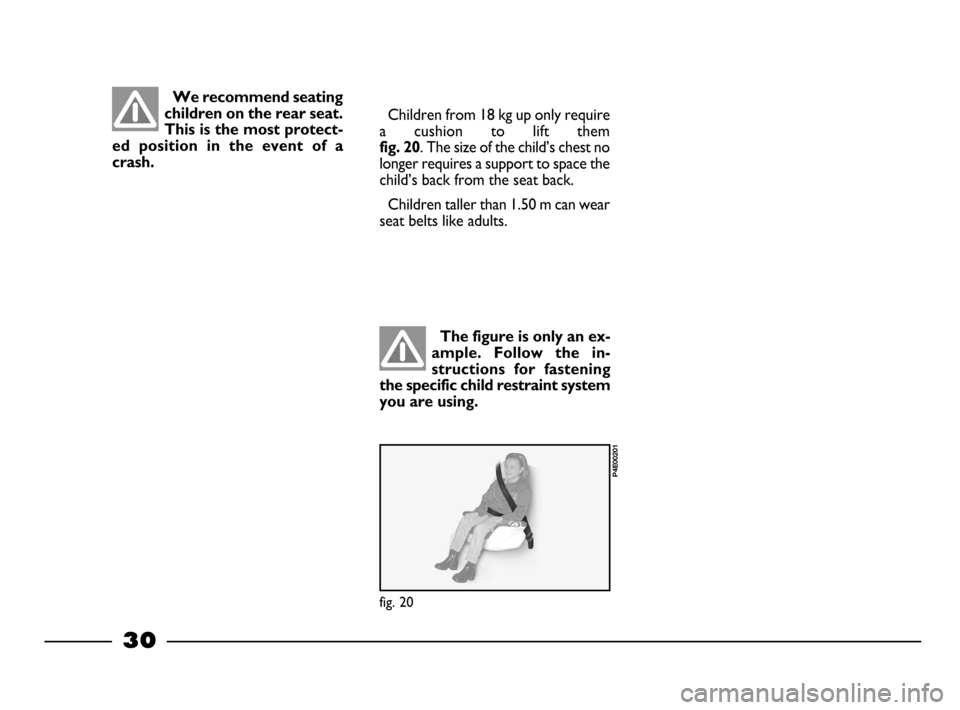
Children from 18 kg up only require
a cushion to lift them
fig. 20. The size of the child’s chest no
longer requires a support to space the
child’s back from the seat back.
Children taller than 1.50 m can wear
seat belts like adults.
fig. 20
P4E00201
The figure is only an ex-
ample. Follow the in-
structions for fastening
the specific child restraint system
you are using.
20-63 03/03/2003 06:02 PM Page 30
Page 32 of 156
The figure is only an ex-
ample. Follow the in-
structions for fastening
the specific child restraint system
you are using.
31
GROUP 2
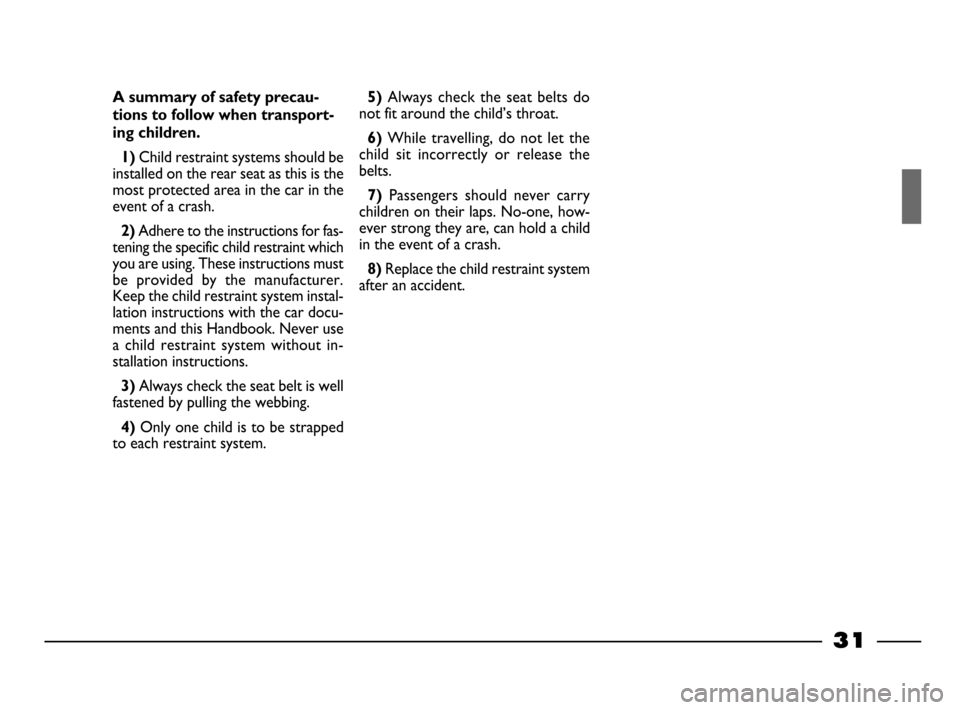
Children from 15 kg can be secured
directly with the car seat belts. The
child seat has the purpose of posi-
tioning the child correctly with respect
to the seat belt, so that the diagonal
section crosses the child’s chest and
never the throat, and that the hori-
zontal section fits snugly on the child’s
hips and not to the abdomen
fig. 19.
fig. 19
P4E00200
5) Always check the seat belts do
not fit around the child’s throat.
6) While travelling, do not let the
child sit incorrectly or release the
belts.
7) Passengers should never carry
children on their laps. No-one, how-
ever strong they are, can hold a child
in the event of a crash.
8)Replace the child restraint system
after an accident.
A summary of safety precau-
tions to follow when transport-
ing children.
1)
Child restraint systems should be
installed on the rear seat as this is the
most protected area in the car in the
event of a crash.
2)Adhere to the instructions for fas-
tening the specific child restraint which
you are using. These instructions must
be provided by the manufacturer.
Keep the child restraint system instal-
lation instructions with the car docu-
ments and this Handbook. Never use
a child restraint system without in-
stallation instructions.
3) Always check the seat belt is well
fastened by pulling the webbing.
4)Only one child is to be strapped
to each restraint system.
20-63 03/03/2003 06:02 PM Page 31
Page 33 of 156
32
PRETENSIONERS
The pretensioner does not require
any maintenance or lubrication. Any
modification of its original state inval-
idates its efficiency. If, as the result of
exceptional natural occurrences
(floods, sea storms etc.) the device be-
come soaked through with water and
mud, it is essential that it be replaced.
The pretensioner will give maximum
protection when the seat belt adheres
snugly to the wearer’s chest and hips. To render the protective action of
the front seat belts even more effec-
tive, some versions of Fiat Palio are fit-
ted with pretensioners. These devices
“feel” that a violent collision is in
progress via a sensor, and pull back a
few centimeters of webbing. In this
way the pretensioner ensures that the
belt is adhering perfectly to the body
before the belt begins to hold back the
wearer.
When the pretensioner has been
triggered the retractor will lock.
The seat belt cannot be drawn back
up even when guiding it manually.
When the pretensioner is triggered
a small amount of smoke may be pro-
duced. The smoke is not harmful and
does not indicate the beginning of a
fire.
Under no circumstances
should the components of
the pretensioner be tam-
pered with or removed. Any in-
terventions should be carried out
by qualified and authorized per-
sonnel. Always contact a Fiat
Dealership
20-63 03/03/2003 06:02 PM Page 32
Page 53 of 156
52
To return the seat to normal
position
1)
Tip the entire seat backwards.
2) Tip the seat back backwards. Pass
the belts to the side and fasten the seat
back to the retainers. Make sure it is
fastened.
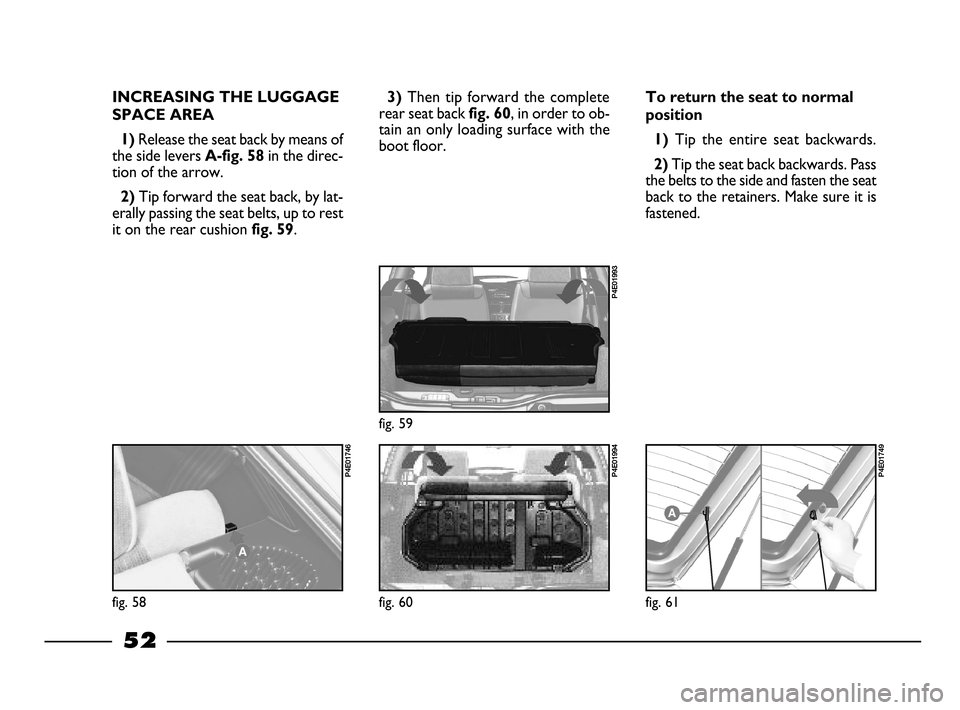
INCREASING THE LUGGAGE
SPACE AREA
1)
Release the seat back by means of
the side levers
A-fig. 58in the direc-
tion of the arrow.
2) Tip forward the seat back, by lat-
erally passing the seat belts, up to rest
it on the rear cushion
fig. 59.
3) Then tip forward the complete
rear seat back
fig. 60, in order to ob-
tain an only loading surface with the
boot floor.
fig. 58
P4E01746
fig. 59
P4E01993
fig. 60
P4E01994
fig. 61
P4E01749
20-63 03/03/2003 06:03 PM Page 52
Page 59 of 156
58
The bag inflates instantly and acts as
a soft protective barrier between the
driver’s body and the structures that
could cause injury. The bag deflate im-
mediately afterwards.
A person not wearing the seat belt
may crash into the bag before it is ful-
ly inflated. In this case the protection
is considerably decreased.
As a consequence, the air bag is not
a replacement for the use of seat belts
but rather a complement. We rec-
ommend that seat belts are worn at all
times as prescribed by legislation in Eu-
rope and most other countries world-
wide.In the event of a less severe collision
(for which seat belts are sufficient pro-
tection) the airbag is not activated.
For impacts against very deformable
or mobile objects (traffic sign poles,
heaps of gravel or snow, parked vehi-
cles), side impacts, wedging under oth-
er vehicles or barriers (e.g. under a
track or guard rail), the airbag is not
necessary. In the event of frontal im-
pacts involving, for example, the mud-
guard against a guardrail, the airbags
are not triggered as they would not of-
fer additional protection with respect
to the seat belts.
Therefore, the fact that the airbag
does not inflate is not a sign of sys-
tem malfunction.AIR BAG
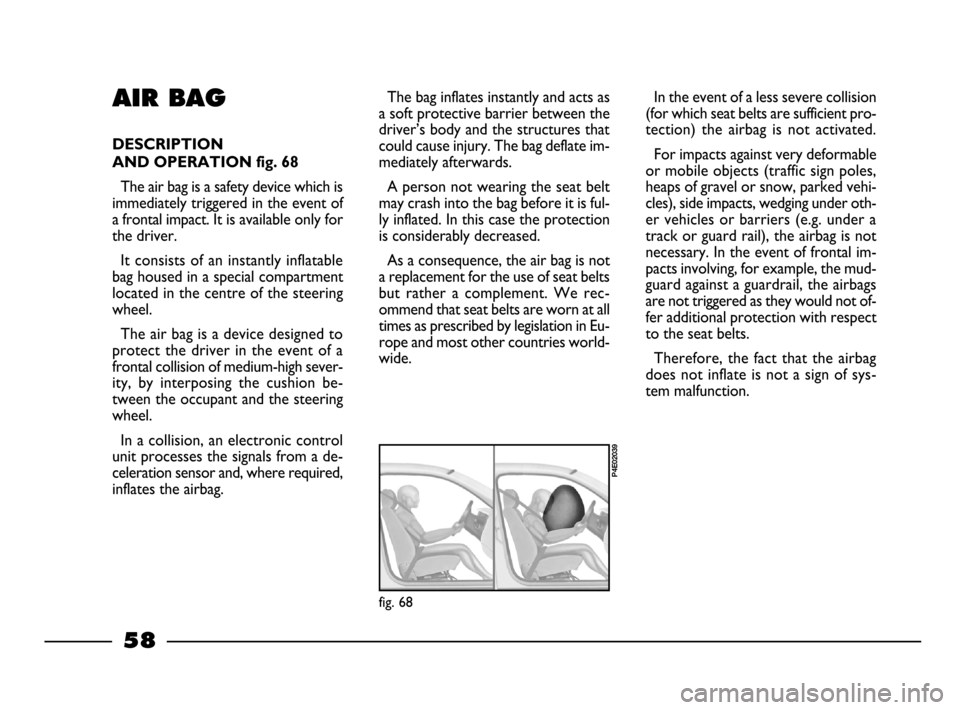
DESCRIPTION
AND OPERATION fig. 68
The air bag is a safety device which is
immediately triggered in the event of
a frontal impact. It is available only for
the driver.
It consists of an instantly inflatable
bag housed in a special compartment
located in the centre of the steering
wheel.
The air bag is a device designed to
protect the driver in the event of a
frontal collision of medium-high sever-
ity, by interposing the cushion be-
tween the occupant and the steering
wheel.
In a collision, an electronic control
unit processes the signals from a de-
celeration sensor and, where required,
inflates the airbag.
fig. 68
P4E02039
20-63 03/03/2003 06:03 PM Page 58
Page 60 of 156
59
When the ignition key is
turned to MAR, the indi-
cator û
comes on after
about four seconds. If the warn-
ing light does not come on, or it
remains on while travelling go
immediately to a Fiat Dealership.
Do not apply stickers or
other objects on the
steering wheel. Do not
travel with items on your lap, in
front of you or with a pipe, pencil
etc. between your lips. In a colli-
sion where the airbag is triggerd
you could seriously hurt yourself
GENERAL WARNINGS
It may happen that the air bag
inflates if the car is involved in
hard impacts or collisions in the
area of the underbody, for exam-
ple hard knocks against steps,
kerbs or raised road bumps, or if
the car drops into large pot-holes
or road dips.
When the airbag inflates it
emits a small amount of dust and
smoke. This dust and smoke is
harmless and it is not the begin-
ning of a fire.
If the warning light
ûcomes on
while travelling (indication of a
fault) go as soon as possible to a
Fiat Dealership.
The air bag system is valid for 10
years. When the expiry date is
near, contact a Fiat Dealership.
Should an accident occur in
which the airbag is activated,
take the car to a Fiat Dealership
to have the whole device re-
placed (electronic control unit,
seat belts, pretensioners) and tohave the electrical system
checked.
Any diagnostic, repair or re-
placement operations concerning
the airbag system must exclu-
sively be carried out at a Fiat
Dealership.
If you are having the car
scrapped, have the airbag system
deactivated at a Fiat Dealership.
If the car changes hands, the
new owner must be made aware
of the indications given above and
be given this Owner’s Handbook.
Pretensioners (if electronically
controlled) and air bag are trig-
gered by the electronic control
unit according to different types
of impact. Therefore, if some de-
vices do not trigger this does not
indicate a fault in the system.
20-63 03/03/2003 06:03 PM Page 59
Page 61 of 156
60
Always drive with both
hands on the rim of the
steering wheel so that the
airbag is free to inflate and pro-
tect you from serious injury in a
collision. Do not drive with your
body bending toward the steer-
ing wheel, but sit in an upright po-
sition with your back resting
against the seat.
If the car has been stolen
or an attempt has been
made to steal it, or it has
been vandalised in any way, or
subjected to flooding, have the
airbag system checked at a Fiat
Dealership.The air bag does not
substitute seat belts, but
increases its efficiency.
Furthermore, since the airbag is
not inflated in frontal collisions at
low speed, side collisions, rear
end shunts or overturns, in such
cases the occupants are protect-
ed by the seat belts only and
therefore they should always be
fastened.Correct functioning of
airbag and pretensioners
is only guaranteed when
the car is not overloaded.SOUND SYSTEMRemember that airbag
can be triggered when
the ignition key is insert-
ed and set to MAR, even with the
car stationary, if another vehicle
crashes into it. On the other
hand, when the car is stationary
and the ignition key is removed,
the airbag does not trigger in the
event of an impact.
Visit the Fiat Dealership
if you want to fit a sound
system after purchasing
your car. Qualified, trained staff
will provide useful advice for safe-
guarding the battery. Excessive
intake when the engine is not
running will damage the battery
and may invalidate the battery
warranty.
Fiat recommends wide range of
music systems as Fiat acces-
sories, which are available with
Fiat dealerships.
20-63 03/03/2003 06:03 PM Page 60
Page 71 of 156
70
WHEN TRAVELLING
– The first rule of safe driving is pru-
dence.
– Prudence also means putting your-
self into a position where you can pre-
dict wrong or imprudent behaviour
from other drivers.
– Stick closely to the rules of the
road in the particular country where
the car is being driven and, above all,
do not exceed speed limits.
– Ensure that, besides yourself, all the
other passengers in the car have their
seat belts fastened, that children are
sitting in the appropriate child seats
and any animals in the car are placed
in suitable compartments.
Driving under the influ-
ence of drugs or certain
medicines is dangerous
for both you and other road
users.
Always fasten both front
and back seat belts, in-
cluding the child restraint
systems. Travelling with the seat
belts unfastened increases the
risk of injury or death in an acci-
dent.
Do not drive with ob-
jects on the floor in front
of the driver’s seat: they
could get caught under the ped-
als making braking or accelerat-
ing impossible.
Pay attention to the
measurements of car-
pets. Any hinderance,
even modest, to the braking sys-
tem could necessiate a longer
than normal pedal run.
You should be physically fit and men-
tally alert before setting out on long
journeys.
– Do not drive too many hours at a
time but stop at intervals to stretch
your legs and recoup your energy.
– Constantly change the air in the
passenger compartment.
– Never coast downhill (i.e. with the
engine off): if you do, you lose the aid
of engine braking and the brake boost-
er so that braking requires greater ef-
fort.
64-79 03/03/2003 06:45 PM Page 70
Page 84 of 156
83
1. STOP THE CAR
– Stop the car in a position that is not
dangerous for oncoming traffic where
you can change the wheel safely. The
ground should be flat and adequately
firm. If you have to change the wheel
at night, choose a lit area if possible.
– Turn the engine off and pull up the
handbrake.
– Engage first or reverse gear.
– Alert other drivers that the car is
stationary in compliance with local
regulations: hazard warning lights,
warning triangle etc.
Any passenger should get out and
wait as far away as possible from the
dangers of traffic.
If the road is sloping or bumpy, place
wedges or other suitable material un-
der the wheels to prevent the car from
moving.
2. TAKE OUT THE TOOLS,
JACK AND SPARE WHEEL
They are in the boot.
The tool bag is secured to the inter-
nal boot wall by proper belts,
fig. 2;
to take it out, lift the adhesive strip of
the belts. The bag contains: the jack
A-
fig. 3
, the jack operating handle B, the
wheel bolt wrench
C, the tow hitch D
and the screwdriver E.
fig. 2
P4E02373
fig. 4
P4E02375
fig. 3
P4E02374
– Lift the carpet covered flap.
– Loosen the fastener
A-fig. 4and
take the spare wheel.
80-103 03/03/2003 06:49 PM Page 83