brake light FIAT PANDA 2017 319 / 3.G User Guide
[x] Cancel search | Manufacturer: FIAT, Model Year: 2017, Model line: PANDA, Model: FIAT PANDA 2017 319 / 3.GPages: 216, PDF Size: 19.25 MB
Page 70 of 216
WARNING
67)The system is an aid for the driver, who
must always pay full attention while
driving. The responsibility always rests with
the driver, who must take into account
the traffic conditions in order to drive
in complete safety. The driver must always
maintain a safe distance from the vehicle
in front.
68)If the driver depresses the brake pedal
fully or carries out a fast steering during
system operation, the automatic braking
function may stop (e.g. to allow a possible
manoeuvre to avoid the obstacle).
69)The laser beam is not visible at the
naked eye. Do not look directly, or with
optical instruments (e.g. lenses), at the
laser beam from a distance lower than 10
cm: this may cause damage to the sight.
The laser beam is also present when
the key is at MAR but its operation is off,
not available or manually deactivated
with the display Setup Menu.
70)The system intervenes on vehicles
travelling in the same lane. Small sized
vehicles (e.g. bicycles or motorbikes)
or people, animals and things (e.g.
pushchairs) and more in general all those
obstacles with a low reflection of the light
emitted by the laser (e.g. vehicles soiled
with mud) are not taken into consideration.71)If the car must be placed on a roller
bench (at a speed within 5 and 30 km/h)
for maintenance interventions or if it is
washed in an automatic roller washing
tunnel with an obstacle in the front part
(e.g. another car, a wall or another
obstacle), the system may detect its
presence and activate. In this case the
system must be deactivated through the
display Setup Menu.
72)If the system signals a pressure
decrease on a specific tyre, it is
recommended to check the pressure on all
four tyres.
73)The iTPMS does not relieve the driver
from the obligation to check the tyre
pressure every month; it is not to
be considered a system to replace
maintenance or a safety system.
74)Tyre pressure must be checked with
tyres cold. Should it become necessary for
whatever reason to check pressure with
warm tyres, do not reduce pressure even
though it is higher than the prescribed
value, but repeat the check when tyres are
cold.
75)The iTPMS cannot indicate sudden
tyre pressure drops (for example when
a tyre bursts). In this case, stop the vehicle,
braking with caution and avoiding abrupt
steering.
76)The system only warns that the tyre
pressure is low: it is not able to inflate
them.
77)Insufficient tyre inflation increases fuel
consumption, reduces the tread duration
and may affect the capacity to drive safely.
WARNING
30)The laser sensor may have limited or
absent operation due to weather
conditions such as: heavy rain, hail, thick
fog, heavy snow, formation of ice layers on
the windscreen.
31)Sensor operation may also be
compromised by the presence of dust,
condensation, dirt or ice on the
windscreen, by traffic conditions (e.g.
vehicles that are driving not aligned with
you car, vehicle driving in a transverse
or opposite way on the same lane, bend
with a small radius of curvature), by road
surface conditions and by driving
conditions (e.g. off-road driving). Make sure
the windscreen is always clean. Use
specific detergents and clean cloths to
avoid scratching the windscreen. The
sensor operation may also be limited or
absent in some driving, traffic and road
surface conditions.
32)Projecting loads on the roof of the car
may interfere with the correct operation
of the sensor. Before starting make sure
the load is correctly positioned, in order not
to cover the sensor operating range.
33)If the windscreen must be replaced
due to scratches, chipping or breakage,
contact exclusively a Fiat Dealership.
Do not replace the windscreen on your
own, risk of malfunction! It is advisable to
replace the windscreen if it is damaged
in the laser sensor area.
68
SAFETY
Page 94 of 216
STARTING THE
ENGINE
116) 117)
38) 39) 40) 41)
Before starting the engine, adjust the
seat, the interior rear view mirrors,
the door mirrors and fasten the seat
belt correctly.
Never press the accelerator pedal for
starting the engine.
VERSIONS WITH MANUAL
GEARBOX
Petrol versions
Proceed as follows:
engage the handbrake and place
the gear lever in neutral.For 0.9
TwinAir and 0.9 TwinAir Turbo
versionsengage the handbrake and
place the gear lever in neutral or fully
press the clutch pedal if a gear other
than neutral is engaged;
for all versions (except 0.9
TwinAir Turbo)fully depress the clutch
pedal, without pressing the accelerator;
turn the ignition key to AVV and
release it as soon as the engine starts.Diesel versions
Proceed as follows:
engage the handbrake, put the gear
lever into neutral and turn the ignition
key to MAR: the warning lights
and
on the instrument panel will turn
on;
wait for the warning lightsand
to turn off and then fully depress
the clutch pedal without pressing the
accelerator;
turn the ignition key to AVV as soon
as warning light
switches off.
Release the ignition key as soon as the
engine starts.
IMPORTANT If the engine does not
start at the first attempt, return the
ignition key to STOP before repeating
the procedure. If, with the ignition
key at MAR, the warning lights
and
(only for petrol versions) stay on
in the instrument panel, the ignition key
must be brought back to STOP and
then to MAR again. If the
warning
light stays on, retry with the other
keys provided. Contact a Fiat
Dealership if you still cannot start the
engine.VERSIONS WITH
DUALOGIC GEARBOX
118)Engine starting is allowed both with a
gear engaged and with the gearbox
in neutral (N).
However, the brake pedal must always
be pressed first if neutral is not
engaged. It is therefore advisable to
place the gear lever in neutral (N) before
starting the engine.
LPG AND NATURAL
POWER VERSIONS
The engine always starts up on petrol
independently of the mode previously
selected.
42)
STOPPING THE ENGINE
43)Turn the ignition key to STOP while the
engine is idling.
IMPORTANT After a demanding drive,
before turning the engine off you should
allow it to idle to allow the temperature
in the engine compartment to
decrease.
92
STARTING AND DRIVING
Page 95 of 216
WARNING
116)It is dangerous to run the engine in
enclosed areas. The engine takes in
oxygen and releases carbon dioxide,
carbon monoxide and other toxic gases.
117)Remember that the brake servo
and power steering are not operational until
the engine has been started, therefore
you need to apply much more force than
usual to the brake pedal and steering
wheel.
118)If the engine fails to start with a gear
engaged, the potentially dangerous
situation due to the fact that the gearbox is
automatically placed in neutral will be
signalled by an acoustic signal.
WARNING
38)If the warning lightflashes for 60
seconds after starting or during an
extended towing period, this indicates a
problem in the glow plug preheating
system. You can use the vehicle as usual if
the engine starts but you should contact
a Fiat Dealership as soon as possible.
39)It is advisable not to demand maximum
performance from your vehicle (e.g.
excessive acceleration, long distances at
maximum rpm, excessively intense braking,
etc.) when it is first used.
40)When the engine is off, do not leave
the key turned to MAR to prevent
unnecessary electrical consumption from
draining the battery.41)Never bump start the engine by
pushing, towing or coasting downhill. This
could cause fuel to flow into the catalytic
converter and damage it beyond repair.
42)There must therefore always be some
petrol in the tank to protect the petrol
pump and to guarantee temporary
switching from LPG or Methane to petrol
operation, if high performance is required.
43)A quick burst on the accelerator
before stopping the engine serves no
practical purpose; it wastes fuel and is
especially damaging to turbocharged
engines.
PARKING THE
VEHICLE
When parking and leaving the car,
proceed as follows:
engage a gear (1st gear if facing
uphill or reverse if facing downhill) and
leave the wheels turned;
stop the engine and engage the
handbrake;
always remove the ignition key.
Block the wheels with a wedge or a
stone if the car is parked on a steep
slope.
On versions equipped with Dualogic
transmission, wait for the letter P to be
displayed before releasing the brake
pedal.
WARNING Never leave the car with the
gearbox in neutral (or, on versions
equipped with Dualogic transmission,
before putting the gear lever in the
P position).
Handbrake
194) 195) 196)
The handbrake lever is located between
the two front seats.
Handbrake engagement: pull lever A
fig. 77 upwards until the vehicle is
braked.
93
Page 96 of 216
Handbrake disengagement: slightly
raise lever A and hold button B
pressed, checking that the
warning
light switches off in the instrument
panel.
WARNING
119)Never leave children unattended in
the car. Always remove the key from the
ignition when leaving the car and take
it with you.
120)The car should be braked after a few
clicks of the lever, if it is not, contact a
Fiat Dealership to have it adjusted.
121)In the case of parking manoeuvres on
roads on a gradient, the front wheels
must be steered towards the pavement
(when parking downhill), or in the opposite
direction if the vehicle is parked uphill.
Block the wheels with a wedge or a stone if
the car is parked on a steep slope.
MANUAL GEARBOX
122)44)
To engage the gears, press the clutch
pedal fully and put the gear lever into
the required position (the diagram
for gear engagement is shown on the
knob fig. 78).
For 0.9 TwinAir, 0.9 TwinAir Turbo and
1.2 8v 69 HP versions: to engage
reverse R from neutral, raise ring A fig.
78 underneath the knob and, at the
same time, shift the lever to the right
and then backwards.
For version 1.3 16v MultiJet: to engage
reverse R from neutral position, shift
the lever to the right and then back.IMPORTANT Reverse can only be
engaged when the vehicle is completely
stationary. With the engine running,
wait for at least 2 seconds with the
clutch pedal fully pressed before
engaging reverse to prevent damage to
the gears and grating.
IMPORTANT The clutch pedal should
be used only for gear changes. Do
not drive with your foot resting on the
clutch pedal, however lightly. For
versions/markets where provided, the
electronic clutch pedal control could cut
in, interpreting the incorrect driving
style as a fault.
WARNING
122)Depress the clutch pedal fully to
change gear correctly. It is therefore
essential that there is nothing under the
pedals: make sure the mats are lying
flat and do not get in the way of the
pedals.
WARNING
44)Do not drive with your hand resting on
the gear lever as the force exerted, even
if slight, could lead over time to premature
wear of the internal gearbox components.
77F1D0146
78F1D0069
94
STARTING AND DRIVING
Page 99 of 216
IMPORTANT When the "Off Road"
mode is activated, the City Brake
Control system is temporarily
deactivated. Temporarily deactivation of
the system results in the switching on
of the
warning light on the
instrument panel. When the "Off Road"
mode is deactivated, the City Brake
Control system is enabled again.
Disengagement
To deactivate the "Off Road" mode and
return to the "Auto" mode, rotate the
ring nut to the left and hold in this
position for half a second. In this case,
the LED corresponding to “Auto” mode
will light up and the “Off Road” mode
deactivation indication will appear
on the display.
IMPORTANT If “Off Road” or “Auto”
mode was active when the engine was
stopped, the next time it is started
the mode that was selected is
reactivated.
"HDC" FUNCTION
This driving function permits a constant
vehicle speed to be maintained
downhill.Engagement/Disengagement
For engaging/disengaging the HDC
function refer to the "Active safety
systems" paragraph in the "Safety"
chapter.
FAILURE OF THE MODE
SELECTOR SYSTEM
IMPORTANT In the event of system
failure or a fault with knob, no driving
modes can be selected. The display will
show a dedicated message.
IMPORTANT In this case it is not
advisable trying to drive down roads
with a steep gradient, the system
cannot help the driver in any way.
DUALDRIVE
ELECTRIC POWER
STEERING
123) 124)
This only operates with the key turned
to MAR and the engine started. The
steering allows the force required at the
steering wheel to be adjusted to suit
driving conditions.
IMPORTANT When turning the ignition
key quickly, full power steering
functionality can be achieved after a
few seconds.
CITY FUNCTION
ACTIVATION/
DEACTIVATION
Press the CITY fig. 82 button to
activate/deactivate the function. The
activation of the function is signalled by
the word CITY on the display (in some
versions it is signalled by the word CITY
appearing on the instrument panel).
When the CITY function is on, the
steering wheel effort is lighter, making
parking easier: therefore, this function is
particularly useful for driving in city
centres.
97
Page 106 of 216
An electric brake (or electric winch)
should be supplied directly by the
battery through a cable with a cross
section of no less than 2.5 mm
2.
In addition to the electrical branches,
the vehicle electrical system can only
be connected to the supply cable for an
electric brake and to the cable for an
internal light for the trailer, not
exceeding 15 W. For connections, use
the preset control unit with a battery
cable with section not less than 2.5
mm
2.
On Panda Cross and Panda 4x4
versions, in the event of prolonged
vehicle use at maximum tow capacity
on slopes, replacing engine oil more
frequently (every 10,000 km) is
advisable.
IMPORTANT The use of auxiliary loads
other than external lights (electric brake,
winch, etc.) must be used with engine
running.
IMPORTANT To install a tow hook
contact a Fiat Dealership.
WARNING
131)The ABS with which the vehicle is
equipped will not control the braking
system of the trailer. Particular caution is
required on slippery roads.
132)Never modify the braking system of
the vehicle to control the trailer brake.
The trailer braking system must be fully
independent of the vehicle’s hydraulic
system.
104
STARTING AND DRIVING
Page 109 of 216
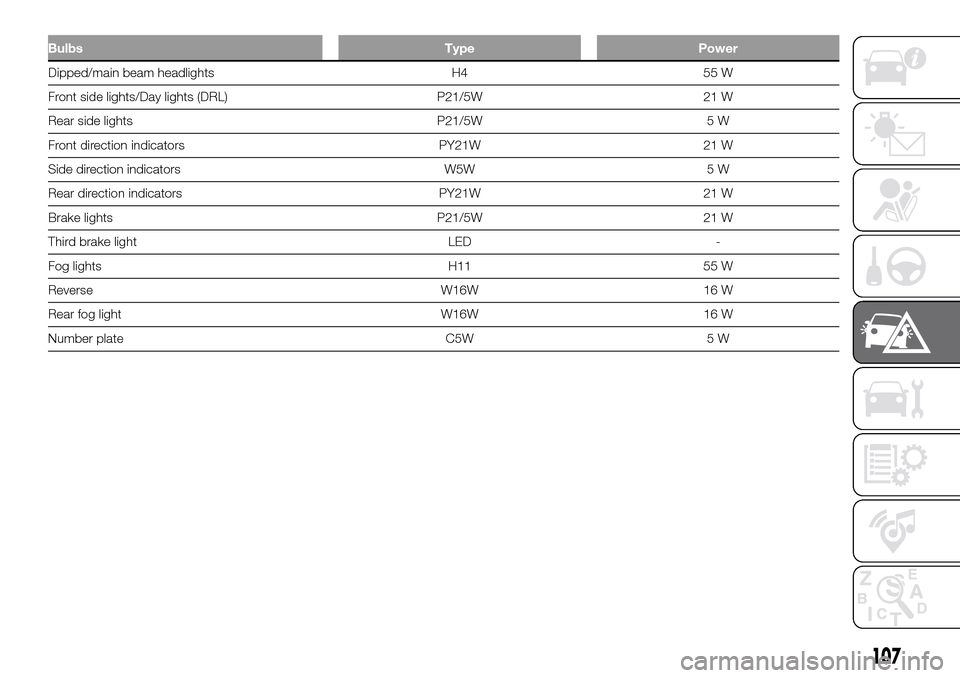
Bulbs Type Power
Dipped/main beam headlights H4 55 W
Front side lights/Day lights (DRL) P21/5W 21 W
Rear side lights P21/5W 5 W
Front direction indicators PY21W 21 W
Side direction indicators W5W 5 W
Rear direction indicators PY21W 21 W
Brake lights P21/5W 21 W
Third brake light LED -
Fog lights H11 55 W
Reverse W16W 16 W
Rear fog light W16W 16 W
Number plate C5W 5 W
107
Page 112 of 216
reposition the guard door B fig. 99,
taking care that the tabs are positioned
in their housings and tighten the fixing
screws A.
SIDE LIGHTS/DAYTIME
RUNNING LIGHTS (DRL)
(for versions/markets, where provided -
except Panda Cross versions)
To replace the bulb, proceed as follows:
steer the wheel completely, adjust
the screws A fig. 97 and remove the
flap B;
adjust the clip C fig. 101 and
disconnect the electrical connector D;
rotate and remove the bulb holder E,
release and replace the bulb;
refit the new lamp and carry out the
procedure described previously in
reverse.DAYTIME RUNNING
LIGHTS (DRL)
(Panda Cross versions)
IMPORTANT To change LED DRLs
contact a Fiat Dealership.
REAR LIGHT CLUSTERS
These contain the bulbs for the side
lights, brake lights and direction
indicators.
To replace the bulb proceed as follows:
undo the two screws A fig. 102
from their seats, pull gently outwards
until releasing the whole headlight from
the two clips (press-fitted D fig. 103 )
and release the connector;
undo the five screws B from their
seats and remove the bulb holder C;
remove the bulbs, pushing them
slightly and turning them anti-
clockwise;
refit the new lamp and carry out the
procedure described previously in
reverse.
REVERSING LIGHT/REAR
FOG LIGHT
135)The reversing lights and rear fog lights
are located in the rear bumper.
To replace the bulb, proceed as follows:
adjust the tabs A and remove the
flap B fig. 104
101F1D0084
103F1D0086
102F1D0085
110
IN AN EMERGENCY
Page 113 of 216
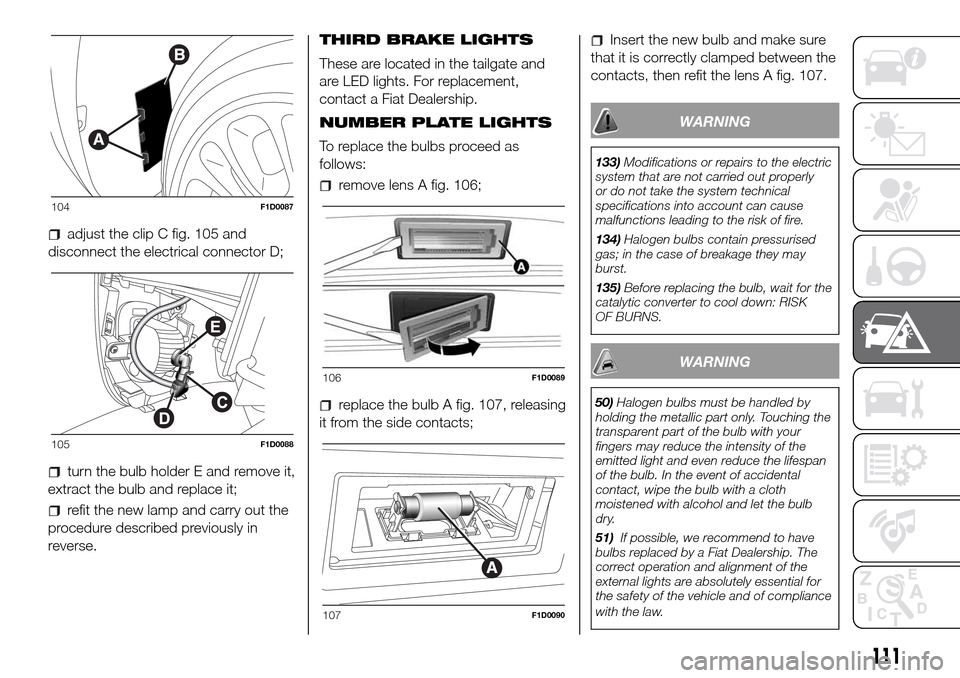
adjust the clip C fig. 105 and
disconnect the electrical connector D;
turn the bulb holder E and remove it,
extract the bulb and replace it;
refit the new lamp and carry out the
procedure described previously in
reverse.THIRD BRAKE LIGHTS
These are located in the tailgate and
are LED lights. For replacement,
contact a Fiat Dealership.
NUMBER PLATE LIGHTS
To replace the bulbs proceed as
follows:
remove lens A fig. 106;
replace the bulb A fig. 107, releasing
it from the side contacts;
Insert the new bulb and make sure
that it is correctly clamped between the
contacts, then refit the lens A fig. 107.
WARNING
133)Modifications or repairs to the electric
system that are not carried out properly
or do not take the system technical
specifications into account can cause
malfunctions leading to the risk of fire.
134)Halogen bulbs contain pressurised
gas; in the case of breakage they may
burst.
135)Before replacing the bulb, wait for the
catalytic converter to cool down: RISK
OF BURNS.
WARNING
50)Halogen bulbs must be handled by
holding the metallic part only. Touching the
transparent part of the bulb with your
fingers may reduce the intensity of the
emitted light and even reduce the lifespan
of the bulb. In the event of accidental
contact, wipe the bulb with a cloth
moistened with alcohol and let the bulb
dry.
51)If possible, we recommend to have
bulbs replaced by a Fiat Dealership. The
correct operation and alignment of the
external lights are absolutely essential for
the safety of the vehicle and of compliance
with the law.
104F1D0087
105F1D0088
106F1D0089
107F1D0090
111
Page 116 of 216
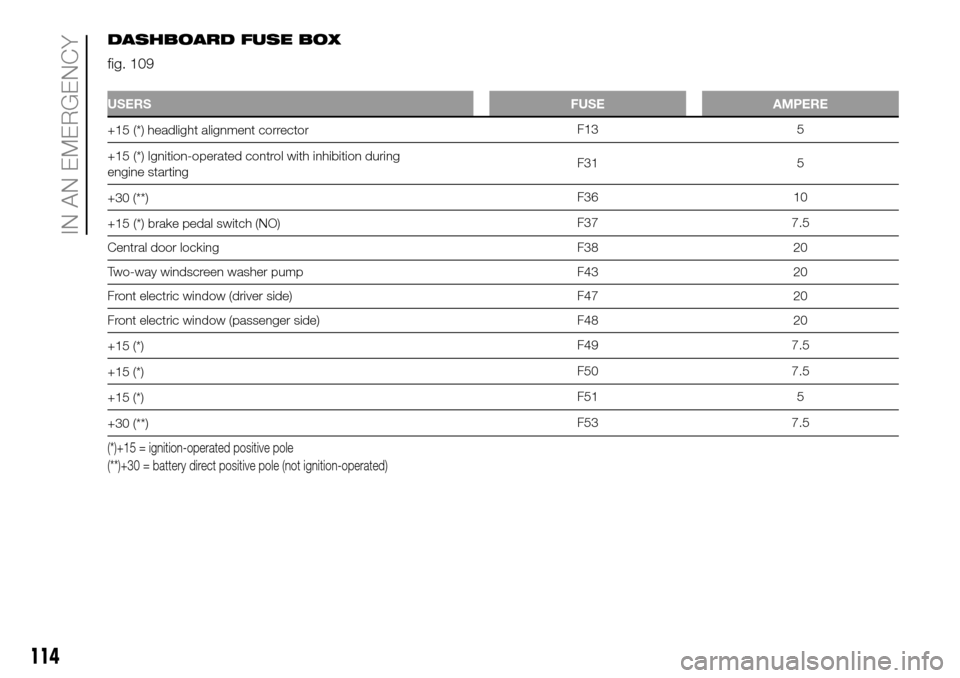
DASHBOARD FUSE BOX
fig. 109
USERSFUSE AMPERE
+15(*) headlight alignment correctorF13 5
+15
(*) Ignition-operated control with inhibition during
engine startingF31 5
+30
(**)F36 10
+15
(*) brake pedal switch (NO)F37 7.5
Central door locking F38 20
Two-way windscreen washer pump F43 20
Front electric window (driver side) F47 20
Front electric window (passenger side) F48 20
+15
(*)F49 7.5
+15
(*)F50 7.5
+15
(*)F51 5
+30
(**)F53 7.5
(*)+15 = ignition-operated positive pole
(**)+30 = battery direct positive pole (not ignition-operated)
114
IN AN EMERGENCY