Pressure FIAT PANDA 2017 319 / 3.G Owners Manual
[x] Cancel search | Manufacturer: FIAT, Model Year: 2017, Model line: PANDA, Model: FIAT PANDA 2017 319 / 3.GPages: 216, PDF Size: 19.25 MB
Page 16 of 216
WARNING
2)The fabric upholstery of the seats has
been designed to withstand long-term
wear deriving from normal use of the car.
Some precautions are however required.
Avoid prolonged and/or excessive rubbing
against clothing accessories such as
metal buckles and Velcro strips which, by
applying a high pressure on the fabric in
a small area, could cause it to break,
thereby damaging the upholstery.
3)Before tilting the backrest, remove any
objects on the seat cushion.
HEAD RESTRAINTS
11) 12)
FRONT HEAD
RESTRAINTS
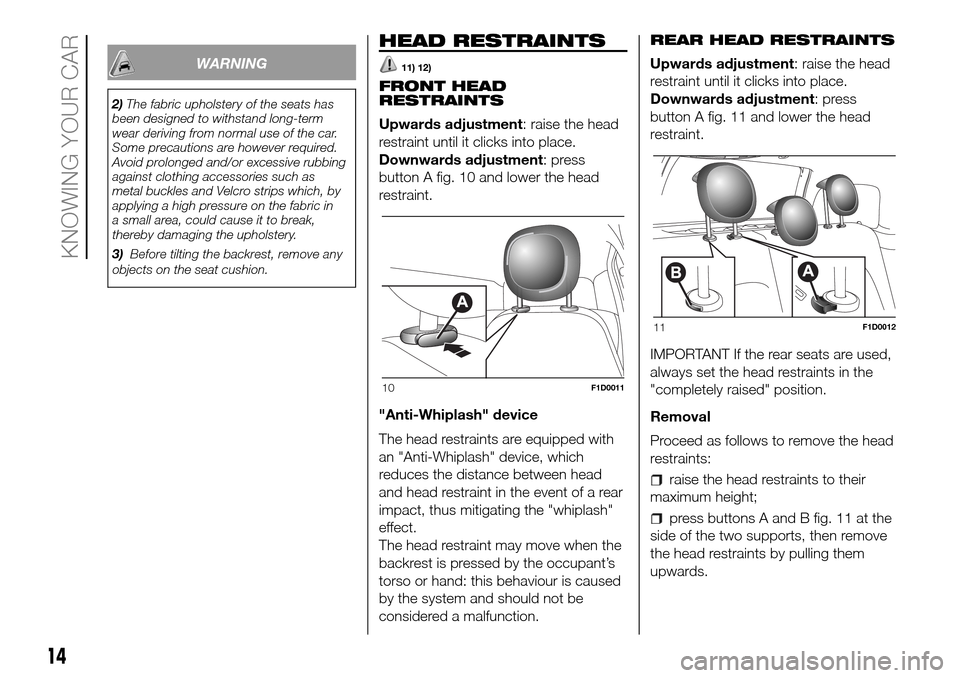
Upwards adjustment: raise the head
restraint until it clicks into place.
Downwards adjustment: press
button A fig. 10 and lower the head
restraint.
"Anti-Whiplash" device
The head restraints are equipped with
an "Anti-Whiplash" device, which
reduces the distance between head
and head restraint in the event of a rear
impact, thus mitigating the "whiplash"
effect.
The head restraint may move when the
backrest is pressed by the occupant’s
torso or hand: this behaviour is caused
by the system and should not be
considered a malfunction.REAR HEAD RESTRAINTS
Upwards adjustment: raise the head
restraint until it clicks into place.
Downwards adjustment: press
button A fig. 11 and lower the head
restraint.
IMPORTANT If the rear seats are used,
always set the head restraints in the
"completely raised" position.
Removal
Proceed as follows to remove the head
restraints:
raise the head restraints to their
maximum height;
press buttons A and B fig. 11 at the
side of the two supports, then remove
the head restraints by pulling them
upwards.
10F1D0011
11F1D0012
14
KNOWING YOUR CAR
Page 34 of 216
LPG tank certification
The LPG tank is certified in accordance
with the regulations in force.
In Italy, the tank has a life of 10 years
starting from the car registration date. If
the vehicle has been registered in a
country other than Italy, the duration
and the testing/inspection procedures
of the LPG tank can vary depending on
the national laws of that country. In all
case, when the time limit for your
country has expired, go to a Fiat Dealer
to have the tank replaced.
SELECTION OF
PETROL/LPG SUPPLY
TYPE
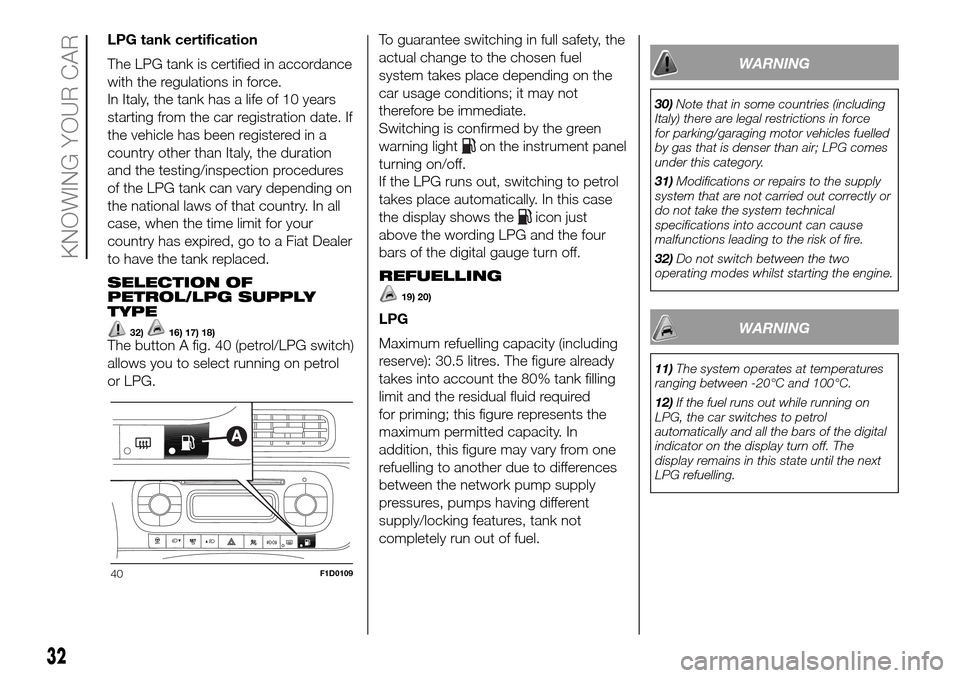
32)16) 17) 18)The button A fig. 40 (petrol/LPG switch)
allows you to select running on petrol
or LPG.To guarantee switching in full safety, the
actual change to the chosen fuel
system takes place depending on the
car usage conditions; it may not
therefore be immediate.
Switching is confirmed by the green
warning light
on the instrument panel
turning on/off.
If the LPG runs out, switching to petrol
takes place automatically. In this case
the display shows the
icon just
above the wording LPG and the four
bars of the digital gauge turn off.
REFUELLING
19) 20)
LPG
Maximum refuelling capacity (including
reserve): 30.5 litres. The figure already
takes into account the 80% tank filling
limit and the residual fluid required
for priming; this figure represents the
maximum permitted capacity. In
addition, this figure may vary from one
refuelling to another due to differences
between the network pump supply
pressures, pumps having different
supply/locking features, tank not
completely run out of fuel.
WARNING
30)Note that in some countries (including
Italy) there are legal restrictions in force
for parking/garaging motor vehicles fuelled
by gas that is denser than air; LPG comes
under this category.
31)Modifications or repairs to the supply
system that are not carried out correctly or
do not take the system technical
specifications into account can cause
malfunctions leading to the risk of fire.
32)Do not switch between the two
operating modes whilst starting the engine.
WARNING
11)The system operates at temperatures
ranging between -20°C and 100°C.
12)If the fuel runs out while running on
LPG, the car switches to petrol
automatically and all the bars of the digital
indicator on the display turn off. The
display remains in this state until the next
LPG refuelling.
40F1D0109
32
KNOWING YOUR CAR
Page 36 of 216
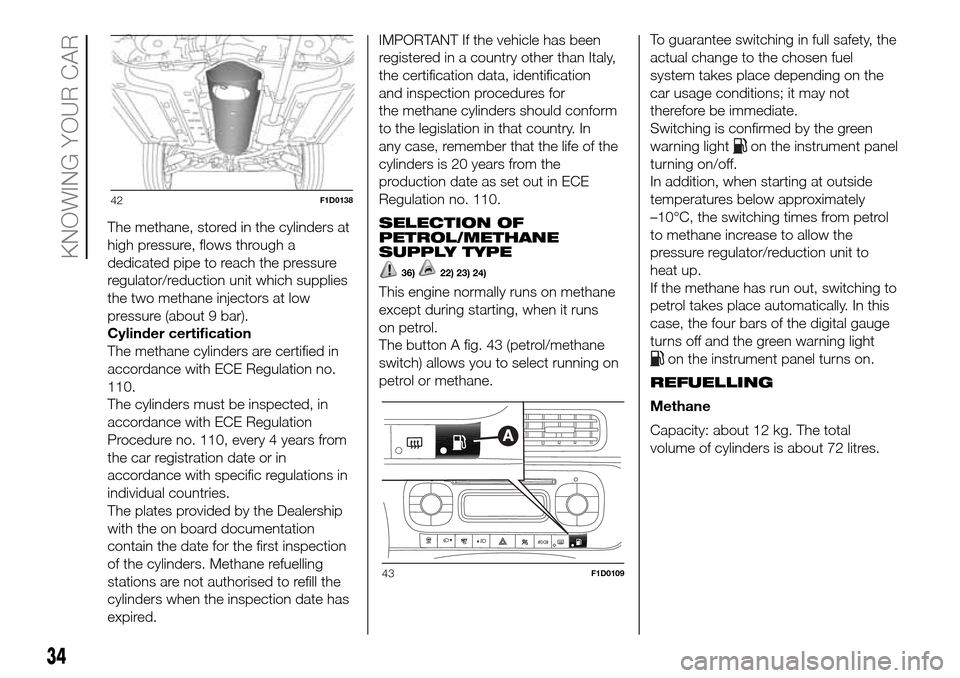
The methane, stored in the cylinders at
high pressure, flows through a
dedicated pipe to reach the pressure
regulator/reduction unit which supplies
the two methane injectors at low
pressure (about 9 bar).
Cylinder certification
The methane cylinders are certified in
accordance with ECE Regulation no.
110.
The cylinders must be inspected, in
accordance with ECE Regulation
Procedure no. 110, every 4 years from
the car registration date or in
accordance with specific regulations in
individual countries.
The plates provided by the Dealership
with the on board documentation
contain the date for the first inspection
of the cylinders. Methane refuelling
stations are not authorised to refill the
cylinders when the inspection date has
expired.IMPORTANT If the vehicle has been
registered in a country other than Italy,
the certification data, identification
and inspection procedures for
the methane cylinders should conform
to the legislation in that country. In
any case, remember that the life of the
cylinders is 20 years from the
production date as set out in ECE
Regulation no. 110.
SELECTION OF
PETROL/METHANE
SUPPLY TYPE
36)22) 23) 24)
This engine normally runs on methane
except during starting, when it runs
on petrol.
The button A fig. 43 (petrol/methane
switch) allows you to select running on
petrol or methane.To guarantee switching in full safety, the
actual change to the chosen fuel
system takes place depending on the
car usage conditions; it may not
therefore be immediate.
Switching is confirmed by the green
warning light
on the instrument panel
turning on/off.
In addition, when starting at outside
temperatures below approximately
–10°C, the switching times from petrol
to methane increase to allow the
pressure regulator/reduction unit to
heat up.
If the methane has run out, switching to
petrol takes place automatically. In this
case, the four bars of the digital gauge
turns off and the green warning light
on the instrument panel turns on.
REFUELLING
Methane
Capacity: about 12 kg. The total
volume of cylinders is about 72 litres.
42F1D0138
43F1D0109
34
KNOWING YOUR CAR
Page 37 of 216
WARNING
33)The Fiat Panda Natural Power is
equipped with a high pressure methane
fuel supply system, designed to operate at
a rated pressure of 200 bar. It is dangerous
to stretch the system with higher
pressures. To prevent damage to the gas
system parts when towing or lifting the
vehicle, follow the instructions in the Owner
Handbook, in the paragraph: “Towing the
vehicle”. If there is a fault in the methane
system, only contact a Fiat Dealership. Do
not alter the methane system configuration
or components. They are designed
exclusively for the Fiat Panda Natural
Power. The use of other components or
materials could cause malfunctions and
prejudice safety.
34)When oven painting, the cylinders must
be removed from the vehicle and
subsequently refitted by a Fiat Dealership.
Although the methane system has
numerous safety features, it is advisable to
close the manual cocks for the cylinders
every time the vehicle is not in use for
a long period, transported on other
vehicles or moved in an emergency as a
result of a breakdown or accident.
35)Modifications or repairs to the supply
system that are not carried out correctly or
do not take the system technical
specifications into account can cause
malfunctions leading to the risk of fire.
36)Do not switch between the two
operating modes whilst starting the engine.
WARNING
21)If the fuel runs out while running on
methane, the car switches to petrol
automatically and all the bars of the digital
indicator on the display turn off. The
display remains in this state until the next
methane refuelling.
22)Regardless of the last fuel system
used, at the following engine starting, after
the initial petrol stage, the system will
automatically switch to methane.
23)When switching from petrol to methane
is requested, a metal noise from the valves
which pressurise the circuit can be heard,
as it happens while starting the car. As a
result of the switching logic described
above, a delay between the valve ticking
and the the green warning light
on
the instrument panel turning off is
completely normal.24)In particular usage conditions, such as
starting and operation at low ambient
temperature, the system may switch
temporarily to petrol operation, without
indicating the performed switching. In the
event of low methane levels in the tank or a
request for high performance (e.g.
overtaking, fully laden vehicle, steep hills)
the system may automatically switch to
petrol operation to guarantee the engine
power requested. The green warning light
on the instrument panel turns on to
indicate this. When the above conditions
are no longer present, the system
automatically restores methane operation.
The green warning light
turns off. To
achieve the automatic switching described
above, make sure that there is always
enough fuel in the petrol tank.
35
Page 45 of 216
Warning light What it means
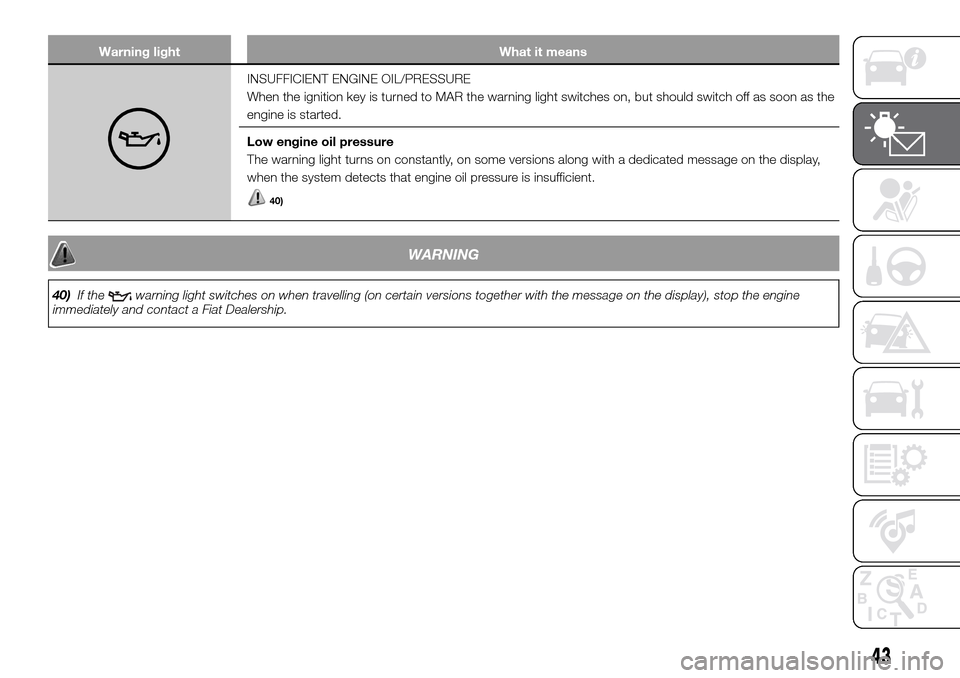
INSUFFICIENT ENGINE OIL/PRESSURE
When the ignition key is turned to MAR the warning light switches on, but should switch off as soon as the
engine is started.
Low engine oil pressure
The warning light turns on constantly, on some versions along with a dedicated message on the display,
when the system detects that engine oil pressure is insufficient.
40)
WARNING
40)If thewarning light switches on when travelling (on certain versions together with the message on the display), stop the engine
immediately and contact a Fiat Dealership.
43
Page 55 of 216
Warning light What it means
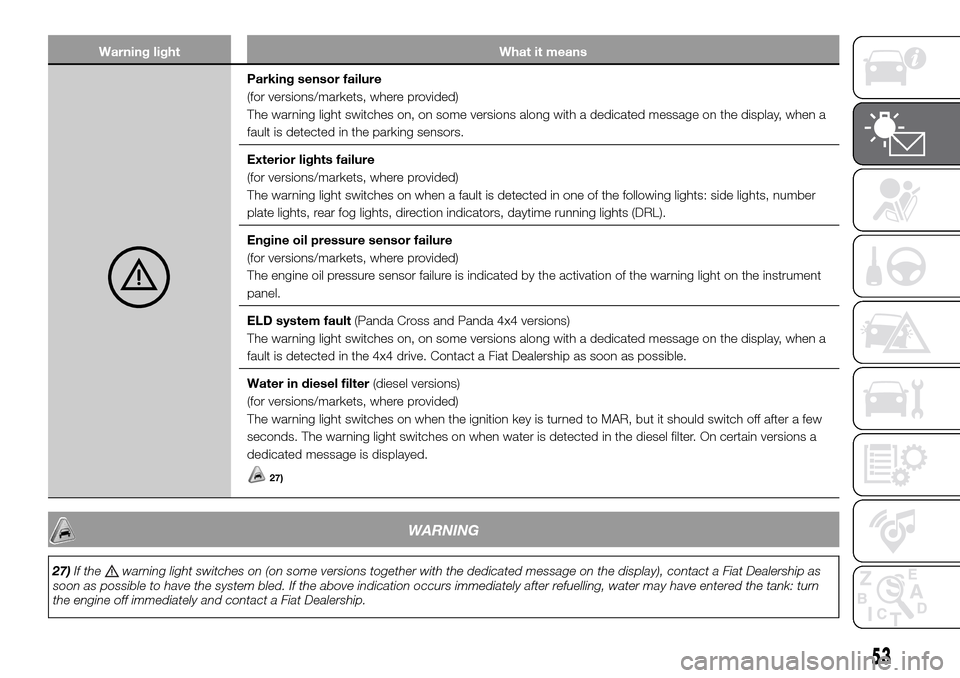
Parking sensor failure
(for versions/markets, where provided)
The warning light switches on, on some versions along with a dedicated message on the display, when a
fault is detected in the parking sensors.
Exterior lights failure
(for versions/markets, where provided)
The warning light switches on when a fault is detected in one of the following lights: side lights, number
plate lights, rear fog lights, direction indicators, daytime running lights (DRL).
Engine oil pressure sensor failure
(for versions/markets, where provided)
The engine oil pressure sensor failure is indicated by the activation of the warning light on the instrument
panel.
ELD system fault(Panda Cross and Panda 4x4 versions)
The warning light switches on, on some versions along with a dedicated message on the display, when a
fault is detected in the 4x4 drive. Contact a Fiat Dealership as soon as possible.
Water in diesel filter(diesel versions)
(for versions/markets, where provided)
The warning light switches on when the ignition key is turned to MAR, but it should switch off after a few
seconds. The warning light switches on when water is detected in the diesel filter. On certain versions a
dedicated message is displayed.
27)
WARNING
27)If thewarning light switches on (on some versions together with the dedicated message on the display), contact a Fiat Dealership as
soon as possible to have the system bled. If the above indication occurs immediately after refuelling, water may have entered the tank: turn
the engine off immediately and contact a Fiat Dealership.
53
Page 56 of 216
Warning light What it means
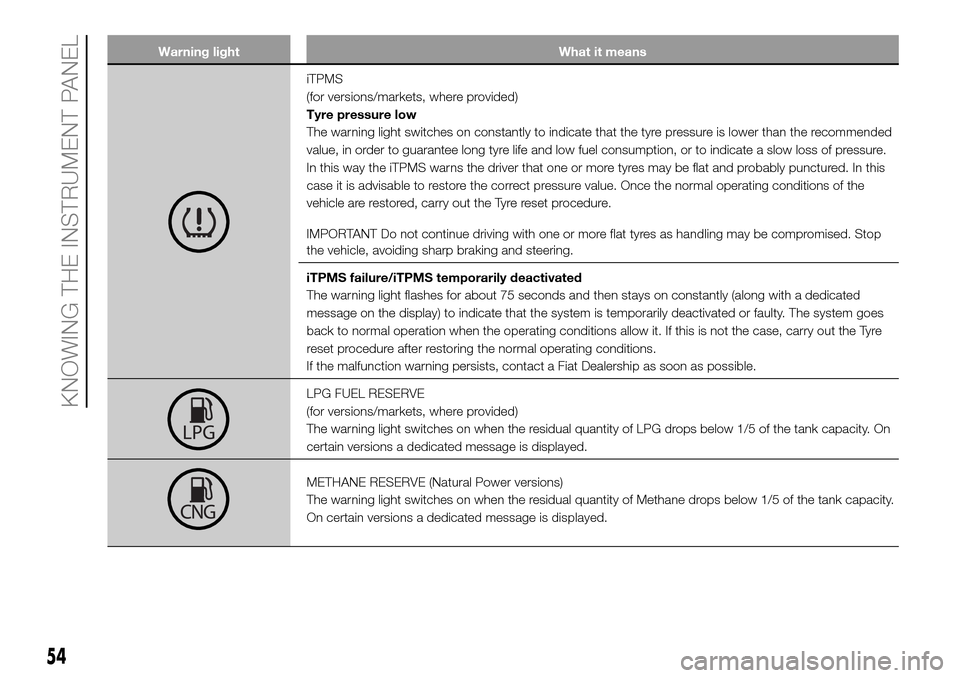
iTPMS
(for versions/markets, where provided)
Tyre pressure low
The warning light switches on constantly to indicate that the tyre pressure is lower than the recommended
value, in order to guarantee long tyre life and low fuel consumption, or to indicate a slow loss of pressure.
In this way the iTPMS warns the driver that one or more tyres may be flat and probably punctured. In this
case it is advisable to restore the correct pressure value. Once the normal operating conditions of the
vehicle are restored, carry out the Tyre reset procedure.
IMPORTANT Do not continue driving with one or more flat tyres as handling may be compromised. Stop
the vehicle, avoiding sharp braking and steering.
iTPMS failure/iTPMS temporarily deactivated
The warning light flashes for about 75 seconds and then stays on constantly (along with a dedicated
message on the display) to indicate that the system is temporarily deactivated or faulty. The system goes
back to normal operation when the operating conditions allow it. If this is not the case, carry out the Tyre
reset procedure after restoring the normal operating conditions.
If the malfunction warning persists, contact a Fiat Dealership as soon as possible.
LPG FUEL RESERVE
(for versions/markets, where provided)
The warning light switches on when the residual quantity of LPG drops below 1/5 of the tank capacity. On
certain versions a dedicated message is displayed.
METHANE RESERVE (Natural Power versions)
The warning light switches on when the residual quantity of Methane drops below 1/5 of the tank capacity.
On certain versions a dedicated message is displayed.
54
KNOWING THE INSTRUMENT PANEL
Page 62 of 216
ACTIVE SAFETY
SYSTEMS
ABS (Anti-lock Braking
System)
This system, which is an integral part of
the braking system, prevents one or
more wheels from locking and slipping
in all road surface conditions,
irrespective of the intensity of the
braking action, ensuring that the vehicle
can be controlled even during
emergency braking.
IMPORTANT To obtain the maximum
efficiency of the braking system, a
bedding-in period of about 500 km is
needed: during this period it is better to
avoid sharp, repeated and prolonged
braking.
The ABS also includes the following
systems: EBD (Electronic Braking Force
Distribution), MSR (Motor
Schleppmoment Regelung) and MBA
(Mechanical Brake Assist) (for
versions/markets, where provided).
System intervention
The driver can feel that the ABS system
has come into action because the
brake pedal pulsates slightly and the
system gets noisier: this is entirely
normal with the system operating.
44) 45) 46) 47) 48) 49) 50) 51) 52)
ESC SYSTEM (Electronic
Stability Control)
(for versions/markets, where provided)
This is an electronic system that
controls vehicle stability in the event of
tyre grip loss, helping maintain
directional control. The system is
capable of recognising potentially
dangerous situations in terms of the
stability and intervenes automatically on
the brakes in a differentiated manner
for the four wheels in order to provide a
stabilising torque.
The ESC system switches on
automatically when the engine is
started and cannot be switched off.
System intervention
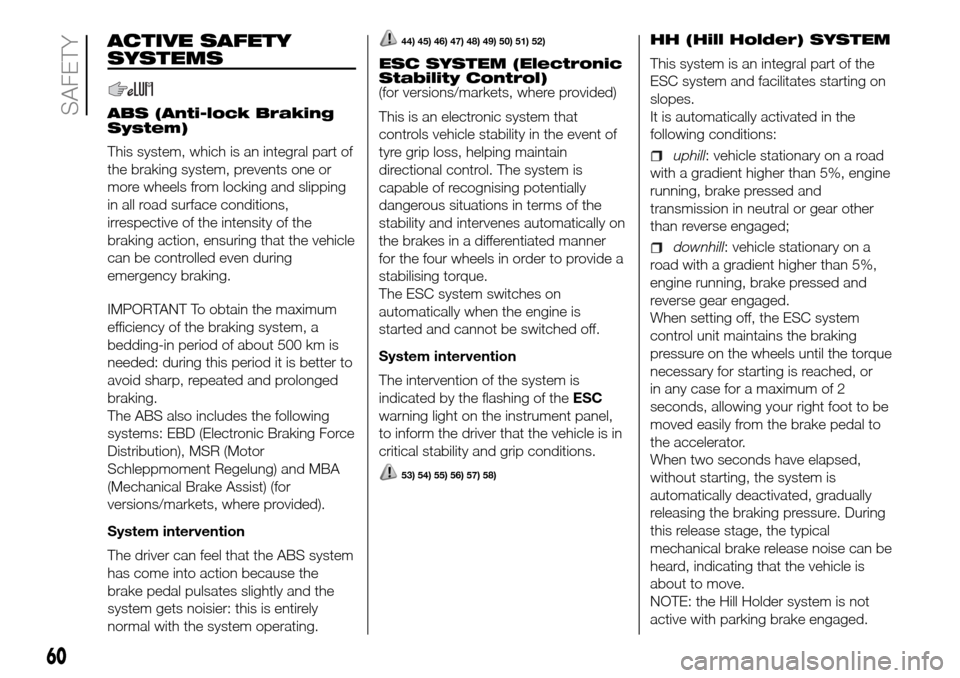
The intervention of the system is
indicated by the flashing of theESC
warning light on the instrument panel,
to inform the driver that the vehicle is in
critical stability and grip conditions.
53) 54) 55) 56) 57) 58)
HH (Hill Holder) SYSTEM
This system is an integral part of the
ESC system and facilitates starting on
slopes.
It is automatically activated in the
following conditions:
uphill: vehicle stationary on a road
with a gradient higher than 5%, engine
running, brake pressed and
transmission in neutral or gear other
than reverse engaged;
downhill: vehicle stationary on a
road with a gradient higher than 5%,
engine running, brake pressed and
reverse gear engaged.
When setting off, the ESC system
control unit maintains the braking
pressure on the wheels until the torque
necessary for starting is reached, or
in any case for a maximum of 2
seconds, allowing your right foot to be
moved easily from the brake pedal to
the accelerator.
When two seconds have elapsed,
without starting, the system is
automatically deactivated, gradually
releasing the braking pressure. During
this release stage, the typical
mechanical brake release noise can be
heard, indicating that the vehicle is
about to move.
NOTE: the Hill Holder system is not
active with parking brake engaged.
60
SAFETY
Page 63 of 216
IMPORTANT The Hill Holder system is
not a parking brake, therefore do not
leave the vehicle without activating the
handbrake, switching off the engine,
and engaging first gear, with the vehicle
parked in safe conditions.
ASR (AntiSlip
Regulation) SYSTEM
It is an integral part of the ESC system.
It is automatically activated in the case
of drive wheels slipping, loss of grip
on wet roads (aquaplaning) and
acceleration on slippery, snowy or icy
roads, etc.
Depending on the slipping conditions,
two different control systems are
activated:
if the slipping involves both drive
wheels, the ASR intervenes reducing
the power transmitted by the engine;
if the slipping only involves one
of the drive wheels, it intervenes
automatically braking the wheel that is
slipping.
Engagement/disengagement of the
ASR system
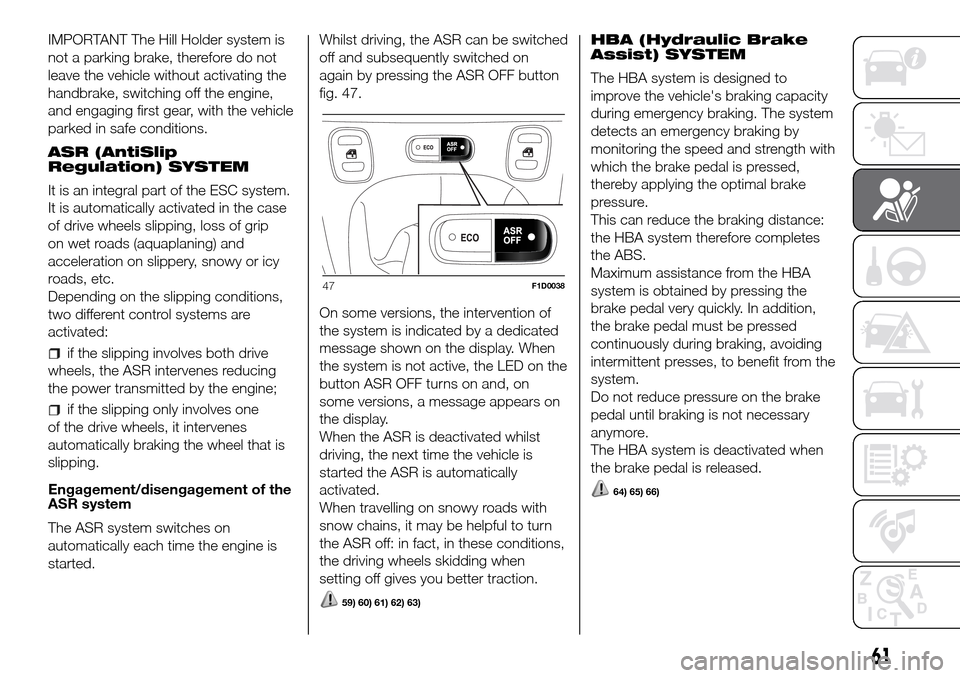
The ASR system switches on
automatically each time the engine is
started.Whilst driving, the ASR can be switched
off and subsequently switched on
again by pressing the ASR OFF button
fig. 47.
On some versions, the intervention of
the system is indicated by a dedicated
message shown on the display. When
the system is not active, the LED on the
button ASR OFF turns on and, on
some versions, a message appears on
the display.
When the ASR is deactivated whilst
driving, the next time the vehicle is
started the ASR is automatically
activated.
When travelling on snowy roads with
snow chains, it may be helpful to turn
the ASR off: in fact, in these conditions,
the driving wheels skidding when
setting off gives you better traction.
59) 60) 61) 62) 63)
HBA (Hydraulic Brake
Assist) SYSTEM
The HBA system is designed to
improve the vehicle's braking capacity
during emergency braking. The system
detects an emergency braking by
monitoring the speed and strength with
which the brake pedal is pressed,
thereby applying the optimal brake
pressure.
This can reduce the braking distance:
the HBA system therefore completes
the ABS.
Maximum assistance from the HBA
system is obtained by pressing the
brake pedal very quickly. In addition,
the brake pedal must be pressed
continuously during braking, avoiding
intermittent presses, to benefit from the
system.
Do not reduce pressure on the brake
pedal until braking is not necessary
anymore.
The HBA system is deactivated when
the brake pedal is released.
64) 65) 66)
47F1D0038
61
Page 65 of 216
IMPORTANT The system does not
relieve the driver of the responsibility of
controlling the vehicle and does not
replace attention while driving. The
driver of the vehicle takes the complete
responsibility for the consequences of
their actions and of an incorrect and not
responsible use of the vehicle.
Enabling the system
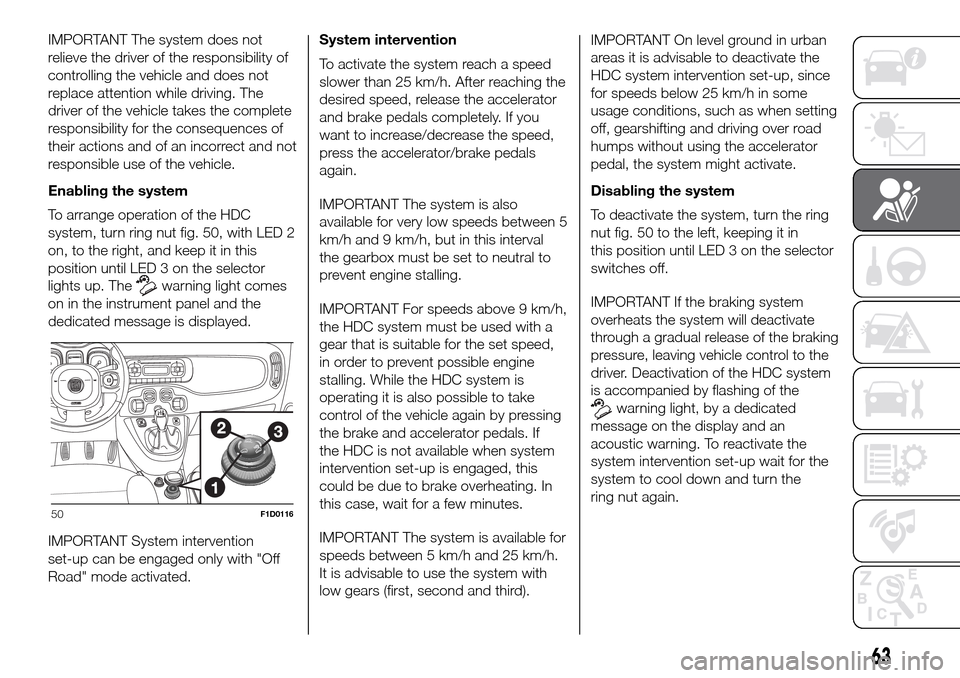
To arrange operation of the HDC
system, turn ring nut fig. 50, with LED 2
on, to the right, and keep it in this
position until LED 3 on the selector
lights up. The
warning light comes
on in the instrument panel and the
dedicated message is displayed.
IMPORTANT System intervention
set-up can be engaged only with "Off
Road" mode activated.System intervention
To activate the system reach a speed
slower than 25 km/h. After reaching the
desired speed, release the accelerator
and brake pedals completely. If you
want to increase/decrease the speed,
press the accelerator/brake pedals
again.
IMPORTANT The system is also
available for very low speeds between 5
km/h and 9 km/h, but in this interval
the gearbox must be set to neutral to
prevent engine stalling.
IMPORTANT For speeds above 9 km/h,
the HDC system must be used with a
gear that is suitable for the set speed,
in order to prevent possible engine
stalling. While the HDC system is
operating it is also possible to take
control of the vehicle again by pressing
the brake and accelerator pedals. If
the HDC is not available when system
intervention set-up is engaged, this
could be due to brake overheating. In
this case, wait for a few minutes.
IMPORTANT The system is available for
speeds between 5 km/h and 25 km/h.
It is advisable to use the system with
low gears (first, second and third).IMPORTANT On level ground in urban
areas it is advisable to deactivate the
HDC system intervention set-up, since
for speeds below 25 km/h in some
usage conditions, such as when setting
off, gearshifting and driving over road
humps without using the accelerator
pedal, the system might activate.
Disabling the system
To deactivate the system, turn the ring
nut fig. 50 to the left, keeping it in
this position until LED 3 on the selector
switches off.
IMPORTANT If the braking system
overheats the system will deactivate
through a gradual release of the braking
pressure, leaving vehicle control to the
driver. Deactivation of the HDC system
is accompanied by flashing of the
warning light, by a dedicated
message on the display and an
acoustic warning. To reactivate the
system intervention set-up wait for the
system to cool down and turn the
ring nut again.
50F1D0116
63