mirror FIAT PANDA 2018 Owner handbook (in English)
[x] Cancel search | Manufacturer: FIAT, Model Year: 2018, Model line: PANDA, Model: FIAT PANDA 2018Pages: 228, PDF Size: 17.05 MB
Page 5 of 228
USE OF THE OWNER HANDBOOK
OPERATING INSTRUCTIONS
Each time direction instructions (left/right or forwards/backwards) about the vehicle are given, these must be intended as
regarding an occupant in the driver's seat. Special cases not complying with this rule will be specified as appropriate in the text.
The figures in the Owner Handbook are provided by way of example only: this might imply that some details of the image do
not correspond to the actual arrangement of your car. In addition, the Handbook has been conceived considering vehicles with
steering wheel on the left side; it is therefore possible that on vehicles with steering wheel on the right side, the position or
construction of some controls is not exactly mirror-like with respect to the figure.
To identify the chapter with the information needed you can consult the index at the end of this Owner Handbook.
Chapters can be rapidly identified with dedicated graphic tabs, at the side of each odd page. A few pages further there is a key
for getting to know the chapter order and the relevant symbols in the tabs. There is in any case a textual indication of the
current chapter at the side of each even page.
WARNINGS AND PRECAUTIONS
While reading this Owner Handbook you will find a series ofWARNINGSto prevent procedures that could damage your
vehicle.
There are alsoPRECAUTIONSthat must be carefully followed to prevent incorrect use of the components of the vehicle,
which could cause accidents or injuries.
Therefore, allWARNINGSandPRECAUTIONSmust always be followed carefully.
WARNINGSandPRECAUTIONSare recalled in the text with the following symbols:
personal safety;
vehicle safety;
environmental protection.
NOTE These symbols, when necessary, are indicated besides the title or at the end of the line and are followed by a number.
That number recalls the corresponding warning at the end of the relevant section.
Page 9 of 228
KNOWING YOUR CAR
In-depth knowledge of your new vehicle
starts here.
IThe handbook that you are reading
simply and directly explains how it
is made and how it works.
That’s why we advise you to read it
seated comfortably on board, so that
you can see immediately what is
described here for yourself.DASHBOARD ................................. 8
KEYS .............................................. 9
IGNITION DEVICE ........................... 10
THE FIAT CODE SYSTEM ............... 10
DOORS ........................................... 11
SEATS ............................................ 12
HEAD RESTRAINTS ........................ 14
STEERING WHEEL ......................... 15
REAR VIEW MIRRORS .................... 15
EXTERIOR LIGHTS ......................... 16
INTERIOR LIGHTS .......................... 18
WINDOW WASHING ....................... 19
CLIMATE CONTROL SYSTEM ........ 21
ELECTRIC WINDOWS .................... 25
BONNET ......................................... 25
BOOT ............................................. 27
USB PORT ...................................... 28
SMARTPHONE DOCKING .............. 29
VERSION WITH LPG SYSTEM ........ 30
VERSION WITH METHANE
SYSTEM (NATURAL POWER) ......... 32
7
Page 17 of 228
STEERING WHEEL
13) 14)
ADJUSTMENTS
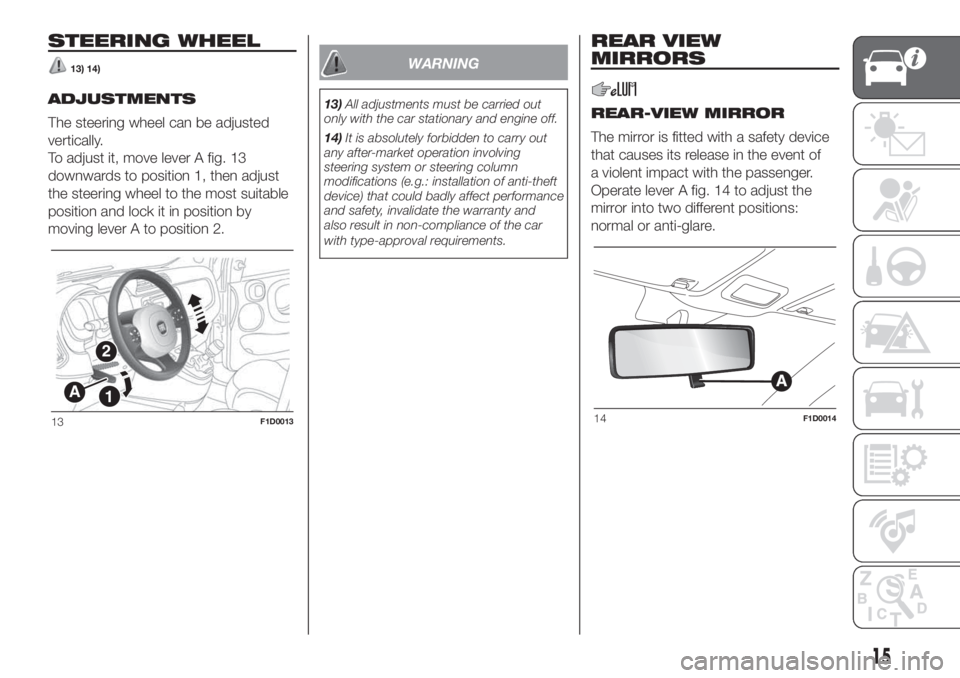
The steering wheel can be adjusted
vertically.
To adjust it, move lever A fig. 13
downwards to position 1, then adjust
the steering wheel to the most suitable
position and lock it in position by
moving lever A to position 2.
WARNING
13)All adjustments must be carried out
only with the car stationary and engine off.
14)It is absolutely forbidden to carry out
any after-market operation involving
steering system or steering column
modifications (e.g.: installation of anti-theft
device) that could badly affect performance
and safety, invalidate the warranty and
also result in non-compliance of the car
with type-approval requirements.
REAR VIEW
MIRRORS
REAR-VIEW MIRROR
The mirror is fitted with a safety device
that causes its release in the event of
a violent impact with the passenger.
Operate lever A fig. 14 to adjust the
mirror into two different positions:
normal or anti-glare.
A
2
1
13F1D001314F1D0014
15
Page 18 of 228
DOOR MIRRORS
15)
Manual adjustment
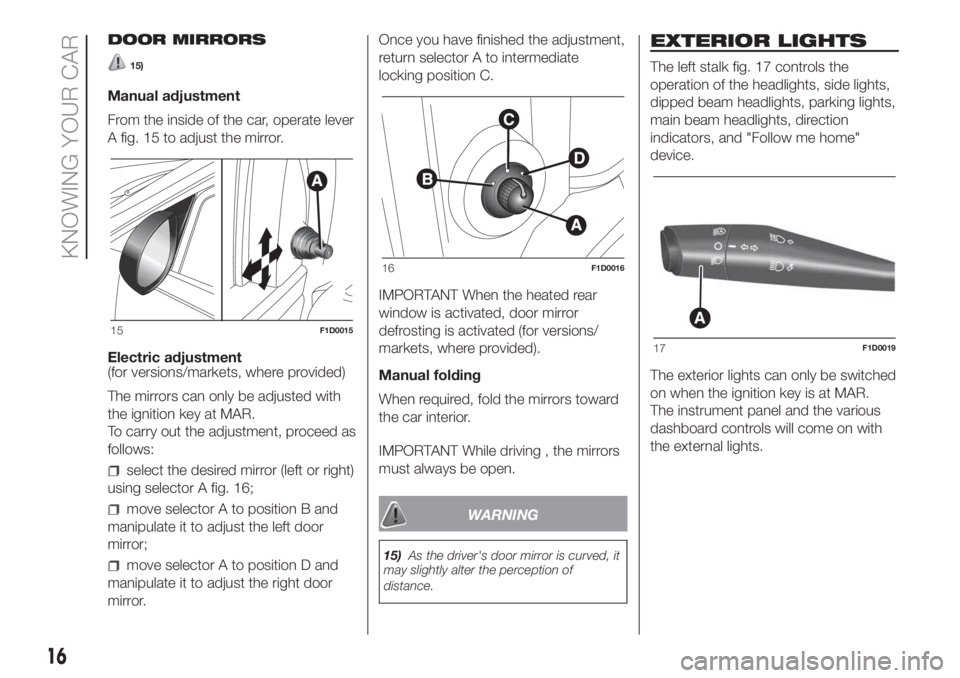
From the inside of the car, operate lever
A fig. 15 to adjust the mirror.
Electric adjustment
(for versions/markets, where provided)
The mirrors can only be adjusted with
the ignition key at MAR.
To carry out the adjustment, proceed as
follows:
select the desired mirror (left or right)
using selector A fig. 16;
move selector A to position B and
manipulate it to adjust the left door
mirror;
move selector A to position D and
manipulate it to adjust the right door
mirror.Once you have finished the adjustment,
return selector A to intermediate
locking position C.
IMPORTANT When the heated rear
window is activated, door mirror
defrosting is activated (for versions/
markets, where provided).
Manual folding
When required, fold the mirrors toward
the car interior.
IMPORTANT While driving , the mirrors
must always be open.
WARNING
15)As the driver's door mirror is curved, it
may slightly alter the perception of
distance.
EXTERIOR LIGHTS
The left stalk fig. 17 controls the
operation of the headlights, side lights,
dipped beam headlights, parking lights,
main beam headlights, direction
indicators, and "Follow me home"
device.
The exterior lights can only be switched
on when the ignition key is at MAR.
The instrument panel and the various
dashboard controls will come on with
the external lights.
15F1D0015
16F1D0016
A
17F1D0019
16
KNOWING YOUR CAR
Page 24 of 228
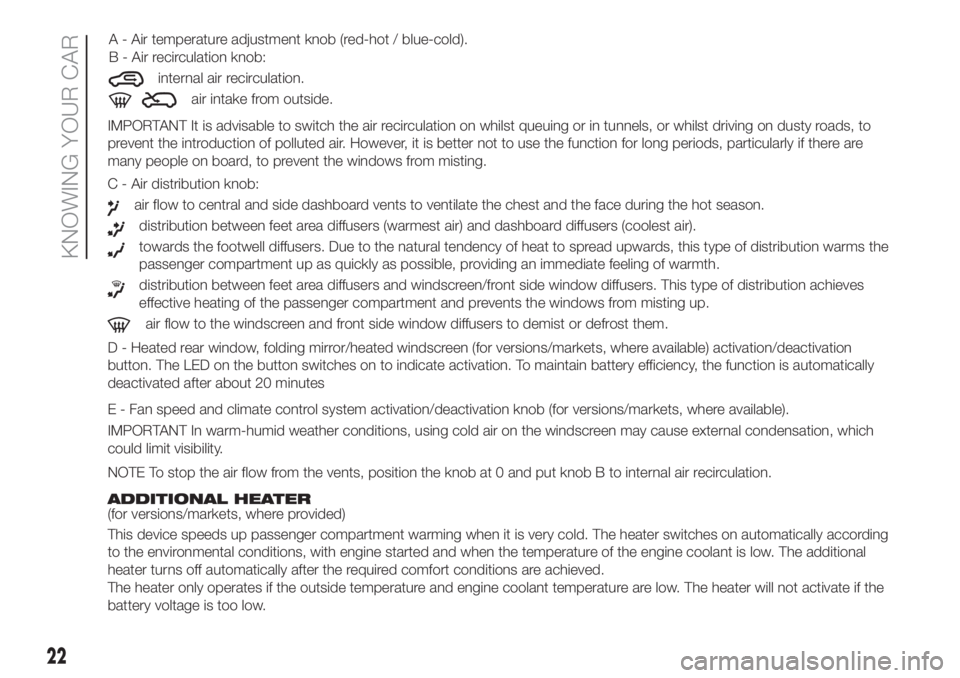
IMPORTANT It is advisable to switch the air recirculation on whilst queuing or in tunnels, or whilst driving on dusty roads, to
prevent the introduction of polluted air. However, it is better not to use the function for long periods, particularly if there are
many people on board, to prevent the windows from misting.
C - Air distribution knob:
air flow to central and side dashboard vents to ventilate the chest and the face during the hot season.
distribution between feet area diffusers (warmest air) and dashboard diffusers (coolest air).
towards the footwell diffusers. Due to the natural tendency of heat to spread upwards, this type of distribution warms the
passenger compartment up as quickly as possible, providing an immediate feeling of warmth.
distribution between feet area diffusers and windscreen/front side window diffusers. This type of distribution achieves
effective heating of the passenger compartment and prevents the windows from misting up.
air flow to the windscreen and front side window diffusers to demist or defrost them.
D - Heated rear window, folding mirror/heated windscreen (for versions/markets, where available) activation/deactivation
button. The LED on the button switches on to indicate activation. To maintain battery efficiency, the function is automatically
deactivated after about 20 minutes
E - Fan speed and climate control system activation/deactivation knob (for versions/markets, where available).
IMPORTANT In warm-humid weather conditions, using cold air on the windscreen may cause external condensation, which
could limit visibility.
NOTE To stop the air flow from the vents, position the knob at 0 and put knob B to internal air recirculation.
.
ADDITIONAL HEATER
(for versions/markets, where provided)
This device speeds up passenger compartment warming when it is very cold. The heater switches on automatically according
to the environmental conditions, with engine started and when the temperature of the engine coolant is low. The additional
heater turns off automatically after the required comfort conditions are achieved.
The heater only operates if the outside temperature and engine coolant temperature are low. The heater will not activate if the
battery voltage is too low.
22
KNOWING YOUR CAR
A - Air temperature adjustment knob (red-hot / blue-cold).
B - Air recirculation knob:
internal air recirculation.
air intake from outside.
Page 26 of 228
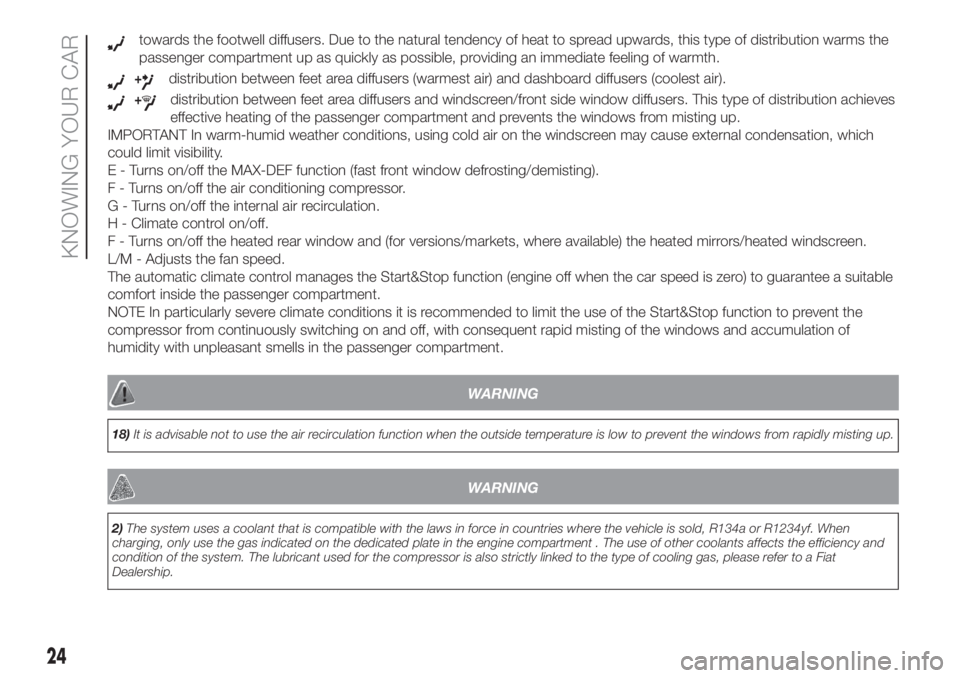
towards the footwell diffusers. Due to the natural tendency of heat to spread upwards, this type of distribution warms the
passenger compartment up as quickly as possible, providing an immediate feeling of warmth.
+distribution between feet area diffusers (warmest air) and dashboard diffusers (coolest air).
+distribution between feet area diffusers and windscreen/front side window diffusers. This type of distribution achieves
effective heating of the passenger compartment and prevents the windows from misting up.
IMPORTANT In warm-humid weather conditions, using cold air on the windscreen may cause external condensation, which
could limit visibility.
E - Turns on/off the MAX-DEF function (fast front window defrosting/demisting).
F - Turns on/off the air conditioning compressor.
G - Turns on/off the internal air recirculation.
H - Climate control on/off.
F - Turns on/off the heated rear window and (for versions/markets, where available) the heated mirrors/heated windscreen.
L/M - Adjusts the fan speed.
The automatic climate control manages the Start&Stop function (engine off when the car speed is zero) to guarantee a suitable
comfort inside the passenger compartment.
NOTE In particularly severe climate conditions it is recommended to limit the use of the Start&Stop function to prevent the
compressor from continuously switching on and off, with consequent rapid misting of the windows and accumulation of
humidity with unpleasant smells in the passenger compartment.
.
WARNING
18)It is advisable not to use the air recirculation function when the outside temperature is low to prevent the windows from rapidly misting up.
WARNING
2)The system uses a coolant that is compatible with the laws in force in countries where the vehicle is sold, R134a or R1234yf. When
charging, only use the gas indicated on the dedicated plate in the engine compartment . The use of other coolants affects the efficiency and
condition of the system. The lubricant used for the compressor is also strictly linked to the type of cooling gas, please refer to a Fiat
Dealership.
24
KNOWING YOUR CAR
Page 71 of 228
71)If the car must be placed on a roller
bench (at a speed within 5 and 30 km/h)
for maintenance interventions or if it is
washed in an automatic roller washing
tunnel with an obstacle in the front part
(e.g. another car, a wall or another
obstacle), the system may detect its
presence and activate. In this case the
system must be deactivated through the
display Setup Menu.
72)If the system signals a pressure
decrease on a specific tyre, it is
recommended to check the pressure on all
four tyres.
73)The iTPMS does not relieve the driver
from the obligation to check the tyre
pressure every month; it is not to
be considered a system to replace
maintenance or a safety system.
74)Tyre pressure must be checked with
tyres cold. Should it become necessary for
whatever reason to check pressure with
warm tyres, do not reduce pressure even
though it is higher than the prescribed
value, but repeat the check when tyres are
cold.
75)The iTPMS cannot indicate sudden
tyre pressure drops (for example when
a tyre bursts). In this case, stop the vehicle,
braking with caution and avoiding abrupt
steering.
76)The system only warns that the tyre
pressure is low: it is not able to inflate
them.
77)Insufficient tyre inflation increases fuel
consumption, reduces the tread duration
and may affect the capacity to drive safely.
WARNING
30)The laser sensor may have limited or
absent operation due to weather
conditions such as: heavy rain, hail, thick
fog, heavy snow, formation of ice layers on
the windscreen.
31)Sensor operation may also be
compromised by the presence of dust,
condensation, dirt or ice on the
windscreen, by traffic conditions (e.g.
vehicles that are driving not aligned with
you car, vehicle driving in a transverse
or opposite way on the same lane, bend
with a small radius of curvature), by road
surface conditions and by driving
conditions (e.g. off-road driving). Make sure
the windscreen is always clean. Use
specific detergents and clean cloths to
avoid scratching the windscreen. The
sensor operation may also be limited or
absent in some driving, traffic and road
surface conditions.
32)Projecting loads on the roof of the car
may interfere with the correct operation
of the sensor. Before starting make sure
the load is correctly positioned, in order not
to cover the sensor operating range.
33)If the windscreen must be replaced
due to scratches, chipping or breakage,
contact exclusively a Fiat Dealership.
Do not replace the windscreen on your
own, risk of malfunction! It is advisable to
replace the windscreen if it is damaged
in the laser sensor area.34)Do not tamper nor operate on the laser
sensor. Do not close the openings in the
aesthetic cover located under the interior
rear view mirror. In the event of a sensor
failure, contact a Fiat Dealership.
35)Do not cover the operating range of the
sensor with stickers or other objects. Also
pay attention to other objects on the
bonnet (e.g. a layer of snow) and make
sure they do not interfere with the light
emitted by the laser.
36)If a trailer or a vehicle is towed the
system must be deactivated with the
display Setup Menu.
69
Page 95 of 228
STARTING THE
ENGINE
116) 117)
38) 39) 40) 41)
Before starting the engine, adjust the
seat, the interior rear view mirrors,
the door mirrors and fasten the seat
belt correctly.
Never press the accelerator pedal for
starting the engine.
VERSIONS WITH MANUAL
TRANSMISSION
Petrol versions
Proceed as follows:
engage the handbrake and put the
gear lever in neutral.For 0.9 TwinAir
and 0.9 TwinAir Turbo versions
engage the handbrake and place the
gear lever in neutral or fully press the
clutch pedal if a gear other than neutral
is engaged;
for all versions (except 0.9
TwinAir and 0.9 TwinAir Turbo)fully
depress the clutch pedal without
touching the accelerator;
turn the ignition key to AVV and
release it as soon as the engine starts.Diesel versions
Proceed as follows:
engage the handbrake, put the gear
lever into neutral and turn the ignition
key to MAR: the warning lights
and
on the instrument panel will turn
on;
wait for the warning lightsand
to turn off and then fully depress
the clutch pedal without pressing the
accelerator;
turn the ignition key to the AVV
position as soon as the warning light
turns off. Release the ignition key as
soon as the engine starts.
IMPORTANT If the engine does not
start at the first attempt, return the
ignition key to STOP before repeating
the procedure. If, with the ignition
key on MAR, the instrument panel
warning lights
andstay on (for
petrol versions only), it is advisable to
turn the key to STOP and then back to
MAR. If the
warning light remains
on, try with the other keys provided
with the car. Contact a Fiat Dealership if
you still cannot start the engine.VERSIONS WITH
DUALOGIC
TRANSMISSION
118)
Engine starting is allowed both with a
gear engaged and with the gearbox
in neutral (N).
However, the brake pedal must always
be pressed first if neutral is not
engaged. It is therefore advisable to
place the gear lever in neutral (N) before
starting the engine.
LPG AND NATURAL
POWER VERSIONS
The engine always starts up on petrol
independently of the previously
selected mode.
42)
SWITCHING OFF THE
ENGINE
43)
Turn the ignition key to STOP while the
engine is idling.
IMPORTANT After a demanding drive,
before turning the engine off you should
allow it to idle to allow the temperature
in the engine compartment to
decrease.
93
Page 108 of 228
TOWING TRAILERS
131) 132)
IMPORTANT
For towing motorhomes or trailers the
vehicle must be fitted with an approved
tow hook and an adequate electrical
system. Installation must be carried out
by a specialist.
Install any specific and/or additional
door mirrors as specified by the
Highway Code.
Remember that when towing a trailer,
steep hills are harder to climb, braking
distances increase and overtaking
takes longer depending on the overall
weight of the trailer.
Engage a low gear when driving
downhill, rather than constantly using
the brake.
The weight the trailer exerts on the
vehicle tow hook reduces the vehicle's
loading capacity by the same amount.
To make sure that the maximum
towable weight is not exceeded (given
in the vehicle registration document)
account should be taken of the fully
laden trailer, including accessories and
luggage.Do not exceed the speed limits specific
to each country you are driving in, in
the case of vehicles towing trailers.
In any case, the top speed must not
exceed 100 km/h.
An electric brake (or electric winch)
should be supplied directly by the
battery through a cable with a cross
section of no less than 2.5 mm
2.
In addition to the electrical branches,
the vehicle electrical system can only
be connected to the supply cable for an
electric brake and to the cable for an
internal light for the trailer, not
exceeding 15 W. For connections, use
the preset control unit with a battery
cable with section not less than 2.5
mm
2.
On Panda Cross and Panda 4x4
versions, in the event of prolonged
vehicle use at maximum tow capacity
on slopes, replacing engine oil more
frequently (every 10,000 km) is
advisable.
IMPORTANT The use of auxiliary loads
other than external lights (electric brake,
winch, etc.) must take place with
engine running.
IMPORTANT To install a tow hook
contact a Fiat Dealership.
WARNING
131)The ABS with which the vehicle is
equipped will not control the braking
system of the trailer. Particular caution is
required on slippery roads.
132)Never modify the braking system of
the vehicle to control the trailer brake.
The trailer braking system must be fully
independent of the vehicle’s hydraulic
system.
106
STARTING AND DRIVING
Page 117 of 228
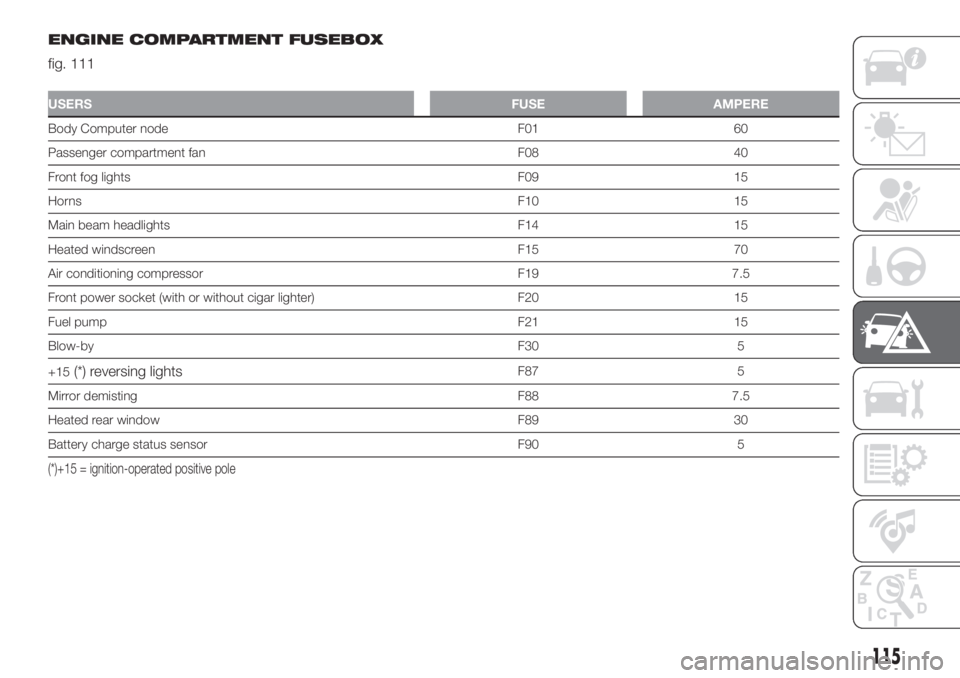
ENGINE COMPARTMENT FUSEBOX
fig. 111
USERSFUSE AMPERE
Body Computer node F01 60
Passenger compartment fan F08 40
Front fog lights F09 15
HornsF10 15
Main beam headlights F14 15
Heated windscreen F15 70
Air conditioning compressor F19 7.5
Front power socket (with or without cigar lighter) F20 15
Fuel pump F21 15
Blow-byF30 5
+15
(*) reversing lightsF87 5
Mirror demisting F88 7.5
Heated rear window F89 30
Battery charge status sensor F90 5
(*)+15 = ignition-operated positive pole
115