ESP FIAT PUNTO EVO 2009 1.G User Guide
[x] Cancel search | Manufacturer: FIAT, Model Year: 2009, Model line: PUNTO EVO, Model: FIAT PUNTO EVO 2009 1.GPages: 270, PDF Size: 7.97 MB
Page 108 of 270
107
❒if only one of the drive wheels skids, the system inter-
venes by automatically braking the wheel that is
skidding.
The action of the ASR system is especially useful in the fol-
lowing conditions:
❒slipping of the inner wheel when cornering due to the
effect of dynamic load changes or excessive accelera-
tion;
❒too much power transmitted to the wheels also in re-
lation to the conditions of the road surface;
❒acceleration on slippery, snowy or icy surfaces;
❒in the case of loss of grip on a wet surface (aquaplaning). Failure indications
System failure is indicated by warning light *lighting up
on the instrument panel with digital display and warning
light álighting up on the instrument panel with multi-
function display (where provided) (see section “Warn-
ing lights and messages”).
IMPORTANT The Hill Holder system is not a parking
brake; therefore, never leave the vehicle without having
engaged the handbrake, turned the engine off and select-
ed first gear.KNOWING
YOUR
VEHICLE
SAFETY
STARTING
AND DRIVING
WARNING LIGHTS
AND MESSAGES
IN AN
EMERGENCY
SERVICING
AND CARE
TECHNICAL
SPECIFICATIONS
CONTENTS
For the correct operation of the ESP and
ASR systems, the tyres must be the same
make and type on all wheels, in perfect condition
and, above all, of the type, make and size recom-
mended.
WARNING
For the correct operation of the ESP and
ASR systems, the tyres must absolutely be
the same make and type on all wheels, in perfect
condition and, above all, of the type, make and
size specified.
WARNING
ASR SYSTEM (Anti-slip Regulator)
This function controls car drive and cuts in automatically
every time one or both driving wheels skid.
Depending on how skiddy the road is, two different con-
trol systems are activated:
❒if both drive wheels skid, the ASR function intervenes
by reducing the power transmitted by the engine;
082-128 PUNTO FL EN 3ed 9-12-2009 13:43 Pagina 107
Page 109 of 270
108
F0U0106mfig. 116
When travelling on snowy roads with snow chains, it may be
helpful to turn the ASR off: in fact, in these conditions, if the dri-
ve wheels skid when moving off, you get better traction. MSR system (engine drive regulation)
This is an integral part of the ASR system that, in the event of
sudden gear shifting on hills, cuts in to provide torque to the en-
gine, thus preventing excessive driving wheel drag that, espe-
cially in poor grip conditions, can lead to loss of stability.
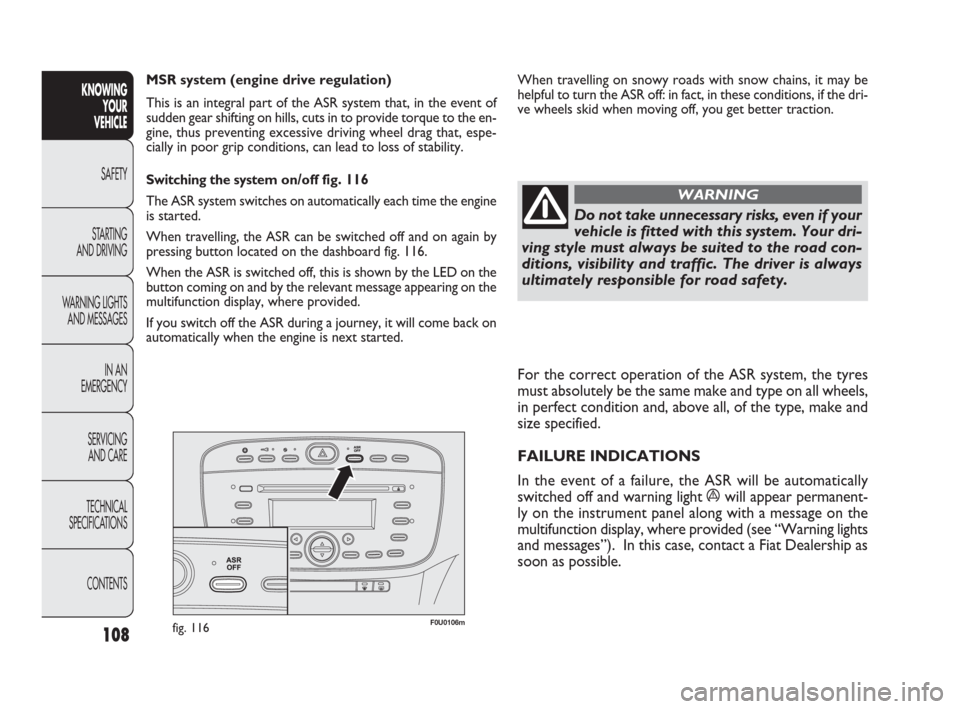
Switching the systemon/off fig. 116
The ASR system switches on automatically each time the engine
is started.
When travelling, the ASR can be switched off and on again by
pressing button located on the dashboard fig. 116.
When the ASR is switched off, this is shown by the LED on the
button coming on and by the relevant message appearing on the
multifunction display, where provided.
If you switch off the ASR during a journey, it will come back on
automatically when the engine is next started.
KNOWING
YOUR
VEHICLE
SAFETY
STARTING
AND DRIVING
WARNING LIGHTS
AND MESSAGES
IN AN
EMERGENCY
SERVICING
AND CARE
TECHNICAL
SPECIFICATIONS
CONTENTS
Do not take unnecessary risks, even if your
vehicle is fitted with this system. Your dri-
ving style must always be suited to the road con-
ditions, visibility and traffic. The driver is always
ultimately responsible for road safety.
WARNING
For the correct operation of the ASR system, the tyres
must absolutely be the same make and type on all wheels,
in perfect condition and, above all, of the type, make and
size specified.
FAILURE INDICATIONS
In the event of a failure, the ASR will be automatically
switched off and warning light áwill appear permanent-
ly on the instrument panel along with a message on the
multifunction display, where provided (see “Warning lights
and messages”). In this case, contact a Fiat Dealership as
soon as possible.
082-128 PUNTO FL EN 3ed 9-12-2009 13:43 Pagina 108
Page 110 of 270
109
EOBD SYSTEM
The EOBD system (European On Board Diagnosis) pro-
vides a continuous diagnosis of the car’s emission-related
components.
It also alerts the driver, by way of warning light Ulight-
ing up on the instrument panel (together with the relevant
message on the multifunction display, where provided) (see
section “Warning lights and messages”), when these com-
ponents are no longer in peak condition.
The goal of the system is to:
❒keep the system efficiency under control;
❒warn when a fault causes emissions levels to increase;
❒warn of the need to replace non-performing compo-
nents.
The system also has a connector that can be interfaced
with appropriate equipment, which makes it possible to
read the error codes stored in the control unit, together
with a series of specific parameters for engine operation
and diagnosis. This check can also be carried out by traf-
fic police.
IMPORTANT After eliminating the problem, to check the
system completely, Fiat Dealerships run a bench test and,
if necessary, road tests which may also call for a long jour-
ney.
KNOWING
YOUR
VEHICLE
SAFETY
STARTING
AND DRIVING
WARNING LIGHTS
AND MESSAGES
IN AN
EMERGENCY
SERVICING
AND CARE
TECHNICAL
SPECIFICATIONS
CONTENTS
Go to a Fiat Dealership as soon as possi-
ble if warning light
Ueither does not light
up when the key is turned to MAR or comes
on permanently or flashes while travelling (along
with a message on the multifunction display, where
provided). The operation of the
Uwarning light
may be checked by traffic police using appropriate
equipment. Respect the regulations in force in the
country where you are driving.
082-128 PUNTO FL EN 3ed 9-12-2009 13:43 Pagina 109
Page 122 of 270
121
The beeping:
❒increases as the distance between the car and the ob-
stacle decreases;
❒becomes continuous when the distance between the
car and the obstacle is less than around 30 cm and stops
immediately if the distance increases;
❒is constant if the distance is unvaried; if this situation oc-
curs for the side sensors, the beeping will stop after
about 3 seconds to avoid, for example, warning indica-
tions in the event of manoeuvres alongside walls.
Detection distances
If several obstacles are detected by the sensors, only the
nearest one is considered.
FAILURE INDICATIONS
See “Warning lights and messages” section.
OPERATION WITH TRAILER
The operation of the sensors is automatically deactivated
when the trailer electric plug is inserted in the car tow
hook socket.
The sensors are automatically enabled again when the trail-
er cable plug is removed.
When using special washing equipment such as high pres-
sure jets or steam cleaning, clean the sensors very quick-
ly keeping the jet more than 10 cm away.KNOWING
YOUR
VEHICLE
SAFETY
STARTING
AND DRIVING
WARNING LIGHTS
AND MESSAGES
IN AN
EMERGENCY
SERVICING
AND CARE
TECHNICAL
SPECIFICATIONS
CONTENTS
The driver always has ultimate responsi-
bility for parking and other dangerous ma-
noeuvres. When parking, make sure that no-one
is standing in the area, especially children or an-
imals. The parking sensors are designed to assist
drivers: in all cases, you must always pay the ut-
most attention during potentially dangerous ma-
noeuvres, even when carried out at low speed.
WARNING
The sensor must be clean of mud, dirt, snow
or ice in order for the system to work. Be
careful not to scratch or damage the sen-
sors while cleaning them. Avoid using dry, rough or
hard cloths. The sensors should be washed with
clean water, possibly with some car shampoo.
082-128 PUNTO FL EN 3ed 9-12-2009 13:43 Pagina 121
Page 124 of 270
123
CD CHANGER CAPABILITY
(for versions/markets where provided)
The system consists of:
❒power cables
❒connection cables. ❒2 mid-woofers on front doors (165 mm diameter, 40W
max power each);
❒2 full-range speakers on rear doors and rear valance
panels (130 mm diameter, 40W max power each);
❒radio aerial wire;
❒aerial.
Sound system installation
The sound system must be installed in the place occupied
by the central oddments compartment, where you will find
the wiring.
To extract the compartment, press in the points shown in
the diagram corresponding to the retainer systems.KNOWING
YOUR
VEHICLE
SAFETY
STARTING
AND DRIVING
WARNING LIGHTS
AND MESSAGES
IN AN
EMERGENCY
SERVICING
AND CARE
TECHNICAL
SPECIFICATIONS
CONTENTS
For connection to the preset cables, con-
tact a Fiat Dealership to prevent any prob-
lem that could impair car safety.
WARNING
For connection to the preset cables, con-
tact a Fiat Dealership to prevent any prob-
lem that could impair car safety.
WARNING
082-128 PUNTO FL EN 3ed 9-12-2009 13:43 Pagina 123
Page 133 of 270
132
F0U0115mfig. 132F0U0116mfig. 133
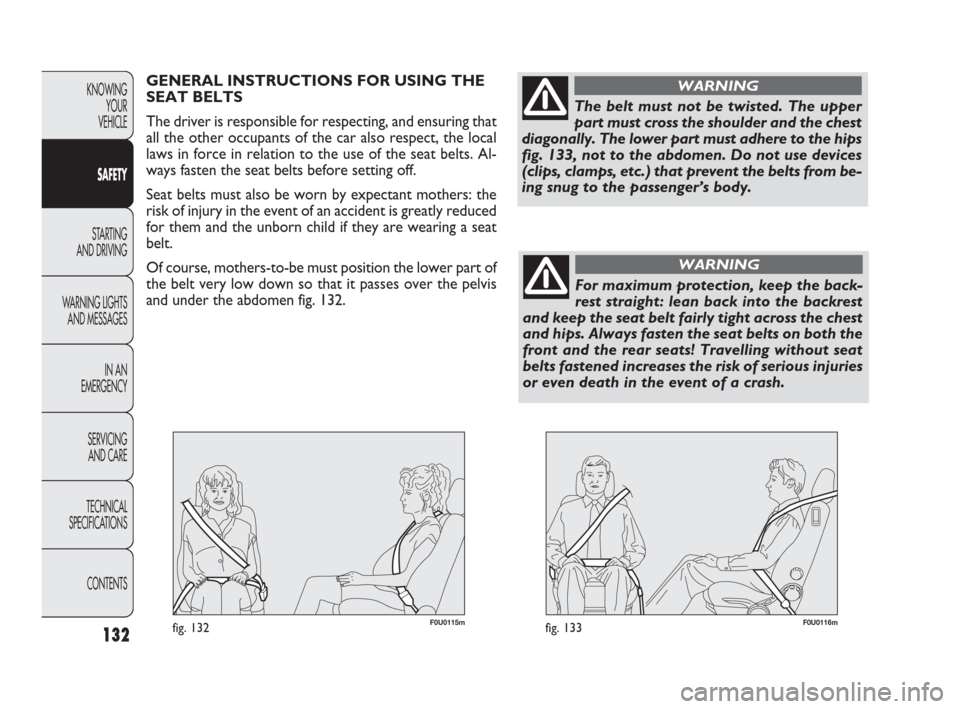
GENERAL INSTRUCTIONS FOR USING THE
SEAT BELTS
The driver is responsible for respecting, and ensuring that
all the other occupants of the car also respect, the local
laws in force in relation to the use of the seat belts. Al-
ways fasten the seat belts before setting off.
Seat belts must also be worn by expectant mothers: the
risk of injury in the event of an accident is greatly reduced
for them and the unborn child if they are wearing a seat
belt.
Of course, mothers-to-be must position the lower part of
the belt very low down so that it passes over the pelvis
and under the abdomen fig. 132.KNOWING
YOUR
VEHICLE
SAFETY
STARTING
AND DRIVING
WARNING LIGHTS
AND MESSAGES
IN AN
EMERGENCY
SERVICING
AND CARE
TECHNICAL
SPECIFICATIONS
CONTENTS
The belt must not be twisted. The upper
part must cross the shoulder and the chest
diagonally. The lower part must adhere to the hips
fig. 133, not to the abdomen. Do not use devices
(clips, clamps, etc.) that prevent the belts from be-
ing snug to the passenger’s body.
WARNING
For maximum protection, keep the back-
rest straight: lean back into the backrest
and keep the seat belt fairly tight across the chest
and hips. Always fasten the seat belts on both the
front and the rear seats! Travelling without seat
belts fastened increases the risk of serious injuries
or even death in the event of a crash.
WARNING
129-148 PUNTO FL EN 3ed 9-12-2009 13:39 Pagina 132
Page 142 of 270
141
Front airbags may not be activated in the following situa-
tions:
❒in collisions against very strangely shaped objects that
do not affect the front surface of the car (e.g. mudguard
collision against guard rail, piles of gravel etc.);
❒jamming of the car underneath other vehicles or pro-
tective barriers (e.g. underneath a truck or a guard rail);
in this case, the bags would offer no additional pro-
tection with respect to the seat belt and their deploy-
ment is unnecessary. In these cases, non-deployment
of the airbag does not necessarily indicate a system mal-
function.FRONT AIRBAGS
The car is fitted with front airbags for the driver and the
passenger, and with a knee bag on the driver’s side (where
provided).
The front driver/passenger airbags and the driver’s knee
bag (where provided) have been designed to protect the
occupants in the event of head-on crashes of medium/high
severity, by placing the cushion between the occupant and
the steering wheel or dashboard.
Non-activation in other types of crash (side-on collisions,
rear shunts, roll-overs, etc.) is therefore not a sign of sys-
tem malfunction.
An electronic control unit causes the bag to inflate, if nec-
essary, in the event of a head-on crash. The bag will inflate
instantaneously, placing itself between the front occupant’s
body and the structures which could cause injury. It will
deflate immediately afterwards.
The front driver/passenger airbags and the driver’s knee
bag (where provided) are not a replacement for, but rather
complement the use of, belts, which should always be
worn, as specified by law in Europe and most non-Euro-
pean countries.
The volume of the front airbags at maximum inflation fills
most of the space between the steering wheel and the dri-
ver and between the dashboard and the passenger.
In the event of an impact, someone not wearing a seat belt
could move forward and come into contact with a bag
which is still in the opening phase. The protection offered
by the bag is reduced in such a case.
KNOWING
YOUR
VEHICLE
SAFETY
STARTING
AND DRIVING
WARNING LIGHTS
AND MESSAGES
IN AN
EMERGENCY
SERVICING
AND CARE
TECHNICAL
SPECIFICATIONS
CONTENTS
Do not apply stickers or other objects on
the steering wheel, passenger side airbag
cover or upper side upholstery. Do not place ob-
jects (e.g. mobile phones) on the passenger side
dashboard because these could interfere with the
correct opening of the airbag and cause severe in-
jury to occupants.
WARNING
The airbags are not deployed in the event of minor colli-
sions (for which the withholding action of the seat belts is
sufficient). For this reason, the seat belt must be worn at
all times. In the case of side-on collisions, the seat belts hold
occupants in the correct position and prevent them from
being thrown out of the car by a very violent impact.
129-148 PUNTO FL EN 3ed 9-12-2009 13:40 Pagina 141
Page 155 of 270
154
KNOWING
YOUR
VEHICLE
SAFETY
STARTING
AND DRIVING
WARNING LIGHTS
AND MESSAGES
IN AN
EMERGENCY
SERVICING
AND CARE
TECHNICAL
SPECIFICATIONS
CONTENTS
SAVING FUEL
Here are some suggestions which may help you to save fu-
el and reduce the amount of toxic emissions released in-
to the atmosphere.
GENERAL CONSIDERATIONS
Car maintenance
Have checks and adjustments carried out in accordance
with the “Scheduled Servicing Plan”.
Tyres
Check the tyre pressures at least once every 4 weeks: if
the pressure is too low, consumption levels increase as re-
sistance to rolling is higher.
Unnecessary loads
Do not travel with an overloaded boot. The weight of
the car (especially when driving in town) and its arrange-
ment greatly affect fuel consumption and stability.
Roof rack/ski rack
Remove the roof rack or ski rack from the roof after use.
These accessories decrease aerodynamic penetration and
have a negative effect on fuel consumption. It is better to
use a trailer to transport particularly bulky objects.Electrical devices
Use electrical devices only for the amount of time need-
ed. The heated rear window, auxiliary headlights, wind-
screen wipers and fan heater use up a considerable amount
of current, causing increased fuel consumption (up to
+25% in the urban cycle).
Air conditioning
Air conditioning leads to higher fuel consumption (on av-
erage up to +20%). If the temperature outside is not too
extreme, try and use the air vents.
Spoilers
The use of non-certified spoilers may adversely affect aero-
dynamics and fuel consumption.
DRIVING STYLE
Starting
Do not warm up the engine at low or high revs when the
vehicle is stationary; this causes the engine to warm up more
slowly, thereby increasing fuel consumption and emissions.
It is advisable to set off immediately and slowly, avoiding high
revs: this allows the engine to warm up more quickly.
Unnecessary actions
Avoid revving up when stationary at traffic lights or before
stopping the engine. The latter action, like double de-
clutching, is entirely unnecessary and causes increased fu-
el consumption and pollution.
149-160 PUNTO FL EN 3ed 9-12-2009 13:41 Pagina 154
Page 157 of 270
156
TOWING TRAILERS
IMPORTANT NOTES
The car must be equipped with an approved tow hook and
adequate electrical system to tow caravans or trailers. In-
stallation must be performed by specialised personnel who
will issue the required papers for travelling on roads.
Install any specific and/or additional rear-view mirrors in
accordance with the highway code of the country in which
you are travelling.
Remember that, when towing a trailer, steep hills are hard-
er to climb, braking distances increase and overtaking takes
longer relative to the overall weight of the trailer.
Engage a low gear when driving downhill, rather than con-
stantly using the brake.
The weight of the trailer on the car’s tow hook will re-
duce the load capacity of the car by the same amount. Con-
sider the weight of the trailer fully laden, including acces-
sories and luggage, to make sure you do not exceed the
maximum towable weight (shown on the vehicle regis-
tration document).
Respect each country’s speed limits for vehicles towing
trailers. The top speed must not exceed 100 km/h at any
time.
You should fit a suitable stabiliser to the trailer.
KNOWING
YOUR
VEHICLE
SAFETY
STARTING
AND DRIVING
WARNING LIGHTS
AND MESSAGES
IN AN
EMERGENCY
SERVICING
AND CARE
TECHNICAL
SPECIFICATIONS
CONTENTS
The ABS with which the car may be
equipped will not control the braking sys-
tem of the trailer. Particular caution is therefore
required on slippery roads.
WARNING
Never modify the braking system of the
car to control the trailer brake. The trail-
er braking system must be fully independent from
the hydraulic system of the car.
WARNING
149-160 PUNTO FL EN 3ed 9-12-2009 13:41 Pagina 156
Page 160 of 270
159
KNOWING
YOUR
VEHICLE
SAFETY
STARTING
AND DRIVING
WARNING LIGHTS
AND MESSAGES
IN AN
EMERGENCY
SERVICING
AND CARE
TECHNICAL
SPECIFICATIONS
CONTENTS
SNOW TYRES
Use snow tyres of the same size as the normal tyres pro-
vided with the car.
A Fiat Dealership will be happy to provide advice con-
cerning the most suitable type of tyre for the customer’s
requirements.
For the type, pressures and specifications of the snow tyre
to be used, follow carefully the instructions given in the
“Wheels” paragraph of the “Technical specifications” sec-
tion.
The performance of these tyres is considerably reduced
when the tread depth is less than 4 mm. If this is the case,
replace them.
Due to their specific features, the performance of snow
tyres is much lower than that of standard tyres in normal
conditions or on long motorway stretches. You should
therefore use them only in the conditions for which they
were designed.
IMPORTANT When using snow tyres with a maximum
speed index below the one that can be reached by the
car (increased by 5%), place a notice in the passenger com-
partment, plainly in view, which states the maximum speed
allowed by the snow tyres (as per EC Directive).
All four tyres should be the same (brand and profile) to
ensure greater safety when driving and braking as well as
making the car more responsive.
Remember that you should not change the rotation di-
rection of the tyres.
SNOW CHAINS
The use of snow chains should be in compliance with lo-
cal regulations. Snow chains may be fitted only to the front
wheel tyres (drive wheels). Use of Lineaccessori Fiat snow
chains is recommended. Check the tension of the chains
after the first few metres have been driven.
IMPORTANT When the snow chains are on, use the ac-
celerator with extreme care to prevent, or to limit as much
as possible, the driving wheels from skidding. This could
cause the chains to break, resulting in damage to the ve-
hicle body or mechanical components.
IMPORTANT Snow chains can only be fitted on 15”
tyres. Use compact 9-mm snow chains.
The maximum speed for snow tyres
marked “Q” is 160 km/h, while it is 190
km/h for “T” tyres and 210 km/h for “H” tyres.
You should, however, always stick to the speed
limits of the highway code.
WARNING
149-160 PUNTO FL EN 3ed 9-12-2009 13:41 Pagina 159