Window FIAT PUNTO EVO 2010 1.G Owner's Manual
[x] Cancel search | Manufacturer: FIAT, Model Year: 2010, Model line: PUNTO EVO, Model: FIAT PUNTO EVO 2010 1.GPages: 270, PDF Size: 8.34 MB
Page 146 of 270
145
KNOWING
YOUR
VEHICLE
SAFETY
STARTING
AND DRIVING
WARNING LIGHTS
AND MESSAGES
IN AN
EMERGENCY
SERVICING
AND CARE
TECHNICAL
SPECIFICATIONS
CONTENTS
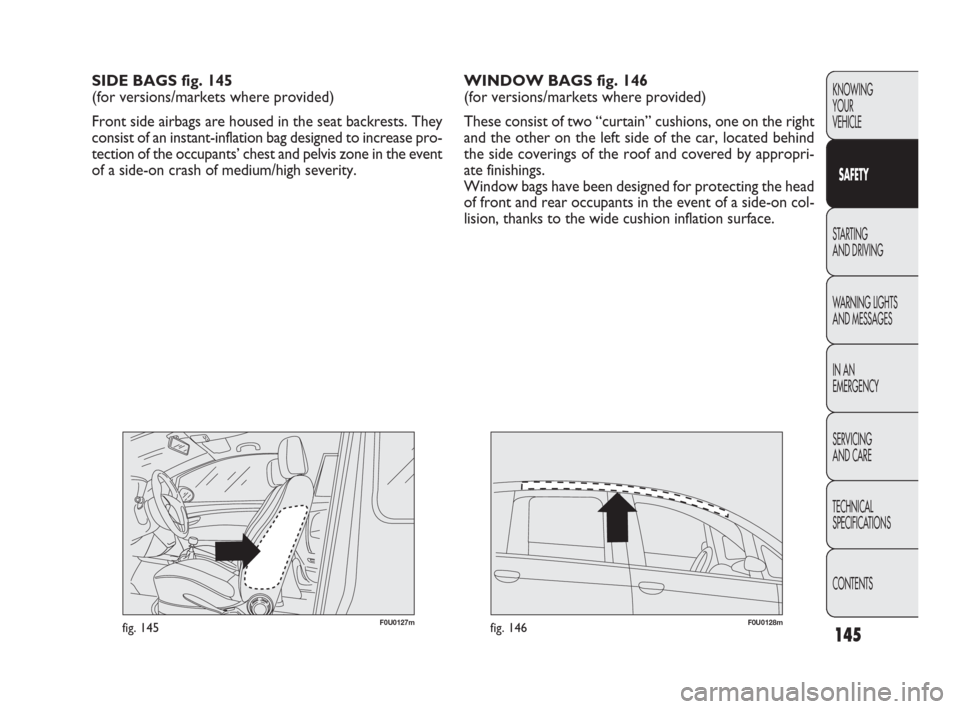
WINDOW BAGS fig. 146
(for versions/markets where provided)
These consist of two “curtain” cushions, one on the right
and the other on the left side of the car, located behind
the side coverings of the roof and covered by appropri-
ate finishings.
Window bags have been designed for protecting the head
of front and rear occupants in the event of a side-on col-
lision, thanks to the wide cushion inflation surface.
F0U0127mfig. 145
SIDE BAGS fig. 145
(for versions/markets where provided)
Front side airbags are housed in the seat backrests. They
consist of an instant-inflation bag designed to increase pro-
tection of the occupants’ chest and pelvis zone in the event
of a side-on crash of medium/high severity.
F0U0128mfig. 146
129-148 PUNTO FL EN 4ed 18-01-2010 12:26 Pagina 145
Page 148 of 270
147
KNOWING
YOUR
VEHICLE
SAFETY
STARTING
AND DRIVING
WARNING LIGHTS
AND MESSAGES
IN AN
EMERGENCY
SERVICING
AND CARE
TECHNICAL
SPECIFICATIONS
CONTENTS
Do not rest your head, arms or elbows on
the doors, windows or window bag de-
ployment area as you could be injured during the
inflation phase.
WARNING
Never lean you head, arms or elbows out
of the window.
WARNING
Do not cover the front seat backrest with
sheets or covers that are not compatible
with side bags.
WARNING
If, when turning the key to MAR, the warn-
ing light
¬does not turn on or if it stays
on when travelling (together with the message on
the multifunction display, where provided), there
could be a failure in the safety systems; if this is
the case, the airbags or pretensioners may not trig-
ger in the event of an accident or, in a minor num-
ber of cases, they could activate incorrectly. Con-
tact a Fiat Dealership immediately to have the
system checked before driving off.
WARNING
GENERAL WARNINGS
Do not travel with objects in your lap,
in front of your chest, or between your lips
(pipes, pencils, etc.). In the event of a crash when
the airbag is deployed, you may be seriously in-
jured.
WARNING
Always drive keeping your hands on the
steering wheel rim so that, in the event of
airbag activation, it can inflate without obstruc-
tion. Do not drive with your body slouched for-
wards; keep the backrest upright and lean back
into it.
WARNING
129-148 PUNTO FL EN 4ed 18-01-2010 12:26 Pagina 147
Page 155 of 270
154
KNOWING
YOUR
VEHICLE
SAFETY
STARTING
AND DRIVING
WARNING LIGHTS
AND MESSAGES
IN AN
EMERGENCY
SERVICING
AND CARE
TECHNICAL
SPECIFICATIONS
CONTENTS
SAVING FUEL
Here are some suggestions which may help you to save fu-
el and reduce the amount of toxic emissions released in-
to the atmosphere.
GENERAL CONSIDERATIONS
Car maintenance
Have checks and adjustments carried out in accordance
with the “Scheduled Servicing Plan”.
Tyres
Check the tyre pressures at least once every 4 weeks: if
the pressure is too low, consumption levels increase as re-
sistance to rolling is higher.
Unnecessary loads
Do not travel with an overloaded boot. The weight of
the car (especially when driving in town) and its arrange-
ment greatly affect fuel consumption and stability.
Roof rack/ski rack
Remove the roof rack or ski rack from the roof after use.
These accessories decrease aerodynamic penetration and
have a negative effect on fuel consumption. It is better to
use a trailer to transport particularly bulky objects.Electrical devices
Use electrical devices only for the amount of time need-
ed. The heated rear window, auxiliary headlights, wind-
screen wipers and fan heater use up a considerable amount
of current, causing increased fuel consumption (up to
+25% in the urban cycle).
Air conditioning
Air conditioning leads to higher fuel consumption (on av-
erage up to +20%). If the temperature outside is not too
extreme, try and use the air vents.
Spoilers
The use of non-certified spoilers may adversely affect aero-
dynamics and fuel consumption.
DRIVING STYLE
Starting
Do not warm up the engine at low or high revs when the
vehicle is stationary; this causes the engine to warm up more
slowly, thereby increasing fuel consumption and emissions.
It is advisable to set off immediately and slowly, avoiding high
revs: this allows the engine to warm up more quickly.
Unnecessary actions
Avoid revving up when stationary at traffic lights or before
stopping the engine. The latter action, like double de-
clutching, is entirely unnecessary and causes increased fu-
el consumption and pollution.
149-160 PUNTO FL EN 4ed 20-01-2010 14:37 Pagina 154
Page 161 of 270
❒clean and protect the painted parts using protective
wax;
❒clean and protect the shiny metal parts using special
compounds readily available;
❒sprinkle talcum powder on the rubber windscreen
and rear window wiper blades and lift them off the
glass;
❒open the windows slightly;
❒cover the car with a fabric or perforated plastic sheet.
Do not use compact plastic sheets which do not allow
humidity to evaporate from the surface of the car;
❒inflate tyres to a pressure of +0.5 bar above the nor-
mal specified pressure and check regularly;
❒if you don’t disconnect the battery from the electrical
system, check its charge every month and recharge it
if the indicator shows a dark colour without the cen-
tral green area;
❒do not drain the engine cooling system.
IMPORTANT Where relevant, switch off the car alarm
with the remote control.
CAR INACTIVITY
If the car is to be left inactive for longer than a month,
the following precautions should be observed:
❒park the car in covered, dry and, if possible, well-ven-
tilated premises;
❒engage a gear;
❒check that the handbrake is engaged;
❒disconnect the clip for the negative battery terminal
and check battery charge. Repeat this check once
every three months during storage. Recharge the
battery if the indicator is dark and the middle area is
not green;
160
KNOWING
YOUR
VEHICLE
SAFETY
STARTING
AND DRIVING
WARNING LIGHTS
AND MESSAGES
IN AN
EMERGENCY
SERVICING
AND CARE
TECHNICAL
SPECIFICATIONS
CONTENTS
16” and 17” tyres cannot be fitted with
chains.
WARNING
Keep your speed down when snow chains
are fitted: do not exceed 50 km/h. Avoid
potholes, steps and pavements, and do
not drive for long distances on roads not
covered with snow to prevent damaging
the car and the road surface.
WARNING
149-160 PUNTO FL EN 4ed 20-01-2010 14:37 Pagina 160
Page 204 of 270
203
KNOWING
YOUR
VEHICLE
SAFETY
STARTING
AND DRIVING
WARNING LIGHTS
AND MESSAGES
IN AN
EMERGENCY
SERVICING
AND CARE
TECHNICAL
SPECIFICATIONS
CONTENTS
7.5
7.5
5
5
10
5
20
20
20
20
5
5
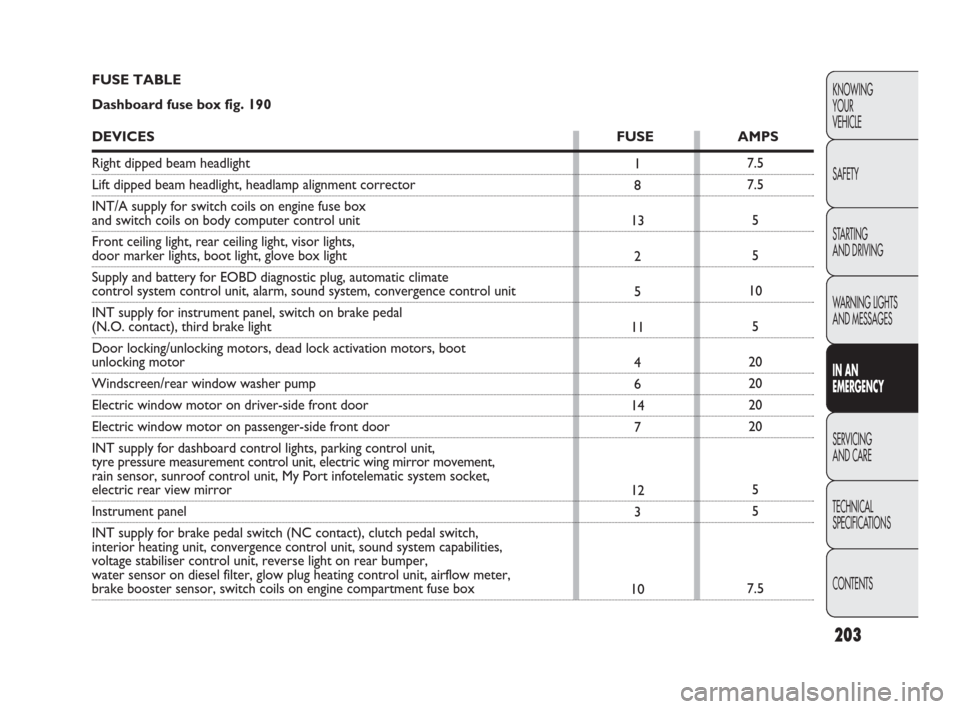
7.5 1
8
13
2
5
11
4
6
14
7
12
3
10
FUSE TABLE
Dashboard fuse box fig. 190
DEVICESFUSE AMPS
Right dipped beam headlight
Lift dipped beam headlight, headlamp alignment corrector
INT/A supply for switch coils on engine fuse box
and switch coils on body computer control unit
Front ceiling light, rear ceiling light, visor lights,
door marker lights, boot light, glove box light
Supply and battery for EOBD diagnostic plug, automatic climate
control system control unit, alarm, sound system, convergence control unit
INT supply for instrument panel, switch on brake pedal
(N.O. contact), third brake light
Door locking/unlocking motors, dead lock activation motors, boot
unlocking motor
Windscreen/rear window washer pump
Electric window motor on driver-side front door
Electric window motor on passenger-side front door
INT supply for dashboard control lights, parking control unit,
tyre pressure measurement control unit, electric wing mirror movement,
rain sensor, sunroof control unit, My Port infotelematic system socket,
electric rear view mirror
Instrument panel
INT supply for brake pedal switch (NC contact), clutch pedal switch,
interior heating unit, convergence control unit, sound system capabilities,
voltage stabiliser control unit, reverse light on rear bumper,
water sensor on diesel filter, glow plug heating control unit, airflow meter,
brake booster sensor, switch coils on engine compartment fuse box
175-210 PUNTO FL EN 4ed 20-01-2010 15:09 Pagina 203
Page 205 of 270
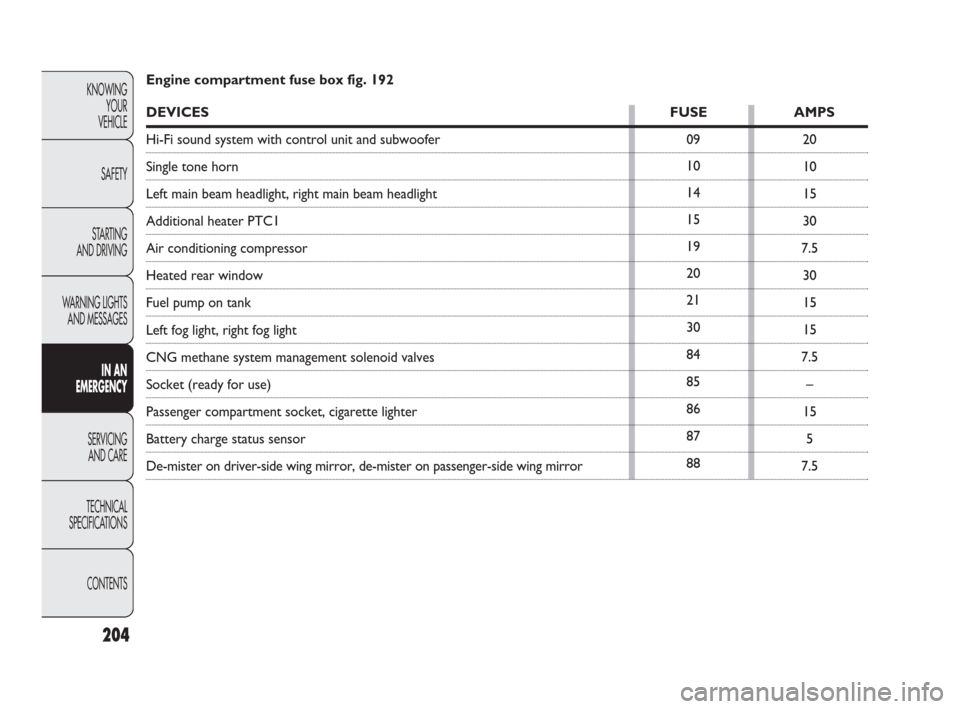
09
10
14
15
19
20
21
30
84
85
86
87
8820
10
15
30
7.5
30
15
15
7.5
–
15
5
7.5
204
KNOWING
YOUR
VEHICLE
SAFETY
STARTING
AND DRIVING
WARNING LIGHTS
AND MESSAGES
IN AN
EMERGENCY
SERVICING
AND CARE
TECHNICAL
SPECIFICATIONS
CONTENTS
Engine compartment fuse box fig. 192
DEVICESFUSE AMPS
Hi-Fi sound system with control unit and subwoofer
Single tone horn
Left main beam headlight, right main beam headlight
Additional heater PTC1
Air conditioning compressor
Heated rear window
Fuel pump on tank
Left fog light, right fog light
CNG methane system management solenoid valves
Socket (ready for use)
Passenger compartment socket, cigarette lighter
Battery charge status sensor
De-mister on driver-side wing mirror, de-mister on passenger-side wing mirror
175-210 PUNTO FL EN 4ed 20-01-2010 15:09 Pagina 204
Page 206 of 270
205
KNOWING
YOUR
VEHICLE
SAFETY
STARTING
AND DRIVING
WARNING LIGHTS
AND MESSAGES
IN AN
EMERGENCY
SERVICING
AND CARE
TECHNICAL
SPECIFICATIONS
CONTENTS
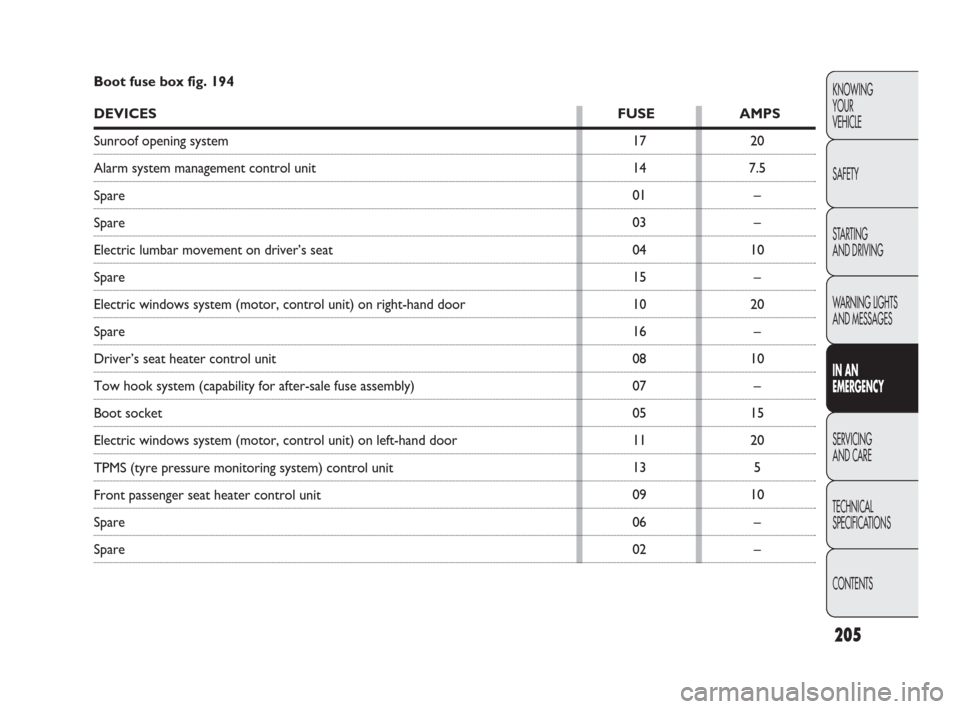
17
14
01
03
04
15
10
16
08
07
05
11
13
09
06
0220
7.5
–
–
10
–
20
–
10
–
15
20
5
10
–
– Boot fuse box fig. 194
DEVICESFUSE AMPS
Sunroof opening system
Alarm system management control unit
Spare
Spare
Electric lumbar movement on driver’s seat
Spare
Electric windows system (motor, control unit) on right-hand door
Spare
Driver’s seat heater control unit
Tow hook system (capability for after-sale fuse assembly)
Boot socket
Electric windows system (motor, control unit) on left-hand door
TPMS (tyre pressure monitoring system) control unit
Front passenger seat heater control unit
Spare
Spare
175-210 PUNTO FL EN 4ed 20-01-2010 15:10 Pagina 205
Page 213 of 270
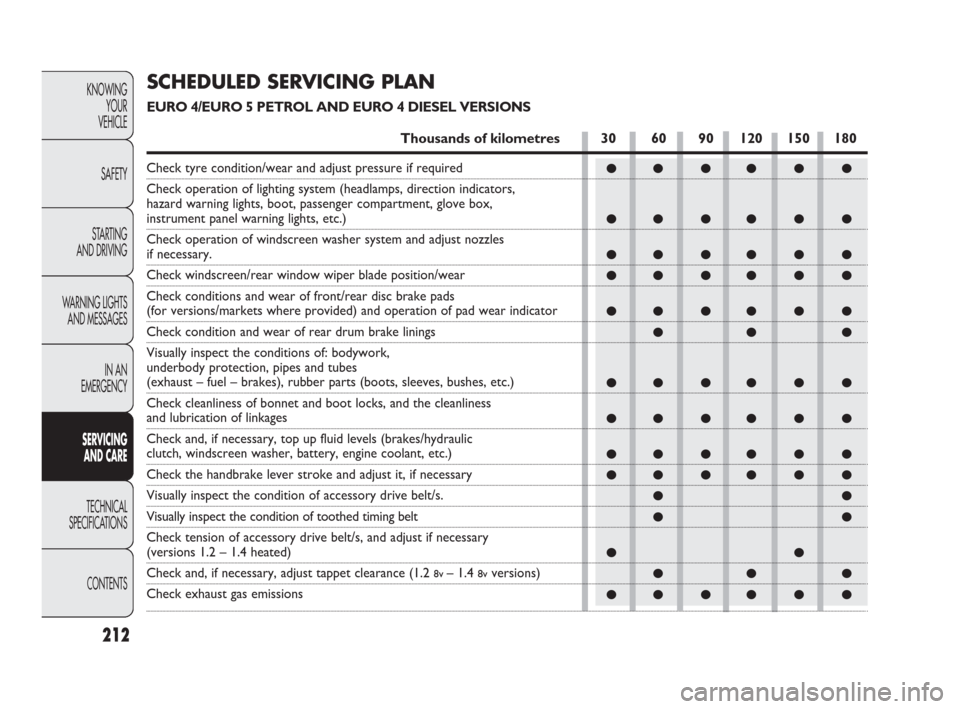
●● ●● ● ●
●● ●● ● ●
●● ●● ● ●
●● ●● ● ●
●● ●● ● ●
●● ●
●● ●● ● ●
●● ●● ● ●
●● ●● ● ●
●● ●● ● ●
●●
●●
●●
●● ●
●● ●● ● ●
212
KNOWING
YOUR
VEHICLE
SAFETY
STARTING
AND DRIVING
WARNING LIGHTS
AND MESSAGES
IN AN
EMERGENCY
SERVICING
AND CARE
TECHNICAL
SPECIFICATIONS
CONTENTS
SCHEDULED SERVICING PLAN
EURO 4/EURO 5 PETROL AND EURO 4 DIESEL VERSIONS
Thousands of kilometres 30 60 90 120 150 180
Check tyre condition/wear and adjust pressure if required
Check operation of lighting system (headlamps, direction indicators,
hazard warning lights, boot, passenger compartment, glove box,
instrument panel warning lights, etc.)
Check operation of windscreen washer system and adjust nozzles
if necessary.
Check windscreen/rear window wiper blade position/wear
Check conditions and wear of front/rear disc brake pads
(for versions/markets where provided) and operation of pad wear indicator
Check condition and wear of rear drum brake linings
Visually inspect the conditions of: bodywork,
underbody protection, pipes and tubes
(exhaust – fuel – brakes), rubber parts (boots, sleeves, bushes, etc.)
Check cleanliness of bonnet and boot locks, and the cleanliness
and lubrication of linkages
Check and, if necessary, top up fluid levels (brakes/hydraulic
clutch, windscreen washer, battery, engine coolant, etc.)
Check the handbrake lever stroke and adjust it, if necessary
Visually inspect the condition of accessory drive belt/s.
Visually inspect the condition of toothed timing belt
Check tension of accessory drive belt/s, and adjust if necessary
(versions 1.2 – 1.4 heated)
Check and, if necessary, adjust tappet clearance (1.2 8v – 1.4 8vversions)
Check exhaust gas emissions
211-234 PUNTO FL EN 4ed 18-01-2010 12:27 Pagina 212
Page 215 of 270
214
KNOWING
YOUR
VEHICLE
SAFETY
STARTING
AND DRIVING
WARNING LIGHTS
AND MESSAGES
IN AN
EMERGENCY
SERVICING
AND CARE
TECHNICAL
SPECIFICATIONS
CONTENTS
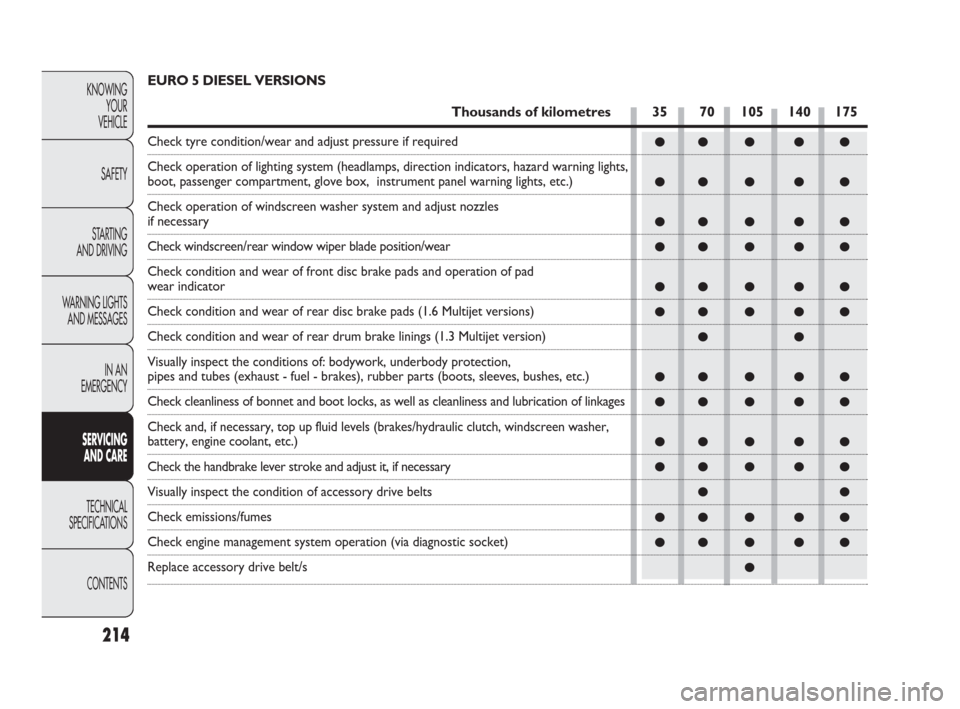
●● ● ● ●
●● ● ● ●
●● ● ● ●
●● ● ● ●
●● ● ● ●
●● ● ● ●
●●
●● ● ● ●
●● ● ● ●
●● ● ● ●
●● ● ● ●
●●
●● ● ● ●
●● ● ● ●
●
EURO 5 DIESEL VERSIONS
Thousands of kilometres 35 70 105 140 175
Check tyre condition/wear and adjust pressure if required
Check operation of lighting system (headlamps, direction indicators, hazard warning lights,
boot, passenger compartment, glove box, instrument panel warning lights, etc.)
Check operation of windscreen washer system and adjust nozzles
if necessary
Check windscreen/rear window wiper blade position/wear
Check condition and wear of front disc brake pads and operation of pad
wear indicator
Check condition and wear of rear disc brake pads (1.6 Multijet versions)
Check condition and wear of rear drum brake linings (1.3 Multijet version)
Visually inspect the conditions of: bodywork, underbody protection,
pipes and tubes (exhaust - fuel - brakes), rubber parts (boots, sleeves, bushes, etc.)
Check cleanliness of bonnet and boot locks, as well as cleanliness and lubrication of linkages
Check and, if necessary, top up fluid levels (brakes/hydraulic clutch, windscreen washer,
battery, engine coolant, etc.)
Check the handbrake lever stroke and adjust it, if necessary
Visually inspect the condition of accessory drive belts
Check emissions/fumes
Check engine management system operation (via diagnostic socket)
Replace accessory drive belt/s
211-234 PUNTO FL EN 4ed 18-01-2010 12:27 Pagina 214
Page 217 of 270
216
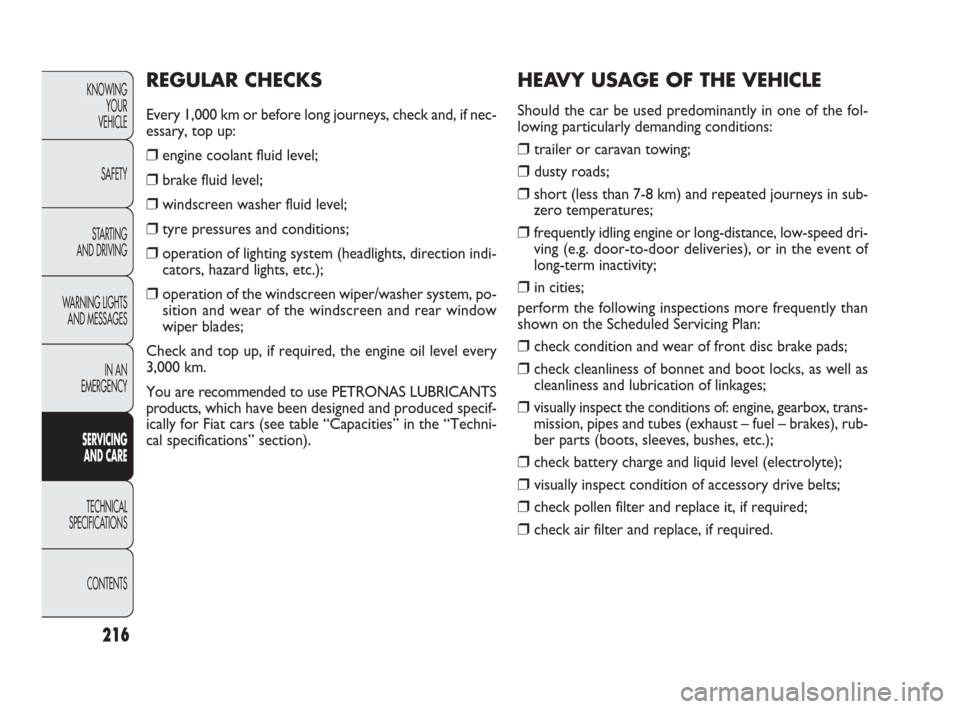
HEAVY USAGE OF THE VEHICLE
Should the car be used predominantly in one of the fol-
lowing particularly demanding conditions:
❒ trailer or caravan towing;
❒ dusty roads;
❒short (less than 7-8 km) and repeated journeys in sub-
zero temperatures;
❒frequently idling engine or long-distance, low-speed dri-
ving (e.g. door-to-door deliveries), or in the event of
long-term inactivity;
❒ in cities;
perform the following inspections more frequently than
shown on the Scheduled Servicing Plan:
❒ check condition and wear of front disc brake pads;
❒check cleanliness of bonnet and boot locks, as well as
cleanliness and lubrication of linkages;
❒visually inspect the conditions of: engine, gearbox, trans-
mission, pipes and tubes (exhaust – fuel – brakes), rub-
ber parts (boots, sleeves, bushes, etc.);
❒check battery charge and liquid level (electrolyte);
❒ visually inspect condition of accessory drive belts;
❒ check pollen filter and replace it, if required;
❒ check air filter and replace, if required.
REGULAR CHECKS
Every 1,000 km or before long journeys, check and, if nec-
essary, top up:
❒engine coolant fluid level;
❒brake fluid level;
❒windscreen washer fluid level;
❒tyre pressures and conditions;
❒operation of lighting system (headlights, direction indi-
cators, hazard lights, etc.);
❒operation of the windscreen wiper/washer system, po-
sition and wear of the windscreen and rear window
wiper blades;
Check and top up, if required, the engine oil level every
3,000 km.
You are recommended to use PETRONAS LUBRICANTS
products, which have been designed and produced specif-
ically for Fiat cars (see table “Capacities” in the “Techni-
cal specifications” section).
KNOWING
YOUR
VEHICLE
SAFETY
STARTING
AND DRIVING
WARNING LIGHTS
AND MESSAGES
IN AN
EMERGENCY
SERVICING
AND CARE
TECHNICAL
SPECIFICATIONS
CONTENTS
211-234 PUNTO FL EN 4ed 18-01-2010 12:27 Pagina 216