brake light FIAT QUBO 2010 1.G Owner's Manual
[x] Cancel search | Manufacturer: FIAT, Model Year: 2010, Model line: QUBO, Model: FIAT QUBO 2010 1.GPages: 230, PDF Size: 4.38 MB
Page 162 of 230
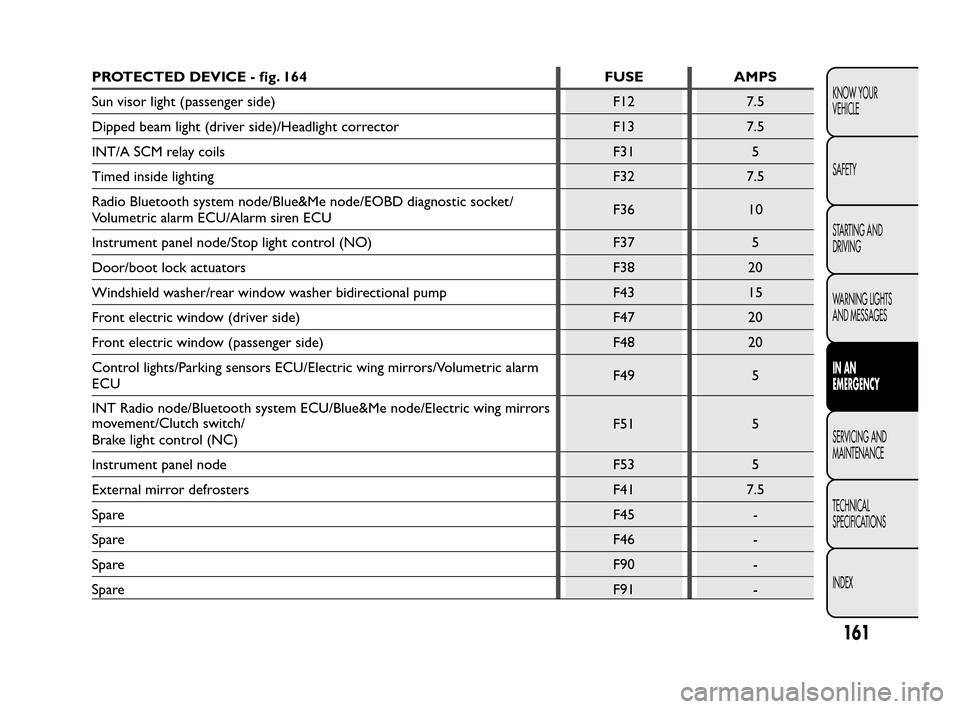
PROTECTED DEVICE - fig. 164 FUSE AMPS
Sun visor light (passenger side) F12 7.5
Dipped beam light (driver side)/Headlight corrector F13 7.5
INT/A SCM relay coils F31 5
Timed inside lighting F32 7.5
Radio Bluetooth system node/Blue&Me node/EOBD diagnostic socket/
Volumetric alarm ECU/Alarm siren ECUF36 10
Instrument panel node/Stop light control (NO) F37 5
Door/boot lock actuators F38 20
Windshield washer/rear window washer bidirectional pump F43 15
Front electric window (driver side) F47 20
Front electric window (passenger side) F48 20
Control lights/Parking sensors ECU/Electric wing mirrors/Volumetric alarm
ECUF49 5
INT Radio node/Bluetooth system ECU/Blue&Me node/Electric wing mirrors
movement/Clutch switch/
Brake light control (NC)F51 5
Instrument panel node F53 5
External mirror defrosters F41 7.5
SpareF45 -
SpareF46 -
SpareF90 -
SpareF91 -
161
KNOW YOUR
VEHICLE
SAFETY
STARTING AND
DRIVING
WARNING LIGHTS
AND MESSAGES
IN AN
EMERGENCY
SERVICING AND
MAINTENANCE
TECHNICAL
SPECIFICA
TIONS
INDEX
Page 166 of 230
WARNING
Before towing, turn the ignition key to
M
ARandthentoSTOPwithout
extracting it .The steering column will
automatically lock when the key is removed and
the wheels cannot be steered.
WARNING
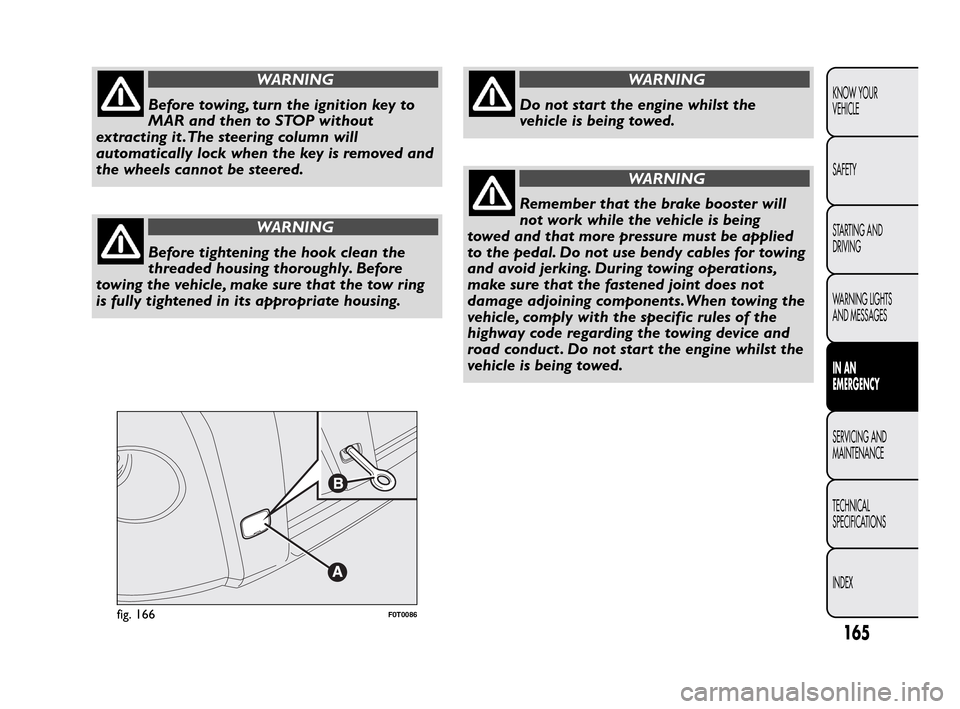
Before tightening the hook clean the
t
hreaded housing thoroughly. Before
towing the vehicle, make sure that the tow ring
is fully tightened in its appropriate housing.
WARNING
Do not start the engine whilst the
v
ehicle is being towed.
WARNING
Remember that the brake booster will
n
ot work while the vehicle is being
towed and that more pressure must be applied
to the pedal. Do not use bendy cables for towing
and avoid jerking. During towing operations,
make sure that the fastened joint does not
damage adjoining components.When towing the
vehicle, comply with the specific rules of the
highway code regarding the towing device and
road conduct . Do not start the engine whilst the
vehicle is being towed.
fig. 166F0T0086
165
KNOW YOUR
VEHICLE
SAFETY
STARTING AND
DRIVING
WARNING LIGHTS
AND MESSAGES
IN AN
EMERGENCY
SERVICING AND
MAINTENANCE
TECHNICAL
SPECIFICA
TIONS
INDEX
Page 169 of 230
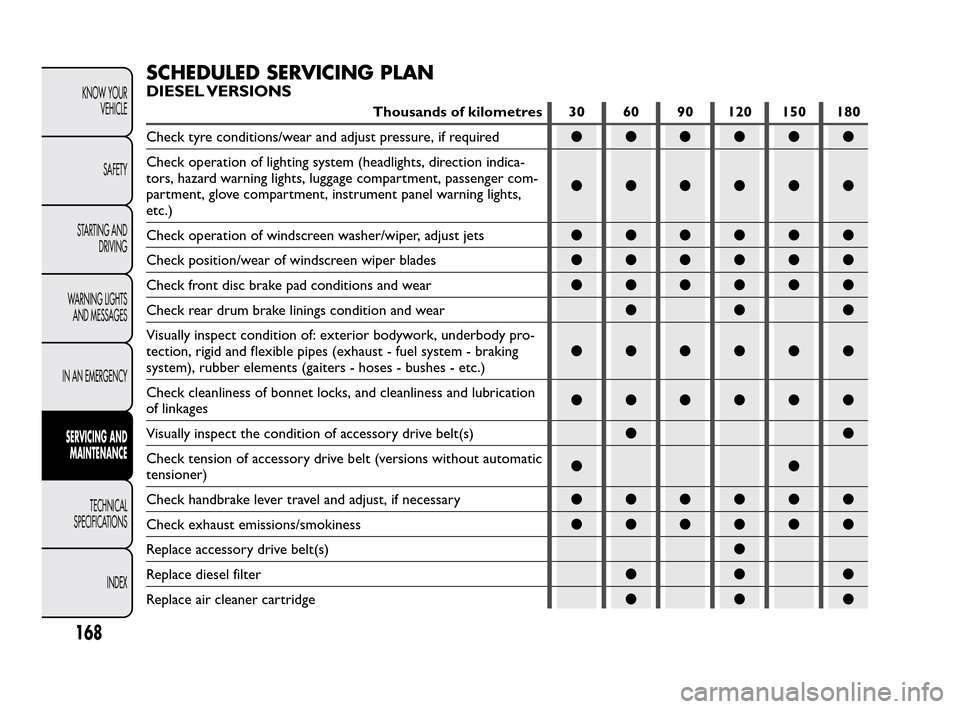
SCHEDULED SERVICING PLAN
DIESEL VERSIONS
Thousands of kilometres 30 60 90 120 150 180
Check tyre conditions/wear and adjust pressure, if required●●●●●●
Check operation of lighting system (headlights, direction indica-
tors, hazard warning lights, luggage compartment, passenger com-
partment, glove compartment, instrument panel warning lights,
etc.)●●●●●●
Check operation of windscreen washer/wiper, adjust jets●●●●●●
Check position/wear of windscreen wiper blades●●●●●●
Check front disc brake pad conditions and wear●●●●●●
Check rear drum brake linings condition and wear●●●
Visually inspect condition of: exterior bodywork, underbody pro-
tection, rigid and flexible pipes (exhaust - fuel system - braking
system), rubber elements (gaiters - hoses - bushes - etc.)●●●●●●
Check cleanliness of bonnet locks, and cleanliness and lubrication
of linkages●●●●●●
Visually inspect the condition of accessory drive belt(s)●●
Check tension of accessory drive belt (versions without automatic
tensioner)●●
Check handbrake lever travel and adjust, if necessary●●●●●●
Check exhaust emissions/smokiness●●●●●●
Replace accessory drive belt(s)●
Replace diesel filter●●●
Replace air cleaner cartridge●●●
168
KNOW YOUR
VEHICLE
SAFETY
STARTING AND
DRIVING
WARNING LIGHTS
AND MESSAGES
IN AN EMERGENCY
SERVICING AND
MAINTENANCE
TECHNICAL
SPECIFICA
TIONS
INDEX
Page 170 of 230
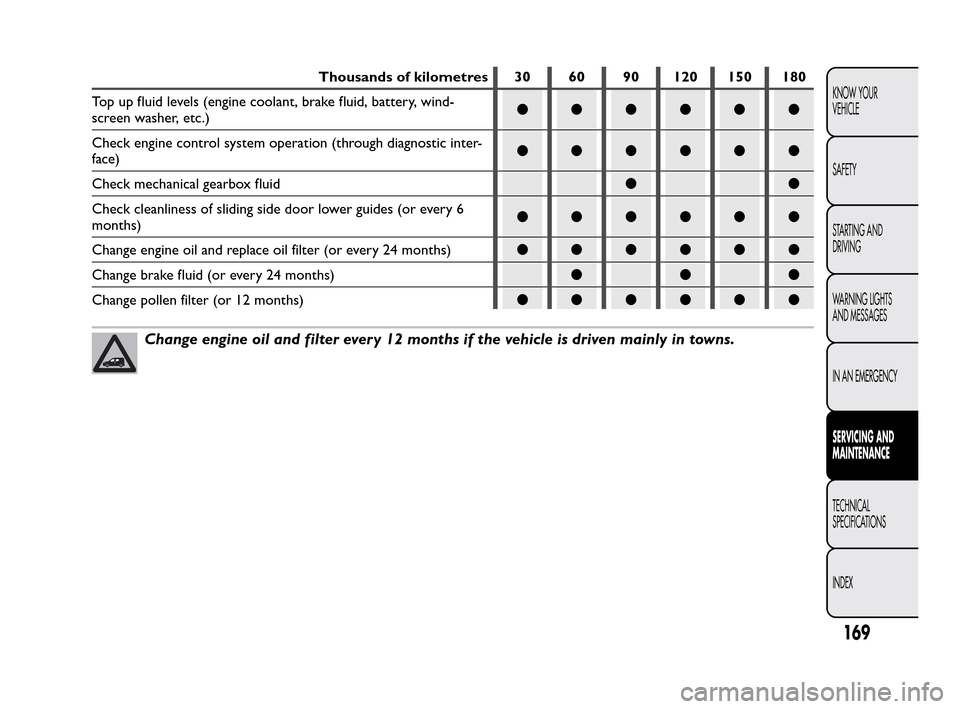
Thousands of kilometres 30 60 90 120 150 180
Top up fluid levels (engine coolant, brake fluid, battery, wind-
screen washer, etc.)●●●●●●
Check engine control system operation (through diagnostic inter-
face)●●●●●●
Check mechanical gearbox fluid●●
Check cleanliness of sliding side door lower guides (or every 6
months)●●●●●●
Change engine oil and replace oil filter (or every 24 months)●●●●●●
Change brake fluid (or every 24 months)●●●
Change pollen filter (or 12 months)●●●●●●
Change engine oil and filter every 12 months if the vehicle is driven mainly in towns.
169
KNOW YOUR
VEHICLE
SAFETY
STARTING AND
DRIVING
WARNING LIGHTS
AND MESSAGES
IN AN EMERGENCY
SERVICING AND
MAINTENANCE
TECHNICAL
SPECIFICA
TIONS
INDEX
Page 171 of 230
REGULAR CHECKS
Every 1,000 km or before long journeys, check and, if
necessary, top up:
❒engine coolant level;
❒brake fluid level;
❒windscreen washer fluid level;
❒tyre inflation pressure and condition;
❒operation of lighting system (headlamps, direction
indicators, hazard warning lights, etc.);
❒operation of screen wash/wipe system and
positioning/wear of windscreen/rear window wiper
blades.
Check and top up, if required, the engine oil level
every 3,000 km.
You are recommended to use PETRONAS
LUBRICANTS products, which have been designed
and produced specifically for Fiat vehicles (see
“Capacities” table in the “Technical specifications”
section).
HEAVY USAGE OF THE VEHICLE
Should prevailing use of the vehicle be under one of
the following specially heavy conditions:
❒towing a trailer or caravan;
❒dusty roads;
❒short, repeated journeys (less than 7-8 km) at
sub-zero outside temperatures;
❒engine often idling, or driving long distances at low
speed (e.g. door to door deliveries) or long period
of idleness;
❒urban trips;
perform the following inspections more frequently
than shown on the Scheduled Servicing Plan:
❒check front disc brake pad condition and wear;
❒check cleanliness of bonnet and boot locks,
cleanliness and lubrication of linkage;
❒visually inspect the conditions of: engine, gearbox,
transmission, pipes and tubes (exhaust - fuel -
brakes), rubber parts (boots, sleeves, bushes, etc.);
❒check battery charge status and fluid (electrolyte)
level (refer to "Battery - Check state of charge
and electrolyte level" paragraph in this chapter);
❒visually inspect condition of the auxiliary drive
belts;
170
KNOW YOUR
VEHICLE
SAFETY
STARTING AND
DRIVING
WARNING LIGHTS
AND MESSAGES
IN AN EMERGENCY
SERVICING AND
MAINTENANCE
TECHNICAL
SPECIFICA
TIONS
INDEX
Page 173 of 230
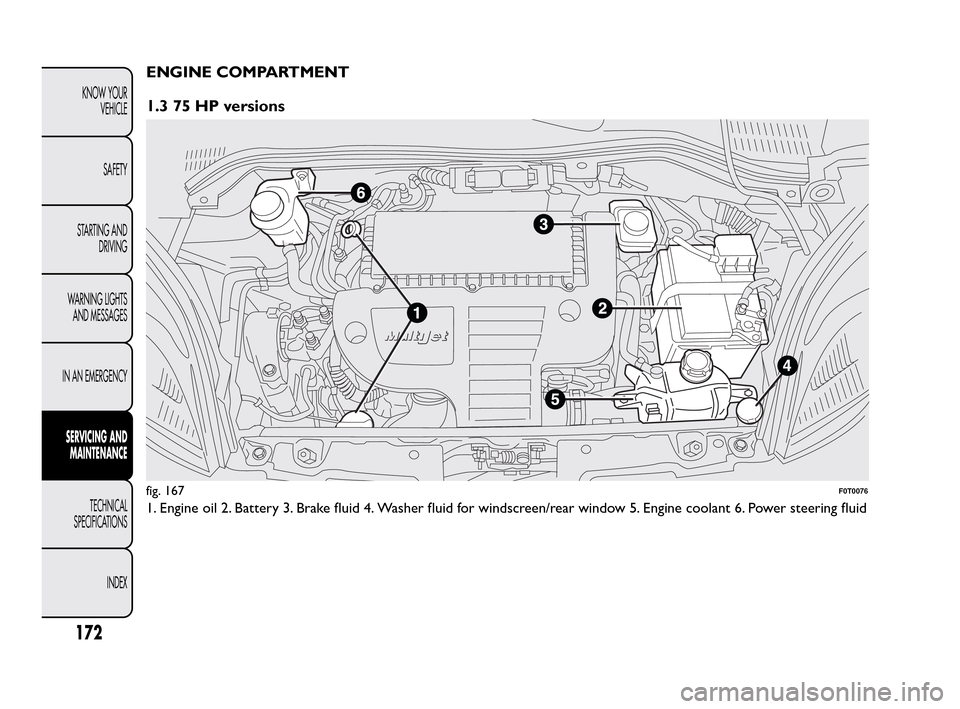
ENGINE COMPARTMENT
1.3 75 HP versions
1. Engine oil 2. Battery 3. Brake fluid 4. Washer fluid for windscreen/rear window 5. Engine coolant 6. Power steering fluid
fig. 167F0T0076
172
KNOW YOUR
VEHICLE
SAFETY
STARTING AND
DRIVING
WARNING LIGHTS
AND MESSAGES
IN AN EMERGENCY
SERVICING AND
MAINTENANCE
TECHNICAL
SPECIFICA
TIONS
INDEX
Page 176 of 230

WINDSCREEN/REAR WINDOW WASHING
FLUID
To add fluid lift the cap Afig. 170 and pour in a
mixture of water and TUTELA PROFESSIONAL SC
35 fluid, in the following proportions:
❒30% of TUTELA PROFESSIONAL SC 35 and 70%
water in summer
❒50% TUTELA PROFESSIONAL SC 35 and 50%
water in winter.
At temperatures below -20°C, use undiluted
TUTELA PROFESSIONAL SC 35 fluid.
Check level through the reservoir.
WARNING
Do not travel if the windscreen washer
reser
voir is empty: using the windscreen
washer is essential for improving visibility.
WARNING
Some commercial windscreen washer
addi
tives are flammable.The engine
compartment contains hot parts which could
start a fire if they come into contact .
BRAKE FLUID
Undo the cap A fig. 171 and check that the liquid
contained in the reservoir is at the maximum level.
Fluid level in the reservoir must not exceed the MAX
mark.
If you do need to top up, use the brake fluid shown
in the "Fluids and lubricants" table (see "Technical
Specifications"). When opening the cap A, make sure
that no dirt gets into the reservoir.
Always use a funnel with a built-in filter with a mesh
of 0.12 mm or less for topping up.
fig. 170F0T0079fig. 171F0T0080
175
KNOW YOUR
VEHICLE
SAFETY
STARTING AND
DRIVING
WARNING LIGHTS
AND MESSAGES
IN AN EMERGENCY
SERVICING AND
MAINTENANCE
TECHNICAL
SPECIFICA
TIONS
INDEX
Page 177 of 230
IMPORTANT Brake fluid absorbs moisture. For this
reason, if the vehicle is mainly used in areas with a
high degree of atmospheric humidity, the fluid should
be replaced at more frequent intervals than specified
in the “Schedule Servicing Plan”.
Prevent brake fluid, which is highly
corrosive, from coming into contact with
painted parts.Wash with water
immediately if this should happen.
WARNING
Brake fluid is poisonous and highly
c
orrosive. In the event of accidental
contact , wash the parts immediately with water
and mild soap, then rinse with plenty of water.
Call a doctor immediately if swallowed.
WARNING
Symbolon the contain indicates a
synthetic brake fluid, which is different
from a mineral fluid. Using a mineral-type fluid
will damage the special rubber seals of the
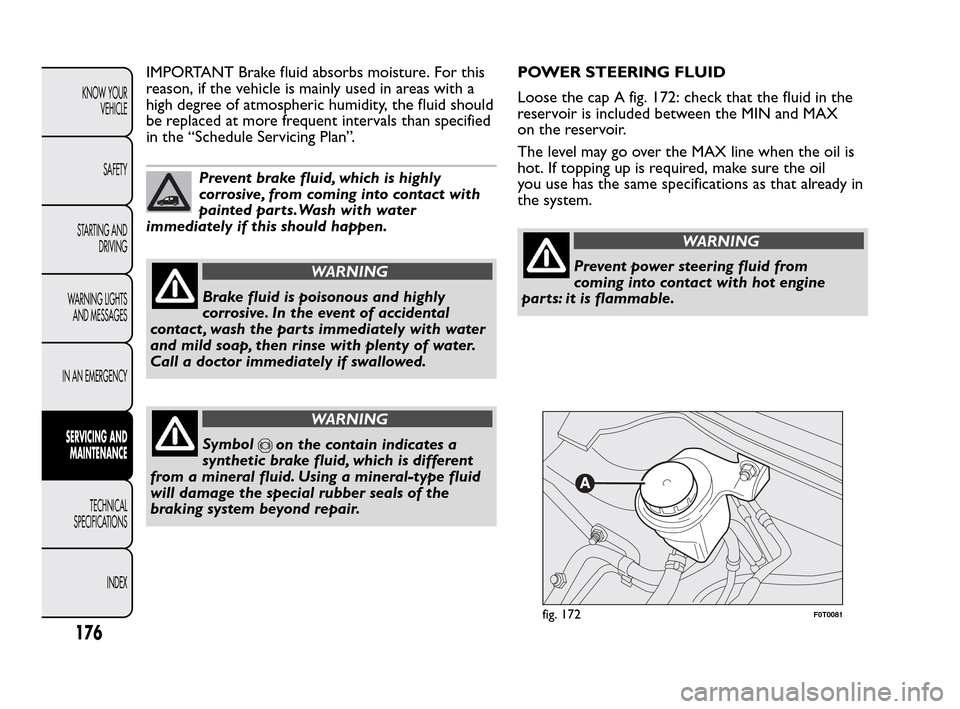
braking system beyond repair.POWER STEERING FLUID
Loose the cap A fig. 172: check that the fluid in the
reservoir is included between the MIN and MAX
on the reservoir.
The level may go over the MAX line when the oil is
hot. If topping up is required, make sure the oil
you use has the same specifications as that already in
the system.
WARNING
Prevent power steering fluid from
c
oming into contact with hot engine
parts: it is flammable.
fig. 172F0T0081
176
KNOW YOUR
VEHICLE
SAFETY
STARTING AND
DRIVING
WARNING LIGHTS
AND MESSAGES
IN AN EMERGENCY
SERVICING AND
MAINTENANCE
TECHNICAL
SPECIFICA
TIONS
INDEX
Page 182 of 230
WARNING
Remember that the road holding
qu
alities of your vehicle also depend on
the correct inflation pressure of the tyres.
WARNING
Excessively low pressure will cause
o
verheating of the tyre and may cause
severe tyre damage.
WARNING
Do not exchange the tyres from the left
to
the right of the vehicle and vice versa.
WARNING
Do not repaint alloy wheel rims at
temper
atures higher than 150°C.The
mechanical characteristics of the wheels might
be compromised.
RUBBER LINES
Follow the requirements in “Scheduled Servicing
Plan” in this section carefully for brake and fuel
rubber lines.
Ozone, high temperatures and a prolonged lack of
fluid in the system may cause hardening and cracking
of the tubes, which could result in leaks. Careful
inspections are therefore necessary.
181
KNOW YOUR
VEHICLE
SAFETY
STARTING AND
DRIVING
WARNING LIGHTS
AND MESSAGES
IN AN EMERGENCY
SERVICING AND
MAINTENANCE
TECHNICAL
SPECIFICA
TIONS
INDEX
Page 188 of 230
PLASTIC PARTS
It is advisable to clean interior plastic parts with a
damp cloth and a solution of water and non-abrasive
mild soap. To remove grease and tough stains, use
products designed specifically for cleaning plastics.
These have no solvents and have been designed
so that they do not alter the appearance and colour
of the components.
IMPORTANT Never use spirits or petroleum to
clean the instrument panel glass.REAL LEATHER STEERING WHEEL/GEAR
LEVER KNOB/HANDBRAKE
(for versions/markets, where provided)
These components must be cleaned with mild soap
and water only. Never use alcohol or alcohol-based
products.
Read the product label carefully before using specific
products for cleaning the interiors: make sure the
product does not contain spirits or alcohol-based
substances.
If, when cleaning the windscreen with special
products, window cleaner accidentally drips onto the
leather of the steering wheel/gear lever knob/hand
brake, wipe away immediately and then wash the
affected area with mild soap and water.
IMPORTANT Be careful when installing a steering
wheel locking device not to damage the leather
upholstery.
187
KNOW YOUR
VEHICLE
SAFETY
STARTING AND
DRIVING
WARNING LIGHTS
AND MESSAGES
IN AN EMERGENCY
SERVICING AND
MAINTENANCE
TECHNICAL
SPECIFICA
TIONS
INDEX