air FIAT QUBO 2016 1.G User Guide
[x] Cancel search | Manufacturer: FIAT, Model Year: 2016, Model line: QUBO, Model: FIAT QUBO 2016 1.GPages: 231, PDF Size: 5.02 MB
Page 85 of 231
81KNOW YOUR
VEHICLESAFETY
STARTING AND
DRIVING
WARNING LIGHTS
AND MESSAGES
IN AN EMERGENCY
SERVICING AND
MAINTENANCE
TECHNICAL
SPECIFICATIONS
INDEX
REFUELLING THE VEHICLEDIESEL ENGINES
Operation at low temperatures
If the outside temperature is very low, the diesel
thickens due to the formation of paraffin clots with
consequent defective operation of the fuel supply
system.
In order to avoid these problems, different types of
diesel are distributed according to the season:
summer type, winter type and arctic type
(cold/mountain areas). If refuelling with diesel fuel
whose specifications are not suitable for the usage
temperature, it is advisable to mix TUTELA DIESEL
ART additive in the proportions shown on the
container with the fuel. Pour the additive into the
tank before the fuel.
When using or parking the vehicle for a long time in
the mountains or cold areas, it is advisable to refuel
using locally available diesel.
In this case, it is also advisable to keep the tank over
50% full.
For diesel engines, use only diesel fuel for
motor vehicles in accordance with EN590
European specifications.The use of other
products or mixtures may damage the engine
beyond repair and consequently invalidate the
warranty, due to the damage caused. If you
accidentally introduce other types of fuel into the
tank, do not start the engine. Empty the tank. If
the engine has been run for even an extremely
limited amount of time, you must not only drain
the fuel tank, but the rest of the supply circuit
as well.
Page 88 of 231
PROTECTING THE ENVIRONMENTThe following devices are used for reducing diesel
fuel engine emissions:
❒oxidising catalytic converter
❒exhaust gas recirculation system (EGR)
❒diesel particulate filter (DPF) (for versions/
markets, where provided).
DIESEL PARTICULATE FILTER (DPF)
(for versions/markets, where provided)
The Diesel Particulate Filter is a mechanical filter,
integral to the exhaust system, that physically traps
carbon particulates present in the exhaust gases
of diesel engines.
The diesel particulate filter has been adopted to
eliminate almost all particulates in compliance with
current/future regulations.
During normal use of the vehicle, the engine
management control unit records a set of data
(travel time, type of route, temperatures reached
etc.) and calculates how much particulate has been
trapped by the filter.Since this filter physically traps particulate, it must be
regenerated (cleaned) at regular intervals by burning
the carbon particles.
The regeneration procedure is managed
automatically by the engine management control unit
according to the filter conditions and vehicle use
conditions.
During regeneration, the following may occur: a
limited increase in the engine speed, activation of the
fan, a limited increase in fumes and high
temperatures at the exhaust.
These are not faults; they do not impair vehicle
performance or damage the environment. If
the dedicated message is displayed, refer to the
“Warning lights and messages” section.
84KNOW YOUR
VEHICLE
SAFETY
STARTING AND
DRIVING
WARNING LIGHTS
AND MESSAGES
IN AN EMERGENCY
SERVICING AND
MAINTENANCE
TECHNICAL
SPECIFICATIONS
INDEX
Page 95 of 231
All restraint devices must bear the type-approval
data along with the control mark on a label firmly
secured to the child seat which must never be
removed.
Over 1.50 m in height, from the point of view of
restraint systems, children are considered as adults
and wear seat belts normally.
Lineaccessori Fiat has child seats for each weight
group. These devices are recommended, having been
specifically designed for Fiat cars.
WARNING
DANGER: Do not put cradle seats facing
backwards on the front seat if the front
passenger air bag is enabled.
Deployment of the air bag in an
accident could cause fatal injuries to the child.
It is advisable to carr y children on the rear seat ,
which is the most protected position in the
event of an accident . Child seats must not be
fitted on the front seat of vehicles with a
passenger air bag; their deployment in
an accident , however serious, could cause fatal
injuries to the child. If necessary, children can
travel in the front seat , if the front passenger air
bag can be disabled. In this case, check that
the air bag is actually deactivated by making
sure the “ warning light appears on the
instrument panel (see “Front passenger air bag”
in the “Front air bags” section). Also, the
passenger seat should be as far back as possible
to avoid contact between the child seat and
the dashboard.
91KNOW YOUR
VEHICLESAFETYSTARTING AND
DRIVING
WARNING LIGHTS
AND MESSAGES
IN AN EMERGENCY
SERVICING AND
MAINTENANCE
TECHNICAL
SPECIFICATIONS
INDEX
Page 100 of 231
Below is a summary of the rules of safety to
be followed when carrying children:
❒Install the child seats on the rear seat, which is the
most protected position in the event of an
accident.
❒If the passenger's air bag is deactivated, always
check the amber warning light
on the
instrument panel to make sure that it has actually
been deactivated.
❒Carefully follow the instructions that came with
the child seat, which the manufacturer must supply
by law. Keep the instructions in the vehicle along
with the other papers and this handbook. Do
not use child seats without instructions.
❒Always check the seat belt is well fastened by
pulling on it.
❒Only one child is to be strapped into each seat;
never carry two children using one child seat.
❒Always check the seat belts do not rest on the
child's neck.
❒While travelling, do not let the child sit incorrectly
or release the belts.
❒Never carry children on your lap, even newborns.
No-one can hold a child in the event of an
accident.
❒In the event of an accident, replace the child seat
with a new one.
WARNING
Do not arrange child seats on the front
seat in cars fitted with passenger's air
bag. Children must never travel on the front
seat .
96KNOW YOUR
VEHICLE
SAFETY
STARTING AND
DRIVING
WARNING LIGHTS
AND MESSAGES
IN AN EMERGENCY
SERVICING AND
MAINTENANCE
TECHNICAL
SPECIFICATIONS
INDEX
Page 104 of 231
FRONT AIRBAGSThe vehicle is fitted with front airbags for driver and
passenger (for versions/markets where provided).
The front driver/passenger airbags (for versions/
markets, where provided) are designed to protect
the front-seat occupants in the event of head-on
crashes of medium-high severity, by placing the bag
between the occupant and the steering wheel or
dashboard.
Non-activation in other types of crash (side-on
collisions, rear shunts, roll-overs, etc.) is therefore
not a sign of system malfunction.
An electronic control unit causes the bag to inflate, if
necessary, in the event of a head-on crash.The bag will inflate instantaneously, placing itself
between the front occupant's body and the
structures which could cause injury. It will deflate
immediately afterwards.
Front driver/passenger airbags (for versions/markets,
where provided) are not a replacement for, but
rather a complement to, the seat belts, which should
be worn at all times as specified by law in Europe
and most non-European countries.
In the event of an impact, those not wearing a seat
belt will move forward and come into contact with
the bag which is still inflating. The protection offered
by the bag is compromised in these circumstances.
Front airbags may not be activated in the following
situations:
❒head-on impacts against highly deformable objects
that do not affect the front surface of the vehicle
(e.g. front wing hitting a guard rail);
❒jamming of the vehicle underneath other vehicles
or protective barriers (e.g. underneath a truck or
a guard rail); in this case, the bags would offer
no additional protection with respect to the seat
belt and their deployment is unnecessary. Lack
of deployment in such cases is consequently not
the sign of a fault.
100KNOW YOUR
VEHICLE
SAFETY
STARTING AND
DRIVING
WARNING LIGHTS
AND MESSAGES
IN AN EMERGENCY
SERVICING AND
MAINTENANCE
TECHNICAL
SPECIFICATIONS
INDEX
Page 105 of 231
WARNING
Do not apply stickers or other objects to
the steering wheel, the dashboard in
the passenger side airbag area and the seats.
Do not place objects (e.g. mobile phones) on the
passenger side dashboard because these could
interfere with the correct opening of the airbag
and cause severe injur y to occupants.The front driver and passenger airbags are designed
and calibrated to best protect front-seat passengers
wearing seat belts. The volume of the front airbags at
maximum inflation fills most of the space between
the steering wheel and the driver and between
the dashboard and the passenger.
The airbags are not deployed in the event of small
head-on collisions (for which the withholding action
of the seat belts is sufficient). Seat belts must always
be worn. In the event of head-on collisions, they
ensure the correct positioning of the occupant.
101KNOW YOUR
VEHICLESAFETYSTARTING AND
DRIVING
WARNING LIGHTS
AND MESSAGES
IN AN EMERGENCY
SERVICING AND
MAINTENANCE
TECHNICAL
SPECIFICATIONS
INDEX
Page 106 of 231
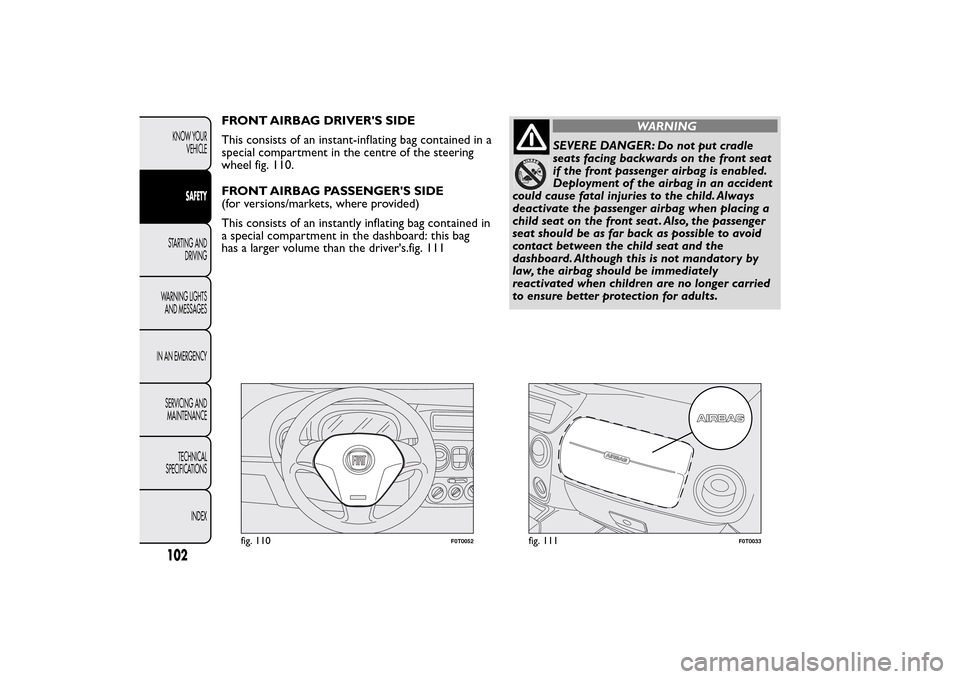
FRONT AIRBAG DRIVER'S SIDE
This consists of an instant-inflating bag contained in a
special compartment in the centre of the steering
wheel fig. 110.
FRONT AIRBAG PASSENGER'S SIDE
(for versions/markets, where provided)
This consists of an instantly inflating bag contained in
a special compartment in the dashboard: this bag
has a larger volume than the driver's.fig. 111
WARNING
SEVERE DANGER: Do not put cradle
seats facing backwards on the front seat
if the front passenger airbag is enabled.
Deployment of the airbag in an accident
could cause fatal injuries to the child. Always
deactivate the passenger airbag when placing a
child seat on the front seat . Also, the passenger
seat should be as far back as possible to avoid
contact between the child seat and the
dashboard. Although this is not mandatory by
law, the airbag should be immediately
reactivated when children are no longer carried
to ensure better protection for adults.
fig. 110
F0T0052
fig. 111
F0T0033
102KNOW YOUR
VEHICLE
SAFETY
STARTING AND
DRIVING
WARNING LIGHTS
AND MESSAGES
IN AN EMERGENCY
SERVICING AND
MAINTENANCE
TECHNICAL
SPECIFICATIONS
INDEX
Page 107 of 231
MANUAL DEACTIVATION OF
PASSENGER'S FRONT AIRBAG AND SIDE
BAG
(for versions/markets, where provided)
Whenever a child needs to be carried on the front
seat, the passenger's front airbag and side bags
(for versions/markets where provided) can be
deactivated.
The warning light
on the instrument panel stays
on until the passenger's front airbag and side bags
(for versions/markets where provided) are
reactivated.
IMPORTANT Refer to "Digital display" and
“Multifunction display” in the “Know your vehicle”
section to manually deactivate the passenger's front
airbag and side bags (for versions/markets, where
provided).
SIDE BAGS(for versions/markets, where provided)
On some versions, the vehicle may be fitted with
driver and passenger's front side bags.
Side bags protect occupants from side-on crashes of
medium/high severity by placing the bag between
the occupant and the internal parts of the side
structure of the vehicle.
Non-activation of side bags in other types of
collisions (head-on collisions, rear shunts, roll-overs,
etc...) is not an indication of system malfunction.
An electronic control unit causes the bags to inflate
in the event of a side-on collision. The bags inflate
instantaneously, placing themselves between the
occupant's body and the structures which could
cause injury. They deflate immediately afterwards.
Side bags are not a replacement of, but rather a
complement to, seat belts, which you are
recommended to wear at all times, as specified by
law in Europe and most non-European countries.
For this reason, the seat belt must be worn at all
times. In the case of side-on collisions, the seat belts
hold occupants in the correct position and prevent
them from being thrown out of the car by a very
violent collision.
103KNOW YOUR
VEHICLESAFETYSTARTING AND
DRIVING
WARNING LIGHTS
AND MESSAGES
IN AN EMERGENCY
SERVICING AND
MAINTENANCE
TECHNICAL
SPECIFICATIONS
INDEX
Page 108 of 231
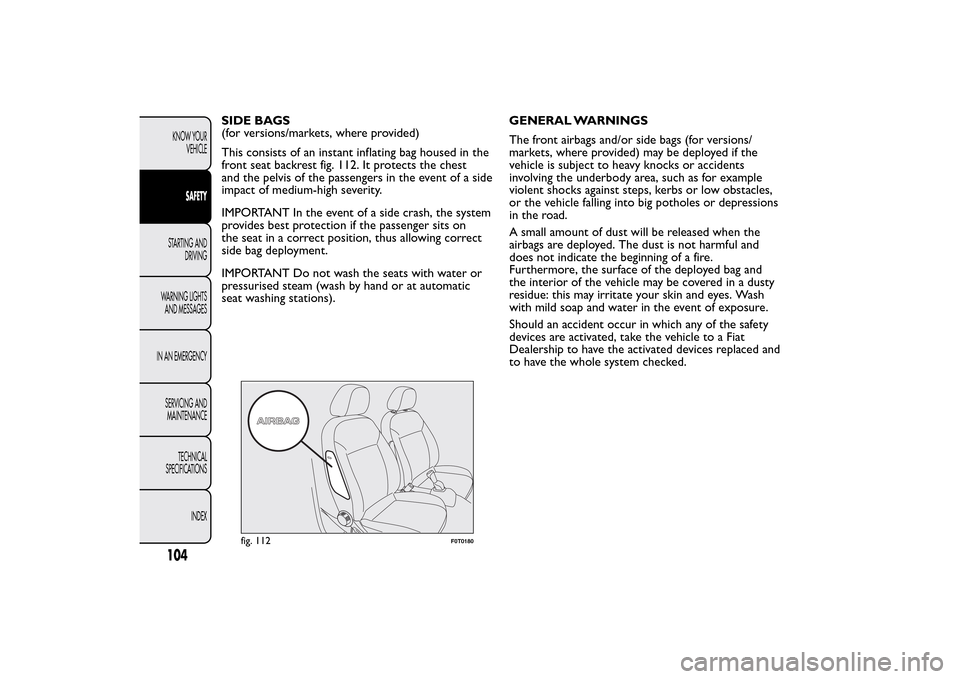
SIDE BAGS
(for versions/markets, where provided)
This consists of an instant inflating bag housed in the
front seat backrest fig. 112. It protects the chest
and the pelvis of the passengers in the event of a side
impact of medium-high severity.
IMPORTANT In the event of a side crash, the system
provides best protection if the passenger sits on
the seat in a correct position, thus allowing correct
side bag deployment.
IMPORTANT Do not wash the seats with water or
pressurised steam (wash by hand or at automatic
seat washing stations).GENERAL WARNINGS
The front airbags and/or side bags (for versions/
markets, where provided) may be deployed if the
vehicle is subject to heavy knocks or accidents
involving the underbody area, such as for example
violent shocks against steps, kerbs or low obstacles,
or the vehicle falling into big potholes or depressions
in the road.
A small amount of dust will be released when the
airbags are deployed. The dust is not harmful and
does not indicate the beginning of a fire.
Furthermore, the surface of the deployed bag and
the interior of the vehicle may be covered in a dusty
residue: this may irritate your skin and eyes. Wash
with mild soap and water in the event of exposure.
Should an accident occur in which any of the safety
devices are activated, take the vehicle to a Fiat
Dealership to have the activated devices replaced and
to have the whole system checked.
fig. 112
F0T0180
104KNOW YOUR
VEHICLE
SAFETY
STARTING AND
DRIVING
WARNING LIGHTS
AND MESSAGES
IN AN EMERGENCY
SERVICING AND
MAINTENANCE
TECHNICAL
SPECIFICATIONS
INDEX
Page 109 of 231
Every control, repair and replacement operation
concerning the airbags must be carried out only at
Fiat Dealerships.
If you are having the vehicle scrapped, have the airbag
system deactivated at a Fiat Dealership first. If the
vehicle changes ownership, the new owner must be
informed of the method of use of air bags and the
above warnings and also be given this "Owner's
Handbook".
Pretensioners, front airbags and front side bags are
deployed differently according to the type of
collision. Non-deployment of one of these devices
does not therefore indicate a system fault.
WARNING
There may be a fault in the retaining
systems if the warning light
does not
light up when the key is turn on or remains on
while travelling (on some versions with a
message on the display). In this case, the airbags
or the pretensioners may not be activated in
the case of an accident or (more seldom) they
may be activated incorrectly. Contact a Fiat
Dealership immediately to have the system
checked.
WARNING
The expiration dates of the explosive
charge and the clock wire are shown on
a label contained in the glove box. Go to a Fiat
Dealership to have the devices replaced when
the expiration date approaches.
WARNING
Do not travel carrying objects in your
lap, in front of your chest or between
your lips (pipe, pencils, etc .): they could cause
severe injur y if the airbag is deployed.
105KNOW YOUR
VEHICLESAFETYSTARTING AND
DRIVING
WARNING LIGHTS
AND MESSAGES
IN AN EMERGENCY
SERVICING AND
MAINTENANCE
TECHNICAL
SPECIFICATIONS
INDEX