air FIAT QUBO 2016 1.G Service Manual
[x] Cancel search | Manufacturer: FIAT, Model Year: 2016, Model line: QUBO, Model: FIAT QUBO 2016 1.GPages: 231, PDF Size: 5.02 MB
Page 176 of 231
❒visually inspect conditions of: engine, gearbox,
transmission, pipes and hoses (exhaust - fuel
system - brakes) and rubber elements (boots -
sleeves - bushes - etc.);
❒check battery charge status and fluid (electrolyte)
level (refer to "Battery - Check state of charge
and electrolyte level" paragraph in this chapter);
❒visually inspect condition of the auxiliary drive
belts;
❒check and, if necessary, replace pollen filter, in
particular it should be replaced if there is a
noticeable decrease in the passenger compartment
air intake flow rate.
❒check and, if necessary, replace air filter.
CHECKING LEVELS
When topping up, take care not to mix up
the various types of fluids: they are not
compatible with each other and could
seriously damage the vehicle.
WARNING
Never smoke while working in the
engine compar tment : inflammable gases
and vapours may be present , constituting a fire
risk.
172KNOW YOUR
VEHICLE
SAFETY
STARTING AND
DRIVING
WARNING LIGHTS
AND MESSAGES
IN AN EMERGENCY
SERVICING AND
MAINTENANCE
TECHNICAL
SPECIFICATIONS
INDEX
Page 182 of 231
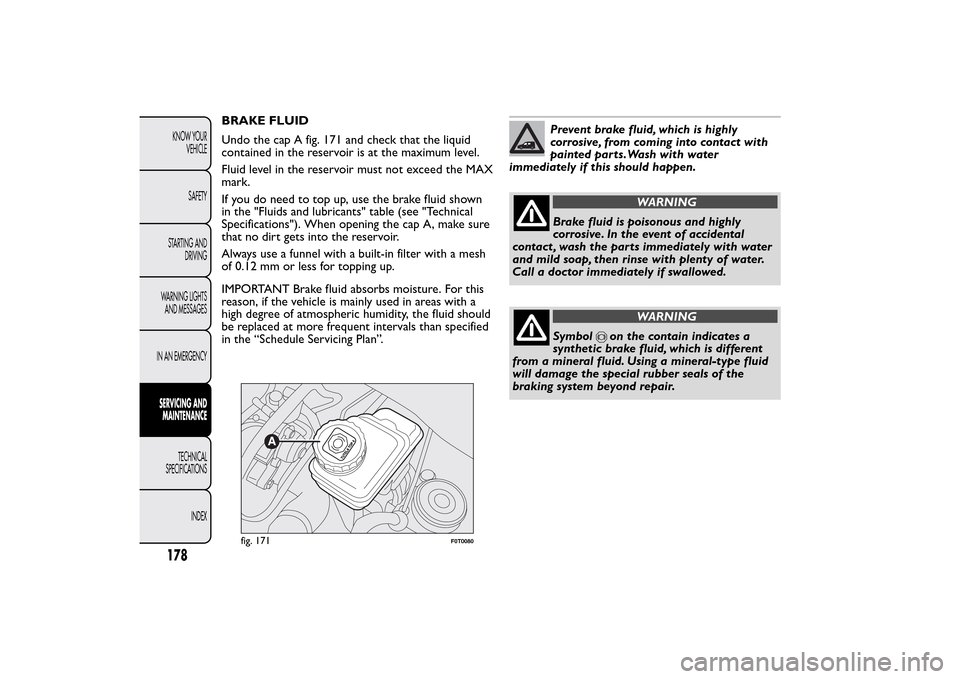
BRAKE FLUID
Undo the cap A fig. 171 and check that the liquid
contained in the reservoir is at the maximum level.
Fluid level in the reservoir must not exceed the MAX
mark.
If you do need to top up, use the brake fluid shown
in the "Fluids and lubricants" table (see "Technical
Specifications"). When opening the cap A, make sure
that no dirt gets into the reservoir.
Always use a funnel with a built-in filter with a mesh
of 0.12 mm or less for topping up.
IMPORTANT Brake fluid absorbs moisture. For this
reason, if the vehicle is mainly used in areas with a
high degree of atmospheric humidity, the fluid should
be replaced at more frequent intervals than specified
in the “Schedule Servicing Plan”.
Prevent brake fluid, which is highly
corrosive, from coming into contact with
painted parts.Wash with water
immediately if this should happen.
WARNING
Brake fluid is poisonous and highly
corrosive. In the event of accidental
contact , wash the parts immediately with water
and mild soap, then rinse with plenty of water.
Call a doctor immediately if swallowed.
WARNING
Symbol
on the contain indicates a
synthetic brake fluid, which is different
from a mineral fluid. Using a mineral-type fluid
will damage the special rubber seals of the
braking system beyond repair.
fig. 171
F0T0080
178KNOW YOUR
VEHICLE
SAFETY
STARTING AND
DRIVING
WARNING LIGHTS
AND MESSAGES
IN AN EMERGENCY
SERVICING AND
MAINTENANCE
TECHNICAL
SPECIFICATIONS
INDEX
Page 184 of 231
AIR CLEANER/ POLLEN FILTERHave the air cleaner or the pollen filter replaced by a
Fiat Dealership.
BATTERYThe battery is of the “limited maintenance” type:
under normal conditions of use, the electrolyte does
not need topping up with distilled water.
It does, however, need to be checked regularly at a
Fiat Dealership or by specialist personnel to make
sure it is working properly.
WARNING
The battery fluid is poisonous and
corrosive. Avoid contact with the skin
and eyes. Keep naked flames and sources of
sparks away from the battery: risk of explosion
and fire.
WARNING
Running the battery with an excessively
low liquid level will damage the battery
beyond repair and even cause an explosion.
REPLACING THE BATTERY
If required, replace the battery with an original spare
part with the same specifications.
If a battery with different specifications is fitted, the
service intervals given in the “Scheduled Servicing
Plan” will no longer be valid.
180KNOW YOUR
VEHICLE
SAFETY
STARTING AND
DRIVING
WARNING LIGHTS
AND MESSAGES
IN AN EMERGENCY
SERVICING AND
MAINTENANCE
TECHNICAL
SPECIFICATIONS
INDEX
Page 190 of 231
SPRAY NOZZLES
If the jet is not coming out, firstly check that there is
fluid in the windscreen/rear window reservoir (for
versions/markets where provided) (see “Checking
levels” in this section).
Then check that the nozzle holes are not clogged;
use a needle to unblock them if necessary.
Windscreen (washer)
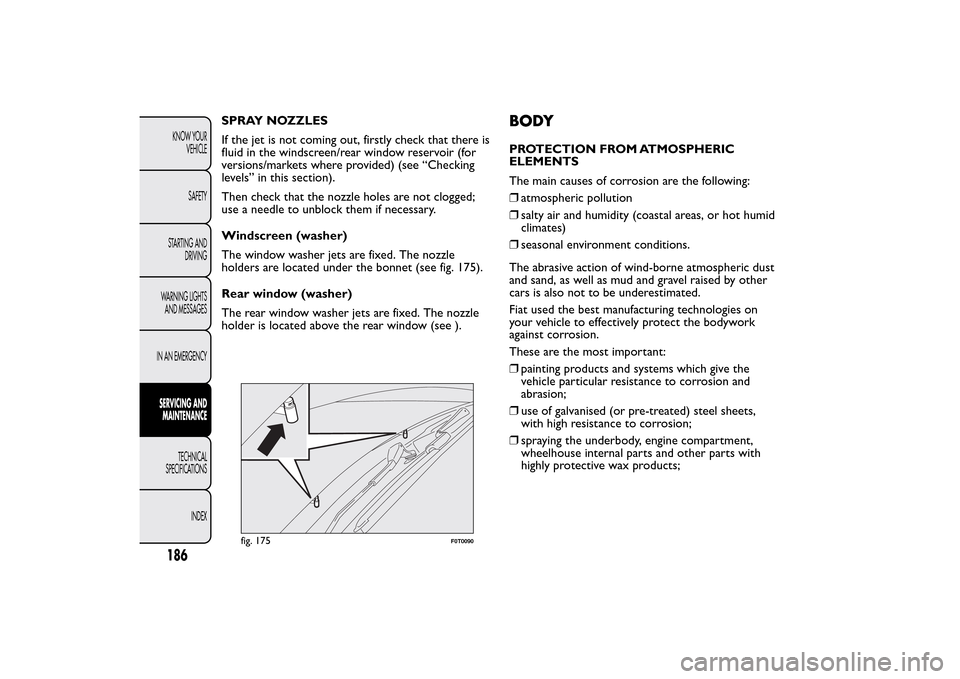
The window washer jets are fixed. The nozzle
holders are located under the bonnet (see fig. 175).
Rear window (washer)
The rear window washer jets are fixed. The nozzle
holder is located above the rear window (see ).
BODYPROTECTION FROM ATMOSPHERIC
ELEMENTS
The main causes of corrosion are the following:
❒atmospheric pollution
❒salty air and humidity (coastal areas, or hot humid
climates)
❒seasonal environment conditions.
The abrasive action of wind-borne atmospheric dust
and sand, as well as mud and gravel raised by other
cars is also not to be underestimated.
Fiat used the best manufacturing technologies on
your vehicle to effectively protect the bodywork
against corrosion.
These are the most important:
❒painting products and systems which give the
vehicle particular resistance to corrosion and
abrasion;
❒use of galvanised (or pre-treated) steel sheets,
with high resistance to corrosion;
❒spraying the underbody, engine compartment,
wheelhouse internal parts and other parts with
highly protective wax products;
fig. 175
F0T0090
186KNOW YOUR
VEHICLE
SAFETY
STARTING AND
DRIVING
WARNING LIGHTS
AND MESSAGES
IN AN EMERGENCY
SERVICING AND
MAINTENANCE
TECHNICAL
SPECIFICATIONS
INDEX
Page 191 of 231
❒spraying of plastic materials for protective
purposes in the most exposed points: under the
doors, inside the mudguard, along the edges, etc.
❒use of “open” boxed sections to prevent
condensation and pockets of moisture from
triggering rust inside.
VEHICLE BODY AND UNDERBODY
WARRANTY
Your vehicle is covered by warranty against
perforation due to rust of any original element of the
structure or body.
For the general terms of this warranty, refer to your
Warranty Booklet.ADVICE FOR PRESERVING THE
BODYWORK
Paint
Paintwork does not only serve an aesthetic purpose,
but also protects the underlying sheet metal.
Touch up abrasions and scratches immediately to
prevent the formation of rust. Use only original paint
products for touch-ups (see “Bodywork paint
identification plate” in the “Technical specifications”
section).
Normal care for paintwork consists of washing the
car; how often depends on the conditions and
environment where the car is used.
For example, it is advisable to wash the vehicle more
often in areas with high atmospheric pollution or if
you are travelling on roads sprinkled with salt.
To wash the vehicle properly, proceed as follows:
❒wash the body using a low pressure jet of water;
❒wipe a sponge with a slightly soapy solution over
the bodywork, frequently rinsing with the sponge;
❒rinse well with water and dry with a jet of air or a
chamois leather.
If you put the vehicle through a car wash, follow
these recommendations:
❒remove the antenna from the roof so it does not
get damaged;
187KNOW YOUR
VEHICLE
SAFETY
STARTING AND
DRIVING
WARNING LIGHTS
AND MESSAGES
IN AN EMERGENCYSERVICING AND
MAINTENANCETECHNICAL
SPECIFICATIONS
INDEX
Page 192 of 231
❒the car wash should use water added to a soapy
solution;
❒rinse thoroughly to avoid soap marks staying on
the bodywork or less visible parts.
Some car washes with old-style blades
and/or in a poor state of repair can
damage the paintwork, facilitating the
formation of lines that give the paint a dull/misty
appearance, especially on dark colours. If this
happens, lightly polish the paintwork with
appropriate products.
Dry the less visible parts particularly carefully, such
as the door frames, bonnet and the headlight frames,
where water may stagnate more easily. It is a good
idea to leave the vehicle outdoors for a while after
washing it to give water time to evaporate.
Do not wash the vehicle after it has been left in the
sun or with the bonnet hot: this may alter the shine
of the paintwork.Exterior plastic parts should be cleaned in the same
way as the rest of the vehicle. Where possible, do
not park the vehicle under trees; the resinous
substances released by many species give the paint a
dull appearance and increase the possibility of rust.
IMPORTANT Bird droppings should be washed
off immediately and thoroughly as the acid
they contain is particularly aggressive.
Detergents cause water pollution.The
vehicle should be washed in areas
equipped for collecting and purifying the
liquid used in the washing process.
188KNOW YOUR
VEHICLE
SAFETY
STARTING AND
DRIVING
WARNING LIGHTS
AND MESSAGES
IN AN EMERGENCY
SERVICING AND
MAINTENANCE
TECHNICAL
SPECIFICATIONS
INDEX
Page 199 of 231
FUEL SYSTEMVersions Fuel system
1.3 Multijet 75 HPElectronically controlled Common Rail Multijet direct injection with turbocharger and
intercooler
WARNING
Modifications or repairs to the fuel supply system that are not carried out properly or do not
take the technical specifications of the system into account can cause malfunctions leading
to the risk of fire.
TRANSMISSIONVersions Gearbox Clutch Traction
1.3 Multijet 75 HPFive forward speed plus
reverse with synchronizers
for the engagement of the
forward speedsHydraulic drive Front
195KNOW YOUR
VEHICLE
SAFETY
STARTING AND
DRIVING
WARNING LIGHTS
AND MESSAGES
IN AN EMERGENCY
SERVICING AND
MAINTENANCETECHNICAL
SPECIFICATIONSINDEX
Page 201 of 231
WHEELSWHEELS AND TYRES
Pressed steel or alloy wheels. Tubeless radial carcass
tyres. All approved tyres are listed in the Log Book.
IMPORTANT If there are any discrepancies between
the Owner's handbook and the logbook, take the
information from the latter.
Respect the prescribed size to ensure safety of the
vehicle in movement. Fit tyres of the same make and
type on all wheels.
IMPORTANT Do not use air chambers with tubeless
tyres.
SPARE WHEEL
Pressed steel rims. Tubeless tyre.
WHEEL GEOMETRY
Front wheel toe-in measured between rims: -1 ±1
mm
The values refer to the vehicle in running order.
CORRECT READING OF THE TYRE
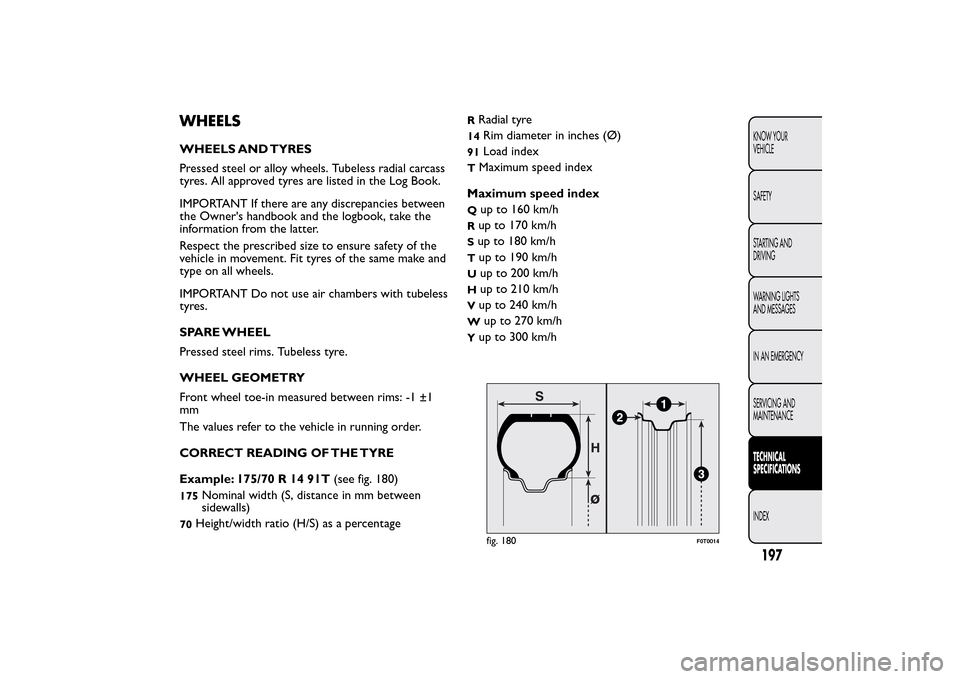
Example: 175/70 R 14 91T(see fig. 180)175
Nominal width (S, distance in mm between
sidewalls)
70
Height/width ratio (H/S) as a percentage
RRadial tyre14
Rim diameter in inches (Ø)
91
Load index
T
Maximum speed index
Maximum speed index
Q
up to 160 km/h
Rup to 170 km/hSup to 180 km/hT
up to 190 km/h
U
up to 200 km/h
H
up to 210 km/h
V
up to 240 km/h
W
up to 270 km/h
Y
up to 300 km/hfig. 180
F0T0014
197KNOW YOUR
VEHICLE
SAFETY
STARTING AND
DRIVING
WARNING LIGHTS
AND MESSAGES
IN AN EMERGENCY
SERVICING AND
MAINTENANCETECHNICAL
SPECIFICATIONSINDEX
Page 224 of 231
INDEX
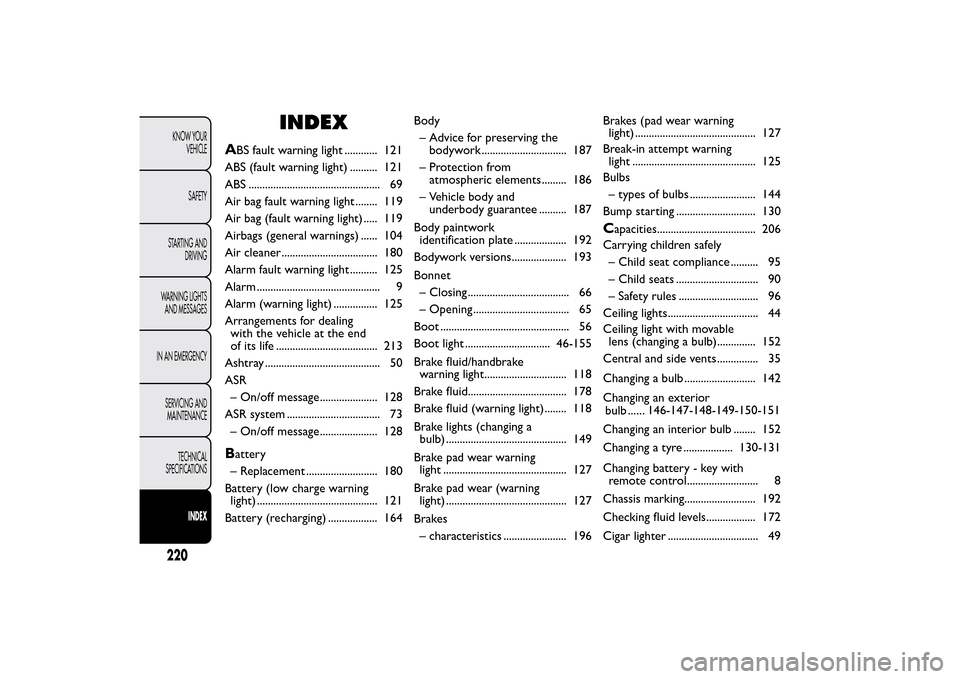
A
BS fault warning light ............ 121
ABS (fault warning light) .......... 121
ABS ................................................ 69
Air bag fault warning light ........ 119
Air bag (fault warning light) ..... 119
Airbags (general warnings) ...... 104
Air cleaner ................................... 180
Alarm fault warning light .......... 125
Alarm ............................................. 9
Alarm (warning light) ................ 125
Arrangements for dealing
with the vehicle at the end
of its life ..................................... 213
Ashtray .......................................... 50
ASR
– On/off message..................... 128
ASR system .................................. 73
– On/off message..................... 128
Battery
– Replacement .......................... 180
Battery (low charge warning
light) ............................................ 121
Battery (recharging) .................. 164Body
– Advice for preserving the
bodywork ............................... 187
– Protection from
atmospheric elements......... 186
– Vehicle body and
underbody guarantee .......... 187
Body paintwork
identification plate ................... 192
Bodywork versions.................... 193
Bonnet
– Closing ..................................... 66
– Opening ................................... 65
Boot ............................................... 56
Boot light ............................... 46-155
Brake fluid/handbrake
warning light.............................. 118
Brake fluid.................................... 178
Brake fluid (warning light)........ 118
Brake lights (changing a
bulb) ............................................ 149
Brake pad wear warning
light ............................................. 127
Brake pad wear (warning
light) ............................................ 127
Brakes
– characteristics ....................... 196Brakes (pad wear warning
light) ............................................ 127
Break-in attempt warning
light ............................................. 125
Bulbs
– types of bulbs ........................ 144
Bump starting ............................. 130
Capacities.................................... 206
Carrying children safely
– Child seat compliance .......... 95
– Child seats .............................. 90
– Safety rules ............................. 96
Ceiling lights................................. 44
Ceiling light with movable
lens (changing a bulb).............. 152
Central and side vents ............... 35
Changing a bulb .......................... 142
Changing an exterior
146-147-148-149-150-151
Changing an interior bulb ........ 152
Changing a tyre .................. 130-131
Changing battery - key with
remote control.......................... 8
Chassis marking.......................... 192
Checking fluid levels.................. 172
Cigar lighter ................................. 49
220KNOW YOUR
VEHICLE
SAFETY
STARTING AND
DRIVING
WARNING LIGHTS
AND MESSAGES
IN AN EMERGENCY
SERVICING AND
MAINTENANCE
TECHNICAL
SPECIFICATIONS
INDEX
bulb ......
Page 225 of 231
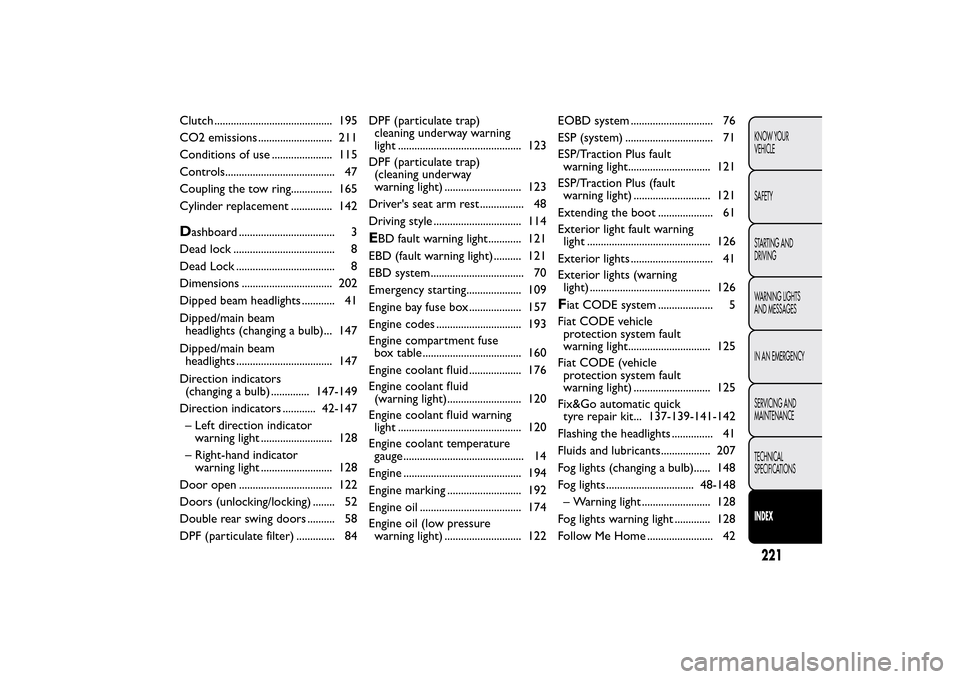
Clutch ........................................... 195
CO2 emissions ........................... 211
Conditions of use ...................... 115
Controls........................................ 47
Coupling the tow ring............... 165
Cylinder replacement ............... 142D
ashboard ................................... 3
Dead lock ..................................... 8
Dead Lock .................................... 8
Dimensions ................................. 202
Dipped beam headlights ............ 41
Dipped/main beam
headlights (changing a bulb)... 147
Dipped/main beam
headlights ................................... 147
Direction indicators
(changing a bulb) .............. 147-149
Direction indicators ............ 42-147
– Left direction indicator
warning light .......................... 128
– Right-hand indicator
warning light .......................... 128
Door open .................................. 122
Doors (unlocking/locking) ........ 52
Double rear swing doors .......... 58
DPF (particulate filter) .............. 84DPF (particulate trap)
cleaning underway warning
light ............................................. 123
DPF (particulate trap)
(cleaning underway
warning light) ............................ 123
Driver's seat arm rest ................ 48
Driving style ................................ 114
EBD fault warning light............ 121
EBD (fault warning light) .......... 121
EBD system .................................. 70
Emergency starting.................... 109
Engine bay fuse box ................... 157
Engine codes ............................... 193
Engine compartment fuse
box table .................................... 160
Engine coolant fluid ................... 176
Engine coolant fluid
(warning light)........................... 120
Engine coolant fluid warning
light ............................................. 120
Engine coolant temperature
gauge............................................ 14
Engine ........................................... 194
Engine marking ........................... 192
Engine oil ..................................... 174
Engine oil (low pressure
warning light) ............................ 122EOBD system .............................. 76
ESP (system) ................................ 71
ESP/Traction Plus fault
warning light.............................. 121
ESP/Traction Plus (fault
warning light) ............................ 121
Extending the boot .................... 6
Exterior light fault warning
light ............................................. 126
Exterior lights .............................. 41
Exterior lights (warning
light) ............................................ 126
Fiat CODE system .................... 5
Fiat CODE vehicle
protection system fault
warning light.............................. 125
Fiat CODE (vehicle
protection system fault
warning light) ............................ 125
Fix&Go automatic quick
tyre repair kit... 137-139-141-142
Flashing the headlights ............... 41
Fluids and lubricants.................. 207
Fog lights (changing a bulb)...... 148
Fog lights ................................ 48-148
– Warning light ......................... 128
Fog lights warning light ............. 128
Follow Me Home ........................ 42
221KNOW YOUR
VEHICLE
SAFETY
STARTING AND
DRIVING
WARNING LIGHTS
AND MESSAGES
IN AN EMERGENCY
SERVICING AND
MAINTENANCE
TECHNICAL
SPECIFICATIONSINDEX
1