air FIAT QUBO 2016 1.G Owner's Manual
[x] Cancel search | Manufacturer: FIAT, Model Year: 2016, Model line: QUBO, Model: FIAT QUBO 2016 1.GPages: 231, PDF Size: 5.02 MB
Page 110 of 231
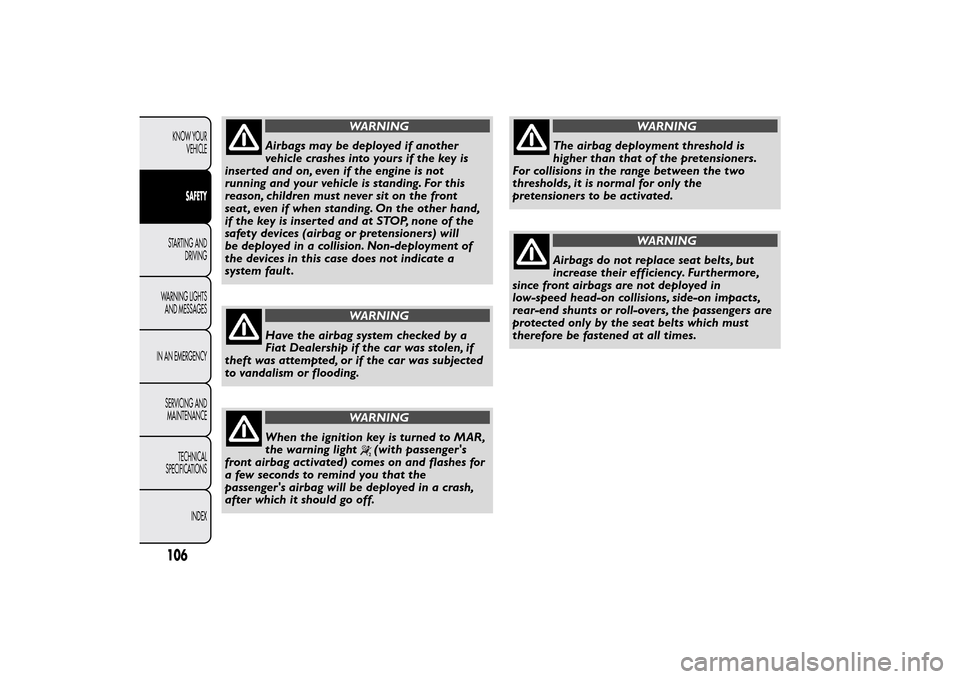
WARNING
Airbags may be deployed if another
vehicle crashes into yours if the key is
inserted and on, even if the engine is not
running and your vehicle is standing. For this
reason, children must never sit on the front
seat , even if when standing. On the other hand,
if the key is inser ted and at STOP, none of the
safety devices (airbag or pretensioners) will
be deployed in a collision. Non-deployment of
the devices in this case does not indicate a
system fault .
WARNING
Have the airbag system checked by a
Fiat Dealership if the car was stolen, if
theft was attempted, or if the car was subjected
to vandalism or flooding.
WARNING
When the ignition key is turned to MAR,
the warning light
(with passenger's
front airbag activated) comes on and flashes for
a few seconds to remind you that the
passenger's airbag will be deployed in a crash,
after which it should go off.
WARNING
The airbag deployment threshold is
higher than that of the pretensioners.
For collisions in the range between the two
thresholds, it is normal for only the
pretensioners to be activated.
WARNING
Airbags do not replace seat belts, but
increase their efficiency. Furthermore,
since front airbags are not deployed in
low-speed head-on collisions, side-on impacts,
rear-end shunts or roll-overs, the passengers are
protected only by the seat belts which must
therefore be fastened at all times.
106KNOW YOUR
VEHICLE
SAFETY
STARTING AND
DRIVING
WARNING LIGHTS
AND MESSAGES
IN AN EMERGENCY
SERVICING AND
MAINTENANCE
TECHNICAL
SPECIFICATIONS
INDEX
Page 113 of 231
EMERGENCY STARTING
Go to a Fiat Dealership immediately if warning light
comes on steady on the instrument panel.
Never jump start the engine by pushing,
towing or coasting downhill.This could
cause fuel to flow into the catalytic
conver ter and damage it beyond repair.STOPPING THE ENGINE
Turn the ignition key to STOP while the engine is
idling.
IMPORTANT After a long drive, you should allow
the engine to “catch its breath” before turning it off
by letting it idle to allow the temperature in the
engine compartment to fall.
A quick burst on the accelerator before
stopping the engine serves no practical
purpose; it wastes fuel and is especially
damaging to turbocharged engines.
109KNOW YOUR
VEHICLE
SAFETYSTARTING AND
DRIVINGWARNING LIGHTS
AND MESSAGES
IN AN EMERGENCY
SERVICING AND
MAINTENANCE
TECHNICAL
SPECIFICATIONS
INDEX
Page 118 of 231
Electric devices
Only use electrical devices for the amount of time
needed. The heated rear window, additional
headlights, windscreen/rear window wipers and
heater fan need a considerable amount of energy,
therefore increasing fuel consumption (by up to 25%
in the urban cycle).
Climate control system
The air conditioner leads to higher fuel consumption
(on average up to +20%). If the temperature outside
is not too extreme, try and use the air vents.
Spoilers
The use of non-certified spoilers may adversely affect
aerodynamics and fuel consumption.DRIVING STYLE
The main driving styles that affect fuel consumption
are listed below.
Starting
Do not warm up the engine at low or high revs when
the vehicle is stationary; this causes the engine to
warm up more slowly, thereby increasing fuel
consumption and emissions. It is advisable to set off
immediately and slowly, avoiding high revs: this allows
the engine to warm up more quickly.
Unnecessary actions
Avoid revving up when stationary at traffic lights or
before stopping the engine. The latter action, like
double declutching, is unnecessary and increases
consumption and pollution.
Gear selection
Use a higher gear as soon as traffic and road
conditions allow. Using a low gear for faster
acceleration will increase fuel consumption.
In the same way, improper use of a high gear
increases fuel consumption, emissions and engine
wear.
Top speed
Fuel consumption increases considerably with speed.
Maintain a constant speed, avoiding unnecessary
114KNOW YOUR
VEHICLE
SAFETYSTARTING AND
DRIVINGWARNING LIGHTS
AND MESSAGES
IN AN EMERGENCY
SERVICING AND
MAINTENANCE
TECHNICAL
SPECIFICATIONS
INDEX
braking and acceleration, which cost in terms of both
fuel consumption and emissions.
Page 119 of 231
Acceleration
Sudden acceleration has a very negative effect on fuel
consumption and emissions: accelerate gradually.
CONDITIONS OF USE
The main conditions of use which negatively affect
consumption are illustrated below.
Cold starting
Short distances and frequent cold start-ups prevent
the engine from reaching its optimum running
temperature.
Consequently, both consumption (from +15 to +30%
on the urban cycle) and emissions will increase.
Traffic and road conditions
Heavy traffic, for instance when travelling in a queue
with frequent use of low gears or in cities with
lots of traffic lights, causes fairly high fuel
consumption. Mountain roads and uneven surfaces
also have a negative effect on consumption.
Traffic hold-ups
During prolonged hold-ups (e.g. at level crossings)
the engine should be switched off.
TOWING TRAILERSIMPORTANT
The vehicle must be provided with a type-approved
tow hitch and adequate electrical system to tow
trailers. Installation must be performed by specialised
personnel who will issue the required papers for
travelling on roads.
Install any specific and/or additional rear-view mirrors
in accordance with the highway code of the country
in which you are travelling.
Remember that when towing a trailer, steep hills are
harder to climb, braking distances increase and
overtaking takes longer depending on the overall
weight of the trailer.
Engage a low gear when driving downhill, rather than
constantly using the brake.
The weight of the trailer on the vehicle tow hitch
will reduce the loading capacity of the vehicle by the
same amount.
Consider the weight at full load, including accessories
and luggage, to make sure you do not exceed the
maximum towable weight (shown in the log book).
Respect each country's speed limits for vehicles
towing trailers. In all cases, the top speed must not
exceed 80 km/h.
115KNOW YOUR
VEHICLE
SAFETYSTARTING AND
DRIVINGWARNING LIGHTS
AND MESSAGES
IN AN EMERGENCY
SERVICING AND
MAINTENANCE
TECHNICAL
SPECIFICATIONS
INDEX
Page 123 of 231

Handbrake engaged
The warning light turns on when the handbrake is
engaged.
On some versions, an acoustic tone accompanies the
warning light when the vehicle is moving.
IMPORTANT If the warning light comes on when the
car is in motion, check that the handbrake is not
on.
AIR BAG FAULT (red)
When the ignition key is turned to MAR, the warning
light turns on but should go off after a few seconds.
The warning light stays on constantly if there is a
fault in the air bag system.
A specific message is displayed on certain versions.
WARNING
The warning light
may not light up
when the key is turned to MAR or stay
on while travelling to indicate a retaining
system fault . In this case, the air bags or the
pretensioners may not be activated in the case
of an accident or (more seldom) they may be
activated incorrectly. Contact a Fiat Dealership
immediately to have the system checked.
WARNING
Failure of warning light
is indicated by
warning light
blinking for longer than
the normal 4 seconds indicating that the front
passenger air bag is off. In addition, the air
bag system automatically disables the air bags
on the passenger's side (both front and side
air bags, for versions/markets, where provided).
In this case, the warning light
may not
indicate a fault in the system. Contact a Fiat
Dealership immediately to have the system
checked.
PASSENGER/SIDE AIR BAGS OFF
(amber)
The warning light
comes on when the front
passenger air bag and the side bag (for versions/
markets where provided) are deactivated.
With the front passenger air bags enabled, when the
ignition key is turned to MAR, the warning light
will come on steadily for about four seconds, blink
for another four seconds and then should go out.
119KNOW YOUR
VEHICLE
SAFETY
STARTING AND
DRIVINGWARNING LIGHTS
AND MESSAGESIN AN EMERGENCY
SERVICING AND
MAINTENANCE
TECHNICAL
SPECIFICATIONS
INDEX
Page 124 of 231
WARNING
Failure of the warning light
is
indicated by warning light.In
addition, the air bag system automatically
disables the passenger air bags (both front and
side air bags, for versions/markets, where
provided). Contact a Fiat Dealership
immediately to have the system checked.
OVERHEATED ENGINE COOLANT
(red)
When the ignition key is turned to MAR, the warning
light turns on but should go off after a few seconds.
The warning light turns on when the engine is
overheated.If the warning light comes on, proceed as follows:
❒When travelling normally: stop the vehicle, stop
the engine and check that the coolant level in
the vessel is not under the MIN line. If it is, wait
for a few minutes to allow the engine to cool
down, then slowly and carefully open the vessel
cap. Top up with coolant fluid making sure that the
liquid level is included between the MIN and
MAX lines on the vessel. Also check for leaks. Go
to a Fiat Dealership if the warning light comes
on again when the engine is next started.
❒If the vehicle is used under demanding conditions
(e.g. towing trailers uphill or fully loaded): slow
down and, if the light stays on, stop the vehicle.
Stop for two or three minutes with the engine
running and slightly accelerated to assist better
coolant circulation. Then switch the engine off.
Check correct fluid level in the vessel as described
above.
IMPORTANT On particularly demanding journeys, it
is advisable to keep the engine on and slightly
accelerated for a few minutes before switching it off.
A specific message is displayed on certain versions.
120KNOW YOUR
VEHICLE
SAFETY
STARTING AND
DRIVING
WARNING LIGHTS
AND MESSAGESIN AN EMERGENCY
SERVICING AND
MAINTENANCE
TECHNICAL
SPECIFICATIONS
INDEX
Page 134 of 231
WARNING
This procedure must be performed by
experts because incorrect actions may
cause considerable electrical discharge.
Furthermore, batter y fluid is poisonous and
corrosive: avoid contact with skin and eyes.
Keep naked flames and lit cigarettes away from
the battery. Do not create sparks.
BUMP STARTING
Never bump start the engine by pushing, towing or
driving downhill. This could cause fuel to flow into
the catalytic converter and damage it beyond repair.
IMPORTANT Remember that the brake booster
and the power steering system are not active until
the engine is started, so you will need to apply much
more force to the brake pedal or steering wheel.
CHANGING A TYREThe vehicle is originally equipped with the Fix&Go
automatic quick tyre repair kit (see instructions
in the next chapter). As an alternative, the vehicle
may have a normal-sized spare wheel.
Changing the wheel and correct use of the jack and
spare wheel require some precautions, which are
listed below.
WARNING
The spare wheel (for versions/markets,
where provided) is specific for your
vehicle.Therefore, it must not be used on other
models. Do not use spare wheels of other
models on your vehicle.The spare wheel must
be used only in an emergency. Use of the spare
wheel must kept to the minimum necessar y.
130KNOW YOUR
VEHICLE
SAFETY
STARTING AND
DRIVING
WARNING LIGHTS
AND MESSAGES
IN AN
EMERGENCY
SERVICING AND
MAINTENANCE
TECHNICAL
SPECIFICATIONS
INDEX
Page 135 of 231
WARNING
Use your hazard lights, warning triangle,
etc . to show that your vehicle is
stationary according to the regulations in force.
Passengers should get out of the vehicle,
particularly if it is heavily loaded, and wait for
the wheel to be changed away from the traffic .
If you are on a slope or uneven surface, place
wedges or other suitable objects under the
wheels to secure the vehicle. Have the standard
wheel repaired and refitted as soon as possible.
Do not apply grease to the bolt threads before
fitting: they could unscrew themselves.
WARNING
Use the jack only to replace wheels on
the vehicle with which it is supplied
or on other vehicles of the same model. Never
use the jack for other purposes, such as lifting
other models. Never use the jack to carr y out
repairs under the vehicle. Incorrect positioning
of the jack may cause the raised vehicle to
fall. Do not use the jack for loads higher than
the one shown on its label.
WARNING
Incorrect hub cap assembly may cause it
to come off when the car is moving.
Never tamper with the inflation valve. Never
introduce tools of any kind between rim and
tyre. Check tyre and spare wheel pressures
regularly, complying with the values given in the
"Technical specifications" chapter.
Important notes:
❒the jack weighs 1.76 kg;
❒the jack requires no adjustment;
❒the jack cannot be repaired; if it breaks, it must be
replaced with a new one of the same type;
❒no tool other than the cranking handle may be
fitted on the jack.
To change a wheel proceed as follows:
❒stop the vehicle in a position where it is not a
danger for other traffic and where you can replace
the wheel safely. The ground should be flat and
solid;
❒stop the engine off and pull up the handbrake;
❒engage first gear or reverse;
❒wear the reflective safety jacket (compulsory by
law) before getting out of the vehicle;
131KNOW YOUR
VEHICLE
SAFETY
STARTING AND
DRIVING
WARNING LIGHTS
AND MESSAGESIN AN
EMERGENCYSERVICING AND
MAINTENANCE
TECHNICAL
SPECIFICATIONS
INDEX
Page 141 of 231

FIX & GO AUTOMATIC QUICK TYRE
REPAIR KITThe Fix&Go Automatic quick tyre repair kit is
located in a special container in the boot.
The quick tyre repair kit contains fig. 127:
❒a canister A containing liquid sealant, provided
with filling tube B and adhesive label C with the
wording "max. 80 km/h" to be affixed in a position
clearly visible to the driver (on the dashboard)
after repairing the tyre;
❒compressor D including gauge and connections in
the compartment;
❒instruction booklet (see fig. 128), to be used for
prompt and proper use of the quick repair kit
and to be then handed to the personnel charged
with handling the treated tyre;❒a pair of protective gloves located in the side
compartment of the compressor;
❒adapters for inflating different elements.
The Fix & Go container also contains some spare
fuses.
WARNING
Give the instruction booklet to the
personnel charged with handling the
treated tyre.Punctures caused by foreign bodies can be
repaired if the damage does not exceed
4 mm on the tread and on the shoulder of
the tyre.
fig. 127
F0T0129
fig. 128
F0T0130
137KNOW YOUR
VEHICLE
SAFETY
STARTING AND
DRIVING
WARNING LIGHTS
AND MESSAGESIN AN
EMERGENCYSERVICING AND
MAINTENANCE
TECHNICAL
SPECIFICATIONS
INDEX
Page 142 of 231
WARNING
It is not possible to repair damage to the
tyre sidewall. Do not use the quick
repair kit if the tyre was damaged by running
on a flat .
WARNING
Repair is not possible if the wheel rim is
damaged (groove is deformed, causing
air to escape). Do not remove foreign bodies
(screws or nails) from the tyre.IMPORTANT INFORMATION:
The sealing fluid of the quick tyre repair kit is
effective at external temperatures of between -20°C
and +50°C.
WARNING
Do not operate the compressor for
longer than 20 minutes at a time. Risk
of overheating.The quick repair kit is not
suitable for definitive repairs, so the tyres
repaired may be used only temporarily.Dispose of the cylinder and the sealant
properly. Dispose according to the
national and local laws in force.
138KNOW YOUR
VEHICLE
SAFETY
STARTING AND
DRIVING
WARNING LIGHTS
AND MESSAGES
IN AN
EMERGENCY
SERVICING AND
MAINTENANCE
TECHNICAL
SPECIFICATIONS
INDEX