ECU FIAT QUBO 2017 1.G User Guide
[x] Cancel search | Manufacturer: FIAT, Model Year: 2017, Model line: QUBO, Model: FIAT QUBO 2017 1.GPages: 260, PDF Size: 4.74 MB
Page 103 of 260
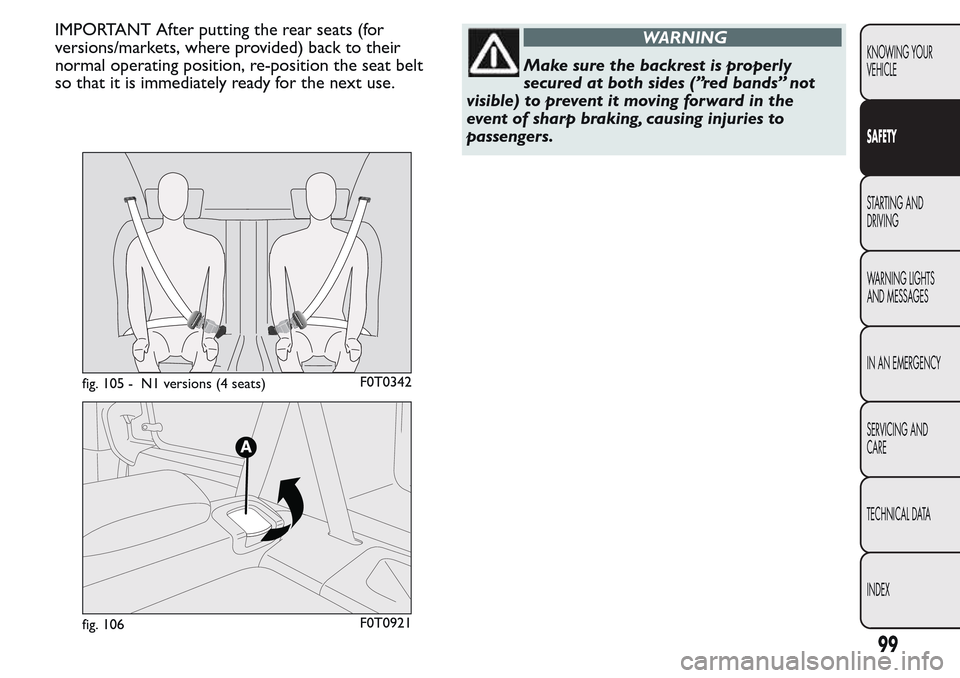
IMPORTANT After putting the rear seats (for
versions/markets, where provided) back to their
normal operating position, re-position the seat belt
so that it is immediately ready for the next use.WARNING
Make sure the backrest is properly
secured at both sides (”red bands” not
visible) to prevent it moving forward in the
event of sharp braking, causing injuries to
passengers.
fig. 105 - N1 versions (4 seats)F0T0342
fig. 106F0T0921
99
KNOWING YOUR
VEHICLE
SAFETY
STARTING AND
DRIVING
WARNING LIGHTS
AND MESSAGES
IN AN EMERGENCY
SERVICING AND
CARE
TECHNICAL DATA
INDEX
Page 109 of 260
FITTING A CHILD RESTRAINT SYSTEM
WITH SEAT BELTS
WARNING
Incorrect fitting of the child restraint
system may result in an inefficient
protection system. In the event of an accident
the child restraint system may become loose
and the child may be injured, even fatally.When
fitting a restraint system for newborns or
children, strictly comply with the instructions
provided by the Manufacturer.
WARNING
When the child restraint system is not
used, secure it with the seat belt or with
the ISOFIX anchorages, or remove it from the
vehicle. Do not leave it unsecured inside the
passenger compar tment . In this way, in the case
of sudden braking or an accident , it will not
cause injuries to the occupants.
WARNING
After installing a child restraint system,
do not move the seat : always remove
the child restraint system before making any
adjustment .
WARNING
Always make sure that the diagonal
section of the seat belt does not pass
under the arms or behind the back of the child.
In the event of an accident the seat belt will
not be able to secure the child, with the risk of
injury, including fatal injury.Therefore the
child must always wear the seat belt correctly.
WARNING
The figures are only examples for fitting
purposes. Fit the child restraint system
according to the instructions, which must be
included.
105
KNOWING YOUR
VEHICLE
SAFETY
STARTING AND
DRIVING
WARNING LIGHTS
AND MESSAGES
IN AN EMERGENCY
SERVICING AND
CARE
TECHNICAL DATA
INDEX
Page 129 of 260
HANDBRAKE
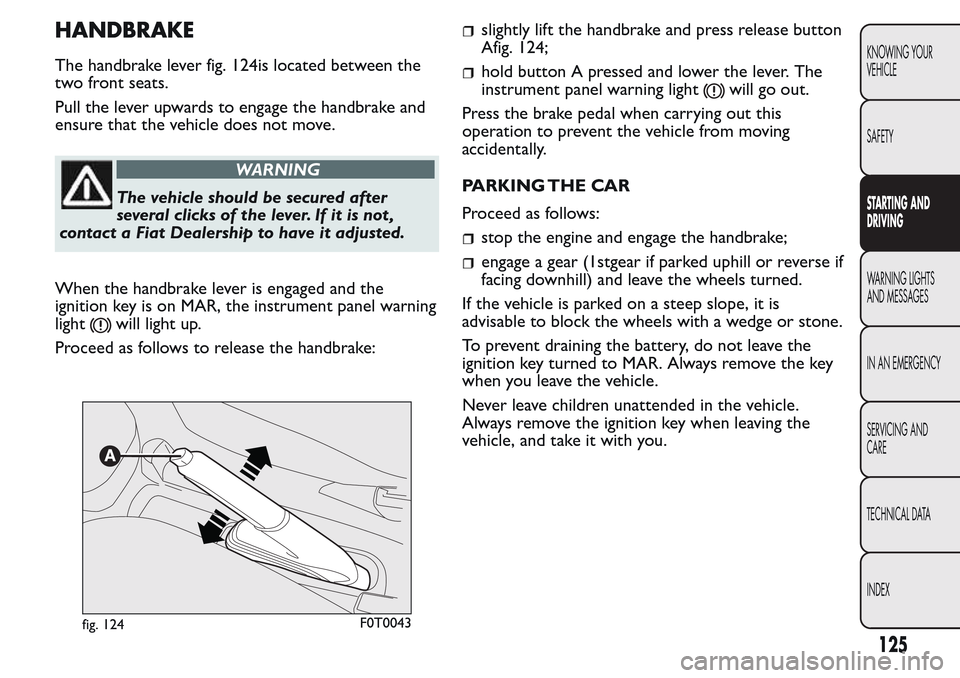
The handbrake lever fig. 124is located between the
two front seats.
Pull the lever upwards to engage the handbrake and
ensure that the vehicle does not move.
WARNING
The vehicle should be secured after
several clicks of the lever. If it is not ,
contact a Fiat Dealership to have it adjusted.
When the handbrake lever is engaged and the
ignition key is on MAR, the instrument panel warning
light
will light up.
Proceed as follows to release the handbrake:
slightly lift the handbrake and press release button
Afig. 124;
hold button A pressed and lower the lever. The
instrument panel warning light
will go out.
Press the brake pedal when carrying out this
operation to prevent the vehicle from moving
accidentally.
PARKING THE CAR
Proceed as follows:
stop the engine and engage the handbrake;
engage a gear (1stgear if parked uphill or reverse if
facing downhill) and leave the wheels turned.
If the vehicle is parked on a steep slope, it is
advisable to block the wheels with a wedge or stone.
To prevent draining the battery, do not leave the
ignition key turned to MAR. Always remove the key
when you leave the vehicle.
Never leave children unattended in the vehicle.
Always remove the ignition key when leaving the
vehicle, and take it with you.
fig. 124F0T0043
125
KNOWING YOUR
VEHICLE
SAFETY
STARTING AND
DRIVING
WARNING LIGHTS
AND MESSAGES
IN AN EMERGENCY
SERVICING AND
CARE
TECHNICAL DATA
INDEX
Page 152 of 260
WARNING
Use your hazard lights, warning triangle,
etc to show that your vehicle is
stationar y. Passengers should get out of the
vehicle, particularly if it is heavily loaded, and
wait for the wheel to be changed away from the
traffic . If you are on a slope or uneven surface,
place wedges or other suitable objects under
the wheels to secure the vehicle. Have the
wheel repaired and refitted as soon as possible.
Do not apply grease to the bolt threads before
fitting: they could come unscrewed.
WARNING
Use the jack only to replace wheels on
the vehicle with which it is supplied
or on other vehicles of the same model. Never
use the jack for other purposes, such as lifting
other models. Never use the jack to carr y out
repairs under the vehicle. Incorrect positioning
of the jack may cause the lifted vehicle to
fall. Do not use the jack for loads higher than
the one shown on its label.
WARNING
Incorrect hub cap assembly may cause it
to come off when the vehicle is moving.
Never tamper with the inflation valve. Never
introduce tools of any kind between rim and
tyre. Check tyre and space-saver wheel
pressures regularly, referring to the values
shown in the "Technical data" chapter.
Please note that:
the jack weight is 1.76 kg;
the jack requires no adjustment;
the jack cannot be repaired and in the event of a
fault it must be replaced by another genuine one;
no tool other than its cranking device may be
fitted on the jack.
To change a wheel, proceed as follows:
stop the vehicle in a position that is not dangerous
for oncoming traffic where you can change the
wheel safely. The ground must be flat and
sufficiently compact;
switch off the engine and pull the handbrake;
engage first gear or reverse;
wear the reflective safety jacket (compulsory by
law in certain countries) before getting out of
the vehicle;
148
KNOWING YOUR
VEHICLE
SAFETY
STARTING AND
DRIVING
WARNING LIGHTS
AND MESSAGES
IN AN
EMERGENCY
SERVICING AND
CARE
TECHNICAL DATA
INDEX
Page 156 of 260
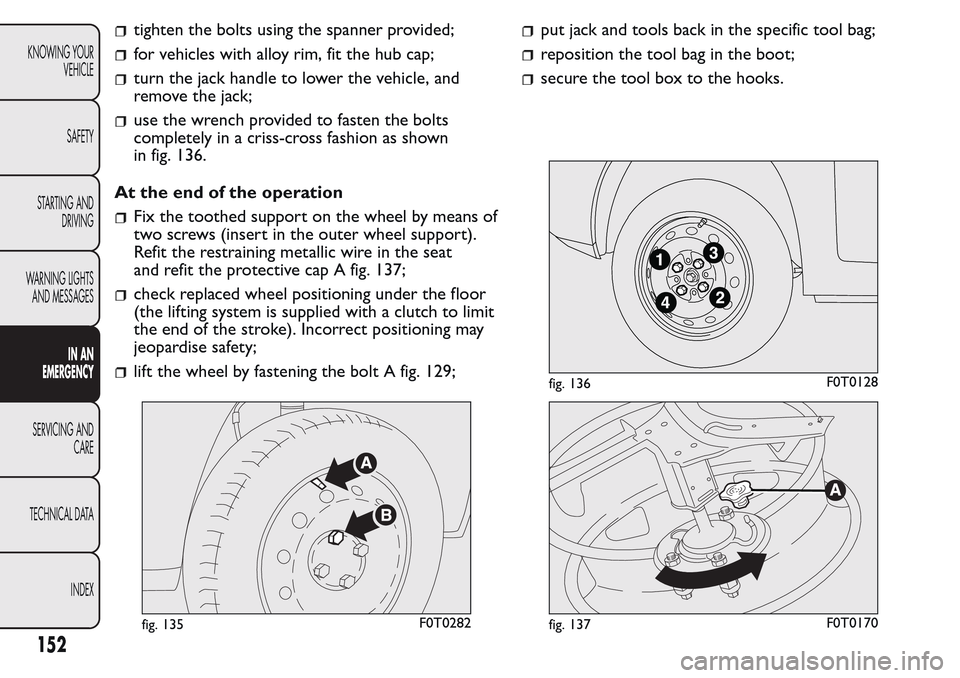
tighten the bolts using the spanner provided;
for vehicles with alloy rim, fit the hub cap;
turn the jack handle to lower the vehicle, and
remove the jack;
use the wrench provided to fasten the bolts
completely in a criss-cross fashion as shown
in fig. 136.
At the end of the operation
Fix the toothed support on the wheel by means of
two screws (insert in the outer wheel support).
Refit the restraining metallic wire in the seat
and refit the protective cap A fig. 137;
check replaced wheel positioning under the floor
(the lifting system is supplied with a clutch to limit
the end of the stroke). Incorrect positioning may
jeopardise safety;
lift the wheel by fastening the bolt A fig. 129;
put jack and tools back in the specific tool bag;
reposition the tool bag in the boot;
secure the tool box to the hooks.
fig. 135F0T0282
fig. 136F0T0128
fig. 137F0T0170
152
KNOWING YOUR
VEHICLE
SAFETY
STARTING AND
DRIVING
WARNING LIGHTS
AND MESSAGES
IN AN
EMERGENCY
SERVICING AND
CARE
TECHNICAL DATA
INDEX
Page 157 of 260
FIX & GO AUTOMATIC KIT
WARNING
The information required by the
applicable regulation is indicated on the
Fix&Go kit package label. Compliance with the
indications on the label is an essential condition
to ensure the safety and the effectiveness of
the Fix&Go kit . Carefully read the label before
use, avoid improper use. Fix&Go is subject to
expiration and must be replaced periodically.
The kit should be used by adults and cannot be
used by children.
Show the package and the label to the
personnel charged with handling the tyre
treated with the tyre repair kit .
Fix&Go provides a temporary repair,
therefore the tyre must be examined and
repaired by a specialist as soon as
possible.The sealing fluid is effective at
temperatures between -40°C and +50°C. It is
possible to repair tyres which have been damaged
on tread up to a diameter of 4mm; however,
tyres damaged on their side cannot be repaired.
Before using Fix&Go kit , ensure that the tyre isn't
excessively damaged and that the rim is in good
condition, otherwise do not use it and contact
a Fiat Dealership. Do not remove foreign bodies
from the tyre. Do not let the compressor turned
on for more than 20 consecutive minutes -
overheating hazard.
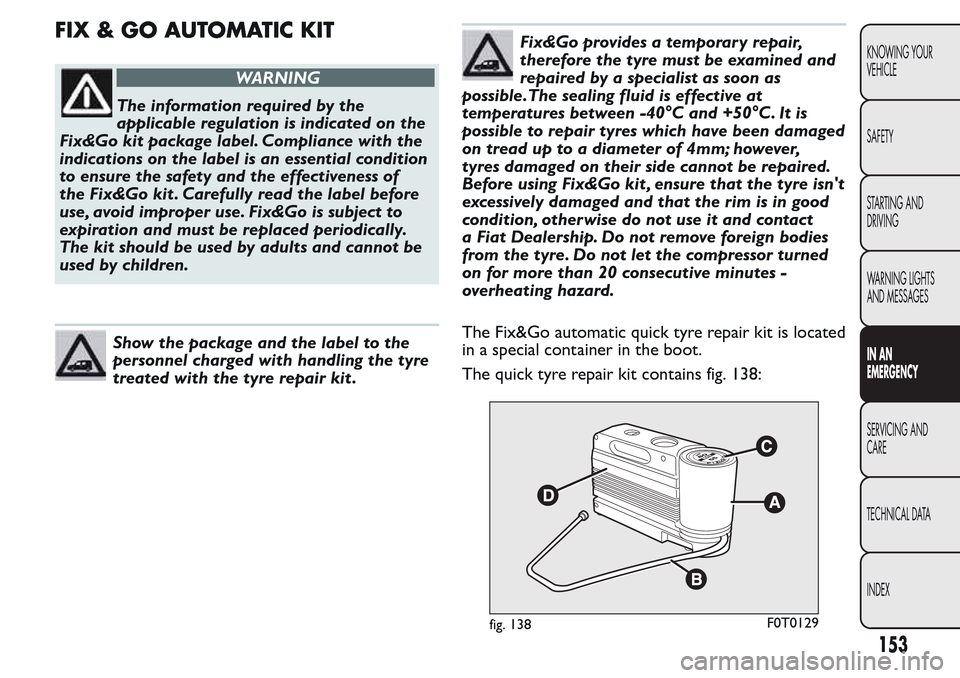
The Fix&Go automatic quick tyre repair kit is located
in a special container in the boot.
The quick tyre repair kit contains fig. 138:
fig. 138F0T0129
153
KNOWING YOUR
VEHICLE
SAFETY
STARTING AND
DRIVING
WARNING LIGHTS
AND MESSAGES
IN AN
EMERGENCY
SERVICING AND
CARE
TECHNICAL DATA
INDEX
Page 159 of 260
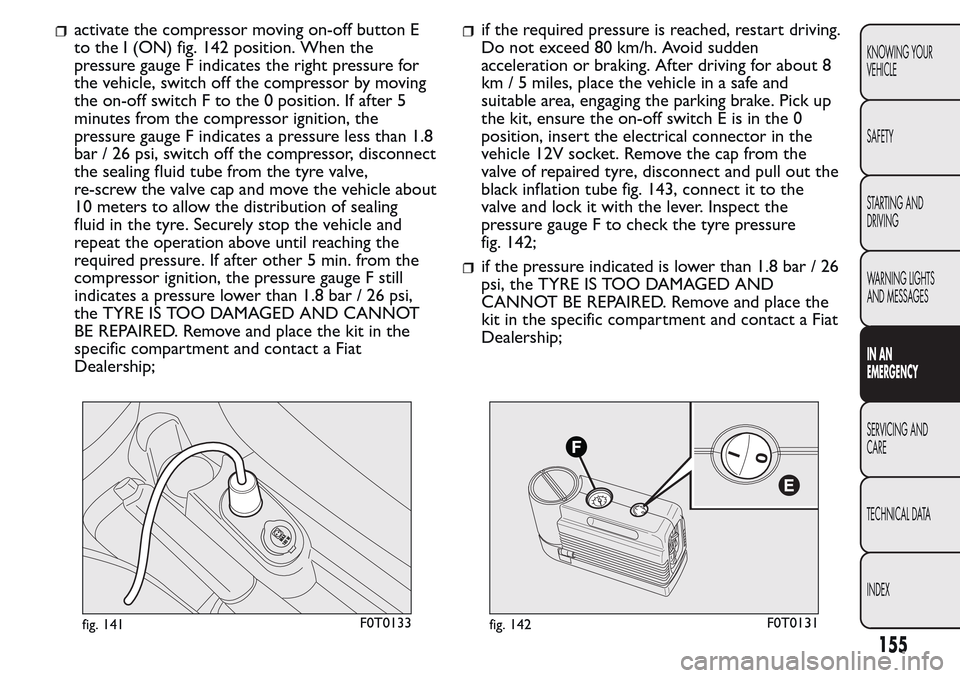
activate the compressor moving on-off button E
to the I (ON) fig. 142 position. When the
pressure gauge F indicates the right pressure for
the vehicle, switch off the compressor by moving
the on-off switch F to the 0 position. If after 5
minutes from the compressor ignition, the
pressure gauge F indicates a pressure less than 1.8
bar / 26 psi, switch off the compressor, disconnect
the sealing fluid tube from the tyre valve,
re-screw the valve cap and move the vehicle about
10 meters to allow the distribution of sealing
fluid in the tyre. Securely stop the vehicle and
repeat the operation above until reaching the
required pressure. If after other 5 min. from the
compressor ignition, the pressure gauge F still
indicates a pressure lower than 1.8 bar / 26 psi,
the TYRE IS TOO DAMAGED AND CANNOT
BE REPAIRED. Remove and place the kit in the
specific compartment and contact a Fiat
Dealership;if the required pressure is reached, restart driving.
Do not exceed 80 km/h. Avoid sudden
acceleration or braking. After driving for about 8
km / 5 miles, place the vehicle in a safe and
suitable area, engaging the parking brake. Pick up
the kit, ensure the on-off switch E is in the 0
position, insert the electrical connector in the
vehicle 12V socket. Remove the cap from the
valve of repaired tyre, disconnect and pull out the
black inflation tube fig. 143, connect it to the
valve and lock it with the lever. Inspect the
pressure gauge F to check the tyre pressure
fig. 142;
if the pressure indicated is lower than 1.8 bar / 26
psi, the TYRE IS TOO DAMAGED AND
CANNOT BE REPAIRED. Remove and place the
kit in the specific compartment and contact a Fiat
Dealership;
fig. 141F0T0133fig. 142F0T0131
155
KNOWING YOUR
VEHICLE
SAFETY
STARTING AND
DRIVING
WARNING LIGHTS
AND MESSAGES
IN AN
EMERGENCY
SERVICING AND
CARE
TECHNICAL DATA
INDEX
Page 170 of 260
CHANGING AN INTERIOR BULB
For the type of bulb and corresponding power rating,
see the paragraph "Changing a bulb".
FRONT CEILING LIGHT
Ceiling light with movable lens
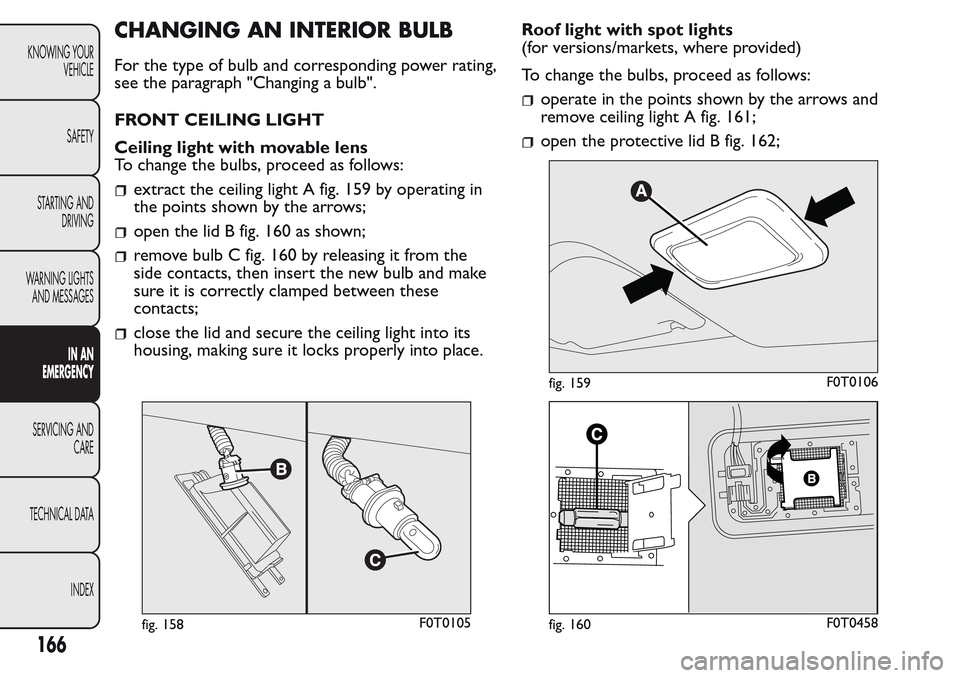
To change the bulbs, proceed as follows:
extract the ceiling light A fig. 159 by operating in
the points shown by the arrows;
open the lid B fig. 160 as shown;
remove bulb C fig. 160 by releasing it from the
side contacts, then insert the new bulb and make
sure it is correctly clamped between these
contacts;
close the lid and secure the ceiling light into its
housing, making sure it locks properly into place.Roof light with spot lights
(for versions/markets, where provided)
To change the bulbs, proceed as follows:
operate in the points shown by the arrows and
remove ceiling light A fig. 161;
open the protective lid B fig. 162;
fig. 158F0T0105
fig. 159F0T0106
fig. 160F0T0458
166
KNOWING YOUR
VEHICLE
SAFETY
STARTING AND
DRIVING
WARNING LIGHTS
AND MESSAGES
IN AN
EMERGENCY
SERVICING AND
CARE
TECHNICAL DATA
INDEX
Page 171 of 260
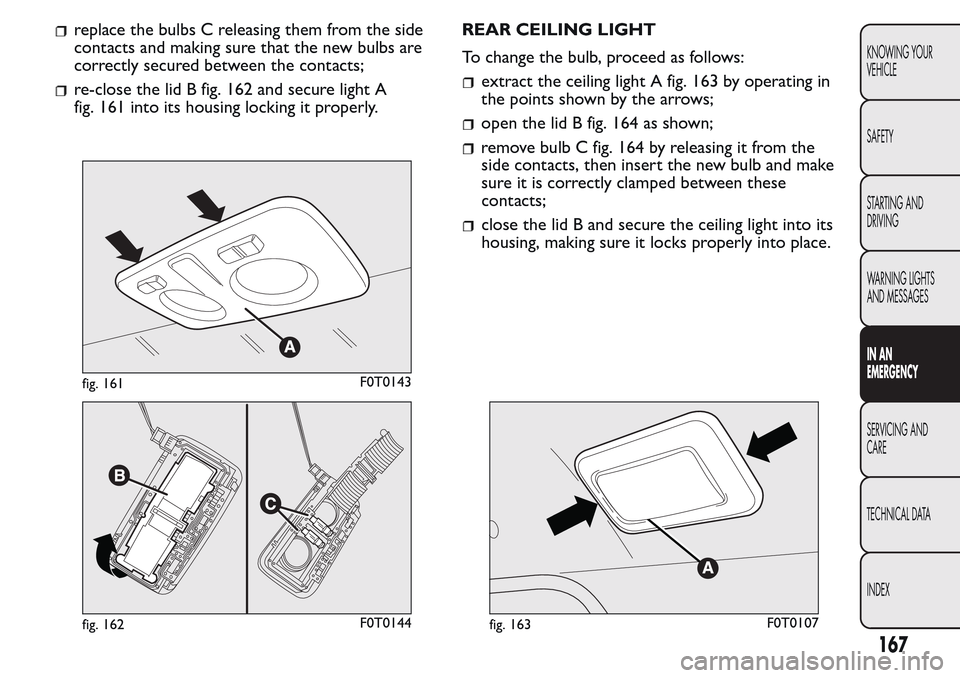
replace the bulbs C releasing them from the side
contacts and making sure that the new bulbs are
correctly secured between the contacts;
re-close the lid B fig. 162 and secure light A
fig. 161 into its housing locking it properly.REAR CEILING LIGHT
To change the bulb, proceed as follows:extract the ceiling light A fig. 163 by operating in
the points shown by the arrows;
open the lid B fig. 164 as shown;
remove bulb C fig. 164 by releasing it from the
side contacts, then insert the new bulb and make
sure it is correctly clamped between these
contacts;
close the lid B and secure the ceiling light into its
housing, making sure it locks properly into place.
fig. 161F0T0143
fig. 162F0T0144fig. 163F0T0107
167
KNOWING YOUR
VEHICLE
SAFETY
STARTING AND
DRIVING
WARNING LIGHTS
AND MESSAGES
IN AN
EMERGENCY
SERVICING AND
CARE
TECHNICAL DATA
INDEX
Page 180 of 260
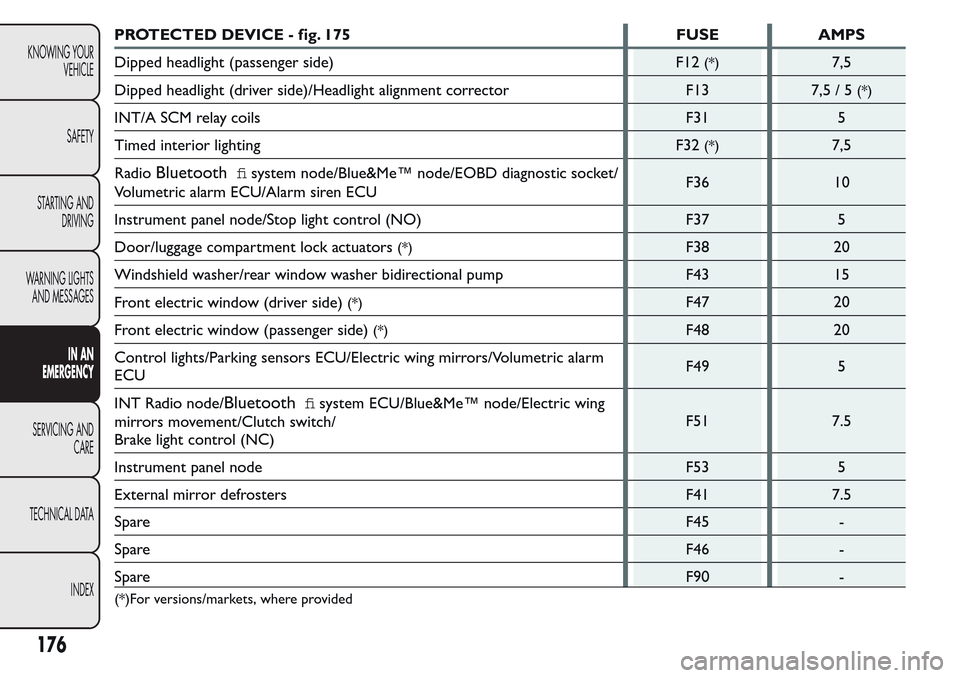
PROTECTED DEVICE - fig. 175 FUSE AMPS
Dipped headlight (passenger side)
F12
(*)7,5
Dipped headlight (driver side)/Headlight alignment corrector F13
7,5/5
(*)
INT/A SCM relay coils F31 5
Timed interior lighting
F32
(*)7,5
Radio
Bluetoothfisystem node/Blue&Me™ node/EOBD diagnostic socket/
Volumetric alarm ECU/Alarm siren ECUF36 10
Instrument panel node/Stop light control (NO) F37 5
Door/luggage compartment lock actuators
(*)F38 20
Windshield washer/rear window washer bidirectional pump F43 15
Front electric window (driver side)
(*)F47 20
Front electric window (passenger side)
(*)F48 20
Control lights/Parking sensors ECU/Electric wing mirrors/Volumetric alarm
ECUF49 5
INT Radio node/
Bluetoothfisystem ECU/Blue&Me™ node/Electric wing
mirrors movement/Clutch switch/
Brake light control (NC)F51 7.5
Instrument panel node F53 5
External mirror defrosters F41 7.5
SpareF45 -
SpareF46 -
SpareF90 -
(*)For versions/markets, where provided
176
KNOWING YOUR
VEHICLE
SAFETY
STARTING AND
DRIVING
WARNING LIGHTS
AND MESSAGES
IN AN
EMERGENCY
SERVICING AND
CARE
TECHNICAL DATA
INDEX