seats FIAT QUBO 2017 1.G Owners Manual
[x] Cancel search | Manufacturer: FIAT, Model Year: 2017, Model line: QUBO, Model: FIAT QUBO 2017 1.GPages: 260, PDF Size: 4.74 MB
Page 31 of 260
SEATS
FRONT SEATS
WARNING
All adjustments must be made with the
vehicle stationary.
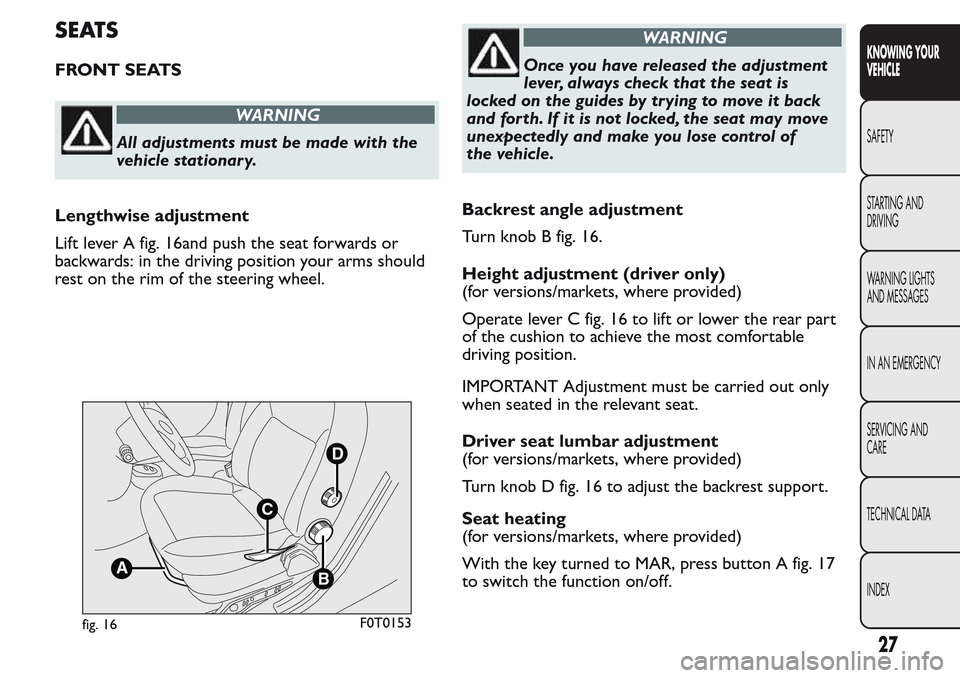
Lengthwise adjustment
Lift lever A fig. 16and push the seat forwards or
backwards: in the driving position your arms should
rest on the rim of the steering wheel.
WARNING
Once you have released the adjustment
lever, always check that the seat is
locked on the guides by trying to move it back
and forth. If it is not locked, the seat may move
unexpectedly and make you lose control of
the vehicle.
Backrest angle adjustment
Turn knob B fig. 16.
Height adjustment (driver only)
(for versions/markets, where provided)
Operate lever C fig. 16 to lift or lower the rear part
of the cushion to achieve the most comfortable
driving position.
IMPORTANT Adjustment must be carried out only
when seated in the relevant seat.
Driver seat lumbar adjustment
(for versions/markets, where provided)
Turn knob D fig. 16 to adjust the backrest support.
Seat heating
(for versions/markets, where provided)
With the key turned to MAR, press button A fig. 17
to switch the function on/off.
B
D
C
A
fig. 16F0T0153
27
KNOWING YOUR
VEHICLE
SAFETY
STARTING AND
DRIVING
WARNING LIGHTS
AND MESSAGES
IN AN EMERGENCY
SERVICING AND
CARE
TECHNICAL DATA
INDEX
Page 33 of 260
Repositioning the seat
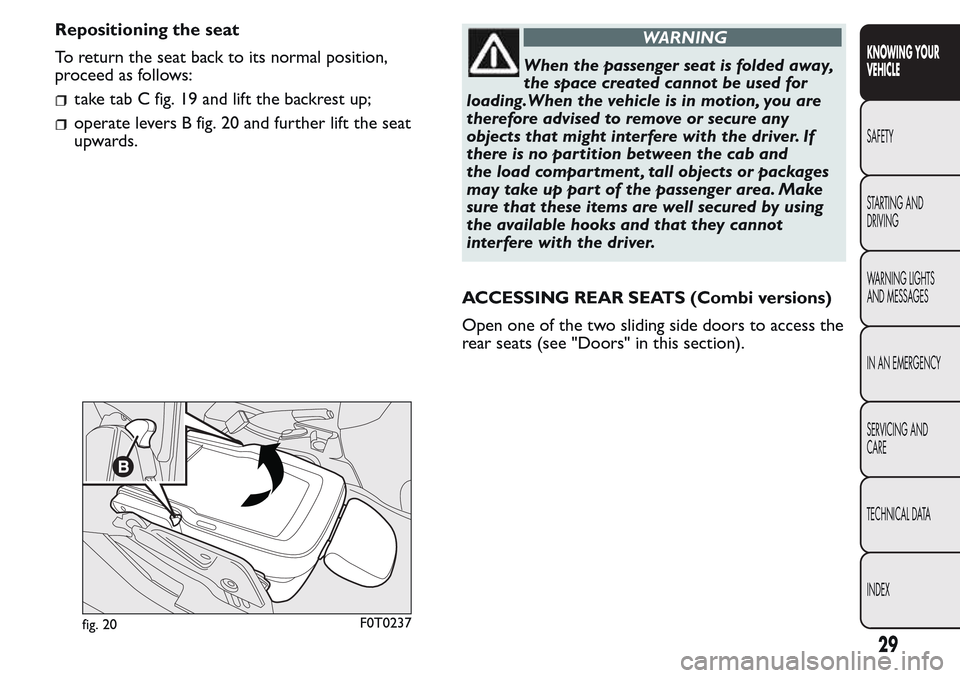
To return the seat back to its normal position,
proceed as follows:
take tab C fig. 19 and lift the backrest up;
operate levers B fig. 20 and further lift the seat
upwards.
WARNING
When the passenger seat is folded away,
the space created cannot be used for
loading.When the vehicle is in motion, you are
therefore advised to remove or secure any
objects that might interfere with the driver. If
there is no partition between the cab and
the load compartment , tall objects or packages
may take up par t of the passenger area. Make
sure that these items are well secured by using
the available hooks and that they cannot
interfere with the driver.
ACCESSING REAR SEATS (Combi versions)
Open one of the two sliding side doors to access the
rear seats (see "Doors" in this section).
fig. 20F0T0237
29
KNOWING YOUR
VEHICLE
SAFETY
STARTING AND
DRIVING
WARNING LIGHTS
AND MESSAGES
IN AN EMERGENCY
SERVICING AND
CARE
TECHNICAL DATA
INDEX
Page 34 of 260
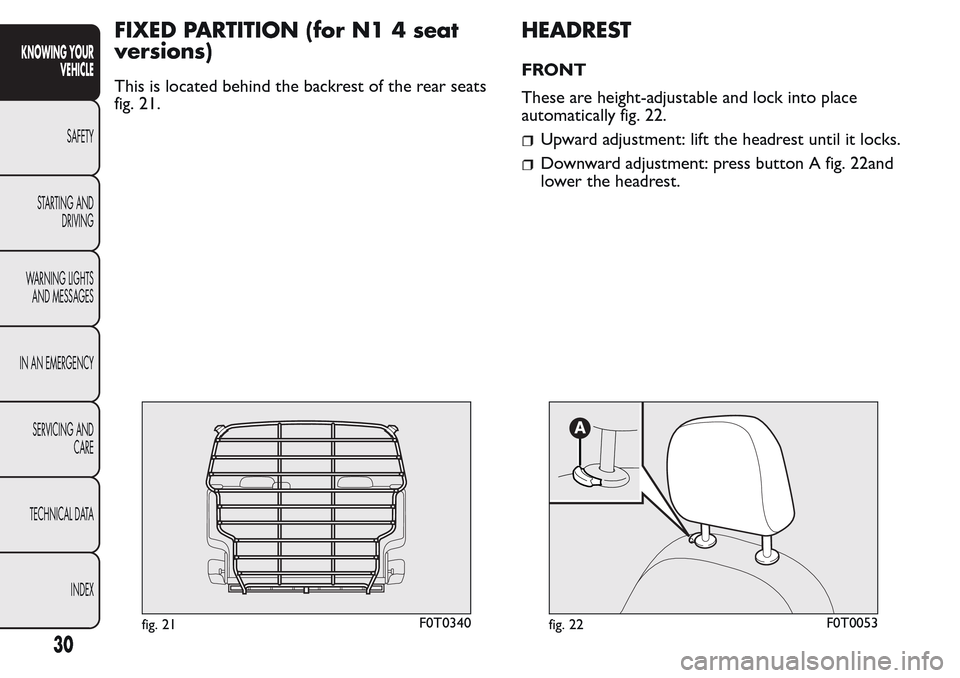
FIXED PARTITION (for N1 4 seat
versions)
This is located behind the backrest of the rear seats
fig. 21.
HEADREST
FRONT
These are height-adjustable and lock into place
automatically fig. 22.
Upward adjustment: lift the headrest until it locks.
Downward adjustment: press button A fig. 22and
lower the headrest.
fig. 21F0T0340fig. 22F0T0053
30
KNOWING YOUR
VEHICLE
SAFETY
STARTING AND
DRIVING
WARNING LIGHTS
AND MESSAGES
IN AN EMERGENCY
SERVICING AND
CARE
TECHNICAL DATA
INDEX
Page 35 of 260
WARNING
All adjustments must be carried out only
with the vehicle stationary and the
engine off. Headrests must be adjusted so that
the head, rather than the neck, rests on them.
Only in this case they can protect your head
correctly.To maximise the protective action
provided by the headrest , adjust the seat back
so that your trunk is upright and keep your
head as close to the headrest as possible.
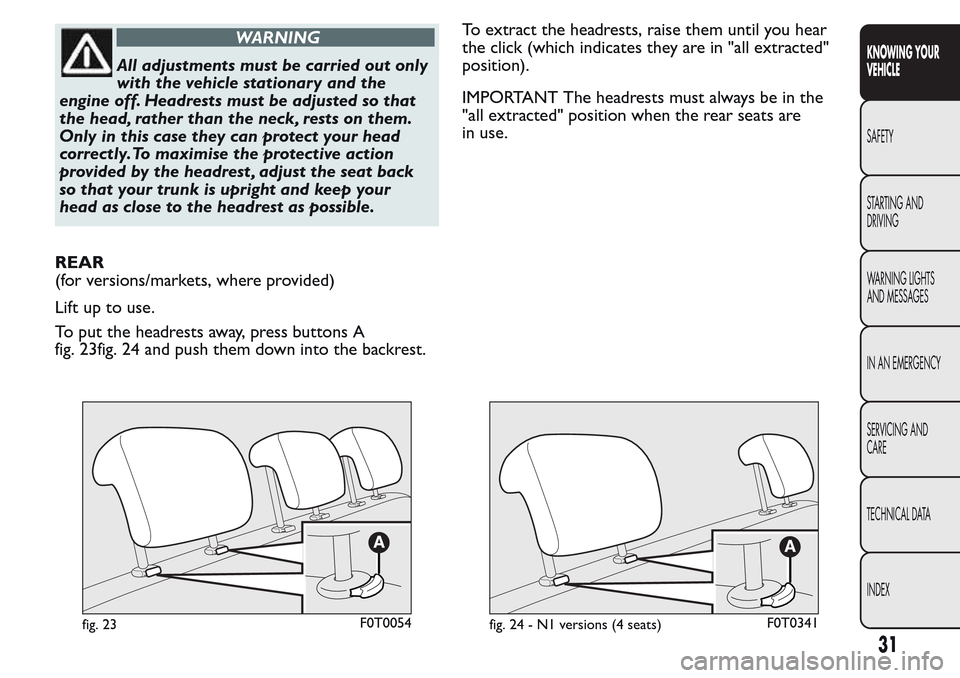
REAR
(for versions/markets, where provided)
Lift up to use.
To put the headrests away, press buttons A
fig. 23fig. 24 and push them down into the backrest.To extract the headrests, raise them until you hear
the click (which indicates they are in "all extracted"
position).
IMPORTANT The headrests must always be in the
"all extracted" position when the rear seats are
in use.
fig. 23F0T0054fig. 24 - N1 versions (4 seats)F0T0341
31
KNOWING YOUR
VEHICLE
SAFETY
STARTING AND
DRIVING
WARNING LIGHTS
AND MESSAGES
IN AN EMERGENCY
SERVICING AND
CARE
TECHNICAL DATA
INDEX
Page 64 of 260
The tailgate can be opened at any time if the doors
are unlocked.
To open it, enable the handle, opening one of the
front doors or unlocking the doors with the remote
control or using the key without remote control.
The tailgate unlocks also by pressing the
button
on the remote control.
To close the tailgate use handle B fig. 64.
Do not tr y to close the tailgate by
pressing on the side shock absorbers C
fig. 64. Also be careful not to knock the
side shock absorbers when you load the boot , to
avoid damaging them.
EMERGENCY OPENING FROM THE INSIDE
In the event of an emergency, you can open the
tailgate from inside as follows:
Open the sliding side door and fully fold the rear
seats;
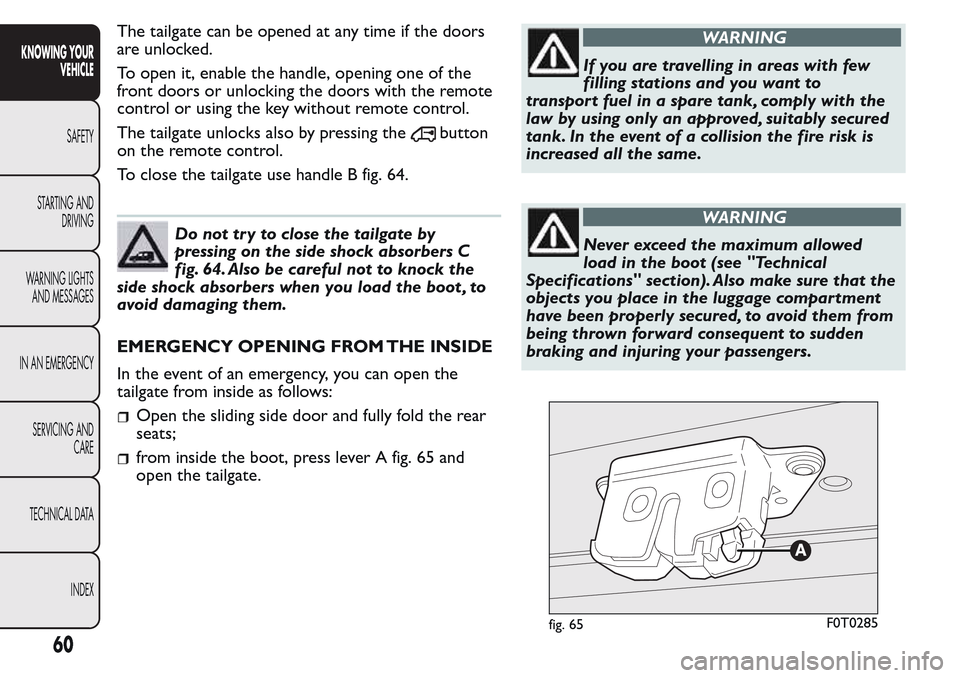
from inside the boot, press lever A fig. 65 and
open the tailgate.
WARNING
If you are travelling in areas with few
filling stations and you want to
transport fuel in a spare tank, comply with the
law by using only an approved, suitably secured
tank. In the event of a collision the fire risk is
increased all the same.
WARNING
Never exceed the maximum allowed
load in the boot (see "Technical
Specifications" section). Also make sure that the
objects you place in the luggage compar tment
have been properly secured, to avoid them from
being thrown forward consequent to sudden
braking and injuring your passengers.
fig. 65F0T0285
60
KNOWING YOUR
VEHICLE
SAFETY
STARTING AND
DRIVING
WARNING LIGHTS
AND MESSAGES
IN AN EMERGENCY
SERVICING AND
CARE
TECHNICAL DATA
INDEX
Page 66 of 260
To close the door, turn the key in the lock or press
the
button on the remote control.
WARNING
When closing, shut the right-hand door 2
fig. 66 fully before you close the
left-hand door 1 fig. 66. Never shut the two
doors at the same time.
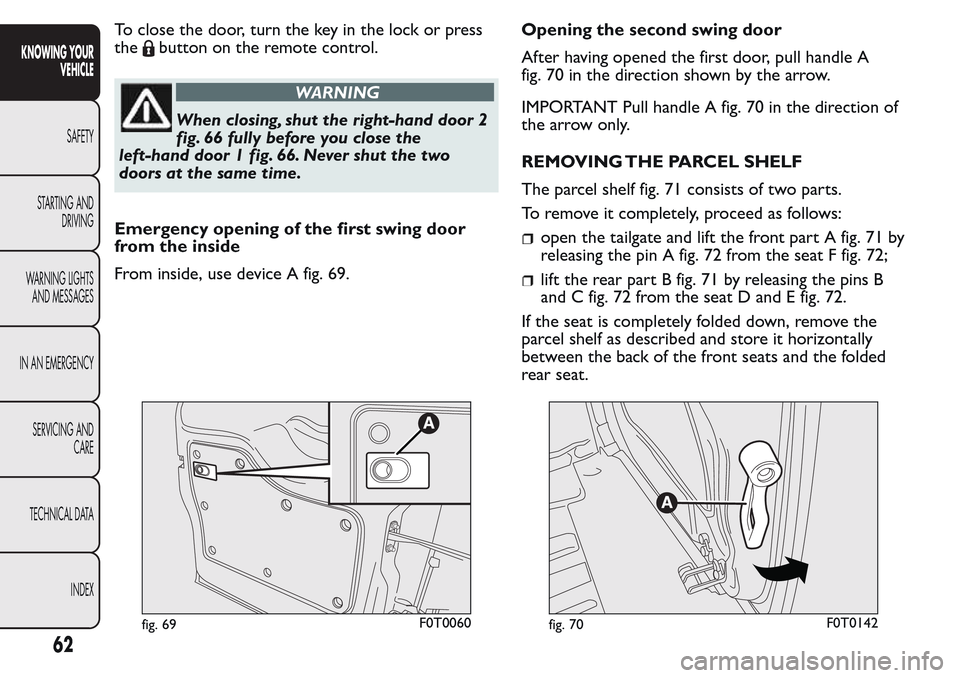
Emergency opening of the first swing door
from the inside
From inside, use device A fig. 69.Opening the second swing door
After having opened the first door, pull handle A
fig. 70 in the direction shown by the arrow.
IMPORTANT Pull handle A fig. 70 in the direction of
the arrow only.
REMOVING THE PARCEL SHELF
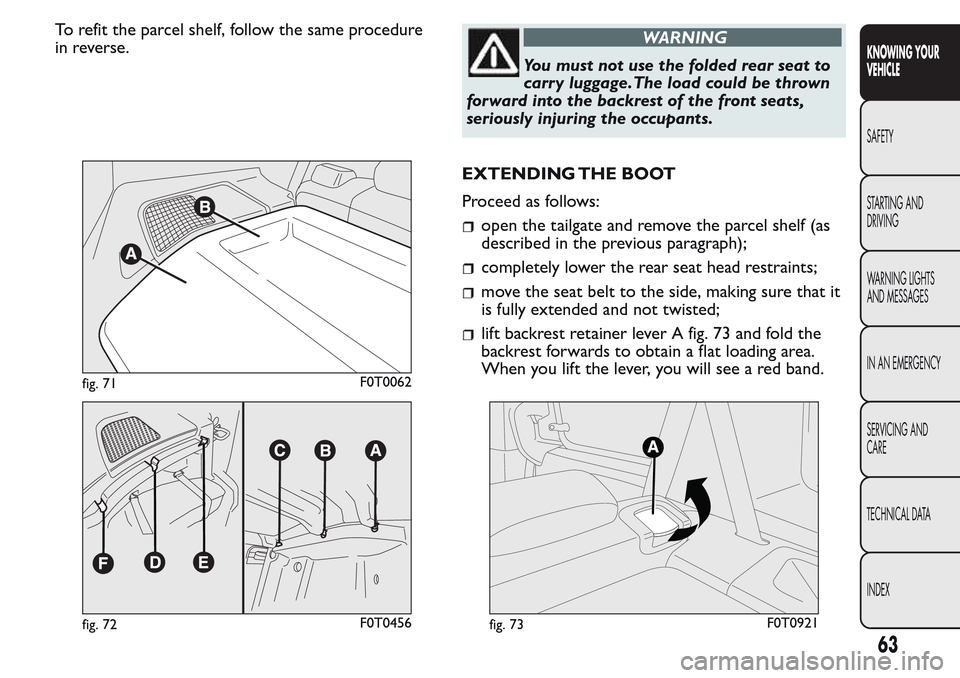
The parcel shelf fig. 71 consists of two parts.
To remove it completely, proceed as follows:
open the tailgate and lift the front part A fig. 71 by
releasing the pin A fig. 72 from the seat F fig. 72;
lift the rear part B fig. 71 by releasing the pins B
and C fig. 72 from the seat D and E fig. 72.
If the seat is completely folded down, remove the
parcel shelf as described and store it horizontally
between the back of the front seats and the folded
rear seat.
fig. 69F0T0060fig. 70F0T0142
62
KNOWING YOUR
VEHICLE
SAFETY
STARTING AND
DRIVING
WARNING LIGHTS
AND MESSAGES
IN AN EMERGENCY
SERVICING AND
CARE
TECHNICAL DATA
INDEX
Page 67 of 260
To refit the parcel shelf, follow the same procedure
in reverse.WARNING
You must not use the folded rear seat to
carr y luggage.The load could be thrown
forward into the backrest of the front seats,
seriously injuring the occupants.
EXTENDING THE BOOT
Proceed as follows:
open the tailgate and remove the parcel shelf (as
described in the previous paragraph);
completely lower the rear seat head restraints;
move the seat belt to the side, making sure that it
is fully extended and not twisted;
lift backrest retainer lever A fig. 73 and fold the
backrest forwards to obtain a flat loading area.
When you lift the lever, you will see a red band.
fig. 71F0T0062
fig. 72F0T0456fig. 73F0T0921
63
KNOWING YOUR
VEHICLE
SAFETY
STARTING AND
DRIVING
WARNING LIGHTS
AND MESSAGES
IN AN EMERGENCY
SERVICING AND
CARE
TECHNICAL DATA
INDEX
Page 69 of 260
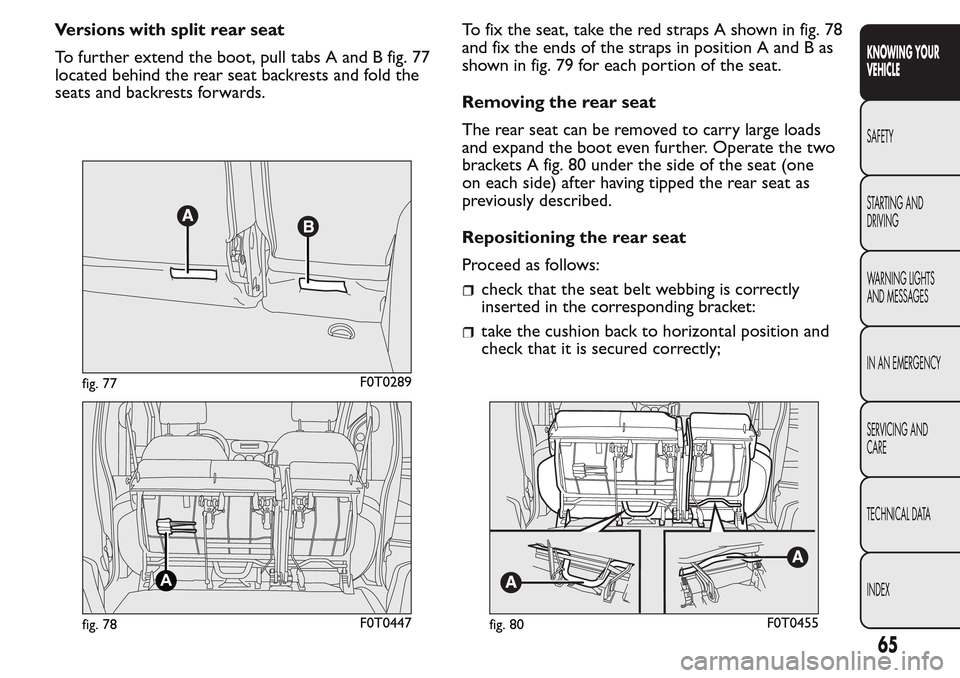
Versions with split rear seat
To further extend the boot, pull tabs A and B fig. 77
located behind the rear seat backrests and fold the
seats and backrests forwards.To fix the seat, take the red straps A shown in fig. 78
and fix the ends of the straps in position A and B as
shown in fig. 79 for each portion of the seat.
Removing the rear seat
The rear seat can be removed to carry large loads
and expand the boot even further. Operate the two
brackets A fig. 80 under the side of the seat (one
on each side) after having tipped the rear seat as
previously described.
Repositioning the rear seat
Proceed as follows:
check that the seat belt webbing is correctly
inserted in the corresponding bracket:
take the cushion back to horizontal position and
check that it is secured correctly;
fig. 77F0T0289
A
fig. 78F0T0447fig. 80F0T0455
65
KNOWING YOUR
VEHICLE
SAFETY
STARTING AND
DRIVING
WARNING LIGHTS
AND MESSAGES
IN AN EMERGENCY
SERVICING AND
CARE
TECHNICAL DATA
INDEX
Page 75 of 260
Adjusting headlight alignment
Press the
orbuttons on the control
panelfig. 90.
The instrument panel display shows the position in
relation to the adjustment set.
Position 0 - one or two people in the front seats.
Position1-fivepeople.
Position2-fivepeople + load in the boot.
Position 3 - driver + maximum permitted load
stowed in the boot.
IMPORTANT Check the alignment of the light beams
each time the weight of the load transported
changes.
FOG LIGHT DIRECTION
(for versions/markets, where provided)
Contact a Fiat Dealership to have the direction
checked and, if necessary, adjusted.
ADJUSTING THE HEADLIGHTS WHEN
ABROAD
The dipped headlights are directed for operation in
the country where the vehicle was originally
purchased. In countries where you drive on the
other side of the road, you need to alter the beam
direction by affixing a specially designed self-adhesive
film in order not to dazzle the vehicles travelling in
the opposite direction.
ABS SYSTEM
This is an integral part of the braking system, which
prevents one or more wheels from locking or
slipping regardless of the road surface conditions and
braking intensity, giving the best control during
emergency braking.
The EBD system (Electronic Braking Force
Distribution) completes the system, allowing the
brake force to be distributed between the front and
rear wheels.
IMPORTANT For maximum efficiency of the braking
system, a bedding-in period of about 500 km is
needed: during this period it is better to avoid sharp,
repeated and prolonged braking.
SYSTEM INTERVENTION
The driver can tell the ABS system has come into
action because the brake pedal pulsates slightly and
the system gets noisier: it means that the vehicle
speed should be altered to suit the type of road
surface.
MECHANICAL BRAKE ASSIST (emergency
braking assistance)
(for versions/markets, where provided)
This system, which cannot be deactivated, recognises
emergency braking conditions (according to the
brake pedal operation speed) and provides an
additional hydraulic braking pressure to support that
71
KNOWING YOUR
VEHICLE
SAFETY
STARTING AND
DRIVING
WARNING LIGHTS
AND MESSAGES
IN AN EMERGENCY
SERVICING AND
CARE
TECHNICAL DATA
INDEX
Page 101 of 260
SAFETY
OCCUPANT PROTECTION SYSTEMS
Some of the most important safety equipment of the
vehicle comprise the following protection systems:
seat belts;
SBR (Seat Belt Reminder) system;
head restraints;
child restraint systems;
front, side airbag (for versions/markets, where
provided).
Read the information given the following pages with
the utmost care.
It is of fundamental importance that the protection
systems are used in the correct way to guarantee the
maximum possible safety level for the driver and
the passengers.
For the description of the head restraint adjustment
see the "Head restraints" paragraph in the "Knowing
your vehicle" chapter.
SEAT BELTS
USING THE SEAT BELTS
All vehicle seats are equipped with seat belts with
three anchor points and a retractor.
The retractor mechanism operates locking the belt in
the event of sharp braking or strong deceleration
due to an impact.
This allows the belt strap to slide freely and to adapt
to the body of the occupant.
In the event of an accident, the belt will lock
reducing the risk of impact inside the passenger
compartment and of being projected outside the
vehicle. The driver is responsible for respecting, and
ensuring that all the other occupants of the vehicle
also respect, the local laws in force in relation to the
use of the seat belts.
Always fasten the seat belts before setting off.
The seat belt should be worn keeping the chest
straight and rested against the backrest.
To fasten the seat belts, hold the tongue A fig. 103
and insert it into the buckle B, until it clicks into
place.
If the seat belt jams during removal, let it rewind for
a short stretch, then pull it out again without jerking.
97
KNOWING YOUR
VEHICLE
SAFETY
STARTING AND
DRIVING
WARNING LIGHTS
AND MESSAGES
IN AN EMERGENCY
SERVICING AND
CARE
TECHNICAL DATA
INDEX