seats FIAT QUBO 2017 1.G User Guide
[x] Cancel search | Manufacturer: FIAT, Model Year: 2017, Model line: QUBO, Model: FIAT QUBO 2017 1.GPages: 260, PDF Size: 4.74 MB
Page 103 of 260
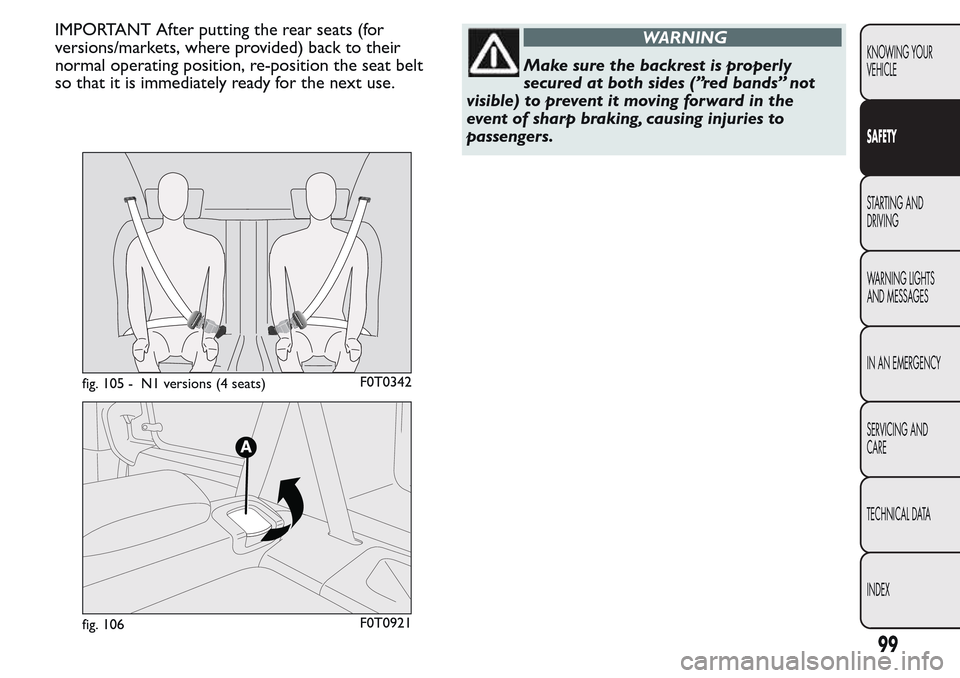
IMPORTANT After putting the rear seats (for
versions/markets, where provided) back to their
normal operating position, re-position the seat belt
so that it is immediately ready for the next use.WARNING
Make sure the backrest is properly
secured at both sides (”red bands” not
visible) to prevent it moving forward in the
event of sharp braking, causing injuries to
passengers.
fig. 105 - N1 versions (4 seats)F0T0342
fig. 106F0T0921
99
KNOWING YOUR
VEHICLE
SAFETY
STARTING AND
DRIVING
WARNING LIGHTS
AND MESSAGES
IN AN EMERGENCY
SERVICING AND
CARE
TECHNICAL DATA
INDEX
Page 106 of 260
WARNING
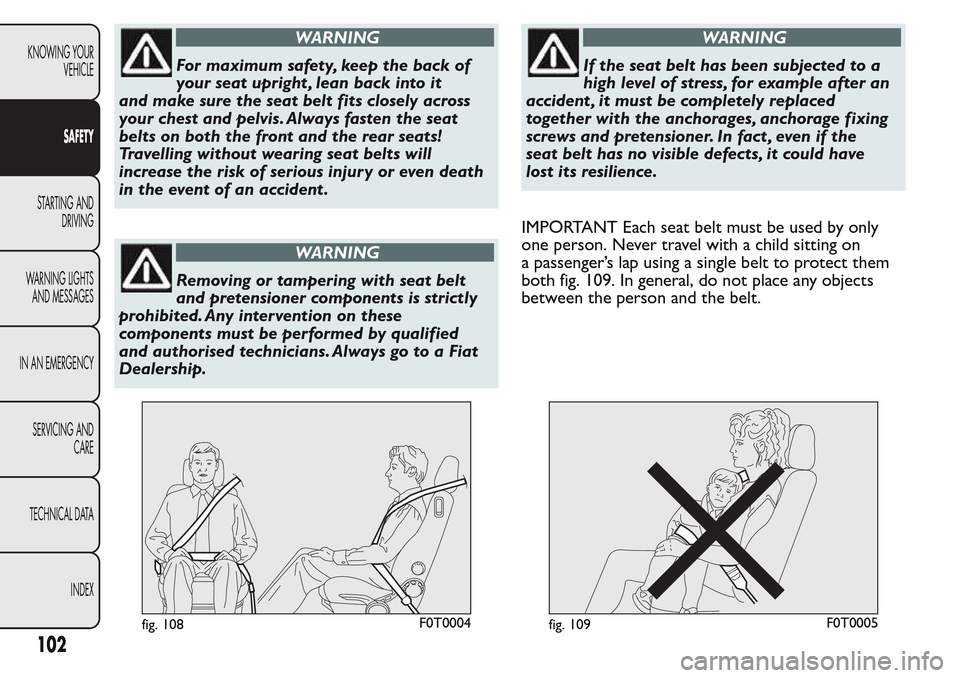
For maximum safety, keep the back of
your seat upright , lean back into it
and make sure the seat belt fits closely across
your chest and pelvis. Always fasten the seat
belts on both the front and the rear seats!
Travelling without wearing seat belts will
increase the risk of serious injur y or even death
in the event of an accident .
WARNING
Removing or tampering with seat belt
and pretensioner components is strictly
prohibited. Any intervention on these
components must be performed by qualified
and authorised technicians. Always go to a Fiat
Dealership.
WARNING
If the seat belt has been subjected to a
high level of stress, for example after an
accident , it must be completely replaced
together with the anchorages, anchorage fixing
screws and pretensioner. In fact , even if the
seat belt has no visible defects, it could have
lost its resilience.
IMPORTANT Each seat belt must be used by only
one person. Never travel with a child sitting on
a passenger’s lap using a single belt to protect them
both fig. 109. In general, do not place any objects
between the person and the belt.
fig. 108F0T0004fig. 109F0T0005
102
KNOWING YOUR
VEHICLE
SAFETY
STARTING AND
DRIVING
WARNING LIGHTS
AND MESSAGES
IN AN EMERGENCY
SERVICING AND
CARE
TECHNICAL DATA
INDEX
Page 107 of 260
SEAT BELTS MAINTENANCE
For keeping the seat belts in efficient conditions,
carefully observe the following warnings:
always use the seat belt with the strap well
stretched and not twisted; make sure that it
is free to run without obstructions;
check seat belt operation as follows: attach the
seat belt and pull it hard;
replace the belt after an accident of a certain
severity even if it does not appear to be damaged.
Always replace the seat belt if the pretensioners
were deployed;
prevent the retractors from getting wet: their
correct operation is only guaranteed if water does
not get inside;
replace the seat belt when it shows wear or cuts.
CARRYING CHILDREN SAFELY
For optimal protection in the event of an impact, all
occupants must be seated and wearing adequate
restraint systems, including newborn and other
children!
This prescription is compulsory in all EC countries
according to EC Directive 2003/20/EC.
Children below the height of 1.50 metres and up to
12 years must be protected with suitable restraint
systems and be seated on the rear seats. Statistics on
accidents indicate that the rear seats offer greater
safety for children.
Compared with an adult, a child's head is larger and
heavier in proportion to their body and the child's
muscular and bone structures are not fully
developed. Therefore, correct restraint systems
other than adult seat belts are necessary to reduce
as much as possible the risk of injuries in the event
of an accident, braking or a sudden manoeuvre.
Children must be seated safely and comfortably.
Depending on the characteristics of the child
restraint systems used, you are advised to keep
children in rearward facing child restraint systems for
as long as possible (at least until 3-4 years old),
since this is the most protected position in the event
of an impact.
It is recommended to always choose the restraint
system most suitable for the child; for this reason
always refer to the Owner Handbook provided with
the child restraint system, to be sure that it is of
the right type for the children it is intended for.
103
KNOWING YOUR
VEHICLE
SAFETY
STARTING AND
DRIVING
WARNING LIGHTS
AND MESSAGES
IN AN EMERGENCY
SERVICING AND
CARE
TECHNICAL DATA
INDEX
Page 112 of 260
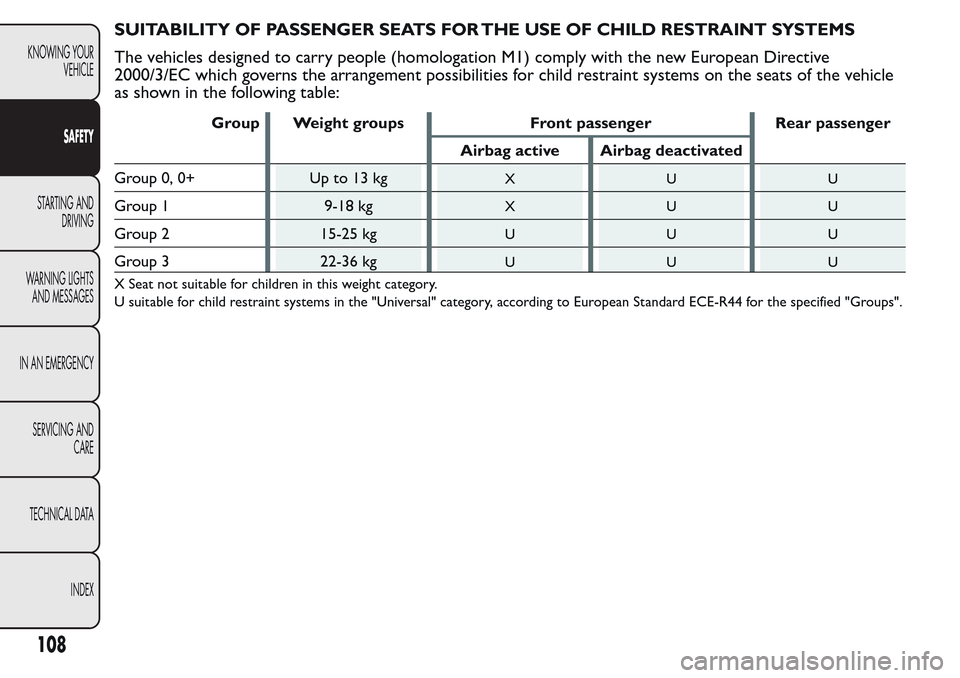
SUITABILITY OF PASSENGER SEATS FOR THE USE OF CHILD RESTRAINT SYSTEMS
The vehicles designed to carry people (homologation M1) comply with the new European Directive
2000/3/EC which governs the arrangement possibilities for child restraint systems on the seats of the vehicle
as shown in the following table:
Group Weight groups Front passenger Rear passenger
Airbag active Airbag deactivated
Group 0, 0+ Up to 13 kg
XUU
Group 1 9-18 kgXUU
Group 2 15-25 kgUUU
Group 3 22-36 kgUUU
X Seat not suitable for children in this weight category.
U suitable for child restraint systems in the "Universal" category, according to European Standard ECE-R44 for the specified "Groups".
108
KNOWING YOUR
VEHICLE
SAFETY
STARTING AND
DRIVING
WARNING LIGHTS
AND MESSAGES
IN AN EMERGENCY
SERVICING AND
CARE
TECHNICAL DATA
INDEX
Page 113 of 260
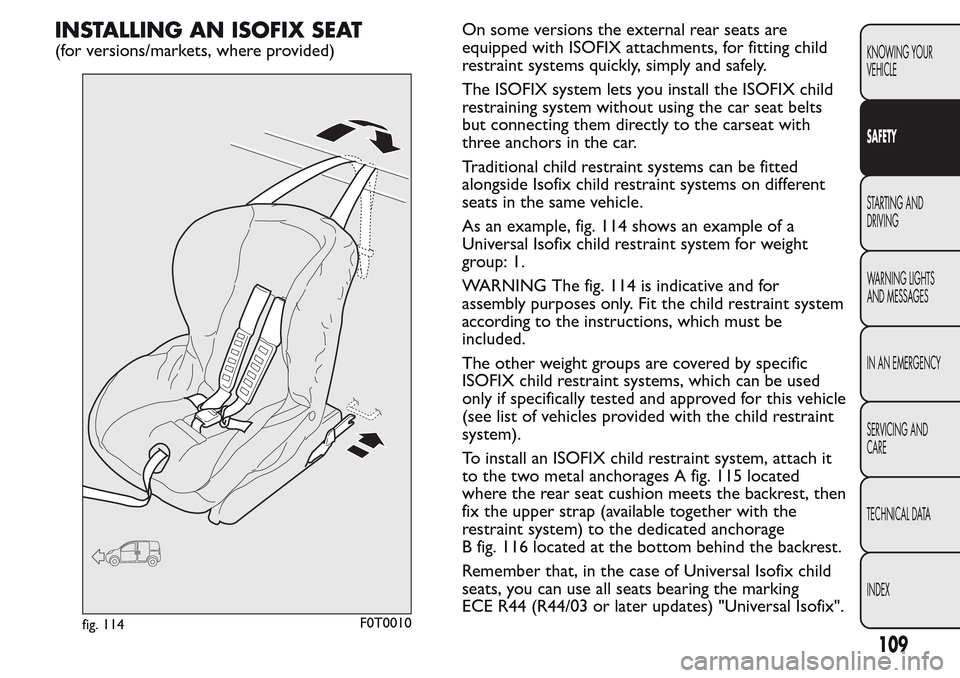
INSTALLING AN ISOFIX SEAT
(for versions/markets, where provided)On some versions the external rear seats are
equipped with ISOFIX attachments, for fitting child
restraint systems quickly, simply and safely.
The ISOFIX system lets you install the ISOFIX child
restraining system without using the car seat belts
but connecting them directly to the carseat with
three anchors in the car.
Traditional child restraint systems can be fitted
alongside Isofix child restraint systems on different
seats in the same vehicle.
As an example, fig. 114 shows an example of a
Universal Isofix child restraint system for weight
group: 1.
WARNING The fig. 114 is indicative and for
assembly purposes only. Fit the child restraint system
according to the instructions, which must be
included.
The other weight groups are covered by specific
ISOFIX child restraint systems, which can be used
only if specifically tested and approved for this vehicle
(see list of vehicles provided with the child restraint
system).
To install an ISOFIX child restraint system, attach it
to the two metal anchorages A fig. 115 located
where the rear seat cushion meets the backrest, then
fix the upper strap (available together with the
restraint system) to the dedicated anchorage
B fig. 116 located at the bottom behind the backrest.
Remember that, in the case of Universal Isofix child
seats, you can use all seats bearing the marking
ECE R44 (R44/03 or later updates) "Universal Isofix".
fig. 114F0T0010
109
KNOWING YOUR
VEHICLE
SAFETY
STARTING AND
DRIVING
WARNING LIGHTS
AND MESSAGES
IN AN EMERGENCY
SERVICING AND
CARE
TECHNICAL DATA
INDEX
Page 115 of 260
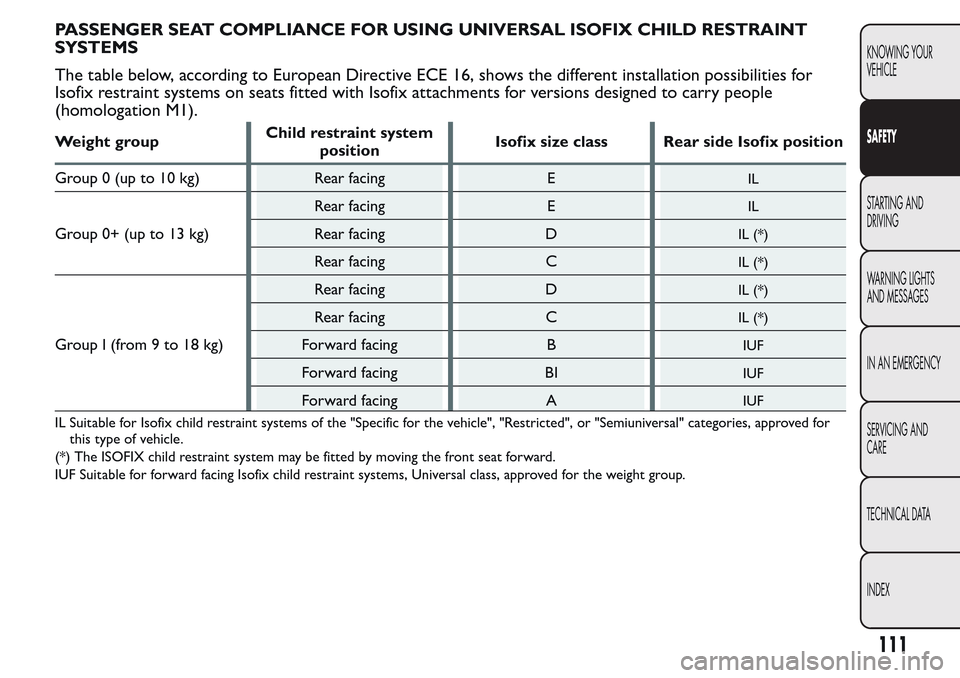
PASSENGER SEAT COMPLIANCE FOR USING UNIVERSAL ISOFIX CHILD RESTRAINT
SYSTEMS
The table below, according to European Directive ECE 16, shows the different installation possibilities for
Isofix restraint systems on seats fitted with Isofix attachments for versions designed to carry people
(homologation M1).
Weight groupChild restraint system
positionIsofix size class Rear side Isofix position
Group 0 (up to 10 kg) Rear facing E
IL
Group 0+ (up to 13 kg)Rear facing E
IL
Rear facing DIL (*)
Rear facing CIL (*)
GroupI(from9to18kg)Rear facing D
IL (*)
Rear facing CIL (*)
Forward facing BIUF
Forward facing BIIUF
Forward facing AIUF
IL Suitable for Isofix child restraint systems of the "Specific for the vehicle", "Restricted", or "Semiuniversal" categories, approved for
this type of vehicle.
(*) The ISOFIX child restraint system may be fitted by moving the front seat forward.
IUF Suitable for forward facing Isofix child restraint systems, Universal class, approved for the weight group.
111
KNOWING YOUR
VEHICLE
SAFETY
STARTING AND
DRIVING
WARNING LIGHTS
AND MESSAGES
IN AN EMERGENCY
SERVICING AND
CARE
TECHNICAL DATA
INDEX
Page 116 of 260
Below is a summary of the main safety rules
to be followed when carrying children
Main recommendations to carry children safely:
Install the child restraint systems on the rear seat,
which is the most protected position in the event
of an impact.
Keep children in rearward facing child restraint
systems for as long as possible, until 3–4 years
old if possible.
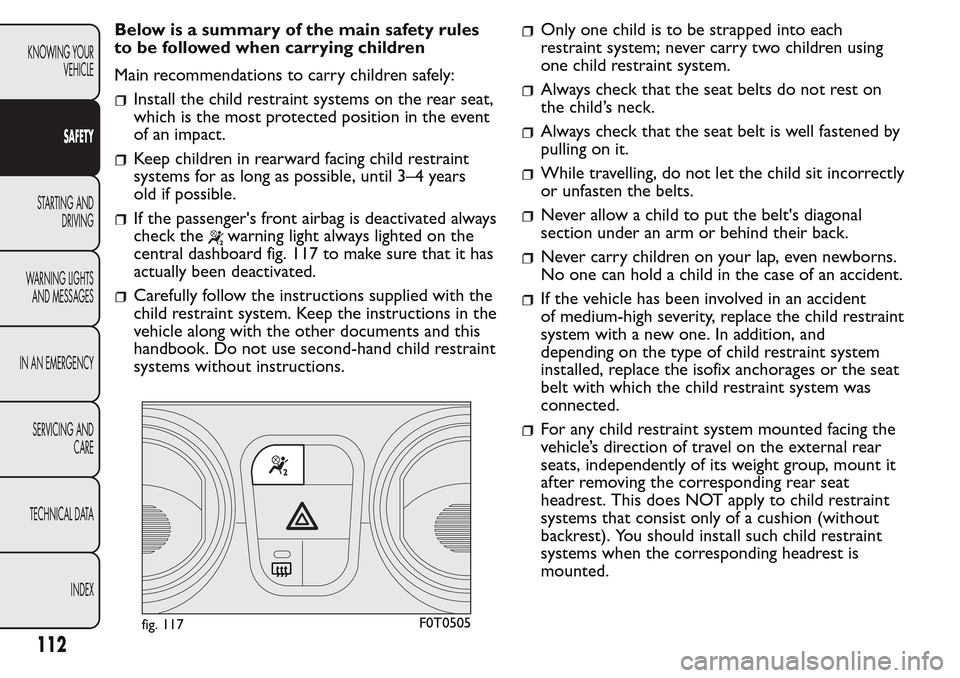
If the passenger's front airbag is deactivated always
check the
warning light always lighted on the
central dashboard fig. 117 to make sure that it has
actually been deactivated.
Carefully follow the instructions supplied with the
child restraint system. Keep the instructions in the
vehicle along with the other documents and this
handbook. Do not use second-hand child restraint
systems without instructions.
Only one child is to be strapped into each
restraint system; never carry two children using
one child restraint system.
Always check that the seat belts do not rest on
the child’s neck.
Always check that the seat belt is well fastened by
pulling on it.
While travelling, do not let the child sit incorrectly
or unfasten the belts.
Never allow a child to put the belt's diagonal
section under an arm or behind their back.
Never carry children on your lap, even newborns.
No one can hold a child in the case of an accident.
If the vehicle has been involved in an accident
of medium-high severity, replace the child restraint
system with a new one. In addition, and
depending on the type of child restraint system
installed, replace the isofix anchorages or the seat
belt with which the child restraint system was
connected.
For any child restraint system mounted facing the
vehicle’s direction of travel on the external rear
seats, independently of its weight group, mount it
after removing the corresponding rear seat
headrest. This does NOT apply to child restraint
systems that consist only of a cushion (without
backrest). You should install such child restraint
systems when the corresponding headrest is
mounted.
fig. 117F0T0505
112
KNOWING YOUR
VEHICLE
SAFETY
STARTING AND
DRIVING
WARNING LIGHTS
AND MESSAGES
IN AN EMERGENCY
SERVICING AND
CARE
TECHNICAL DATA
INDEX
Page 118 of 260
frontal impacts against highly deformable objects
not involving the front surface of the vehicle (e.g.
wing collision against guard rail, etc.);
vehicle wedging under other vehicles or protective
barriers (e.g. trucks or guard rails);
Failure to activate in the conditions described above
is due to the fact that they may not provide any
additional protection compared with seat belts, so
their activation would be inappropriate. In these
cases, non-deployment does not indicate a system
malfunction.
WARNING
Do not apply stickers or other objects to
the steering wheel, the dashboard in
the passenger side airbag area and the seats.
Never put objects (e.g. mobile phones) on the
passenger side of the dashboard since they
could interfere with correct inflation of the
passenger airbag and also cause serious injur y
to the passengers.
The driver's and passenger's front airbags have been
designed and calibrated to protect front seat
occupants wearing seat belts. At their maximum
inflation, their volume fills most of the space
between the steering wheel and the driver and
between the dashboard and the passenger.
The airbags are not deployed in the event of minor
frontal impacts (for which the restraining actionof the seat belts is sufficient). Seat belts must always
be worn. In the event of frontal impacts they
guarantee correct positioning of the passenger.
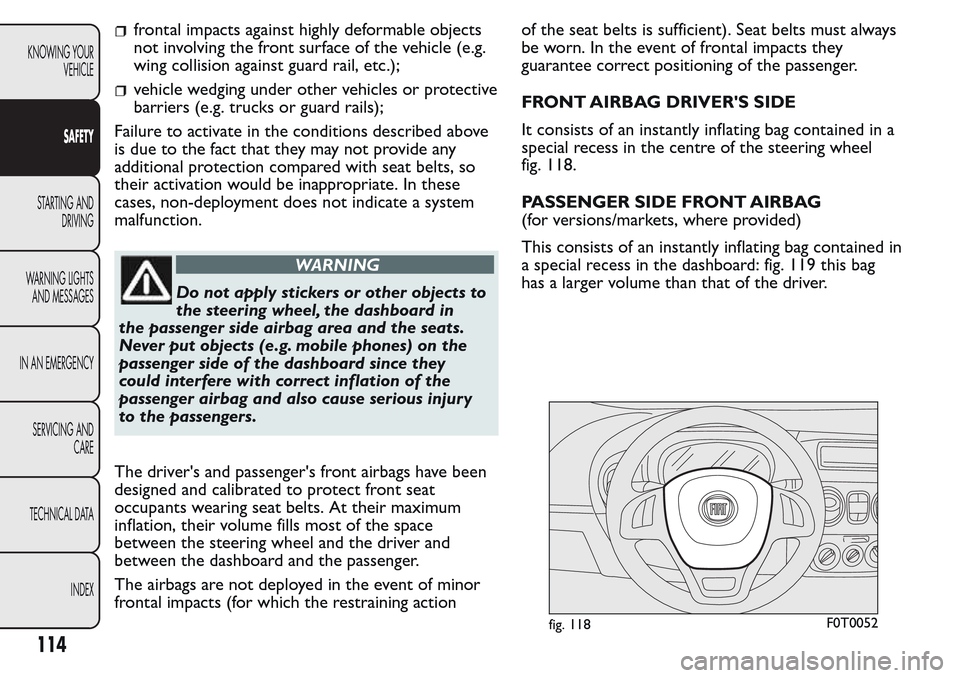
FRONT AIRBAG DRIVER'S SIDE
It consists of an instantly inflating bag contained in a
special recess in the centre of the steering wheel
fig. 118.
PASSENGER SIDE FRONT AIRBAG
(for versions/markets, where provided)
This consists of an instantly inflating bag contained in
a special recess in the dashboard: fig. 119 this bag
has a larger volume than that of the driver.
fig. 118F0T0052
114
KNOWING YOUR
VEHICLE
SAFETY
STARTING AND
DRIVING
WARNING LIGHTS
AND MESSAGES
IN AN EMERGENCY
SERVICING AND
CARE
TECHNICAL DATA
INDEX
Page 122 of 260
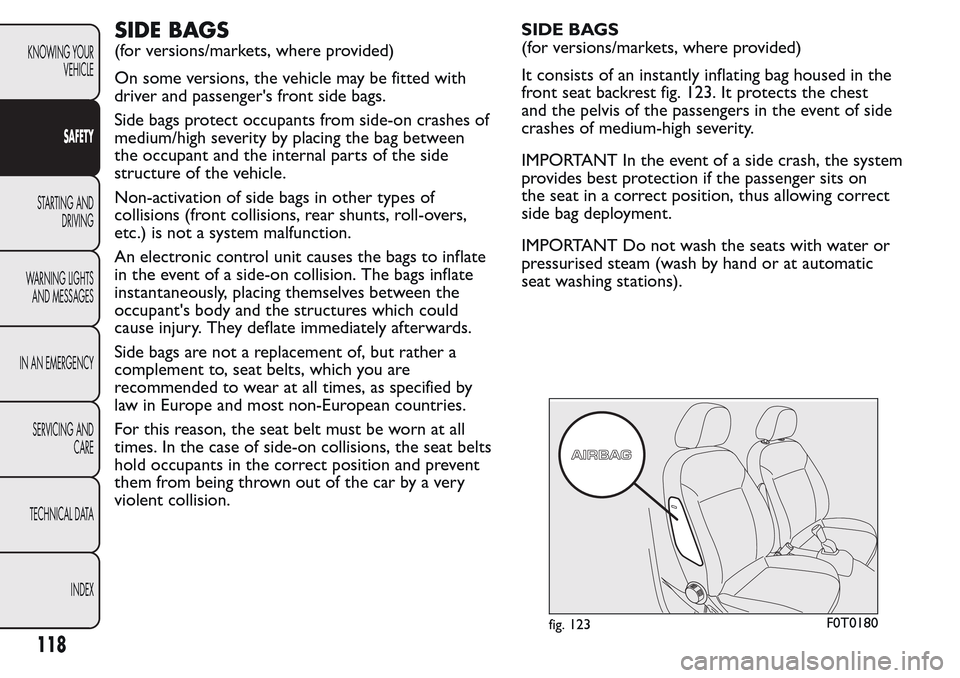
SIDE BAGS
(for versions/markets, where provided)
On some versions, the vehicle may be fitted with
driver and passenger's front side bags.
Side bags protect occupants from side-on crashes of
medium/high severity by placing the bag between
the occupant and the internal parts of the side
structure of the vehicle.
Non-activation of side bags in other types of
collisions (front collisions, rear shunts, roll-overs,
etc.) is not a system malfunction.
An electronic control unit causes the bags to inflate
in the event of a side-on collision. The bags inflate
instantaneously, placing themselves between the
occupant's body and the structures which could
cause injury. They deflate immediately afterwards.
Side bags are not a replacement of, but rather a
complement to, seat belts, which you are
recommended to wear at all times, as specified by
law in Europe and most non-European countries.
For this reason, the seat belt must be worn at all
times. In the case of side-on collisions, the seat belts
hold occupants in the correct position and prevent
them from being thrown out of the car by a very
violent collision.SIDE BAGS
(for versions/markets, where provided)
It consists of an instantly inflating bag housed in the
front seat backrest fig. 123. It protects the chest
and the pelvis of the passengers in the event of side
crashes of medium-high severity.
IMPORTANT In the event of a side crash, the system
provides best protection if the passenger sits on
the seat in a correct position, thus allowing correct
side bag deployment.
IMPORTANT Do not wash the seats with water or
pressurised steam (wash by hand or at automatic
seat washing stations).
fig. 123F0T0180
118
KNOWING YOUR
VEHICLE
SAFETY
STARTING AND
DRIVING
WARNING LIGHTS
AND MESSAGES
IN AN EMERGENCY
SERVICING AND
CARE
TECHNICAL DATA
INDEX
Page 129 of 260
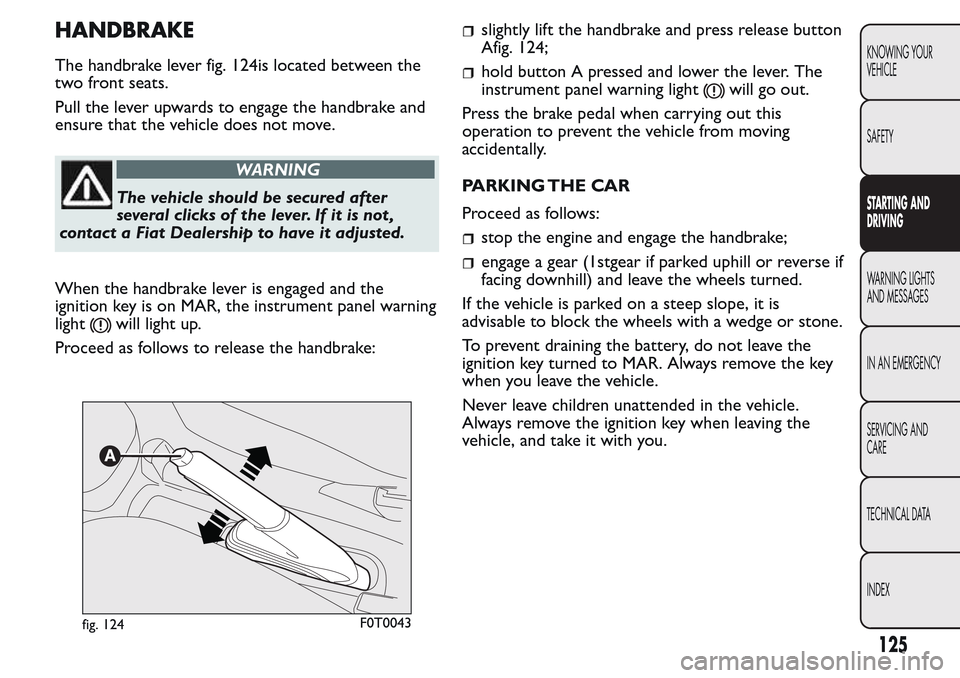
HANDBRAKE
The handbrake lever fig. 124is located between the
two front seats.
Pull the lever upwards to engage the handbrake and
ensure that the vehicle does not move.
WARNING
The vehicle should be secured after
several clicks of the lever. If it is not ,
contact a Fiat Dealership to have it adjusted.
When the handbrake lever is engaged and the
ignition key is on MAR, the instrument panel warning
light
will light up.
Proceed as follows to release the handbrake:
slightly lift the handbrake and press release button
Afig. 124;
hold button A pressed and lower the lever. The
instrument panel warning light
will go out.
Press the brake pedal when carrying out this
operation to prevent the vehicle from moving
accidentally.
PARKING THE CAR
Proceed as follows:
stop the engine and engage the handbrake;
engage a gear (1stgear if parked uphill or reverse if
facing downhill) and leave the wheels turned.
If the vehicle is parked on a steep slope, it is
advisable to block the wheels with a wedge or stone.
To prevent draining the battery, do not leave the
ignition key turned to MAR. Always remove the key
when you leave the vehicle.
Never leave children unattended in the vehicle.
Always remove the ignition key when leaving the
vehicle, and take it with you.
fig. 124F0T0043
125
KNOWING YOUR
VEHICLE
SAFETY
STARTING AND
DRIVING
WARNING LIGHTS
AND MESSAGES
IN AN EMERGENCY
SERVICING AND
CARE
TECHNICAL DATA
INDEX