ESP FIAT QUBO 2017 1.G Owner's Manual
[x] Cancel search | Manufacturer: FIAT, Model Year: 2017, Model line: QUBO, Model: FIAT QUBO 2017 1.GPages: 260, PDF Size: 4.74 MB
Page 132 of 260
SAVING FUEL
Some useful tips are given below for fuel saving and
reducing harmful emissions of CO2 and other
pollutants (nitrogen oxides, unburnt hydrocarbons,
Particulate Matter (PM) etc.).
GENERAL CONSIDERATIONS
The general factors that affect fuel consumption are
listed below.
Vehicle maintenance
Have checks and adjustments carried out in
accordance with the “Scheduled Servicing Plan”.
Ty r e s
Check the tyre pressure at least once every four
weeks: if the pressure is too low, consumption levels
increase as resistance to rolling is higher.
Unnecessary loads
Do not travel with an overloaded boot. The weight
of the vehicle (especially when driving in town)
and its trim greatly affect fuel consumption
and stability.
Roof rack/ski rack
Remove the roof rack or the ski rack from the roof
after use. These accessories reduce the aerodynamic
coefficient of the vehicle and have a negative effecton fuel consumption. It is better to use a trailer to
transport particularly bulky objects.
Electric devices
Only use electrical devices for the amount of time
needed. The heated rear window, additional
headlights, windscreen/rear window wipers and
heater fan need a considerable amount of energy,
therefore increasing fuel consumption (by up to 25%
in the urban cycle).
Climate control system
The air conditioner leads to higher fuel consumption
(on average up to +20%). If the temperature outside
is not too extreme, try and use the air vents.
Spoilers
The use of non-certified spoilers may adversely affect
aerodynamics and fuel consumption.
128
KNOWING YOUR
VEHICLE
SAFETY
STARTING AND
DRIVING
WARNING LIGHTS
AND MESSAGES
IN AN EMERGENCY
SERVICING AND
CARE
TECHNICAL DATA
INDEX
Page 134 of 260
Traffic hold-ups
During prolonged hold-ups (e.g. at level crossings)
the engine should be switched off.TOWING TRAILERS
IMPORTANT
The vehicle must be provided with a type-approved
tow hitch and adequate electrical system to tow
trailers. Installation must be performed by specialised
personnel who will issue the required papers for
travelling on roads.
Install any specific and/or additional rear-view mirrors
in accordance with the highway code of the country
in which you are travelling.
Remember that when towing a trailer, steep hills are
harder to climb, braking distances increase and
overtaking takes longer depending on the overall
weight of the trailer.
Engage a low gear when driving downhill, rather than
constantly using the brake.
The weight of the trailer on the vehicle tow hitch
will reduce the loading capacity of the vehicle by the
same amount.
Consider the weight at full load, including accessories
and luggage, to make sure you do not exceed the
maximum towable weight (shown in the log book).
Respect each country's speed limits for vehicles
towing trailers. In all cases, the top speed must not
exceed 80 km/h.
130
KNOWING YOUR
VEHICLE
SAFETY
STARTING AND
DRIVING
WARNING LIGHTS
AND MESSAGES
IN AN EMERGENCY
SERVICING AND
CARE
TECHNICAL DATA
INDEX
Page 161 of 260
CHANGING A BULB
GENERAL INSTRUCTIONS
Before changing a bulb check the contacts for
oxidation;
burnt bulbs must be replaced by others of the
same type and power;
always check the height of the headlight beam
after changing a bulb, for reasons of safety;
when a light is not working, check that the
corresponding fuse is intact before changing the
bulb. For the location of fuses, refer to the
“Changing a fuse” paragraph in this section;
WARNING
Modifications or repairs to the electrical
system that are not carried out
properly or do not take the system's technical
specifications into account can cause
malfunctions leading to the risk of fire.
WARNING
Halogen bulbs contain pressurised gas
which may cause small fragments of
glass to be projected outwards if the bulb is
broken.
Halogen bulbs must be handled holding
the metallic part only.Touching the
transparent part of the bulb with your
fingers may reduce the intensity of the emitted
light and even reduce the lifespan of the bulb.
If you do touch it accidentally, rub the bulb with
an alcohol-soaked cloth and leave to dry.
If possible, we recommend have bulbs
replaced by a Fiat Dealership. Proper
operation and orientation of the external
lights are essential for the safety of the running
vehicle, and to avoid incurring legal sanctions.
IMPORTANT The internal surface of the light may
appear slightly misty: this does not indicate a fault,
and is actually caused by low temperature and the
degree of humidity in the air. Misting will rapidly
disappear when the headlights are switched on. The
presence of drops inside the headlights indicates
infiltration of water. Go to a Fiat Dealership.
157
KNOWING YOUR
VEHICLE
SAFETY
STARTING AND
DRIVING
WARNING LIGHTS
AND MESSAGES
IN AN
EMERGENCY
SERVICING AND
CARE
TECHNICAL DATA
INDEX
Page 164 of 260
CHANGING AN EXTERIOR BULB
For the type of bulb and corresponding power rating,
see the paragraph "Changing a bulb".
FRONT LIGHT CLUSTERS
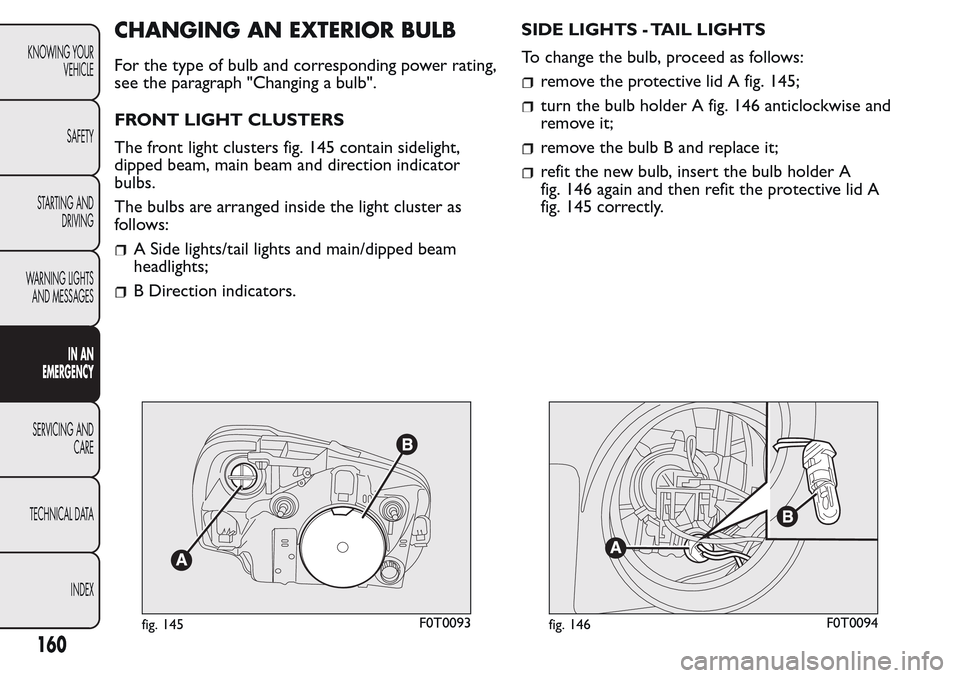
The front light clusters fig. 145 contain sidelight,
dipped beam, main beam and direction indicator
bulbs.
The bulbs are arranged inside the light cluster as
follows:
A Side lights/tail lights and main/dipped beam
headlights;
B Direction indicators.SIDE LIGHTS - TAIL LIGHTS
To change the bulb, proceed as follows:
remove the protective lid A fig. 145;
turn the bulb holder A fig. 146 anticlockwise and
remove it;
remove the bulb B and replace it;
refit the new bulb, insert the bulb holder A
fig. 146 again and then refit the protective lid A
fig. 145 correctly.
fig. 145F0T0093fig. 146F0T0094
160
KNOWING YOUR
VEHICLE
SAFETY
STARTING AND
DRIVING
WARNING LIGHTS
AND MESSAGES
IN AN
EMERGENCY
SERVICING AND
CARE
TECHNICAL DATA
INDEX
Page 170 of 260
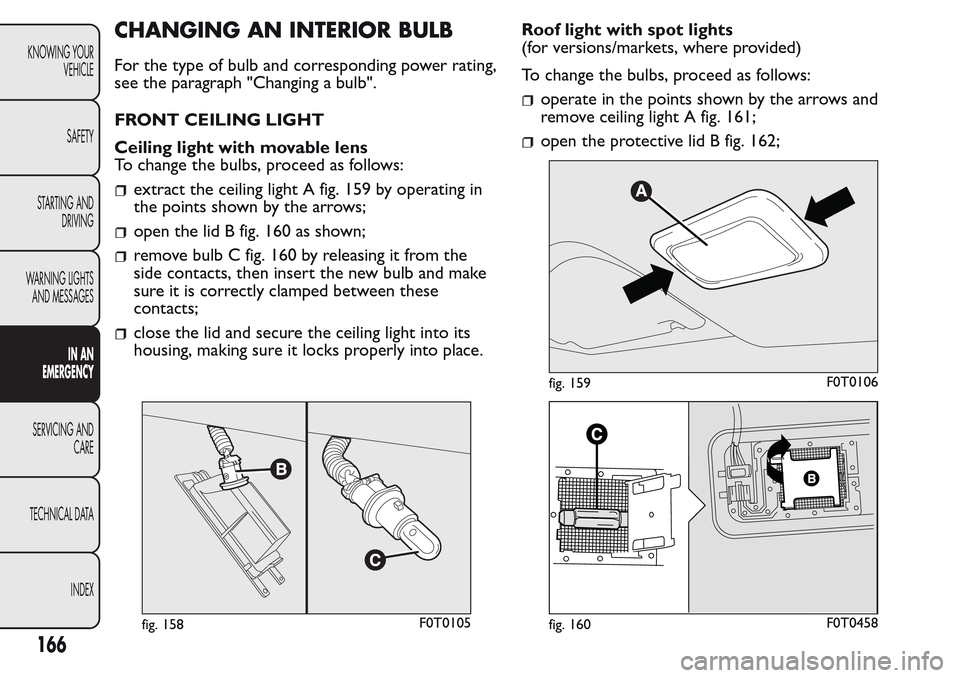
CHANGING AN INTERIOR BULB
For the type of bulb and corresponding power rating,
see the paragraph "Changing a bulb".
FRONT CEILING LIGHT
Ceiling light with movable lens
To change the bulbs, proceed as follows:
extract the ceiling light A fig. 159 by operating in
the points shown by the arrows;
open the lid B fig. 160 as shown;
remove bulb C fig. 160 by releasing it from the
side contacts, then insert the new bulb and make
sure it is correctly clamped between these
contacts;
close the lid and secure the ceiling light into its
housing, making sure it locks properly into place.Roof light with spot lights
(for versions/markets, where provided)
To change the bulbs, proceed as follows:
operate in the points shown by the arrows and
remove ceiling light A fig. 161;
open the protective lid B fig. 162;
fig. 158F0T0105
fig. 159F0T0106
fig. 160F0T0458
166
KNOWING YOUR
VEHICLE
SAFETY
STARTING AND
DRIVING
WARNING LIGHTS
AND MESSAGES
IN AN
EMERGENCY
SERVICING AND
CARE
TECHNICAL DATA
INDEX
Page 173 of 260
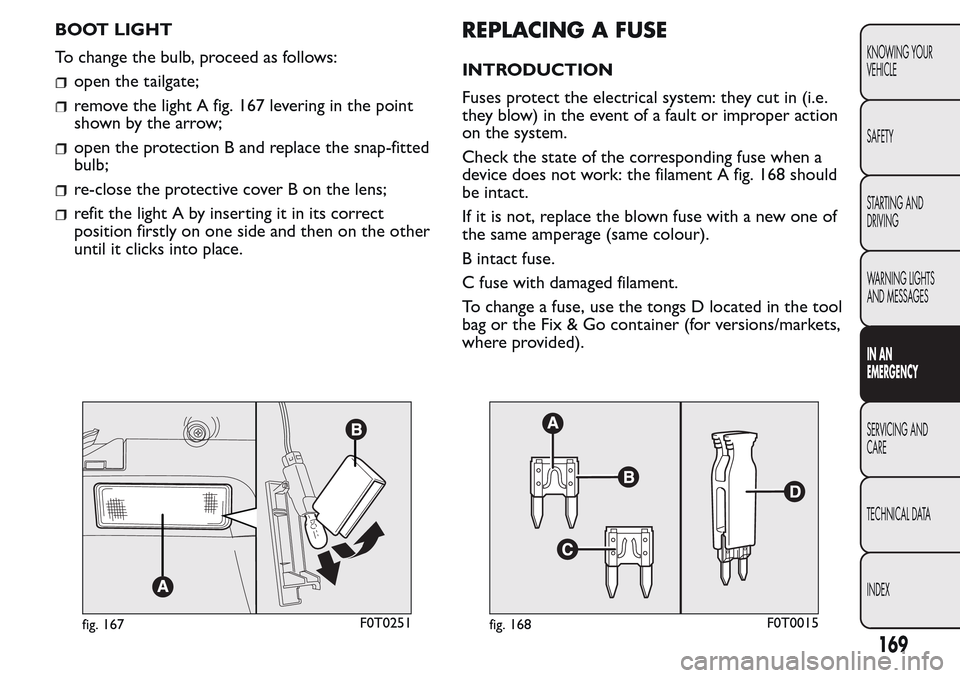
BOOT LIGHT
To change the bulb, proceed as follows:
open the tailgate;
remove the light A fig. 167 levering in the point
shown by the arrow;
open the protection B and replace the snap-fitted
bulb;
re-close the protective cover B on the lens;
refit the light A by inserting it in its correct
position firstly on one side and then on the other
until it clicks into place.
REPLACING A FUSE
INTRODUCTION
Fuses protect the electrical system: they cut in (i.e.
they blow) in the event of a fault or improper action
on the system.
Check the state of the corresponding fuse when a
device does not work: the filament A fig. 168 should
be intact.
If it is not, replace the blown fuse with a new one of
the same amperage (same colour).
B intact fuse.
C fuse with damaged filament.
To change a fuse, use the tongs D located in the tool
bag or the Fix & Go container (for versions/markets,
where provided).
fig. 167F0T0251fig. 168F0T0015
169
KNOWING YOUR
VEHICLE
SAFETY
STARTING AND
DRIVING
WARNING LIGHTS
AND MESSAGES
IN AN
EMERGENCY
SERVICING AND
CARE
TECHNICAL DATA
INDEX
Page 176 of 260
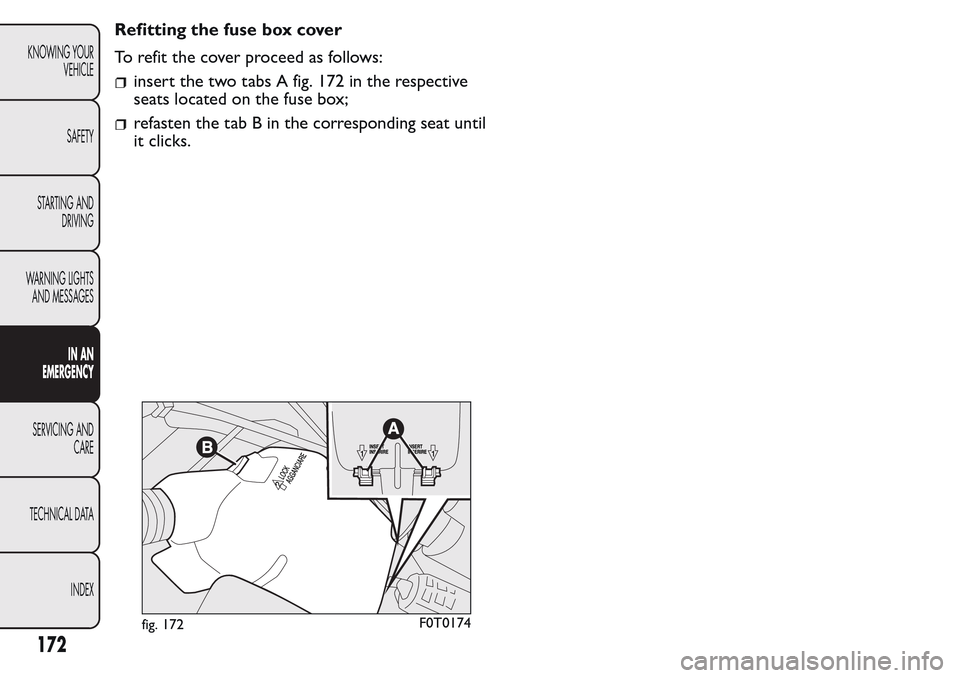
Refitting the fuse box cover
To refit the cover proceed as follows:
insert the two tabs A fig. 172 in the respective
seats located on the fuse box;
refasten the tab B in the corresponding seat until
it clicks.
fig. 172F0T0174
172
KNOWING YOUR
VEHICLE
SAFETY
STARTING AND
DRIVING
WARNING LIGHTS
AND MESSAGES
IN AN
EMERGENCY
SERVICING AND
CARE
TECHNICAL DATA
INDEX
Page 186 of 260
The front and rear tow hooks should be
used only for emergencies on the road.You
are allowed to tow the car for short
distances using an appropriate device in
accordance with the highway code (a rigid bar),
to move the vehicle on the road in readiness
for towing or transporting via a breakdown
vehicle.Tow hooks MUST NOT be used to tow
vehicles off the road or where there are obstacles
and/or for towing operations using cables or
other non-rigid devices. Respecting the above
conditions, towing must take place with the two
vehicles (one towing, the other towed) aligned
as much as possible along the same centre line.
182
KNOWING YOUR
VEHICLE
SAFETY
STARTING AND
DRIVING
WARNING LIGHTS
AND MESSAGES
IN AN
EMERGENCY
SERVICING AND
CARE
TECHNICAL DATA
INDEX
Page 190 of 260
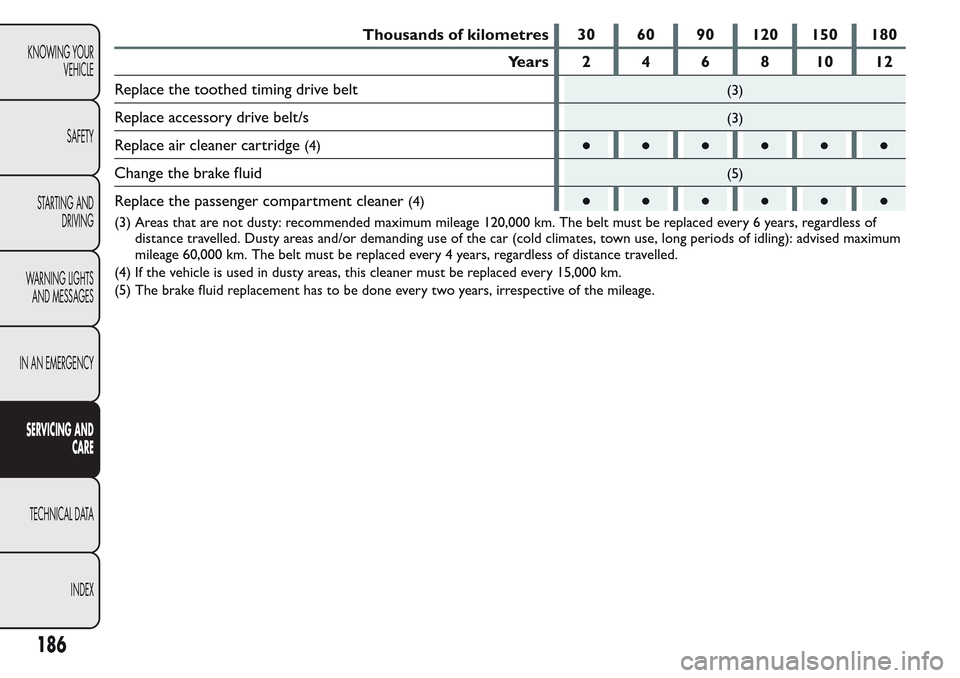
Thousands of kilometres 30 60 90 120 150 180
Years 2 4 6 8 10 12
Replace the toothed timing drive belt
(3)
Replace accessory drive belt/s(3)
Replace air cleaner cartridge(4)●●●●●●
Change the brake fluid
(5)
Replace the passenger compartment cleaner(4)●●●●●●
(3) Areas that are not dusty: recommended maximum mileage 120,000 km. The belt must be replaced every 6 years, regardless of
distance travelled. Dusty areas and/or demanding use of the car (cold climates, town use, long periods of idling): advised maximum
mileage 60,000 km. The belt must be replaced every 4 years, regardless of distance travelled.
(4) If the vehicle is used in dusty areas, this cleaner must be replaced every 15,000 km.
(5) The brake fluid replacement has to be done every two years, irrespective of the mileage.
186
KNOWING YOUR
VEHICLE
SAFETY
STARTING AND
DRIVING
WARNING LIGHTS
AND MESSAGES
IN AN EMERGENCY
SERVICING AND
CARE
TECHNICAL DATA
INDEX
Page 192 of 260
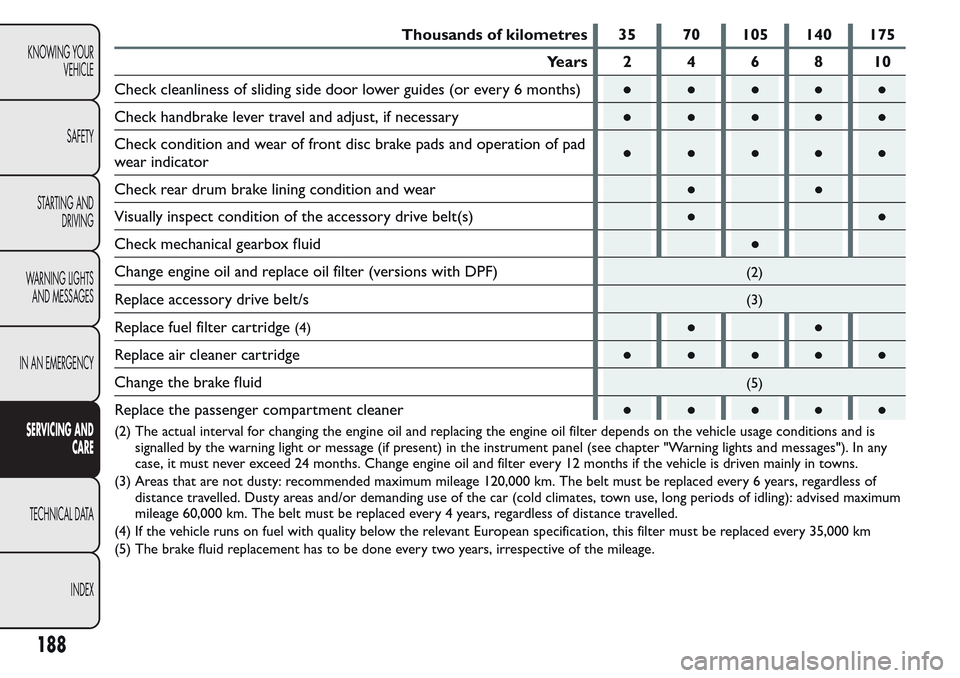
Thousands of kilometres 35 70 105 140 175
Years 2 4 6 8 10
Check cleanliness of sliding side door lower guides (or every 6 months)●●●●●
Check handbrake lever travel and adjust, if necessary●●●●●
Check condition and wear of front disc brake pads and operation of pad
wear indicator●●●●●
Check rear drum brake lining condition and wear●●
Visually inspect condition of the accessory drive belt(s)●●
Check mechanical gearbox fluid●
Change engine oil and replace oil filter (versions with DPF)
(2)
Replace accessory drive belt/s(3)
Replace fuel filter cartridge(4)●●
Replace air cleaner cartridge●●●●●
Change the brake fluid
(5)
Replace the passenger compartment cleaner●●●●●
(2) The actual interval for changing the engine oil and replacing the engine oil filter depends on the vehicle usage conditions and is
signalled by the warning light or message (if present) in the instrument panel (see chapter "Warning lights and messages"). In any
case, it must never exceed 24 months. Change engine oil and filter every 12 months if the vehicle is driven mainly in towns.
(3) Areas that are not dusty: recommended maximum mileage 120,000 km. The belt must be replaced every 6 years, regardless of
distance travelled. Dusty areas and/or demanding use of the car (cold climates, town use, long periods of idling): advised maximum
mileage 60,000 km. The belt must be replaced every 4 years, regardless of distance travelled.
(4) If the vehicle runs on fuel with quality below the relevant European specification, this filter must be replaced every 35,000 km
(5) The brake fluid replacement has to be done every two years, irrespective of the mileage.
188
KNOWING YOUR
VEHICLE
SAFETY
STARTING AND
DRIVING
WARNING LIGHTS
AND MESSAGES
IN AN EMERGENCY
SERVICING AND
CARE
TECHNICAL DATA
INDEX