ESP FIAT QUBO 2017 1.G User Guide
[x] Cancel search | Manufacturer: FIAT, Model Year: 2017, Model line: QUBO, Model: FIAT QUBO 2017 1.GPages: 260, PDF Size: 4.74 MB
Page 81 of 260
WARNING
Do not take unnecessary risks, even if
your vehicle is fitted with this system.
Your driving style must always be suited to the
road conditions, visibility and traffic .The driver
is always responsible for road safety.
FAILURE INDICATIONS
In the event of a failure, the ASR system will be
automatically switched off and warning light
will
appear permanently on the instrument panel along
with a message on the multifunction display (for
versions/markets where provided) (see “Warning
lights and messages” section). In this case, contact a
Fiat Dealership as soon as possible.
HYDRAULIC BRAKE ASSIST (assistance
during emergency braking)
(for versions/markets, where provided)
The HBA system is an integral part of the ESC
system and is designed to improve the vehicle’s
braking capacity during emergency braking.
The system detects emergency braking by
monitoring the speed and force with which the brake
pedal is pressed, and consequently applies the
optimal brake pressure. This can reduce the braking
distance: the HBA system therefore completes
the ABS.Maximum assistance of the HBA system is obtained
pressing the brake pedal very quickly; in addition, the
brake pedal should be pressed continuously during
braking, avoiding intermittent presses, to obtain
benefits from the system. Do not reduce pressure on
the brake pedal until braking is no longer necessary.
The HBA system is deactivated when the brake pedal
is released.
WARNING
The HBA system cannot overrule the
natural laws of physics, and cannot
increase the grip available according to the
condition of the road.
WARNING
The HBA system cannot prevent
accidents, including those due
to excessive speed on corners, driving on
low-grip surfaces or aquaplaning.
WARNING
The capability of the HBA must never
be tested irresponsibly and dangerously,
in such a way as to compromise personal safety
and the safety of others.
77
KNOWING YOUR
VEHICLE
SAFETY
STARTING AND
DRIVING
WARNING LIGHTS
AND MESSAGES
IN AN EMERGENCY
SERVICING AND
CARE
TECHNICAL DATA
INDEX
Page 83 of 260
Operating conditions
The system is active for speeds above 15 km/h. In a
few situations such as sporty driving, particular
conditions of the road surface (e.g. icy, snowy,
unsurfaced roads...) the signalling may be delayed or
partial in detecting the contemporary deflation of
more than one tyre. Under special conditions (e.g.
vehicle loaded asymmetrically on one side, towing
a trailer, damaged or worn tyre, fitting the
space-saver wheel, use of the "Fix&Go Automatic"
kit, fitting snow chains, fitting different tyres on
the axles) the system may give false indications or be
temporarily deactivated.
If the system is temporarily deactivated, the warning
light
flashes for about 75 seconds and then is
continuously on; at the same time, the display shows
a dedicated message. This indication is displayed
also after the engine has been switched off and then
on again if the correct operating conditions are
not restored.
WARNING
The system is an aid for the driver, who
must always pay full attention while
driving.The responsibility always rests with the
driver, who must take into account the traffic
conditions in order to drive in complete safety.
The driver must always maintain a safe distance
from the vehicle in front .
WARNING
If the driver depresses the brake pedal
fully or carries out a fast steering during
system operation, the automatic braking
function may stop (e.g. to allow a possible
manoeuvre to avoid the obstacle).
WARNING
The laser beam is not visible at the
naked eye. Do not look directly, or with
optical instruments (e.g. lenses), at the laser
beam from a distance lower than 10 cm: this
may cause damage to the sight .The laser beam
is also present when the key is at MAR but its
operation is off, not available or manually
deactivated with the display Setup Menu.
WARNING
The system intervenes on vehicles
travelling in the same lane. Small sized
vehicles (e.g. bicycles or motorbikes) or people,
animals and things (e.g. pushchairs) and more in
general all those obstacles with a low reflection
of the light emitted by the laser (e.g. vehicles
soiled with mud) are not taken into
consideration.
79
KNOWING YOUR
VEHICLE
SAFETY
STARTING AND
DRIVING
WARNING LIGHTS
AND MESSAGES
IN AN EMERGENCY
SERVICING AND
CARE
TECHNICAL DATA
INDEX
Page 90 of 260
WARNING
The ultimate responsibility when
parking and carrying out other
dangerous manoeuvres still rests with the
driver.When parking, make sure that no-one is
standing in the area, especially children or
animals. Parking sensors are designed to assist
drivers; however, you must always concentrate
fully during potentially dangerous manoeuvres,
even if carried out at low speeds.
START&STOP SYSTEM
(for versions/markets, where provided)
INTRODUCTION
The Start&Stop device automatically stops the engine
each time the vehicle is stationary and starts it
again when the driver wants to move off. This
improves the efficiency of the vehicle by reducing fuel
consumption, the emission of harmful gases and
noise pollution.
OPERATING MODES
Engine stopping mode
WITH MANUAL GEARBOX
With the vehicle stationary, the engine stops with
the gearbox in neutral and the clutch pedal released.
WITH ROBOTISED GEARBOX
The engine cuts out if the vehicle stops with the
brake pedal pressed.
This condition can be maintained even if the brake
pedal is not depressed, if the gear lever is in position
N.
NoteThe engine can only be stopped automatically
after a speed of about 10 km/h is reached, to prevent
the engine from being repeatedly stopped when
driving at walking pace.
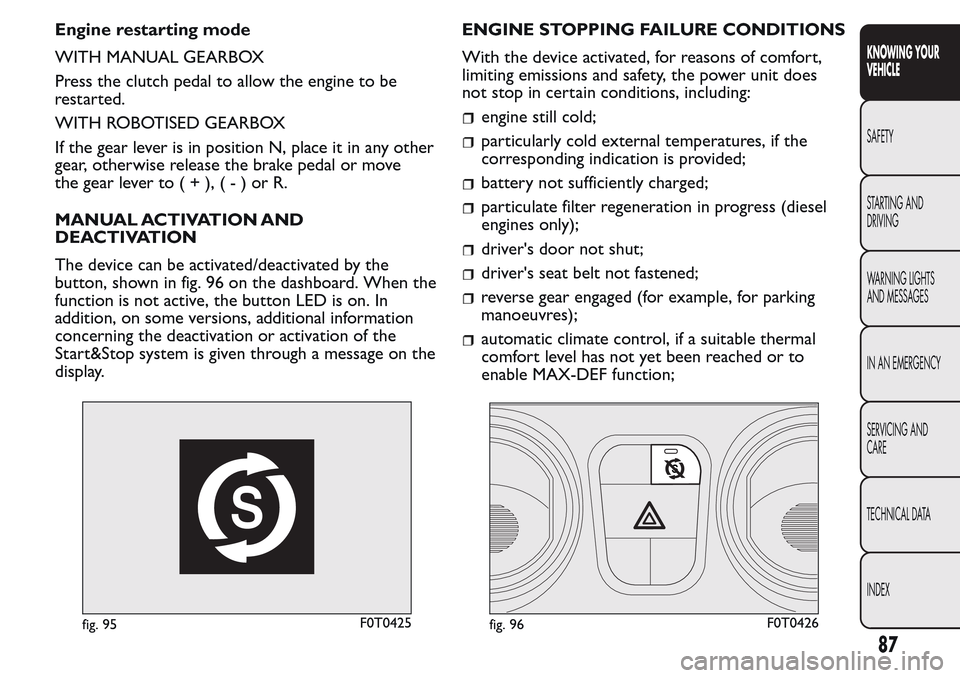
The engine being stopped is signalled by the icon
fig. 95 on the display, depending on the trim level.
86
KNOWING YOUR
VEHICLE
SAFETY
STARTING AND
DRIVING
WARNING LIGHTS
AND MESSAGES
IN AN EMERGENCY
SERVICING AND
CARE
TECHNICAL DATA
INDEX
Page 91 of 260
Engine restarting mode
WITH MANUAL GEARBOX
Press the clutch pedal to allow the engine to be
restarted.
WITH ROBOTISED GEARBOX
If the gear lever is in position N, place it in any other
gear, otherwise release the brake pedal or move
the gear lever to(+),(-)orR.
MANUAL ACTIVATION AND
DEACTIVATION
The device can be activated/deactivated by the
button, shown in fig. 96 on the dashboard. When the
function is not active, the button LED is on. In
addition, on some versions, additional information
concerning the deactivation or activation of the
Start&Stop system is given through a message on the
display.ENGINE STOPPING FAILURE CONDITIONS
With the device activated, for reasons of comfort,
limiting emissions and safety, the power unit does
not stop in certain conditions, including:
engine still cold;
particularly cold external temperatures, if the
corresponding indication is provided;
battery not sufficiently charged;
particulate filter regeneration in progress (diesel
engines only);
driver's door not shut;
driver's seat belt not fastened;
reverse gear engaged (for example, for parking
manoeuvres);
automatic climate control, if a suitable thermal
comfort level has not yet been reached or to
enable MAX-DEF function;
fig. 95F0T0425fig. 96F0T0426
87
KNOWING YOUR
VEHICLE
SAFETY
STARTING AND
DRIVING
WARNING LIGHTS
AND MESSAGES
IN AN EMERGENCY
SERVICING AND
CARE
TECHNICAL DATA
INDEX
Page 101 of 260
SAFETY
OCCUPANT PROTECTION SYSTEMS
Some of the most important safety equipment of the
vehicle comprise the following protection systems:
seat belts;
SBR (Seat Belt Reminder) system;
head restraints;
child restraint systems;
front, side airbag (for versions/markets, where
provided).
Read the information given the following pages with
the utmost care.
It is of fundamental importance that the protection
systems are used in the correct way to guarantee the
maximum possible safety level for the driver and
the passengers.
For the description of the head restraint adjustment
see the "Head restraints" paragraph in the "Knowing
your vehicle" chapter.
SEAT BELTS
USING THE SEAT BELTS
All vehicle seats are equipped with seat belts with
three anchor points and a retractor.
The retractor mechanism operates locking the belt in
the event of sharp braking or strong deceleration
due to an impact.
This allows the belt strap to slide freely and to adapt
to the body of the occupant.
In the event of an accident, the belt will lock
reducing the risk of impact inside the passenger
compartment and of being projected outside the
vehicle. The driver is responsible for respecting, and
ensuring that all the other occupants of the vehicle
also respect, the local laws in force in relation to the
use of the seat belts.
Always fasten the seat belts before setting off.
The seat belt should be worn keeping the chest
straight and rested against the backrest.
To fasten the seat belts, hold the tongue A fig. 103
and insert it into the buckle B, until it clicks into
place.
If the seat belt jams during removal, let it rewind for
a short stretch, then pull it out again without jerking.
97
KNOWING YOUR
VEHICLE
SAFETY
STARTING AND
DRIVING
WARNING LIGHTS
AND MESSAGES
IN AN EMERGENCY
SERVICING AND
CARE
TECHNICAL DATA
INDEX
Page 105 of 260
Operations which lead to knocks,
vibrations or localised heating (over 100°C
for a maximum of 6 hours) in the area
around the pretensioner may cause damage or
trigger them.This device is not affected by
vibrations caused by irregularities of the road
surface or low obstacles such as kerbs, etc .
Contact a Fiat Dealership for any assistance.
LOAD LIMITERS
(for versions/markets, where provided)
To increase occupant safety in an accident, the front
and rear (for versions/markets where provided)
seat belt reels contain a load limiter which controls
the force acting on the chest and shoulders during
the restraining action of the belts in the event of
a head-on collision.
GENERAL INSTRUCTIONS FOR USING
THE SEAT BELTS
The driver is responsible for respecting, and ensuring
that all the other occupants of the vehicle also
respect, the local laws in force in relation to the use
of the seat belts. Always fasten the seat belts before
setting off.
Seat belts are also to be worn by pregnant women:
the risk of injury in the case of impact is greatly
reduced for them and the unborn child if they are
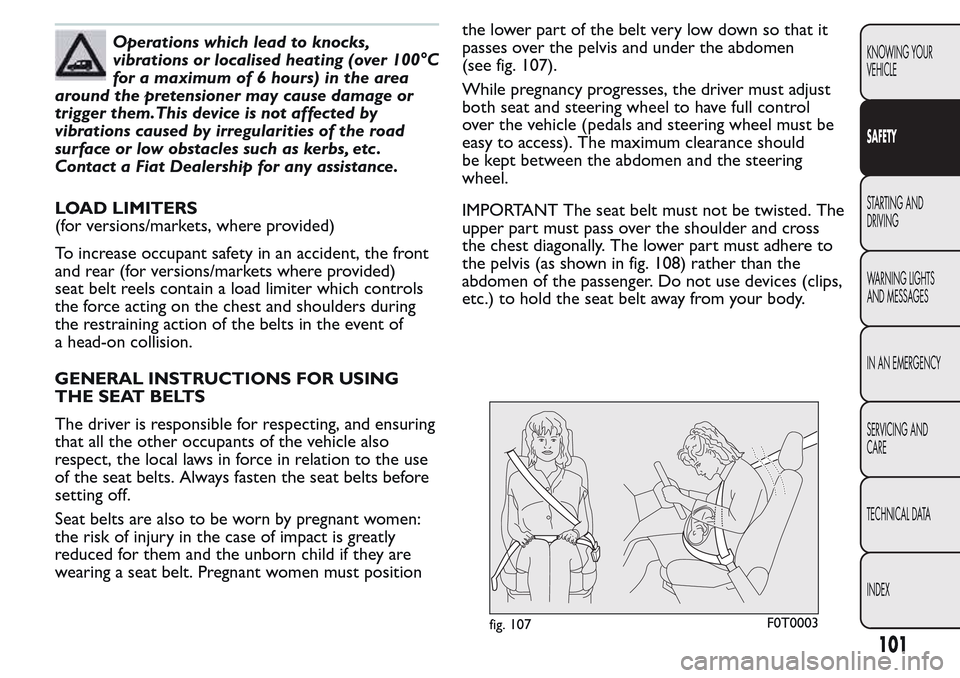
wearing a seat belt. Pregnant women must positionthe lower part of the belt very low down so that it
passes over the pelvis and under the abdomen
(see fig. 107).
While pregnancy progresses, the driver must adjust
both seat and steering wheel to have full control
over the vehicle (pedals and steering wheel must be
easy to access). The maximum clearance should
be kept between the abdomen and the steering
wheel.
IMPORTANT The seat belt must not be twisted. The
upper part must pass over the shoulder and cross
the chest diagonally. The lower part must adhere to
the pelvis (as shown in fig. 108) rather than the
abdomen of the passenger. Do not use devices (clips,
etc.) to hold the seat belt away from your body.
fig. 107F0T0003
101
KNOWING YOUR
VEHICLE
SAFETY
STARTING AND
DRIVING
WARNING LIGHTS
AND MESSAGES
IN AN EMERGENCY
SERVICING AND
CARE
TECHNICAL DATA
INDEX
Page 111 of 260
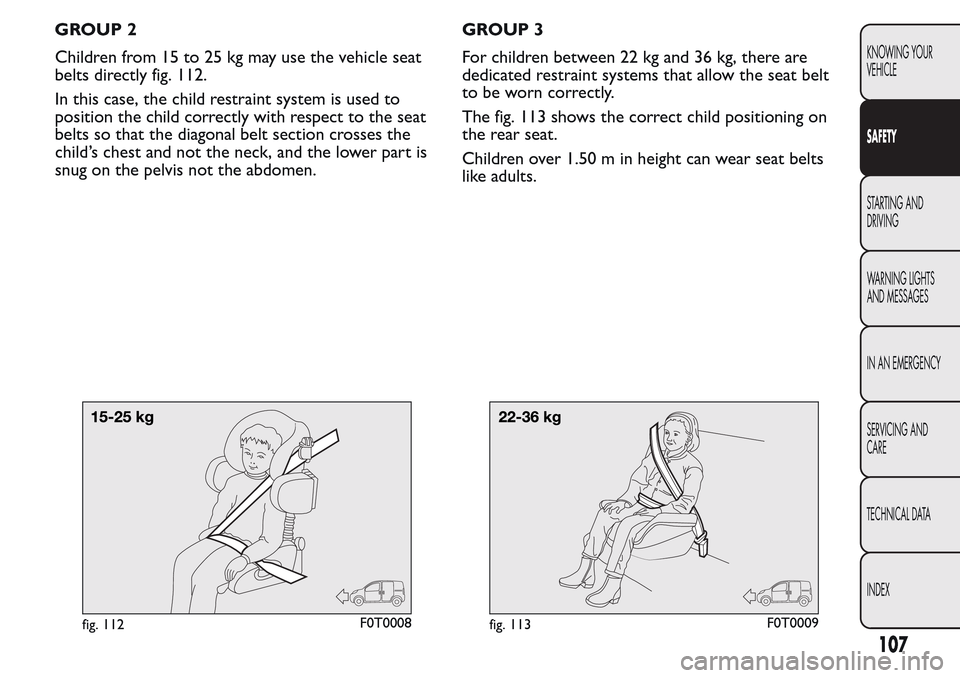
GROUP 2
Children from 15 to 25 kg may use the vehicle seat
belts directly fig. 112.
In this case, the child restraint system is used to
position the child correctly with respect to the seat
belts so that the diagonal belt section crosses the
child’s chest and not the neck, and the lower part is
snug on the pelvis not the abdomen.GROUP 3
For children between 22 kg and 36 kg, there are
dedicated restraint systems that allow the seat belt
to be worn correctly.
The fig. 113 shows the correct child positioning on
the rear seat.
Children over 1.50 m in height can wear seat belts
like adults.
fig. 112F0T0008fig. 113F0T0009
107
KNOWING YOUR
VEHICLE
SAFETY
STARTING AND
DRIVING
WARNING LIGHTS
AND MESSAGES
IN AN EMERGENCY
SERVICING AND
CARE
TECHNICAL DATA
INDEX
Page 116 of 260
Below is a summary of the main safety rules
to be followed when carrying children
Main recommendations to carry children safely:
Install the child restraint systems on the rear seat,
which is the most protected position in the event
of an impact.
Keep children in rearward facing child restraint
systems for as long as possible, until 3–4 years
old if possible.
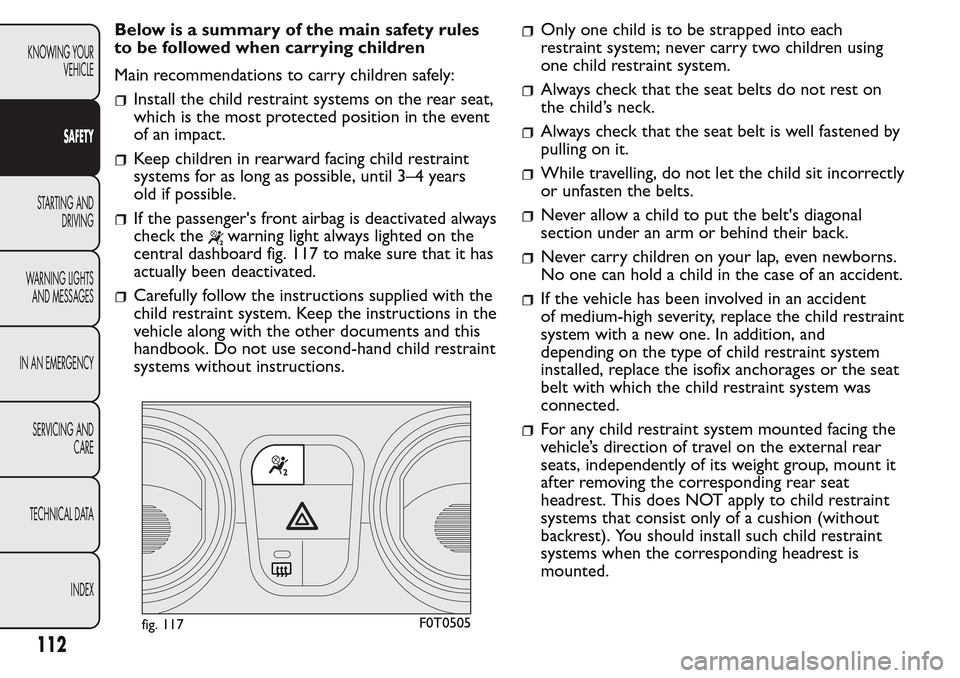
If the passenger's front airbag is deactivated always
check the
warning light always lighted on the
central dashboard fig. 117 to make sure that it has
actually been deactivated.
Carefully follow the instructions supplied with the
child restraint system. Keep the instructions in the
vehicle along with the other documents and this
handbook. Do not use second-hand child restraint
systems without instructions.
Only one child is to be strapped into each
restraint system; never carry two children using
one child restraint system.
Always check that the seat belts do not rest on
the child’s neck.
Always check that the seat belt is well fastened by
pulling on it.
While travelling, do not let the child sit incorrectly
or unfasten the belts.
Never allow a child to put the belt's diagonal
section under an arm or behind their back.
Never carry children on your lap, even newborns.
No one can hold a child in the case of an accident.
If the vehicle has been involved in an accident
of medium-high severity, replace the child restraint
system with a new one. In addition, and
depending on the type of child restraint system
installed, replace the isofix anchorages or the seat
belt with which the child restraint system was
connected.
For any child restraint system mounted facing the
vehicle’s direction of travel on the external rear
seats, independently of its weight group, mount it
after removing the corresponding rear seat
headrest. This does NOT apply to child restraint
systems that consist only of a cushion (without
backrest). You should install such child restraint
systems when the corresponding headrest is
mounted.
fig. 117F0T0505
112
KNOWING YOUR
VEHICLE
SAFETY
STARTING AND
DRIVING
WARNING LIGHTS
AND MESSAGES
IN AN EMERGENCY
SERVICING AND
CARE
TECHNICAL DATA
INDEX
Page 128 of 260
Warning lightwill blink for 60 seconds
after starting or during prolonged
cranking to indicate a fault to the glow
plug heating system. Use the vehicle normally if
the engine starts, but go to a Fiat Dealership
as soon as possible.
HOW TO WARM UP THE ENGINE AFTER IT
HAS JUST STARTED
Proceed as follows:
drive off slowly, letting the engine turn at medium
revs. Do not accelerate abruptly;
do not demand to performance for the first few
kilometres. Wait until the engine coolant gauge
starts moving.
EMERGENCY STARTING
Go to a Fiat Dealership immediately if warning light
comes on steady on the instrument panel.
Never jump start the engine by pushing,
towing or coasting downhill.This could
cause fuel to flow into the catalytic
conver ter and damage it beyond repair.STOPPING THE ENGINE
Turn the ignition key to STOP while the engine is
idling.
IMPORTANT After a long drive, you should allow
the engine to “catch its breath” before turning it off
by letting it idle to allow the temperature in the
engine compartment to fall.
A quick burst on the accelerator before
turning off the engine serves absolutely no
practical purpose, it wastes fuel and is
especially damaging to turbocharged engines.
124
KNOWING YOUR
VEHICLE
SAFETY
STARTING AND
DRIVING
WARNING LIGHTS
AND MESSAGES
IN AN EMERGENCY
SERVICING AND
CARE
TECHNICAL DATA
INDEX
Page 130 of 260
SNOW TYRES
The Fiat Dealership will be happy to provide advice
concerning the most suitable type of tyre for the
customer's requirements.
For the type, pressures and specifications of the
snow tyre to be used, follow carefully the
instructions given in the “Wheels” paragraph of the
“Technical specifications” section.
The winter performance of these tyres is
considerably reduced when the tread thickness is less
than 4 mm. If this is the case, replace them.
Due to the specific characteristics of snow tyres, in
normal weather conditions or on long motorway
journeys, the performance of these tyres is lower
than that of standard tyres. Their usage should
therefore be restricted in accordance with their type
approval.
IMPORTANT When using snow tyres with a
maximum speed index below the one that can be
reached by the vehicle (increased by 5%), place
a notice in the passenger compartment, plainly in
view, which states the maximum speed allowed
by the snow tyres (as per EC Directive).
All four tyres should be the same (brand and profile)
to ensure greater safety when driving and braking
as well as making the car more responsive.
Remember that you should not change the rotation
direction of the tyres.
WARNING
You must not exceed 160 km/h on snow
tyres with a “Q” mark; in any case, make
sure you stick to the rules of the highway code.
126
KNOWING YOUR
VEHICLE
SAFETY
STARTING AND
DRIVING
WARNING LIGHTS
AND MESSAGES
IN AN EMERGENCY
SERVICING AND
CARE
TECHNICAL DATA
INDEX