lock FIAT QUBO 2017 1.G Owner's Manual
[x] Cancel search | Manufacturer: FIAT, Model Year: 2017, Model line: QUBO, Model: FIAT QUBO 2017 1.GPages: 260, PDF Size: 4.74 MB
Page 63 of 260
WARNING
Improper use of the electric windows
can be dangerous. Before and during
their operation ensure that passengers are not
at risk from the moving glass, either by personal
objects caught in the mechanism or struck by
it directly. When leaving the car, always remove
the ignition key to avoid the risk of injury due
to accidental operation of the electric
windows.
MANUAL FRONT WINDOWS
On some versions, the front windows are opened
and closed manually.
Wind the handle to open/close.
LUGGAGE COMPARTMENT
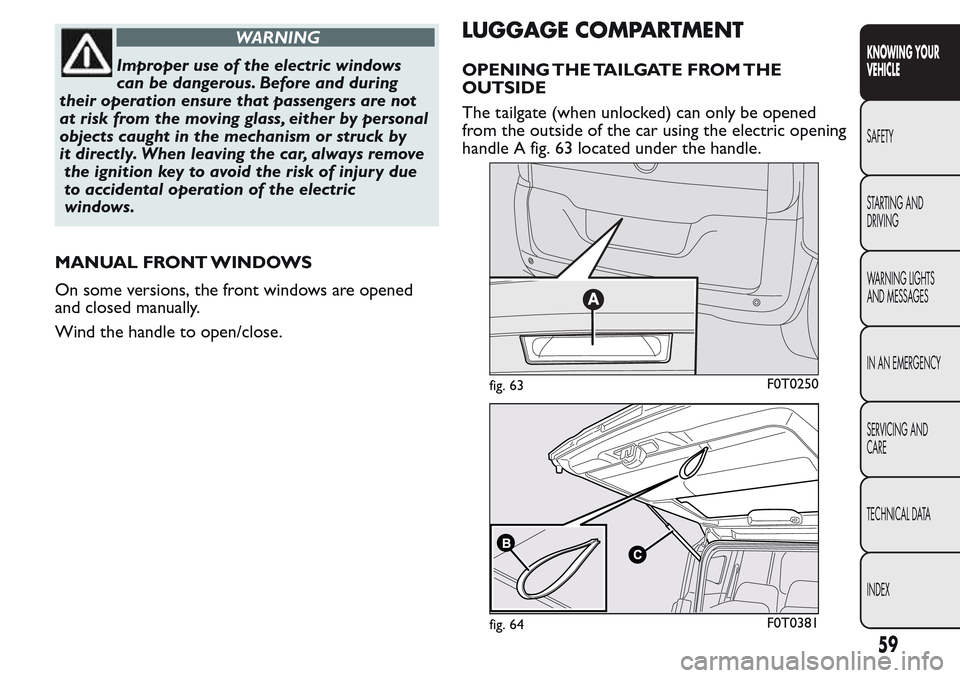
OPENING THE TAILGATE FROM THE
OUTSIDE
fig. 63F0T0250
fig. 64F0T0381
59
KNOWING YOUR
VEHICLE
SAFETY
STARTING AND
DRIVING
WARNING LIGHTS
AND MESSAGES
IN AN EMERGENCY
SERVICING AND
CARE
TECHNICAL DATA
INDEX
The tailgate (when unlocked) can only be opened
from the outside of the car using the electric opening
handle A fig. 63 located under the handle.
Page 64 of 260
The tailgate can be opened at any time if the doors
are unlocked.
To open it, enable the handle, opening one of the
front doors or unlocking the doors with the remote
control or using the key without remote control.
The tailgate unlocks also by pressing the
button
on the remote control.
To close the tailgate use handle B fig. 64.
Do not tr y to close the tailgate by
pressing on the side shock absorbers C
fig. 64. Also be careful not to knock the
side shock absorbers when you load the boot , to
avoid damaging them.
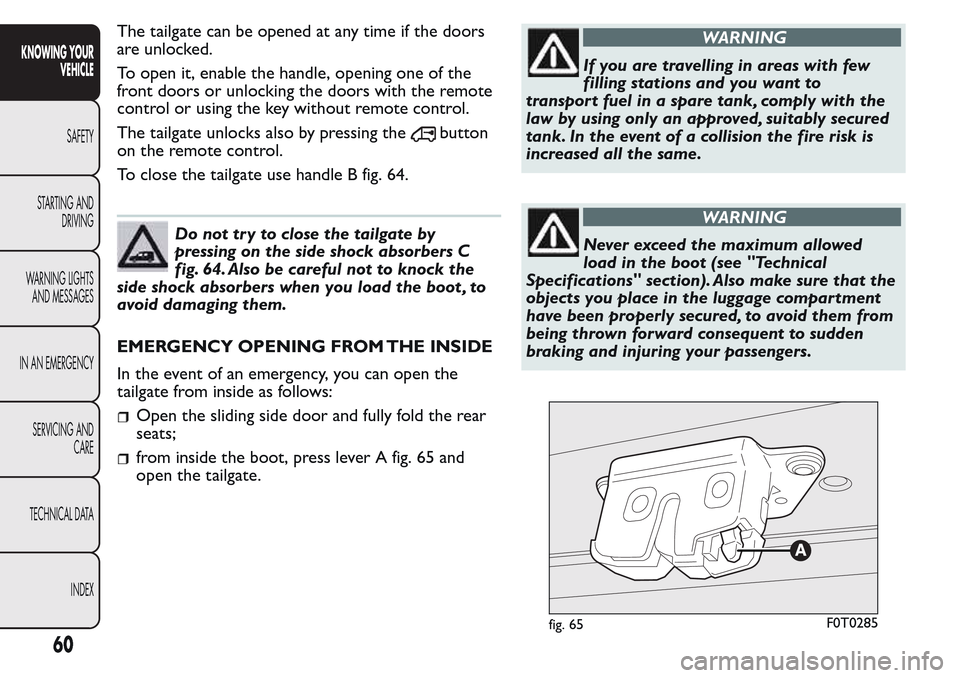
EMERGENCY OPENING FROM THE INSIDE
In the event of an emergency, you can open the
tailgate from inside as follows:
Open the sliding side door and fully fold the rear
seats;
from inside the boot, press lever A fig. 65 and
open the tailgate.
WARNING
If you are travelling in areas with few
filling stations and you want to
transport fuel in a spare tank, comply with the
law by using only an approved, suitably secured
tank. In the event of a collision the fire risk is
increased all the same.
WARNING
Never exceed the maximum allowed
load in the boot (see "Technical
Specifications" section). Also make sure that the
objects you place in the luggage compar tment
have been properly secured, to avoid them from
being thrown forward consequent to sudden
braking and injuring your passengers.
fig. 65F0T0285
60
KNOWING YOUR
VEHICLE
SAFETY
STARTING AND
DRIVING
WARNING LIGHTS
AND MESSAGES
IN AN EMERGENCY
SERVICING AND
CARE
TECHNICAL DATA
INDEX
Page 65 of 260
DOUBLE REAR WING DOORS
(for versions/markets, where provided)
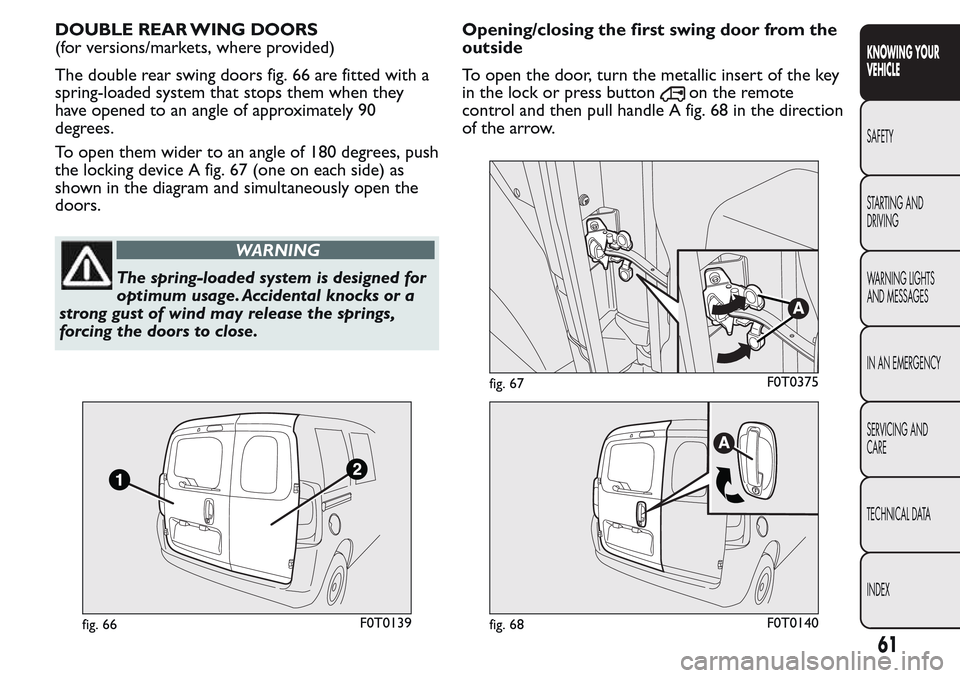
The double rear swing doors fig. 66 are fitted with a
spring-loaded system that stops them when they
have opened to an angle of approximately 90
degrees.
To open them wider to an angle of 180 degrees, push
the locking device A fig. 67 (one on each side) as
shown in the diagram and simultaneously open the
doors.
WARNING
The spring-loaded system is designed for
optimum usage. Accidental knocks or a
strong gust of wind may release the springs,
forcing the doors to close.Opening/closing the first swing door from the
outside
To open the door, turn the metallic insert of the key
in the lock or press button
on the remote
control and then pull handle A fig. 68 in the direction
of the arrow.
fig. 66F0T0139
fig. 67F0T0375
fig. 68F0T0140
61
KNOWING YOUR
VEHICLE
SAFETY
STARTING AND
DRIVING
WARNING LIGHTS
AND MESSAGES
IN AN EMERGENCY
SERVICING AND
CARE
TECHNICAL DATA
INDEX
Page 66 of 260
To close the door, turn the key in the lock or press
the
button on the remote control.
WARNING
When closing, shut the right-hand door 2
fig. 66 fully before you close the
left-hand door 1 fig. 66. Never shut the two
doors at the same time.
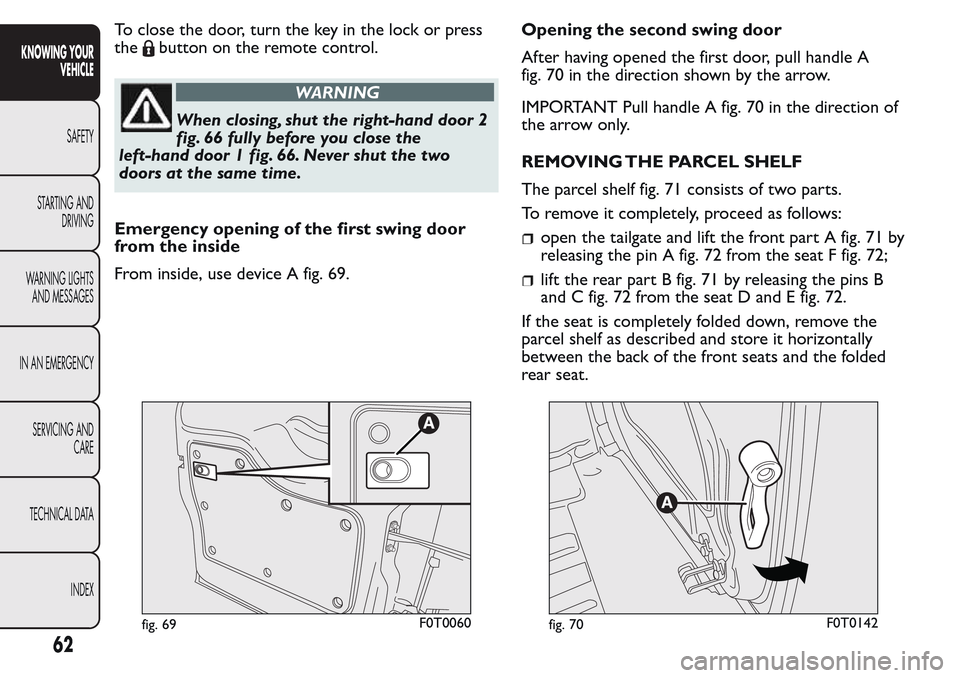
Emergency opening of the first swing door
from the inside
From inside, use device A fig. 69.Opening the second swing door
After having opened the first door, pull handle A
fig. 70 in the direction shown by the arrow.
IMPORTANT Pull handle A fig. 70 in the direction of
the arrow only.
REMOVING THE PARCEL SHELF
The parcel shelf fig. 71 consists of two parts.
To remove it completely, proceed as follows:
open the tailgate and lift the front part A fig. 71 by
releasing the pin A fig. 72 from the seat F fig. 72;
lift the rear part B fig. 71 by releasing the pins B
and C fig. 72 from the seat D and E fig. 72.
If the seat is completely folded down, remove the
parcel shelf as described and store it horizontally
between the back of the front seats and the folded
rear seat.
fig. 69F0T0060fig. 70F0T0142
62
KNOWING YOUR
VEHICLE
SAFETY
STARTING AND
DRIVING
WARNING LIGHTS
AND MESSAGES
IN AN EMERGENCY
SERVICING AND
CARE
TECHNICAL DATA
INDEX
Page 73 of 260
WARNING
For safety reasons, the bonnet must
always be perfectly closed while
travelling. Make sure that the bonnet is
perfectly closed and that the lock is engaged. If
you discover during travel that the lock is not
fully engaged, stop immediately and close
the bonnet in the correct manner.
ROOF RACK/SKI RACK
FASTENERS
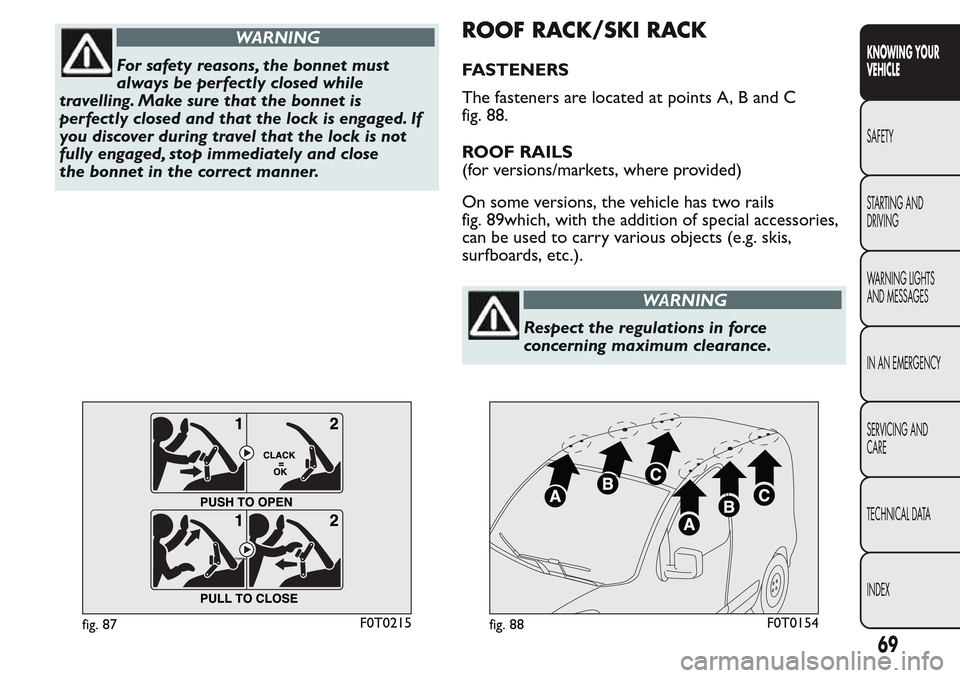
The fasteners are located at points A, B and C
fig. 88.
ROOF RAILS
(for versions/markets, where provided)
On some versions, the vehicle has two rails
fig. 89which, with the addition of special accessories,
can be used to carry various objects (e.g. skis,
surfboards, etc.).
WARNING
Respect the regulations in force
concerning maximum clearance.
fig. 87F0T0215fig. 88F0T0154
69
KNOWING YOUR
VEHICLE
SAFETY
STARTING AND
DRIVING
WARNING LIGHTS
AND MESSAGES
IN AN EMERGENCY
SERVICING AND
CARE
TECHNICAL DATA
INDEX
Page 75 of 260
Adjusting headlight alignment
Press the
orbuttons on the control
panelfig. 90.
The instrument panel display shows the position in
relation to the adjustment set.
Position 0 - one or two people in the front seats.
Position1-fivepeople.
Position2-fivepeople + load in the boot.
Position 3 - driver + maximum permitted load
stowed in the boot.
IMPORTANT Check the alignment of the light beams
each time the weight of the load transported
changes.
FOG LIGHT DIRECTION
(for versions/markets, where provided)
Contact a Fiat Dealership to have the direction
checked and, if necessary, adjusted.
ADJUSTING THE HEADLIGHTS WHEN
ABROAD
The dipped headlights are directed for operation in
the country where the vehicle was originally
purchased. In countries where you drive on the
other side of the road, you need to alter the beam
direction by affixing a specially designed self-adhesive
film in order not to dazzle the vehicles travelling in
the opposite direction.
ABS SYSTEM
This is an integral part of the braking system, which
prevents one or more wheels from locking or
slipping regardless of the road surface conditions and
braking intensity, giving the best control during
emergency braking.
The EBD system (Electronic Braking Force
Distribution) completes the system, allowing the
brake force to be distributed between the front and
rear wheels.
IMPORTANT For maximum efficiency of the braking
system, a bedding-in period of about 500 km is
needed: during this period it is better to avoid sharp,
repeated and prolonged braking.
SYSTEM INTERVENTION
The driver can tell the ABS system has come into
action because the brake pedal pulsates slightly and
the system gets noisier: it means that the vehicle
speed should be altered to suit the type of road
surface.
MECHANICAL BRAKE ASSIST (emergency
braking assistance)
(for versions/markets, where provided)
This system, which cannot be deactivated, recognises
emergency braking conditions (according to the
brake pedal operation speed) and provides an
additional hydraulic braking pressure to support that
71
KNOWING YOUR
VEHICLE
SAFETY
STARTING AND
DRIVING
WARNING LIGHTS
AND MESSAGES
IN AN EMERGENCY
SERVICING AND
CARE
TECHNICAL DATA
INDEX
Page 76 of 260
provided by the driver. This allows faster and more
powerful operation of the braking system.
IMPORTANT When the Mechanical Brake Assist is
activated, noises may be heard from the system. This
is normal. In any case, while braking keep the brake
pedal firmly depressed.
WARNING
When the ABS cuts in and you feel the
brake pedal pulsating, do not remove
your foot , but keep the pedal pushed down; in
doing so you, will stop in the shortest distance
possible under the road conditions at the time.
WARNING
If the ABS cuts in, it is a sign that the
grip between tyre and the road surface
has reached the limit : you must slow down to
match the speed to the road grip available.
WARNING
The ABS gets the most from the
available grip, but it cannot improve it ;
you should therefore take every care when
driving on slippery surfaces and not take
unnecessary risks.FAILURE INDICATIONS
ABS failure
ABS failure is indicated by warning light
in the
instrument panel coming on (together with the
appropriate message on the multifunction display on
some versions) (see “Warning lights and messages”).
In this case, the braking system will work as normal,
but without the extra capacity offered by the ABS
system. Drive carefully to the nearest Fiat Dealership
to have the system checked.
EBD failure
ABS failure is indicated by warning light
andin
the instrument panel coming on (together with the
appropriate message on the multifunction display
on some versions) (see “Warning lights and
messages”).
In this case, the rear wheels may suddenly lock and
the vehicle may swerve when braking sharply. Drive
carefully to the nearest Fiat Dealership to have
the system checked.
72
KNOWING YOUR
VEHICLE
SAFETY
STARTING AND
DRIVING
WARNING LIGHTS
AND MESSAGES
IN AN EMERGENCY
SERVICING AND
CARE
TECHNICAL DATA
INDEX
Page 86 of 260
Traction Plus operation
The system is deactivated when starting up. To
activate the "Traction Plus" system, press the button
(T+ fig. 92): the LED on the button switches on.
The activation of the Traction Plus system involves
the following functions being switched on:
inhibition of the ASR function, in order to fully
exploit the engine torque;
the differential locking effect on the front axle,
through the braking system, to improve traction
on irregular grounds.
If the "Traction Plus" system is faulty, the "general
failure" instrument panel warning light
comes on
steady.
EOBD SYSTEM
The EOBD system (European On Board Diagnosis)
allows continuous diagnosis of emission-related
components on the vehicle.
It also alerts the driver, by turning on instrument
panel warning light
(together with the relevant
message in the display, on some versions), when
these components are no longer in peak condition
(see “Warning lights and messages” section).
The aim of the system is to:
monitor system efficiency;
warn about increased emissions due to a vehicle
malfunction;
to warn of the need to replace deteriorated
components.
The system also has a connector that can be
interfaced with appropriate equipment, which makes
it possible to read the error codes stored in the
control unit, together with a series of specific
parameters for engine operation and diagnosis.
This check can also be carried out by traffic police.
IMPORTANT After resolving the problem, to check
the system completely, Fiat Dealerships are obliged
to run a bench test and, if necessary, road tests
which may call for a long journey.
82
KNOWING YOUR
VEHICLE
SAFETY
STARTING AND
DRIVING
WARNING LIGHTS
AND MESSAGES
IN AN EMERGENCY
SERVICING AND
CARE
TECHNICAL DATA
INDEX
Page 87 of 260
WARNING
Go to a Fiat Dealership as soon as
possible if warning light
either does
not light up when the key is turned to MAR to if
while travelling the warning lights comes on
either steady or blinking (along with a message
on the display).The operation of warning light
may be checked by the traffic police using
specific devices. Follow the laws in force in
the country where you are driving.
SPEED BLOCK
(for 1.3 MultiJet versions with manual gearbox)
The vehicle is equipped with a function that limits
the speed that can be set, when requested by the
user, to one of 4 preset values: 90, 100, 110 or 130
km/h.
This function must be activated/deactivated through
a Fiat Dealership.
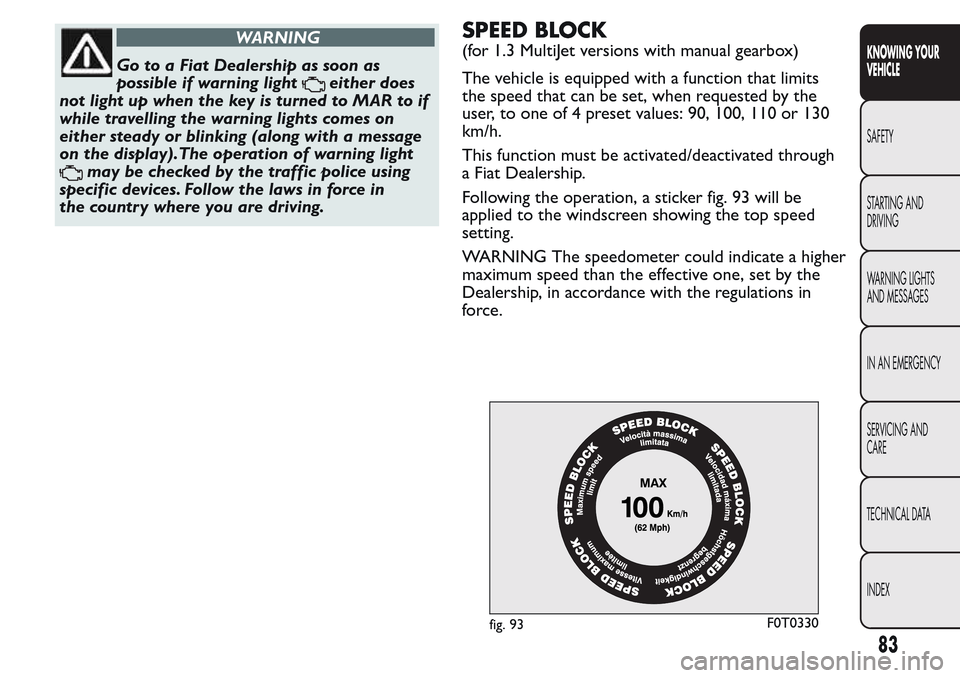
Following the operation, a sticker fig. 93 will be
applied to the windscreen showing the top speed
setting.
WARNING The speedometer could indicate a higher
maximum speed than the effective one, set by the
Dealership, in accordance with the regulations in
force.
fig. 93F0T0330
83
KNOWING YOUR
VEHICLE
SAFETY
STARTING AND
DRIVING
WARNING LIGHTS
AND MESSAGES
IN AN EMERGENCY
SERVICING AND
CARE
TECHNICAL DATA
INDEX
Page 98 of 260
REFUELLING CAPACITY
To fill the tank completely, top up twice after the
first click of the trigger. Further top-ups could cause
faults in the fuel feeding system.
FUEL FILLER CAP
Opening
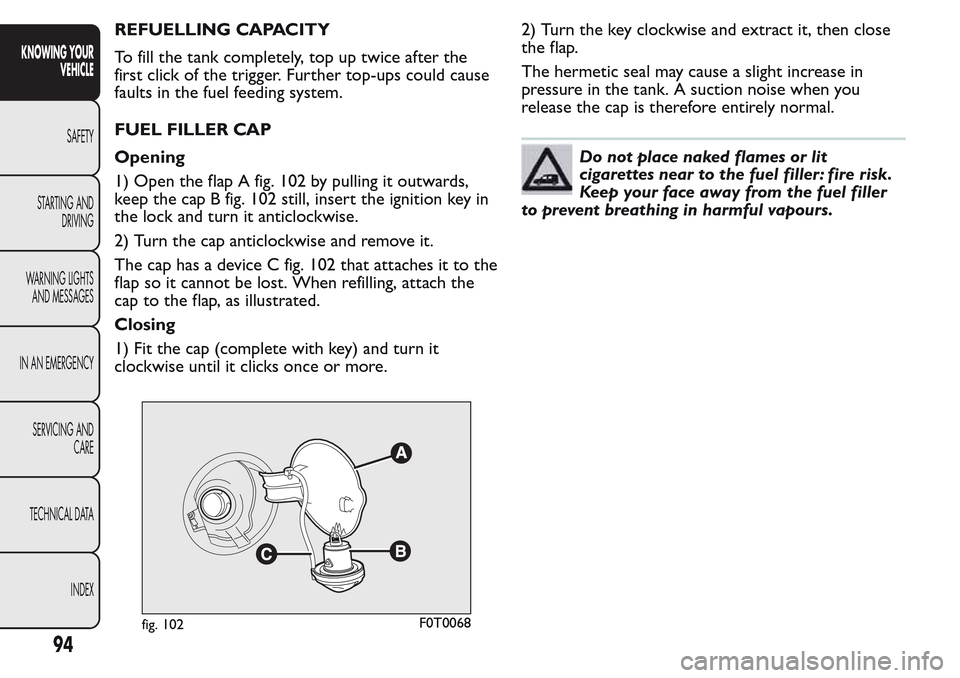
1) Open the flap A fig. 102 by pulling it outwards,
keep the cap B fig. 102 still, insert the ignition key in
the lock and turn it anticlockwise.
2) Turn the cap anticlockwise and remove it.
The cap has a device C fig. 102 that attaches it to the
flap so it cannot be lost. When refilling, attach the
cap to the flap, as illustrated.
Closing
1) Fit the cap (complete with key) and turn it
clockwise until it clicks once or more.2) Turn the key clockwise and extract it, then close
the flap.
The hermetic seal may cause a slight increase in
pressure in the tank. A suction noise when you
release the cap is therefore entirely normal.
Do not place naked flames or lit
cigarettes near to the fuel filler: fire risk.
Keep your face away from the fuel filler
to prevent breathing in harmful vapours.
fig. 102F0T0068
94
KNOWING YOUR
VEHICLE
SAFETY
STARTING AND
DRIVING
WARNING LIGHTS
AND MESSAGES
IN AN EMERGENCY
SERVICING AND
CARE
TECHNICAL DATA
INDEX