fuel cap FIAT SCUDO 2011 Owner handbook (in English)
[x] Cancel search | Manufacturer: FIAT, Model Year: 2011, Model line: SCUDO, Model: FIAT SCUDO 2011Pages: 210, PDF Size: 3.29 MB
Page 8 of 210
7
SAFETY
DEVICES
CORRECT USE
OF THE
VEHICLE
WARNING
LIGHTS AND
MESSAGES
IN AN
EMERGENCY
VEHICLE
MAINTENANCE
TECHNICAL
SPECIFICATIONS
INDEX
DASHBOARD
AND CONTROLS
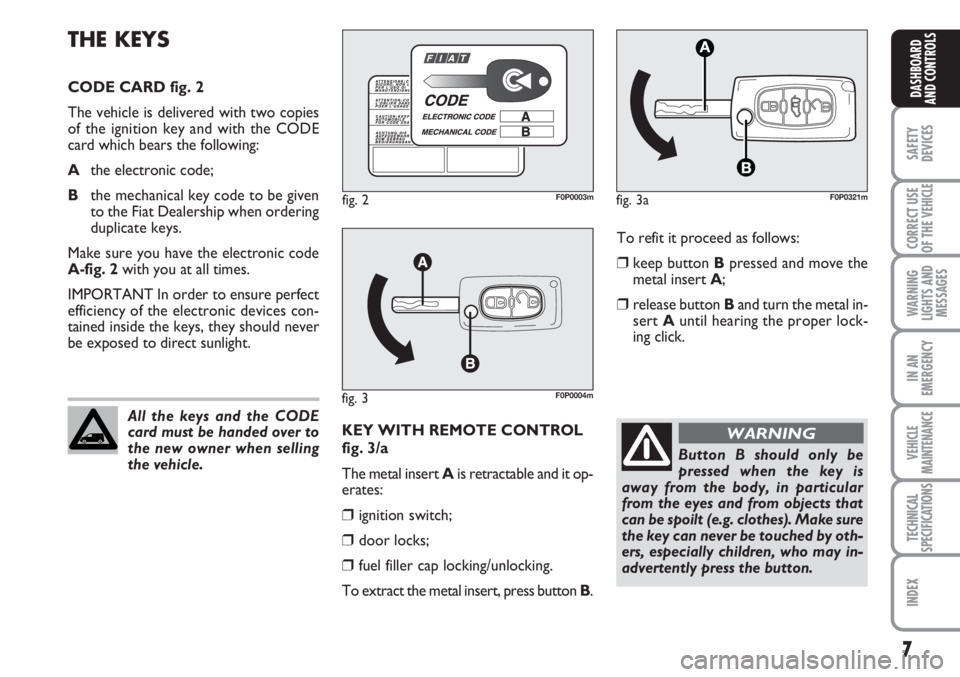
To refit it proceed as follows:
❒keep button Bpressed and move the
metal insert A;
❒release button Band turn the metal in-
sert A until hearing the proper lock-
ing click.
THE KEYS
CODE CARD fig. 2
The vehicle is delivered with two copies
of the ignition key and with the CODE
card which bears the following:
Athe electronic code;
Bthe mechanical key code to be given
to the Fiat Dealership when ordering
duplicate keys.
Make sure you have the electronic code
A-fig. 2with you at all times.
IMPORTANT In order to ensure perfect
efficiency of the electronic devices con-
tained inside the keys, they should never
be exposed to direct sunlight.
All the keys and the CODE
card must be handed over to
the new owner when selling
the vehicle.
fig. 2F0P0003m
fig. 3F0P0004m
fig. 3aF0P0321m
KEY WITH REMOTE CONTROL
fig. 3/a
The metal insert Ais retractable and it op-
erates:
❒ignition switch;
❒door locks;
❒fuel filler cap locking/unlocking.
To extract the metal insert, press button B.
Button B should only be
pressed when the key is
away from the body, in particular
from the eyes and from objects that
can be spoilt (e.g. clothes). Make sure
the key can never be touched by oth-
ers, especially children, who may in-
advertently press the button.
WARNING
Page 11 of 210
10
SAFETY
DEVICES
CORRECT USE
OF THE
VEHICLE
WARNING
LIGHTS AND
MESSAGES
IN AN
EMERGENCY
VEHICLE
MAINTENANCE
TECHNICAL
SPECIFICATIONS
INDEX
DASHBOARD
AND CONTROLS
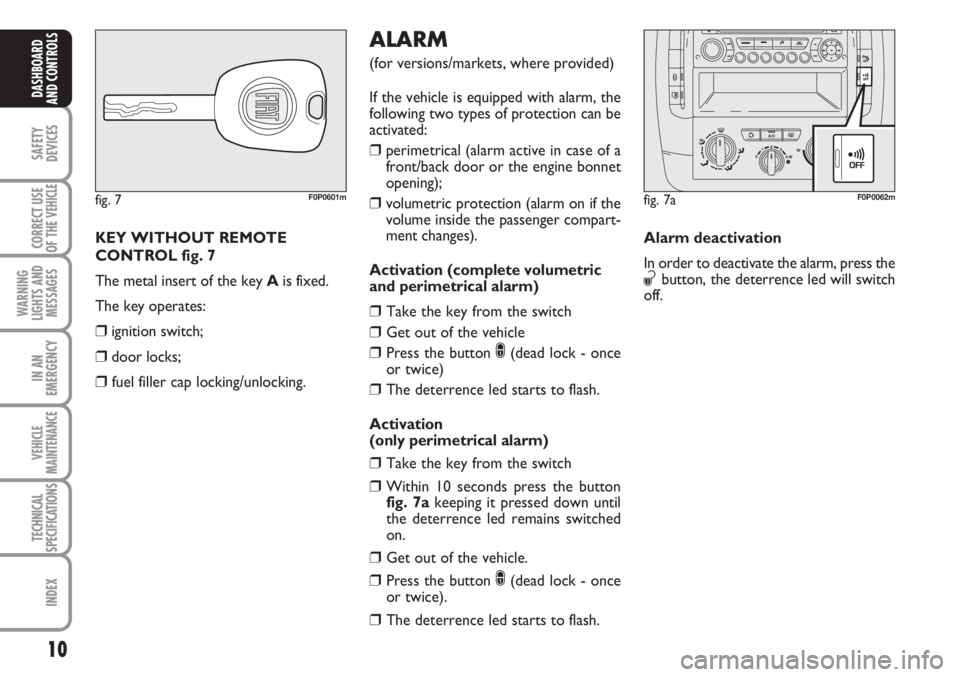
KEY WITHOUT REMOTE
CONTROL fig. 7
The metal insert of the key Ais fixed.
The key operates:
❒ignition switch;
❒door locks;
❒fuel filler cap locking/unlocking.
fig. 7F0P0601m
ALARM
(for versions/markets, where provided)
If the vehicle is equipped with alarm, the
following two types of protection can be
activated:
❒perimetrical (alarm active in case of a
front/back door or the engine bonnet
opening);
❒volumetric protection (alarm on if the
volume inside the passenger compart-
ment changes).
Activation (complete volumetric
and perimetrical alarm)
❒Take the key from the switch
❒Get out of the vehicle
❒Press the button ∫(dead lock - once
or twice)
❒The deterrence led starts to flash.
Activation
(only perimetrical alarm)
❒Take the key from the switch
❒Within 10 seconds press the button
fig. 7akeeping it pressed down until
the deterrence led remains switched
on.
❒Get out of the vehicle.
❒Press the button ∫(dead lock - once
or twice).
❒The deterrence led starts to flash.
fig. 7aF0P0062m
Alarm deactivation
In order to deactivate the alarm, press the
ªbutton, the deterrence led will switch
off.
Page 92 of 210
91
SAFETY
DEVICES
CORRECT USE
OF THE
VEHICLE
WARNING
LIGHTS AND
MESSAGES
IN AN
EMERGENCY
VEHICLE
MAINTENANCE
TECHNICAL
SPECIFICATIONS
INDEX
DASHBOARD
AND CONTROLS
Refuelling
To guarantee full tank filling, carry out two
refuelling operations after the first click of
the fuel delivery gun. Avoid further top-
ping up operations that could cause dam-
ages to the fuel system.
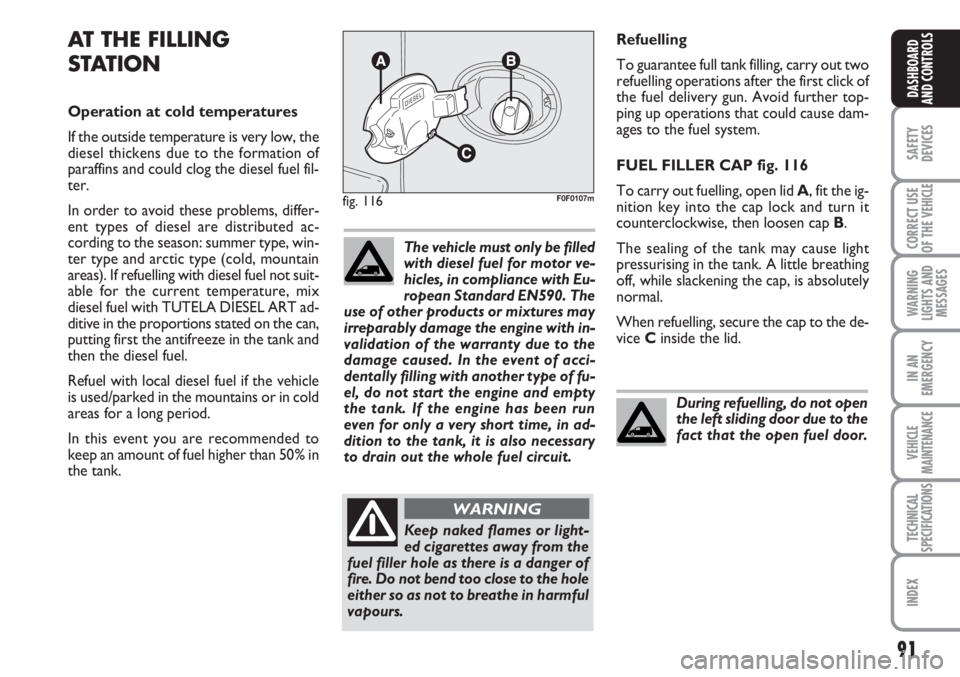
FUEL FILLER CAP fig. 116
To carry out fuelling, open lid A, fit the ig-
nition key into the cap lock and turn it
counterclockwise, then loosen cap B.
The sealing of the tank may cause light
pressurising in the tank. A little breathing
off, while slackening the cap, is absolutely
normal.
When refuelling, secure the cap to the de-
vice Cinside the lid.
fig. 116F0F0107m
AT THE FILLING
STATION
Operation at cold temperatures
If the outside temperature is very low, the
diesel thickens due to the formation of
paraffins and could clog the diesel fuel fil-
ter.
In order to avoid these problems, differ-
ent types of diesel are distributed ac-
cording to the season: summer type, win-
ter type and arctic type (cold, mountain
areas). If refuelling with diesel fuel not suit-
able for the current temperature, mix
diesel fuel with TUTELA DIESEL ART ad-
ditive in the proportions stated on the can,
putting first the antifreeze in the tank and
then the diesel fuel.
Refuel with local diesel fuel if the vehicle
is used/parked in the mountains or in cold
areas for a long period.
In this event you are recommended to
keep an amount of fuel higher than 50% in
the tank.The vehicle must only be filled
with diesel fuel for motor ve-
hicles, in compliance with Eu-
ropean Standard EN590. The
use of other products or mixtures may
irreparably damage the engine with in-
validation of the warranty due to the
damage caused. In the event of acci-
dentally filling with another type of fu-
el, do not start the engine and empty
the tank. If the engine has been run
even for only a very short time, in ad-
dition to the tank, it is also necessary
to drain out the whole fuel circuit.
Keep naked flames or light-
ed cigarettes away from the
fuel filler hole as there is a danger of
fire. Do not bend too close to the hole
either so as not to breathe in harmful
vapours.
WARNING
During refuelling, do not open
the left sliding door due to the
fact that the open fuel door.
Page 135 of 210
ENGINE STARTING
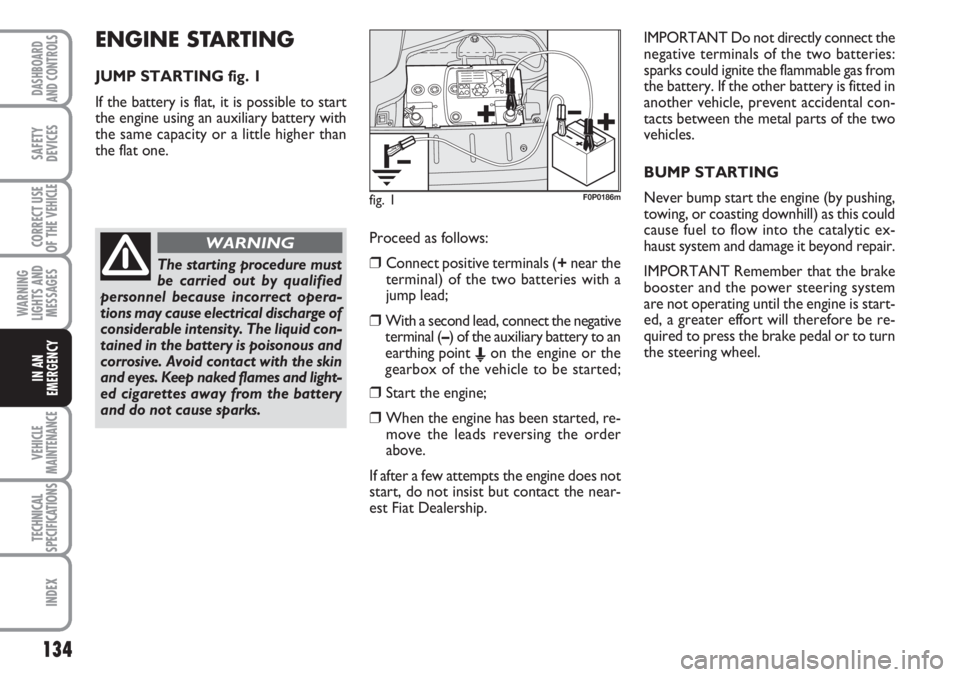
JUMP STARTING fig. 1
If the battery is flat, it is possible to start
the engine using an auxiliary battery with
the same capacity or a little higher than
the flat one.
134
WARNING
LIGHTS AND
MESSAGES
VEHICLE
MAINTENANCE
TECHNICAL
SPECIFICATIONS
INDEX
DASHBOARD
AND CONTROLS
SAFETY
DEVICES
CORRECT USE
OF THE
VEHICLE
IN AN
EMERGENCY
Proceed as follows:
❒Connect positive terminals (+near the
terminal) of the two batteries with a
jump lead;
❒With a second lead, connect the negative
terminal (–) of the auxiliary battery to an
earthing point
Eon the engine or the
gearbox of the vehicle to be started;
❒ Start the engine;
❒ When the engine has been started, re-
move the leads reversing the order
above.
If after a few attempts the engine does not
start, do not insist but contact the near-
est Fiat Dealership.IMPORTANT Do not directly connect the
negative terminals of the two batteries:
sparks could ignite the flammable gas from
the battery. If the other battery is fitted in
another vehicle, prevent accidental con-
tacts between the metal parts of the two
vehicles.
BUMP STARTING
Never bump start the engine (by pushing,
towing, or coasting downhill) as this could
cause fuel to flow into the catalytic ex-
haust system and damage it beyond repair.
IMPORTANT Remember that the brake
booster and the power steering system
are not operating until the engine is start-
ed, a greater effort will therefore be re-
quired to press the brake pedal or to turn
the steering wheel.
fig. 1F0P0186m
The starting procedure must
be carried out by qualified
personnel because incorrect opera-
tions may cause electrical discharge of
considerable intensity. The liquid con-
tained in the battery is poisonous and
corrosive. Avoid contact with the skin
and eyes. Keep naked flames and light-
ed cigarettes away from the battery
and do not cause sparks.
WARNING
Page 158 of 210
157
WARNING
LIGHTS AND
MESSAGES
TECHNICAL
SPECIFICATIONS
INDEX
DASHBOARD
AND CONTROLS
SAFETY
DEVICES
CORRECT USE
OF THE
VEHICLE
IN AN
EMERGENCY
VEHICLE
MAINTENANCE
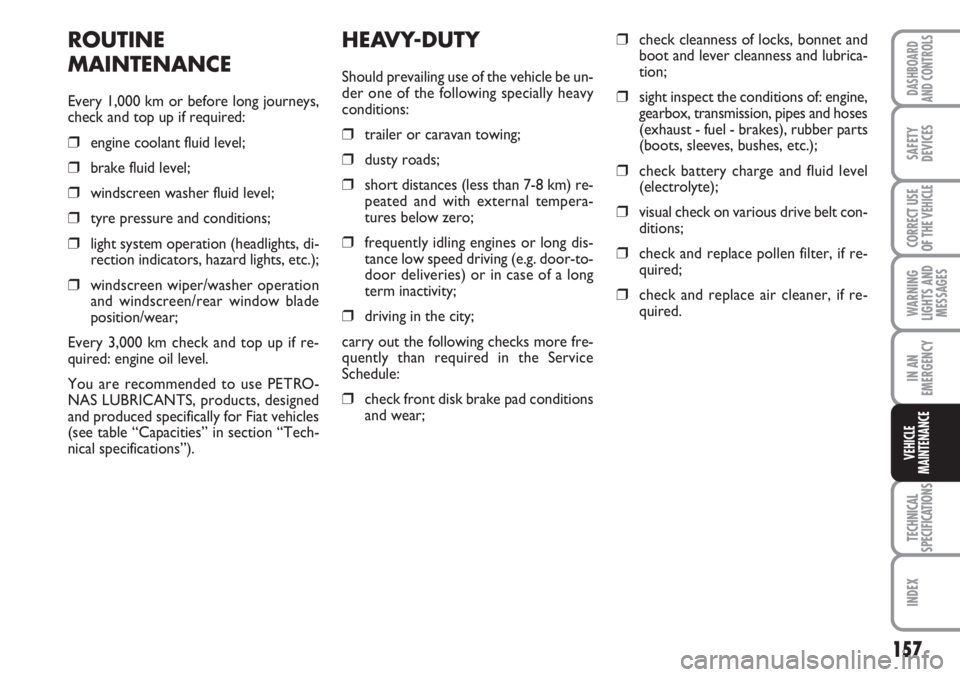
HEAVY-DUTY
Should prevailing use of the vehicle be un-
der one of the following specially heavy
conditions:
❒trailer or caravan towing;
❒dusty roads;
❒short distances (less than 7-8 km) re-
peated and with external tempera-
tures below zero;
❒frequently idling engines or long dis-
tance low speed driving (e.g. door-to-
door deliveries) or in case of a long
term inactivity;
❒driving in the city;
carry out the following checks more fre-
quently than required in the Service
Schedule:
❒check front disk brake pad conditions
and wear;
❒check cleanness of locks, bonnet and
boot and lever cleanness and lubrica-
tion;
❒sight inspect the conditions of: engine,
gearbox, transmission, pipes and hoses
(exhaust - fuel - brakes), rubber parts
(boots, sleeves, bushes, etc.);
❒check battery charge and fluid level
(electrolyte);
❒visual check on various drive belt con-
ditions;
❒check and replace pollen filter, if re-
quired;
❒check and replace air cleaner, if re-
quired.
ROUTINE
MAINTENANCE
Every 1,000 km or before long journeys,
check and top up if required:
❒engine coolant fluid level;
❒brake fluid level;
❒windscreen washer fluid level;
❒tyre pressure and conditions;
❒light system operation (headlights, di-
rection indicators, hazard lights, etc.);
❒windscreen wiper/washer operation
and windscreen/rear window blade
position/wear;
Every 3,000 km check and top up if re-
quired: engine oil level.
You are recommended to use PETRO-
NAS LUBRICANTS, products, designed
and produced specifically for Fiat vehicles
(see table “Capacities” in section “Tech-
nical specifications”).
Page 174 of 210
173
WARNING
LIGHTS AND
MESSAGES
INDEX
DASHBOARD
AND CONTROLS
SAFETY
DEVICES
CORRECT USE
OF THE
VEHICLE
IN AN
EMERGENCY
VEHICLE
MAINTENANCE
TECHNICAL
SPECIFICATIONS
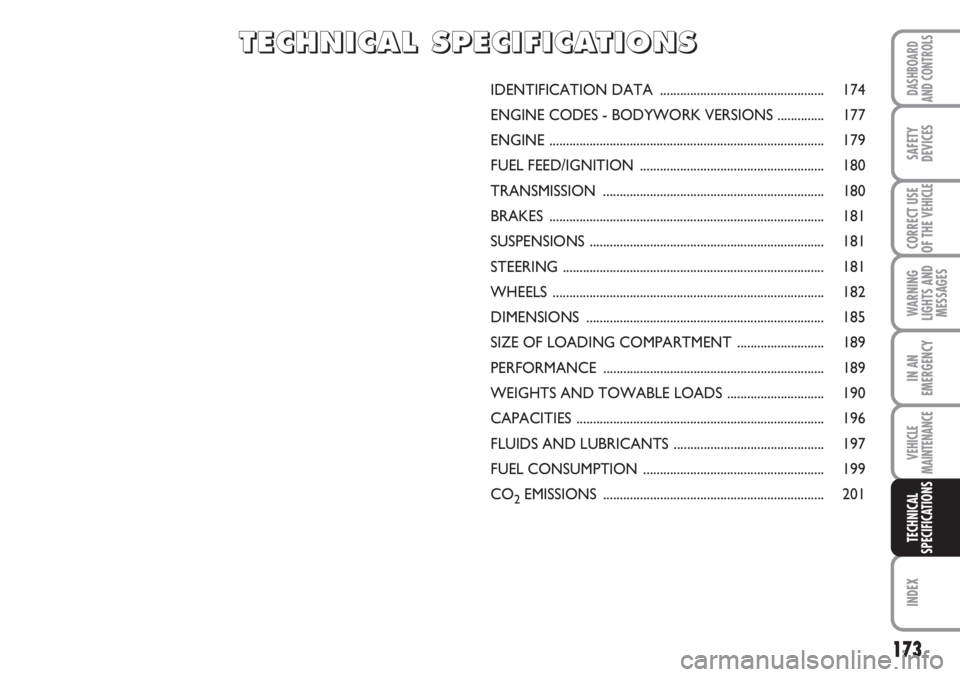
IDENTIFICATION DATA ................................................. 174
ENGINE CODES - BODYWORK VERSIONS .............. 177
ENGINE .................................................................................. 179
FUEL FEED/IGNITION ....................................................... 180
TRANSMISSION .................................................................. 180
BRAKES .................................................................................. 181
SUSPENSIONS ...................................................................... 181
STEERING .............................................................................. 181
WHEELS ................................................................................. 182
DIMENSIONS ....................................................................... 185
SIZE OF LOADING COMPARTMENT .......................... 189
PERFORMANCE .................................................................. 189
WEIGHTS AND TOWABLE LOADS ............................. 190
CAPACITIES .......................................................................... 196
FLUIDS AND LUBRICANTS ............................................. 197
FUEL CONSUMPTION ...................................................... 199
CO
2EMISSIONS .................................................................. 201
T T
E E
C C
H H
N N
I I
C C
A A
L L
S S
P P
E E
C C
I I
F F
I I
C C
A A
T T
I I
O O
N N
S S
Page 197 of 210
196
WARNING
LIGHTS AND
MESSAGES
INDEX
DASHBOARD
AND CONTROLS
SAFETY
DEVICES
CORRECT USE
OF THE
VEHICLE
IN AN
EMERGENCY
VEHICLE
MAINTENANCE
TECHNICAL
SPECIFICATIONS
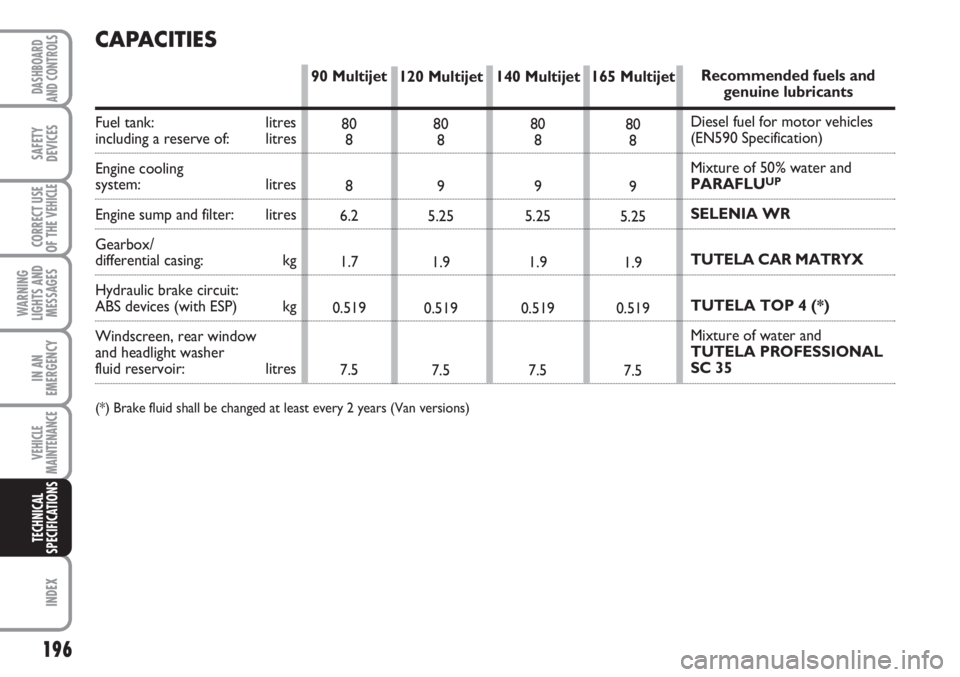
120 Multijet
80
8
9
5.25
1.9
0.519
7.5140 Multijet
80
8
9
5.25
1.9
0.519
7.5 90 Multijet
80
8
8
6.2
1.7
0.519
7.5
CAPACITIES
Fuel tank: litresincluding a reserve of: litres
Engine cooling
system: litres
Engine sump and filter: litres
Gearbox/
differential casing: kg
Hydraulic brake circuit:
ABS devices (with ESP) kg
Windscreen, rear window
and headlight washer
fluid reservoir: litres
(*) Brake fluid shall be changed at least every 2 years (Van versions)
Recommended fuels and
genuine lubricants
Diesel fuel for motor vehicles
(EN590 Specification)
Mixture of 50% water and
PARAFLU
UP
SELENIA WR
TUTELA CAR MATRYX
TUTELA TOP 4 (*)
Mixture of water and
TUTELA PROFESSIONAL
SC 35 165 Multijet
80
8
9
5.25
1.9
0.519
7.5
Page 203 of 210
202
WARNING
LIGHTS AND
MESSAGES
DASHBOARD
AND CONTROLS
SAFETY
DEVICES
CORRECT USE
OF THE
VEHICLE
IN AN
EMERGENCY
VEHICLE
MAINTENANCE
TECHNICAL
SPECIFICATIONS
INDEX
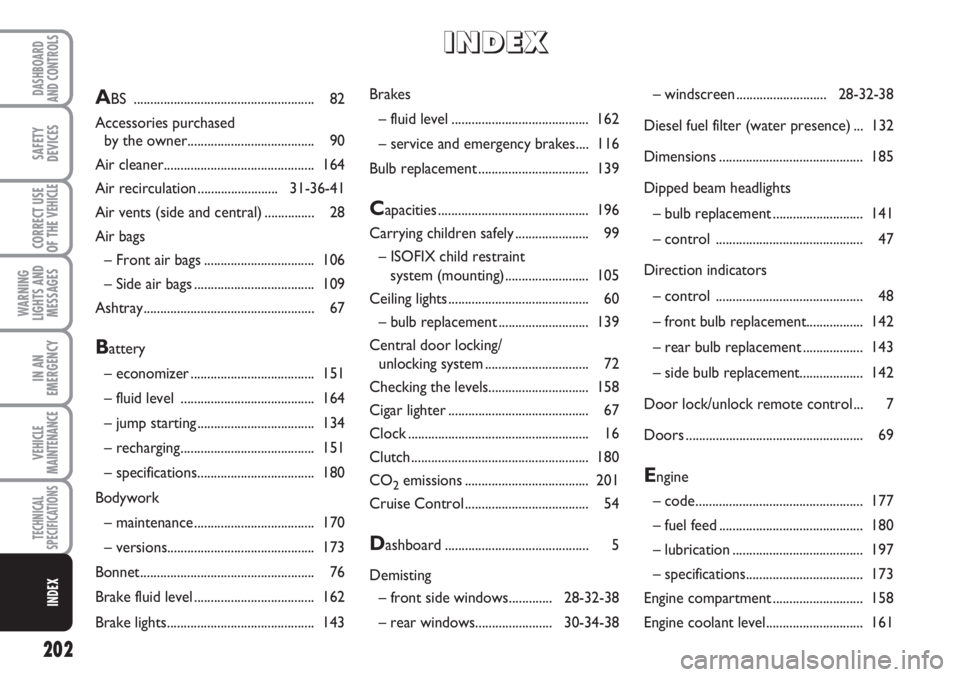
Brakes
– fluid level ......................................... 162
– service and emergency brakes.... 116
Bulb replacement................................. 139
Capacities ............................................. 196
Carrying children safely...................... 99
– ISOFIX child restraint
system (mounting)......................... 105
Ceiling lights.......................................... 60
– bulb replacement ........................... 139
Central door locking/
unlocking system............................... 72
Checking the levels.............................. 158
Cigar lighter .......................................... 67
Clock ...................................................... 16
Clutch..................................................... 180
CO
2emissions ..................................... 201
Cruise Control ..................................... 54
Dashboard ........................................... 5
Demisting
– front side windows.............28-32-38
– rear windows.......................30-34-38– windscreen...........................28-32-38
Diesel fuel filter (water presence) ... 132
Dimensions........................................... 185
Dipped beam headlights
– bulb replacement ........................... 141
– control ............................................ 47
Direction indicators
– control ............................................ 48
– front bulb replacement................. 142
– rear bulb replacement.................. 143
– side bulb replacement................... 142
Door lock/unlock remote control ... 7
Doors ..................................................... 69
Engine
– code.................................................. 177
– fuel feed ........................................... 180
– lubrication....................................... 197
– specifications................................... 173
Engine compartment........................... 158
Engine coolant level............................. 161
ABS ...................................................... 82
Accessories purchased
by the owner...................................... 90
Air cleaner............................................. 164
Air recirculation........................31-36-41
Air vents (side and central) ............... 28
Air bags
– Front air bags................................. 106
– Side air bags .................................... 109
Ashtray................................................... 67
Battery
– economizer..................................... 151
– fluid level ........................................ 164
– jump starting ................................... 134
– recharging........................................ 151
– specifications................................... 180
Bodywork
– maintenance.................................... 170
– versions............................................ 173
Bonnet.................................................... 76
Brake fluid level .................................... 162
Brake lights............................................ 143
I I
N N
D D
E E
X X
Page 204 of 210
203
WARNING
LIGHTS AND
MESSAGES
DASHBOARD
AND CONTROLS
SAFETY
DEVICES
CORRECT USE
OF THE
VEHICLE
IN AN
EMERGENCY
VEHICLE
MAINTENANCE
TECHNICAL
SPECIFICATIONS
INDEX
Handbrake ........................................... 116
Hazard lights ......................................... 61
Head restraints..................................... 23
Headlight washers............................... 53
Headlights
– adjusting headlight beam .............. 81
Heated rear window................30-35-43
Heating and ventilation ....................... 27
Identification data................................ 174
In an emergency ................................... 133
Instrument panel
brightness adjuster............................ 15
Instrument panel.................................. 13
Instruments........................................... 14
Interiors ................................................ 172
Interior equipment.............................. 65
Jack ......................................................... 136
Keys ....................................................... 77
Load recommendations.................... 79
Lubricants (specifications) ................ 197
Main beam headlights
– bulb replacement ........................... 141
– control ............................................ 47
Manual climate control system ......... 31
Number plate lights ........................... 144
Paint ...................................................... 170
Parking.................................................... 116
Performance ......................................... 198
Pneumatic suspensions ....................... 78
Power steering fluid level................... 163
Power windows/window winders .... 74
Pretensioners........................................ 96
Quick tyre repair kit ........................ 138
Rearview mirrors
– driving mirror................................. 25
– door mirrors .................................. 25
Rev counter ......................................... 14
Reversing lights..................................... 143
Roof rack/ski rack (presetting) ......... 77
Routine maintenance.......................... 157 Engine oil
– checking the level .......................... 160
– consumption ................................ 160
– specifications................................... 197
EOBD system....................................... 87
Fiat CODE .......................................... 6
Fix & Go................................................ 138
Fluid levels (checks)............................. 158
Front fog lights/rear fog lights
– bulb replacement ....................142-143
– control ............................................ 47
Fuel
– filler cap ......................................... 91
– fuel cut-off switch.......................... 64
– fuel gauge......................................... 14
Fuel consumption................................ 199
Fuel cut-off switch............................... 64
Fuel level gauge.................................... 14
Fuses....................................................... 146
Gearbox
– manual gearbox use ...................... 117
Glovebox/oddment
compartments.................................... 65
Page 208 of 210
The engine of your car is factory filled with Selenia.
Oil change? The experts recommend Selenia
This is an engine oil range which satisfies the most advanced
international specifications. Its superior technical characteristics
allowSelenia to guarantee the highest performance
and protection of your engine.
The Selenia range includes a number of technologically advanced products:
SELENIA K PURE ENERGY
Synthetic lubricant designed for latest generation, low
emission, petrol engines. Its specific formulation warrants
the utmost protection also for high performance
turbocharged engines with high thermal stress.
Its low ash content helps to maintain the total cleanliness
of modern catalysts.
SELENIA WR PURE ENERGY
Fully synthetic lubricant that can meet the requirements of
the latest diesel engines. Low ash content to protect the
particulate filter from the residual products of combustion.
High Fuel Economy System that allows
considerable fuel saving.
It reduces the danger of dirtying the turbine to ensure the
protection of increasingly high performance diesel
enginesSELENIA MULTIPOWER
Particularly ideal for the protection of new generation petrol
engines, very effective even in the most severe weather
conditions. It guarantees a reduction in fuel consumption
(Energy conserving) and it is also ideal for alternative
engines.
SELENIA SPORT
Fully synthetic lubricant capable of meeting the needs of
high performance engines.
Studied to protect the engine also in high thermal stress
conditions, it prevents deposits on the turbine to achieve
the utmost performance in total safety.
The range also includes Selenia StAR Pure Energy, Selenia
Racing, Selenia K, Selenia WR, Selenia 20K, Selenia 20K AR.
For further information on Selenia products visit the web site
www.selenia.com.