belt FIAT SCUDO 2013 Owner handbook (in English)
[x] Cancel search | Manufacturer: FIAT, Model Year: 2013, Model line: SCUDO, Model: FIAT SCUDO 2013Pages: 223, PDF Size: 9.76 MB
Page 103 of 223
99
CORRECT USE
OF THE
VEHICLE
WARNING
LIGHTS AND
MESSAGES
IN AN
EMERGENCY
VEHICLE
MAINTENANCE
TECHNICAL
SPECIFICATIONS
INDEX
DASHBOARD
AND CONTROLS
SAFETY
DEVICES
For optimal protection in the event of an
impact, all occupants must be seated and
wearing adequate restraint systems, in-
cluding infants and other children. This pre-
scription is compulsory in all EC countries
according to EC Directive 2003/20/EC.
Compared with an adult, a child’s head is
larger and heavier in proportion to his/her
body and the child’s muscular and bone
structures are not fully developed. There-
fore, correct restraint systems other than
adult seat belts are necessary to reduce as
much as possible the risk of injuries in case
of accident, braking or sudden manoeu-
vre.
Children must be seated safely and com-
fortably. As far as the characteristics of the
child restraint systems used, you are ad-
vised to keep children in rearward facing
restraint systems for as long as possible;
this is the most protected position in the
event of an impact.
The choice of the most suitable child re-
straint system depends on the weight of
the child; there are various types of child
restraint systems and you are advised al-
ways to choose the one that is most suit-
able for the child. When over 1.50 m in height, from the
point of view of restraint systems, children
are considered as adults and wear seat
belts normally.
In Europe the characteristics of child re-
straint systems are ruled by regulation
ECE-R44, making them compulsory and
dividing them into five weight groups:
Group 0 up to 10 kg
Group 0+ up to 13 kg
Group 1 9-18 kg
Group 2 15-25 kg
Group 3 22-36 kg
All child restraint systems must bear the
type-approval data along with the control
mark on a label firmly secured to the child
restraint system which must never be re-
moved. Lineaccessori Fiat offers child re-
straint systems for each weight group.
These devices are recommended having
been specifically designed and tested for
Fiat cars.
CARRYING CHILDREN SAFELY
A label with the dedicated
symbol indicating that it is
mandatory to deactivate the airbag
for rearward facing child restraint sys-
tems is applied on the sun visor. Al-
ways comply with the instructions on
the sun visor (see the “Airbag” section
in this paragraph).
WARNING
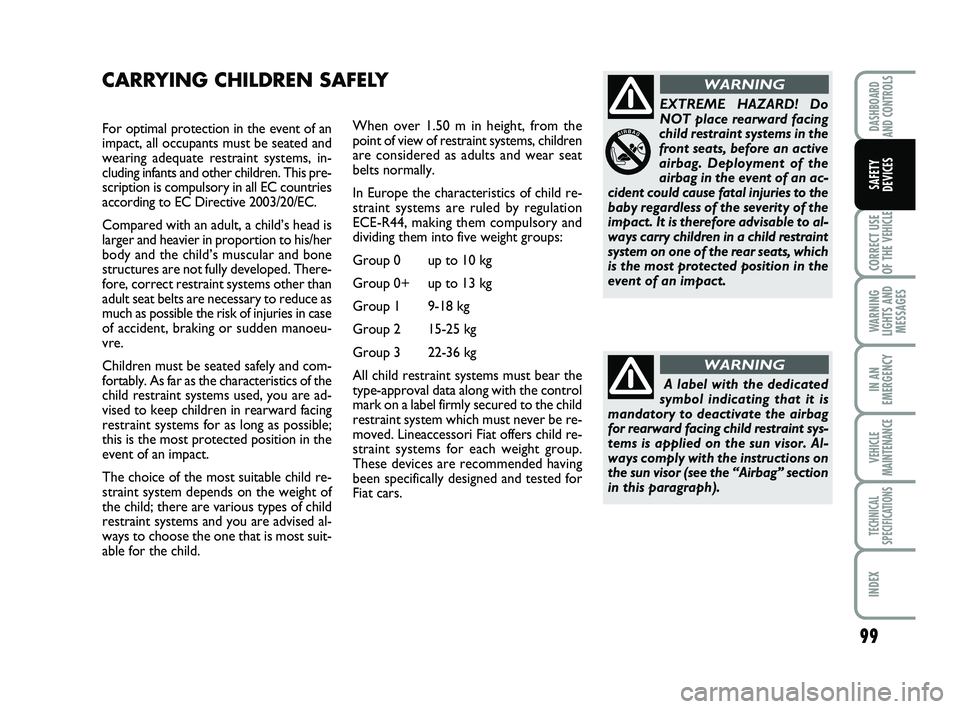
EXTREME HAZARD! Do
NOT place rearward facing
child restraint systems in the
front seats, before an active
airbag. Deployment of the
airbag in the event of an ac-
cident could cause fatal injuries to the
baby regardless of the severity of the
impact. It is therefore advisable to al-
ways carry children in a child restraint
system on one of the rear seats, which
is the most protected position in the
event of an impact.
WARNING
093-112 SCUDO LUM GB 9-10-2012 15:48 Pagina 99
Page 104 of 223
100
CORRECT USE
OF THE
VEHICLE
WARNING
LIGHTS AND
MESSAGES
IN AN
EMERGENCY
VEHICLE
MAINTENANCE
TECHNICAL
SPECIFICATIONS
IINDEX
DASHBOARD
AND CONTROLS
SAFETY
DEVICES
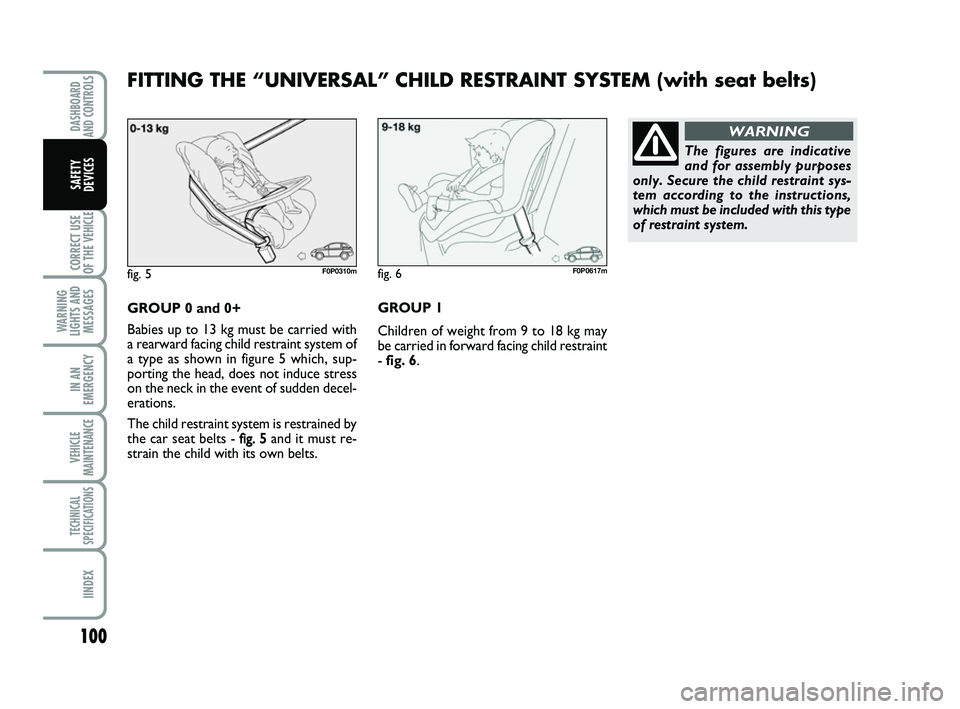
GROUP 0 and 0+
Babies up to 13 kg must be carried with
a rearward facing child restraint system of
a type as shown in figure 5 which, sup-
porting the head, does not induce stress
on the neck in the event of sudden decel-
erations.
The child restraint system is restrained by
the car seat belts - fig. 5and it must re-
strain the child with its own belts.
fig. 5F0P0310m
The figures are indicative
and for assembly purposes
only. Secure the child restraint sys-
tem according to the instructions,
which must be included with this type
of restraint system.
WARNING
fig. 6F0P0617m
GROUP 1
Children of weight from 9 to 18 kg may
be carried in forward facing child restraint
- fig. 6.
FITTING THE “UNIVERSAL” CHILD RESTRAINT SYSTEM (with seat belts)
093-112 SCUDO LUM GB 9-10-2012 15:48 Pagina 100
Page 105 of 223
101
CORRECT USE
OF THE
VEHICLE
WARNING
LIGHTS AND
MESSAGES
IN AN
EMERGENCY
VEHICLE
MAINTENANCE
TECHNICAL
SPECIFICATIONS
INDEX
DASHBOARD
AND CONTROLS
SAFETY
DEVICES
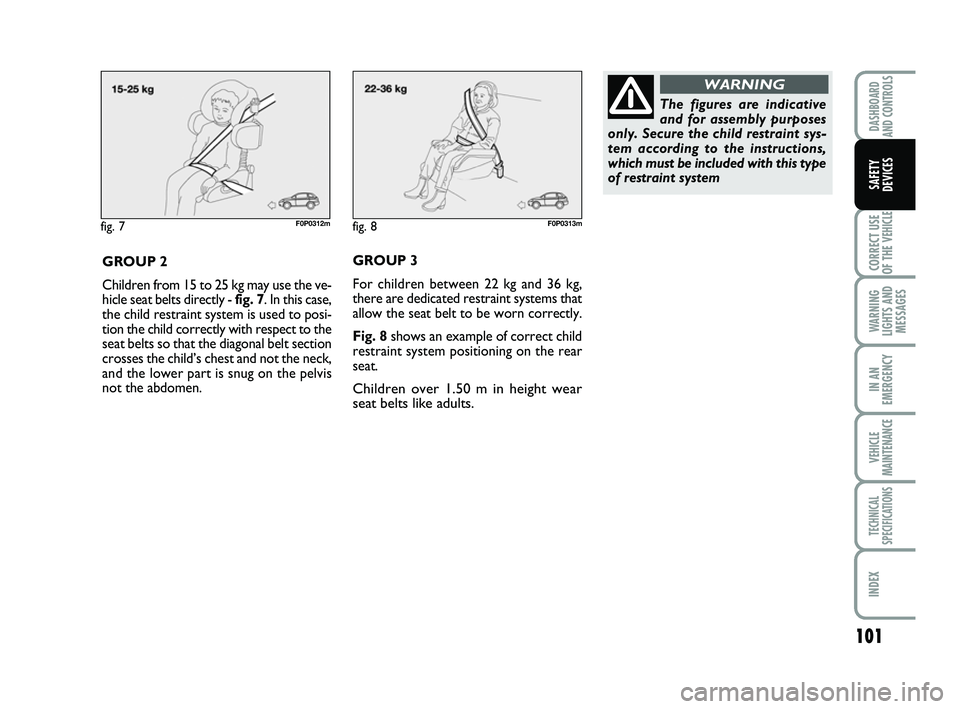
fig. 7F0P0312m
GROUP 2
Children from 15 to 25 kg may use the ve-
hicle seat belts directly - fig. 7. In this case,
the child restraint system is used to posi-
tion the child correctly with respect to the
seat belts so that the diagonal belt section
crosses the child’s chest and not the neck,
and the lower part is snug on the pelvis
not the abdomen.
The figures are indicative
and for assembly purposes
only. Secure the child restraint sys-
tem according to the instructions,
which must be included with this type
of restraint system
WARNING
GROUP 3
For children between 22 kg and 36 kg,
there are dedicated restraint systems that
allow the seat belt to be worn correctly.
Fig. 8shows an example of correct child
restraint system positioning on the rear
seat.
Children over 1.50 m in height wear
seat belts like adults.
fig. 8F0P0313m
093-112 SCUDO LUM GB 9-10-2012 15:48 Pagina 101
Page 107 of 223
103
CORRECT USE
OF THE
VEHICLE
WARNING
LIGHTS AND
MESSAGES
IN AN
EMERGENCY
VEHICLE
MAINTENANCE
TECHNICAL
SPECIFICATIONS
INDEX
DASHBOARD
AND CONTROLS
SAFETY
DEVICES
FITTING THE
“UNIVERSAL ISOFIX”
CHILD RESTRAINT
SYSTEM
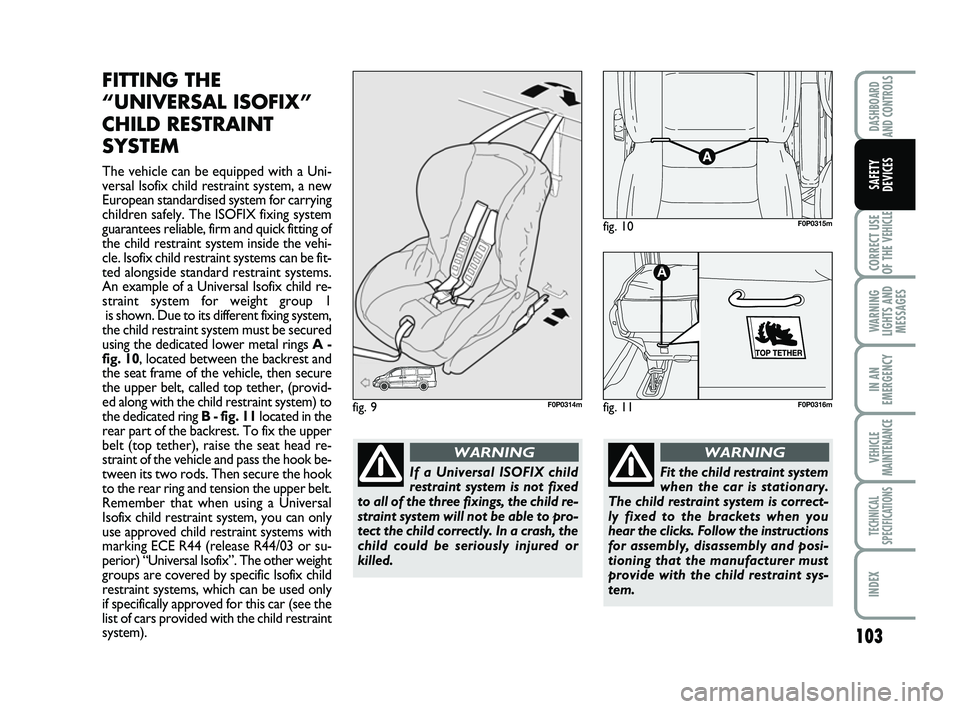
The vehicle can be equipped with a Uni-
versal Isofix child restraint system, a new
European standardised system for carrying
children safely. The ISOFIX fixing system
guarantees reliable, firm and quick fitting of
the child restraint system inside the vehi-
cle. Isofix child restraint systems can be fit-
ted alongside standard restraint systems.
An example of a Universal Isofix child re-
straint system for weight group 1
is shown. Due to its different fixing system,
the child restraint system must be secured
using the dedicated lower metal rings A -
fig. 10, located between the backrest and
the seat frame of the vehicle, then secure
the upper belt, called top tether, (provid-
ed along with the child restraint system) to
the dedicated ring B - fig. 11located in the
rear part of the backrest. To fix the upper
belt (top tether), raise the seat head re-
straint of the vehicle and pass the hook be-
tween its two rods. Then secure the hook
to the rear ring and tension the upper belt.
Remember that when using a Universal
Isofix child restraint system, you can only
use approved child restraint systems with
marking ECE R44 (release R44/03 or su-
perior) “Universal Isofix”. The other weight
groups are covered by specific Isofix child
restraint systems, which can be used only
if specifically approved for this car (see the
list of cars provided with the child restraint
system).
fig. 9F0P0314m
fig. 10F0P0315m
fig. 11
A
F0P0316m
If a Universal ISOFIX child
restraint system is not fixed
to all of the three fixings, the child re-
straint system will not be able to pro-
tect the child correctly. In a crash, the
child could be seriously injured or
killed.
WARNING
Fit the child restraint system
when the car is stationary.
The child restraint system is correct-
ly fixed to the brackets when you
hear the clicks. Follow the instructions
for assembly, disassembly and posi-
tioning that the manufacturer must
provide with the child restraint sys-
tem.
WARNING
093-112 SCUDO LUM GB 9-10-2012 15:48 Pagina 103
Page 109 of 223
105
CORRECT USE
OF THE
VEHICLE
WARNING
LIGHTS AND
MESSAGES
IN AN
EMERGENCY
VEHICLE
MAINTENANCE
TECHNICAL
SPECIFICATIONS
INDEX
DASHBOARD
AND CONTROLS
SAFETY
DEVICES
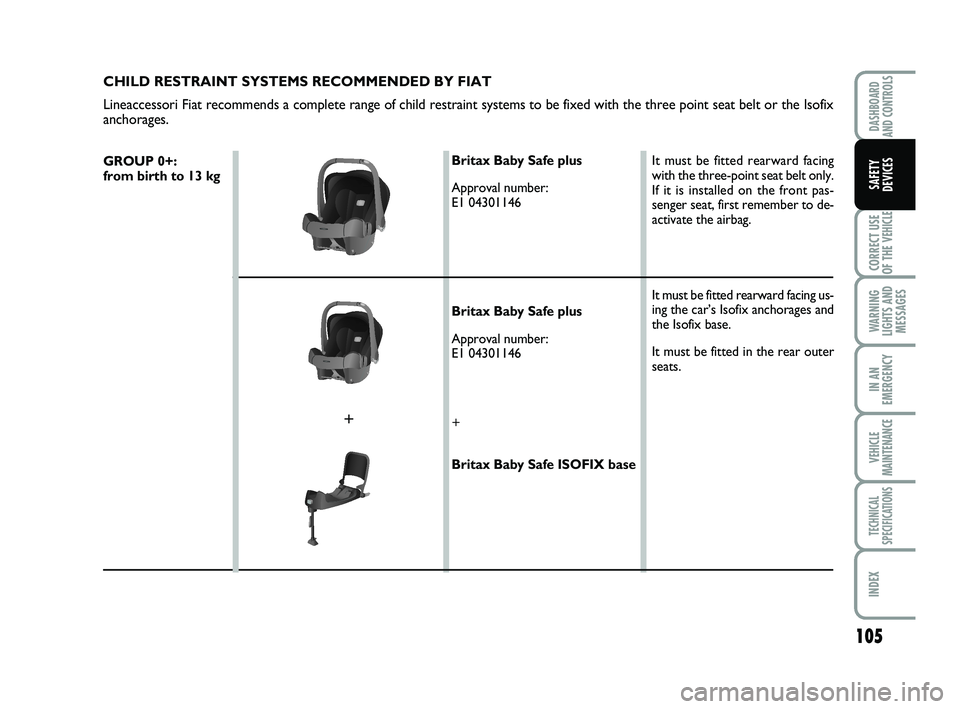
CHILD RESTRAINT SYSTEMS RECOMMENDED BY FIAT
Lineaccessori Fiat recommends a complete range of child restraint systems to be fixed with the three point seat belt or the Isofix
anchorages.
GROUP 0+:
from birth to 13 kgBritax Baby Safe plus
Approval number:
E1 04301146
Britax Baby Safe plus
Approval number:
E1 04301146
+
Britax Baby Safe ISOFIX baseIt must be fitted rearward facing
with the three-point seat belt only.
If it is installed on the front pas-
senger seat, first remember to de-
activate the airbag.
It must be fitted rearward facing us-
ing the car’s Isofix anchorages and
the Isofix base.
It must be fitted in the rear outer
seats.
+
093-112 SCUDO LUM GB 9-10-2012 15:48 Pagina 105
Page 110 of 223
106
CORRECT USE
OF THE
VEHICLE
WARNING
LIGHTS AND
MESSAGES
IN AN
EMERGENCY
VEHICLE
MAINTENANCE
TECHNICAL
SPECIFICATIONS
IINDEX
DASHBOARD
AND CONTROLS
SAFETY
DEVICES
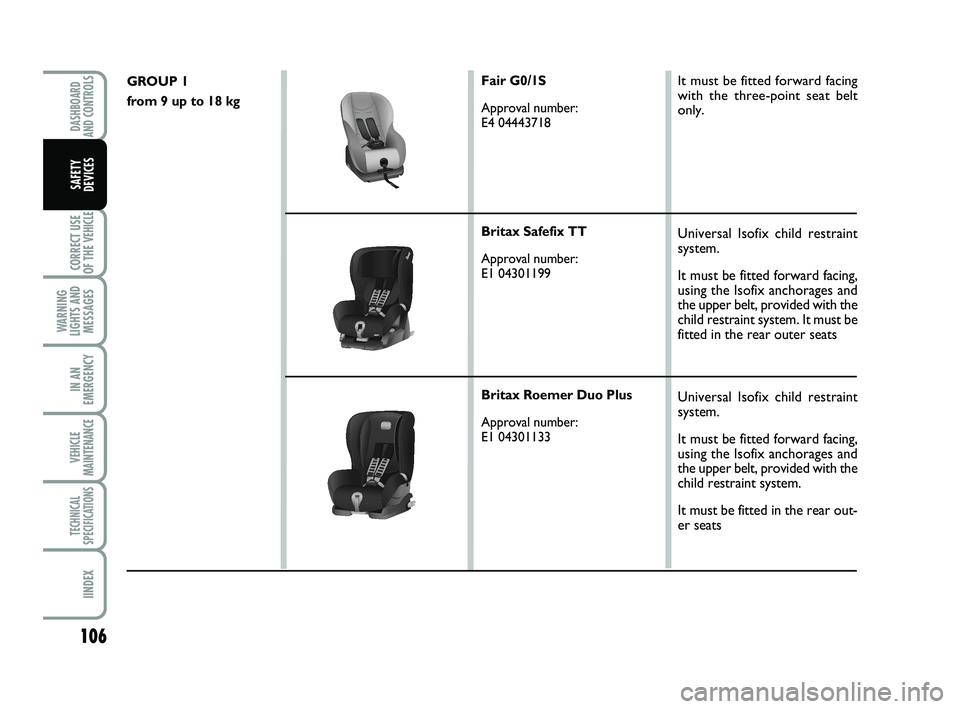
GROUP 1
from 9 up to 18 kgFair G0/1S
Approval number:
E4 04443718
Britax Safefix TT
Approval number:
E1 04301199
Britax Roemer Duo Plus
Approval number:
E1 04301133It must be fitted forward facing
with the three-point seat belt
only.
Universal Isofix child restraint
system.
It must be fitted forward facing,
using the Isofix anchorages and
the upper belt, provided with the
child restraint system. It must be
fitted in the rear outer seats
Universal Isofix child restraint
system.
It must be fitted forward facing,
using the Isofix anchorages and
the upper belt, provided with the
child restraint system.
It must be fitted in the rear out-
er seats
093-112 SCUDO LUM GB 9-10-2012 15:48 Pagina 106
Page 111 of 223
107
CORRECT USE
OF THE
VEHICLE
WARNING
LIGHTS AND
MESSAGES
IN AN
EMERGENCY
VEHICLE
MAINTENANCE
TECHNICAL
SPECIFICATIONS
INDEX
DASHBOARD
AND CONTROLS
SAFETY
DEVICES
MAIN RECOMMENDATIONS TO CARRY CHILDREN SAFELY:
1) The recommended position for installing child restraint systems, is on the rear seat, as it is the most protected area in the event
of an impact.
2) If the passenger airbag is deactivated, always check that the amber warning light on the instrument panel switches on constantly
to make sure that it has actually been deactivated.
3) Carefully follow the instructions provided with the child restraint system which are mandatory by law. Keep the instructions in
the vehicle along with the other documents and this handbook. Do not use second-hand child restraint systems without in-
structions.
4) Always check that the seat belts are well fastened with a traction test.
5) Only one child is to be secured into each restraint system; never carry two children using one child restraint system.
6) Always check that the seat belts do not interfere with the child’s throat.
7) While travelling, do not let the child sit incorrectly or unfasten the belts.
8) Never allow a child to put the seat belt’s diagonal section under an arm or behind their back.
9) Never carry children on your lap, not even newborns. No-one, regardless of his/her strength, can restrain a child in the event of
an accident.
10) In the event of an accident, replace the child restraint system with a new one
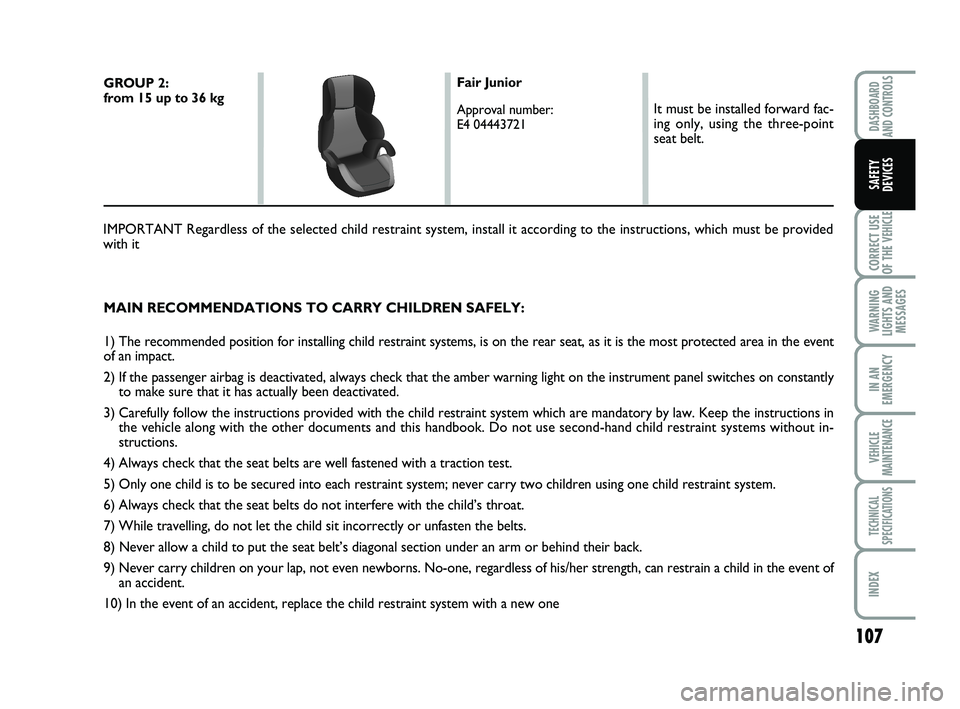
GROUP 2:
from 15 up to 36 kgFair Junior
Approval number:
E4 04443721
It must be installed forward fac-
ing only, using the three-point
seat belt.
IMPORTANT Regardless of the selected child restraint system, install it according to the instructions, which must be provided
with it
093-112 SCUDO LUM GB 9-10-2012 15:48 Pagina 107
Page 112 of 223
108
CORRECT USE OF THE
VEHICLE
WARNING LIGHTS ANDMESSAGES
IN AN EMERGENCY
VEHICLE MAINTENANCE
TECHNICAL SPECIFICATIONS
IINDEX
DASHBOARD AND CONTROLS
SAFETY DEVICES
FRONT AIRBAGS
The front driver and passenger airbags (for versions/markets where provided)protect the front seat occupants in theevent of head-on impacts of medium-highseverity, by placing the bag between theoccupant and the steering wheel or dash-board. Therefore non-deployment inother types of impacts (side impacts, rearshunts, roll-overs, etc.) does not indicatea system malfunction.
Front driver and passenger airbags (for ver-sions/markets where provided) are not areplacement for, but are complementaryto, the seat belts, which you are recom-mended to always wear, as specified by lawin Europe and most non-European coun-tries.
An electronic control unit will inflate the bag, when necessary, in the event of afrontal impact. The bag will inflate instan-taneously placing itself between the frontoccupant’s body and the structures whichcould cause injury. It will deflate immedi-ately afterwards. The volume of frontairbags at max. inflation fills most of thespace between the steering wheel and thedriver and between the dashboard and thepassenger.
AIRBAG
The car is equipped with front airbags fordriver and passenger (for versions/markets,where provided), seat-mounted side airbagsfor driver’s and passenger pelvis-chest-shoulder protection (for versions/ markets,where provided), and window airbags forprotecting the heads of front and rear out-er occupants (for versions/markets whereprovided).
The location of the airbags on the car is marked by the writing “AIRBAG” in themiddle of the steering wheel, on the dash-board, on the side trim or on a label placednext to the airbag deployment area.
In the event of impact, those not wearing a seat belt are projected forwards and maycome into contact with the bag which is stillinflating. The protection offered by the bagis compromised in these circumstances.
Front airbags may not activate in the fol- lowing situations:
❒frontal impacts against highly deformableobjects not involving the front surface ofthe vehicle (e.g. wing collision againstguard rail, heaps of gravel, etc.);
❒underride impacts with other vehicles
Failure to activate in the conditions de- scribed above is due to the fact that theymay not provide any additional protection
compared with seat belts, so their activa-tion would be inappropriate. In these cas-es, non-deployment of the airbag does notnecessarily indicate a system malfunction.
093-112 SCUDO LUM GB 9-10-2012 15:48 Pagina 108
.
Page 115 of 223
111
CORRECT USE OF THE
VEHICLE
WARNING LIGHTS ANDMESSAGES
IN AN EMERGENCY
VEHICLE MAINTENANCE
TECHNICAL SPECIFICATIONS
INDEX
DASHBOARD AND CONTROLS
SAFETY DEVICES
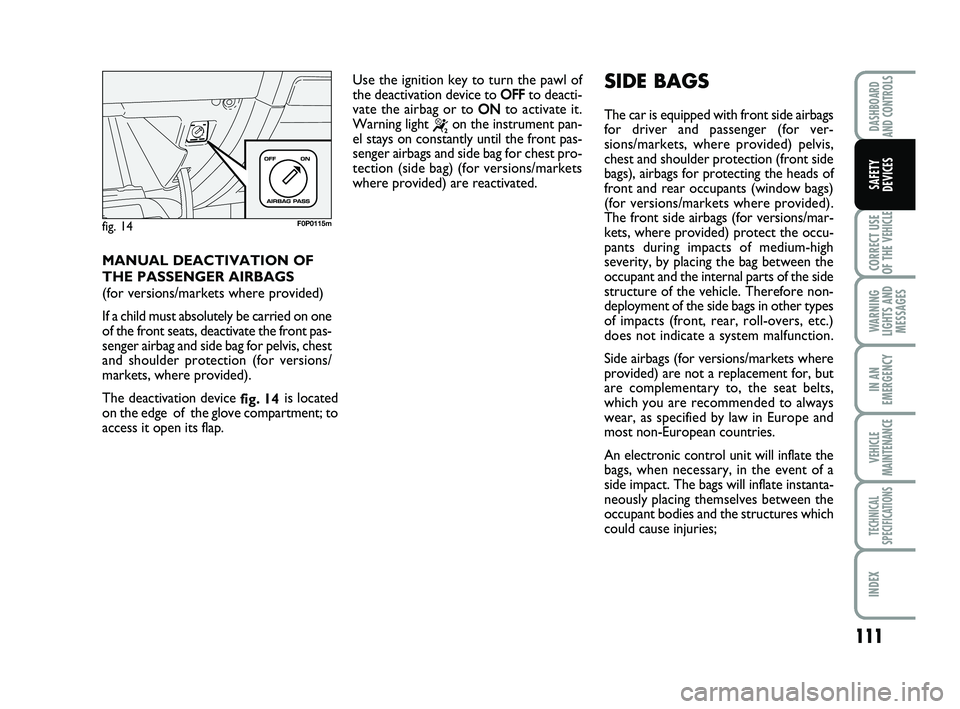
MANUAL DEACTIVATION OF
THE PASSENGER AIRBAGS
(for versions/markets where provided)
If a child must absolutely be carried on one of the front seats, deactivate the front pas-senger airbag and side bag for pelvis, chestand shoulder protection (for versions/markets, where provided).
The deactivation device on the edge of the glove compartment; toaccess it open its flap.
fig. 14F0P0115m
Use the ignition key to turn the pawl of the deactivation device to OFFto deacti- vate the airbag or to ONto activate it. Warning light “on the instrument pan-el stays on constantly until the front pas-senger airbags and side bag for chest pro-tection (side bag) (for versions/marketswhere provided) are reactivated.
SIDE BAGS
The car is equipped with front side airbagsfor driver and passenger (for ver-sions/markets, where provided) pelvis,chest and shoulder protection (front sidebags), airbags for protecting the heads offront and rear occupants (window bags)(for versions/markets where provided).The front side airbags (for versions/mar-kets, where provided) protect the occu-pants during impacts of medium-highseverity, by placing the bag between theoccupant and the internal parts of the sidestructure of the vehicle. Therefore non-deployment of the side bags in other typesof impacts (front, rear, roll-overs, etc.)does not indicate a system malfunction.
Side airbags (for versions/markets where provided) are not a replacement for, butare complementary to, the seat belts,which you are recommended to alwayswear, as specified by law in Europe andmost non-European countries.
An electronic control unit will inflate the bags, when necessary, in the event of aside impact. The bags will inflate instanta-neously placing themselves between theoccupant bodies and the structures whichcould cause injuries;
093-112 SCUDO LUM GB 9-10-2012 15:48 Pagina 111
fig. 14
is located
Page 118 of 223
114
CORRECT USE
OF THE
VEHICLE
WARNING
LIGHTS AND
MESSAGES
IN AN
EMERGENCY
VEHICLE
MAINTENANCE
TECHNICAL
SPECIFICATIONS
IINDEX
DASHBOARD
AND CONTROLS
SAFETY
DEVICES
If the vehicle has been stolen
or in the case of attempt to
steal it, if it has been subjected to
vandalism or floods, have the airbag
system checked by a Fiat Dealership.
WARNING
The airbags may also be de-
ployed when the vehicle is
not moving, if the key is in the igni-
tion and turned to MAR-ON or when
the engine is off, if the vehicle is hit
by another moving vehicle. For this
reason, children must NEVER occupy
the front seats in a rearward facing
seat even if the vehicle is not moving.
Deployment of the airbag following
an impact could cause fatal injuries
to the child. Always deactivate the
front passenger airbag if arranging a
child restraint system on one of the
front seats is necessary. On the oth-
er hand, if the key is turned to STOP,
none of the safety devices (airbags or
pretensioners) will be deployed in the
event of an impact. Non-deployment
of these devices does not indicate a
system malfunction.
WARNING
The airbag deployment
threshold is higher than that
of the pretensioners. For collisions in
the range between the two thresholds,
it is normal for only the pretensioners
to be activated.
WARNING
The airbag does not replace
the seat belts but increases
their efficiency. Because front airbags
are not deployed for low-speed im-
pacts, side collisions, rear-end shunts
or rollovers, in these cases occupants
are protected only by their seat belts,
which must therefore always be fas-
tened.
WARNINGThe expiry dates of the py-
rotechnic charge and the
clock spring are shown on a specific
plate contained in the glove box. Con-
tact a Fiat Dealership when these
dates approach.
WARNING
Do not travel carrying objects
in your lap, in front of your
chest or between your lips (pipe, pen-
cils, etc.). They could cause severe in-
jury if the airbag is deployed.
WARNING
093-112 SCUDO LUM GB 9-10-2012 15:48 Pagina 114