air condition FIAT SCUDO 2015 Owner handbook (in English)
[x] Cancel search | Manufacturer: FIAT, Model Year: 2015, Model line: SCUDO, Model: FIAT SCUDO 2015Pages: 227, PDF Size: 4.46 MB
Page 50 of 227
46SAFETY
DEVICESCORRECT USE
OF THE VEHICLE
WARNING
LIGHTS AND
MESSAGESIN AN
EMERGENCYVEHICLE
MAINTENANCETECHNICAL
SPECIFICATIONSINDEX
DASHBOARD
AND
CONTROLS
Switching the climate control
system off (A/C) A
Press button Ato turn the system off.
When turned off the system conditions
are the following:❒
set temperature displays off;
❒
air recirculation is on;
❒
conditioner compressor off;
❒
fan off.
Heated rear window can be turned on or
off also when the system is off.
IMPORTANT The system will store the
temperatures set before turning off and
will resume them when pressing any but-
ton (except heated rear window); if the
function corresponding to the button
pressed is off it will be turned on; if on it
will be kept active.
Press AUTOto turn the system in au-
tomatic mode.ADDITIONAL HEATER
(for versions/markets, where provided)
This device shall be used to speed up pas-
senger compartment warming when it is
very cold.
The additional heater turns off automati-
cally after reaching the required comfort
conditions.
Automatic two-zone climate
control system
The additional heater will switch on au-
tomatically after turning the ignition key
to M.Manual Heater and Climate
control system
The additional heater will switch on au-
tomatically by turning knob M or Ito the
last red sector and turning the fan on
(knob D) to the first speed at least.
IMPORTANT Heater works only with
low outside temperature and engine
coolant temperature.
IMPORTANT Heater will not turn on if
the battery voltage is not sufficient.
020-082 SCUDO LUM GB 19/11/13 09.54 Pagina 46
Page 52 of 227
48SAFETY
DEVICESCORRECT USE
OF THE VEHICLE
WARNING
LIGHTS AND
MESSAGESIN AN
EMERGENCYVEHICLE
MAINTENANCETECHNICAL
SPECIFICATIONSINDEX
DASHBOARD
AND
CONTROLS
WARMING THE PASSENGER
COMPARTMENT
Proceed as follows:❒
knob Aturned to red section;
❒
slider Bturned to the required speed.
FAST HEATING
For fast heating of the passenger com-
partment, proceed as follows:
❒
knob Aturned to red section;
❒
turn air recirculation on;
❒
knob Bturned to 4p(max. fan speed).
Then use the controls to keep the re-
quired comfort conditions and to turn air
recirculation off.
IMPORTANT With cold engine, you have
to wait for a few minutes to let the sys-
tem fluid reach the operating temperature.
fig. 52
F0P0045m
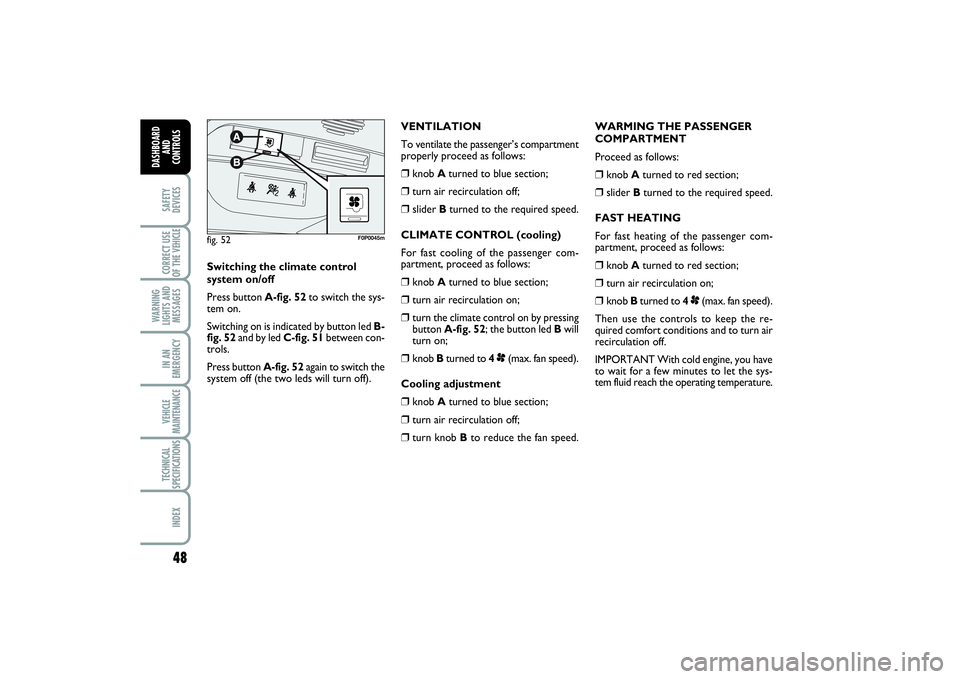
Switching the climate control
system on/off
Press button A-fig. 52to switch the sys-
tem on.
Switching on is indicated by button led B-
fig. 52and by led C-fig. 51between con-
trols.
Press button A-fig. 52again to switch the
system off (the two leds will turn off).VENTILATION
To ventilate the passenger’s compartment
properly proceed as follows:
❒
knob Aturned to blue section;
❒
turn air recirculation off;
❒
slider Bturned to the required speed.
CLIMATE CONTROL (cooling)
For fast cooling of the passenger com-
partment, proceed as follows:
❒
knob Aturned to blue section;
❒
turn air recirculation on;
❒
turn the climate control on by pressing
button A-fig. 52; the button led Bwill
turn on;
❒
knob Bturned to 4p(max. fan speed).
Cooling adjustment
❒
knob Aturned to blue section;
❒
turn air recirculation off;
❒
turn knob Bto reduce the fan speed.
020-082 SCUDO LUM GB 19/11/13 09.54 Pagina 48
Page 95 of 227
91
SAFETY
DEVICESCORRECT USE
OF THE VEHICLE WARNING
LIGHTS AND
MESSAGESIN AN
EMERGENCYVEHICLE
MAINTENANCETECHNICAL
SPECIFICATIONSINDEX DASHBOARD
AND CONTROLS
Insufficient tyre pressure
The warning light
n
switches on, to-
gether with a dedicated message on the
display, to indicate that the tyre pressure
is lower than the recommended value
and/or that slow pressure loss is occur-
ring. In these circumstances, optimal tyre
duration and fuel consumption may not be
guaranteed.
Should two or more tyres be in the con-
dition mentioned above, the display will
show the indications corresponding to each
tyre in sequence.
❒
Slow down immediately, avoid sudden
braking and steering.
❒
Stop as soon as traffic conditions al-
low.
❒
In the event of a puncture, use the
quick tyre repair kit or fit the spare
wheel (for versions/markets, where
provided);
or
❒
if you have a compressor, for example
the one of the quick tyre repair kit,
check the pressure of the four tyres
when cold;or
❒
if you cannot check the pressure im-
mediately, drive very carefully and slow-
ly.
The alarm is active until the next inflation,
repair or replacement of the tyre involved.
The spare wheel (space-saver wheel or
steel rim) does not have sensors.
The detected pressure loss does not al-
ways involve visible deformation of the
tyre. Therefore, do not rely on the visual
check only.iTPMS failure
When a fault in the iT.P.M.S. is detected,
the warning light
n
switches on and flash-
es, the warning light è
switches on as
well and a dedicated message is displayed.
In this case, the monitoring of the tyre
pressure is no longer guaranteed.
This alarm is displayed also when at least
one of the wheels is not equipped with
sensor (e.g. with spare wheel, space-saver
or steel type).
Contact a Fiat Dealership to have the sys-
tem checked or, after a puncture, refit a
tyre equipped with sensor on the origi-
nal rim.
083-096 SCUDO LUM GB 27/03/14 10:22 Pagina 91
Page 116 of 227
112CORRECT USE
OF THE VEHICLE
WARNING
LIGHTS AND
MESSAGESIN AN
EMERGENCYVEHICLE
MAINTENANCETECHNICAL
SPECIFICATIONSIINDEXDASHBOARD
AND CONTROLSSAFETY
DEVICES
FRONT AIRBAGS
The front driver and passenger airbags
(for versions/markets where provided)
protect the front seat occupants in the
event of head-on impacts of medium-high
severity, by placing the bag between the
occupant and the steering wheel or dash-
board. Therefore non-deployment in
other types of impacts (side impacts, rear
shunts, roll-overs, etc.) does not indicate
a system malfunction. Front driver and passenger airbags (for ver-
sions/markets where provided) are not a
replacement for, but are complementary
to, the seat belts, which you are recom-
mended to always wear, as specified by law
in Europe and most non-European coun-
tries.
An electronic control unit will inflate the
bag, when necessary, in the event of a
frontal impact. The bag will inflate instan-
taneously placing itself between the front
occupant’s body and the structures which
could cause injury. It will deflate immedi-
ately afterwards. The volume of front
airbags at max. inflation fills most of the
space between the steering wheel and the
driver and between the dashboard and the
passenger.
AIRBAGThe car is equipped with front airbags for
driver and passenger (for versions/markets,
where provided), seat-mounted side airbags
for driver’s and passenger pelvis-chest-
shoulder protection (for versions/ markets,
where provided), and window airbags for
protecting the heads of front and rear out-
er occupants (for versions/markets where
provided).
The location of the airbags on the car is
marked by the writing “AIRBAG” in the
middle of the steering wheel, on the dash-
board, on the side trim or on a label placed
next to the airbag deployment area.In the event of impact, those not wearing
a seat belt are projected forwards and may
come into contact with the bag which is still
inflating. The protection offered by the bag
is compromised in these circumstances.
Front airbags may not activate in the fol-
lowing situations:
❒frontal impacts against highly deformable
objects not involving the front surface of
the vehicle (e.g. wing collision against
guard rail, heaps of gravel, etc.);❒underride impacts with other vehicles;
Failure to activate in the conditions de-
scribed above is due to the fact that they
may not provide any additional protection
compared with seat belts, so their activa-
tion would be inappropriate. In these cas-
es, non-deployment of the airbag does not
necessarily indicate a system malfunction.
097-118 SCUDO LUM GB 02/04/14 10:40 Pagina 112
Page 128 of 227
124WARNING
LIGHTS AND
MESSAGESIN AN
EMERGENCYVEHICLE
MAINTENANCETECHNICAL
SPECIFICATIONSINDEXDASHBOARD
AND CONTROLSSAFETY
DEVICESCORRECT USE
OF THE VEHICLE
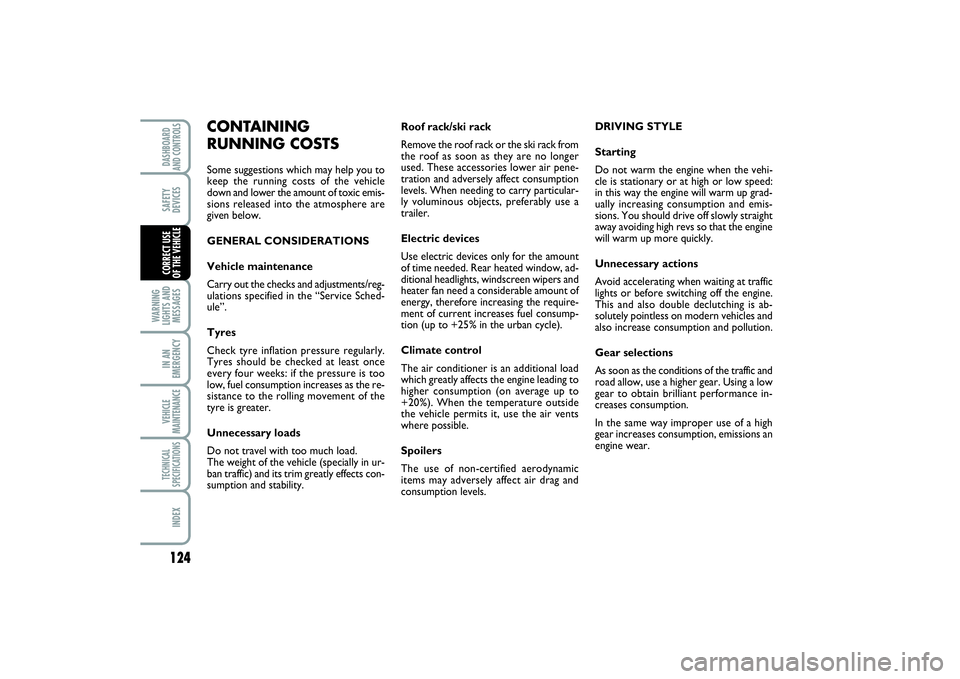
Roof rack/ski rack
Remove the roof rack or the ski rack from
the roof as soon as they are no longer
used. These accessories lower air pene-
tration and adversely affect consumption
levels. When needing to carry particular-
ly voluminous objects, preferably use a
trailer.
Electric devices
Use electric devices only for the amount
of time needed. Rear heated window, ad-
ditional headlights, windscreen wipers and
heater fan need a considerable amount of
energy, therefore increasing the require-
ment of current increases fuel consump-
tion (up to +25% in the urban cycle).
Climate control
The air conditioner is an additional load
which greatly affects the engine leading to
higher consumption (on average up to
+20%). When the temperature outside
the vehicle permits it, use the air vents
where possible.
Spoilers
The use of non-certified aerodynamic
items may adversely affect air drag and
consumption levels.DRIVING STYLE
Starting
Do not warm the engine when the vehi-
cle is stationary or at high or low speed:
in this way the engine will warm up grad-
ually increasing consumption and emis-
sions. You should drive off slowly straight
away avoiding high revs so that the engine
will warm up more quickly.
Unnecessary actions
Avoid accelerating when waiting at traffic
lights or before switching off the engine.
This and also double declutching is ab-
solutely pointless on modern vehicles and
also increase consumption and pollution.
Gear selections
As soon as the conditions of the traffic and
road allow, use a higher gear. Using a low
gear to obtain brilliant performance in-
creases consumption.
In the same way improper use of a high
gear increases consumption, emissions an
engine wear.
CONTAINING
RUNNING COSTSSome suggestions which may help you to
keep the running costs of the vehicle
down and lower the amount of toxic emis-
sions released into the atmosphere are
given below.
GENERAL CONSIDERATIONS
Vehicle maintenance
Carry out the checks and adjustments/reg-
ulations specified in the “Service Sched-
ule”.
Tyres
Check tyre inflation pressure regularly.
Tyres should be checked at least once
every four weeks: if the pressure is too
low, fuel consumption increases as the re-
sistance to the rolling movement of the
tyre is greater.
Unnecessary loads
Do not travel with too much load.
The weight of the vehicle (specially in ur-
ban traffic) and its trim greatly effects con-
sumption and stability.
119-128 SCUDO LUM GB 18/11/13 14.26 Pagina 124
Page 166 of 227
162WARNING
LIGHTS AND
MESSAGESTECHNICAL
SPECIFICATIONSINDEXDASHBOARD
AND CONTROLSSAFETY
DEVICESCORRECT USE
OF THE VEHICLEIN AN
EMERGENCYVEHICLE
MAINTENANCE
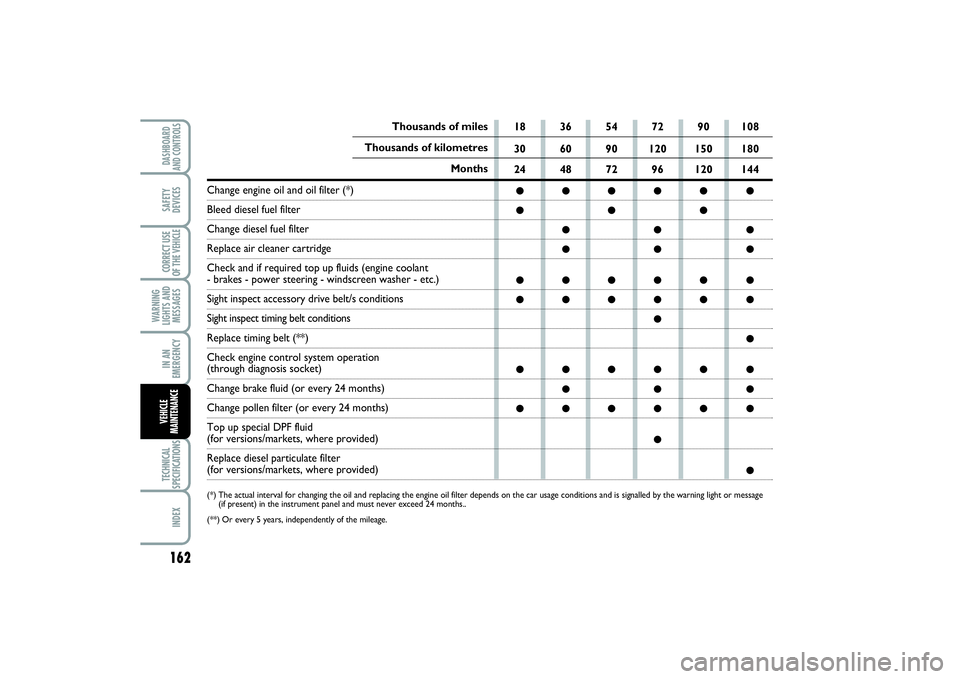
18 36 54 72 90 108
30 60 90 120 150 180
24 48 72 96 120 144●●●●● ●
●●●
●● ●
●● ●
●●●●● ●
●●●●● ●
●
●
●●●●● ●
●● ●
●●●●● ●
●
●
Thousands of miles
Thousands of kilometres
Months
Change engine oil and oil filter (*)Bleed diesel fuel filterChange diesel fuel filterReplace air cleaner cartridge
Check and if required top up fluids (engine coolant- brakes - power steering - windscreen washer - etc.)Sight inspect accessory drive belt/s conditionsSight inspect timing belt conditionsReplace timing belt (**)
Check engine control system operation(through diagnosis socket)Change brake fluid (or every 24 months)Change pollen filter (or every 24 months)
Top up special DPF fluid (for versions/markets, where provided)
Replace diesel particulate filter (for versions/markets, where provided) (*) The actual interval for changing the oil and replacing the engine oil filter depends on the car usage conditions and is signalled by the warning light or message
(if present) in the instrument panel and must never exceed 24 months..
(**) Or every 5 years, independently of the mileage.
159-178 SCUDO LUM GB 12/12/13 10.02 Pagina 162
Page 167 of 227
163
WARNING
LIGHTS AND
MESSAGESTECHNICAL
SPECIFICATIONSINDEX DASHBOARD
AND CONTROLSSAFETY
DEVICESCORRECT USE
OF THE VEHICLEIN AN
EMERGENCYVEHICLE
MAINTENANCE
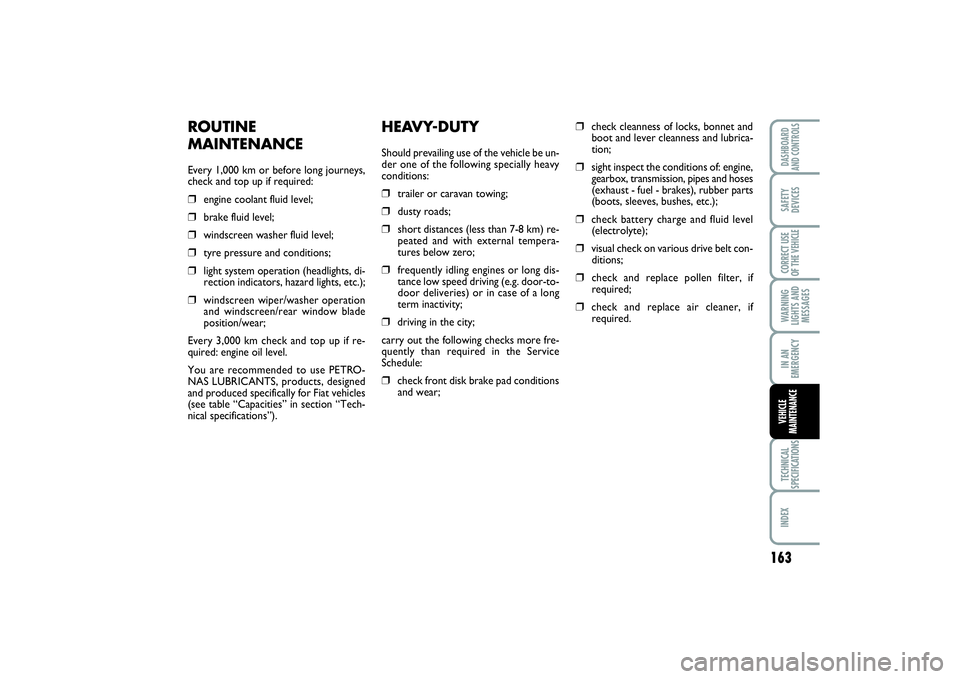
HEAVY-DUTYShould prevailing use of the vehicle be un-
der one of the following specially heavy
conditions:❒
trailer or caravan towing;
❒
dusty roads;
❒
short distances (less than 7-8 km) re-
peated and with external tempera-
tures below zero;
❒
frequently idling engines or long dis-
tance low speed driving (e.g. door-to-
door deliveries) or in case of a long
term inactivity;
❒
driving in the city;
carry out the following checks more fre-
quently than required in the Service
Schedule:
❒
check front disk brake pad conditions
and wear;
❒
check cleanness of locks, bonnet and
boot and lever cleanness and lubrica-
tion;
❒
sight inspect the conditions of: engine,
gearbox, transmission, pipes and hoses
(exhaust - fuel - brakes), rubber parts
(boots, sleeves, bushes, etc.);
❒
check battery charge and fluid level
(electrolyte);
❒
visual check on various drive belt con-
ditions;
❒
check and replace pollen filter, if
required;
❒
check and replace air cleaner, if
required.
ROUTINE
MAINTENANCEEvery 1,000 km or before long journeys,
check and top up if required:❒
engine coolant fluid level;
❒
brake fluid level;
❒
windscreen washer fluid level;
❒
tyre pressure and conditions;
❒
light system operation (headlights, di-
rection indicators, hazard lights, etc.);
❒
windscreen wiper/washer operation
and windscreen/rear window blade
position/wear;
Every 3,000 km check and top up if re-
quired: engine oil level.
You are recommended to use PETRO-
NAS LUBRICANTS, products, designed
and produced specifically for Fiat vehicles
(see table “Capacities” in section “Tech-
nical specifications”).
159-178 SCUDO LUM GB 12/12/13 10.02 Pagina 163
Page 174 of 227
170WARNING
LIGHTS AND
MESSAGESTECHNICAL
SPECIFICATIONSINDEXDASHBOARD
AND CONTROLSSAFETY
DEVICESCORRECT USE
OF THE VEHICLEIN AN
EMERGENCYVEHICLE
MAINTENANCE
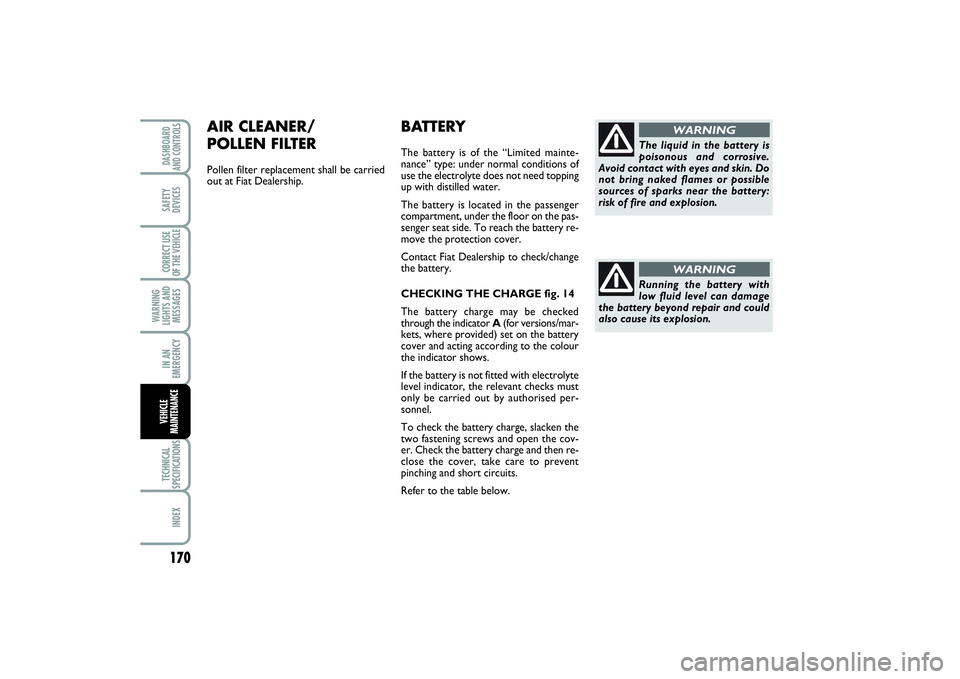
BATTERYThe battery is of the “Limited mainte-
nance” type: under normal conditions of
use the electrolyte does not need topping
up with distilled water.
The battery is located in the passenger
compartment, under the floor on the pas-
senger seat side. To reach the battery re-
move the protection cover.
Contact Fiat Dealership to check/change
the battery.
CHECKING THE CHARGE fig. 14
The battery charge may be checked
through the indicator A(for versions/mar-
kets, where provided) set on the battery
cover and acting according to the colour
the indicator shows.
If the battery is not fitted with electrolyte
level indicator, the relevant checks must
only be carried out by authorised per-
sonnel.
To check the battery charge, slacken the
two fastening screws and open the cov-
er. Check the battery charge and then re-
close the cover, take care to prevent
pinching and short circuits.
Refer to the table below.
The liquid in the battery is
poisonous and corrosive.
Avoid contact with eyes and skin. Do
not bring naked flames or possible
sources of sparks near the battery:
risk of fire and explosion.
WARNING
Running the battery with
low fluid level can damage
the battery beyond repair and could
also cause its explosion.
WARNING
AIR CLEANER/
POLLEN FILTERPollen filter replacement shall be carried
out at Fiat Dealership.
159-178 SCUDO LUM GB 12/12/13 10.02 Pagina 170
Page 180 of 227
176WARNING
LIGHTS AND
MESSAGESTECHNICAL
SPECIFICATIONSINDEXDASHBOARD
AND CONTROLSSAFETY
DEVICESCORRECT USE
OF THE VEHICLEIN AN
EMERGENCYVEHICLE
MAINTENANCE
❒
Spraying of plastic parts, with a protec-
tive function in the more exposed
points: underdoor, inner fender parts,
edges, etc;
❒
Use of “open” boxed sections to pre-
vent condensation and pockets of mois-
ture from triggering rust inside.
BODY AND UNDERBODY
WARRANTY
Your vehicle is covered by warranty
against perforation due to rust of any orig-
inal element of the structure or body.
For the general terms of this warranty, re-
fer to Fiat Warranty Booklet.
ADVICE FOR PRESERVING THE
BODYWORK
Paintwork
The paintwork is not only to make your
vehicle look attractive but also to protect
the steel.
In the case of deep scrapes or scores, you
are advised to have the necessary touching
up carried out immediately to avoid the for-
mation of rust. For touching up use only
original products (see “Bodywork paint
identification plate” in section “Technical
specifications”).
BODYWORKPROTECTION FROM
ATMOSPHERIC AGENTS
The main causes of corrosion are the fol-
lowing:❒
atmospheric pollution;
❒
salty air and humidity (coastal areas, or
hot humid climates);
❒
seasonal environment conditions.
Not to be underestimated is also the abra-
sive action of wind-borne atmospheric
dust and sand and mud and gravel raised
by other vehicles.
On your vehicle, Fiat implemented the
best manufacturing technologies to effec-
tively protect the bodywork against cor-
rosion.
These are the most important:
❒
Painting products and systems which
give the vehicle particular resistance to
corrosion and abrasion;
❒
Use of galvanised (or pretreated) steel
sheets, with high resistance to corro-
sion;
❒
Spraying the underbody, engine com-
partment, wheelhouse internal parts
and other parts with highly protective
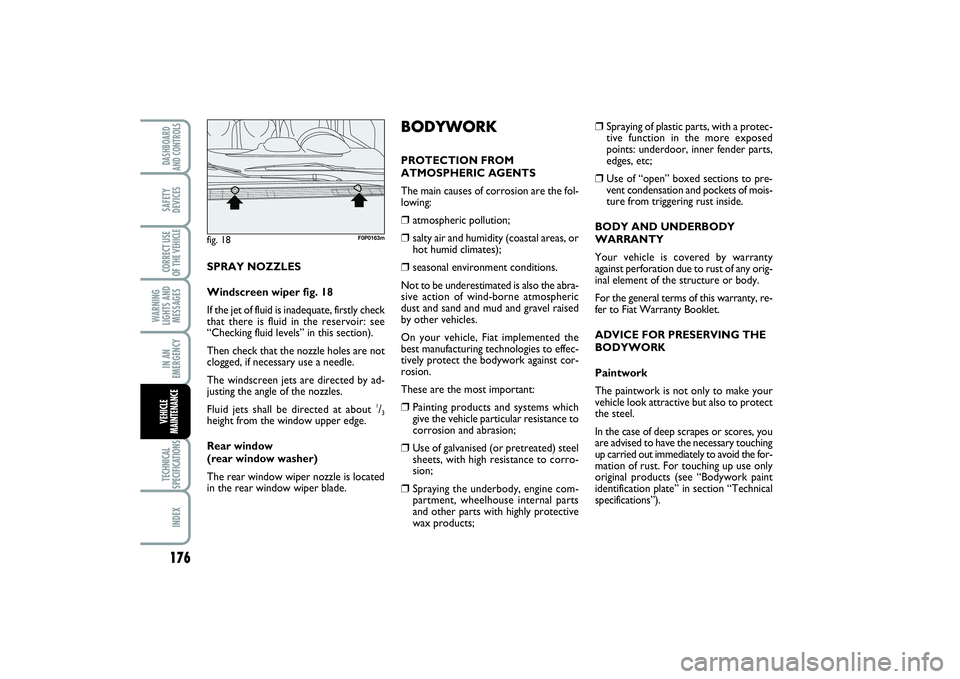
wax products; SPRAY NOZZLES
Windscreen wiper fig. 18
If the jet of fluid is inadequate, firstly check
that there is fluid in the reservoir: see
“Checking fluid levels” in this section).
Then check that the nozzle holes are not
clogged, if necessary use a needle.
The windscreen jets are directed by ad-
justing the angle of the nozzles.
Fluid jets shall be directed at about
1/3
height from the window upper edge.
Rear window
(rear window washer)
The rear window wiper nozzle is located
in the rear window wiper blade.fig. 18
F0P0163m
159-178 SCUDO LUM GB 12/12/13 10.02 Pagina 176
Page 215 of 227
211
WARNING
LIGHTS AND
MESSAGESINDEX DASHBOARD
AND CONTROLSSAFETY
DEVICESCORRECT USE
OF THE VEHICLEIN AN
EMERGENCYVEHICLE
MAINTENANCETECHNICAL
SPECIFICATIONS
❒
extra-urban cycle: frequent accelerat-
ing in all gears, simulating extraurban
use of the vehicle: speed varies between
0 and 120 km/h;
❒
combined consumption: is calculated
weighing about 37% of urban cycle con-
sumption and about 63% of extraurban
consumption.
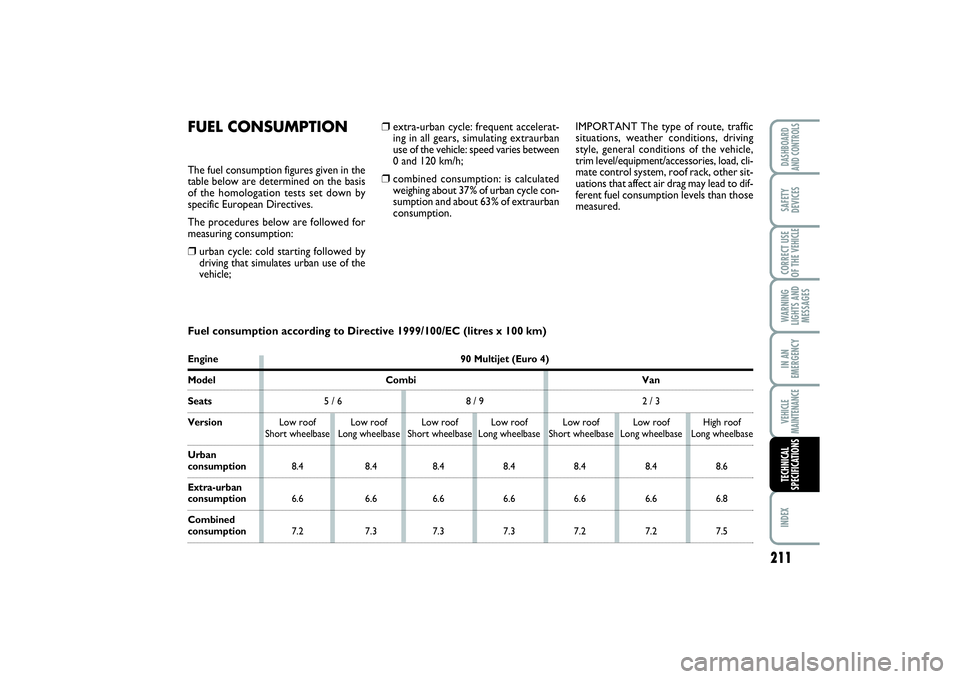
FUEL CONSUMPTION The fuel consumption figures given in the
table below are determined on the basis
of the homologation tests set down by
specific European Directives.
The procedures below are followed for
measuring consumption:❒
urban cycle: cold starting followed by
driving that simulates urban use of the
vehicle;IMPORTANT The type of route, traffic
situations, weather conditions, driving
style, general conditions of the vehicle,
trim level/equipment/accessories, load, cli-
mate control system, roof rack, other sit-
uations that affect air drag may lead to dif-
ferent fuel consumption levels than those
measured.
Fuel consumption according to Directive 1999/100/EC (litres x 100 km)Engine 90 Multijet (Euro 4)Model Combi VanSeats5 / 6 8 / 9 2 / 3
VersionLow roof Low roof Low roof Low roof Low roof Low roof High roof
Short wheelbase Long wheelbase Short wheelbase Long wheelbase Short wheelbase Long wheelbase Long wheelbase
Urban
consumption8.4 8.4 8.4 8.4 8.4 8.4 8.6
Extra-urbanconsumption6.6 6.6 6.6 6.6 6.6 6.6 6.8
Combined consumption7.2 7.3 7.3 7.3 7.2 7.2 7.5
179-214 SCUDO LUM GB 18/11/13 14.23 Pagina 211