tyre FIAT SEICENTO 2007 1.G User Guide
[x] Cancel search | Manufacturer: FIAT, Model Year: 2007, Model line: SEICENTO, Model: FIAT SEICENTO 2007 1.GPages: 154, PDF Size: 3.68 MB
Page 93 of 154
92IN AN EMERGENCY
5) Lower the car and remove the
jack.
6)Torque the screws in the order
described above fig. 8.
After refitting the wheel:
– place the spare wheel in its recess
in the boot and fasten it with the ring
nut A-fig. 3;
– put the jack in its bag and place this
in the replaced wheel.
IMPORTANTTubeless tyres are
used.
Check the inflation pressure of the
tyres and the spare wheel regularly.
fig. 9
P4Q00099
8) Ensure that the housings for the
wheel bolts on the spare wheel are
clean and free from dirt which could
cause the wheel bolts to come loose.
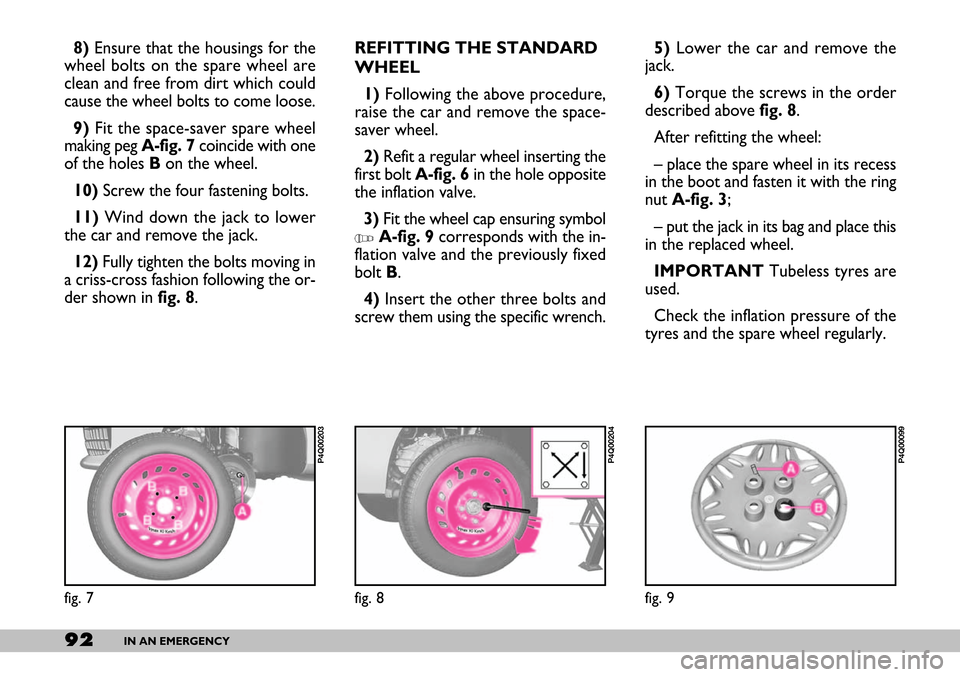
9) Fit the space-saver spare wheel
making peg A-fig. 7coincide with one
of the holes B on the wheel.
10)Screw the four fastening bolts.
11)Wind down the jack to lower
the car and remove the jack.
12)Fully tighten the bolts moving in
a criss-cross fashion following the or-
der shown in fig. 8.REFITTING THE STANDARD
WHEEL
1)Following the above procedure,
raise the car and remove the space-
saver wheel.
2)Refit a regular wheel inserting the
first bolt A-fig. 6in the hole opposite
the inflation valve.
3)Fit the wheel cap ensuring symbol
YA-fig. 9corresponds with the in-
flation valve and the previously fixed
bolt B.
4)Insert the other three bolts and
screw them using the specific wrench.
fig. 7
P4Q00203
fig. 8
P4Q00204
Page 107 of 154
106IN AN EMERGENCY
JACKING THE CAR
WITH THE JACK
See
IF A TYRE IS PUNCTUREDin this
chapter. Please note:
– The jack requires no adjustments.
– The jack cannot be repaired. If it
breaks it must be replaced with a new
jack.
– Apart from the handle shown in
this chapter no other tools should be
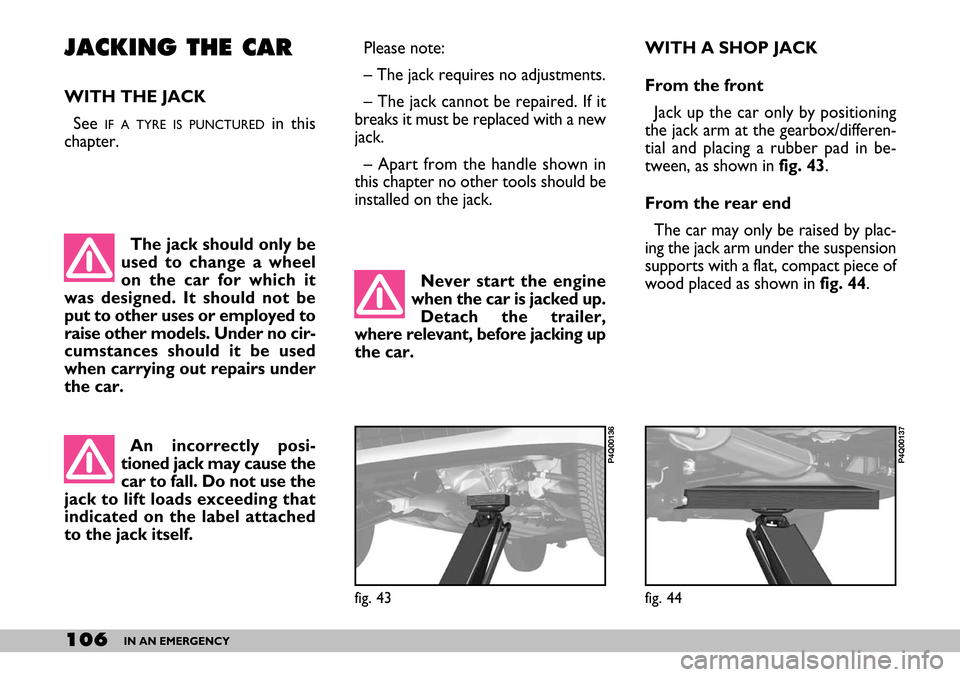
installed on the jack. WITH A SHOP JACK
From the front
Jack up the car only by positioning
the jack arm at the gearbox/differen-
tial and placing a rubber pad in be-
tween, as shown in fig. 43.
From the rear end
The car may only be raised by plac-
ing the jack arm under the suspension
supports with a flat, compact piece of
wood placed as shown in fig. 44. The jack should only be
used to change a wheel
on the car for which it
was designed. It should not be
put to other uses or employed to
raise other models. Under no cir-
cumstances should it be used
when carrying out repairs under
the car.
An incorrectly posi-
tioned jack may cause the
car to fall. Do not use the
jack to lift loads exceeding that
indicated on the label attached
to the jack itself. Never start the engine
when the car is jacked up.
Detach the trailer,
where relevant, before jacking up
the car.
fig. 43
P4Q00136
fig. 44
P4Q00137
Page 110 of 154
109CAR MAINTENANCE
If the vehicle is often
used for towing a trailer,
the scheduled servicing
will be required more frequently.
C C C C
A A A A
R R R R
M M M M
A A A A
I I I I
N N N N
T T T T
E E E E
N N N N
A A A A
N N N N
C C C C
E E E E
SCHEDULED
SERVICING
Correct maintenance of the car is
essential for ensuring it stays in tip-top
condition for a long time to come.
This is why Fiat has programmed a
number of service checks and opera-
tions every twenty thousand kilome-
tres.
It is however important to remem-
ber that
SCHEDULED SERVICINGis not all
your vehicle requires. Regular
checked - also in the initial period be-
fore the 20,000 kilometre coupon and
later between coupons - ordinary care
is required, such as checking fluid lev-
els and topping up, checking tyre in-
flation pressure, etc. IMPORTANTThe Manufacturer
requires the Service Schedule coupon-
related checks to be carried out. Fail-
ure to do so could result in the war-
ranty being cancelled for those defects
that can be attributed to such failure.
S
CHEDULED SERVICINGis performed at
all Fiat Dealerships, and there is a
set time scale for such operations.
If it is seen that further replacements
or repairs are necessary in addition to
the work being carried out, these will
only be done after the customer has
given his/her consent.IMPORTANT You are recom-
mended to get in touch with a Fiat
Dealershipimmediately if any minor
running problems crop up without
waiting for the next coupon.
Page 111 of 154
110CAR MAINTENANCE
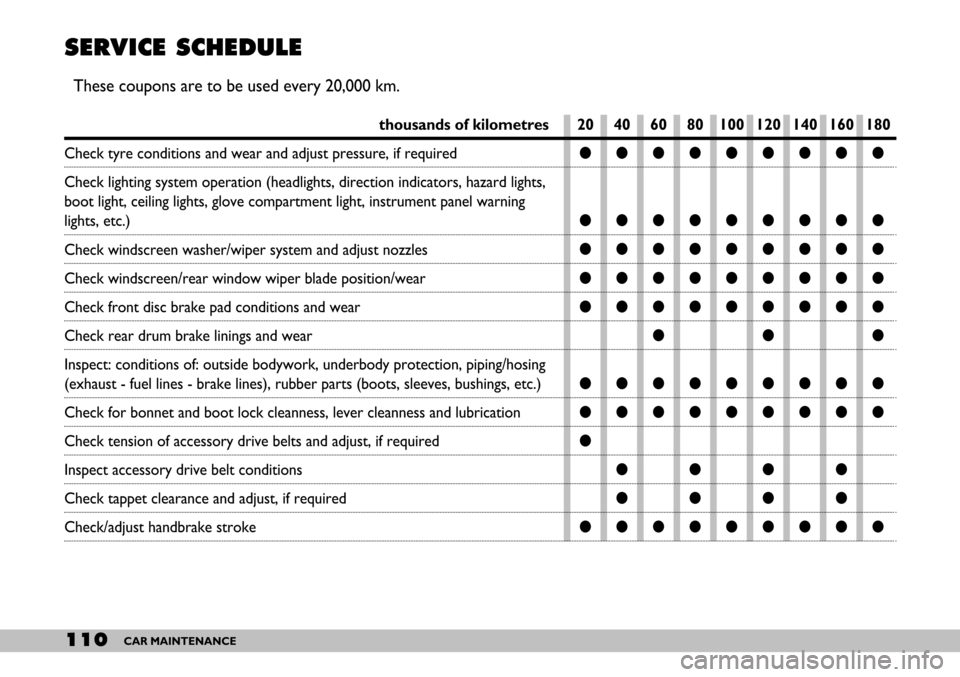
SERVICE SCHEDULE
These coupons are to be used every 20,000 km.
thousands of kilometres
Check tyre conditions and wear and adjust pressure, if required
Check lighting system operation (headlights, direction indicators, hazard lights,
boot light, ceiling lights, glove compartment light, instrument panel warning
lights, etc.)
Check windscreen washer/wiper system and adjust nozzles
Check windscreen/rear window wiper blade position/wear
Check front disc brake pad conditions and wear
Check rear drum brake linings and wear
Inspect: conditions of: outside bodywork, underbody protection, piping/hosing
(exhaust - fuel lines - brake lines), rubber parts (boots, sleeves, bushings, etc.)
Check for bonnet and boot lock cleanness, lever cleanness and lubrication
Check tension of accessory drive belts and adjust, if required
Inspect accessory drive belt conditions
Check tappet clearance and adjust, if required
Check/adjust handbrake stroke20 40 60 80 100 120 140 160 180
●●●●●●●●●
●●●●●●●●●
●●●●●●●●●
●●●●●●●●●
●●●●●●●●●
●●●
●●●●●●●●●
●●●●●●●●●
●
●●●●
●●●●
●●●●●●●●●
Page 113 of 154
112CAR MAINTENANCE
ANNUAL INSPECTION SCHEDULE
– Inspect conditions of. engine, gear-
box, transmission, piping (exhaust -
fuel feed - brakes), rubber parts
(boots - sleeves - bushings - etc.),
brake and fuel line hoses.
– Check for bonnet and boot lock
cleanness, lever cleanness and lubri-
cation.
– Check battery charge status.
– Check conditions of various con-
trol belts.
– Check and top up fluid levels (en-
gine coolant, brakes, windscreen
washer, battery, etc.).
– Change engine oil.
– Replace engine oil filter.
– Replace pollen filter (where fitted). The following annual inspection
schedule is recommended for
cars travelling less than
20,000 km a year (e.g. approxi-
mately 10,000 km). The schedule
includes the following operations:
– Check tyre condition and wear
and adjust pressure, if required (in-
cluding spare wheel).
– Check operation of lights (head-
lights, direction indicators, hazard
lights, boot light, passenger compart-
ment ceiling light, glove compartment
light, instrument panel lights, etc.).
– Check windscreen wiper/washer
and adjust nozzles.
– Check position wear of wind-
screen/rear window wiper blades.
– Check front brake pad conditions
and wear.
ADDITIONAL
CHECKS
Every 1,000 kmor before long
trips, check and top up as necessary:
– engine coolant level, brake fluid
level, windscreen washer liquid level,
tyre pressure and conditions.
Every 3,000 kmcheck and top up
as necessary: engine oil level.
We recommend using FL Selenia
products which were specifically de-
signed and made for use in Fiat vehi-
cles (see
CAPACITIEStable in TECHNICAL
SPECIFICATIONS
).
Page 122 of 154
121CAR MAINTENANCE
If the pressure is too low
the tyre overheats and
this can cause it serious
damage.case, comply with the laws in the
country where the car is being driven.
IMPORTANT
As far as possible avoid sharp brak-
ing and screech starts.
Be careful not to hit the kerb, pot-
holes or other obstacles hard. Driving
for long stretches over bumpy roads
can damage the tyres.
Periodically check that the tyres have
no cuts in the sidewalls, abnormal
swelling or irregular tyre wear. If any
of these occur, have the car seen to
at a Fiat Dealership.
Avoid overloading your car: this can
seriously damage wheels or tyres.
If you get a flat tyre, stop immedi-
ately and change it so as not to dam-
age the tyre, the wheel, the suspen-
sion and the steering.
Tyres age even if they are not used
very much. Cracking of the tread rub-
ber and the sidewalls are a sign of this
ageing. In any case, if the tyres have
been fitted for more than six years
they should be examined by an expert
Tyre pressure must be
correct to ensure good
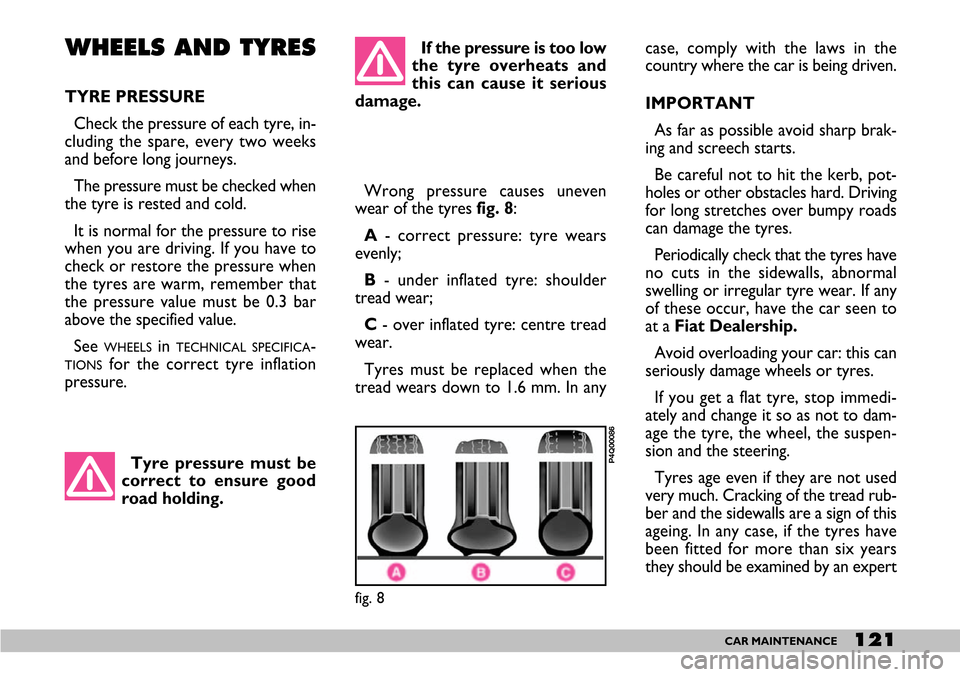
road holding.Wrong pressure causes uneven
wear of the tyres fig. 8:
A - correct pressure: tyre wears
evenly;
B - under inflated tyre: shoulder
tread wear;
C - over inflated tyre: centre tread
wear.
Tyres must be replaced when the
tread wears down to 1.6 mm. In any
fig. 8
P4Q00086
WHEELS AND TYRES
TYRE PRESSURE
Check the pressure of each tyre, in-
cluding the spare, every two weeks
and before long journeys.
The pressure must be checked when
the tyre is rested and cold.
It is normal for the pressure to rise
when you are driving. If you have to
check or restore the pressure when
the tyres are warm, remember that
the pressure value must be 0.3 bar
above the specified value.
See
WHEELSin TECHNICAL SPECIFICA-
TIONSfor the correct tyre inflation
pressure.
Page 123 of 154
122CAR MAINTENANCE
RUBBER TUBING
Follow the SERVICE SCHEDULEto the
letter as concerns braking, power
steering and fuel line rubber tubing.
Ozone, high temperatures and long
absence of fluid in the system can in
fact cause the hardening and cracking
of the pipes with possible loss of fluid.
A careful check is therefore essential.
WINDSCREEN AND
REAR WINDOW
WIPERS
BLADES
Periodically clean the rubber part
with suitable products. We recom-
mendTUTELA PROFESSIONAL
SC35.
Change the blades if the rubber edge
is warped or worn out. You should in
any case change them approximately
once a year. who can judge whether they are still
fit for use. Remember to check the
spare tyre particularly carefully too.
If a replacement is necessary, always
use new tyres and avoid using ones
the origin of which you are not cer-
tain about.
The Fiat 600 fits tubeless tyres. Un-
der no circumstances use an inner
tube with these tyres.
If you replace a tyre it is a good idea
to change the inflation valve, too.
To ensure the front and rear tyres
all wear evenly, you are advised to
change the tyres over every 10-15
thousand kilometres keeping them on
the same side of the car so as not to
reverse the direction of rotation.
Do not change the tyres
over in criss-cross fashion
by moving a tyre from
the left hand side of the car to
the right and vice versa.
Travelling with worn
wiper blades is dangerous
because it reduces visibil-
ity in bad weather.
In winter if the temperature falls be-
low zero, make sure the blades are
not frozen to the windscreen. If nec-
essary, free them with a de-icing com-
pound.
Page 134 of 154
133TECHNICAL SPECIFICATIONS
STEERING
Jointed steering column with two
CV joints.
Permanently lubricated rack and pin-
ion.
Number of steering wheel turns lock
to lock (approximately) ................. 3.9
Minimum steering circle: 10.5 metres
(average between versions).
Electronically controlled power
steering system optional.
WHEELS
RIMS AND TYRES
Printed steel or alloy rims. Specific
wheel bolts (different in size and rec-
iprocally incompatible) for each of the
two types of rim.
Tubeless tyres with radial carcass.
The homologated tyres are listed in
the log book.
IMPORTANT In the event of dis-
crepancies between the information
provided in this Owner Handbook
and the Log Book, consider the spec-
ifications shown in the Log Book only.
To ensure safety of the car in move-
ment, it must be fitted with tyres of
specified size and of the same make
and type on all wheels.IMPORTANT Do not use inner
tubes with tubeless tyres.
Do not fasten alloy wheels with the
steel wheel bolts and vice versa. For
details on the compatibility between
rims and bolts - also with reference to
the space-saver spare wheel - see
IF A
TYRE IS PUNCTURED
.
Page 135 of 154
134TECHNICAL SPECIFICATIONS
WINTER TYRES
Use winter tyres as indicated in the
WINTER TYRESchapter.
SMALL SPARE WHEEL
Printed steel rim.
Tubeless tyre.
SNOW CHAINS
Use only low profile chains, see the
SNOW CHAIN CHAPTER.
WHEEL GEOMETRY
Front wheel toe-in measured from
rim to rim: –1 ±1mm
The figures refer to the car in full
running order.Maximum speed rating
Q= up to 160 km/h.
R= up to 170 km/h.
S= up to 180 km/h.
T= up to 190 km/h.
U= up to 200 km/h.
H= up to 210 km/h.
V= up to 240 km/h.
Maximum speed rating
for snow tyres
Q M+S= up to 160 km/h
T M+S= up to 190 km/h
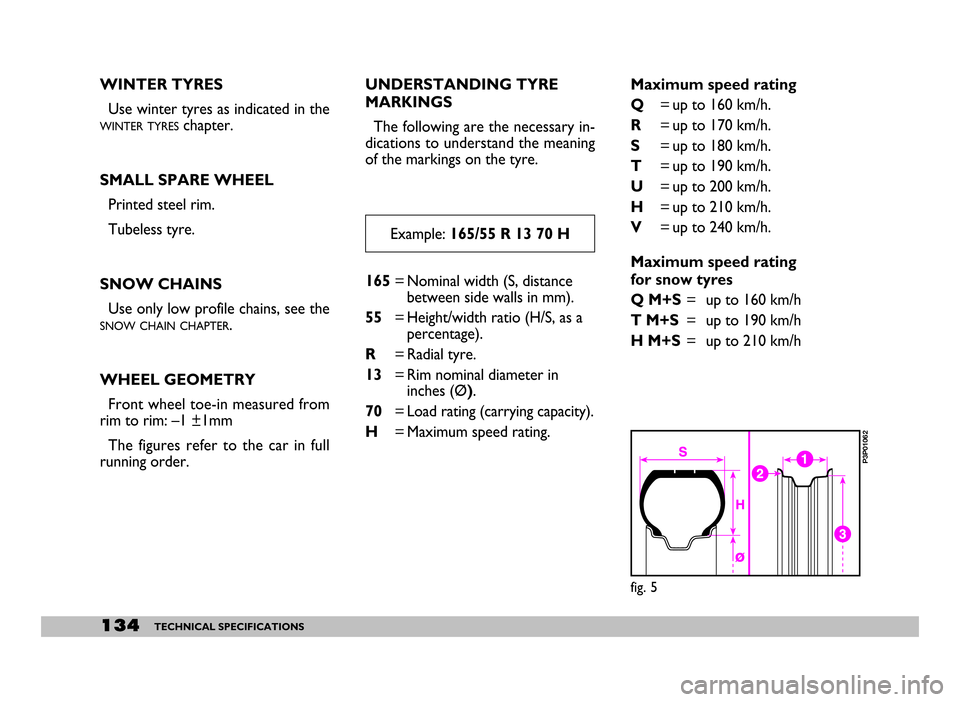
H M+S= up to 210 km/h Example: 165/55 R 13 70 H
165= Nominal width (S, distance
between side walls in mm).
55= Height/width ratio (H/S, as a
percentage).
R= Radial tyre.
13= Rim nominal diameter in
inches (Ø).
70= Load rating (carrying capacity).
H= Maximum speed rating.
fig. 5
P3P01062
UNDERSTANDING TYRE
MARKINGS
The following are the necessary in-
dications to understand the meaning
of the markings on the tyre.
Page 136 of 154
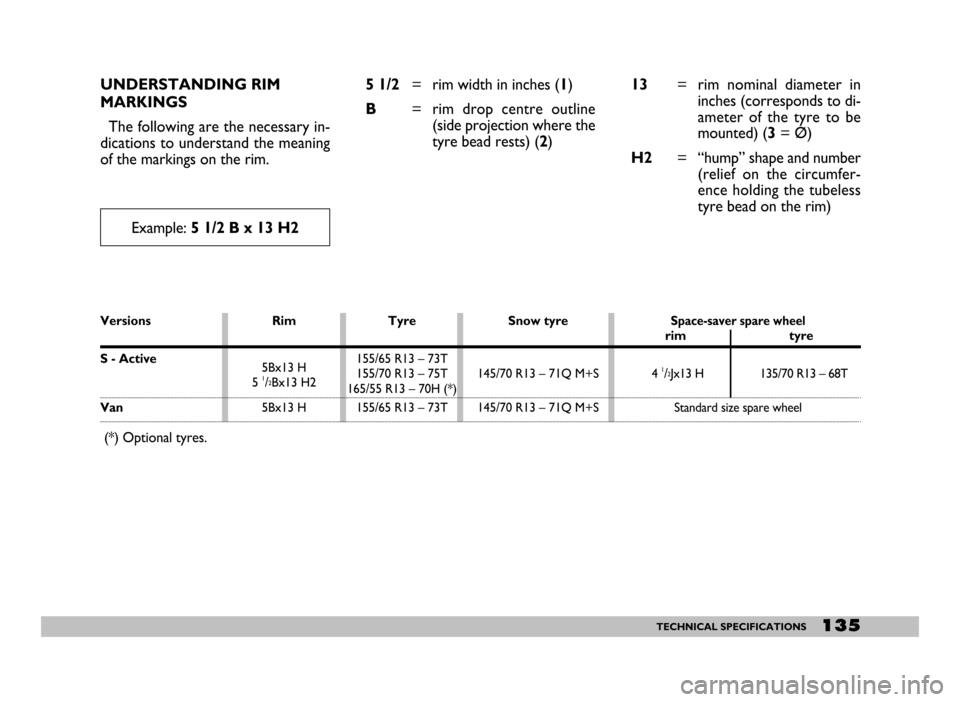
135TECHNICAL SPECIFICATIONS
Tyre
155/65 R13 – 73T
155/70 R13 – 75T
165/55 R13 – 70H (*)
155/65 R13 – 73TSnow tyre
145/70 R13 – 71Q M+S
145/70 R13 – 71Q M+S Rim
5Bx13 H
5
1/2Bx13 H2
5Bx13 H
Space-saver spare wheelrim tyre
4
1/2Jx13 H 135/70 R13 – 68T
Standard size spare wheel
Example: 5 1/2 B x 13 H2
5 1/2= rim width in inches (1)
B= rim drop centre outline
(side projection where the
tyre bead rests) (2) UNDERSTANDING RIM
MARKINGS
The following are the necessary in-
dications to understand the meaning
of the markings on the rim.13= rim nominal diameter in
inches (corresponds to di-
ameter of the tyre to be
mounted) (3 = Ø)
H2= “hump” shape and number
(relief on the circumfer-
ence holding the tubeless
tyre bead on the rim)
Versions
S - Active
Van
(*) Optional tyres.