wheel FIAT SEICENTO 2007 1.G User Guide
[x] Cancel search | Manufacturer: FIAT, Model Year: 2007, Model line: SEICENTO, Model: FIAT SEICENTO 2007 1.GPages: 154, PDF Size: 3.68 MB
Page 55 of 154
54GETTING TO KNOW YOUR CAR
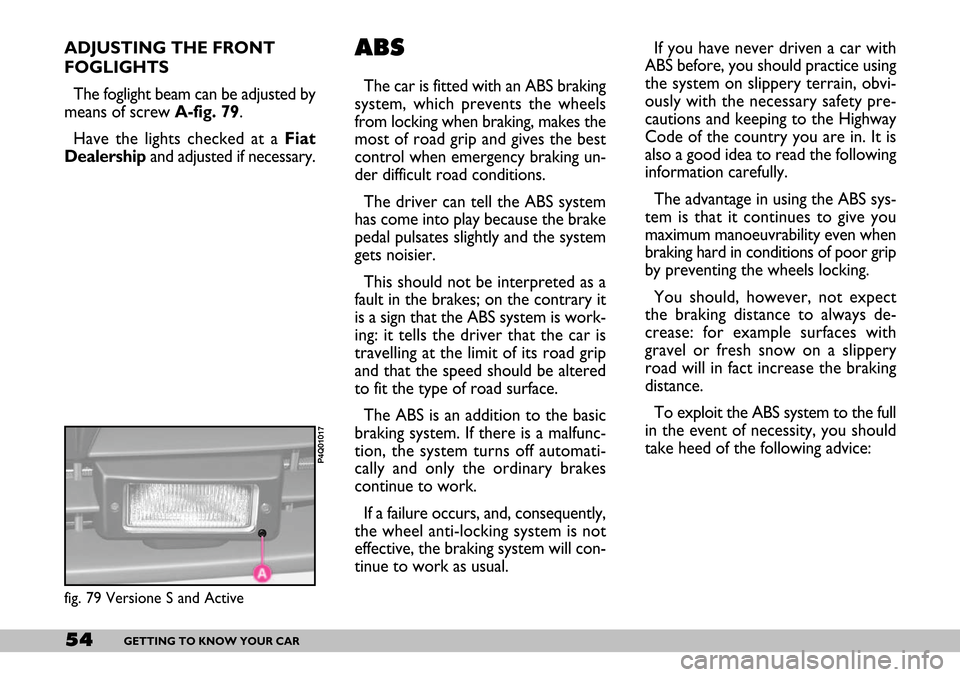
ADJUSTING THE FRONT
FOGLIGHTS
The foglight beam can be adjusted by
means of screw A-fig. 79.
Have the lights checked at a Fiat
Dealershipand adjusted if necessary. If you have never driven a car with
ABS before, you should practice using
the system on slippery terrain, obvi-
ously with the necessary safety pre-
cautions and keeping to the Highway
Code of the country you are in. It is
also a good idea to read the following
information carefully.
The advantage in using the ABS sys-
tem is that it continues to give you
maximum manoeuvrability even when
braking hard in conditions of poor grip
by preventing the wheels locking.
You should, however, not expect
the braking distance to always de-
crease: for example surfaces with
gravel or fresh snow on a slippery
road will in fact increase the braking
distance.
To exploit the ABS system to the full
in the event of necessity, you should
take heed of the following advice:ABS
The car is fitted with an ABS braking
system, which prevents the wheels
from locking when braking, makes the
most of road grip and gives the best
control when emergency braking un-
der difficult road conditions.
The driver can tell the ABS system
has come into play because the brake
pedal pulsates slightly and the system
gets noisier.
This should not be interpreted as a
fault in the brakes; on the contrary it
is a sign that the ABS system is work-
ing: it tells the driver that the car is
travelling at the limit of its road grip
and that the speed should be altered
to fit the type of road surface.
The ABS is an addition to the basic
braking system. If there is a malfunc-
tion, the system turns off automati-
cally and only the ordinary brakes
continue to work.
If a failure occurs, and, consequently,
the wheel anti-locking system is not
effective, the braking system will con-
tinue to work as usual.
fig. 79 Versione S and Active
P4Q01017
Page 56 of 154
55GETTING TO KNOW YOUR CAR
The ABS exploits the
road hold available as
much as possible but can-
not increase it. You should al-
ways drive carefully on slippery
surfaces and avoid any unneces-
sary risks.Braking while cornering always re-
quires extreme care even when using
ABS.
The most important advice to follow
is this:
If the ABS intervenes, it
means that the grip be-
tween the type and the
road is reduced with respect to
the normal conditions. Reduce
speed immediately to match the
poor road conditions.
If there is a fault in the
system and the instru-
ment panel warning light
>comes on, drive you car
slowly to a Fiat Dealership, to
have the system checked and put
right.When the ABS cuts in,
and you feel the brake
pedal pulsating, do not
remove your foot, but keep it
pressed. In doing so you will stop
in the shortest amount of space
possible under the current road
conditions.
If you follow these tips you will be
able to brake better in any situation.
IMPORTANTCars with ABS may
only be fitted with wheel rims, tyres
and brake pads of the make and
model approved by the manufacturer.The system is completed with an
electronic brake force distributor
called EBD which improves braking
system performance by means of the
ABSsystem control unit and sensors.
The car is fitted with an
electronic braking device
(EBD). The >and x
warning light will come on at the
same time when the engine is
running to indicate that there is
an EBD system failure. In this
case violent braking may be ac-
companied by early rear wheel
locking with the possibility of
skidding. Drive the car extremely
carefully to the nearest Fiat Deal-
ership to have the system
checked.
Page 57 of 154
56GETTING TO KNOW YOUR CAR
Warning light >alone,
with the engine running,
normally indicates a fault
in the ABS system only. In this
case, the braking system is still
efficient, though without the
anti-locking device. Under these
conditions, performance of the
EBD system may be reduced.
Also in this case, you are advised
to go immediately to the nearest
Fiat Dealership, driving in such a
way to avoid sharp braking to
have the system checked. FRONT AIRBAGS
The car is fitted with front air bags
(for versions/markets where applica-
ble) for the driver and the passenger.
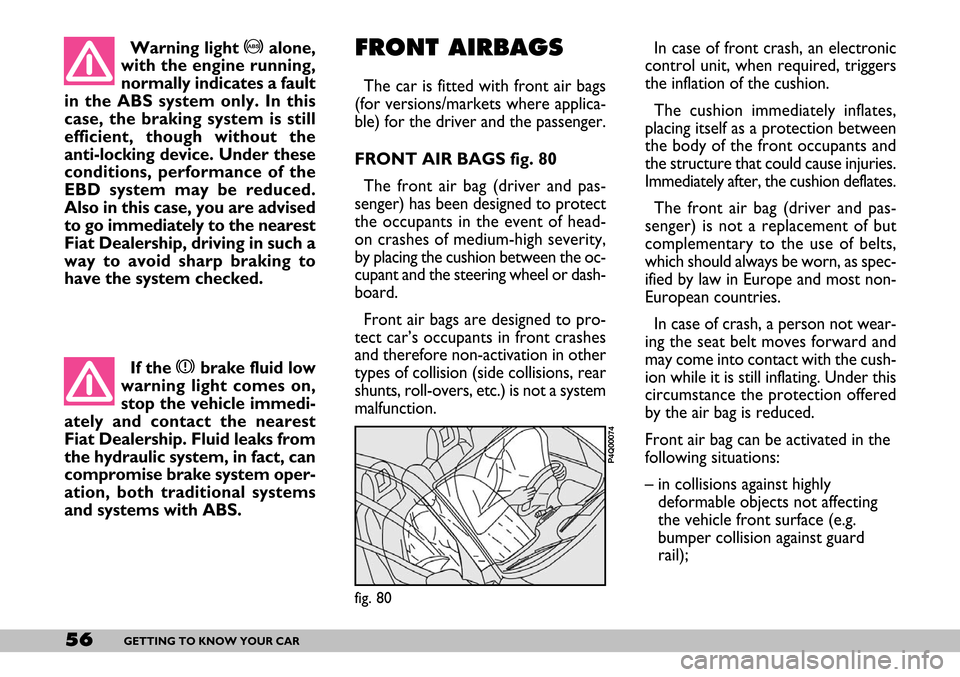
FRONT AIR BAGS fig. 80
The front air bag (driver and pas-
senger) has been designed to protect
the occupants in the event of head-
on crashes of medium-high severity,
by placing the cushion between the oc-
cupant and the steering wheel or dash-
board.
Front air bags are designed to pro-
tect car’s occupants in front crashes
and therefore non-activation in other
types of collision (side collisions, rear
shunts, roll-overs, etc.) is not a system
malfunction.In case of front crash, an electronic
control unit, when required, triggers
the inflation of the cushion.
The cushion immediately inflates,
placing itself as a protection between
the body of the front occupants and
the structure that could cause injuries.
Immediately after, the cushion deflates.
The front air bag (driver and pas-
senger) is not a replacement of but
complementary to the use of belts,
which should always be worn, as spec-
ified by law in Europe and most non-
European countries.
In case of crash, a person not wear-
ing the seat belt moves forward and
may come into contact with the cush-
ion while it is still inflating. Under this
circumstance the protection offered
by the air bag is reduced.
Front air bag can be activated in the
following situations:
– in collisions against highly
deformable objects not affecting
the vehicle front surface (e.g.
bumper collision against guard
rail); If the xbrake fluid low
warning light comes on,
stop the vehicle immedi-
ately and contact the nearest
Fiat Dealership. Fluid leaks from
the hydraulic system, in fact, can
compromise brake system oper-
ation, both traditional systems
and systems with ABS.
fig. 80
P4Q00074
Page 58 of 154
57GETTING TO KNOW YOUR CAR
Do not apply stickers or
other objects to the
steering wheel or to the
passenger's air bag cover or on
the side roof lining. Never apply
objects on the dashboard on pas-
senger side (e.g. mobile phones)
since they could interfere with
proper passenger air bag inflation
and cause severe injuries. – car wedging under other vehicles
or protective barriers (for
example under a truck or guard
rail);
as it offers no additional protection
compared with the seat belts, conse-
quently, it would be pointless. There-
fore, failure to come into action in the
above circumstances does not mean
that the system is not working prop-
erly.FRONT AIRBAG
PASSENGER SIDEThe passenger side airbag was de-
signed and calibrated to protect a per-
son wearing seat belts.
When fully inflated, the bag will fill
most of the space between the dash-
board and the passenger.
Manual deactivation
The passenger side airbag can be de-
activated if it is absolutely necessary
to carry a child in the front passenger
seat.
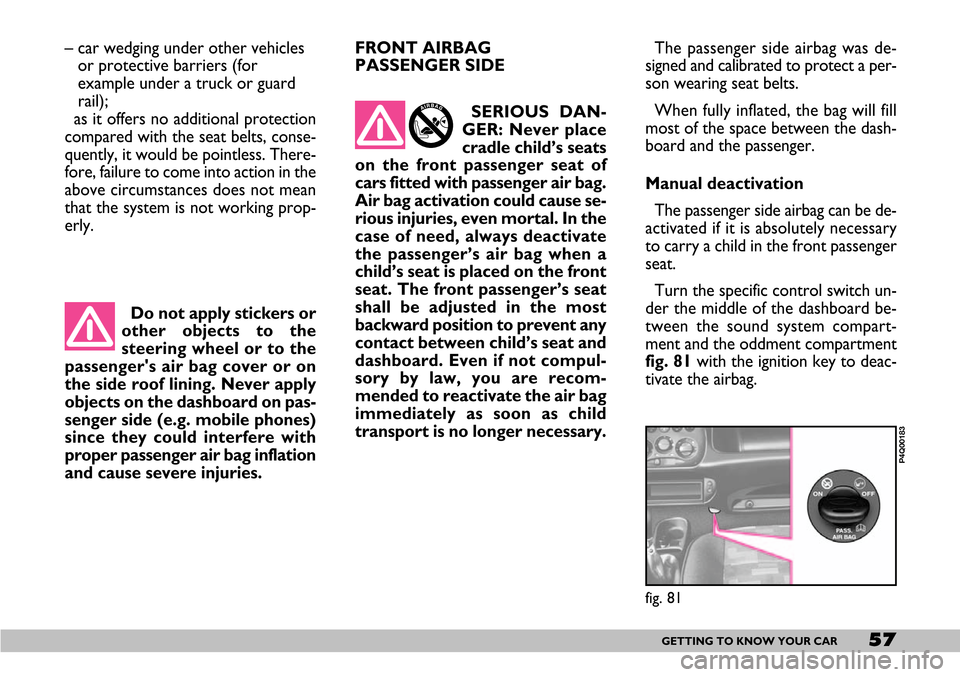
Turn the specific control switch un-
der the middle of the dashboard be-
tween the sound system compart-
ment and the oddment compartment
fig. 81with the ignition key to deac-
tivate the airbag. SERIOUS DAN-
GER: Never place
cradle child’s seats
on the front passenger seat of
cars fitted with passenger air bag.
Air bag activation could cause se-
rious injuries, even mortal. In the
case of need, always deactivate
the passenger’s air bag when a
child’s seat is placed on the front
seat. The front passenger’s seat
shall be adjusted in the most
backward position to prevent any
contact between child’s seat and
dashboard. Even if not compul-
sory by law, you are recom-
mended to reactivate the air bag
immediately as soon as child
transport is no longer necessary.
fig. 81
P4Q00183
Page 60 of 154
59GETTING TO KNOW YOUR CAR
If the ¬warning light
does not turn on when
turning the ignition key
to MAR or if it stays on when
travelling, this could indicate a
failure in safety retaining sys-
tems; under this condition air
bags or pretensioners could not
trigger in the event of collision
or, in a restricted number of
cases, they could trigger acci-
dentally. Stop the car and con-
tact Fiat Dealership to have the
system checked immediately. Do not travel with ob-
jects on your lap or in
front of you. Do not hold
a pipe, a pencil or similar be-
tween your lips. You could seri-
ously hurt yourself if the airbag
inflates in a collision.
The warning light
Fshould come on for ap-
proximately four seconds
and then flash for other four sec-
onds when the passenger side
airbag deactivation switch is
turned to ON and the ignition
key is turned to MAR to remind
you that the passenger side
airbag will be fired in the event of
an accident. The warning light
should then go out. Always drive with both
hands on the rims of the
steering wheel so that the
airbag is free to inflate during a
head-on collision and protection
yourself from serious injury. Do
not drive with your body bending
towards the steering wheel but
sit in an upright position with
your back resting against the
seat. If an attempt has been
made to steal the car or if
it has actually been stolen
or vandalised in any way or sub-
jected to flooding, have the
airbag system checked at a Fiat
Dealership.
Please note that airbags
can be triggered when
the engine is running also
if the car is stationary and an-
other vehicle crashes into it at
suitably high speed. As a conse-
quence, never sit children in the
front seat, also when the car is
still. On the other hand, the
airbags will not be fired if the car
is stationary and the key is not
turned. Missed operation in these
circumstances does not indicate
a fault.
Page 62 of 154
61GETTING TO KNOW YOUR CAR
ELECTRICAL POWER
STEERING SYSTEM
IMPORTANT The electrical
power steering system only works
when the ignition key is at MAR.
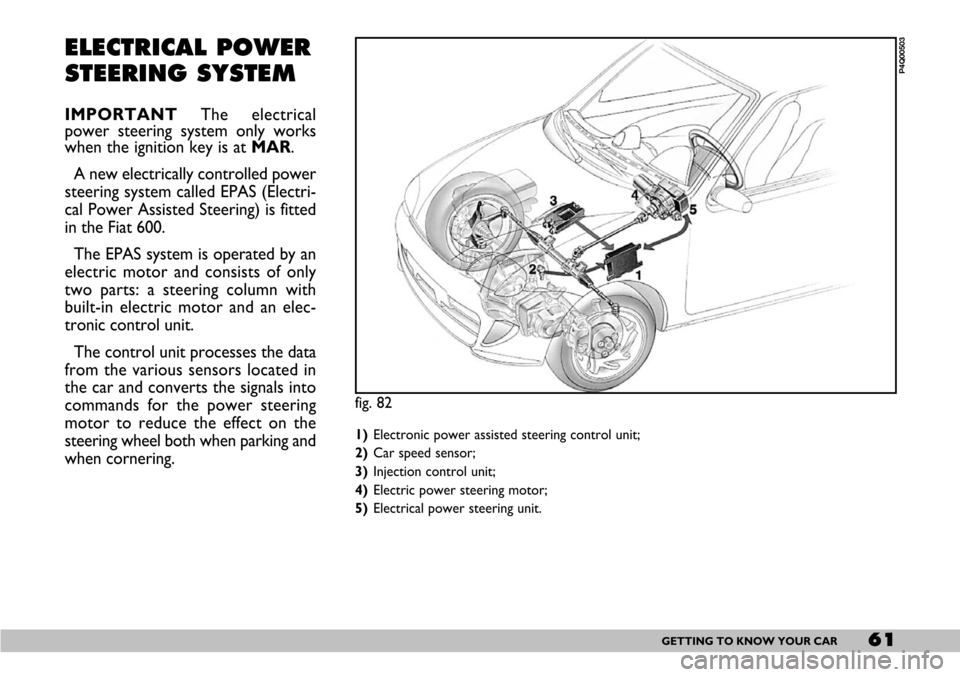
A new electrically controlled power
steering system called EPAS (Electri-
cal Power Assisted Steering) is fitted
in the Fiat 600.
The EPAS system is operated by an
electric motor and consists of only
two parts: a steering column with
built-in electric motor and an elec-
tronic control unit.
The control unit processes the data
from the various sensors located in
the car and converts the signals into
commands for the power steering
motor to reduce the effect on the
steering wheel both when parking and
when cornering.
P4Q00503
fig. 82
1)Electronic power assisted steering control unit;
2)Car speed sensor;
3)Injection control unit;
4)Electric power steering motor;
5)Electrical power steering unit.
Page 63 of 154
62GETTING TO KNOW YOUR CAR
The system is programmed at the
factory to ensure variable degrees of
assistance according to the require-
ments. In other words, power is in-
creased for parking and reduced as
the car’s speed increases.
The EPAS system only works when
the engine is running to avoid deploy-
ing the battery accidentally. Further-
more, it is equipped with a self-test
function to detect faults and incorrect
signals.
IMPORTANTThe steering wheel
may stiffen slightly in parking manoeu-
vres requiring a great deal of steering:
this is normal and caused by the
power steering motor overheat pro-
tection system tripping. The problem
does not require servicing and the
electric power steering system will
work normally the next time the car
is used.If the warning light comes on, see
chapter
GETTING TO KNOW YOUR CAR,
paragraph
WARNING LIGHTS.
FIAT 600 VAN
The version herein illustrated differs
from Fiat 600 saloon described in this
handbook for the different size of the
boot and the availability of two front
seats only.
Load recommendations
Fiat 600 Van has been designed and
approved on the basis of several set
maximum values:
– kerb weight
– payload
– gross vehicle weight
– total weight on the front axle
– total weight on the rear axle
– towable weight.
Each of these limits must be borne
in mind and must never be exceeded
under any circumstances. It is absolutely forbidden
to carry out whatever af-
ter-market operation in-
volving steering system or steer-
ing column modifications (e.g.: in-
stallation of anti-theft Device)
that could badly affect perfor-
mance and safety, cause the lapse
of warranty and also result in
non-compliance of the car with
homologation requirements.
Page 67 of 154
66GETTING TO KNOW YOUR CAR
SPEAKERS
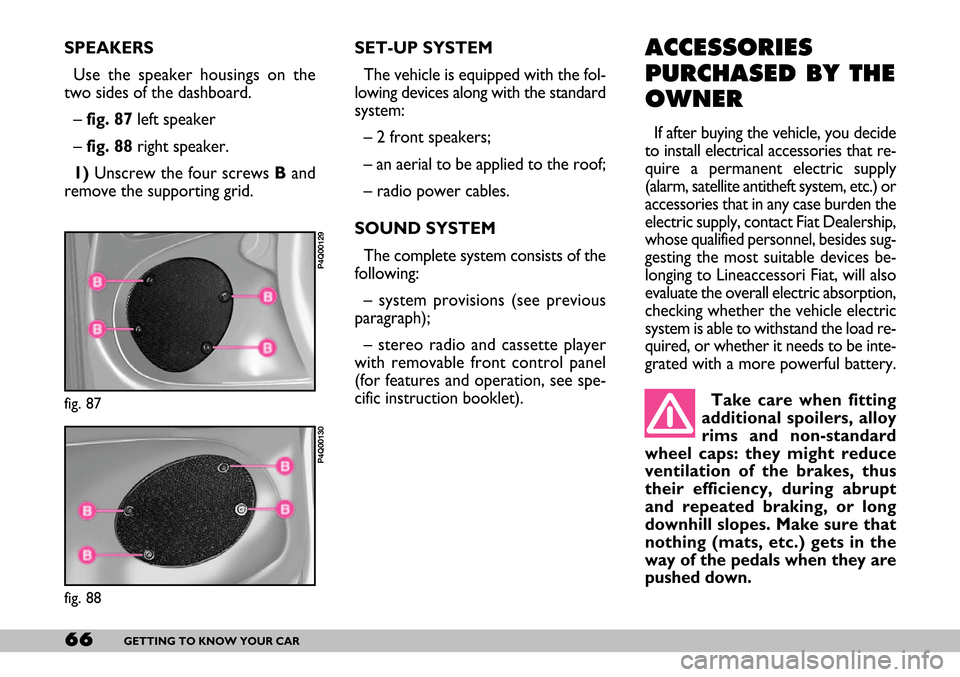
Use the speaker housings on the
two sides of the dashboard.
– fig. 87 left speaker
– fig. 88 right speaker.
1)Unscrew the four screws Band
remove the supporting grid. SET-UP SYSTEM
The vehicle is equipped with the fol-
lowing devices along with the standard
system:
– 2 front speakers;
– an aerial to be applied to the roof;
– radio power cables.
SOUND SYSTEM
The complete system consists of the
following:
– system provisions (see previous
paragraph);
– stereo radio and cassette player
with removable front control panel
(for features and operation, see spe-
cific instruction booklet).
fig. 88
P4Q00130
fig. 87
P4Q00129
ACCESSORIES
PURCHASED BY THE
OWNER
If after buying the vehicle, you decide
to install electrical accessories that re-
quire a permanent electric supply
(alarm, satellite antitheft system, etc.) or
accessories that in any case burden the
electric supply, contact Fiat Dealership,
whose qualified personnel, besides sug-
gesting the most suitable devices be-
longing to Lineaccessori Fiat, will also
evaluate the overall electric absorption,
checking whether the vehicle electric
system is able to withstand the load re-
quired, or whether it needs to be inte-
grated with a more powerful battery.
Take care when fitting
additional spoilers, alloy
rims and non-standard
wheel caps: they might reduce
ventilation of the brakes, thus
their efficiency, during abrupt
and repeated braking, or long
downhill slopes. Make sure that
nothing (mats, etc.) gets in the
way of the pedals when they are
pushed down.
Page 72 of 154
71DRIVING YOUR CAR
EMERGENCY START-UP
If the Fiat CODE system fails to
recognise that code transmitted by
the ignition key (instrument panel
warning light ¢on) the emergency
start-up can be performed by using
the CODE card code.
See the
INANEMERGENCY. A quick burst on the ac-
celerator before turning
off the engine serves ab-
solutely no practical purpose and
wastes fuel.
IMPORTANTAfter a taxing drive
it is better to allow the engine to
“catch its breath” before turning it off,
by letting it idle to allow the temper-
ature in the engine compartment to
fall.
PARKING
Switch off the engine, pull up the
handbrake and put the car in 1st gear
if the car is pointing uphill, reverse if
downhill.
If the car is parked on a steep gradi-
ent it is a good idea to use a stone or
wedge to block the wheels.
Do not leave the ignition key at
MARbecause it drains the battery.
Always remove the key when you
leave the car. Bump starting by push-
ing, towing or rolling
downhill must be avoided
at all costs. This way of starting
could cause a rush of fuel into the
catalytic exhaust pipe and dam-
age it beyond repair.
Remember that as long
as the engine is not run-
ning, the power brakes
and power steering do not work.
You therefore have to use con-
siderably more effort on both the
brake pedal and the steering
wheel. SWITCHING OFF
THE ENGINE
Turn the key to STOPwhile the
engine is idling.
Never leave unsuper-
vised children in the car.
Page 74 of 154
73DRIVING YOUR CAR
IMPORTANT Reverse gear can
only be engaged when the car is com-
pletely stationary. With the engine
running, before engaging the reverse
gear, wait for at least two seconds
with the clutch pedal pressed fully
down to avoid damaging or grating the
gears. SAFE DRIVING
In designing the Fiat 600, Fiat has
made every effort to come up with a
car able to provide driver and pas-
sengers with top-class levels of safety.
Nevertheless it is always the behav-
iour of the person at the wheel that
determines road safety.
Below you will find some simple tips
to help you travel in safety under dif-
ferent conditions. You will no doubt
be familiar with many of them already
but it will be useful to read them all
carefully.
BEFORE GETTING BEHIND
THE WHEEL
– Make sure all lights including the
headlights are working properly.
– Adjust the position of the seats,
steering wheel, inside and outside rear
view mirrors properly for the best
driving position.
– Carefully adjust the head restraints
so the back of the head and not the
nape of the neck is supported. – Make sure that nothing (mats etc.)
gets in the way of the pedals when
they are pushed down.
– Make sure that any child restraint
systems (child seats, carriers etc.) are
properly fixed preferably on the back
seat.
– Place any objects in the boot in
such a way that they cannot be
thrown forwards in the event of an
accident.
– Do not eat a heavy meal before
travelling. Light eating will help keep
your reflexes prompt. Above all, do
not have anything alcoholic to drink.
Periodically, remember to check:
– tyre pressure and condition
– level of battery electrolyte
– engine oil level
– coolant level and condition of the
system
– brake fluid level
– windscreen washer fluid level. To change the gear
properly (with mechani-
cal clutch) you must push
the clutch pedal fully down. It is
therefore essential that there is
nothing under the pedals. Make
sure mats are lying flat and do
not get in the way of the pedals.