wheel FIAT SEICENTO 2007 1.G Owner's Guide
[x] Cancel search | Manufacturer: FIAT, Model Year: 2007, Model line: SEICENTO, Model: FIAT SEICENTO 2007 1.GPages: 154, PDF Size: 3.68 MB
Page 92 of 154
91IN AN EMERGENCY
Please note:
– The jack requires no adjustments.
– The jack cannot be repaired. If it
breaks it must be replaced with a new
jack.
– No tool, other than its handle, in-
dicated in this chapter, can be fitted
onto the jack. CHANGING THE WHEEL
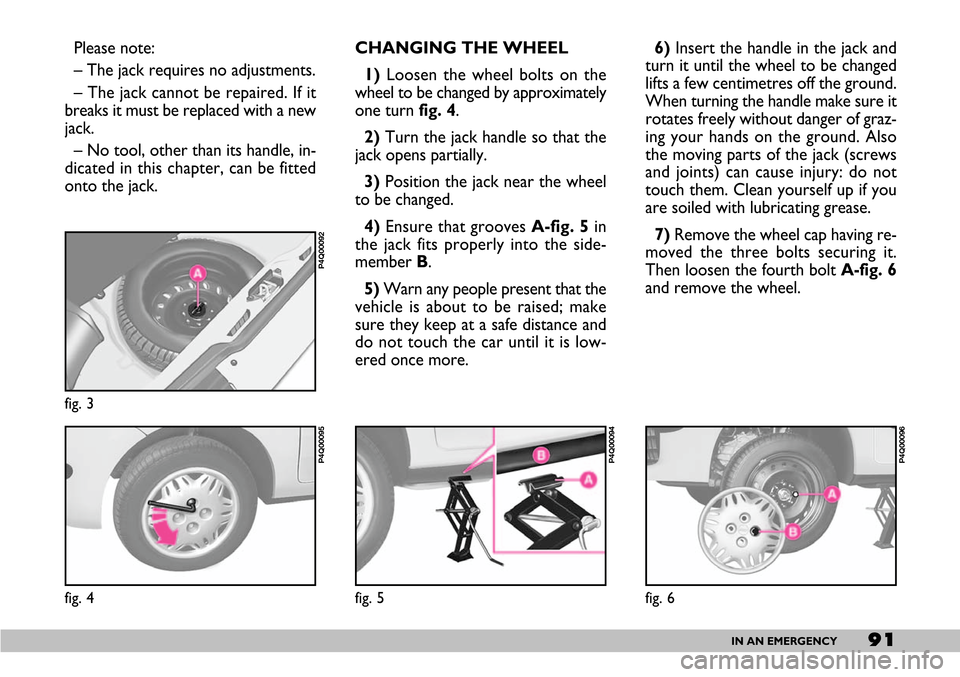
1)Loosen the wheel bolts on the
wheel to be changed by approximately
one turn fig. 4.
2)Turn the jack handle so that the
jack opens partially.
3)Position the jack near the wheel
to be changed.
4)Ensure that grooves A-fig. 5in
the jack fits properly into the side-
member B.
5)Warn any people present that the
vehicle is about to be raised; make
sure they keep at a safe distance and
do not touch the car until it is low-
ered once more.
fig. 4
P4Q00095
fig. 3
P4Q00092
fig. 5
P4Q00094
6) Insert the handle in the jack and
turn it until the wheel to be changed
lifts a few centimetres off the ground.
When turning the handle make sure it
rotates freely without danger of graz-
ing your hands on the ground. Also
the moving parts of the jack (screws
and joints) can cause injury: do not
touch them. Clean yourself up if you
are soiled with lubricating grease.
7)Remove the wheel cap having re-
moved the three bolts securing it.
Then loosen the fourth bolt A-fig. 6
and remove the wheel.
fig. 6
P4Q00096
Page 93 of 154
92IN AN EMERGENCY
5) Lower the car and remove the
jack.
6)Torque the screws in the order
described above fig. 8.
After refitting the wheel:
– place the spare wheel in its recess
in the boot and fasten it with the ring
nut A-fig. 3;
– put the jack in its bag and place this
in the replaced wheel.
IMPORTANTTubeless tyres are
used.
Check the inflation pressure of the
tyres and the spare wheel regularly.
fig. 9
P4Q00099
8) Ensure that the housings for the
wheel bolts on the spare wheel are
clean and free from dirt which could
cause the wheel bolts to come loose.
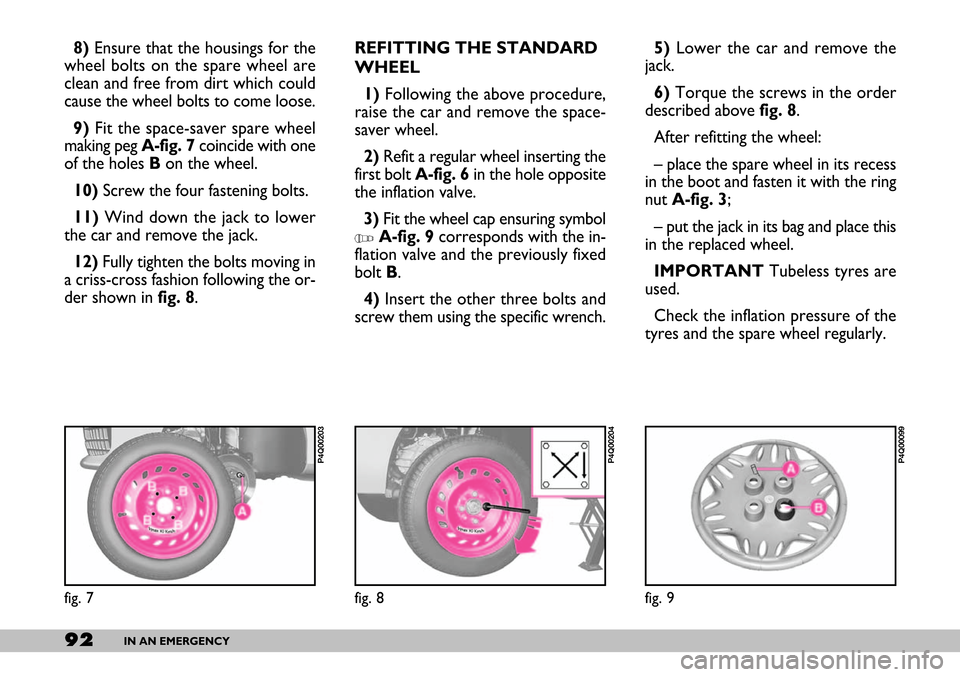
9) Fit the space-saver spare wheel
making peg A-fig. 7coincide with one
of the holes B on the wheel.
10)Screw the four fastening bolts.
11)Wind down the jack to lower
the car and remove the jack.
12)Fully tighten the bolts moving in
a criss-cross fashion following the or-
der shown in fig. 8.REFITTING THE STANDARD
WHEEL
1)Following the above procedure,
raise the car and remove the space-
saver wheel.
2)Refit a regular wheel inserting the
first bolt A-fig. 6in the hole opposite
the inflation valve.
3)Fit the wheel cap ensuring symbol
YA-fig. 9corresponds with the in-
flation valve and the previously fixed
bolt B.
4)Insert the other three bolts and
screw them using the specific wrench.
fig. 7
P4Q00203
fig. 8
P4Q00204
Page 94 of 154
93IN AN EMERGENCY
IMPORTANTFor cars equipped
with optional alloy wheels, a specific
spare wheel is required which differs
from that used on cars equipped with
steel rims. When fitting alloy rims to
replace steel rims at a later date, the
four original wheel bolts should be
changed with a new set of adequately
sized bolts and a specific spare wheel.
It is advised to keep the bolts and
the spare wheel, which would become
necessary if you should decide to re-
turn to the original type of wheels. IF A BULB BURNS
OUT Only touch the metal
part when handling halo-
gen bulbs. If the transpar-
ent bulb is touched it reduces the
intensity of the light emitted and
can also reduce the life of the
bulb. If you touch the bulb acci-
dentally, rub it with a cloth
moistened with alcohol and leave
it to dry. Modifications or repairs
to the electrical system
carried out incorrectly
and without bearing the features
of the system in mind can cause
malfunctions with the risk of fire.
You should, where pos-
sible, have your bulbs
changed at a Fiat Dealer-
ship. Correct operation of the ex-
ternal light beams are essential
for safe driving and compliance
with legal requirements. Halogen bulbs contain
pressurised gas which, if
broken, may cause small
fragments of glass to be pro-
jected outwards.
Page 103 of 154
102IN AN EMERGENCY
Never change a fuse
with another amperage:
fire risk !To locate the fuse, refer to the table
on the following pages. Do not attempt to re-
pair a blown maxi fuse.
Go to a Fiat Dealership.
If the fuse blows again,
have the car inspected at
a Fiat Dealership.
fig. 38
P4Q00121
fig. 39
P4Q01030
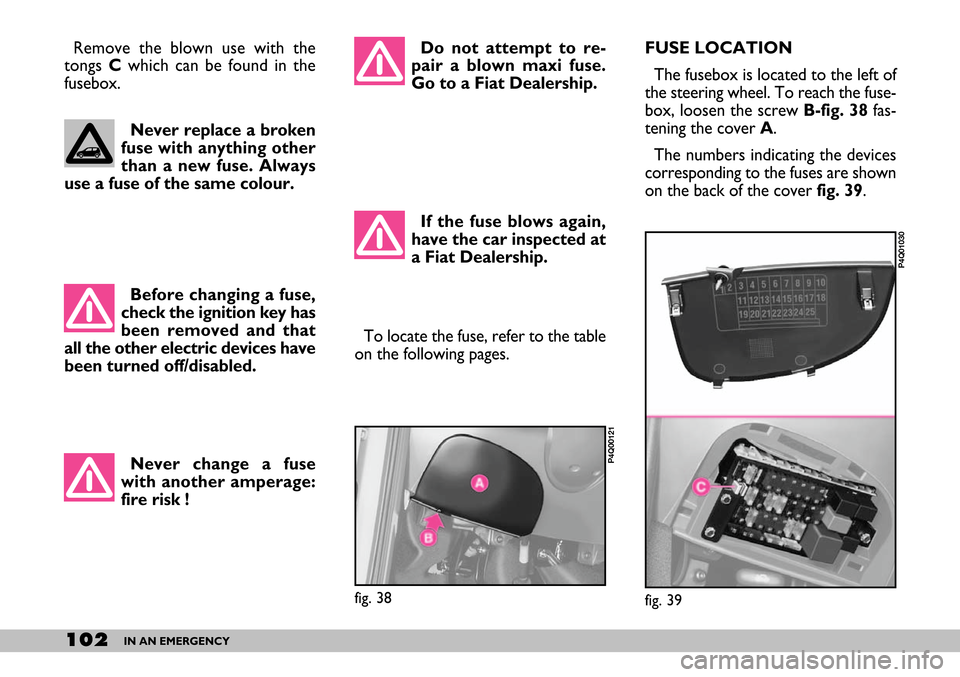
Remove the blown use with the
tongs Cwhich can be found in the
fusebox.
Never replace a broken
fuse with anything other
than a new fuse. Always
use a fuse of the same colour.
Before changing a fuse,
check the ignition key has
been removed and that
all the other electric devices have
been turned off/disabled. FUSE LOCATION
The fusebox is located to the left of
the steering wheel. To reach the fuse-
box, loosen the screw B-fig. 38 fas-
tening the cover A.
The numbers indicating the devices
corresponding to the fuses are shown
on the back of the cover fig. 39.
Page 107 of 154
106IN AN EMERGENCY
JACKING THE CAR
WITH THE JACK
See
IF A TYRE IS PUNCTUREDin this
chapter. Please note:
– The jack requires no adjustments.
– The jack cannot be repaired. If it
breaks it must be replaced with a new
jack.
– Apart from the handle shown in
this chapter no other tools should be
installed on the jack. WITH A SHOP JACK
From the front
Jack up the car only by positioning
the jack arm at the gearbox/differen-
tial and placing a rubber pad in be-
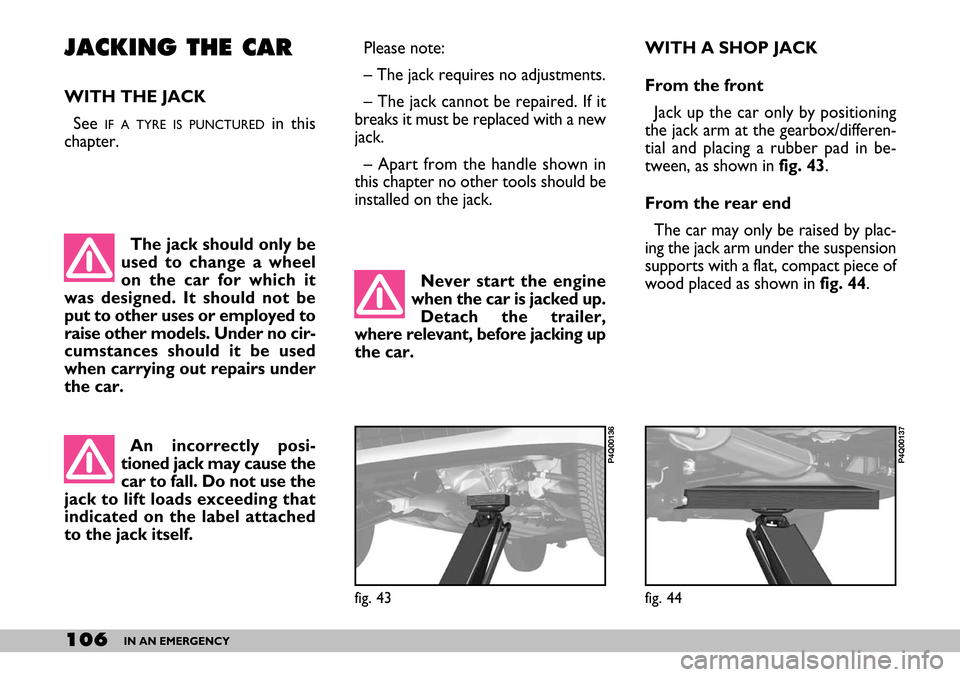
tween, as shown in fig. 43.
From the rear end
The car may only be raised by plac-
ing the jack arm under the suspension
supports with a flat, compact piece of
wood placed as shown in fig. 44. The jack should only be
used to change a wheel
on the car for which it
was designed. It should not be
put to other uses or employed to
raise other models. Under no cir-
cumstances should it be used
when carrying out repairs under
the car.
An incorrectly posi-
tioned jack may cause the
car to fall. Do not use the
jack to lift loads exceeding that
indicated on the label attached
to the jack itself. Never start the engine
when the car is jacked up.
Detach the trailer,
where relevant, before jacking up
the car.
fig. 43
P4Q00136
fig. 44
P4Q00137
Page 108 of 154
107IN AN EMERGENCY
Before starting to tow,
turn the ignition key to
MAR and then to STOP.
Do not remove the key. If the
key is removed, the steering lock
engages automatically which pre-
vents the wheels being turned.
While the car is being
towed with the engine
off, remember that the
brake pedal and steering will re-
quire more effort as you no
longer have the benefit of the
power brakes and power steer-
ing. Do not use flexible cables to
tow. Avoid jerking. Whilst tow-
ing, ensure that the coupling to
the vehicle does not damage the
surrounding components.
The car can be lifted
from the side providing
the hydraulic jack arm is
fitted with a special bracket in
the plate housing.
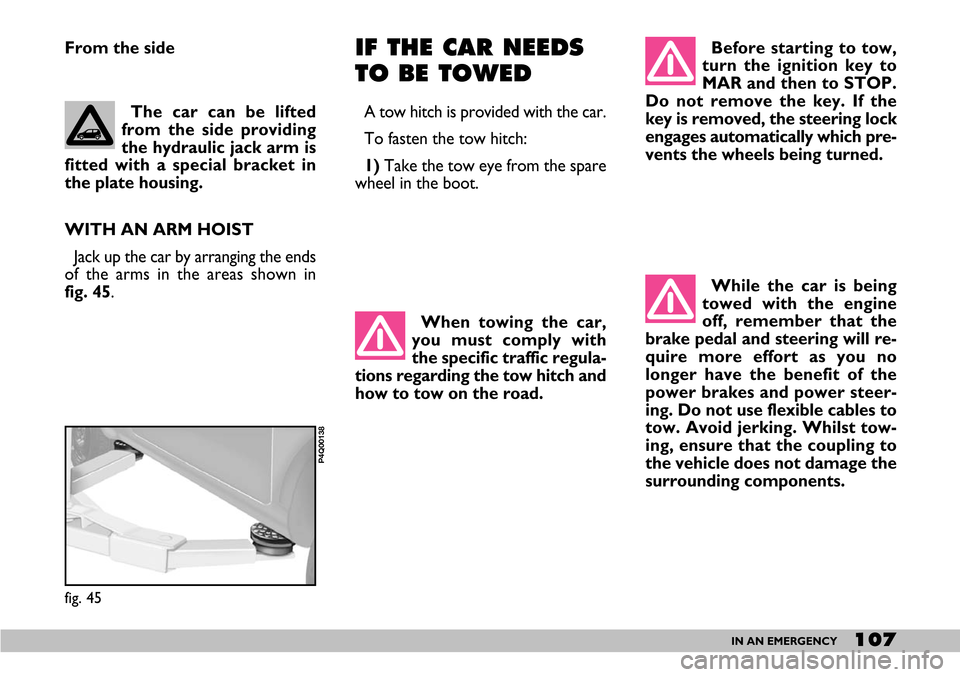
WITH AN ARM HOIST
Jack up the car by arranging the ends
of the arms in the areas shown in
fig. 45.
IF THE CAR NEEDS
TO BE TOWED
A tow hitch is provided with the car.
To fasten the tow hitch:
1)Take the tow eye from the spare
wheel in the boot.
When towing the car,
you must comply with
the specific traffic regula-
tions regarding the tow hitch and
how to tow on the road.
fig. 45
P4Q00138
From the side
Page 113 of 154
112CAR MAINTENANCE
ANNUAL INSPECTION SCHEDULE
– Inspect conditions of. engine, gear-
box, transmission, piping (exhaust -
fuel feed - brakes), rubber parts
(boots - sleeves - bushings - etc.),
brake and fuel line hoses.
– Check for bonnet and boot lock
cleanness, lever cleanness and lubri-
cation.
– Check battery charge status.
– Check conditions of various con-
trol belts.
– Check and top up fluid levels (en-
gine coolant, brakes, windscreen
washer, battery, etc.).
– Change engine oil.
– Replace engine oil filter.
– Replace pollen filter (where fitted). The following annual inspection
schedule is recommended for
cars travelling less than
20,000 km a year (e.g. approxi-
mately 10,000 km). The schedule
includes the following operations:
– Check tyre condition and wear
and adjust pressure, if required (in-
cluding spare wheel).
– Check operation of lights (head-
lights, direction indicators, hazard
lights, boot light, passenger compart-
ment ceiling light, glove compartment
light, instrument panel lights, etc.).
– Check windscreen wiper/washer
and adjust nozzles.
– Check position wear of wind-
screen/rear window wiper blades.
– Check front brake pad conditions
and wear.
ADDITIONAL
CHECKS
Every 1,000 kmor before long
trips, check and top up as necessary:
– engine coolant level, brake fluid
level, windscreen washer liquid level,
tyre pressure and conditions.
Every 3,000 kmcheck and top up
as necessary: engine oil level.
We recommend using FL Selenia
products which were specifically de-
signed and made for use in Fiat vehi-
cles (see
CAPACITIEStable in TECHNICAL
SPECIFICATIONS
).
Page 122 of 154
121CAR MAINTENANCE
If the pressure is too low
the tyre overheats and
this can cause it serious
damage.case, comply with the laws in the
country where the car is being driven.
IMPORTANT
As far as possible avoid sharp brak-
ing and screech starts.
Be careful not to hit the kerb, pot-
holes or other obstacles hard. Driving
for long stretches over bumpy roads
can damage the tyres.
Periodically check that the tyres have
no cuts in the sidewalls, abnormal
swelling or irregular tyre wear. If any
of these occur, have the car seen to
at a Fiat Dealership.
Avoid overloading your car: this can
seriously damage wheels or tyres.
If you get a flat tyre, stop immedi-
ately and change it so as not to dam-
age the tyre, the wheel, the suspen-
sion and the steering.
Tyres age even if they are not used
very much. Cracking of the tread rub-
ber and the sidewalls are a sign of this
ageing. In any case, if the tyres have
been fitted for more than six years
they should be examined by an expert
Tyre pressure must be
correct to ensure good
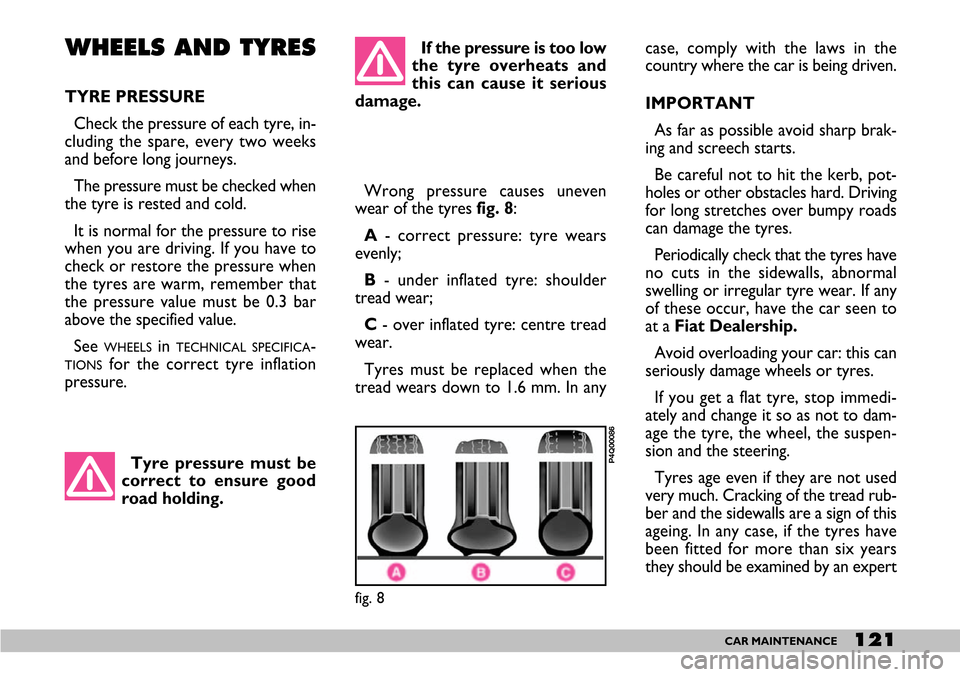
road holding.Wrong pressure causes uneven
wear of the tyres fig. 8:
A - correct pressure: tyre wears
evenly;
B - under inflated tyre: shoulder
tread wear;
C - over inflated tyre: centre tread
wear.
Tyres must be replaced when the
tread wears down to 1.6 mm. In any
fig. 8
P4Q00086
WHEELS AND TYRES
TYRE PRESSURE
Check the pressure of each tyre, in-
cluding the spare, every two weeks
and before long journeys.
The pressure must be checked when
the tyre is rested and cold.
It is normal for the pressure to rise
when you are driving. If you have to
check or restore the pressure when
the tyres are warm, remember that
the pressure value must be 0.3 bar
above the specified value.
See
WHEELSin TECHNICAL SPECIFICA-
TIONSfor the correct tyre inflation
pressure.
Page 126 of 154
125CAR MAINTENANCE
TIPS FOR KEEPING
THE BODYIN GOOD
CONDITIONS
Paintwork
The paintwork is not only to make
your car look attractive but also to
protect the steel.
If your car is scuffed or scratched
deeply you are therefore advised to
touch up the paintwork as necessary
to prevent rust from forming.
Only use genuine products when
touching up the paintwork (see the
TECHNICAL SPECIFICATIONSchapter.
Ordinary maintenance of the paint-
work means washing it. The frequency
you should do this depends on the
conditions and the environment the
car is driven in. For example, in areas
with a high level of air pollution, or on
roads sprinkled with road saltwash
the car more frequently.Detergents pollute wa-
ter. For this reason, the
car must be washed in an
area equipped for the collection
and purification of the liquids
used while washing.
To wash the car properly:
1) Remove the aerial from the roof
to avoid damaging it in an automatic
car wash.
2) Wash the body using a low pres-
sure jet of water.
3) Wipe a sponge with a slightly
soapy solution over the bodywork,
frequently rinsing the sponge.
4) Rinse well with water and dry
with a jet of air or a chamois leather.
When drying the car, be careful to
get at those parts which are not so
easily seen e.g. the door frames, bon-
net and around the headlights where
water can most readily collect.
– the use of zinc-plated (or pre-
treated) sheet steel which is highly re-
sistant to rust;
– the spraying of the underbody, en-
gine compartment, inside the wheel-
arches and other parts with wax-
based products with a high protective
capacity;
– spraying plastic-coating materials
to protect the most exposed points:
under the door, inside the wings, the
edges etc.;
– the use of “open” box sections to
prevent condensation and water from
building up and rusting the inside of
the parts.
BODY AND UNDERBODY
WARRANTY
Your Fiat 600 is covered by guaran-
tee against any original structural or
body part being holed by rust. Refer
to the “Warranty Booklet” for the
general conditions of this guarantee.
Page 132 of 154
131TECHNICAL SPECIFICATIONS
Modifications or repairs
to the fuel feed system
that are not carried out
properly or do not take the sys-
tem’s technical specifications
into account can cause malfunc-
tions leading to the risk of fire. FUEL SUPPLY IGNITION
Integrated multipoint electronic in-
jection and ignition system: a single
control units controls both function
processing injection time (for fuel me-
tering) and spark advance angle at the
same time.
SPARK PLUGS
The cleanness and soundness of the
spark plugs are very important for
keeping the engine efficient and pol-
luting emissions down.
The appearance of the spark plug, if
examined by an expert eyes, is a good
way of pinpointing a problem even if
it has nothing to do with the ignition
system. Therefore, if the engine has
problems, it is important to have the
spark plugs checked at a Fiat Deal-
ership.
TRANSMISSION
CLUTCH
Mechanically controlled without
travel-free pedal.
GEARBOX
Five forward gears and reverse with
synchromesh for front gear engage-
ment.
Cyclical gear reduction and differen-
tial assembly incorporated in the gear-
box.
Drive transmission to the front
wheels by means of drive shafts con-
nected to the differential assembly and
the wheels with CV joints. The spark plugs must be
changed at the times
specified in the
SERVICE
SCHEDULE
. Only use the type of
plugs indicated. If the heat ratio
is less than required or the life
specified is not guaranteed, prob-
lems can arise.