ABS FIAT SEICENTO 2007 1.G Owner's Manual
[x] Cancel search | Manufacturer: FIAT, Model Year: 2007, Model line: SEICENTO, Model: FIAT SEICENTO 2007 1.GPages: 154, PDF Size: 3.68 MB
Page 104 of 154
103IN AN EMERGENCY
An additional 7.5A fuse is located by
the side of the climate control system.
It can be reached from inside the pas-
senger compartment under the dash-
board.
Fuses in the engine
compartment
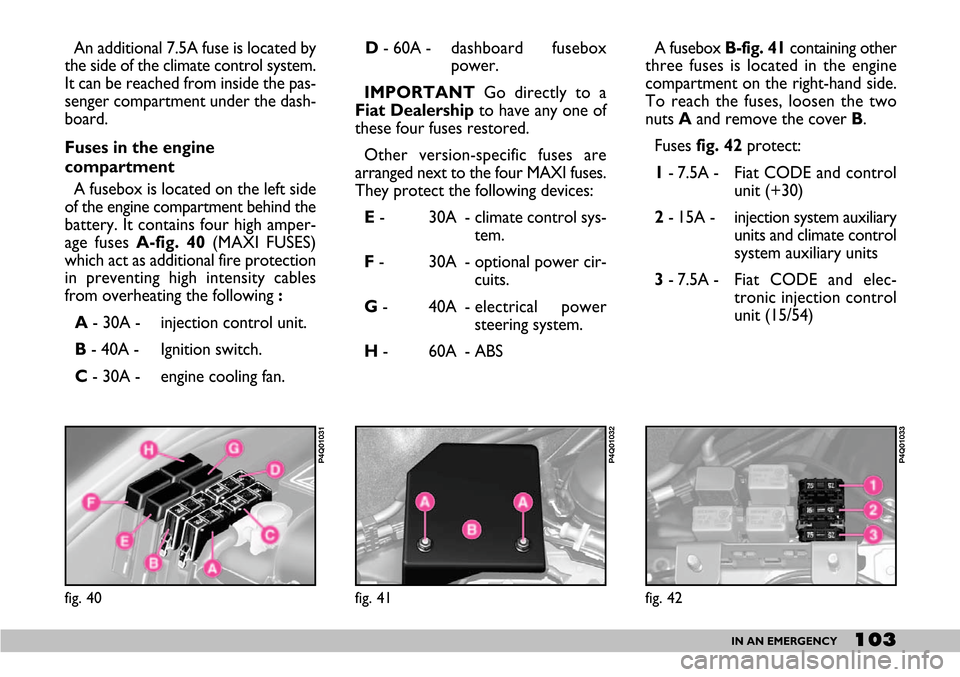
A fusebox is located on the left side
of the engine compartment behind the
battery. It contains four high amper-
age fuses A-fig. 40 (MAXI FUSES)
which act as additional fire protection
in preventing high intensity cables
from overheating the following :
A- 30A - injection control unit.
B- 40A - Ignition switch.
C- 30A - engine cooling fan.D- 60A -dashboard fusebox
power.
IMPORTANT Go directly to a
Fiat Dealershipto have any one of
these four fuses restored.
Other version-specific fuses are
arranged next to the four MAXI fuses.
They protect the following devices:
E - 30A - climate control sys-
tem.
F - 30A - optional power cir-
cuits.
G - 40A - electrical power
steering system.
H - 60A - ABSA fusebox B-fig. 41 containing other
three fuses is located in the engine
compartment on the right-hand side.
To reach the fuses, loosen the two
nuts A and remove the cover B.
Fuses fig. 42 protect:
1 - 7.5A -Fiat CODE and control
unit (+30)
2 - 15A -injection system auxiliary
units and climate control
system auxiliary units
3 - 7.5A -Fiat CODE and elec-
tronic injection control
unit (15/54)
fig. 40
P4Q01031
fig. 41
P4Q01032
fig. 42
P4Q01033
Page 105 of 154
104IN AN EMERGENCY
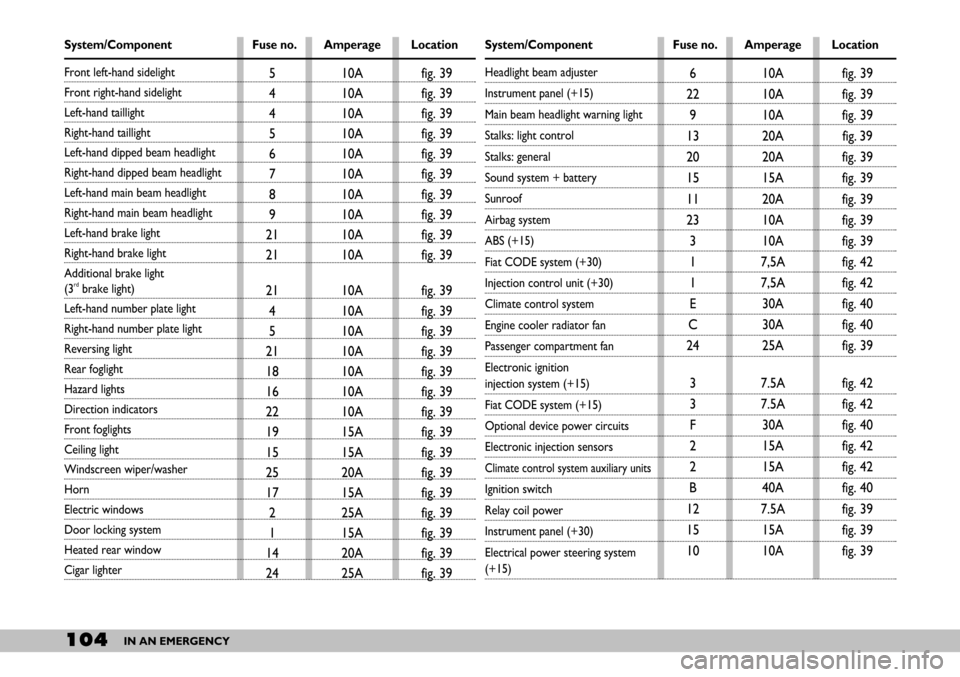
System/Component Fuse no. Amperage Location
Front left-hand sidelight
Front right-hand sidelight
Left-hand taillight
Right-hand taillight
Left-hand dipped beam headlight
Right-hand dipped beam headlight
Left-hand main beam headlight
Right-hand main beam headlight
Left-hand brake light
Right-hand brake light
Additional brake light
(3rdbrake light)
Left-hand number plate light
Right-hand number plate light
Reversing light
Rear foglight
Hazard lights
Direction indicators
Front foglights
Ceiling light
Windscreen wiper/washer
Horn
Electric windows
Door locking system
Heated rear window
Cigar lighter
5 10A fig. 39
4 10A fig. 39
4 10A fig. 39
5 10A fig. 39
6 10A fig. 39
7 10A fig. 39
8 10A fig. 39
9 10A fig. 39
21 10A fig. 39
21 10A fig. 39
21 10A fig. 39
4 10A fig. 39
5 10A fig. 39
21 10A fig. 39
18 10A fig. 39
16 10A fig. 39
22 10A fig. 39
19 15A fig. 39
15 15A fig. 39
25 20A fig. 39
17 15A fig. 39
2 25A fig. 39
1 15A fig. 39
14 20A fig. 39
24 25A fig. 39
System/Component Fuse no. Amperage Location
6 10A fig. 39
22 10A fig. 39
9 10A fig. 39
13 20A fig. 39
20 20A fig. 39
15 15A fig. 39
11 20A fig. 39
23 10A fig. 39
3 10A fig. 39
1 7,5A fig. 42
1 7,5A fig. 42
E 30A fig. 40
C 30A fig. 40
24 25A fig. 39
3 7.5A fig. 42
3 7.5A fig. 42
F 30A fig. 40
2 15A fig. 42
2 15A fig. 42
B 40A fig. 40
12 7.5A fig. 39
15 15A fig. 39
10 10A fig. 39Headlight beam adjuster
Instrument panel (+15)
Main beam headlight warning light
Stalks: light control
Stalks: general
Sound system + battery
Sunroof
Airbag system
ABS (+15)
Fiat CODE system (+30)
Injection control unit (+30)
Climate control system
Engine cooler radiator fan
Passenger compartment fan
Electronic ignition
injection system (+15)
Fiat CODE system (+15)
Optional device power circuits
Electronic injection sensors
Climate control system auxiliary units
Ignition switch
Relay coil power
Instrument panel (+30)
Electrical power steering system
(+15)
Page 118 of 154
The symbol πon the
container indicates syn-
thetic brake fluid distin-
guishing it from mineral fluid. Us-
ing mineral type fluid would
damage the special rubber brak-
ing system gaskets beyond re-
pair.
117CAR MAINTENANCE
Brake fluid is poisonous
and highly corrosive.
Wash the concerned
parts immediately with water
and mild soap in the event of an
accidental contact. Call a doctor
immediately if swallowed. If fluid has to be added, it is sug-
gested to use the brake fluid in table
"Fluids and lubricants" (see chapter
"Technical characteristics").
NOTE Clean accurately the tank cap
and the surrounding surface.
At plug opening, pay maximum at-
tention in order to prevent any impu-
rities from entering the tank.
For topping up, always use a funnel
with integrated filter with mesh equal
to or lower than 0.12 mm.
IMPORTANTBrake fluid absorbs
moisture, for this reason, if the vehi-
cle is mainly used in areas with a high
degree of atmospheric humidity, the
fluid should be replaced at more fre-
quent intervals than specified in the
“Service schedule”.
Make sure that the
highly corrosive brake
fluid does not drip onto
the paintwork. If it does, wash it
off immediately with water.
AIR CLEANER
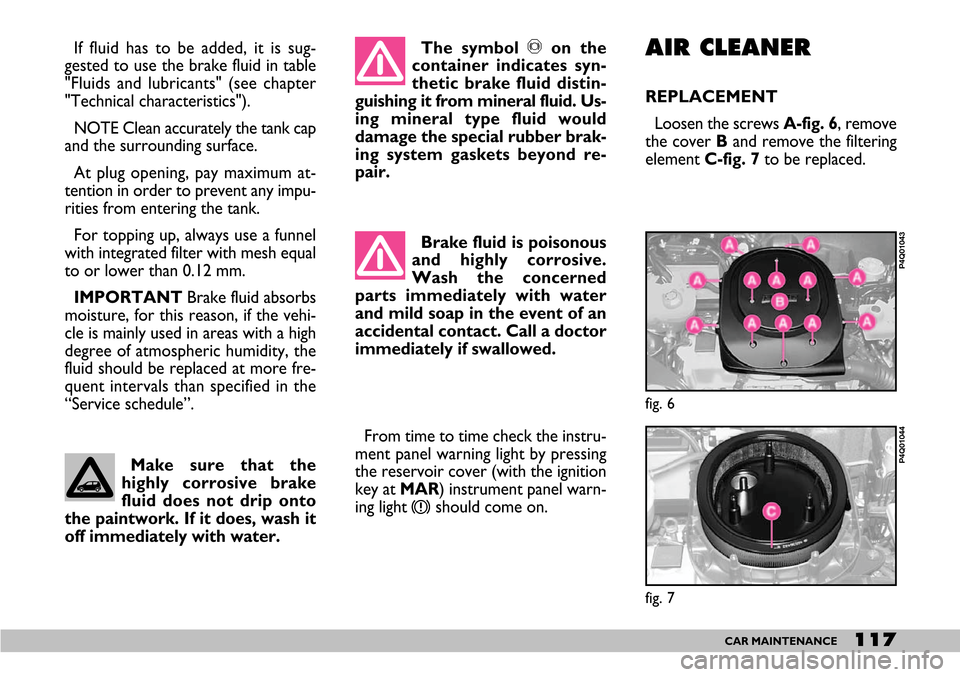
REPLACEMENT
Loosen the screws A-fig. 6, remove
the cover B and remove the filtering
element C-fig. 7 to be replaced.
fig. 6
P4Q01043
fig. 7
P4Q01044
From time to time check the instru-
ment panel warning light by pressing
the reservoir cover (with the ignition
key at MAR) instrument panel warn-
ing light
xshould come on.
Page 123 of 154
122CAR MAINTENANCE
RUBBER TUBING
Follow the SERVICE SCHEDULEto the
letter as concerns braking, power
steering and fuel line rubber tubing.
Ozone, high temperatures and long
absence of fluid in the system can in
fact cause the hardening and cracking
of the pipes with possible loss of fluid.
A careful check is therefore essential.
WINDSCREEN AND
REAR WINDOW
WIPERS
BLADES
Periodically clean the rubber part
with suitable products. We recom-
mendTUTELA PROFESSIONAL
SC35.
Change the blades if the rubber edge
is warped or worn out. You should in
any case change them approximately
once a year. who can judge whether they are still
fit for use. Remember to check the
spare tyre particularly carefully too.
If a replacement is necessary, always
use new tyres and avoid using ones
the origin of which you are not cer-
tain about.
The Fiat 600 fits tubeless tyres. Un-
der no circumstances use an inner
tube with these tyres.
If you replace a tyre it is a good idea
to change the inflation valve, too.
To ensure the front and rear tyres
all wear evenly, you are advised to
change the tyres over every 10-15
thousand kilometres keeping them on
the same side of the car so as not to
reverse the direction of rotation.
Do not change the tyres
over in criss-cross fashion
by moving a tyre from
the left hand side of the car to
the right and vice versa.
Travelling with worn
wiper blades is dangerous
because it reduces visibil-
ity in bad weather.
In winter if the temperature falls be-
low zero, make sure the blades are
not frozen to the windscreen. If nec-
essary, free them with a de-icing com-
pound.
Page 128 of 154
127CAR MAINTENANCE
CLEANING SEATS
AND FABRICS
– Remove dust with a soft brush and
vacuum cleaner.
– Brush the seats with a damp
sponge with water and a neutral soap.
– Remove any grease stains with a
specific product.
CLEANING LEATHER SEATS
– Remove the dry dirt with a
chamois leather or very slightly moist
cloth without exerting too much pres-
sure.
– Remove liquid or grease stains
with a dry absorbent cloth without
rubbing. Then wipe with a chamois
leather or soft cloth moistened with
water and neutral soap.
If the stain does not come out, use a
special cleaning compound being par-
ticularly careful to follow the instruc-
tions for use.
IMPORTANT Never use alcohol
or alcohol-base products.PLASTIC PARTS INSIDE
THE CAR
Use special products designed not to
alter the appearance of the compo-
nents.
IMPORTANT Do not use alcohol
or petrol to clean the instrument
panel.
Do not keep aerosol
cans in the car. There is
the risk they might ex-
plode. Aerosol cans must never
be exposed to a temperature
above 50°C; when the weather
starts to get hot the tempera-
ture inside the car might go well
beyond that figure.INTERIORS
From time to time check that water
has not collected under the mats
(from dripping shoes, umbrellas etc.)
which could cause the steel to rust.
Never use inflammable
products such as petro-
leum ether or petrol to
clean inside the car. The electro-
static loads that are generated
while rubbing to clean could be-
come a fire risk.
Page 133 of 154
132TECHNICAL SPECIFICATIONS
BRAKES
SERVICE AND EMERGENCY
BRAKES
Front:
– disc, floating caliper type with op-
erating cylinder for each wheel.
Rear:
– drum type with self-centring shoes
and operating cylinder for each wheel.
Crossed hydraulic circuit control.
7” vacuum brake booster.
ABS system with four sensors
(where fitted).
Automatic take-up of friction liner
wear.
Brake effort proportioning valves (2)
intervening on hydraulic circuit of the
rear brakes. HANDBRAKE
Controlled by a lever, it works me-
chanically on the rear brakes.
SUSPENSION
Front:
Independent wheel type, lower wish-
bones anchored to telescopic sup-
ports consisting of a cast iron riser
rigidly connected to a hydraulic dou-
ble action shock absorber. Leaf spring
and coaxial pads with the shock ab-
sorbers. Permanently lubricated joints.
Anti-roll bar anchored to the body
acting on suspension arm.
Rear:
Independent wheel with coil springs.
Jointed steel arms with bush and dou-
ble action telescopic gas shock ab-
sorbers. Water, ice and salt
sprinkled on the road de-
posit on the brake disc
and reduce effectiveness when
you brake.
Pay attention when in-
stalling extra spoilers, al-
loy wheels and non stan-
dard wheel caps: they could re-
duce the ventilation of the
brakes, thus reducing their effi-
ciency when braking suddenly
and frequently, or on long down-
hill slopes.
Page 146 of 154
145INDEX
I I I I
N N N N
D D D D
E E E E
X X X X
ABS ............................................ 54
Accessories purchased by the
owner ......................................... 66
– Installation of electric/
electronic devices ................ 67
– Radio transmitters and
cellular telephones ............... 67
Air filter ....................................... 117
Air recirculation ......................... 35
Air vents (adjustable) ................ 33
Front airbags ............................... 56
– front airbag passenger side 57
– general warnings .................. 58
– front airbags .......................... 576
Analogue clock ........................... 24
Ashtray ......................................... 42
At the filling station ................... 66
Battery
– checking the carge ............... 119
– checking the fluid level ....... 118
– jump starting .................. 88-105
– recharging .............................. 105– replacing the battery ........... 118
– useful advice .......................... 119
Bodywork
– advice for maintenance ....... 125
– exterior and underbody
warranty ................................. 125
– protection from
atmospheric agents ............. 124
– versions .................................. 129
Bonnet .......................................... 51
Boot ............................................... 47
– anchoring the load ............... 49
– extension ............................... 48
– opening .................................... 47
Brake fluid level .......................... 116
Brake lights .................................. 99
Brakes
– fluid level ................................ 116
– service and emergency ....... 132
Bulbs
– bulb replacement ................. 93
– bulb types .............................. 95
– external bulb replacement . 96
– general instructions ............. 94
– internal bulb replacement .. 101
Capacities .................................. 139
Car maintenance
– additional checks .................. 112
– annual inspection schedule 112
– scheduled service ................. 109
– service schedule ................... 110
Ceiling light
– bulb replacement ................. 100
– control .................................... 39
Centralised locking system ...... 45
Cheap running ............................ 79
Cigar lighter ................................ 42
Clutch ........................................... 131
Conditions of use ...................... 79
Containing running costs ......... 77
Control buttons ......................... 40
Courtesy light
– bulb replacement ................. 101
– control .................................... 39
Page 148 of 154
147INDEX
Lubricant specifications .......... 140
Main beam headlights
– bulb replacement ................. 96
– control .................................... 37
– flashing .................................... 38
Manual climate control system
– controls .................................. 35
– cooling .................................... 36
– maintenance .......................... 36
Number plate lights ................ 99
Paint ........................................... 125
Parking .......................................... 71
Performance ............................... 137
Pretensioner ............................... 12
Protecting emission control
devices ....................................... 80
Radio-frequency remote control
– homologation numbers ...... 9-143
– operation ............................... 9
– replacing the batteries ........ 9
Rear foglights
– bulb replacement ................. 99
– on/off button ......................... 40Rear window washer
– control .................................... 39
– fluid level ................................ 116
Rear window wiper
– blades ...................................... 122
– control .................................... 39
– nozzles .................................... 124
Rearview mirrors
– exterior .................................. 31
– interior ................................... 31
Refuelling ..................................... 68
Rev counter ................................ 24
Reversing lights ........................... 99
Roof rack/ski rack ...................... 52
Rubber tubing ............................. 122
Safe driving
– before getting behind
the wheel ............................... 73
– driving at night ...................... 75
– driving in the fog .................. 75
– driving in the mountains ..... 76
– driving in the rain ................. 75
– driving on snow and ice ..... 76
– driving with ABS .................. 77– when travelling ..................... 74
Safe driving in harmony
with nature ............................... 4
Seat belts
– general warnings .................. 13
– height adjustment ................ 11
– maintenance .......................... 14
– pretensioners ........................ 12
– rear side seat belt use ........ 11
– transporting children
in safety .................................. 15
– use ........................................... 10
Seats
– accessing the rear seats ...... 31
– children .................................. 15
– cleaning ................................... 127
– fore/aft settings .................... 29
– seat back settings ................. 30
Side/taillights
– control .................................... 37
– front bulb replacement ....... 97
– rear bulb replacement ........ 99
Signs to help you drive
correctly .................................... 5
Snow chains ................................ 85