lock FIAT SEICENTO 2007 1.G Owner's Manual
[x] Cancel search | Manufacturer: FIAT, Model Year: 2007, Model line: SEICENTO, Model: FIAT SEICENTO 2007 1.GPages: 154, PDF Size: 3.68 MB
Page 69 of 154
68GETTING TO KNOW YOUR CAR
IMPORTANTThe hermetic clo-
sure may cause a slight pressure in the
tank: a slight hissing when turning the
cap is quite normal.
To close:
1)the cap coupling is “bayonet”
type. Insert the cap (with the key) and
turn it clockwise until it clicks;
2)keeping the cap still, turn the key
clockwise and remove it; close the
flap.
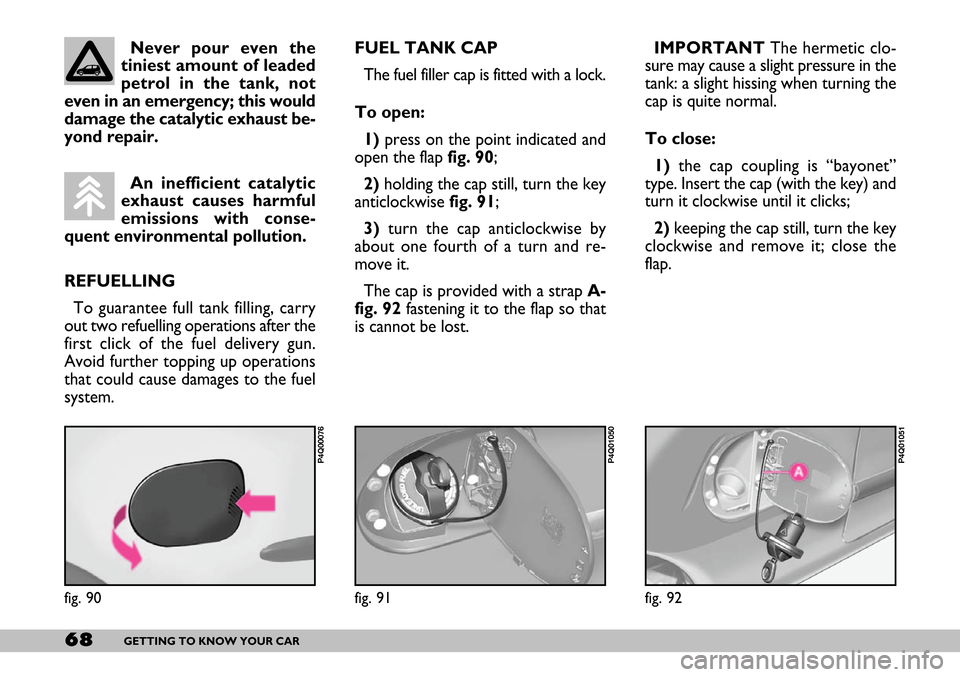
fig. 92
P4Q01051
Never pour even the
tiniest amount of leaded
petrol in the tank, not
even in an emergency; this would
damage the catalytic exhaust be-
yond repair. FUEL TANK CAP
The fuel filler cap is fitted with a lock.
To open:
1)press on the point indicated and
open the flap fig. 90;
2) holding the cap still, turn the key
anticlockwise fig. 91;
3) turn the cap anticlockwise by
about one fourth of a turn and re-
move it.
The cap is provided with a strap A-
fig. 92fastening it to the flap so that
is cannot be lost.
fig. 90
P4Q00076
fig. 91
P4Q01050
An inefficient catalytic
exhaust causes harmful
emissions with conse-
quent environmental pollution.
REFUELLING
To guarantee full tank filling, carry
out two refuelling operations after the
first click of the fuel delivery gun.
Avoid further topping up operations
that could cause damages to the fuel
system.
Page 72 of 154
71DRIVING YOUR CAR
EMERGENCY START-UP
If the Fiat CODE system fails to
recognise that code transmitted by
the ignition key (instrument panel
warning light ¢on) the emergency
start-up can be performed by using
the CODE card code.
See the
INANEMERGENCY. A quick burst on the ac-
celerator before turning
off the engine serves ab-
solutely no practical purpose and
wastes fuel.
IMPORTANTAfter a taxing drive
it is better to allow the engine to
“catch its breath” before turning it off,
by letting it idle to allow the temper-
ature in the engine compartment to
fall.
PARKING
Switch off the engine, pull up the
handbrake and put the car in 1st gear
if the car is pointing uphill, reverse if
downhill.
If the car is parked on a steep gradi-
ent it is a good idea to use a stone or
wedge to block the wheels.
Do not leave the ignition key at
MARbecause it drains the battery.
Always remove the key when you
leave the car. Bump starting by push-
ing, towing or rolling
downhill must be avoided
at all costs. This way of starting
could cause a rush of fuel into the
catalytic exhaust pipe and dam-
age it beyond repair.
Remember that as long
as the engine is not run-
ning, the power brakes
and power steering do not work.
You therefore have to use con-
siderably more effort on both the
brake pedal and the steering
wheel. SWITCHING OFF
THE ENGINE
Turn the key to STOPwhile the
engine is idling.
Never leave unsuper-
vised children in the car.
Page 73 of 154
72DRIVING YOUR CAR
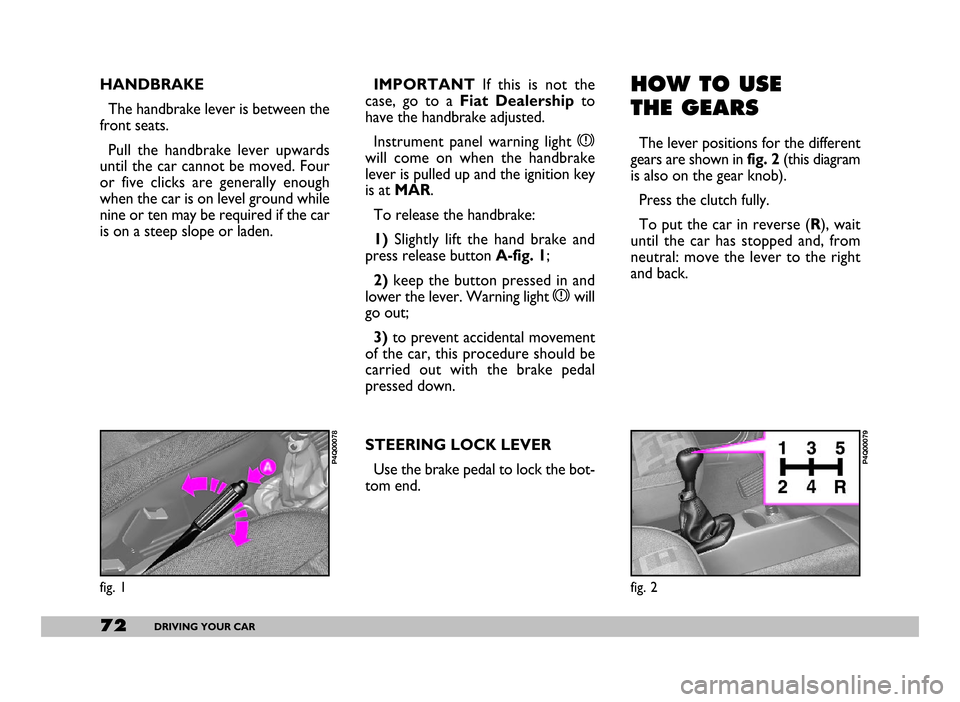
HANDBRAKE
The handbrake lever is between the
front seats.
Pull the handbrake lever upwards
until the car cannot be moved. Four
or five clicks are generally enough
when the car is on level ground while
nine or ten may be required if the car
is on a steep slope or laden. IMPORTANTIf this is not the
case, go to a Fiat Dealership to
have the handbrake adjusted.
Instrument panel warning light x
will come on when the handbrake
lever is pulled up and the ignition key
is at MAR.
To release the handbrake:
1)Slightly lift the hand brake and
press release button A-fig. 1;
2)keep the button pressed in and
lower the lever. Warning light xwill
go out;
3)to prevent accidental movement
of the car, this procedure should be
carried out with the brake pedal
pressed down.
STEERING LOCK LEVER
Use the brake pedal to lock the bot-
tom end. HOW TO USE
THE GEARS
The lever positions for the different
gears are shown in fig. 2(this diagram
is also on the gear knob).
Press the clutch fully.
To put the car in reverse (R), wait
until the car has stopped and, from
neutral: move the lever to the right
and back.
fig. 1
P4Q00078
fig. 2
P4Q00079
Page 77 of 154
76DRIVING YOUR CAR
IMPORTANT On stretches of
road with good visibility, switch off
your rear fog lights; the brightness of
these lights could annoy the people
travelling in the cars behind
– Remember that fog also means the
tarmac is wet and therefore manoeu-
vres of all kinds are more difficult and
stopping distances are longer.
– Keep a good distance from the
cars in front of you.
– As far as possible, avoid spurts of
speed or sudden deceleration.
– Do not overtake other vehicles if
you can help it.
– If you are forced to stop your car
(breakdown, limited visibility etc.) try
to stop off the road. Turn on the haz-
ard lights and, if possible, the dipped-
beam headlights. Rhythmically sound
the horn if you realise another car is
coming.DRIVING IN
THE MOUNTAINS
– When driving downhill use the en-
gine braking effect by engaging a low
gear so as not to overheat the brakes.
– Under no circumstances should
you drive downhill with the engine off
or with the car in neutral, let alone
with the ignition key out.
– Drive at a moderate speed with-
out cutting corners.
– Remember that overtaking while
going uphill is slower and therefore
requires more free road. If you are
being overtaken while driving uphill,
make it easier for the other vehicle to
pass. DRIVING ON SNOW
AND ICE
Here are some tips for driving in
these conditions:
– keep your speed down;
– use chains if the roads are covered
in snow: see paragraph
SNOW TYRESin
this chapter;
– mainly use the braking effect of the
engine and under all circumstances
avoid braking sharply;
– when braking in a car not fitted
with ABS, reduce the possibility of the
wheels locking by varying the pressure
you exert on the brake pedal;
– do not accelerate suddenly and
avoid swerving;
– in the winter, even apparently dry
roads may have icy patches. Be care-
ful therefore when driving over
stretches that do not get much expo-
sure to the sun or are lined with trees
or rock where ice might not have
melted;
– keep a good distance from the ve-
hicles in front;
Page 78 of 154
77DRIVING YOUR CAR
– do not remain stationary in deep
snow with the engine running: the
snow could deviate the exhaust gas
into the passenger compartment.
DRIVING WITH ABS
ABS is a braking system that essen-
tially offers two advantages:
1)it prevents wheel lock-up and
consequent skidding in emergency
stops, particularly when the road does
not offer much grip;
2)it makes it possible to brake and
steer at the same time so you can
avoid unexpected obstacles and direct
the car where you want while braking.
The extent to which this can be done
will depend on the physical limits of
the tyre’s sideways grip.To get the most out of ABS:
– during emergency conditions or
when grip conditions are poor, you
will feel a slight pulsation on the brake
pedal. This is the sign that the ABS is
working. Do not release the brake
pedal but continue to press so as not
to interrupt the braking action;
– ABS prevents the wheels from
locking, but it does not increase actual
grip conditions between tyre and
road. Therefore, even if your car is fit-
ted with ABS, respect the safety dis-
tance from the car in front of you and
keep your speed down when driving
into bends;
– ABS serves to increase the con-
trollability of the car, not to enable
you to go faster.CONTAINING
RUNNING COSTS
AND POLLUTION
Some suggestions which may help
you to keep the running costs of the
vehicle down and lower the amount
of toxic emissions released into the
atmosphere are given below.
GENERAL
CONSIDERATIONS
Car maintenance
The overall state of the car is an im-
portant factor which has a marked in-
fluence over fuel consumption and
driving comfort and on the life span of
your car. For this reason care should
be taken to maintain your car by car-
rying out the necessary checks and
regulations in accordance with the
specifications given in the
SERVICE
SCHEDULE
(see sections: SPARK PLUGS,
IDLING, AIR CLEANERS, TIMING).
Page 96 of 154
95IN AN EMERGENCY
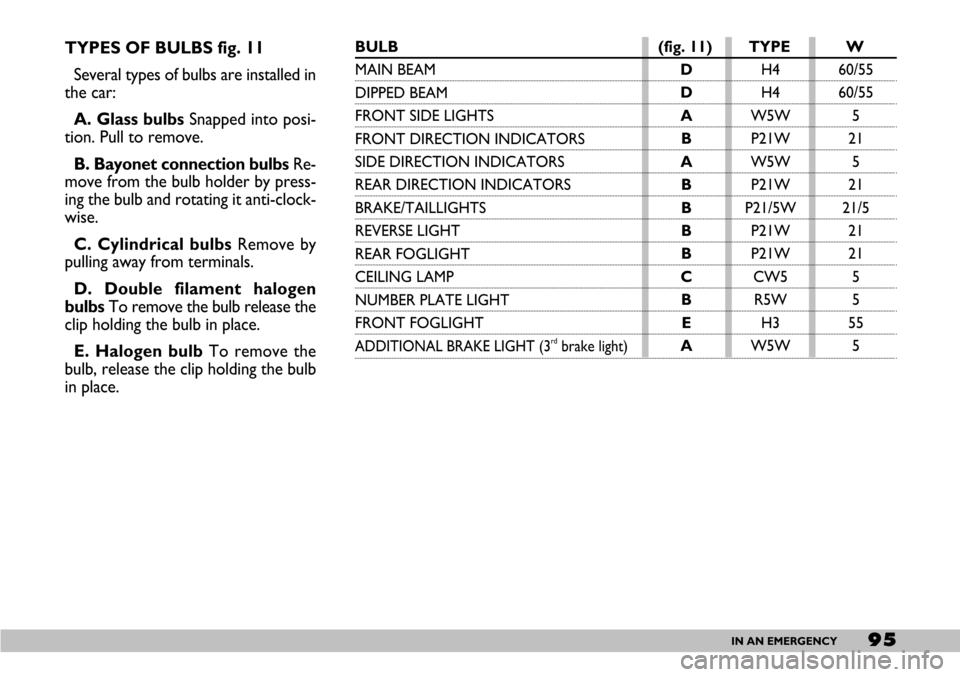
TYPES OF BULBS fig. 11
Several types of bulbs are installed in
the car:
A. Glass bulbs Snapped into posi-
tion. Pull to remove.
B. Bayonet connection bulbs Re-
move from the bulb holder by press-
ing the bulb and rotating it anti-clock-
wise.
C. Cylindrical bulbs Remove by
pulling away from terminals.
D. Double filament halogen
bulbs To remove the bulb release the
clip holding the bulb in place.
E. Halogen bulb To remove the
bulb, release the clip holding the bulb
in place. BULB (fig. 11) TYPE W
MAIN BEAM
DIPPED BEAM
FRONT SIDE LIGHTS
FRONT DIRECTION INDICATORS
SIDE DIRECTION INDICATORS
REAR DIRECTION INDICATORS
BRAKE/TAILLIGHTS
REVERSE LIGHT
REAR FOGLIGHT
CEILING LAMP
NUMBER PLATE LIGHT
FRONT FOGLIGHT
ADDITIONAL BRAKE LIGHT (3rdbrake light)
D
D
A
B
A
B
B
B
B
C
B
E
AH4 60/55
H4 60/55
W5W 5
P21W 21
W5W 5
P21W 21
P21/5W 21/5
P21W 21
P21W 21
CW5 5
R5W 5
H3 55
W5W 5
Page 98 of 154
97IN AN EMERGENCY
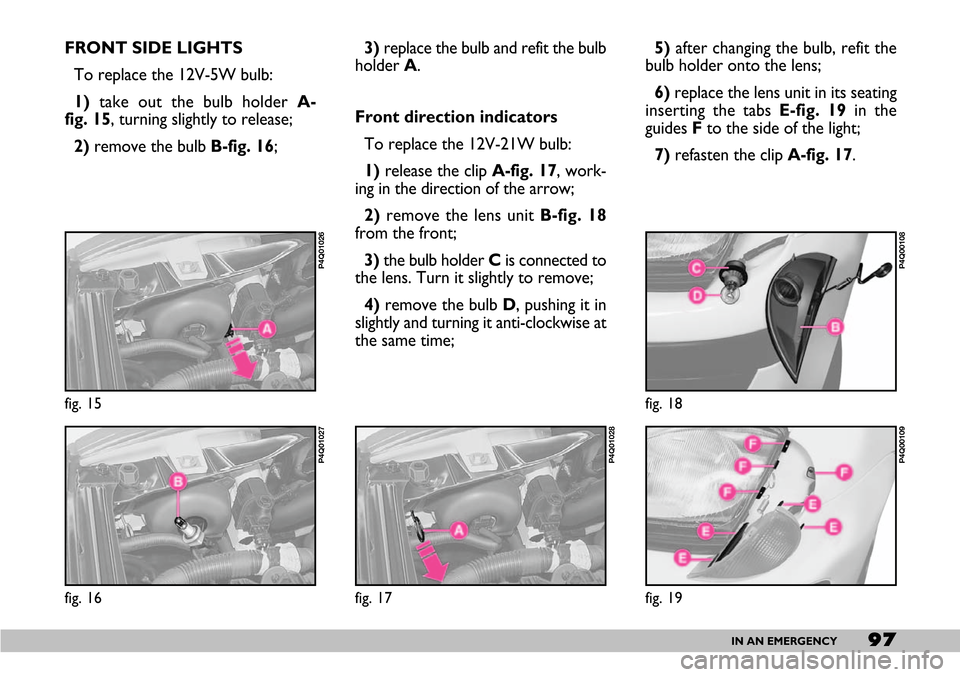
3)replace the bulb and refit the bulb
holder A.
Front direction indicators
To replace the 12V-21W bulb:
1) release the clip A-fig. 17, work-
ing in the direction of the arrow;
2)remove the lens unit B-fig. 18
from the front;
3)the bulb holder Cis connected to
the lens. Turn it slightly to remove;
4)remove the bulb D, pushing it in
slightly and turning it anti-clockwise at
the same time;5)after changing the bulb, refit the
bulb holder onto the lens;
6)replace the lens unit in its seating
inserting the tabs E-fig. 19in the
guides Fto the side of the light;
7)refasten the clip A-fig. 17. FRONT SIDE LIGHTS
To replace the 12V-5W bulb:
1)take out the bulb holder A-
fig. 15, turning slightly to release;
2)remove the bulb B-fig. 16;
fig. 16
P4Q01027
fig. 15
P4Q01026
fig. 17
P4Q01028
fig. 18
P4Q00108
fig. 19
P4Q00109
Page 99 of 154
98IN AN EMERGENCY
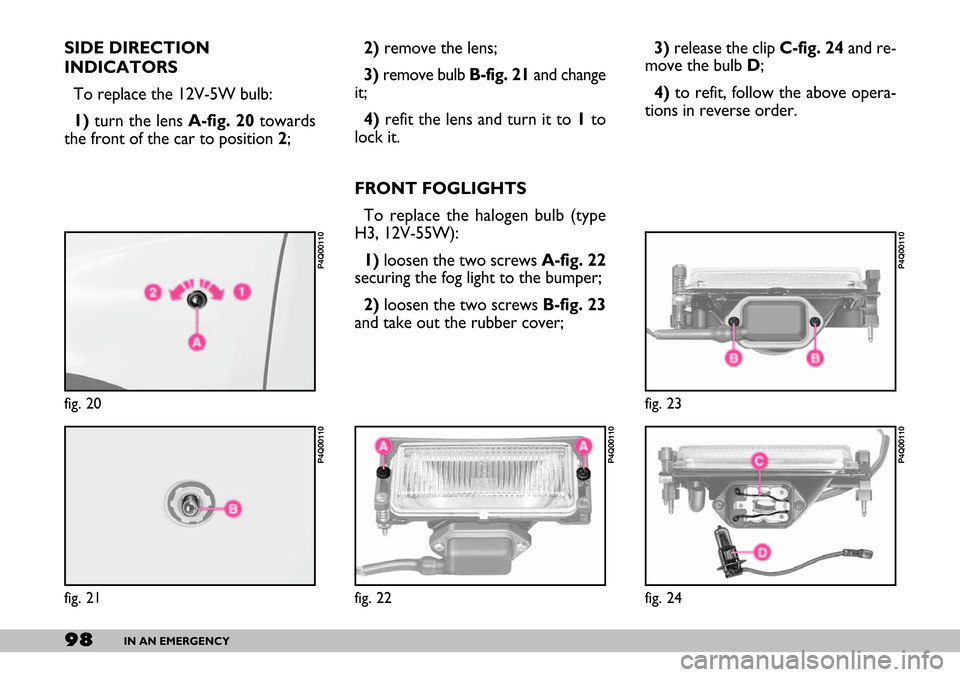
SIDE DIRECTION
INDICATORS
To replace the 12V-5W bulb:
1)turn the lens A-fig. 20towards
the front of the car to position 2;2)remove the lens;
3)remove bulb B-fig. 21and change
it;
4)refit the lens and turn it to 1 to
lock it.
FRONT FOGLIGHTS
To replace the halogen bulb (type
H3, 12V-55W):
1)loosen the two screws A-fig. 22
securing the fog light to the bumper;
2)loosen the two screws B-fig. 23
and take out the rubber cover;3)release the clip C-fig. 24and re-
move the bulb D;
4)to refit, follow the above opera-
tions in reverse order.
fig. 20
P4Q00110
fig. 21
P4Q00110
fig. 22
P4Q00110
fig. 23
P4Q00110
fig. 24
P4Q00110
Page 100 of 154
99IN AN EMERGENCY
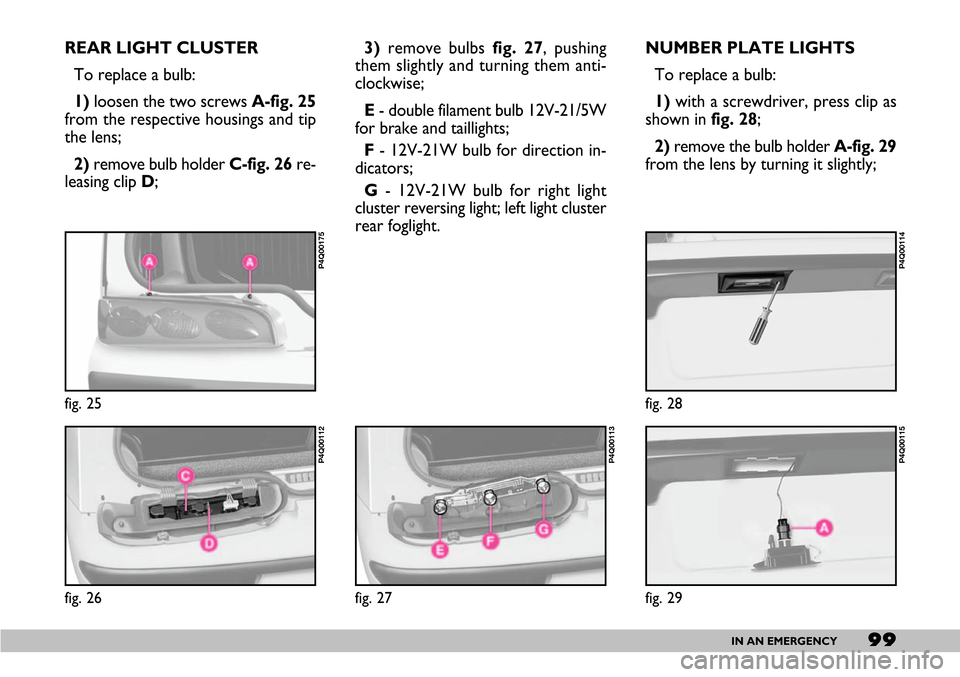
REAR LIGHT CLUSTER
To replace a bulb:
1)loosen the two screws A-fig. 25
from the respective housings and tip
the lens;
2)remove bulb holder C-fig. 26 re-
leasing clip D; 3)remove bulbs fig. 27, pushing
them slightly and turning them anti-
clockwise;
E- double filament bulb 12V-21/5W
for brake and taillights;
F- 12V-21W bulb for direction in-
dicators;
G- 12V-21W bulb for right light
cluster reversing light; left light cluster
rear foglight. NUMBER PLATE LIGHTS
To replace a bulb:
1) with a screwdriver, press clip as
shown in fig. 28;
2) remove the bulb holder A-fig. 29
from the lens by turning it slightly;
fig. 25
P4Q00175
fig. 26
P4Q00112
fig. 27
P4Q00113
fig. 28
P4Q00114
fig. 29
P4Q00115
Page 105 of 154
104IN AN EMERGENCY
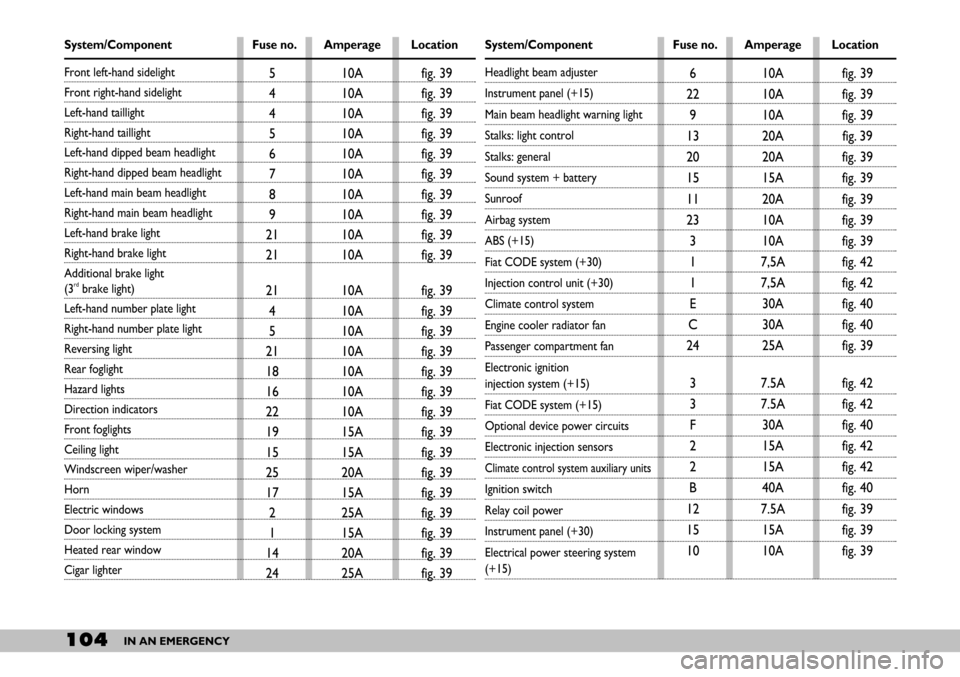
System/Component Fuse no. Amperage Location
Front left-hand sidelight
Front right-hand sidelight
Left-hand taillight
Right-hand taillight
Left-hand dipped beam headlight
Right-hand dipped beam headlight
Left-hand main beam headlight
Right-hand main beam headlight
Left-hand brake light
Right-hand brake light
Additional brake light
(3rdbrake light)
Left-hand number plate light
Right-hand number plate light
Reversing light
Rear foglight
Hazard lights
Direction indicators
Front foglights
Ceiling light
Windscreen wiper/washer
Horn
Electric windows
Door locking system
Heated rear window
Cigar lighter
5 10A fig. 39
4 10A fig. 39
4 10A fig. 39
5 10A fig. 39
6 10A fig. 39
7 10A fig. 39
8 10A fig. 39
9 10A fig. 39
21 10A fig. 39
21 10A fig. 39
21 10A fig. 39
4 10A fig. 39
5 10A fig. 39
21 10A fig. 39
18 10A fig. 39
16 10A fig. 39
22 10A fig. 39
19 15A fig. 39
15 15A fig. 39
25 20A fig. 39
17 15A fig. 39
2 25A fig. 39
1 15A fig. 39
14 20A fig. 39
24 25A fig. 39
System/Component Fuse no. Amperage Location
6 10A fig. 39
22 10A fig. 39
9 10A fig. 39
13 20A fig. 39
20 20A fig. 39
15 15A fig. 39
11 20A fig. 39
23 10A fig. 39
3 10A fig. 39
1 7,5A fig. 42
1 7,5A fig. 42
E 30A fig. 40
C 30A fig. 40
24 25A fig. 39
3 7.5A fig. 42
3 7.5A fig. 42
F 30A fig. 40
2 15A fig. 42
2 15A fig. 42
B 40A fig. 40
12 7.5A fig. 39
15 15A fig. 39
10 10A fig. 39Headlight beam adjuster
Instrument panel (+15)
Main beam headlight warning light
Stalks: light control
Stalks: general
Sound system + battery
Sunroof
Airbag system
ABS (+15)
Fiat CODE system (+30)
Injection control unit (+30)
Climate control system
Engine cooler radiator fan
Passenger compartment fan
Electronic ignition
injection system (+15)
Fiat CODE system (+15)
Optional device power circuits
Electronic injection sensors
Climate control system auxiliary units
Ignition switch
Relay coil power
Instrument panel (+30)
Electrical power steering system
(+15)