central FIAT STILO 2006 1.G User Guide
[x] Cancel search | Manufacturer: FIAT, Model Year: 2006, Model line: STILO, Model: FIAT STILO 2006 1.GPages: 274, PDF Size: 4.76 MB
Page 99 of 274
98
SAFETY
DEVICES
CORRECT USE
OF THE CAR
WARNING
LIGHTS AND
MESSAGES
IN AN
EMERGENCY
CAR
MAINTENANCE
TECHNICAL
SPECIFICATIONS
INDEX
DASHBOARD
AND CONTROLS
ASR SYSTEM
(Antislip Regulation)
It is an integral part of the ESP system, it
controls car drive and cuts in automati-
cally every time one or both driving
wheels slip.
According to slipping conditions, two dif-
ferent control systems are activated:
❒if the slipping involves both the driving
wheels, the ASR function intervenes re-
ducing the power transmitted by the
engine;
❒if the slipping involves only one driving
wheel, the ASR system cuts in auto-
matically braking the wheel that is slip-
ping.
The action of the ASR is particularly help-
ful in the following circumstances:
❒ slipping of the inner wheel due to the
effect of dynamic load changes or ex-
cessive acceleration;
❒ too much power transmitted to the
wheels also in relation to the conditions
of the road surface;
❒ acceleration on slippery, snowy or
frozen surfaces;
❒in the case of loss of grip on a wet sur-
face (aquaplaning).Switching on/off of the ASR system
The ASR system switches on automatically
each time the engine is started.
Switching on/off is indicated by the rele-
vant message on the display (see section
“Warning lights and messages”).
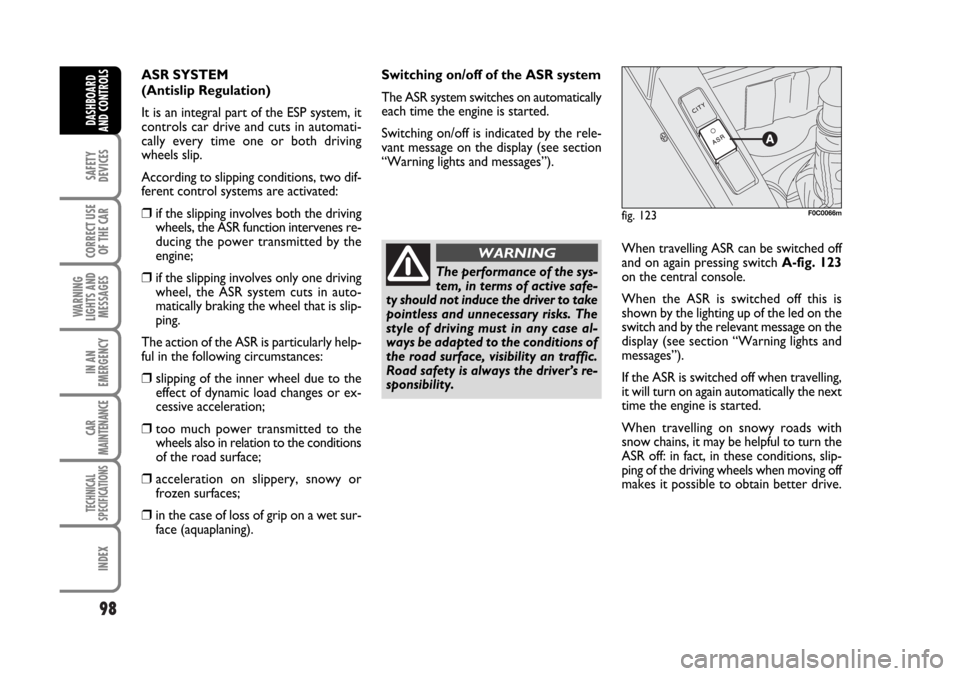
When travelling ASR can be switched off
and on again pressing switch A-fig. 123
on the central console.
When the ASR is switched off this is
shown by the lighting up of the led on the
switch and by the relevant message on the
display (see section “Warning lights and
messages”).
If the ASR is switched off when travelling,
it will turn on again automatically the next
time the engine is started.
When travelling on snowy roads with
snow chains, it may be helpful to turn the
ASR off: in fact, in these conditions, slip-
ping of the driving wheels when moving off
makes it possible to obtain better drive.
The performance of the sys-
tem, in terms of active safe-
ty should not induce the driver to take
pointless and unnecessary risks. The
style of driving must in any case al-
ways be adapted to the conditions of
the road surface, visibility an traffic.
Road safety is always the driver’s re-
sponsibility.
WARNING
fig. 123F0C0066m
Page 103 of 274
102
SAFETY
DEVICES
CORRECT USE
OF THE CAR
WARNING
LIGHTS AND
MESSAGES
IN AN
EMERGENCY
CAR
MAINTENANCE
TECHNICAL
SPECIFICATIONS
INDEX
DASHBOARD
AND CONTROLS
“DUALDRIVE” ELECTRIC
POWER STEERING
SYSTEM
The car is provided with the electrically
controlled power steering system called
“Dualdrive” working only with ignition key
at MARand engine running, that can be
customised by the driver according to the
driving conditions.
IMPORTANT When turning quickly the
ignition key, power steering full operation
is obtained after 1-2 seconds.ACTIVATION/DEACTIVATION
(CITY function)
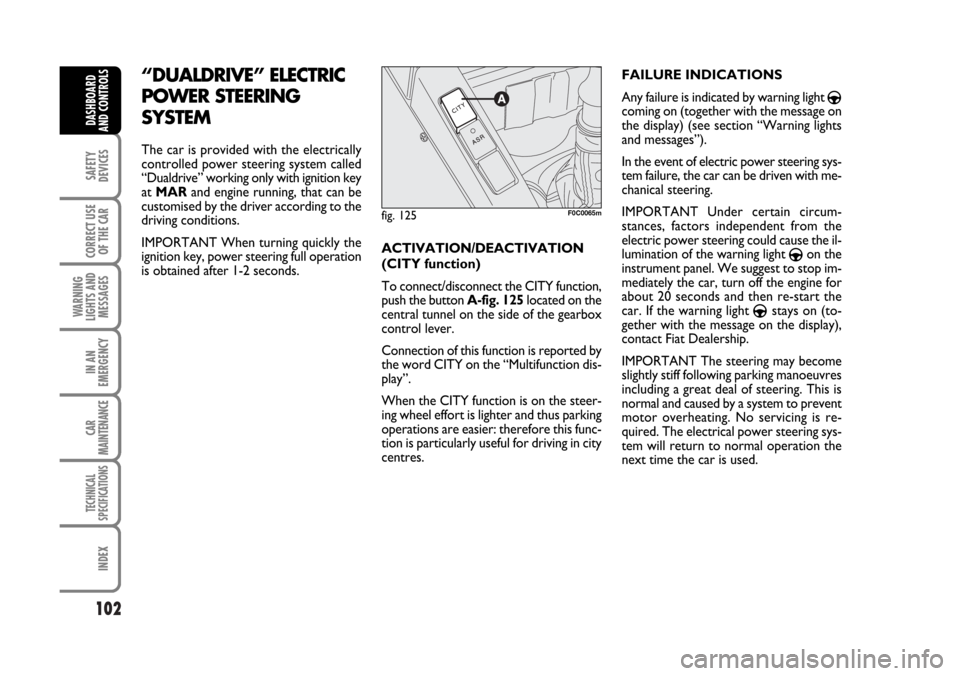
To connect/disconnect the CITY function,
push the button A-fig. 125located on the
central tunnel on the side of the gearbox
control lever.
Connection of this function is reported by
the word CITY on the “Multifunction dis-
play”.
When the CITY function is on the steer-
ing wheel effort is lighter and thus parking
operations are easier: therefore this func-
tion is particularly useful for driving in city
centres.FAILURE INDICATIONS
Any failure is indicated by warning light
gcoming on (together with the message on
the display) (see section “Warning lights
and messages”).
In the event of electric power steering sys-
tem failure, the car can be driven with me-
chanical steering.
IMPORTANT Under certain circum-
stances, factors independent from the
electric power steering could cause the il-
lumination of the warning light
gon the
instrument panel. We suggest to stop im-
mediately the car, turn off the engine for
about 20 seconds and then re-start the
car. If the warning light
gstays on (to-
gether with the message on the display),
contact Fiat Dealership.
IMPORTANT The steering may become
slightly stiff following parking manoeuvres
including a great deal of steering. This is
normal and caused by a system to prevent
motor overheating. No servicing is re-
quired. The electrical power steering sys-
tem will return to normal operation the
next time the car is used.
fig. 125F0C0065m
Page 105 of 274
104
SAFETY
DEVICES
CORRECT USE
OF THE CAR
WARNING
LIGHTS AND
MESSAGES
IN AN
EMERGENCY
CAR
MAINTENANCE
TECHNICAL
SPECIFICATIONS
INDEX
DASHBOARD
AND CONTROLS
Detection distances
Central action radius ......................150 cm
Side action radius ............................ 60 cm
If several obstacles are detected, the con-
trol unit indicates the nearest one.
FAILURE INDICATIONS
In the event of sensor failures, when en-
gaging the reverse gear the driver is
warned by the turning on of warning light
èon the instrument panel and by the rel-
evant message on the display (see section
“Warning lights and messages”).
OPERATION WITH TRAILER
Parking sensor operation is deactivated
automatically when the trailer electric ca-
ble plug is fitted into the car tow hook
socket.
Sensors are reactivated when removing
the trailer cable plug.GENERAL WARNINGS
❒When parking, take the utmost care to
obstacles set above or under the sen-
sors.
❒Objects set close to the car front or
rear part, under certain circumstances
are not detected and could therefore
cause damages to the car.
❒Indications sent by the sensors can be
altered by dirt, snow or ice deposited
on the sensors or by ultrasound sys-
tems (e.g.: truck pneumatic brakes or
pneumatic hammers) set nearby the
car. For proper operation, the
parking sensors set on the
bumpers shall be clean from
mud, dirt, snow or ice. When
cleaning the sensors, take the utmost
care to prevent their damaging; do not
use therefore dry or rough clothes. Sen-
sors shall be washed with clean water
and car detergent, if required. In wash-
ing stations, clean sensors quickly keep-
ing the vapour jet/high pressure wash-
ing nozzles at 10 cm at least from the
sensors.
Parking manoeuvres howev-
er are always under the dri-
ver’s responsibility that shall always
check the absence of people (spe-
cially children) or animals in the ma-
noeuvre space. This system is just a
help for the driver but she/he shall
never reduce attention during dan-
gerous manoeuvres even if performed
at low speed.
WARNING
Page 120 of 274

119
CORRECT USE
OF THE CAR
WARNING
LIGHTS AND
MESSAGES
IN AN
EMERGENCY
CAR
MAINTENANCE
TECHNICAL
SPECIFICATIONS
INDEX
DASHBOARD
AND CONTROLS
SAFETY
DEVICES
PASSENGER SEAT COMPLIANCE WITH REGULATIONS ON CHILD’S SEAT USE
Your car complies with the new European Directive 2000/3/EC regulating child’s seat assembling on the different car seats accord-
ing to the following tables:
3/5-door version, double rear seat
5-door version, rear sliding seat
SEAT
Group Range of weight Front passenger Rear passenger Central passenger
Group 0, 0+ up to 13 kg U U U
Group 1 9-18 kg U U U
Group 2 15-25 kg U U U
Group 3 22-36 kg U U U
Front
passengerCentral
passenger
Key:
U = suitable for child restraint systems of the “Universal” category, according to European Standard EEC-R44 for the specified “Groups”.
L = suitable for certain child’s restraint systems available at Lineaccessori Fiat for the specified group.
SEAT
Group Range of weight
Group 0, 0+ up to 13 kg U U L L
Group 1 9-18 kg U U L L
Group 2 15-25 kg U U L L
Group 3 22-36 kg U U L LRH
side rear
passenger LH
side rear
passenger
Page 142 of 274
141
WARNING
LIGHTS AND
MESSAGES
IN AN
EMERGENCY
CAR
MAINTENANCE
TECHNICAL
SPECIFICATIONS
INDEX
DASHBOARD
AND CONTROLS
SAFETY
DEVICES
CORRECT USE
OF THE CAR
USING THE
“SELESPEED” GEARBOX
(where provided)
The car may be fitted with a mechanical
transmission with electronic control called
“Selespeed”. This device includes a con-
ventional mechanical gearbox to which an
electronically-operated electro-hydraulic
device has been added which controls au-
tomatically the clutch and gear engage-
ment.
The car moves off using only the acceler-
ator pedal.
To be able to use the Selespeed correct-
ly, this chapter should be read in full. OPERATION
The gearbox can work in two operating
modes:
❒the first mode is manual (MANUAL),
the driver directly requests gearshift-
ing;
❒the second mode is automatic (AUTO),
the system directly decides when shift-
ing gear.
On versions fitted with Cruise Control,
when activating it, the Selespeed gearbox
will automatically set in AUTO mode. To
select the manual mode deactivate the
Cruise Control (see paragraph “Cruise
Control” in section “Dashboard and con-
trols”).Manual mode (MANUAL)
In MANUAL mode, the display shows the
gear engaged.
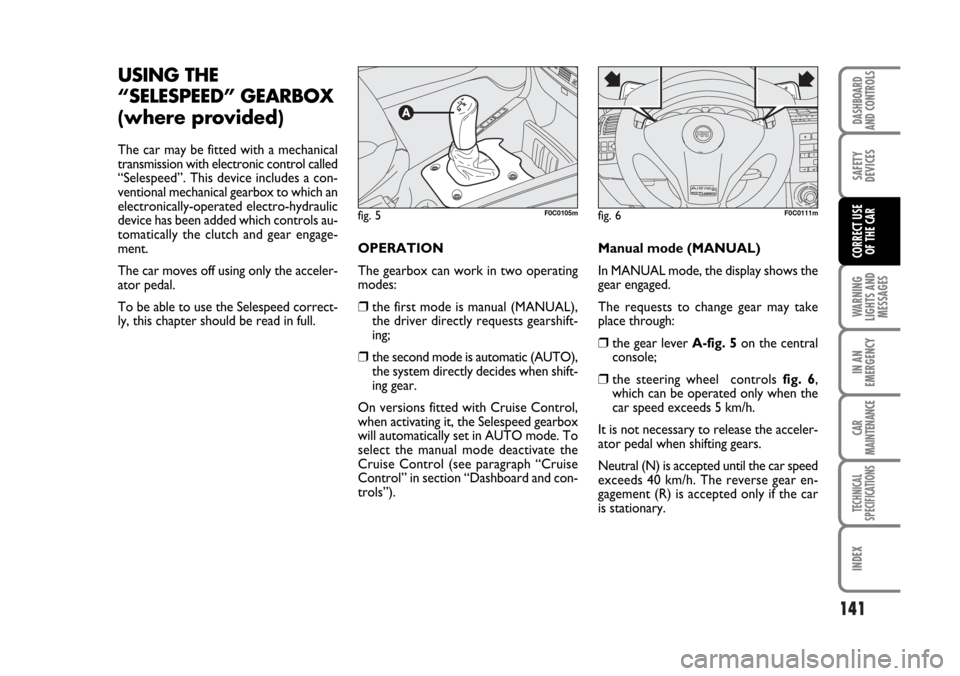
The requests to change gear may take
place through:❒the gear lever A-fig. 5on the central
console;
❒the steering wheel controls fig. 6,
which can be operated only when the
car speed exceeds 5 km/h.
It is not necessary to release the acceler-
ator pedal when shifting gears.
Neutral (N) is accepted until the car speed
exceeds 40 km/h. The reverse gear en-
gagement (R) is accepted only if the car
is stationary.
fig. 5F0C0105mfig. 6F0C0111m
Page 143 of 274
142
WARNING
LIGHTS AND
MESSAGES
IN AN
EMERGENCY
CAR
MAINTENANCE
TECHNICAL
SPECIFICATIONS
INDEX
DASHBOARD
AND CONTROLS
SAFETY
DEVICES
CORRECT USE
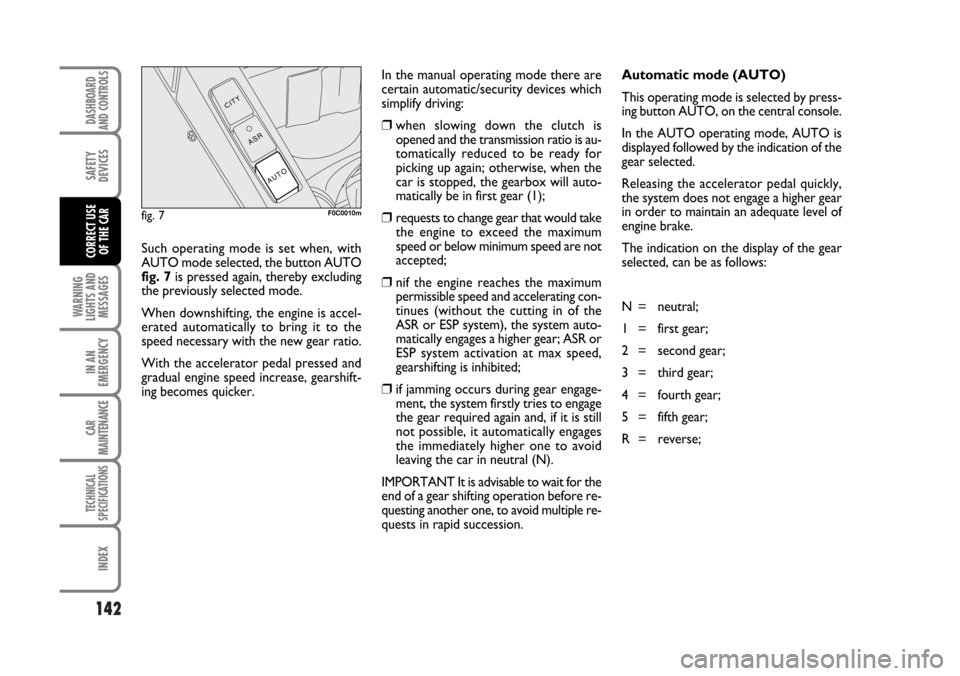
OF THE CARSuch operating mode is set when, with
AUTO mode selected, the button AUTO
fig. 7is pressed again, thereby excluding
the previously selected mode.
When downshifting, the engine is accel-
erated automatically to bring it to the
speed necessary with the new gear ratio.
With the accelerator pedal pressed and
gradual engine speed increase, gearshift-
ing becomes quicker.In the manual operating mode there are
certain automatic/security devices which
simplify driving:
❒when slowing down the clutch is
opened and the transmission ratio is au-
tomatically reduced to be ready for
picking up again; otherwise, when the
car is stopped, the gearbox will auto-
matically be in first gear (1);
❒requests to change gear that would take
the engine to exceed the maximum
speed or below minimum speed are not
accepted;
❒nif the engine reaches the maximum
permissible speed and accelerating con-
tinues (without the cutting in of the
ASR or ESP system), the system auto-
matically engages a higher gear; ASR or
ESP system activation at max speed,
gearshifting is inhibited;
❒if jamming occurs during gear engage-
ment, the system firstly tries to engage
the gear required again and, if it is still
not possible, it automatically engages
the immediately higher one to avoid
leaving the car in neutral (N).
IMPORTANT It is advisable to wait for the
end of a gear shifting operation before re-
questing another one, to avoid multiple re-
quests in rapid succession.Automatic mode (AUTO)
This operating mode is selected by press-
ing button AUTO, on the central console.
In the AUTO operating mode, AUTO is
displayed followed by the indication of the
gear selected.
Releasing the accelerator pedal quickly,
the system does not engage a higher gear
in order to maintain an adequate level of
engine brake.
The indication on the display of the gear
selected, can be as follows:
N = neutral;
1 = first gear;
2 = second gear;
3 = third gear;
4 = fourth gear;
5 = fifth gear;
R = reverse;
fig. 7F0C0010m
Page 144 of 274
143
WARNING
LIGHTS AND
MESSAGES
IN AN
EMERGENCY
CAR
MAINTENANCE
TECHNICAL
SPECIFICATIONS
INDEX
DASHBOARD
AND CONTROLS
SAFETY
DEVICES
CORRECT USE
OF THE CAR
SYSTEM ACTIVATION
Turning the ignition key to MAR, after
about one second, the display shows the
gear engaged (N, 1, 2, 3, 4, 5, R): from this
moment onwards, the Selespeed system
accepts gearshift commands.
IMPORTANT If after 10 seconds the dis-
play does not show the gear engaged, turn
the ignition key to STOP, and wait for the
display to turn off, then repeat system
switch on. If the fault persists, contact Fi-
at Dealership.
IMPORTANT When the driver’s door is
opened the system starts the hydraulic
part of the system to prepare it for when
the engine is started. MOVING-OFF
With the engine on and the car stationary,
the gears that can be engaged for moving
off are only first (1), second (2) and/or re-
verse (R).
To engage them it is possible, keeping the
brake pedal pressed, to use only the
gearshift lever on the central console.
Moving off of the car is obtained releas-
ing the brake pedal and gradually press-
ing the accelerator pedal.
With the ASR system off (pressing the
ASR off button) moving off will be more
“brilliant”.
IMPORTANT Reverse gear (R) can be en-
gaged from any of the following other
gears: neutral (N), first (1) or second (2)
only when the car is stationary.IMPORTANT If when shifting from re-
verse (R) / first (1) or neutral (N) / first (1)
sticking occurs on the first gear, the sys-
tem automatically engages second gear (2).
This is not to be considered as a fault as
it is part of the operating logic. For the
same reason, in the case of sticking on re-
verse gear, the system partially closes the
clutch to allow gear engagement; in this
case the engagement of reverse gear (R)
will not be as smooth as usual.
After a request to shift gear
with the car stationary, be-
fore pressing the accelerator pedal to
make the car move, the driver must
always check the display to see that
the gear engaged is the one required.
WARNING
Page 145 of 274
144
WARNING
LIGHTS AND
MESSAGES
IN AN
EMERGENCY
CAR
MAINTENANCE
TECHNICAL
SPECIFICATIONS
INDEX
DASHBOARD
AND CONTROLS
SAFETY
DEVICES
CORRECT USE
OF THE CAR
IMPORTANT NOTES
❒With the car stopped and a gear en-
gaged always keep the brake pedal
pressed until deciding to move off;
❒during prolonged halts with the engine
running it is advisable to keep the gear-
box in neutral;
❒when the car is parked facing uphill, do
not use the moving off manoeuvre to
keep the car still; use the brake pedal
and press the accelerator pedal only
when the deciding to move off;
❒use second gear (2) only when more
control is needed for moving off ma-
noeuvres at low speed;
❒if, in reverse gear, first (1) gear is en-
gaged or vice versa, shift gear only
when the car is stopped completely and
with the brake pedal pressed.Though highly inadvisable, if when travel-
ling downhill for some unexpected reason
the car is set to neutral (N), when the en-
gagement of a gear is requested, the sys-
tem automatically engages the best gear in
relation to the speed of the car to allow
the correct transmission of torque to the
wheels.
When travelling downhill with a gear en-
gaged and the accelerator released (if the
car is moving), beyond a pre-established
speed, the system engages the clutch au-
tomatically to give the car adequate engine
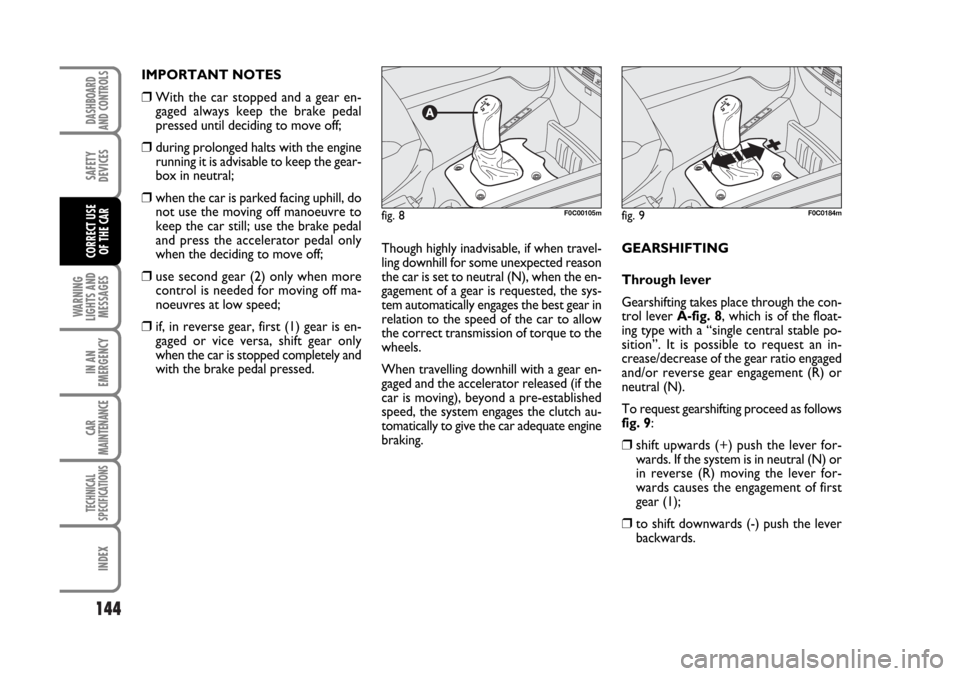
braking.GEARSHIFTING
Through lever
Gearshifting takes place through the con-
trol lever A-fig. 8, which is of the float-
ing type with a “single central stable po-
sition”. It is possible to request an in-
crease/decrease of the gear ratio engaged
and/or reverse gear engagement (R) or
neutral (N).
To request gearshifting proceed as follows
fig. 9:
❒shift upwards (+) push the lever for-
wards. If the system is in neutral (N) or
in reverse (R) moving the lever for-
wards causes the engagement of first
gear (1);
❒to shift downwards (-) push the lever
backwards.
fig. 8F0C00105mfig. 9F0C0184m
Page 157 of 274

156
WARNING
LIGHTS AND
MESSAGES
IN AN
EMERGENCY
CAR
MAINTENANCE
TECHNICAL
SPECIFICATIONS
INDEX
DASHBOARD
AND CONTROLS
SAFETY
DEVICES
CORRECT USE
OF THE CAR
CAR INACTIVITY
If the car is to be left inactive for longer
than a month, the following precautions
should be noted:
❒park the car in covered, dry and if pos-
sible well-ventilated premises;
❒engage a gear;
❒ check that the handbrake is not en-
gaged;
❒disconnect battery terminals (first dis-
connect the negative terminal) and
check the battery charge. This check
is to be repeated every three months
when the car is left inactive. Recharge
if the optical indicator shows a dark
colour without the central green area;
❒ clean and protect the painted parts us-
ing protective wax;
❒clean and protect the shiny metal parts
using special compounds readily avail-
able.
❒sprinkle talcum powder on the rubber
windscreen and rear window wiper
blades and lift them off the glass;
❒slightly open the windows;
❒ cover the car with a cloth or perforat-
ed plastic sheet. Do not use sheets of
non-perforated plastic as they do not
allow moisture on the car body to
evaporate;
❒inflate tyres to +0,5 bar above the nor-
mal specified pressure and check it at
intervals;
❒ if you don’t disconnect the battery from
the electric system, check its charge
every month and recharge it if the op-
tical indicator shows a dark colour
without the central green area;
❒ do not drain the engine cooling system.IMPORTANT Where relevant, switch off
the electronic car alarm with the remote
control.
Page 205 of 274
204
WARNING
LIGHTS AND
MESSAGES
CAR
MAINTENANCE
TECHNICAL
SPECIFICATIONS
IINDEX
DASHBOARD
AND CONTROLS
SAFETY
DEVICES
CORRECT USE
OF THE CAR
IN AN
EMERGENCY
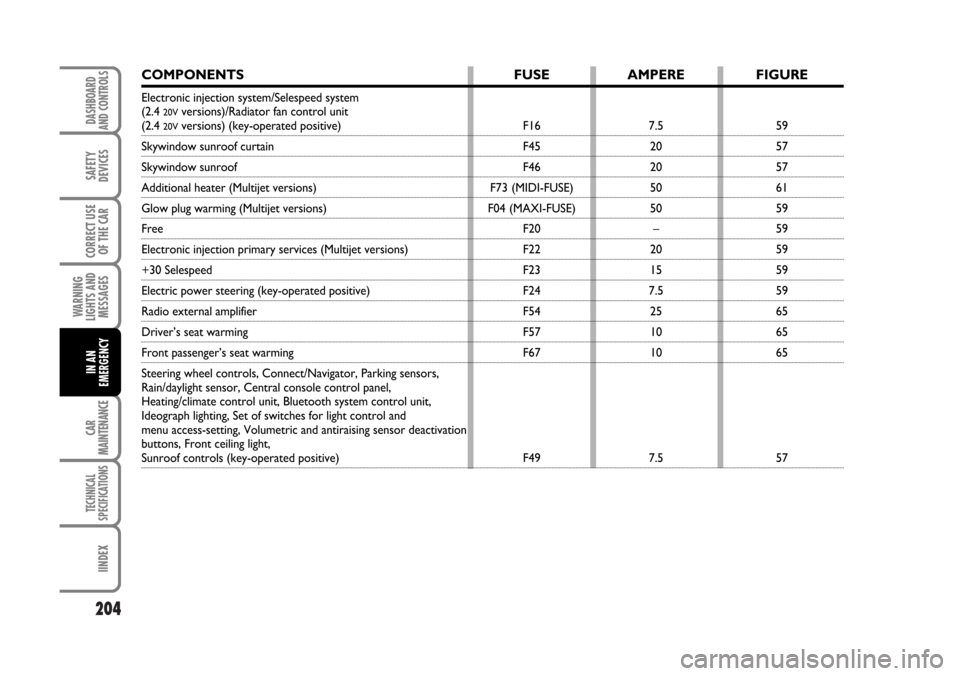
COMPONENTS
Electronic injection system/Selespeed system
(2.4 20Vversions)/Radiator fan control unit(2.4 20Vversions) (key-operated positive)
Skywindow sunroof curtain
Skywindow sunroof
Additional heater (Multijet versions)
Glow plug warming (Multijet versions)
Free
Electronic injection primary services (Multijet versions)
+30 Selespeed
Electric power steering (key-operated positive)
Radio external amplifier
Driver’s seat warming
Front passenger’s seat warming
Steering wheel controls, Connect/Navigator, Parking sensors,
Rain/daylight sensor, Central console control panel,
Heating/climate control unit, Bluetooth system control unit,
Ideograph lighting, Set of switches for light control and
menu access-setting, Volumetric and antiraising sensor deactivation
buttons, Front ceiling light,
Sunroof controls (key-operated positive)
FUSE
F16
F45
F46
F73 (MIDI-FUSE)
F04 (MAXI-FUSE)
F20
F22
F23
F24
F54
F57
F67
F49
AMPERE
7.5
20
20
50
50
–
20
15
7.5
25
10
10
7.5
FIGURE
59
57
57
61
59
59
59
59
59
65
65
65
57