climate control FIAT STILO 2006 1.G Owner's Manual
[x] Cancel search | Manufacturer: FIAT, Model Year: 2006, Model line: STILO, Model: FIAT STILO 2006 1.GPages: 274, PDF Size: 4.76 MB
Page 216 of 274
215
WARNING
LIGHTS AND
MESSAGES
TECHNICAL
SPECIFICATIONS
INDEX
DASHBOARD
AND CONTROLS
SAFETY
DEVICES
CORRECT USE
OF THE CAR
IN AN
EMERGENCY
CAR
MAINTENANCE
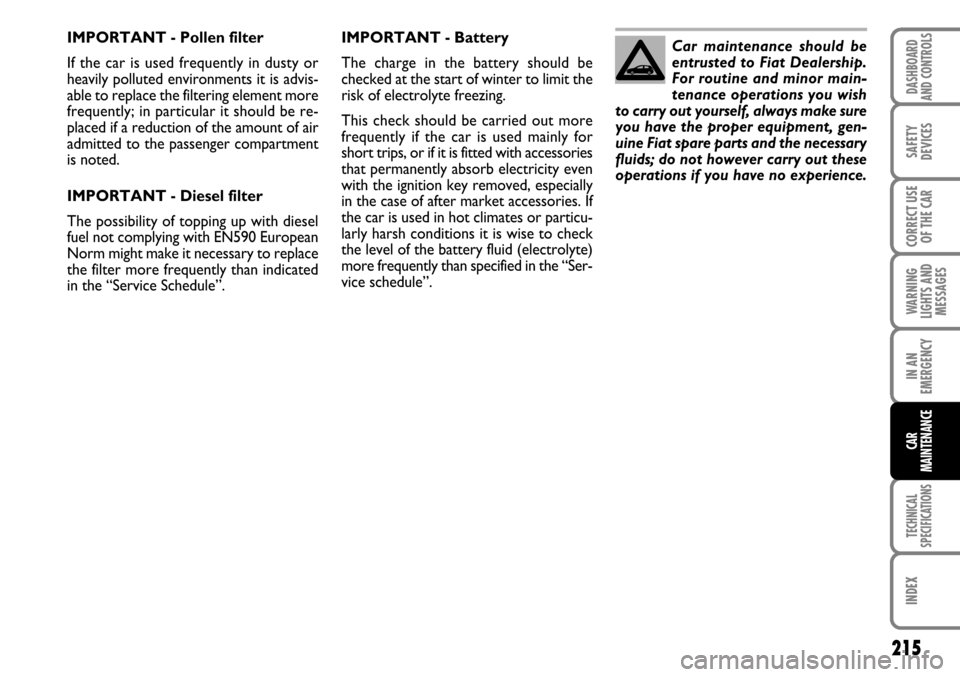
IMPORTANT - Battery
The charge in the battery should be
checked at the start of winter to limit the
risk of electrolyte freezing.
This check should be carried out more
frequently if the car is used mainly for
short trips, or if it is fitted with accessories
that permanently absorb electricity even
with the ignition key removed, especially
in the case of after market accessories. If
the car is used in hot climates or particu-
larly harsh conditions it is wise to check
the level of the battery fluid (electrolyte)
more frequently than specified in the “Ser-
vice schedule”. IMPORTANT - Pollen filter
If the car is used frequently in dusty or
heavily polluted environments it is advis-
able to replace the filtering element more
frequently; in particular it should be re-
placed if a reduction of the amount of air
admitted to the passenger compartment
is noted.
IMPORTANT - Diesel filter
The possibility of topping up with diesel
fuel not complying with EN590 European
Norm might make it necessary to replace
the filter more frequently than indicated
in the “Service Schedule”.Car maintenance should be
entrusted to Fiat Dealership.
For routine and minor main-
tenance operations you wish
to carry out yourself, always make sure
you have the proper equipment, gen-
uine Fiat spare parts and the necessary
fluids; do not however carry out these
operations if you have no experience.
Page 234 of 274

233
WARNING
LIGHTS AND
MESSAGES
TECHNICAL
SPECIFICATIONS
INDEX
DASHBOARD
AND CONTROLS
SAFETY
DEVICES
CORRECT USE
OF THE CAR
IN AN
EMERGENCY
CAR
MAINTENANCE
BODYWORK
PROTECTION FROM
ATMOSPHERIC AGENTS
The main causes of corrosion are the fol-
lowing:
❒atmospheric pollution;
❒salty air and humidity (coastal areas, or
hot humid climates);
❒ seasonal environment conditions.
Not to be underestimated is also the abra-
sive action of wind-borne atmospheric
dust and sand and mud and gravel raised
by other cars.
On your car, Fiat implemented the best
manufacturing technologies to effectively
protect the bodywork against corrosion.These include:
❒ Painting products and systems which
give the car particular resistance to cor-
rosion and abrasion;
❒Use of galvanised (or pretreated) steel
sheets, with high resistance to corro-
sion;
❒Spraying the underbody, engine com-
partment, wheelhouse internal parts
and other parts with highly protective
wax products;
❒Spraying of plastic parts, with a protec-
tive function, in the more exposed
points: underdoor, inner fender parts,
edges, etc.;
❒Use of “open” boxed sections to pre-
vent condensation and pockets of mois-
ture from triggering rust inside.
BODY AND UNDERBODY
WARRANTY
Your car is covered by warranty against
perforation due to rust of any original el-
ement of the structure or body. For the
general terms of this warranty, refer to
the Fiat Warranty booklet.ADVICE FOR PRESERVING
THE BODYWORK
Paint
Paintwork does not only serve an aesteth-
ic purpose, but also protects the under-
lying sheet metal.
In the case of deep scrapes or scores, you
are advised to have the necessary touch-
ing up carried out immediately to avoid
the formation of rust. Use only original
paint products for touching up (see “Body-
work paint identification plate” in section
“Technical specification”).
Normal paint maintenance consists in
washing at intervals depending on the con-
ditions and environment of use. For ex-
ample, in highly polluted areas, or if the
roads are sprayed with salt, it is wise to
wash the car more frequently.
Page 258 of 274
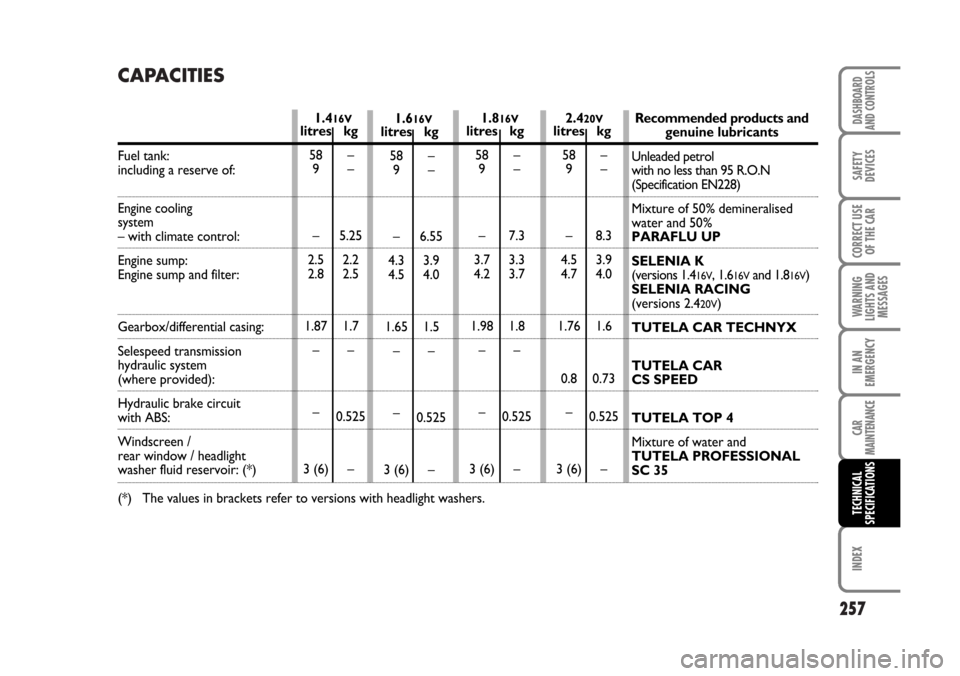
CAPACITIES
257
WARNING
LIGHTS AND
MESSAGES
INDEX
DASHBOARD
AND CONTROLS
SAFETY
DEVICES
CORRECT USE
OF THE CAR
IN AN
EMERGENCY
CAR
MAINTENANCE
TECHNICAL
SPECIFICATIONS
1.416V1.616V1.816V2.420V
Fuel tank:
including a reserve of:
Engine cooling
system
– with climate control:
Engine sump:
Engine sump and filter:
Gearbox/differential casing:
Selespeed transmission
hydraulic system
(where provided):
Hydraulic brake circuit
with ABS:
Windscreen /
rear window / headlight
washer fluid reservoir: (*)
(*) The values in brackets refer to versions with headlight washers.Recommended products and
genuine lubricants
Unleaded petrol
with no less than 95 R.O.N
(Specification EN228)
Mixture of 50% demineralised
water and 50%
PARAFLU UP
SELENIA K
(versions 1.4
16V, 1.616Vand 1.816V)
SELENIA RACING
(versions 2.4
20V)
TUTELA CAR TECHNYX
TUTELA CAR
CS SPEED
TUTELA TOP 4
Mixture of water and
TUTELA PROFESSIONAL
SC 35 litres
58
9
–
2.5
2.8
1.87
–
–
3 (6)kg
–
–
5.25
2.2
2.5
1.7
–
0.525
–litres
58
9
–
4.3
4.5
1.65
–
–
3 (6)kg
–
–
6.55
3.9
4.0
1.5
–
0.525
–litres
58
9
–
3.7
4.2
1.98
–
–
3 (6)kg
–
–
7.3
3.3
3.7
1.8
–
0.525
–litres
58
9
–
4.5
4.7
1.76
0.8
–
3 (6)kg
–
–
8.3
3.9
4.0
1.6
0.73
0.525
–
Page 259 of 274
258
WARNING
LIGHTS AND
MESSAGES
INDEX
DASHBOARD
AND CONTROLS
SAFETY
DEVICES
CORRECT USE
OF THE CAR
IN AN
EMERGENCY
CAR
MAINTENANCE
TECHNICAL
SPECIFICATIONS
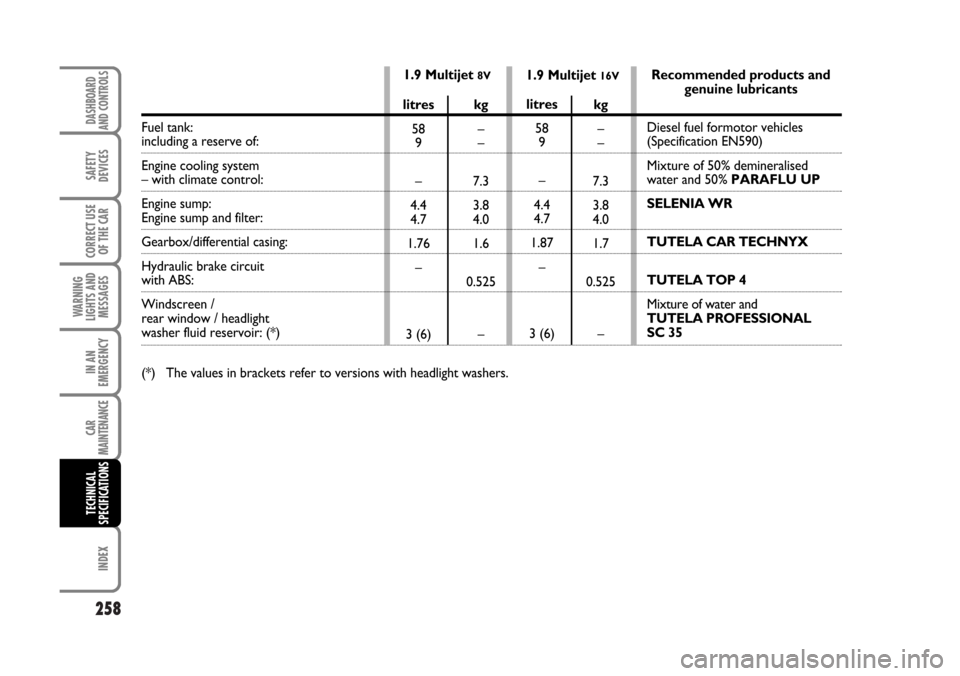
1.9 Multijet 8V1.9 Multijet 16V
Fuel tank:including a reserve of:
Engine cooling system
– with climate control:
Engine sump:
Engine sump and filter:
Gearbox/differential casing:
Hydraulic brake circuit
with ABS:
Windscreen /
rear window / headlight
washer fluid reservoir: (*)
(*) The values in brackets refer to versions with headlight washers.litres
58
9
–
4.4
4.7
1.76
–
3 (6)kg
–
–
7.3
3.8
4.0
1.6
0.525
–litres
58
9
–
4.4
4.7
1.87
–
3 (6)kg
–
–
7.3
3.8
4.0
1.7
0.525
–Recommended products and
genuine lubricants
Diesel fuel formotor vehicles
(Specification EN590)
Mixture of 50% demineralised
water and 50% PARAFLU UP
SELENIA WR
TUTELA CAR TECHNYX
TUTELA TOP 4
Mixture of water and
TUTELA PROFESSIONAL
SC 35
Page 262 of 274

261
WARNING
LIGHTS AND
MESSAGES
INDEX
DASHBOARD
AND CONTROLS
SAFETY
DEVICES
CORRECT USE
OF THE CAR
IN AN
EMERGENCY
CAR
MAINTENANCE
TECHNICAL
SPECIFICATIONS
FUEL CONSUMPTION
The fuel consumption figures given in the
table below are determined on the basis
of the homologation tests set down by
specific European Directives.
The procedures below are followed for
measuring consumption:
❒ urban cycle: cold starting followed by
driving that simulates urban use of the
car;IMPORTANT The type of route, traffic
situations, weather conditions, driving
style, general conditions of the car, trim
level/equipment/accessories, load, climate
control system, roof rack, other situations
that affect air drag may lead to different
fuel consumption levels than those mea-
sured.
❒ extra-urban cycle: frequent acceler-
ating in all gears, simulating extraurban
use of the car; the speed varies be-
tween 0 and 120 km/h;
❒combined consumption: is calculat-
ed weighing about 37% of urban cycle
consumption and about 63% of ex-
traurban consumption.
Fuel consumption according to Directive 1999/100/EC (litres x 100 km)
Saloon versions
Urban
Extra-urban
Combined
1.416V1.616V1.816V
3-door 5-door 3-door 5-door 3-door 5-door
8.2/8.5 (*) 8.5 8.8 9.1 11.3 11.5
5.5/5.6 (*) 5.7 5.5 5.8 6.1 6.2
6.5/6.6 (*) 6.7 6.7 7.0 8.0 8.1
(*) “DYNAMIC” versions
Page 265 of 274
264
WARNING
LIGHTS AND
MESSAGES
DASHBOARD
AND CONTROLS
SAFETY
DEVICES
CORRECT USE
OF THE CAR
IN AN
EMERGENCY
CAR
MAINTENANCE
TECHNICAL
SPECIFICATIONS
INDEX
– types of bulbs .................................. 182
Capacities .............................................. 257
Car inactivity.......................................... 156
Car maintenance............................. 209
– additional checks ............................ 213
– annual Inspection Schedule .......... 213
– scheduled service ........................... 210
– Service Schedule ............................. 211
Cargo box .............................................. 91
Carrying children safely ...................... 116
Ceiling lights ......................................... 67
Central door locking system ............ 79
Checking fluid levels ........................... 216
Child lock .............................................. 79
Child restraint systems
(specifications for use) .................... 119
Cigar lighter .......................................... 72
Climate control system
– automatic two-zone
climate control system ................ 51
– manual climate control system .. 48
CO
2emissions ..................................... 263
Code Card ............................................ 10
Containing running costs ................... 149Controls ................................................ 68
Correct use of the car................. 135
Courtesy mirror light
(bulb replacement) ............................ 194
Cruise Control .................................... 65
Current outlet....................................... 72
Cut-off switch fuel .............................. 69
Dashboard............................................. 5
Dashboard and controls.............. 4
Daylight sensor .................................... 61
Dead lock (device) .............................. 14
Diesel fuel filter ..................................... 225
Diesel particulate filter (DPF) ........... 108
Dimensions ........................................... 250
Dipped beam headlights...................... 59
Direction indicators
– control ............................................. 60
– front bulb replacement ................ 186
– rear bulb replacement ................. 188
– side bulb replacement .................. 186
Doors ..................................................... 79
Dualdrive (electric power steering) 102
Easy entry ............................................ 38
ABS ........................................................ 95
Accessories purchased
by the owner ......................................... 101
Air bags
– front................................................... 126
– side..................................................... 130
Air filter .................................................. 225
Armrests (front rear) .......................... 70
Ashtray .................................................... 72
ASR .......................................................... 98
At the filling station .............................. 105
Automatic headlights sensor
(daylight sensor) ................................. 611
Battery
– checking the charge ....................... 226
– jump starting.................................... 170
– replacing .......................................... 227
Bodywork ............................................... 233
Bonnet ..................................................... 92
Boot ......................................................... 81
Boot light (bulb replacement) ........... 195
Brake Assist ........................................... 96
Brakes ...................................................... 244
Bulb (replacement)............................... 181
I I
N N
D D
E E
X X