climate control FIAT STILO 2006 1.G User Guide
[x] Cancel search | Manufacturer: FIAT, Model Year: 2006, Model line: STILO, Model: FIAT STILO 2006 1.GPages: 274, PDF Size: 4.76 MB
Page 55 of 274

54
SAFETY
DEVICES
CORRECT USE
OF THE CAR
WARNING
LIGHTS AND
MESSAGES
IN AN
EMERGENCY
CAR
MAINTENANCE
TECHNICAL
SPECIFICATIONS
INDEX
DASHBOARD
AND CONTROLS
AQS (Air Quality System)
function activation
The AQS function, (message AQS on the
display), turns on air recirculation auto-
matically when it detects the presence of
outside polluted air (for example when
driving in the city, queues and tunnels).
IMPORTANT When the AQS function is
active, after 15 minutes of consecutive in-
ternal air recirculation, the climate con-
trol system enables outside air inlet (re-
gardless of air pollution level) for approx.
1 minute to change air inside the passen-
ger compartment. INSIDE AIR RECIRCULATION
ON/OFF AND AQS FUNCTION
(Air Quality System)
Press button
T.
Inside air recirculation is controlled by
three operating logics:
❒automatic control, indicated by message
AQS on the display and button led
Toff;
❒forced switching off (inside air recircu-
lation always off with air inlet from out-
side), button led
Toff;
❒forced switching on (inside air recircu-
lation always on with air inlet from out-
side), button led
Ton.Pressing button OFF, the climate control
system turns on automatically the inside
air recirculation function (button led
Ton). In these conditions it is how-
ever possible to take air from the outside
(and vice versa) pressing button
T(button led off).
With button OFF pressed (button led on),
the AQS (Air Quality System) function
cannot be activated.
IMPORTANT The inside air recirculation
system makes it possible to reach the re-
quired “heating” or “cooling” conditions
faster. It is however inadvisable to use it
on rainy/cold days as it would consider-
ably increase the possibility of the win-
dows misting inside, especially if the cli-
mate control system is off. It is advisable
to turn on the inside air recirculation sys-
tem in queues or tunnels to avoid admit-
ting polluted air from outside. The pro-
longed use of this function should how-
ever be avoided, especially with several
persons on board, to avoid the possibili-
ty of the windows misting inside.
Page 56 of 274

55
SAFETY
DEVICES
CORRECT USE
OF THE CAR
WARNING
LIGHTS AND
MESSAGES
IN AN
EMERGENCY
CAR
MAINTENANCE
TECHNICAL
SPECIFICATIONS
INDEX
DASHBOARD
AND CONTROLS
ALIGNMENT OF SET
TEMPERATURES
(MONO function)
Pressing button MONO automatically
aligns the temperature on the passenger’s
side with that on the driver’s side.
Turn the knob AUTO or MONO to
raise/reduce the temperature between the
two zones by the same value.
Press again button MONO to disable the
function.CLIMATE CONTROL
COMPRESSOR ON/OFF
Press button
❄to switch on the climate
control compressor.
Compressor on
❒button led ❄on;
❒symbol ❄on the display, lit.
Compressor off
❒button led ❄off;
❒symbol ❄on the display, off;
❒inside air recirculation off;
❒AQS function disabled.
With the climate control compressor off,
it is not possible to admit air to the pas-
senger compartment with a temperature
below the outside temperature; in this
case symbol ò flashes on the display.
The switching off of the climate control
compressor remains in storage even when
the engine has been stopped. To restore
automatic control for switching on the cli-
mate control compressor, press button
❄or AUTO, in which case, the other man-
ual settings set will be cancelled.AIR DISTRIBUTION SELECTION
Pressing one or more buttons
Q/E/Zit is possible to choose manually 7 of the
possible air distributions to the passenger
compartment:
QAir flow to the windscreen and
front side window vents to demist
or defrost them.
ZAir flow towards the front and
rear lower parts of the passenger
compartment. This type of distri-
bution allows heating of the pas-
senger compartment in the short-
est time.
Q
ZESplitting of the air flow between
front and rear vents, centre and
side dashboard outlets, rear out-
let, windscreen and front side win-
dow demisting vents.
EAir flow to the dashboard centre
and side outlets (passenger’s
body).
Page 57 of 274

56
SAFETY
DEVICES
CORRECT USE
OF THE CAR
WARNING
LIGHTS AND
MESSAGES
IN AN
EMERGENCY
CAR
MAINTENANCE
TECHNICAL
SPECIFICATIONS
INDEX
DASHBOARD
AND CONTROLS
QSplitting of the air flow between
Zfeet vents and windscreen and
front side window demisting/de-
frosting vents. This type of air
distribution allows satisfactory
heating of the passenger com-
partment while preventing pos-
sible misting of the windows.
ZE
Splitting of the air flow between
feet vents (warmest air) and the
dashboard centre and side outlets
and the rear outlet (coolest air).
E QSplitting of the air flow between
centre and side dashboard outlets,
rear outlet and windscreen and
side window demisting/defrosting
vents. This type of air distribution
allows satisfactory ventilation of
the passenger compartment while
preventing possible misting of the
windows.IMPORTANT For operation of the cli-
mate control system, at least one of but-
tons
Q/E/Zshall be activated. Deacti-
vation of all buttons
Q/E/Zis therefore
not enabled by the system.
IMPORTANT To switch the system on
again, press button OFF; this operation re-
sets all operating conditions stored before
switching off.
To restore automatic air distribution con-
trol after a manual selection, press button
AUTO.SWITCHING THE CLIMATE
CONTROL SYSTEM OFF
Press button OFF.
The following information is displayed:
❒writing OFF;
❒outside temperature;
❒inside air recirculation on (button led
Ton).
Page 72 of 274
71
SAFETY
DEVICES
CORRECT USE
OF THE CAR
WARNING
LIGHTS AND
MESSAGES
IN AN
EMERGENCY
CAR
MAINTENANCE
TECHNICAL
SPECIFICATIONS
INDEX
DASHBOARD
AND CONTROLS
ODDMENT COMPARTMENTS
Upper oddment compartment on
passenger’s side
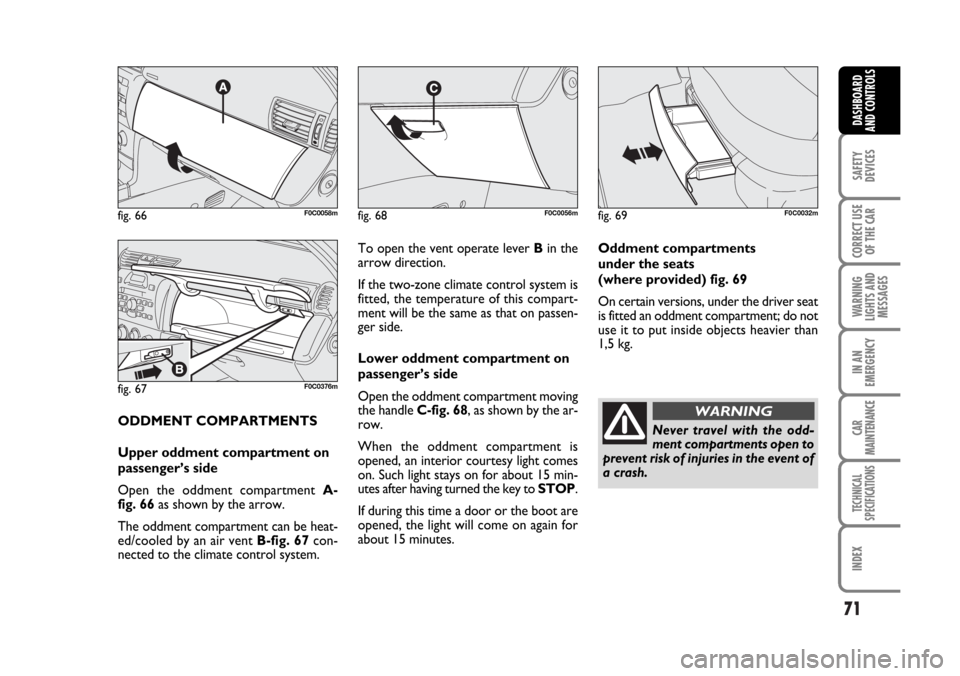
Open the oddment compartment A-
fig. 66as shown by the arrow.
The oddment compartment can be heat-
ed/cooled by an air vent B-fig. 67con-
nected to the climate control system.To open the vent operate lever Bin the
arrow direction.
If the two-zone climate control system is
fitted, the temperature of this compart-
ment will be the same as that on passen-
ger side.
Lower oddment compartment on
passenger’s side
Open the oddment compartment moving
the handle C-fig. 68, as shown by the ar-
row.
When the oddment compartment is
opened, an interior courtesy light comes
on. Such light stays on for about 15 min-
utes after having turned the key to STOP.
If during this time a door or the boot are
opened, the light will come on again for
about 15 minutes.Oddment compartments
under the seats
(where provided) fig. 69
On certain versions, under the driver seat
is fitted an oddment compartment; do not
use it to put inside objects heavier than
1,5 kg.
fig. 66F0C0058m
fig. 67F0C0376m
fig. 68F0C0056mfig. 69F0C0032m
Never travel with the odd-
ment compartments open to
prevent risk of injuries in the event of
a crash.
WARNING
Page 150 of 274

149
WARNING
LIGHTS AND
MESSAGES
IN AN
EMERGENCY
CAR
MAINTENANCE
TECHNICAL
SPECIFICATIONS
INDEX
DASHBOARD
AND CONTROLS
SAFETY
DEVICES
CORRECT USE
OF THE CAR
CONTAINING
RUNNING COSTS
Here are some suggestions which may
help you to keep the running costs of your
car down and lower the amount of toxic
emissions released into the atmosphere.
GENERAL CONSIDERATIONS
Car maintenance
Have checks and adjustments carried out
in accordance with the “Service schedule”.
Tyres
Check the pressure of the tyres routine-
ly at an interval of no more than 4 weeks:
if the pressure is too low, consumption
levels increase as resistance to rolling is
higher.
Unnecessary loads
Do not travel with too much luggage
stowed in the boot. The weight of the car
(especially when driving in town) and its
trim greatly affects consumption and sta-
bility.Roof rack/ski rack
Remove the roof rack or the ski rack from
the roof as soon as they are no longer
used. These accessories lower air pene-
tration and adversely affect consumption
levels. When needing to carry particular-
ly voluminous objects, preferably use a
trailer.
Electric devices
Use electric devices only for the amount
of time needed. Rear heated window, ad-
ditional headlights, windscreen wipers and
heater fan need a considerable amount of
energy, therefore increasing the require-
ment of current increases fuel consump-
tion (up to +25% in the urban cycle).Climate control
The air conditioner is an additional load
which greatly affects the engine leading to
higher consumption (on average up to
+20%). When the temperature outside
the car permits it, use the air vents where
possible.
Spoilers
The use of non-certified aerodynamic
items may adversely affect air drag and
consumption levels.
Page 202 of 274
201
WARNING
LIGHTS AND
MESSAGES
CAR
MAINTENANCE
TECHNICAL
SPECIFICATIONS
INDEX
DASHBOARD
AND CONTROLS
SAFETY
DEVICES
CORRECT USE
OF THE CAR
IN AN
EMERGENCY
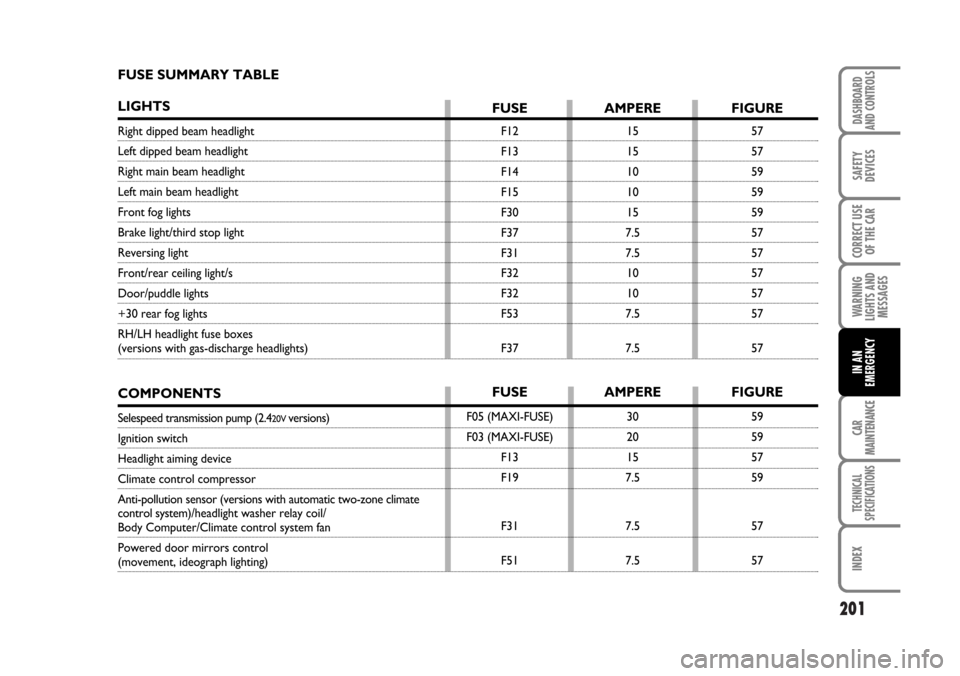
FUSE SUMMARY TABLE
LIGHTS
Right dipped beam headlight
Left dipped beam headlight
Right main beam headlight
Left main beam headlight
Front fog lights
Brake light/third stop light
Reversing light
Front/rear ceiling light/s
Door/puddle lights
+30 rear fog lights
RH/LH headlight fuse boxes
(versions with gas-discharge headlights)
COMPONENTS
Selespeed transmission pump (2.420V versions)
Ignition switch
Headlight aiming device
Climate control compressor
Anti-pollution sensor (versions with automatic two-zone climate
control system)/headlight washer relay coil/
Body Computer/Climate control system fan
Powered door mirrors control
(movement, ideograph lighting)
FIGURE
57
57
59
59
59
57
57
57
57
57
57
FIGURE
59
59
57
59
57
57
FUSE
F12
F13
F14
F15
F30
F37
F31
F32
F32
F53
F37
FUSE
F05 (MAXI-FUSE)
F03 (MAXI-FUSE)
F13
F19
F31
F51
AMPERE
15
15
10
10
15
7.5
7.5
10
10
7.5
7.5
AMPERE
30
20
15
7.5
7.5
7.5
Page 203 of 274
202
WARNING
LIGHTS AND
MESSAGES
CAR
MAINTENANCE
TECHNICAL
SPECIFICATIONS
IINDEX
DASHBOARD
AND CONTROLS
SAFETY
DEVICES
CORRECT USE
OF THE CAR
IN AN
EMERGENCY
COMPONENTS
+ 30 Sound system/Connect-Navigator/
Heating-climate control unit/EOBD system diagnostic socket/
Volumetric-antiraising sensors/Alarm siren/
Bluetooth system control unit
Rear window wiper seat warming relay coil
Left rear power window
Right rear power window
Rear heated window
Windscreen wiper/washer/rear window washer
Passenger compartment current outlet (saloon versions)/Current outlet
(MultiWagon versions)/Cigar lighter
Door mirror demisting device/heated window nozzles
Cruise Control
Electric power steering control unit
Engine compartment control unit
Dashboard control unit
+30 door electronic control unit (door lock actuators,
dead lock, boot, rear heated window)/Trailer control unit, if any
Free
Headlight washer
Primary services (electronic injection)
Secondary services (electronic injection)
Water in diesel fuel filter sensor (Multijet versions)/
flow meter (Multijet versions)
FUSE
F39
F52
F33
F34
F40
F43
F44
F41
F35
F02 (MAXI-FUSE)
F70 (MEGA-FUSE)
F71 (MIDI-FUSE)
F36
F38
F09
F17
F11
F35
AMPERE
10
15
20
20
30
30
20
7.5
7.5
70
150
70
20
–
20
10
15
7.5
FIGURE
57
57
57
57
57
57
57
57
57
59
61
61
57
57
59
59
59
57
Page 204 of 274

203
WARNING
LIGHTS AND
MESSAGES
CAR
MAINTENANCE
TECHNICAL
SPECIFICATIONS
INDEX
DASHBOARD
AND CONTROLS
SAFETY
DEVICES
CORRECT USE
OF THE CAR
IN AN
EMERGENCY
COMPONENTS
Front power window on driver side
Front power window on passenger side
Signal from switch on brake pedal for electronic control units
Instrument panel (key-operated positive)
Instrument panel (+30)
ABS / ASR / ESP control unit (yawing sensor with ESP)
ABS / ASR / ESP control unit
Air bag control unit/OCS sensor (versions with rear side bags)
+30 Electronic injection system
Dashboard control unit
Climate control fan
Radiator fan (low speed - versions 1.416V, 1.616V, 1.816V, Multijet)
Radiator fan (high speed - versions 1.416V, 1.616V, 1.816V, Multijet)
Fan and radiator (versions 2.420V)
Horn
Fuel pump
Electronic injection primary services (petrol versions)
FUSE
F47
F48
F35
F37
F53
F42
F01 (MAXI-FUSE)
F50
F18
F72 (MIDI-FUSE)
F08 (MAXI-FUSE)
F06 (MAXI-FUSE)
F07 (MAXI-FUSE)
F06 (MAXI-FUSE)
F10
F21
F22
AMPERE
20
20
7.5
7.5
7.5
7.5
60
7.5
7.5
60
30
30
50
60
15
15
15
FIGURE
57
57
57
57
57
57
59
57
59
61
59
59
59
59
59
59
59
Page 205 of 274
204
WARNING
LIGHTS AND
MESSAGES
CAR
MAINTENANCE
TECHNICAL
SPECIFICATIONS
IINDEX
DASHBOARD
AND CONTROLS
SAFETY
DEVICES
CORRECT USE
OF THE CAR
IN AN
EMERGENCY
COMPONENTS
Electronic injection system/Selespeed system
(2.4 20Vversions)/Radiator fan control unit(2.4 20Vversions) (key-operated positive)
Skywindow sunroof curtain
Skywindow sunroof
Additional heater (Multijet versions)
Glow plug warming (Multijet versions)
Free
Electronic injection primary services (Multijet versions)
+30 Selespeed
Electric power steering (key-operated positive)
Radio external amplifier
Driver’s seat warming
Front passenger’s seat warming
Steering wheel controls, Connect/Navigator, Parking sensors,
Rain/daylight sensor, Central console control panel,
Heating/climate control unit, Bluetooth system control unit,
Ideograph lighting, Set of switches for light control and
menu access-setting, Volumetric and antiraising sensor deactivation
buttons, Front ceiling light,
Sunroof controls (key-operated positive)
FUSE
F16
F45
F46
F73 (MIDI-FUSE)
F04 (MAXI-FUSE)
F20
F22
F23
F24
F54
F57
F67
F49
AMPERE
7.5
20
20
50
50
–
20
15
7.5
25
10
10
7.5
FIGURE
59
57
57
61
59
59
59
59
59
65
65
65
57
Page 213 of 274
212
WARNING
LIGHTS AND
MESSAGES
TECHNICAL
SPECIFICATIONS
INDEX
DASHBOARD
AND CONTROLS
SAFETY
DEVICES
CORRECT USE
OF THE CAR
IN AN
EMERGENCY
CAR
MAINTENANCE
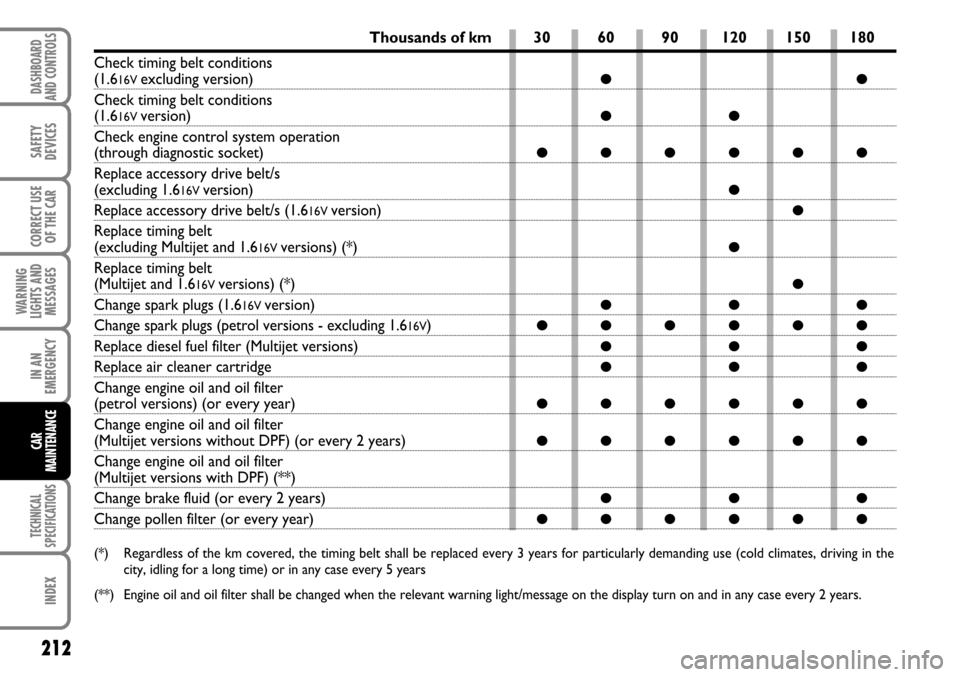
30 60 90 120 150 180
●●
●●
●●●●●●
●
●
●
●
●●●
●●●●●●
●●●
●●●
●●●●●●
●●●●●●
●●●
●●●●●●
Thousands of km
Check timing belt conditions
(1.616V excluding version)
Check timing belt conditions
(1.616V version)
Check engine control system operation
(through diagnostic socket)
Replace accessory drive belt/s
(excluding 1.616V version)
Replace accessory drive belt/s (1.616V version)
Replace timing belt
(excluding Multijet and 1.616V versions) (*)
Replace timing belt
(Multijet and 1.616V versions) (*)
Change spark plugs (1.616V version)
Change spark plugs (petrol versions - excluding 1.616V)
Replace diesel fuel filter (Multijet versions)
Replace air cleaner cartridge
Change engine oil and oil filter
(petrol versions) (or every year)
Change engine oil and oil filter
(Multijet versions without DPF) (or every 2 years)
Change engine oil and oil filter
(Multijet versions with DPF) (**)
Change brake fluid (or every 2 years)
Change pollen filter (or every year)
(*) Regardless of the km covered, the timing belt shall be replaced every 3 years for particularly demanding use (cold climates, driving in the
city, idling for a long time) or in any case every 5 years
(**) Engine oil and oil filter shall be changed when the relevant warning light/message on the display turn on and in any case every 2 years.