Egr FIAT STILO 2006 1.G Owners Manual
[x] Cancel search | Manufacturer: FIAT, Model Year: 2006, Model line: STILO, Model: FIAT STILO 2006 1.GPages: 274, PDF Size: 4.76 MB
Page 67 of 274
66
SAFETY
DEVICES
CORRECT USE
OF THE CAR
WARNING
LIGHTS AND
MESSAGES
IN AN
EMERGENCY
CAR
MAINTENANCE
TECHNICAL
SPECIFICATIONS
INDEX
DASHBOARD
AND CONTROLS
DEVICE DISENGAGEMENT
Turn the knurled ring A-fig. 56to OFF
or the ignition key to STOP. The device
is automatically deactivated also in one of
the following cases:
❒pressing the brake or clutch pedal;
❒ASR or ESP cut-in (where provided);
❒gearshifting in versions with Selespeed
automatic transmission (where provid-
ed);
❒involuntarily moving the Selespeed
lever (where provided) toN.
When travelling with the de-
vice on, never set the
gearshift lever to neutral and do not
move the Selespeed lever to N.
WARNING
In the event of device mal-
function or failure, turn the
knurled ring A-fig. 56to OFF and
contact a Fiat Dealership after check-
ing the protection fuse integrity.
WARNING
Page 99 of 274
98
SAFETY
DEVICES
CORRECT USE
OF THE CAR
WARNING
LIGHTS AND
MESSAGES
IN AN
EMERGENCY
CAR
MAINTENANCE
TECHNICAL
SPECIFICATIONS
INDEX
DASHBOARD
AND CONTROLS
ASR SYSTEM
(Antislip Regulation)
It is an integral part of the ESP system, it
controls car drive and cuts in automati-
cally every time one or both driving
wheels slip.
According to slipping conditions, two dif-
ferent control systems are activated:
❒if the slipping involves both the driving
wheels, the ASR function intervenes re-
ducing the power transmitted by the
engine;
❒if the slipping involves only one driving
wheel, the ASR system cuts in auto-
matically braking the wheel that is slip-
ping.
The action of the ASR is particularly help-
ful in the following circumstances:
❒ slipping of the inner wheel due to the
effect of dynamic load changes or ex-
cessive acceleration;
❒ too much power transmitted to the
wheels also in relation to the conditions
of the road surface;
❒ acceleration on slippery, snowy or
frozen surfaces;
❒in the case of loss of grip on a wet sur-
face (aquaplaning).Switching on/off of the ASR system
The ASR system switches on automatically
each time the engine is started.
Switching on/off is indicated by the rele-
vant message on the display (see section
“Warning lights and messages”).
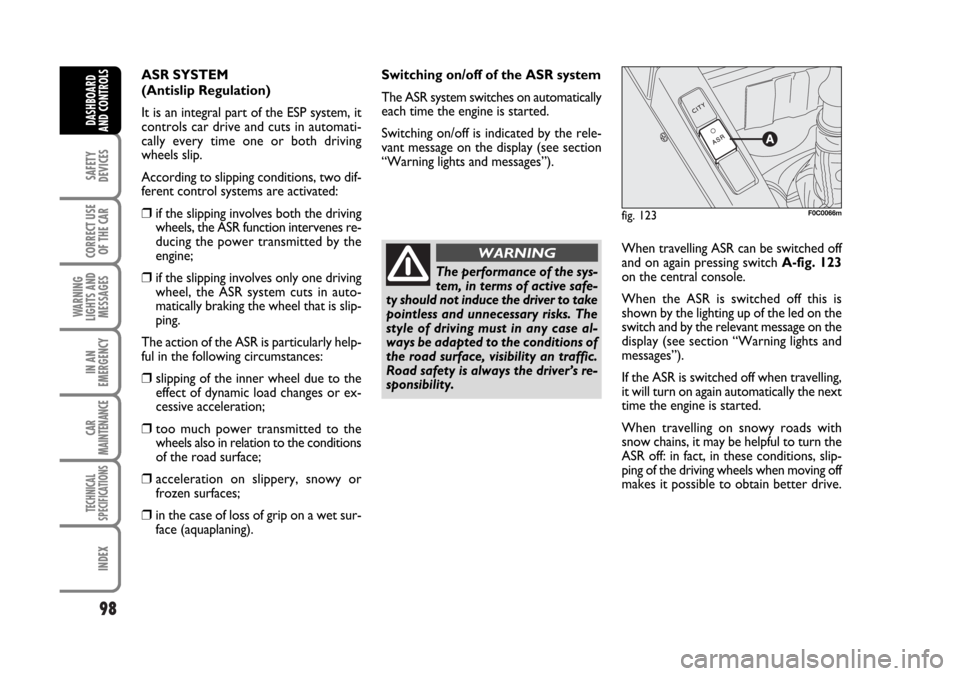
When travelling ASR can be switched off
and on again pressing switch A-fig. 123
on the central console.
When the ASR is switched off this is
shown by the lighting up of the led on the
switch and by the relevant message on the
display (see section “Warning lights and
messages”).
If the ASR is switched off when travelling,
it will turn on again automatically the next
time the engine is started.
When travelling on snowy roads with
snow chains, it may be helpful to turn the
ASR off: in fact, in these conditions, slip-
ping of the driving wheels when moving off
makes it possible to obtain better drive.
The performance of the sys-
tem, in terms of active safe-
ty should not induce the driver to take
pointless and unnecessary risks. The
style of driving must in any case al-
ways be adapted to the conditions of
the road surface, visibility an traffic.
Road safety is always the driver’s re-
sponsibility.
WARNING
fig. 123F0C0066m
Page 100 of 274

99
SAFETY
DEVICES
CORRECT USE
OF THE CAR
WARNING
LIGHTS AND
MESSAGES
IN AN
EMERGENCY
CAR
MAINTENANCE
TECHNICAL
SPECIFICATIONS
INDEX
DASHBOARD
AND CONTROLS
Failure indications
In the event of malfunctioning, the ASR
system is automatically disconnected and
the warning light
áwill come on with
fixed light on the instrument panel to-
gether with the message on the display
(see section “Warning lights and mes-
sages”). In this case contact Fiat Dealer-
ship as soon as possible. MSR system
(engine braking torque control)
The car is fitted with a special system, in-
tegral with the ASR system, that in case of
sudden gear shifting, cuts in providing
torque to the engine thus preventing ex-
cessive driving wheel drive that, specially
in poor grip conditions, can lead to loss of
stability.
EOBD SYSTEM
The EOBD system (European On Board
Diagnosis) allows continuous diagnosis of
the components of the car correlated with
emissions.
It also alerts the driver, by turning on the
warning light
Uon the instrument pan-
el (together with the message on the dis-
play) (see section “Warning lights and
messages”), when these components are
no longer in peak conditions.
The objective is:
❒to keep the system efficiency under
control;
❒warn when a fault causes emissions lev-
els to increase;
❒warn of the need to replace deterio-
rated components.
The system also has a diagnostic connec-
tor that can be interfaced with appropri-
ate tools, which makes it possible to read
the error codes stored in the control unit,
together with a series of specific parame-
ters for engine operation and diagnosis.
This check can also be carried out by the
traffic police.
When using the spare wheel,
the ASR system is excluded
and the warning light
áon the in-
strument panel turns on glowing
steadily together with the message on
the display (see section “Warning
lights and messages”).
WARNING
For correct operation of the
ASR system, the tyres must
absolutely be of the same brand and
type on all wheels, in perfect condi-
tions and, above all, of type, brand
and size specified.
WARNING
Page 109 of 274
108
SAFETY
DEVICES
CORRECT USE
OF THE CAR
WARNING
LIGHTS AND
MESSAGES
IN AN
EMERGENCY
CAR
MAINTENANCE
TECHNICAL
SPECIFICATIONS
INDEX
DASHBOARD
AND CONTROLS
Diesel Particulate Filter clogged
If the dedicated message is displayed, re-
fer to section “Warning lights and mes-
sages”.
During normal service the
catalyst and the diesel par-
ticulate filter (DPF) reach high tem-
peratures. Do not therefore park the
car over inflammable materials (grass,
dry leaves, pine needles, etc.): fire
hazard.
WARNING
PROTECTING THE
ENVIRONMENT
The devices for curtailing petrol engine
emissions are the following:
❒ three-way catalytic converter;
❒Lambda sensors;
❒fuel evaporation system.
In addition, do not let the engine run, even
for a test, with one or more spark plugs
disconnected.
The devices for curtailing diesel fuel en-
gine emissions are the following:
❒oxidising catalytic converter;
❒ exhaust gas recirculation system
(E.G.R.);
❒Lambda sensors;
❒diesel particulate filter (DPF) (where
provided it is fitted instead of the Lamb-
da sensor).DIESEL PARTICULATE FILTER
(DPF) (where provided)
The Diesel Particulate Filter is a mechan-
ical filter, integral with the exhaust system,
that physically traps particulates present
in the exhaust gases of Diesel engines.
The diesel particular filter has been adopt-
ed to eliminate almost totally particulates
in compliance with current / future law
regulations.
During normal use of the car, the engine
control unit records a set of data (e.g.:
travel time, type of route, temperatures,
etc.) and it will then calculate how much
particulates has been trapped by the filter.
Since this filter physically traps particulates,
it shall be cleaned (reclaimed) at regular
intervals by burning carbon particles. Re-
claiming procedure is controlled auto-
matically by the engine control unit ac-
cording to the filter conditions and the
conditions of use of the car. During re-
claiming the following phenomena could
take place: idling slight increase, fan acti-
vation, slight smoke increase, high exhaust
temperatures. These situations shall not
be considered as faults and they do not af-
fect car performance and environment.
Page 152 of 274
151
WARNING
LIGHTS AND
MESSAGES
IN AN
EMERGENCY
CAR
MAINTENANCE
TECHNICAL
SPECIFICATIONS
INDEX
DASHBOARD
AND CONTROLS
SAFETY
DEVICES
CORRECT USE
OF THE CAR
TOWING TRAILERS
IMPORTANT NOTES
For towing caravans or trailers the car
must be fitted with a certified tow hook
and an adequate electric system. Installa-
tion should be carried out by specialised
personnel who release a special document
for circulation on the road.
Install any specific and/or additional rear-
view mirrors as specified by law.
Remember that when towing a trailer,
steep hills are harder to climb, the brak-
ing spaces increase and overtaking takes
longer depending on the overall weight.
Engage a low gear when driving downhill,
rather than constantly using the brake.The weight the trailer exerts on the car
tow hook reduces by the same amount
the actual car loading capacity. To make
sure the maximum towable weight is not
exceeded (given in the log book) account
should be taken of the fully laden trailer,
including accessories and personal be-
longings.
Do not exceed the speed limits of the
country you are driving in. In any case do
not exceed 100 km/h.INSTALLING THE TOW HOOK
The towing device should be fastened to
the body by specialised personnel ac-
cording to any additional and/or integra-
tive information supplied by the Manufac-
turer of the device.
The ABS system with which
the car may be fitted does
not control the trailer braking system.
Drive with extreme care on slippery
roadbeds.
WARNING
Under no circumstances
should the car brake system
be altered to control the trailer brake.
The trailer braking system must be
fully independent of the car hydraulic
system.
WARNING
Page 225 of 274
224
WARNING
LIGHTS AND
MESSAGES
TECHNICAL
SPECIFICATIONS
INDEX
DASHBOARD
AND CONTROLS
SAFETY
DEVICES
CORRECT USE
OF THE CAR
IN AN
EMERGENCY
CAR
MAINTENANCE
Prevent brake fluid, which is
highly corrosive, from coming
into contact with painted
parts. Should it happen, im-
mediately wash with water.
Brake fluid is poisonous and
highly corrosive. In the event
of accidental contact, wash the parts
involved immediately with neutral
soap and water, then rinse thor-
oughly. Call the doctor immediately
if the fluid is swallowed.
WARNING
Symbol πon the container
indicates synthetic brake flu-
id, distinguishing it from the mineral
kind. Using mineral fluids irreversibly
damages the special braking system
rubber seals.
WARNING
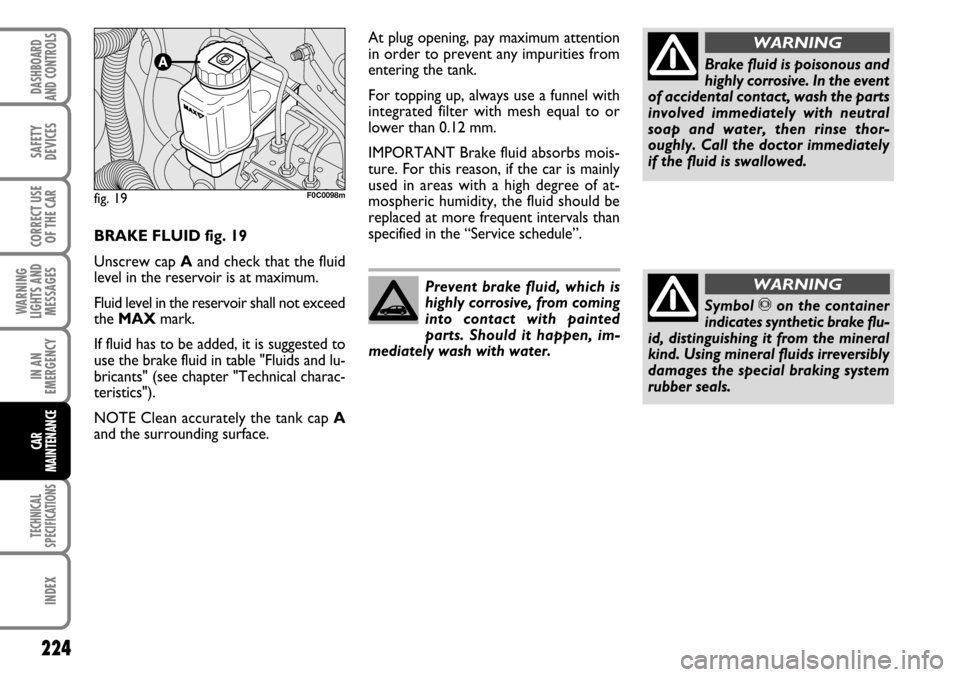
BRAKE FLUID fig. 19
Unscrew cap Aand check that the fluid
level in the reservoir is at maximum.
Fluid level in the reservoir shall not exceed
the MAXmark.
If fluid has to be added, it is suggested to
use the brake fluid in table "Fluids and lu-
bricants" (see chapter "Technical charac-
teristics").
NOTE Clean accurately the tank cap A
and the surrounding surface.
fig. 19F0C0098m
At plug opening, pay maximum attention
in order to prevent any impurities from
entering the tank.
For topping up, always use a funnel with
integrated filter with mesh equal to or
lower than 0.12 mm.
IMPORTANT Brake fluid absorbs mois-
ture. For this reason, if the car is mainly
used in areas with a high degree of at-
mospheric humidity, the fluid should be
replaced at more frequent intervals than
specified in the “Service schedule”.
Page 229 of 274
228
WARNING
LIGHTS AND
MESSAGES
TECHNICAL
SPECIFICATIONS
INDEX
DASHBOARD
AND CONTROLS
SAFETY
DEVICES
CORRECT USE
OF THE CAR
IN AN
EMERGENCY
CAR
MAINTENANCE
IMPORTANT A battery which is kept at
a charge of less than 50% (optical indica-
tor with dark colour without green area
in the middle) for any length of time will
be damaged by sulphation leading to a re-
duction in cranking power.
Moreover, this might lead to a higher risk
of the battery electrolyte freezing (this
may even occur at -10°C). If the car is in-
active for a long period of time, refer to
“Car inactivity”, in section “Correct use
of the car”.In fact, since these devices continue ab-
sorbing energy even when the ignition key
is off, they gradually run down the battery.
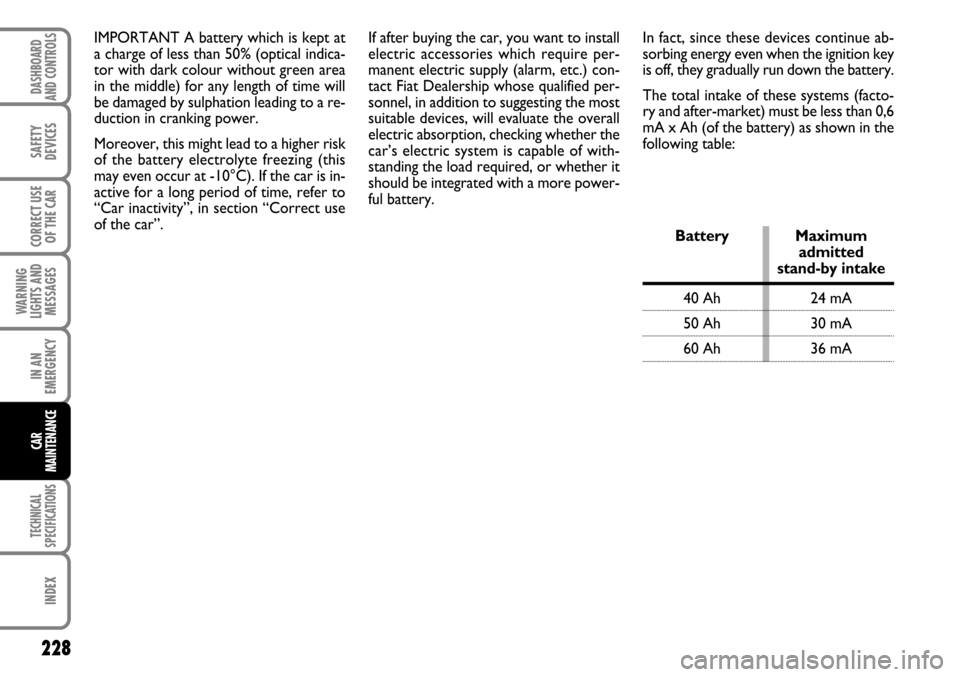
The total intake of these systems (facto-
ry and after-market) must be less than 0,6
mA x Ah (of the battery) as shown in the
following table:
Battery
40 Ah
50 Ah
60 AhIf after buying the car, you want to install
electric accessories which require per-
manent electric supply (alarm, etc.) con-
tact Fiat Dealership whose qualified per-
sonnel, in addition to suggesting the most
suitable devices, will evaluate the overall
electric absorption, checking whether the
car’s electric system is capable of with-
standing the load required, or whether it
should be integrated with a more power-
ful battery.
Maximum
admitted
stand-by intake
24 mA
30 mA
36 mA