esc FIAT TALENTO 2016 2.G User Guide
[x] Cancel search | Manufacturer: FIAT, Model Year: 2016, Model line: TALENTO, Model: FIAT TALENTO 2016 2.GPages: 232, PDF Size: 5.01 MB
Page 96 of 232
safety, the distance between the head
and headrest must be minimum;
adjust cushion (seat) height. This
adjustment optimises visibility;
adjust the steering wheel.
ADJUSTING THE SEAT BELTS
Sit firmly on the backrest.
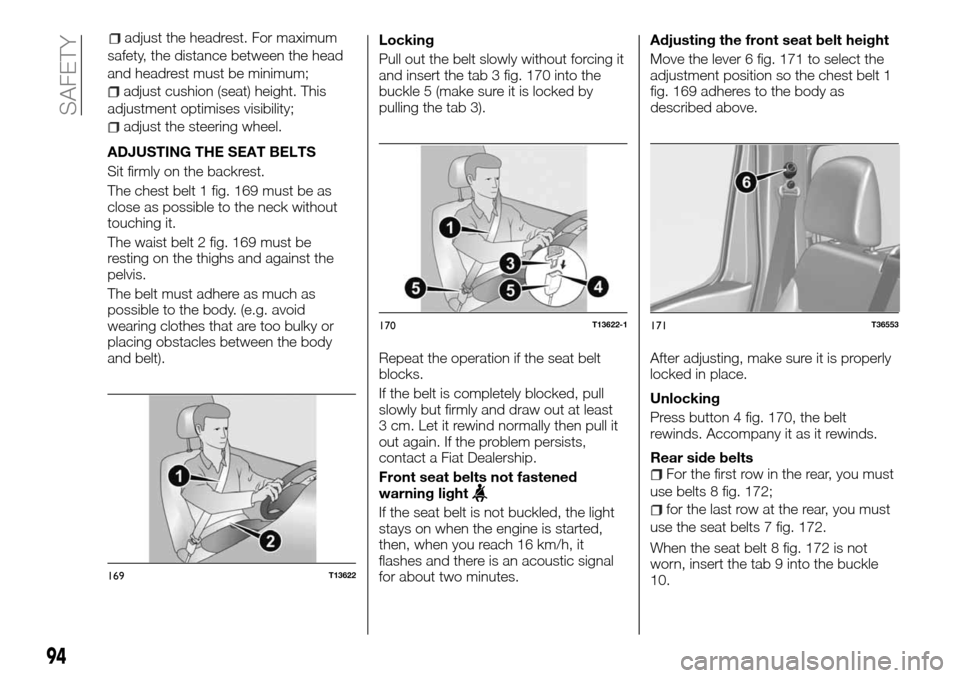
The chest belt 1 fig. 169 must be as
close as possible to the neck without
touching it.
The waist belt 2 fig. 169 must be
resting on the thighs and against the
pelvis.
The belt must adhere as much as
possible to the body. (e.g. avoid
wearing clothes that are too bulky or
placing obstacles between the body
and belt).Locking
Pull out the belt slowly without forcing it
and insert the tab 3 fig. 170 into the
buckle 5 (make sure it is locked by
pulling the tab 3).
Repeat the operation if the seat belt
blocks.
If the belt is completely blocked, pull
slowly but firmly and draw out at least
3 cm. Let it rewind normally then pull it
out again. If the problem persists,
contact a Fiat Dealership.
Front seat belts not fastened
warning light
If the seat belt is not buckled, the light
stays on when the engine is started,
then, when you reach 16 km/h, it
flashes and there is an acoustic signal
for about two minutes.Adjusting the front seat belt height
Move the lever 6 fig. 171 to select the
adjustment position so the chest belt 1
fig. 169 adheres to the body as
described above.
After adjusting, make sure it is properly
locked in place.
Unlocking
Press button 4 fig. 170, the belt
rewinds. Accompany it as it rewinds.
Rear side belts
For the first row in the rear, you must
use belts 8 fig. 172;
for the last row at the rear, you must
use the seat belts 7 fig. 172.
When the seat belt 8 fig. 172 is not
worn, insert the tab 9 into the buckle
10.
169T13622
170T13622-1171T36553
94
SAFETY
adjust the headrest. For maximum
Page 128 of 232
ACTIVE SAFETY
SYSTEMS
Depending on the version, they can
consist of:
by the anti-lock braking system
(ABS);
electronic stability control (ESC) with
understeering and traction control
system;
driving with a trailer assistance;
emergency brake assistance;
road grip control;
assisted departure on inclines.
ABS (Anti-lock Braking
System)
131) 132) 133) 134)
In case of abrupt braking,the ABS
avoids wheel locking, so it manages the
braking distance and maintains vehicle
control.
In these conditions you can carry out
manoeuvres while braking fully.
Moreover, this system optimises the
braking distance, especially on slippery
surfaces (wet roadbed, etc.).
Every time you activate this device, you
know because the brake pedal shakes.
The ABS never improves the "physical"
performance associated with the
wheel's road grip. The rules of the road
must be respected (safety distance
between vehicles, etc.).IMPORTANT In an emergency, we
advise you to apply strong, continuous
pressure to the brake pedal. You do not
need to pump it. The ABS will modulate
the force applied to the brakes.
Irregular operation:
Depending on the vehicle,and
lit on the instrument panel along
with dedicated messages mean: the
ABS, ESC and emergency power
steering have been deactivated.
Braking is always guaranteed;
andSTOPlit on the
instrument panel, along with the
dedicated message on the display,
indicates that there is a fault in the
brake system.
In both cases, contact a Fiat
Dealership.
ESC (Electronic Stability
Control) SYSTEM
135) 136)
Electronic stability control ESC
This system helps maintain control of
the vehicle in "critical" driving conditions
(avoiding an obstacle, loss of grip in a
curve, etc.).
Operating principle
A sensor on the steering wheel
recognises the driving trajectory that the
driver set.
Other sensors installed in the vehicle
measure the real trajectory.The system compares the driver's
adherence to the effective trajectory,
correcting it if necessary, braking a few
wheels and/or reducing engine power if
the system was activated and its
warning light
flashes on the
instrument panel.
Understeering control
This system optimises the ESC action
in case of noticeable understeer (loss of
front grip).
Traction Control System
This system limits the drive wheels
slipping and helps control the vehicle
when starting out, accelerating or
decelerating.
Operating principle
Thanks to the sensor in the wheels, the
system measures and compares the
drive wheel rotation speed, detecting
immediately loss of grip. If a wheel
starts sliding, the system intervenes by
braking to re-stabilise the drive that is
compatible with the level of road grip.
The system also acts on the engine
speed, adapting it to wheel road grip,
independently of the driver's use of the
accelerator.
126
SAFETY
Page 129 of 232
Irregular operation
When the system detects an
operational irregularity, the dedicated
message appears on the display and
the warning lights
andturn
on. In this case, the ESC and traction
control system are deactivated. Contact
a Fiat Dealership.
PBA (Panic Brake
Assist) SYSTEM
This is a complementary system to the
ABS that lets you reduce the vehicle's
braking distance.
Operating principle
The system detects an emergency
braking situation. In such cases, the
power brake immediately creates the
maximum braking, causing the ABS
system to also intervene.
ABS intervention lasts until the brake
pedal is released.
Hazard warning lights on
Depending on the versions, these lights
can go on when you slow down
abruptly.
Anticipated braking
Depending on the versions, when you
quickly release the accelerator, the
system anticipates braking so as to
diminish the braking distance.
When using Cruise Control:
if you are using the accelerator pedal,
with you release it, the system can
activate;
if you are not using the accelerator
pedal, the system will not activate.
Irregular operation
When the system detects an
operational irregularity, the message to
that effect will appear on the instrument
panel with the alarm light
going
on.
Contact a Fiat Dealership.
TSA (Trailer Stability
Assist) DRIVING
ASSISTANCE WITH A
TRAILER
This system helps you maintain control
of the vehicle in case you are using a
trailer. It detects the swinging motion of
the trailer in certain driving conditions.
Operating conditions
The two system must be authorised
by the Fiat Dealership;
the wiring has to be approved by a
Fiat Dealership;
the trailer has to be connected to the
vehicle.
Operating principle
The function stabilises the vehicle by:
asymmetrical front wheel braking to
reduce swinging caused by the trailer;
four wheel braking and a limitation in
engine torque to reduce the vehicle
speed until the swinging stops.The warning light
flashes on the
instrument panel to inform you of the
situation.
TRACTION PLUS (GRIP
CONTROL)
136)
22)
Where the vehicle is provided with one,
road grip check ensures easier control
of the vehicle in conditions where grip is
reduced (crumbly terrain).
"Road" mode
When the vehicle is started, the
appropriate message appears on the
display screen. The indicator light
on the instrument panel is off. This
position guarantees optimal use in
normal road conditions (dry, wet
roadbed, light snow, etc.).
The "Road" mode uses the traction
control system functions.
"Traction +" Mode
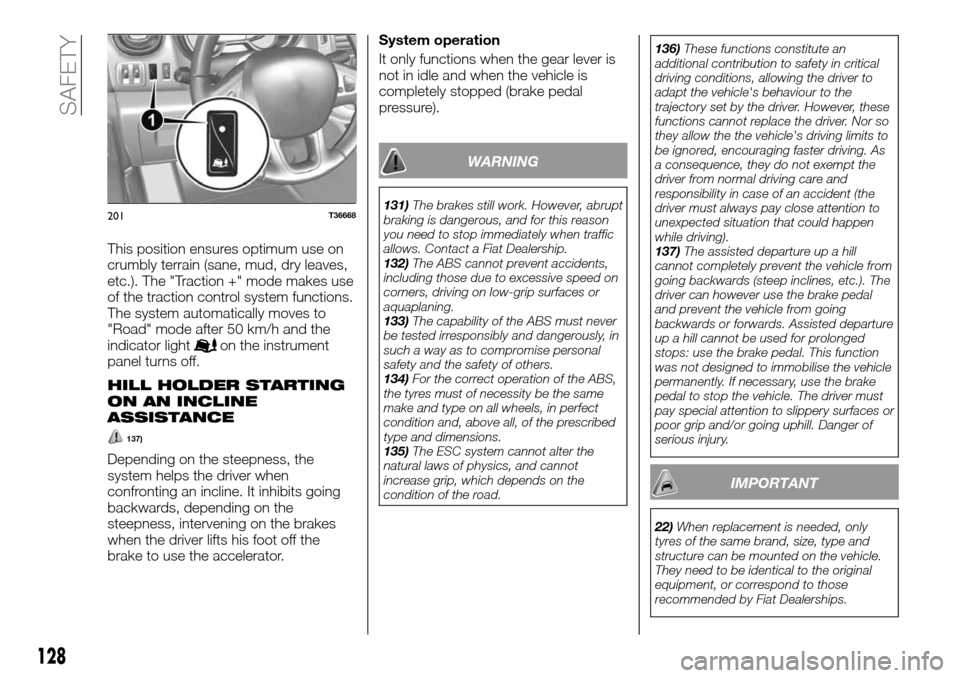
Press button 1 fig. 201: the warning
light
on the instrument panel turns
on along with the dedicated message.
127
Page 130 of 232
This position ensures optimum use on
crumbly terrain (sane, mud, dry leaves,
etc.). The "Traction +" mode makes use
of the traction control system functions.
The system automatically moves to
"Road" mode after 50 km/h and the
indicator light
on the instrument
panel turns off.
HILL HOLDER STARTING
ON AN INCLINE
ASSISTANCE
137)
Depending on the steepness, the
system helps the driver when
confronting an incline. It inhibits going
backwards, depending on the
steepness, intervening on the brakes
when the driver lifts his foot off the
brake to use the accelerator.System operation
It only functions when the gear lever is
not in idle and when the vehicle is
completely stopped (brake pedal
pressure).
WARNING
131)The brakes still work. However, abrupt
braking is dangerous, and for this reason
you need to stop immediately when traffic
allows. Contact a Fiat Dealership.
132)The ABS cannot prevent accidents,
including those due to excessive speed on
corners, driving on low-grip surfaces or
aquaplaning.
133)The capability of the ABS must never
be tested irresponsibly and dangerously, in
such a way as to compromise personal
safety and the safety of others.
134)For the correct operation of the ABS,
the tyres must of necessity be the same
make and type on all wheels, in perfect
condition and, above all, of the prescribed
type and dimensions.
135)The ESC system cannot alter the
natural laws of physics, and cannot
increase grip, which depends on the
condition of the road.136)These functions constitute an
additional contribution to safety in critical
driving conditions, allowing the driver to
adapt the vehicle's behaviour to the
trajectory set by the driver. However, these
functions cannot replace the driver. Nor so
they allow the the vehicle's driving limits to
be ignored, encouraging faster driving. As
a consequence, they do not exempt the
driver from normal driving care and
responsibility in case of an accident (the
driver must always pay close attention to
unexpected situation that could happen
while driving).
137)The assisted departure up a hill
cannot completely prevent the vehicle from
going backwards (steep inclines, etc.). The
driver can however use the brake pedal
and prevent the vehicle from going
backwards or forwards. Assisted departure
up a hill cannot be used for prolonged
stops: use the brake pedal. This function
was not designed to immobilise the vehicle
permanently. If necessary, use the brake
pedal to stop the vehicle. The driver must
pay special attention to slippery surfaces or
poor grip and/or going uphill. Danger of
serious injury.
IMPORTANT
22)When replacement is needed, only
tyres of the same brand, size, type and
structure can be mounted on the vehicle.
They need to be identical to the original
equipment, or correspond to those
recommended by Fiat Dealerships.
201T36668
128
SAFETY
Page 139 of 232
LOADING ADVICE
Transporting items in the load
compartment
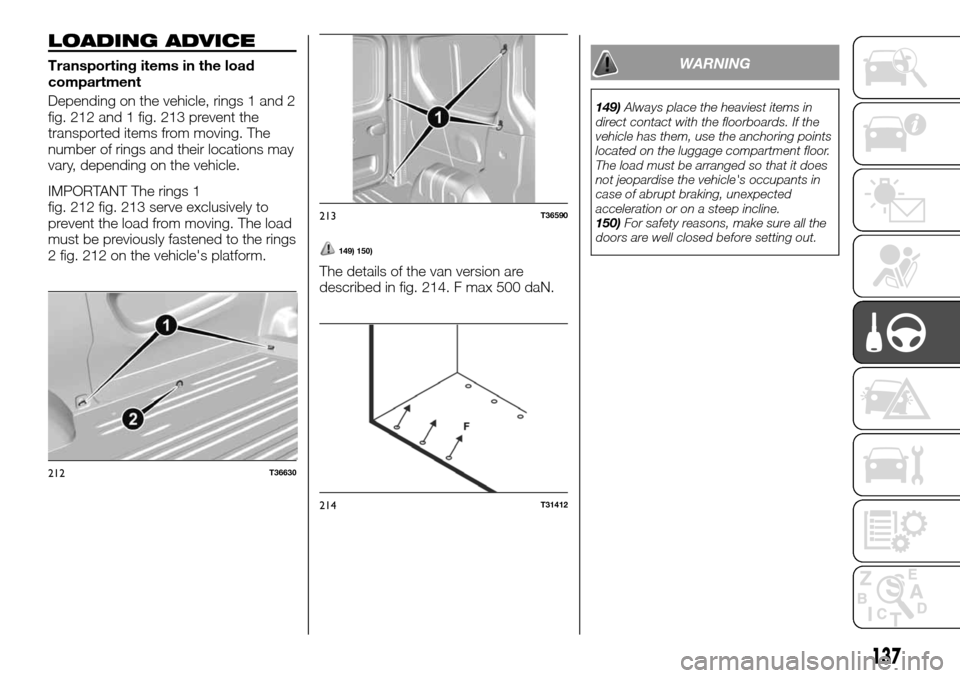
Depending on the vehicle, rings 1 and 2
fig. 212 and 1 fig. 213 prevent the
transported items from moving. The
number of rings and their locations may
vary, depending on the vehicle.
IMPORTANT The rings 1
fig. 212 fig. 213 serve exclusively to
prevent the load from moving. The load
must be previously fastened to the rings
2 fig. 212 on the vehicle's platform.
149) 150)
The details of the van version are
described in fig. 214. F max 500 daN.
WARNING
149)Always place the heaviest items in
direct contact with the floorboards. If the
vehicle has them, use the anchoring points
located on the luggage compartment floor.
The load must be arranged so that it does
not jeopardise the vehicle's occupants in
case of abrupt braking, unexpected
acceleration or on a steep incline.
150)For safety reasons, make sure all the
doors are well closed before setting out.
212T36630
213T36590
214T31412
137
Page 156 of 232
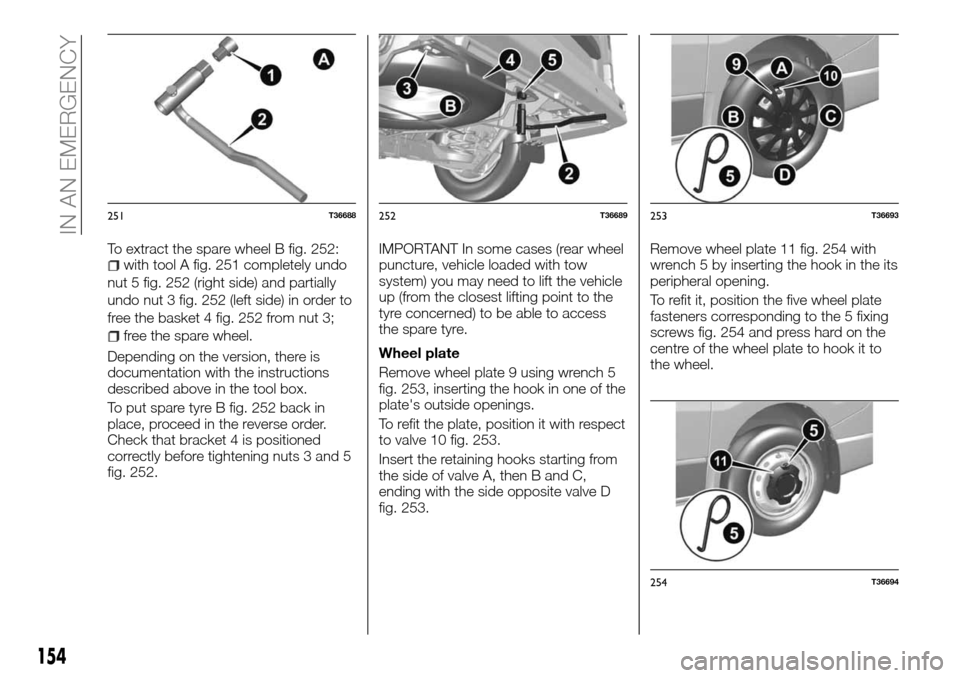
To extract the spare wheel B fig. 252:with tool A fig. 251 completely undo
nut 5 fig. 252 (right side) and partially
undo nut 3 fig. 252 (left side) in order to
free the basket 4 fig. 252 from nut 3;
free the spare wheel.
Depending on the version, there is
documentation with the instructions
described above in the tool box.
To put spare tyre B fig. 252 back in
place, proceed in the reverse order.
Check that bracket 4 is positioned
correctly before tightening nuts 3 and 5
fig. 252.IMPORTANT In some cases (rear wheel
puncture, vehicle loaded with tow
system) you may need to lift the vehicle
up (from the closest lifting point to the
tyre concerned) to be able to access
the spare tyre.
Wheel plate
Remove wheel plate 9 using wrench 5
fig. 253, inserting the hook in one of the
plate's outside openings.
To refit the plate, position it with respect
to valve 10 fig. 253.
Insert the retaining hooks starting from
the side of valve A, then B and C,
ending with the side opposite valve D
fig. 253.Remove wheel plate 11 fig. 254 with
wrench 5 by inserting the hook in the its
peripheral opening.
To refit it, position the five wheel plate
fasteners corresponding to the 5 fixing
screws fig. 254 and press hard on the
centre of the wheel plate to hook it to
the wheel.
251T36688252T36689253T36693
254T36694
154
IN AN EMERGENCY
Page 158 of 232
TYRE INFLATION KIT
172)
32) 33) 34) 35) 36) 37) 38)
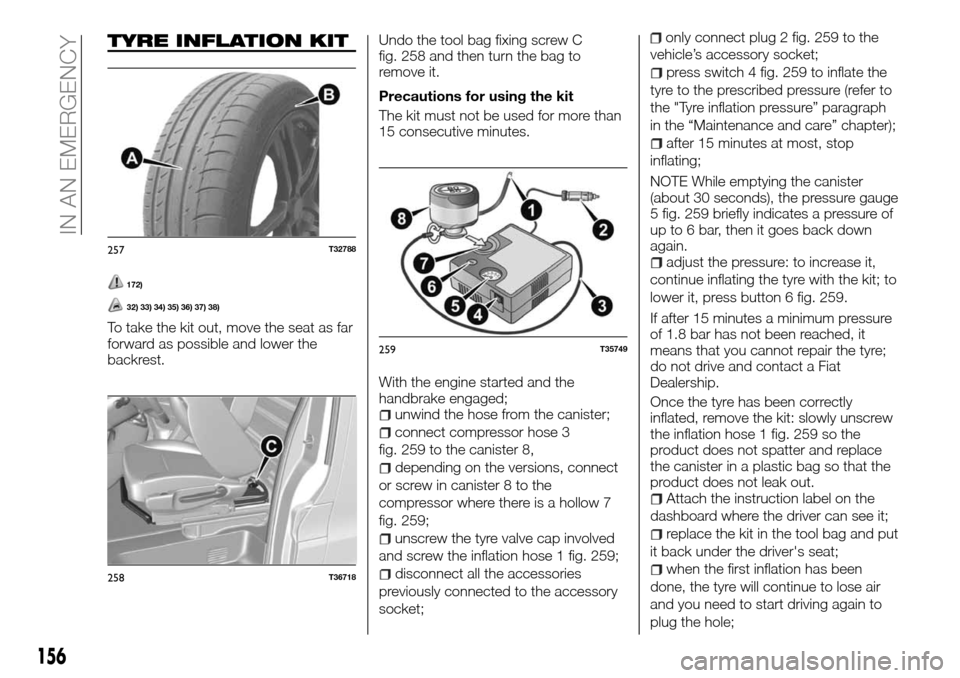
To take the kit out, move the seat as far
forward as possible and lower the
backrest.Undo the tool bag fixing screw C
fig. 258 and then turn the bag to
remove it.
Precautions for using the kit
The kit must not be used for more than
15 consecutive minutes.
With the engine started and the
handbrake engaged;
unwind the hose from the canister;
connect compressor hose 3
fig. 259 to the canister 8,
depending on the versions, connect
or screw in canister 8 to the
compressor where there is a hollow 7
fig. 259;
unscrew the tyre valve cap involved
and screw the inflation hose 1 fig. 259;
disconnect all the accessories
previously connected to the accessory
socket;
only connect plug 2 fig. 259 to the
vehicle’s accessory socket;
press switch 4 fig. 259 to inflate the
tyre to the prescribed pressure (refer to
the "Tyre inflation pressure” paragraph
in the “Maintenance and care” chapter);
after 15 minutes at most, stop
inflating;
NOTE While emptying the canister
(about 30 seconds), the pressure gauge
5 fig. 259 briefly indicates a pressure of
up to 6 bar, then it goes back down
again.
adjust the pressure: to increase it,
continue inflating the tyre with the kit; to
lower it, press button 6 fig. 259.
If after 15 minutes a minimum pressure
of 1.8 bar has not been reached, it
means that you cannot repair the tyre;
do not drive and contact a Fiat
Dealership.
Once the tyre has been correctly
inflated, remove the kit: slowly unscrew
the inflation hose 1 fig. 259 so the
product does not spatter and replace
the canister in a plastic bag so that the
product does not leak out.
Attach the instruction label on the
dashboard where the driver can see it;
replace the kit in the tool bag and put
it back under the driver's seat;
when the first inflation has been
done, the tyre will continue to lose air
and you need to start driving again to
plug the hole;
257T32788
258T36718
259T35749
156
IN AN EMERGENCY
Page 159 of 232
speed between 20 and 60 km/h to
uniformly distribute the product on the
tyre and, after 3 kilometres, stop to
check the pressure;
if the pressure is greater than 1.3 bar
but less than prescribed, you need to
adjust it (see the label attached to the
driver's door pillar), otherwise see a Fiat
Dealership: you cannot repair it.
WARNING
172)There should be no objects at the
driver's feet: in case of sharp braking, they
could slide under the pedals, preventing
their correct use.
IMPORTANT
32)The kit can repair tyres whose treads A
fig. 257 are damaged by foreign objects
smaller than 4 millimetres. It cannot repair
all types of puncture, such as cuts larger
than 4 millimetres and those on side B
fig. 257 of the tyre. Also make sure the rims
are in good condition. Do not remove the
foreign object that caused the puncture if it
is implanted in the tyre.33)Do not use the inflation kit if the tyre is
damaged by driving with a puncture. Check
the tyre sides carefully before any
intervention. Travelling with partially or
completely deflated tyres (or punctured)
can cause safety problems and damage
the concerned tyre beyond repair. This
reparation is temporary. A tyre that has
been punctured must be examined (and
repaired if possible) by a specialist as soon
as possible. When replacing a tyre repaired
by the kit, always notify the tyre repairer.
When driving, you can feel vibrations
caused by the product being in the tyre.
34)The kit is approved only for inflating
tyres of vehicles that were originally
equipped with it. It should never be used to
inflate another vehicle's tyres or any other
object (life vests, inflatable mattresses,
etc.). Avoid splashing on skin when using
the repair canister. If the product comes in
contact with skin, rinse thoroughly. Keep
the kit out of the reach of children. Do not
leave empty canister in the environment.
Deliver it to a Fiat Dealership or to a
consortium specialised in its disposal. The
canister has an expiration date indicated on
the label. Check the expiration date. Go to
a Fiat Dealership to replace the inflation
hose and repair canister.
35)Before using the kit, park the vehicle so
it is sufficiently far from traffic, turn on the
emergency lights, pull up the handbrake
and get all the occupants out of the vehicle,
moving them far away from the traffic.
36)In case you are stopped by the
carriageway, warn other road users that
your vehicle is there by placing the warning
triangle or other device allowed by law in
the country you are driving in.37)Caution, a missing or badly screwed on
valve cap could impact the tyre's grip and
cause a loss of pressure. The valve caps
must all be identical to the original ones
and screwed tightly.
38)After repair using the kit, do not drive
farther than 200 km. In addition, lower your
speed, and in any case do not exceed
80 km/h. The label is to be attached in a
visible part of the dashboard. Depending
on the market country or local laws, a tyre
repaired with the inflation kit must be
replaced.
157
leave immediately and drive at a
Page 161 of 232
BATTERY
RECHARGING
178) 179) 180) 181)
40)
To avoid risk of sparks:Make sure the "electrical users"
(courtesy lights, etc.) are disconnected
before disconnecting or reconnecting a
battery.
if you want to recharge the battery,
turn off the battery charger before
connecting or disconnecting the
battery;
do not place metal objects on the
battery, to prevent a short circuit
between terminals;
wait at least one minute after turning
off the engine to disconnect the battery;
check that the terminals have been
reconnected correctly after refitting.
Connecting a battery charger
The battery charger has to be
compatible with a nominal voltage of
12 Volts.
Do not disconnect the battery while the
engine is started. Follow the battery
charger manufacturer's instructions for
the battery you plan to use.
WARNING
178)Handle the battery carefully, because
it contains sulphuric acid that must not
come into contact with eyes or skin. If that
happens, rinse thoroughly with water. If
necessary, see a doctor. Keep open
flames, incandescent items and sources of
sparks far from the battery's elements: risk
of explosion. When you intervene near the
engine, this last could be hot. Moreover,
the cooling fan could start up at any time.
Risk of injury.
179)Some batteries can have specific
recharging rules, please ask for information
at a Fiat Dealership. Avoid the risk of
sparks that could cause an immediate
explosion. Charge in a well ventilated
place. Danger of serious injury.
180)Battery fluid is poisonous and
corrosive: avoid contact with your skin and
eyes. The battery should be charged in a
well ventilated place, away from naked
flames or possible sources of sparks:
danger of explosion and fire.
181)Do not attempt to charge a frozen
battery: it must be thawed first, otherwise it
may explode. If freezing has occurred, the
battery should be checked by skilled
personnel to make sure that the internal
elements are not damaged and that the
body is not cracked, with the risk of leaking
poisonous and corrosive acid.
IMPORTANT
40)The engine must be stopped before
performing any operation in the engine
compartment.
159
Page 165 of 232
SCHEDULED
SERVICING
Correct servicing is crucial for
guaranteeing a long life for the vehicle
under the best conditions.
For this reason, Fiat has planned a
series of checks and services at fixed
distance intervals and, for
versions/markets, where provided, at
fixed time intervals, as described in the
Scheduled Servicing Plan.
Regardless of the above, it is always
necessary to carefully follow the
instructions in the Scheduled Servicing
Plan (e.g. periodically check level of
liquids, tyre pressure, etc.).
Scheduled Servicing is offered by all
Fiat Dealerships according to fixed time
or kilometres/miles intervals. If, during
each operation, in addition to the ones
scheduled, the need arises for further
replacements or repairs, these may be
carried out with the owner's explicit
agreement only. If your vehicle is used
frequently for towing, the interval
between one service operation and the
next should be reduced.IMPORTANT NOTES
Scheduled Servicing interventions are
set out by the Manufacturer. Failure to
comply with the schedule may
invalidate the warranty.
It is advisable to inform a Fiat
Dealership of any small operating
irregularities without waiting for the next
service.
163