open bonnet FIAT TALENTO 2016 2.G Owners Manual
[x] Cancel search | Manufacturer: FIAT, Model Year: 2016, Model line: TALENTO, Model: FIAT TALENTO 2016 2.GPages: 232, PDF Size: 5.01 MB
Page 63 of 232
NOTE If the window encounters any
resistance during closing (for example a
tree branch, etc.) it stops and lowers a
few centimetres again.
Irregular operation
If the window closing fails to function,
the system moves to no pressure
mode: pull the concerned switch up as
much as needed until the window
closes completely (the window goes
back up gradually); then keep the
switch pulled up (always on the closing
side) for a second, then lower it and
raise it back up completely to reinstate
the system.
If necessary, contact a Fiat Dealership.
Rear sliding windows:
56)
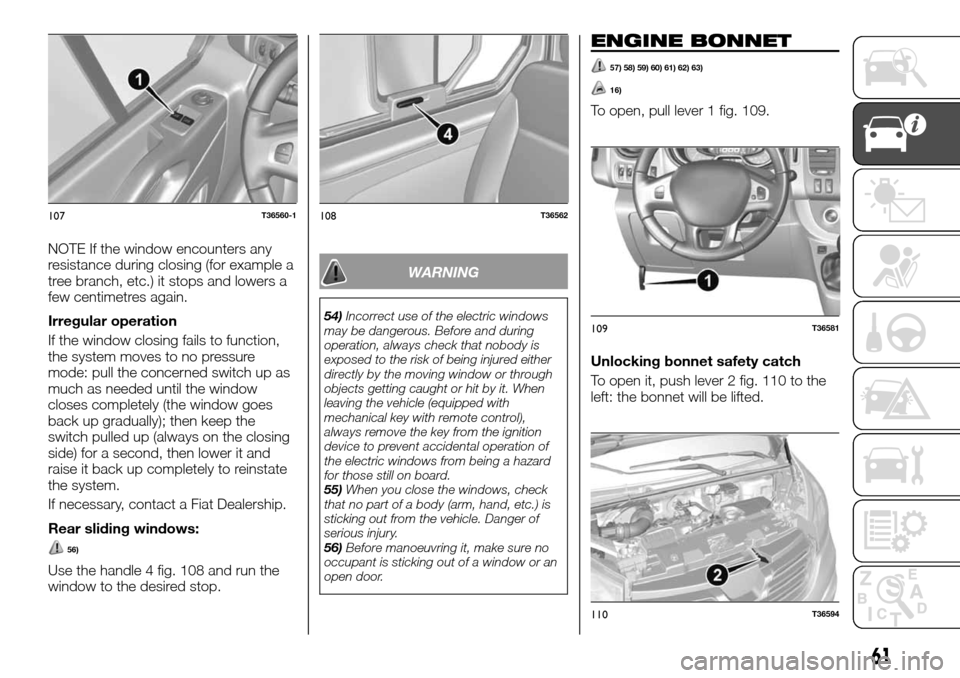
Use the handle 4 fig. 108 and run the
window to the desired stop.
WARNING
54)Incorrect use of the electric windows
may be dangerous. Before and during
operation, always check that nobody is
exposed to the risk of being injured either
directly by the moving window or through
objects getting caught or hit by it. When
leaving the vehicle (equipped with
mechanical key with remote control),
always remove the key from the ignition
device to prevent accidental operation of
the electric windows from being a hazard
for those still on board.
55)When you close the windows, check
that no part of a body (arm, hand, etc.) is
sticking out from the vehicle. Danger of
serious injury.
56)Before manoeuvring it, make sure no
occupant is sticking out of a window or an
open door.
ENGINE BONNET
57) 58) 59) 60) 61) 62) 63)
16)
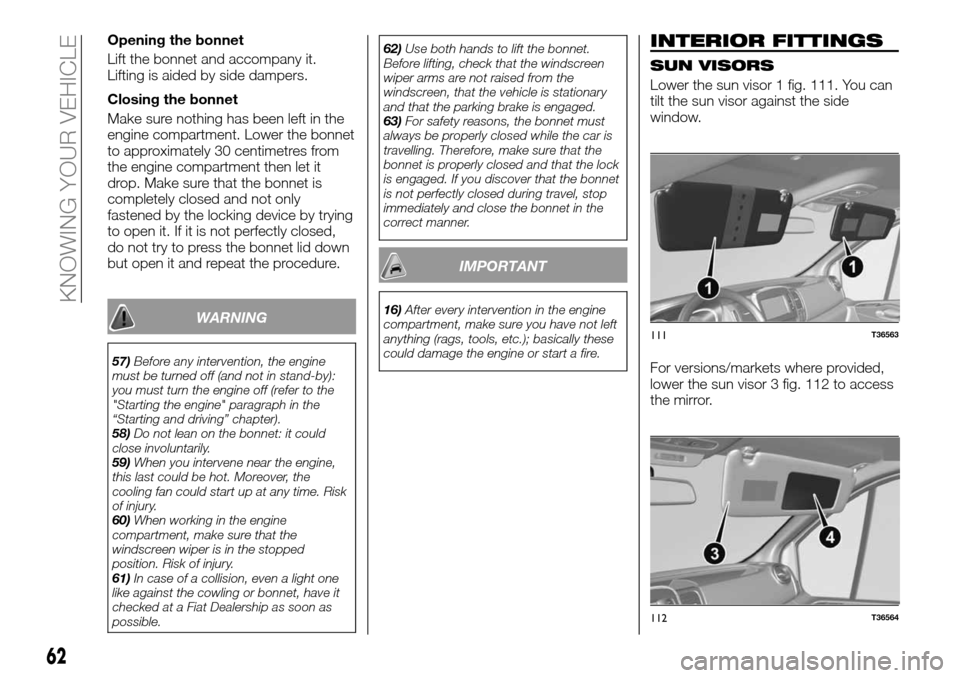
To open, pull lever 1 fig. 109.
Unlocking bonnet safety catch
To open it, push lever 2 fig. 110 to the
left: the bonnet will be lifted.
107T36560-1108T36562
109T36581
110T36594
61
Page 64 of 232
Opening the bonnet
Lift the bonnet and accompany it.
Lifting is aided by side dampers.
Closing the bonnet
Make sure nothing has been left in the
engine compartment. Lower the bonnet
to approximately 30 centimetres from
the engine compartment then let it
drop. Make sure that the bonnet is
completely closed and not only
fastened by the locking device by trying
to open it. If it is not perfectly closed,
do not try to press the bonnet lid down
but open it and repeat the procedure.
WARNING
57)Before any intervention, the engine
must be turned off (and not in stand-by):
you must turn the engine off (refer to the
"Starting the engine" paragraph in the
“Starting and driving” chapter).
58)Do not lean on the bonnet: it could
close involuntarily.
59)When you intervene near the engine,
this last could be hot. Moreover, the
cooling fan could start up at any time. Risk
of injury.
60)When working in the engine
compartment, make sure that the
windscreen wiper is in the stopped
position. Risk of injury.
61)In case of a collision, even a light one
like against the cowling or bonnet, have it
checked at a Fiat Dealership as soon as
possible.62)Use both hands to lift the bonnet.
Before lifting, check that the windscreen
wiper arms are not raised from the
windscreen, that the vehicle is stationary
and that the parking brake is engaged.
63)For safety reasons, the bonnet must
always be properly closed while the car is
travelling. Therefore, make sure that the
bonnet is properly closed and that the lock
is engaged. If you discover that the bonnet
is not perfectly closed during travel, stop
immediately and close the bonnet in the
correct manner.
IMPORTANT
16)After every intervention in the engine
compartment, make sure you have not left
anything (rags, tools, etc.); basically these
could damage the engine or start a fire.
INTERIOR FITTINGS
SUN VISORS
Lower the sun visor 1 fig. 111. You can
tilt the sun visor against the side
window.
For versions/markets where provided,
lower the sun visor 3 fig. 112 to access
the mirror.
111T36563
112T36564
62
KNOWING YOUR VEHICLE
Page 160 of 232
JUMP STARTING
173) 174) 175) 176) 177)
39)
WARNING
173)Check that the wires A and B are not
touching and that the positive cable A does
not touch any metal component of the
vehicle providing the current. You risk injury
and/or damage to the vehicle.
174)Before opening the bonnet, make
sure that the engine is off and that the
ignition key is in the "S" (Stop) position.
Follow the indications on the plate
underneath the bonnet.
175)Do not get too close to the radiator
cooling fan: the electric fan may start;
danger of injury. Scarves, ties and other
loose clothing might be pulled by moving
parts.
176)Remove any metal objects (e.g. rings,
watches, bracelets), that might cause an
accidental electrical contact and cause
serious injury.
177)The batteries contain acid that can
burn skin or eyes. Batteries produce
hydrogen, which is easily flammable and
explosive. Therefore, keep away flames or
devices which may cause sparks.
IMPORTANT
39)Never use a fast battery-charger to
start the engine as this could damage the
electronic systems of your vehicle,
particularly the ignition and engine fuel
supply control units.
260T36708
261T36629
158
IN AN EMERGENCY
Starting the engine that supplies
electrical power and keeping it at
medium speed.
To start, if you use the battery from
another vehicle, you need to have the
right cables (large size) from a Fiat
Dealership or, if you already have them,
make sure they are in perfect condition.
The two batteries have to have nominal
identical voltage: 12 Volt The battery
that supplies the power has to have a
capacity (amperes/hour, Ah) that is at
least identical to the dead battery.
Make sure that there is no contact
between the two vehicles (risk of short
circuit at the moment the positive poles
are in contact) and that the dead
battery is well connected. Disengage
the starter device.Depending on the versions, unhook the
battery guard.
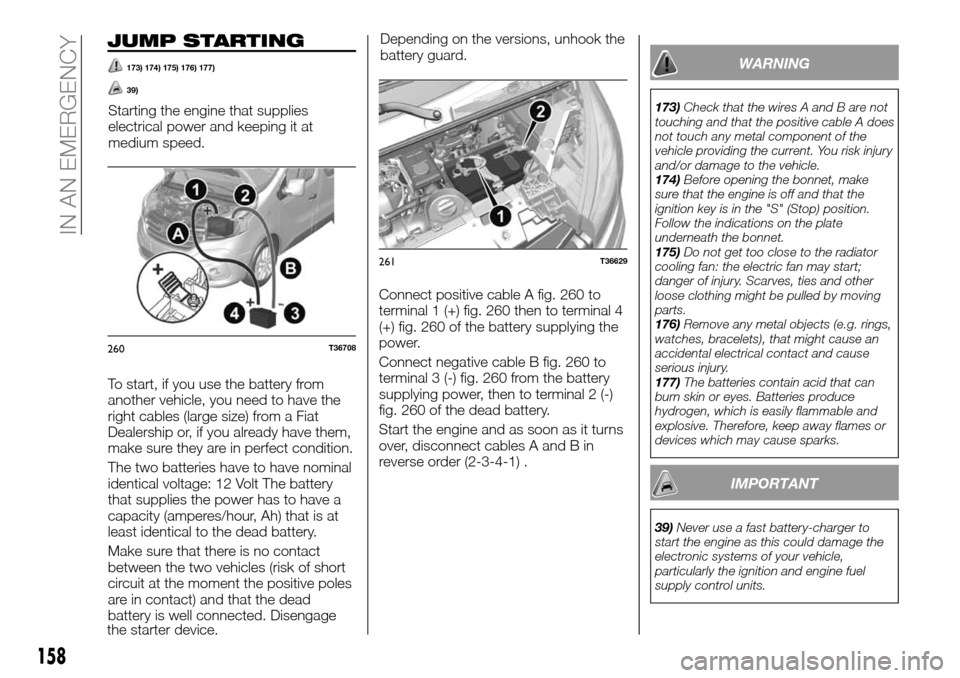
Connect positive cable A fig. 260 to
terminal 1 (+) fig. 260 then to terminal 4
(+) fig. 260 of the battery supplying the
power.
Connect negative cable B fig. 260 to
terminal 3 (-) fig. 260 from the battery
supplying power, then to terminal 2 (-)
fig. 260 of the dead battery.
Start the engine and as soon as it turns
over, disconnect cables A and B in
reverse order (2-3-4-1) .
Page 229 of 232
INDEX
ABS (Anti-lock Braking System). . .126
Accessories purchased by the
owner....................5
Active safety systems..........126
Adblue additive reservoir.........45
Baggage cover..............70
Battery...................173
Battery recharging............159
Bodywork.................178
Braking system..............186
Cargo volumes.............199
Checking levels..............169
Child protection systems........101
Carrying children safely.......101
Fitting a child restraint system
with seat belts............103
ISOFIX fastening system......116
Climate control...............46
Control panel and on-board
instruments...............88
Cruise control (constant speed
regulator).................70
Diesel version particularities......76
Diffusers...................49
Display....................78
Doors.....................21
Centralised door locking/
unlocking for the openable parts . .25Front doors...............21
Manual door locking/unlocking . . .26
Rear swing doors...........23
Sliding side door............22
Tailgate.................24
Electric windows.............60
Engine...................184
Engine bonnet...............61
ESC (Electronic Stability Control)
system.................126
External lights...............37
Daytime running lights........37
Dipped headlights...........37
Direction indicators..........39
Front fog lights.............38
Headlight alignment adjustment . .38
Main beam headlights........37
Rear fog light..............38
Side lights................37
Filters...................172
Front air bags
Driver and passenger air bags . . .97
Front passenger side air bag and
child restraint..............98
Front airbags................97
Front headrest...............28
Handbrake................135
Hazard warning lights..........143
Headrests..................28Heating and ventilation..........48
Heavy-duty use of the vehicle
(scheduled service)..........168
Hill Holder Assistance for starting
uphill...................128
Identification data............182
Ignition device...............46
Installing electrical/electronic
devices...................5
Interior...................180
Interior fittings...............62
Sun visors................62
Interior lights................40
Jump starting..............158
Keys.....................14
Electronic key.............17
Key with remote control.......14
Manual climate control.........50
Occupant protection systems.....93
Parking the vehicle...........135
Passenger compartment fuse
control unit...............150
Passenger compartment fuses. . . .149
PBA (Panic Brake Assist) system. . .127
Periodic checks (scheduled
servicing)................168
Pre-tensioners...............96
Protecting the environment.......75
Radar parking...............57
Radio.....................69
Fluids and lubricants..........211 CO2 Emissions..............217
Consumption...............215
Performance...............213