engine FIAT TEMPRA 1988 Service And Owners Manual
[x] Cancel search | Manufacturer: FIAT, Model Year: 1988, Model line: TEMPRA, Model: FIAT TEMPRA 1988Pages: 171, PDF Size: 18.05 MB
Page 115 of 171
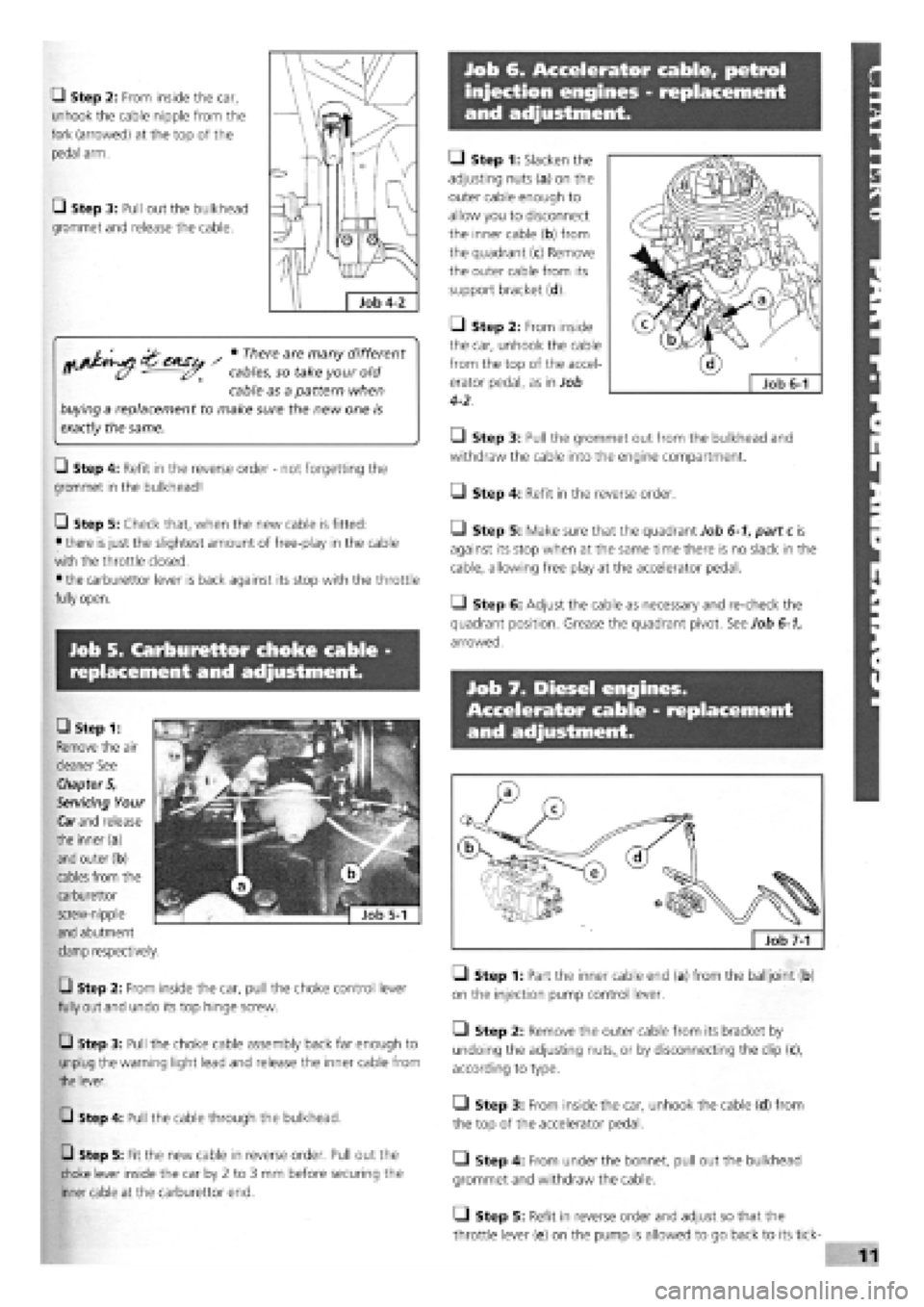
Job 6. Accelerator cable, petrol
injection engines - replacement
and adjustment.
Q Step 2: From inside the car,
unhook the cable nipple from the
fork (arrowed) at the top of the
pedal arm.
• Step 3: Pull out the bulkhead
grommet and release the cable.
^ • There are many different
cables, so take your old
cable as a pattern when
buying a replacement to make sure the new one is
exactly
the same.
Q Step 4: Refit in the reverse order
-
not forgetting the
grommet in the bulkhead!
Q Step 5: Check that, when the new cable is fitted:
• there
is
just the slightest amount of free-play in the cable
with the throttle closed.
• the carburettor lever is back against its stop with the throttle
fully open.
• Step 1: Slacken the
adjusting nuts (a) on the
outer cable enough to
allow you to disconnect
the inner cable (b) from
the quadrant (c) Remove
the outer cable from its
support bracket (d).
Q Step 2: From inside
the car, unhook the cable
from the top of the accel-
erator pedal, as in Job
4-2.
• Step 3: Pull the grommet out from the bulkhead and
withdraw the cable into the engine compartment.
O Step 4: Refit in the reverse order.
• Step 5: Make sure that the quadrant Job 6-1, part c is
against its stop when at the same time there is no slack in the
cable, allowing free play at the accelerator pedal.
• Step 6: Adjust the cable as necessary and re-check the
quadrant position. Grease the quadrant pivot. See Job 6-1,
arrowed.
Job 7. Diesel engines.
Accelerator cable - replacement
and adjustment.
Job 5. Carburettor choke cable -
replacement and adjustment.
Q Step 2: From inside the car, pull the choke control lever
fully out and undo its top hinge screw.
Q Step 3: Pull the choke cable assembly back far enough to
unplug the warning light lead and release the inner cable from
the lever.
Q Step 4: Pull the cable through the bulkhead.
Q Step 5: Fit the new cable in reverse order. Pull out the
choke lever inside the car by 2 to 3 mm before securing the
inner cable at the carburettor end.
Q Step 1: Part the inner cable end (a) from the balljoint (b)
on the injection pump control lever.
• Step 2: Remove the outer cable from its bracket by
undoing the adjusting
nuts,,
or by disconnecting the clip (c),
according to type.
• Step 3: From inside the car, unhook the cable (d) from
the top of the accelerator pedal.
• Step 4: From under the bonnet, pull out the bulkhead
grommet and withdraw the cable.
Q Step 5: Refit in reverse order and adjust so that the
throttle lever (e) on the pump is allowed to go back to its tick-
CD Step 1:
Remove the air
cleaner See
Chapter 5,
Servicing Your
Car
and
release
the inner(a)
and outer (b)
cables from the
carburettor
screw-nipple
and abutment
clamp respectively.
Page 116 of 171
over stop and will also reach its 'maximum speed' stop with
the pedal fully depressed.
Job 8. Mechanical fuel pump,
petrol engine (carburettored) -
replacement.
O Step 1: Disconnect the battery earth lead.
• Step 2: Find the pump on the forward facing side of the
cylinder block near the timing cover end. Disconnect the two
fuel lines from the pump and plug the ends, (labelling them
for correct refitment).
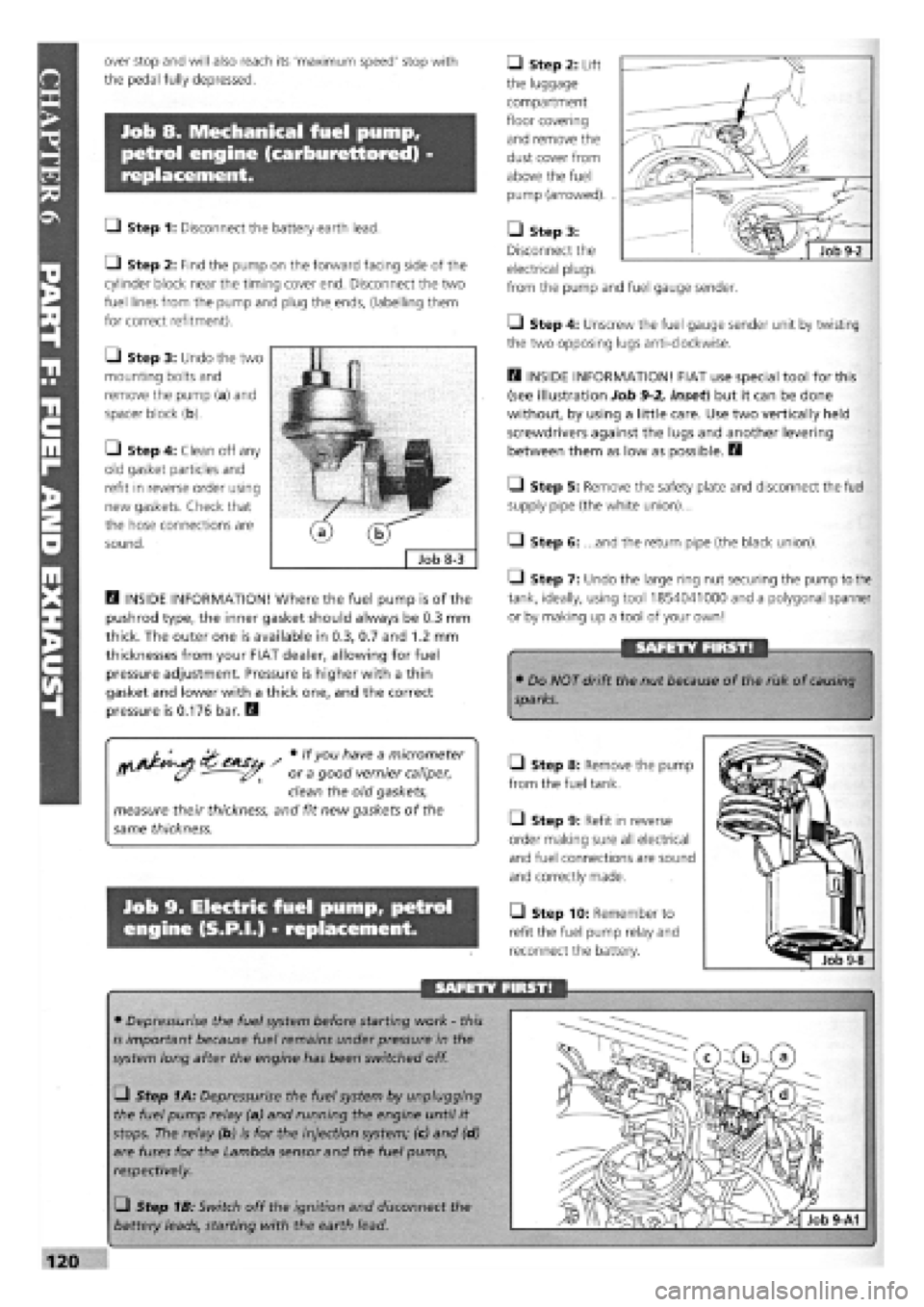
• Step 3: Undo the two
mounting bolts and
remove the pump (a) and
spacer block (b).
• Step 4: Clean off any
old gasket particles and
refit in reverse order using
new gaskets. Check that
the hose connections are
sound.
D INSIDE INFORMATION! Where the fuel pump is of the
pushrod type, the inner gasket should always be 0.3 mm
thick. The outer one is available in 0.3, 0.7 and 1.2 mm
thicknesses from your FIAT dealer, allowing for fuel
pressure adjustment. Pressure is higher with a thin
gasket and lower with a thick one, and the correct
pressure is 0.176 bar. Q
/ # lfyou h"ve a m/cromefer
ff (y - or a good vernier caliper,
clean the old gaskets,
measure their thickness, and fit new gaskets of the
same thickness.
Job 9. Electric fuel pump, petrol
engine (S.P.I.) - replacement.
• Step 2: Lift
the luggage
compartment
floor covering
and remove the
dust cover from
above the fuel
pump (arrowed). .
• Step 3:
Disconnect the
electrical plugs
from the pump and fuel gauge sender.
• Step 4: Unscrew the fuel gauge sender unit by twisting
the two opposing lugs anti-clockwise.
D INSIDE INFORMATION! FIAT use special tool for this
(see illustration Job
9-2,
inset) but it can be done
without, by using a little care. Use two vertically held
screwdrivers against the lugs and another levering
between them as low as possible. H
Q Step 5: Remove the safety plate and disconnect the fuel
supply pipe (the white union)...
Q Step 6: ...and the return pipe (the black union).
1-1 Step 7: Undo the large ring nut securing the pump to the
tank, ideally, using tool 1854041000 and a polygonal spanner
or by making up a tool of your own!
SAFETY FIRST!
• Do NOT drift the nut because of the risk of
causing
sparks.
Q Step 8: Remove the pump
from the fuel tank.
Q Step 9: Refit in reverse
order making sure all electrical
and fuel connections are sound
and correctly made.
• Step 10: Remember to
refit the fuel pump relay and
reconnect the battery.
SAFETY FIRST!
• Depressurise the fuel system before starting work
-
this
is important because fuel remains under pressure in the
system long after the engine has been switched off.
• Step 1A: Depressurise the fuel system by unplugging
the fuel pump relay (a) and running the engine until it
stops. The relay (b) is for the injection system; (c) and (d)
are fuses for the Lambda sensor and the fuel pump,
respectively.
• Step 1B: Switch off the ignition and disconnect the
battery leads, starting with the earth lead.
Page 117 of 171
Job 10. Fuel tank - removal and
refitting.
Job 11. Hot air hoses/thermo-
valves - general.
SAFETY FIRST!
Job 12. Lambda sensor
(S.P.I, engines) - replacement.
• We recommend that you carry out all of this work
out of
doors.
I
IMPORTANT NOTE:
• Read Chapter 1, Safety First! before carrying out
this
work!
• Plan ahead! Run the fuel in the tank as low as possible
before you start this job.
Q Step 1: Disconnect the battery leads starting with the
earth lead.
• Step 2: Syphon any remaining fuel from the tank and
into a suitable closed container.
Q Step 3: Disconnect the fuel sender wiring and any fuel
hoses
from within the boot (model-dependent
-
see Job 9 and
PARTE: ELECTRICAL AND INSTRUMENTS, Job 14).
• Step 4: Disconnect the filler and breather hoses from the
tank,
working from underneath the car.
a - Lambda sensor b - connector to ECU c - sensor heater power supply Job 12-2
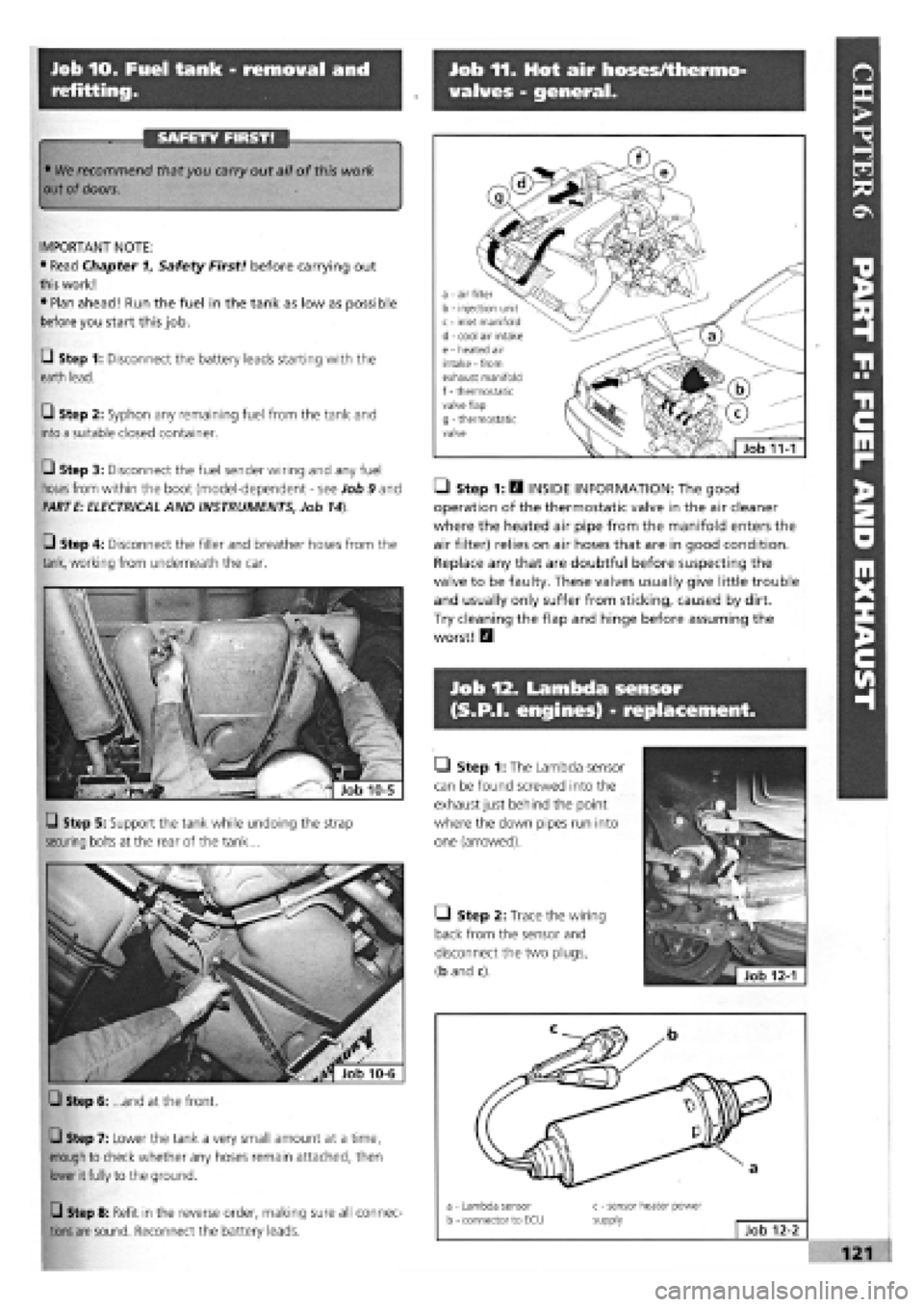
Q Step 5: Support the tank while undoing the strap
securing bolts at the rear of the tank...
Q Step 6: ...and at the front.
Q Step 7: Lower the tank a very small amount at a time,
enough to check whether any hoses remain attached, then
lower it fully to the ground.
Q Step 8: Refit in the reverse order, making sure all connec-
tions are
sound. Reconnect the battery leads.
• Step 1: H INSIDE INFORMATION: The good
operation of the thermostatic valve in the air cleaner
where the heated air pipe from the manifold enters the
air filter) relies on air hoses that are in good condition.
Replace any that are doubtful before suspecting the
valve to be faulty. These valves usually give little trouble
and usually only suffer from sticking, caused by dirt.
Try cleaning the flap and hinge before assuming the
worst! Q
• Step 1: The Lambda sensor
can be found screwed into the
exhaust just behind the point
where the down pipes run into
one (arrowed).
Q Step 2: Trace the wiring
back from the sensor and
disconnect the two plugs,
(b and c).
a - air filter b - injection unit c - inlet manifold d - cool air intake e - heated air intake - from exhaust manifold f
-
thermostatic valve flap g - thermostatic valve
Job 11-1
Page 118 of 171
Job 14. Exhaust system -
replacement.
FACT FILE: LAMBDA SENSOR
• The Lambda sensor is very fragile and
should not be knocked or dropped.
• We recommend that a new one is fitted
only by your FIAT dealer, who can test the
old one to see whether it is working properly.
• No cleaners should be used on the sensor.
Q Step 3: Before refitting, check that the sensor sealing ring
is in good condition, and lubricate the thread of the sensor
with a high-temperature anti-seize compound.
Job 13. Fuel evaporation system.
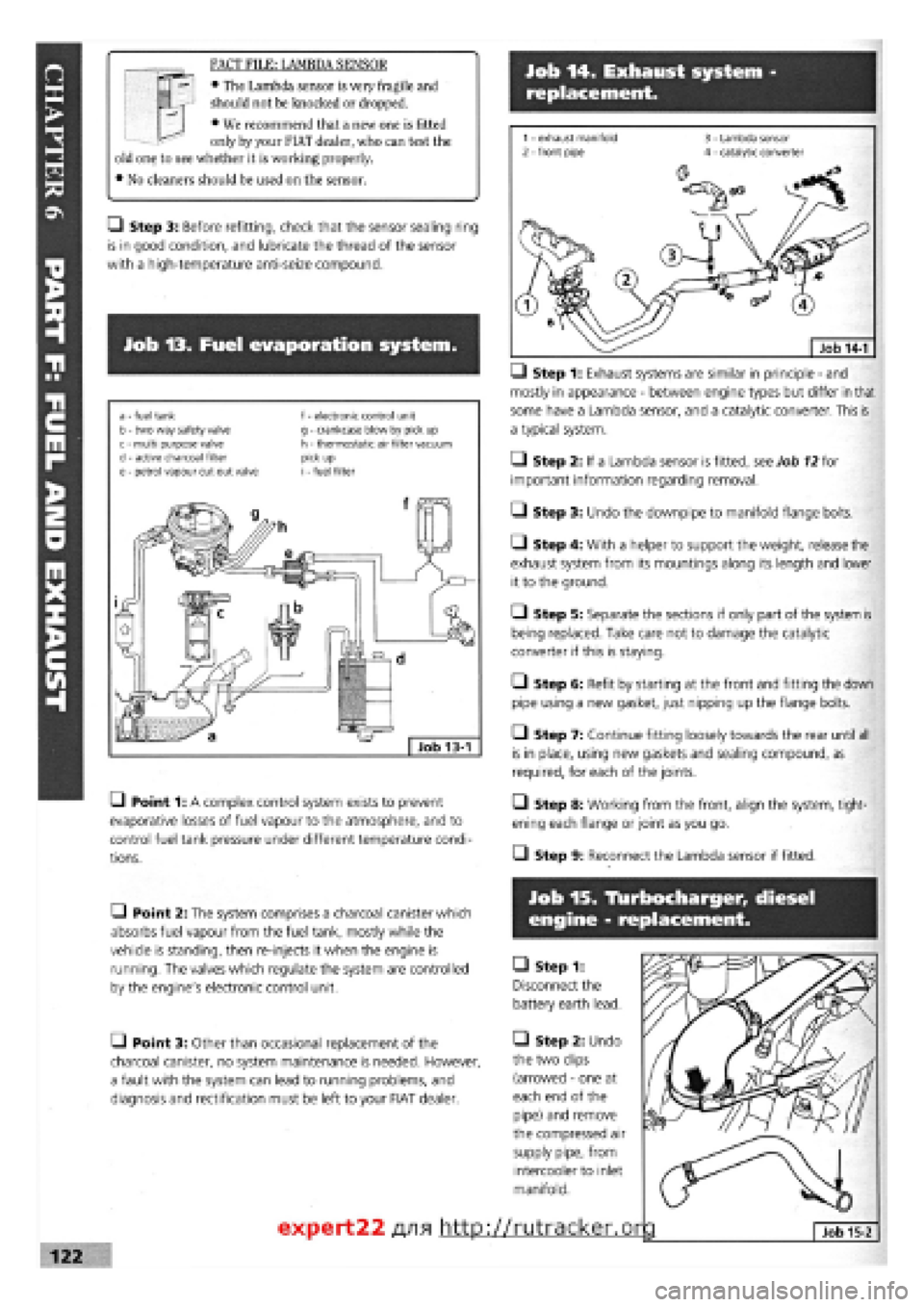
a - fuel tank b - two way safety valve c - multi purpose valve d
-
active charcoal filter e - petrol vapour cut out valve
f - electronic control unit g - crankcase blow by pick up h - thermostatic air filter vacuum pick up i - fuel filter
• Point 1: A complex control system exists to prevent
evaporative losses of fuel vapour to the atmosphere, and to
control fuel tank pressure under different temperature condi-
tions.
—) Step 1: Exhaust systems are similar in principle
-
and
mostly in appearance
-
between engine types but differ in that
some have a Lambda sensor, and a catalytic converter. This is
a typical system.
• Step 2: If a Lambda sensor is fitted, see Job
12
for
important information regarding removal.
• Step 3: Undo the downpipe to manifold flange bolts.
• Step 4: With a helper to support the weight, release the
exhaust system from its mountings along its length and lower
it to the ground.
O Step 5: Separate the sections if only part of the system is
being replaced. Take care not to damage the catalytic
converter if this is staying.
• Step 6: Refit by starting at the front and fitting the down
pipe using a new gasket, just nipping up the flange bolts.
• Step 7: Continue fitting loosely towards the rear until all
is in place, using new gaskets and sealing compound, as
required, for each of the joints.
• Step 8: Working from the front, align the system, tight-
ening each flange or joint as you go.
• Step 9: Reconnect the Lambda sensor if fitted.
• Point 2: The system comprises a charcoal canister which
absorbs fuel vapour from the fuel tank, mostly while the
vehicle is standing, then re-injects it when the engine is
running. The valves which regulate the system are controlled
by the engine's electronic control unit.
• Point 3: Other than occasional replacement of the
charcoal canister, no system maintenance is needed. However,
a fault with the system can lead to running problems, and
diagnosis and rectification must be left to your FIAT dealer.
Job 15. Tlurbocharger, diesel
engine - replacement.
• Step 1:
Disconnect the
battery earth lead.
• Step 2: Undo
the two clips
(arrowed
-
one at
each end of the
pipe) and remove
the compressed air
supply pipe, from
intercooler to inlet
manifold.
expert22 fl/i* http://rutracker.or
Page 120 of 171
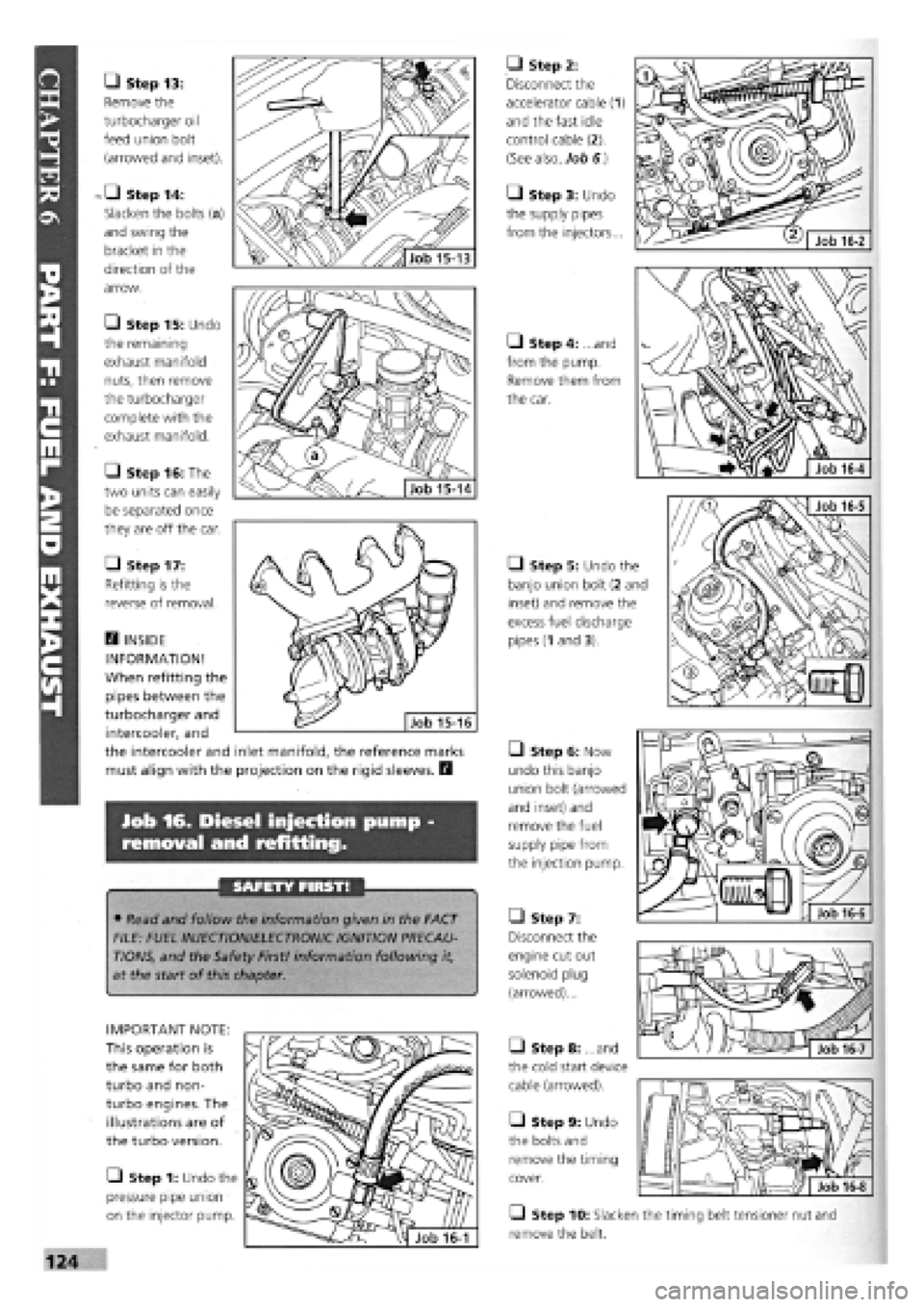
• Step 13:
Remove the
turbocharger oil
feed union bolt
(arrowed and inset).
Step 14:
Slacken the bolts (a)
and swing the
bracket in the
direction of the
arrow.
• Step 15: Undo
the remaining
exhaust manifold
nuts, then remove
the turbocharger
complete with the
exhaust manifold.
• Step 16: The
two units can easily
be separated once
they are off the car.
• Step 17:
Refitting is the
reverse of removal.
• Step 2:
Disconnect the
accelerator cable (1)
and the fast idle
control cable (2).
(See also, Job 6.)
• Step 3: Undo
the supply pipes
from the injectors...
Q Step 4: ...and
from the pump.
Remove them from
the car.
• Step 5: Undo the
banjo union bolt (2 and
inset) and remove the
excess fuel discharge
pipes
(1
and 3).
Job 16. Diesel injection pump -
removal and refitting.
SAFETY FIRST!
• Read and follow the information given in the FACT
FILE: FUEL INJECTION/ELECTRONIC IGNITION PRECAU-
TIONS, and the Safety First! information following it,
at the start of this chapter.
• Step 10: Slacken the timing belt tensioner nut and
remove the belt.
• Step 6: Now
undo this banjo
union bolt (arrowed
and inset) and
remove the fuel
supply pipe from
the injection pump.
• Step 7:
Disconnect the
engine cut out
solenoid plug
(arrowed)...
• Step 8: ...and
the cold start device
cable (arrowed).
• Step 9: Undo
the bolts and
remove the timing
cover.
IMPORTANT NOTE:
This operation is
the same for both
turbo and non-
turbo engines. The
illustrations are of
the turbo version.
• Step 1: Undo the
pressure pipe union
on the injector pump.
• INSIDE
INFORMATION!
When refitting the
pipes between the
turbocharger and
intercooler, and
the intercooler and inlet manifold, the reference marks
must align with the projection on the rigid sleeves. E3
Job 16-6
Page 122 of 171
• Step 22: Inspect the timing belt and if
-
• it is contaminated with any liquid,
• has damaged teeth,
• or frayed edges,
• or it has covered more than 30000 km,
-
fit a new one.
D INSIDE INFORMATION: Some FIAT mechanics
recommend that the belt is replaced as a matter of
course. The cost of a new belt compared to the cost
of a damaged engine, makes it a false economy not to
do so.
E9
Q Step 23: Place the timing belt over the sprockets,
keeping it tight on the run between the pump and camshaft.
Q Step 24: Push the adjusting pulley into the belt and nip
up the lock nut. Without the aid of the special tool, the
adjustment is roughly correct when you can twist the belt at
its longest point between thumb and finger through a quarter
turn (90 degrees).
• Step 25: Turn the engine two full revolutions, re-check
the timing and belt tension. Adjust if necessary and tighten
the adjusting pulley lock nut.
B INSIDE INFORMATION! CHECKING INJECTION
ADVANCE. This cannot be done without the use of a dial
gauge and special adapter to fit on the rear of the
pump. We strongly recommend that although your
engine may seem to be running well, you get it checked
by your FIAT dealer. B
Job 17. Diesel injectors -
remove and refit.
Q Step 1: Clean thoroughly around each injector to prevent
dirt from entering the cylinders when removing the injectors.
Q Step 2: Unscrew the fuel pipe union at the injector, using
a flare nut wrench (split ring spanner).
• Step 3: Loosen the union at the injection-pump-end of
each injector pipe. Disconnect the fuel-return unions at the
injector and move the return pipes away.
• Step 4:
Unscrew the
injector using a
deep 27 mm A/F
socket, or,
preferably, a
proper injector
socket
(arrowed).
Collect the
injector and its
base washer. All seals should be renewed every time the
injector is removed.
• Step 5:
Thoroughly clean
the injector
before refitting,
as dirt here can
cause cylinder
leakage, as can
the re-use of a
sealing washer,
so always renew
them.
• Step 6:
Injector efficiency
and spray pattern
can only be
checked by your
FIAT dealer, or a
Diesel or injection
specialist with test
equipment. This is
an inexpensive
check to have
carried out, while
the injectors are out.
• Step 7: Refit the injector, tightening it to the specified
tightening torque. See Chapter 3, Facts and Figures.
• Step 8: Reconnect all parts in the reverse order. Run the
engine at a fast idle initially to clear air from the high pressure
side of the fuel system.
Job 18. Bleeding Diesel fuel
system.
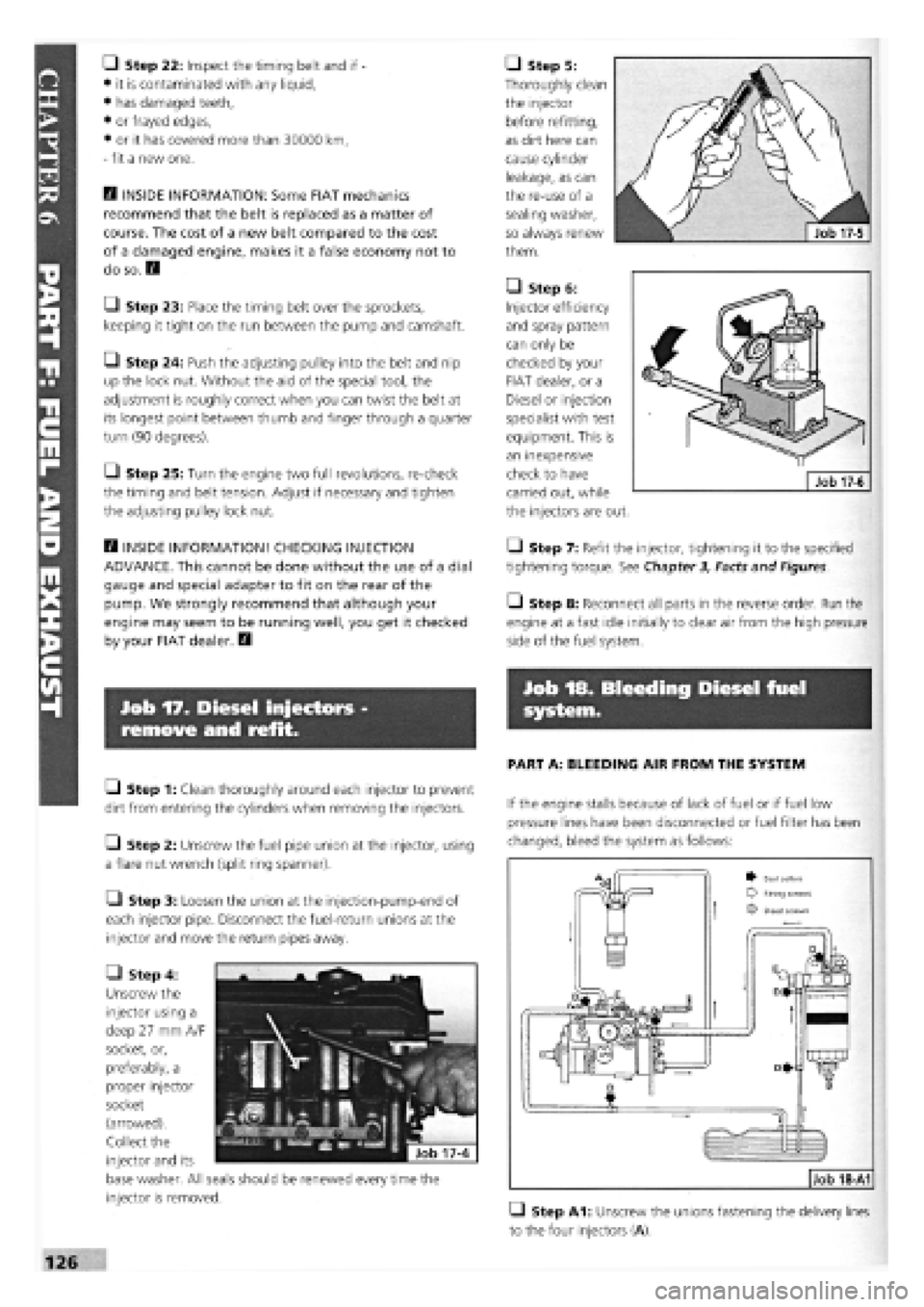
PART A: BLEEDING AIR FROM THE SYSTEM
If the engine stalls because of lack of fuel or if fuel low
pressure lines have been disconnected or fuel filter has been
changed, bleed the system as follows:
• Step A1: Unscrew the unions fastening the delivery lines
to the four injectors (A).
Job 18-A1
^ Seal collars Fifing screws
O Bleed screws
Page 123 of 171
• Step A2: Start the engine and run until fluid emerges
from the loose injector fitting.
G Step A3: Keep the engine running and tighten the four
injector fittings.
B INSIDE INFORMATION: If the engine will not start,
check all fuel inlet pipe union points (see illustration Job
18-A1,
part D) and also the pipe fittings (Job 18-A1,
part E). Replace seal washers to eliminate the possibility
of air leaks. H
PART B: BLEEDING WATER FROM DIESEL
Bleed off water from the fuel filter as follows:
• Step B1: Unscrew the water bleed screw (Job 18-A1,
part B) under the filter.
• Step B2: Unscrew air bleed screw (Job 18-A1, part Q
above the filter.
• Step B3: Let water and fuel emerge until no more water
is present, then tighten, firstly the water bleed screw (B) under
filter, and then the air bleed screw (C) above the filter.
PART G: STEERING AND SUSPENSION
PART G: Contents
Job
1.
The systems explained.
Job
2.
Steering wheel
-
removal and refitting
Job 3. Track rod end balijoint
-
replacement.
Job
4.
Steering rack gaiter
-
replacement.
Job 5. Steering rack
-
replacement.
Job
6.
Power steering pump
-
removal and refitting
Job
7.
Lower wishbone
-
replacement.
Job 8. Bleeding the power steering.
Job 9. Front anti-roll bar
-
removal and refitting.
Job 10. Rear anti-roll bar (when fitted).
Job 11. Front shock absorber
-
replacement.
Job 12. Front wheel bearing
-
replacement.
Job 13. Rear shock absorbers and coil springs
-
replacement.
Job 14. Rear suspension and wheel bearings
-
replacement.
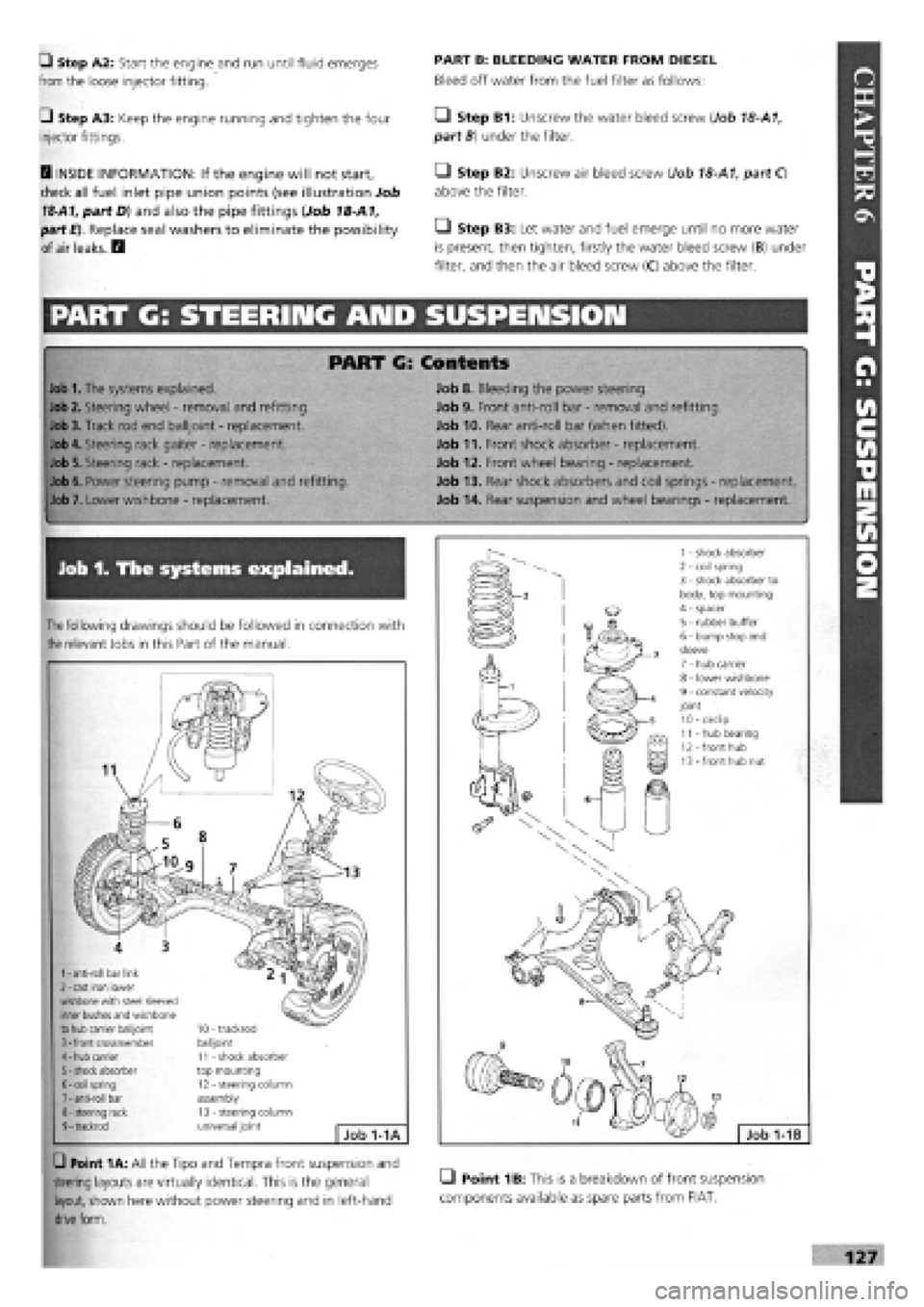
Job 1. The systems explained.
The
following drawings should be followed in connection with
the
relevant Jobs in this Part of the manual.
1
-
anti-roll bar link 2
-
cast iron lower wishbone with steel sleeved inner bushes and wishbone to hub carrier balijoint 3
-
front crossmember 4
-
hub carrier 5
-
shock absorber 6
-
coil spring 7
-
anti-roll bar 8
-
steering rack 9
-
trackrod
10 - trackrod balijoint 11 - shock absorber top mounting 12 - steering column assembly 13 - steering column universal joint Job 1-1A
G Point 1A: All the Tipo and Tempra front suspension and
steering layouts are virtually identical. This is the general LI Point 1B: This is a breakdown of front suspension
layout, shown here without power steering and in left-hand components available as spare parts from FIAT,
drive
form.
Page 127 of 171
Q Step 4: Re-assemble in the reverse order using torque
settings shown in Chapter
3,
Facts and Figures
Job 8. Bleeding the power
steering.
The power assisted steering system is self-bleeding. You
should slowly apply full lock alternately to the right and left
with the car stationary and the engine running, while an
assistant tops up the reservoir. This operation should be
carried out each time the connecting pipes are removed or
refitted.
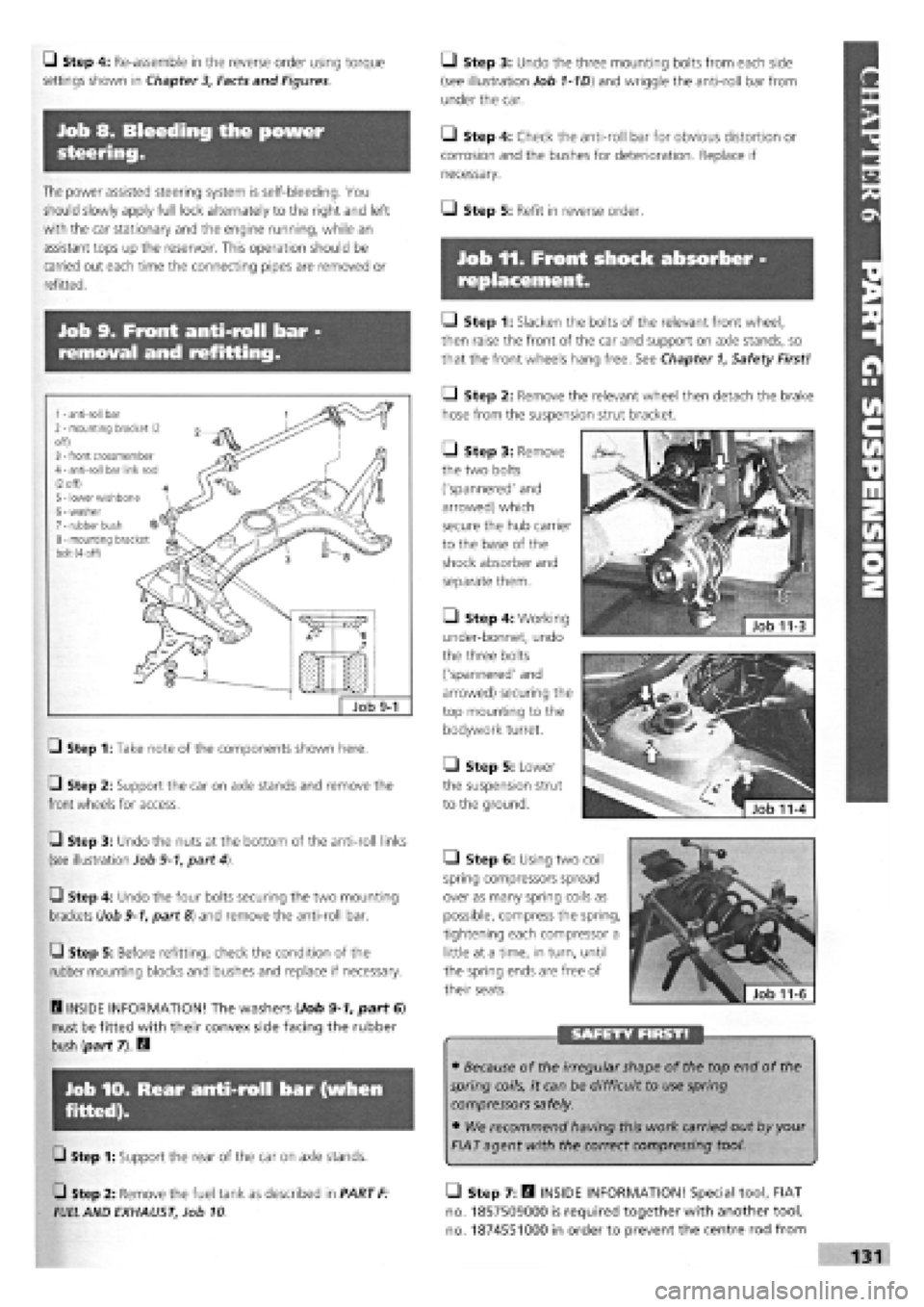
Job 9. Front anti-roll bar -
removal and refitting.
G Step 1: Take note of the components shown here.
G Step 2: Support the car on axle stands and remove the
front wheels for access.
G Step 3: Undo the nuts at the bottom of the anti-roll links
(see illustration Job
9-1,
part 4).
G Step 4: Undo the four bolts securing the two mounting
brackets (Job
9-1,
part 8) and remove the anti-roll bar.
G Step 5: Before refitting, check the condition of the
rubber mounting blocks and bushes and replace if necessary.
Q INSIDE INFORMATION! The washers (Job
9-1,
part 6)
must be fitted with their convex side facing the rubber
bush (part 7). B
lob 10. Rear anti-roll bar (when
fitted).
• Step 3: Undo the three mounting bolts from each side
(see illustration Job
1-1D)
and wriggle the anti-roll bar from
under the car.
• Step 4: Check the anti-roll bar for obvious distortion or
corrosion and the bushes for deterioration. Replace if
necessary.
I—J Step 5: Refit in reverse order.
Job 11. Front shock absorber -
replacement.
Q Step 1: Slacken the bolts of the relevant front wheel,
then raise the front of the car and support on axle stands, so
that the front wheels hang free. See Chapter
1,
Safety First!
Q Step 2: Remove the relevant wheel then detach the brake
hose from the suspension strut bracket.
• Step 3: Remove
the two bolts
('spannered' and
arrowed) which
secure the hub carrier
to the base of the
shock absorber and
separate them.
• Step 4: Working
under-bonnet, undo
the three bolts
('spannered' and
arrowed) securing the
top mounting to the
bodywork turret.
• Step 5: Lower
the suspension strut
to the ground.
• Step 6: Using two coil
spring compressors spread
over as many spring coils as
possible, compress the spring,
tightening each compressor a
little at a time, in turn, until
the spring ends are free of
their seats.
• Because of the irregular shape of the top end of the
spring coils, it can be difficult to use spring
compressors safely.
• We recommend having this work carried out by your
FIAT agent with the correct compressing tool. G Step 1: Support the rear of the car on axle stands.
Job 9-1
1
-
anti-roll bar 2
-
mounting bracket (2 off) 3
-
front crossmember 4
-
anti-roll bar link rod
(2
off) 5
-
lower wishbone 6
-
washer 7
-
rubber bush 8
-
mounting bracket bolt (4 off)
G Step 2: Remove the fuel tank as described in PART
F:
FUEL
AND EXHAUST, Job 10
• Step 7: B INSIDE INFORMATION! Special tool, FIAT
no. 1857509000 is required together with another tool,
no. 1874551000 in order to prevent the centre rod from
Page 134 of 171
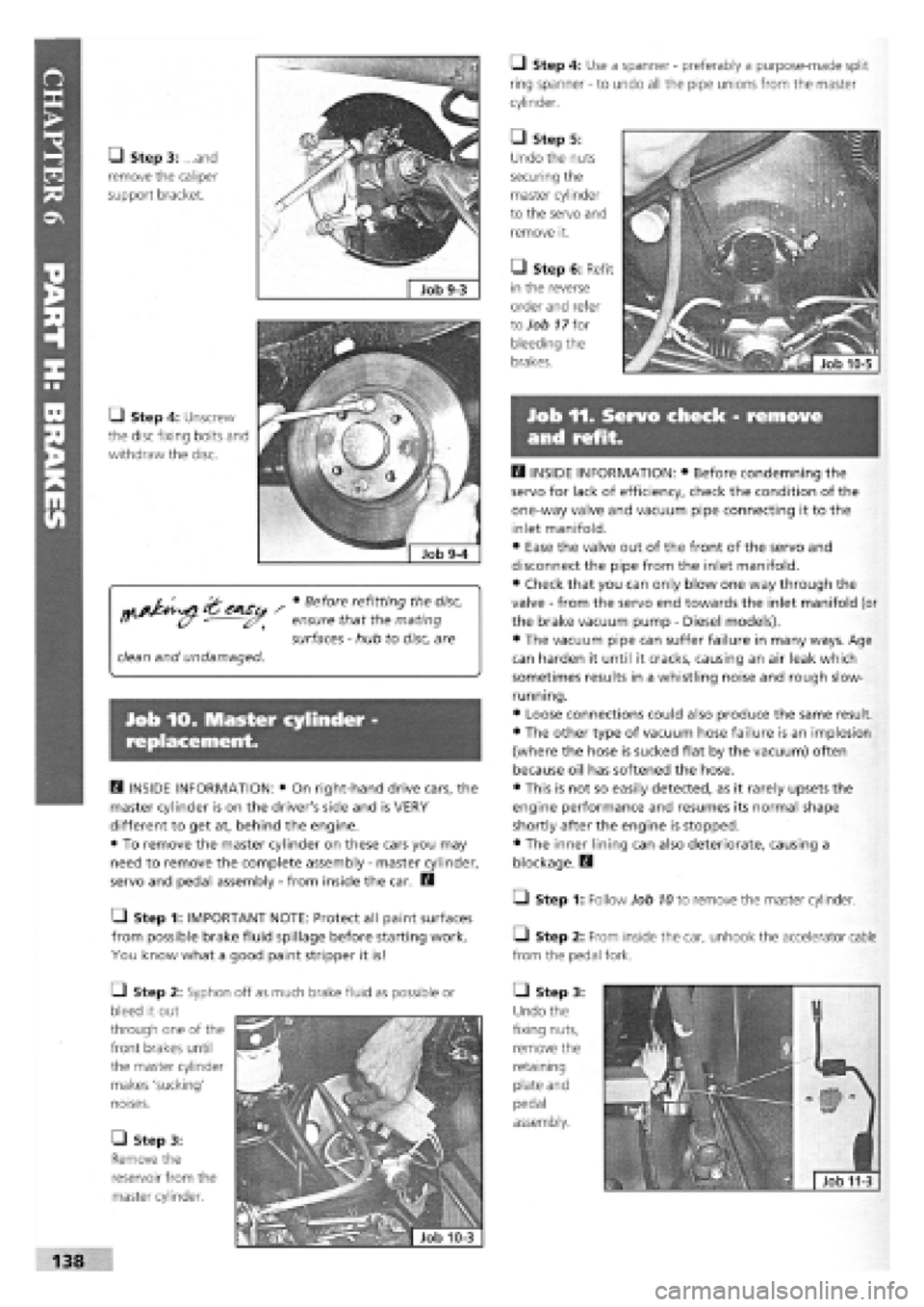
• Step 3: ...and
remove the caliper
support bracket.
Ll Step 4: Unscrew
the disc fixing bolts and
withdraw the disc.
clean and undamaged.
• Before refitting the disc,
ensure that the mating
surfaces
-
hub to disc, are
Job 10. Master cylinder
replacement.
H INSIDE INFORMATION: • On right-hand drive cars, the
master cylinder is on the driver's side and is VERY
different to get at, behind the engine.
• To remove the master cylinder on these cars you may
need to remove the complete assembly
-
master cylinder,
servo and pedal assembly
-
from inside the car. Q
• Step 1: IMPORTANT NOTE: Protect all paint surfaces
from possible brake fluid spillage before starting work.
You know what a good paint stripper it is!
• Step 2: Syphon off as much brake fluid as possible or
bleed it out
through one of the
front brakes until
the master cylinder
makes 'sucking'
noises.
• Step 3:
Remove the
reservoir from the
master cylinder.
138
• Step 4: Use a spanner
-
preferably a purpose-made split
ring spanner
-
to undo all the pipe unions from the master
cylinder.
• Step 5:
Undo the nuts
securing the
master cylinder
to the servo and
remove it.
• Step 6: Refit
in the reverse
order and refer
to Job
77
for
bleeding the
brakes.
Job 11. Servo check
and refit.
remove
Q INSIDE INFORMATION: • Before condemning the
servo for lack of efficiency, check the condition of the
one-way valve and vacuum pipe connecting it to the
inlet manifold.
• Ease the valve out of the front of the servo and
disconnect the pipe from the inlet manifold.
• Check that you can only blow one way through the
valve
-
from the servo end towards the inlet manifold (or
the brake vacuum pump
-
Diesel models).
• The vacuum pipe can suffer failure in many ways. Age
can harden it until it cracks, causing an air leak which
sometimes results in a whistling noise and rough slow-
running.
• Loose connections could also produce the same result.
• The other type of vacuum hose failure is an implosion
(where the hose is sucked flat by the vacuum) often
because oil has softened the hose.
• This is not so easily detected, as it rarely upsets the
engine performance and resumes its normal shape
shortly after the engine is stopped.
• The inner lining can also deteriorate, causing a
blockage. Q
• Step 1: Follow Job
10
to remove the master cylinder.
• Step 2: From inside the car, unhook the accelerator cable
from the pedal fork.
• Step 3:
Undo the
fixing nuts,
remove the
retaining
plate and
pedal
assembly.
•
eP^BH
1
| Mitx
IfP^K p{B||n (Or Hot
I
a^®. i kS^^^Ap
i
/is ^8*5211^3
in A
Mil
11 SaBPffe
l|i§
# J
Job 11-3
Page 135 of 171
Job 12. Pressure regulating valve,
non-ABS system - replacement
and adjustment.
• Step 9: Bleed the brakes, see Job
17
139
-8
The pressure regulating valve is also known as the load
proportioning valve.
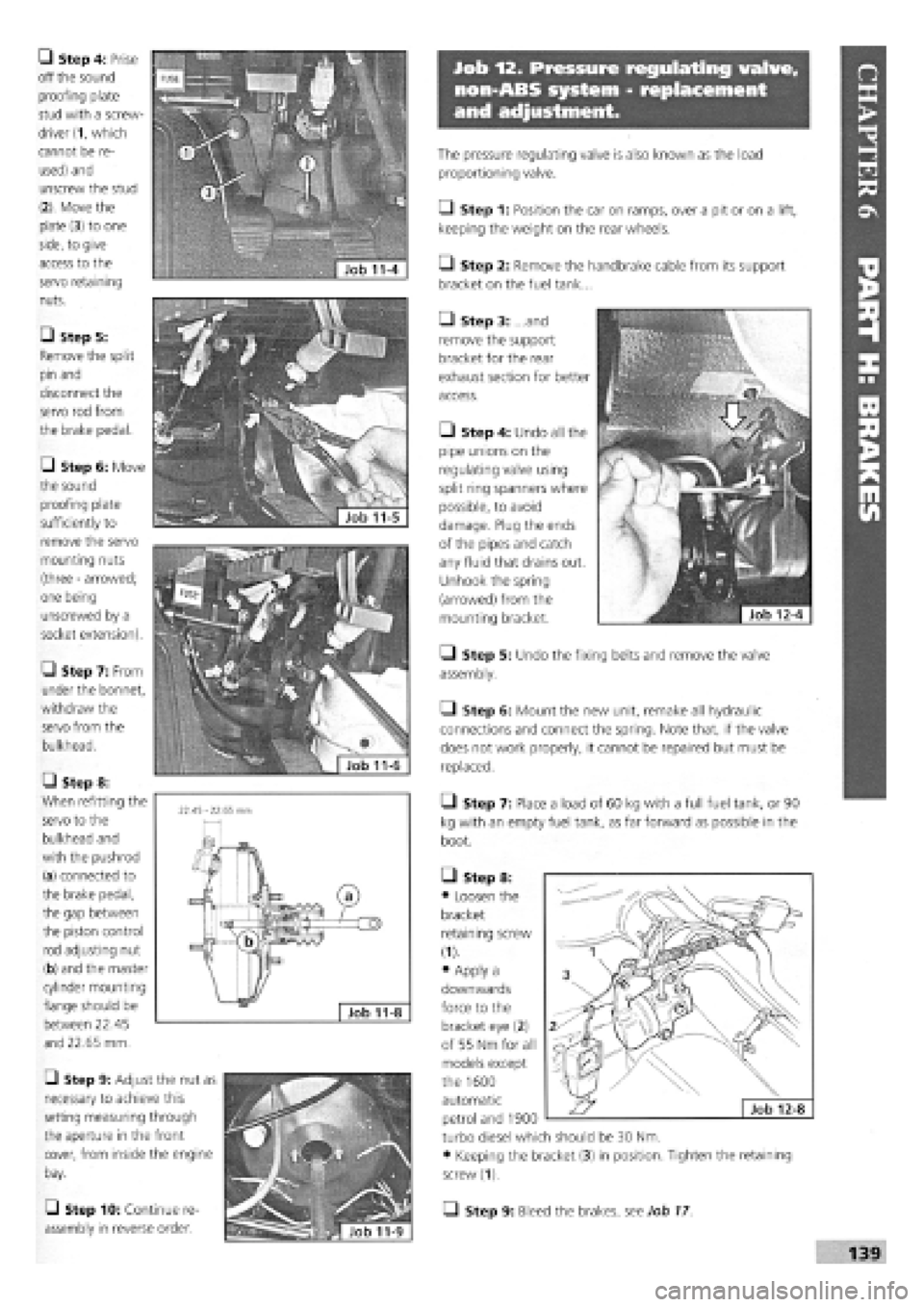
[G Step 1: Position the car on ramps, over a pit or on a lift,
keeping the weight on the rear wheels.
• Step 2: Remove the handbrake cable from its support
bracket on the fuel tank...
• Step 3: ...and
remove the support
bracket for the rear
exhaust section for better
access.
• Step 4: Undo all the
pipe unions on the
regulating valve using
split ring spanners where
possible, to avoid
damage. Plug the ends
of the pipes and catch
any fluid that drains out.
Unhook the spring
(arrowed) from the
mounting bracket.
Q Step 5: Undo the fixing belts and remove the valve
assembly.
• Step 6: Mount the new unit, remake all hydraulic
connections and connect the spring. Note that, if the valve
does not work properly, it cannot be repaired but must be
replaced.
• Step 7: Place a load of 60 kg with a full fuel tank, or 90
kg with an empty fuel tank, as far forward as possible in the
boot.
• Step 4: Prise
off the sound
proofing plate
stud with a screw-
driver (1, which
cannot be re-
used) and
unscrew the stud
(2). Move the
plate (3) to one
side, to give
access to the
servo retaining
nuts.
• Step 5:
Remove the split
pin
and
disconnect the
servo rod from
the brake pedal.
G Step 6: Move
the sound
proofing plate
sufficiently to
remove the servo
mounting nuts
(three
-
arrowed;
one being
unscrewed by a
socket extension).
G Step 7: From
under the bonnet,
withdraw the
servo from the
bulkhead.
G Step 9: Adjust the nut as
necessary to achieve this
setting measuring through
the aperture in the front
cover, from inside the engine
bay.
G Step 10: Continue re-
assembly in reverse order.
G Step 8:
When refitting the
servo to the
bulkhead and
with the pushrod
(a) connected to
the brake pedal,
the gap between
the piston control
rod adjusting nut
(b) and the master
cylinder mounting
flange should be
between 22.45
and 22.65 mm.
22.45-22.65 mm
• Step 8:
• Loosen the
bracket
retaining screw
(1).
• Apply a
downwards
force to the
bracket eye (2)
of 55 Nm for all
models except
the 1600
automatic
petrol and 1900
turbo diesel which should be 30 Nm.
• Keeping the bracket (3) in position. Tighten the retaining
screw (1).