engine FIAT TEMPRA 1988 Service And Manual Online
[x] Cancel search | Manufacturer: FIAT, Model Year: 1988, Model line: TEMPRA, Model: FIAT TEMPRA 1988Pages: 171, PDF Size: 18.05 MB
Page 102 of 171
extend their life by fitting new seals, when necessary. Note that
you will need to use internal circlip pliers to remove the circlip
from the pushrod on the master cylinder in order to dismantle it.
When you need to bleed the clutch hydraulic system, follow
the procedure described for brake bleeding in PART H:
BRAKES, Job 17. Because the circuit is far simpler, the
procedure itself is likely to be both simpler and quicker to carry
out. Note that the bleed screw (f) is normally covered by a cap
(e) which must be removed before the bleed screw can be
slackened.
PART C: COOLING SYSTEM
PART C: Contents - ' B SI s |§w ^ - -
-
silt Job 1: Component positions. Job 4. Thermostat
-
replacement.
Job 2. Radiator and cooling fan
-
replacement. Job 5. Coolant pump
-
replacement.
Job 3. Thermostatic switch
-
testing and replacing.
Job 1. Component positions.
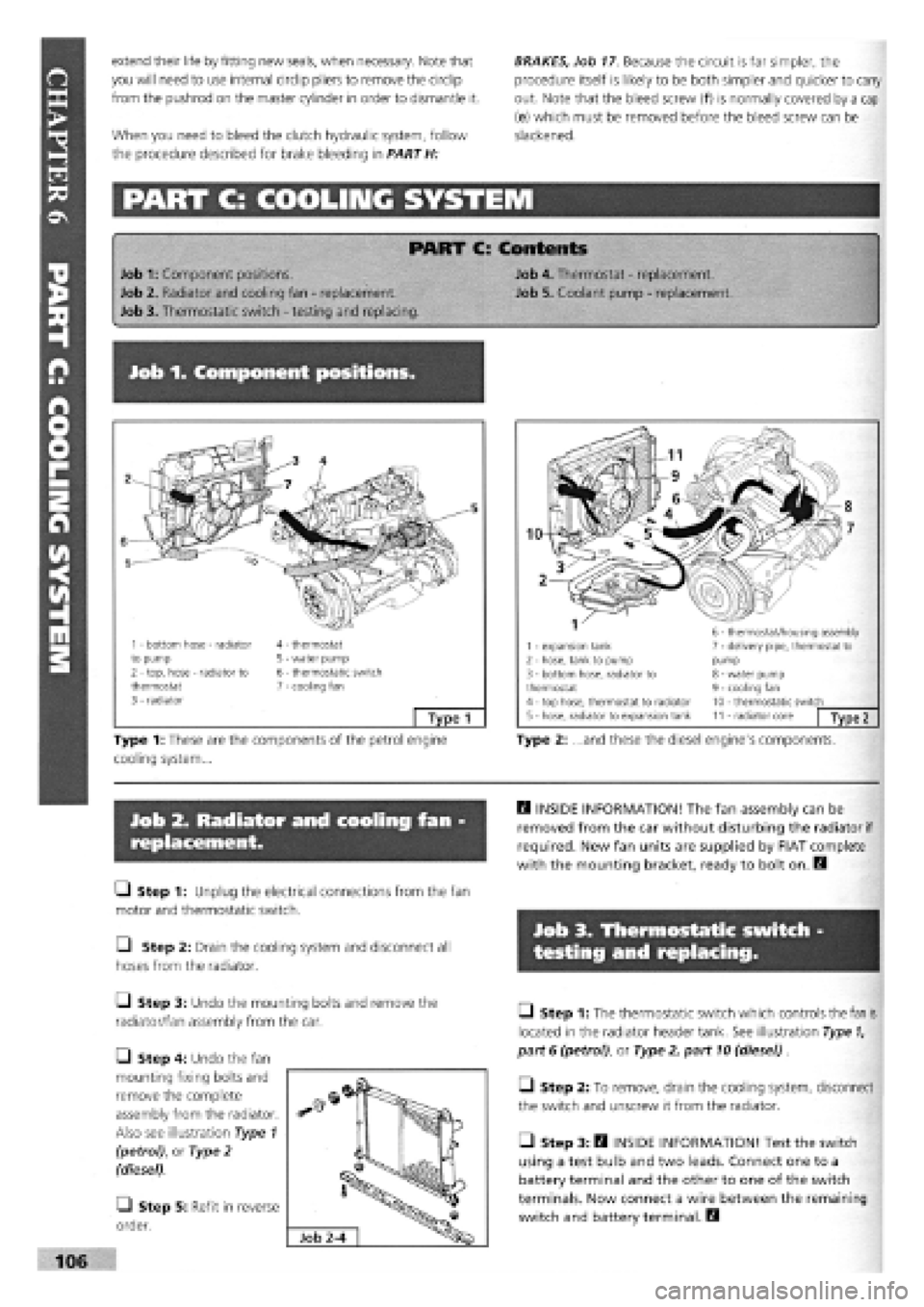
1 - bottom hose - radiator to pump 2 - top, hose - radiator to thermostat 3 - radiator
4 - thermostat 5
-
water pump 6 - thermostatic switch 7 - cooling fan
Type 1
1 - expansion tank 2 - hose, tank to pump 3 - bottom hose, radiator to thermostat 4 - top hose, thermostat to radiator 5 - hose, radiator to expansion tank
6 - thermostat/housing assembly 7 - delivery pipe, thermostat to pump 8
-
water pump 9 - cooling fan 10
-
thermostatic switch 11 - radiator core Type 2
Type 2: ...and these the diesel engine's components. Type 1: These are the components of the petrol engine
cooling system...
Job 2. Radiator and cooling fan -
replacement.
• Step 1: Unplug the electrical connections from the fan
motor and thermostatic switch.
• Step 2: Drain the cooling system and disconnect all
hoses from the radiator.
Q Step 3: Undo the mounting bolts and remove the
radiator/fan assembly from the car.
• Step 4: Undo the fan
mounting fixing bolts and
remove the complete
assembly from the radiator.
Also see illustration Type 1
(petrol), or Type 2
(diesel).
Q Step 5: Refit in reverse
order.
H INSIDE INFORMATION! The fan assembly can be
removed from the car without disturbing the radiator if
required. New fan units are supplied by FIAT complete
with the mounting bracket, ready to bolt on. D
Job 3. Thermostatic switch -
testing and replacing.
• Step 1: The thermostatic switch which controls the fan is
located in the radiator header tank. See illustration Type
1,
part 6 (petrol), or Type 2, part
10
(diesel) .
• Step 2: To remove, drain the cooling system, disconnect
the switch and unscrew it from the radiator.
• Step 3: H INSIDE INFORMATION! Test the switch
using a test bulb and two leads. Connect one to a
battery terminal and the other to one of the switch
terminals. Now connect a wire between the remaining
switch and battery terminal. (9
Page 103 of 171
Job 5. Coolant pump -
replacement.
L) Step 4: Lower the switch into water until the thread is
just
covered and the terminals remain dry.
G Step 5: Heat the water slowly. The bulb should light just
below boiling point (90 to 94 degrees Celsius) and go out
when
the temperature falls below 85 to 89 degrees Celsius.
G Step 6: Refit with a new O-ring but do not over tighten.
Job 4. Thermostat - replacement.
G Step 1: Drain the cooling system.
G Step 2: Disconnect the hoses from the thermostat
housing. Illustration Type 1, part 4 (petrol), or Type 2, part
6 (diesel). Undo the bolts and remove the housing/thermostat
assembly.
G Step 3: Clean the mating surfaces, fit the new unit with a
new
gasket.
G Step 4: Reconnect the hoses and refill the cooling system
with
the correct 50/50 FL 'Paraflu' anti-freeze mixture. See
Chapter
5, Servicing Your Car.
E9 INSIDE INFORMATION! For location of the water pump,
see illustration Type 1 (petrol), or Type 2 (diesel). B
• Step 1: Raise the bonnet and drain the cooling system.
Remove the air cleaner.
• Step 2: Unplug the alternator leads, slacken the bolts and
remove the drive belt. Remove the alternator.
• Step 3: Disconnect the hoses and the metal transfer pipe
from the pump.
• Step 4: Undo the securing bolts and remove the coolant
pump.
• Step 5: Discard the old gasket and clean off the mating
surfaces.
Q Step 6: Refit in reverse order using a new gasket.
• Step 7: Adjust the drivebelt tension. See Chapter 5,
Servicing Your Car.
• Step 8: Fill the cooling system with the correct 50/50
solution of FL 'Paraflu' anti-freeze solution. See Chapter 3,
Facts and Figures.
PART D: IGNITION SYSTEMS
——
PART D: Contents
Job 1. Ignition component positions. Job 4. Distributor
-
removal and refitting (1.6 litre engine).
Job
2.
Ignition coil
-
replacement. Job 5. Electronic ignition.
Job
3.
Distributor
-
removal and refitting (1.4 litre engine).
Job 1. Ignition component
positions.
washer g - distributor spacer Job 1-2B
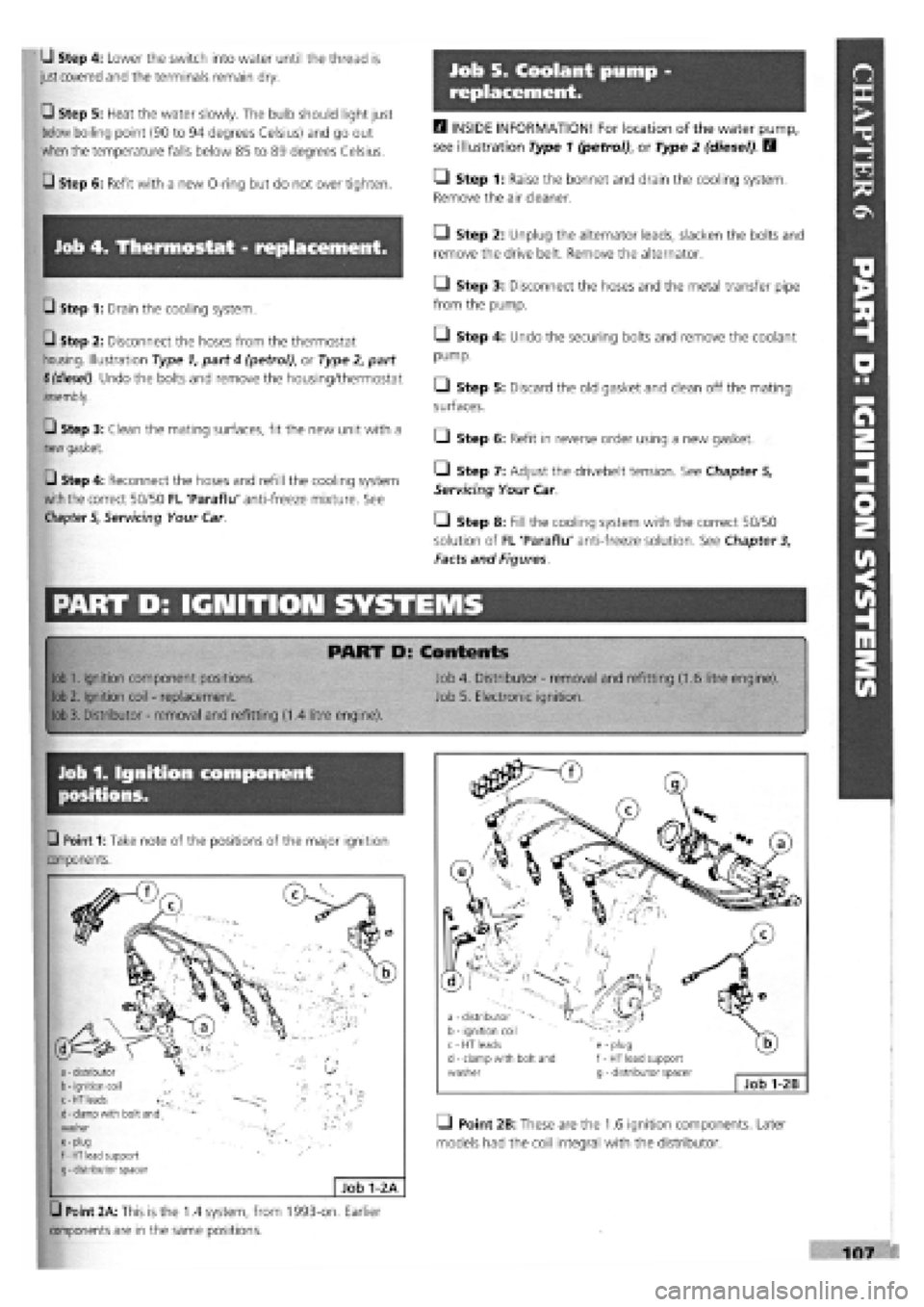
G Point 1: Take note of the positions of the major ignition
components.
Q Point 2B: These are the 1.6 ignition components. Later
models had the coil integral with the distributor.
o
a
>
H
w
w
ON
(A
H
ri
S
VI
107
G Point 2A: This is the 1.4 system, from 1993-on. Earlier
components are in the same positions.
a
-
distributor b
-
ignition coil ^ c-HT leads ^ d
-
clamp with bolt and washer e
-
plug f
-
HT lead support g
-
distributor spacer
Job 1-2 A
Page 104 of 171
Job 2. Ignition coil - replacement.
ALL 1.4 MODELS AND 1.6 MODELS UP TO 1993
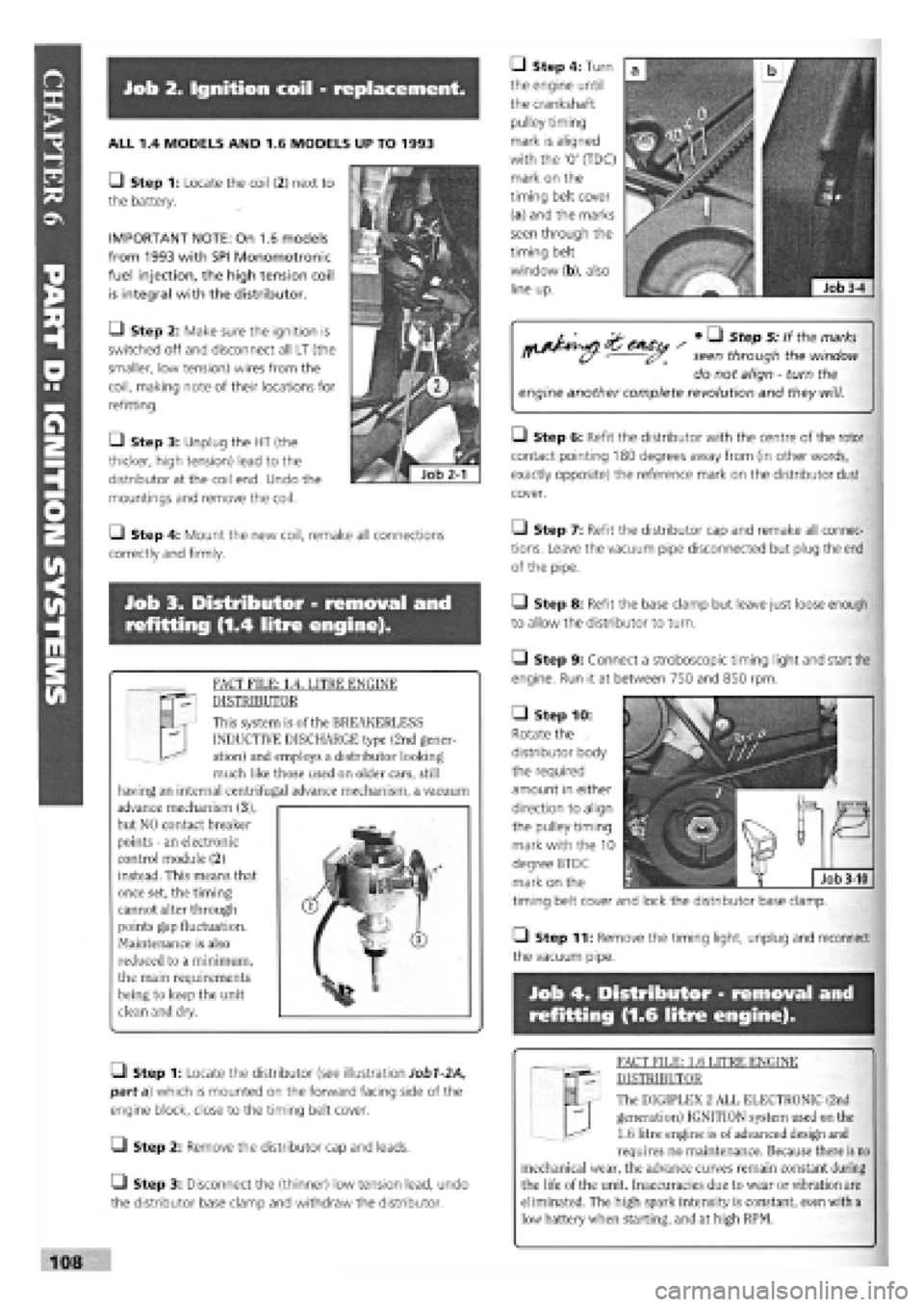
Q Step 1: Locate the coil (2) next to
the battery.
IMPORTANT NOTE: On 1.6 models
from 1993 with SPI Monomotronic
fuel injection, the high tension coil
is integral with the distributor.
• Step 2: Make sure the ignition is
switched off and disconnect all LT (the
smaller, low tension) wires from the
coil, making note of their locations for
refitting.
• Step 3: Unplug the HT (the
thicker, high tension) lead to the
distributor at the coil end. Undo the
mountings and remove the coil.
• Step 4: Mount the new coil, remake all connections
correctly and firmly.
Job 3. Distributor - removal and
refitting (1.4 litre engine).
FACT FILE: 1.4. LITRE ENGINE
DISTRIBUTOR
This system is of the BREAKERLESS
INDUCTIVE DISCHARGE type (2nd gener-
ation) and employs a distributor looking
much like those used on older cars, still
having an internal centrifugal advance mechanism, a vacuum
advance mechanism (3),
but NO contact breaker
points - an electronic
control module (2)
instead. This means that
once set, the timing
cannot alter through
points gap fluctuation.
Maintenance is also
reduced to a minimum,
the main requirements
being to keep the unit
clean and dry.
l_) Step 1: Locate the distributor (see illustration Job1-2A,
part a) which is mounted on the forward facing side of the
engine block, close to the timing belt cover.
I—] Step 2: Remove the distributor cap and leads.
Q Step 3: Disconnect the (thinner) low tension lead, undo
the distributor base clamp and withdraw the distributor.
Q Step 4: Turn
the engine until
the crankshaft
pulley timing
mark is aligned
with the '0' (TDC)
mark on the
timing belt cover
(a) and the marks
seen through the
timing belt
window (b), also
line up.
• Step S: If the
marks
seen through the window
do not align
-
turn the
engine another complete revolution and they will.
• Step 6: Refit the distributor with the centre of the rotor
contact pointing 180 degrees away from (in other words,
exactly opposite) the reference mark on the distributor dust
cover.
Q Step 7: Refit the distributor cap and remake all connec-
tions. Leave the vacuum pipe disconnected but plug the end
of the pipe.
Q Step 8: Refit the base clamp but leave just loose enough
to allow the distributor to turn.
Q Step 9: Connect a stroboscopic timing light and start the
engine. Run it at between 750 and 850 rpm.
• Step 10:
Rotate the
distributor body
the required
amount in either
direction to align
the pulley timing
mark with the 10
degree BTDC
mark on the
timing belt cover
• Step 11: Remove the timing light, unplug and reconnect
the vacuum pipe.
Job 4. Distributor - removal and
refitting (1.6 litre engine).
FACT FILE: 1.6 LITRE ENGINE
DISTRIBUTOR
The DIGIPLEX 2 ALL ELECTRONIC (2nd
generation) IGNITION system used on the
1.6 litre engine is of advanced design and
requires no maintenance. Because there is no
mechanical wear, the advance curves remain constant during
the life of the unit. Inaccuracies due to wear or vibration are
eliminated. The high spark intensity is constant, even with a
low battery when starting, and at high RPM.
and lock the distributor base clamp.
Page 105 of 171
SAFETY FIRST!
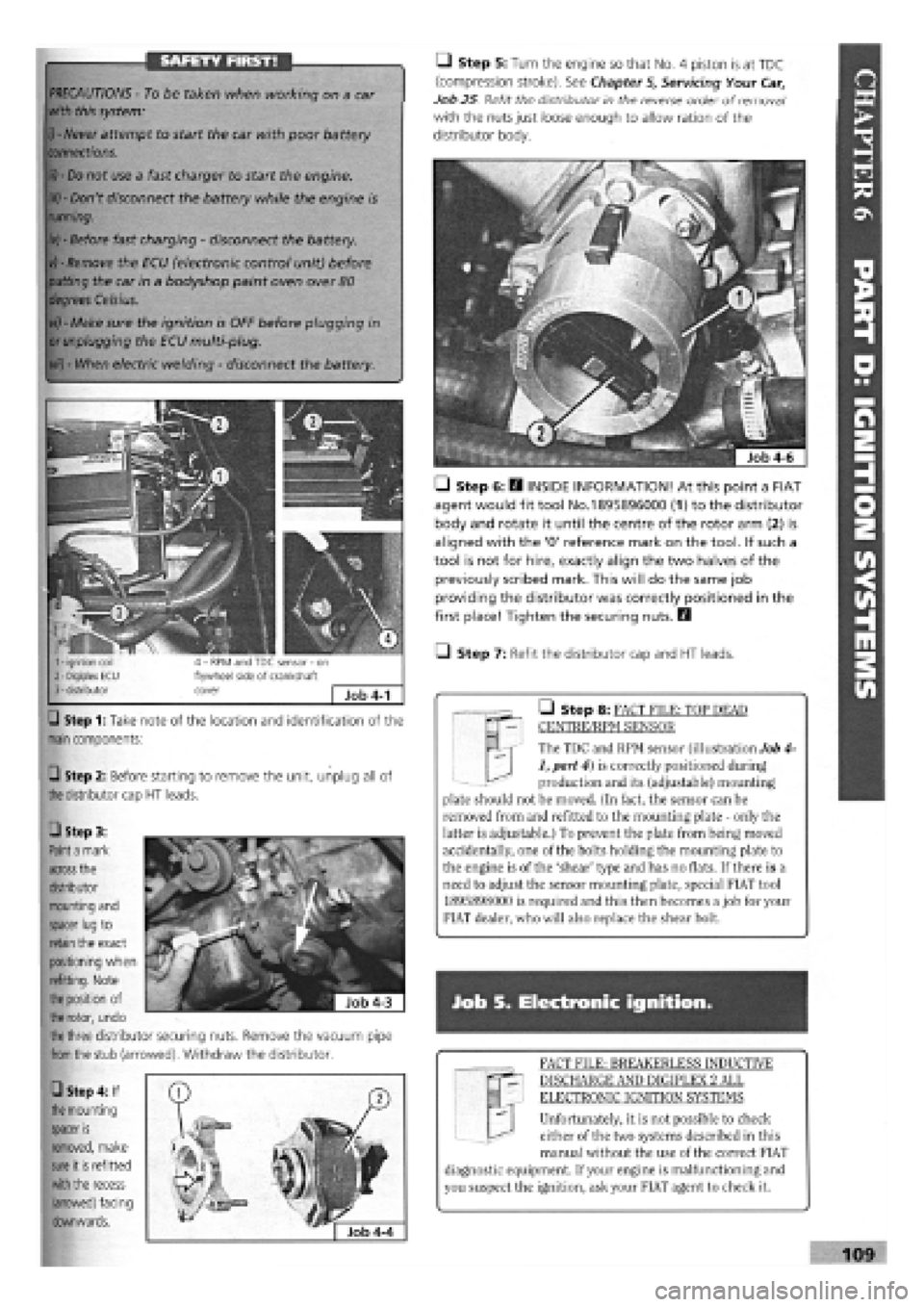
Step 1: Take note of the location and identification of the
main
components:
Q Step 2: Before starting to remove the unit, unplug all of
the
distributor cap
HT
leads.
M | The TDC and RPM sensor (illustration Job 4-
1, part 4) is correctly positioned during
production and its (adjustable) mounting
plate should not be moved. (In fact, the sensor can be
removed from and refitted to the mounting plate - only the
latter is adjustable.) To prevent the plate from being moved
accidentally, one of the bolts holding the mounting plate to
the engine is of the 'shear' type and has no flats. If there is a
need to adjust the sensor mounting plate, special FIAT tool
1895898000 is required and this then becomes a job for your
FIAT dealer, who will also replace the shear bolt.
• Step 8: FACT FILE: TOP DEAD
CENTRE/RPM SENSOR
PRECAUTIONS -
To be taken when working on a car
with this system:
i) - Never
attempt to start the car with poor battery
connections.
ii) - Do
not use a fast charger to start the engine.
iii) -
Don't disconnect the battery while the engine is
running.
iv) -
Before fast charging
-
disconnect the battery.
vj - Remove
the ECU (electronic control unit) before
putting
the car in a bodyshop paint oven over
80
degrees Celsius.
vi) -
Make sure the ignition is OFF before plugging in
or unplugging
the ECU multi-plug.
vii) -
When electric welding
-
disconnect the battery.
Q Step 5: Turn the engine so that No. 4 piston is at TDC
(compression stroke). See Chapter
5,
Servicing Your Car,
Job 25 Refit the distributor in the reverse order of removal1
with the nuts just loose enough to allow ration of the
distributor body.
• Step 6: E3 INSIDE INFORMATION! At this point a FIAT
agent would fit tool No.1895896000 (1) to the distributor
body and rotate it until the centre of the rotor arm (2) is
aligned with the '0' reference mark on the tool. If such a
tool is not for hire, exactly align the two halves of the
previously scribed mark. This will do the same job
providing the distributor was correctly positioned in the
first place! Tighten the securing nuts. Q
• Step 7: Refit the distributor cap and HT leads.
Job S. Electronic ignition.
FACT FILE: BREAKERLESS INDUCTIVE
DISCHARGE AND DIGIPLEX 2 ALL
ELECTRONIC IGNITION SYSTEMS
Unfortunately, it is not possible to check
either of the two systems described in this
manual without the use of the correct FIAT
diagnostic equipment. If your engine is malfunctioning and
you suspect the ignition, ask your FIAT agent to check it.
109
• Step 3:
Paint a
mark
across
the
distributor
mounting and
spacer lug
to
retain
the exact
positioning when
refitting. Note
the position
of
the rotor,
undo
the three
distributor securing nuts. Remove the vacuum pipe
from the
stub (arrowed). Withdraw the distributor.
• Step 4: If
the
mounting
spacer
is
removed, make
sure
it
is
refitted
with the
recess
(arrowed) facing
downwards.
Page 106 of 171
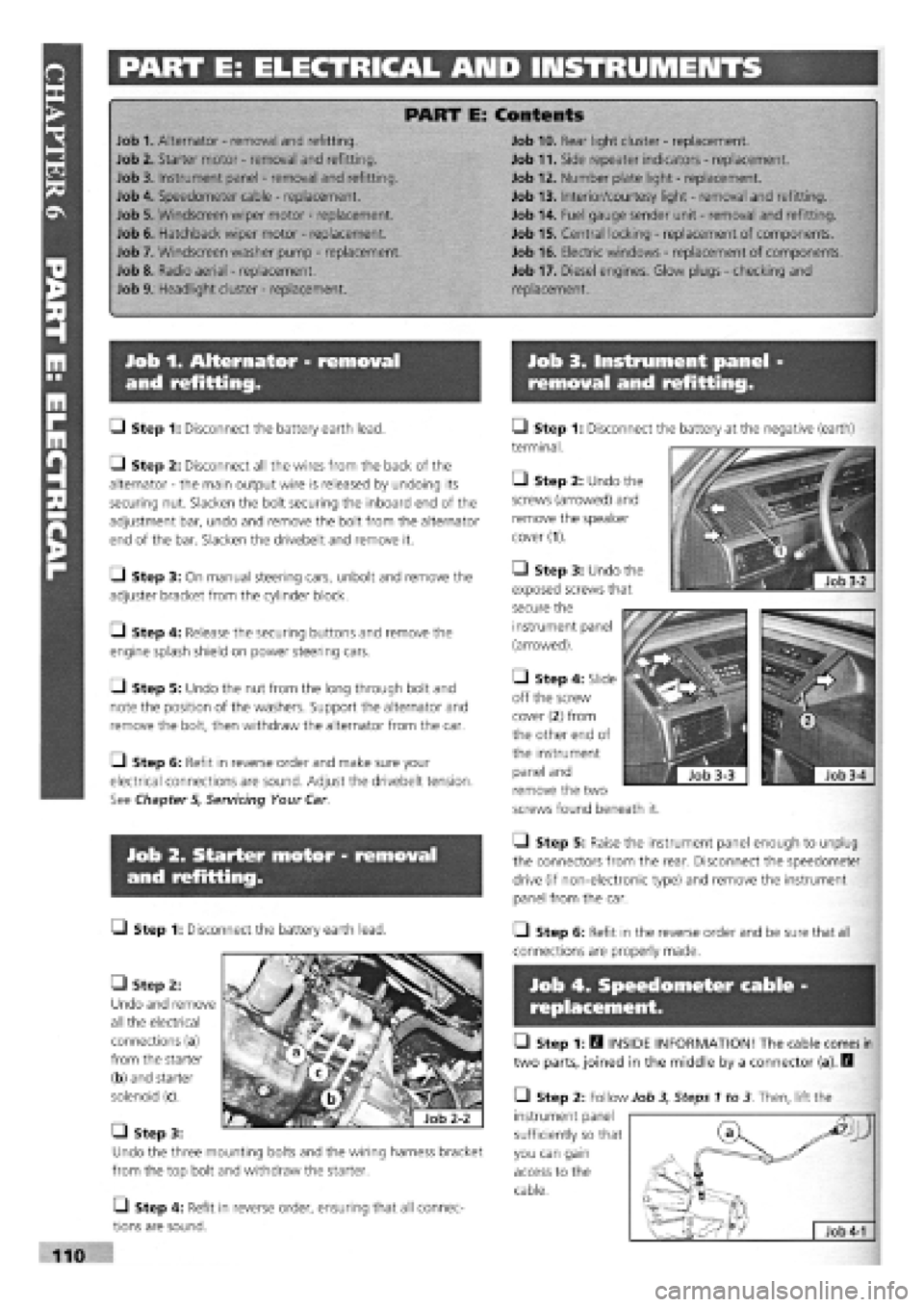
PART E: ELECTRICAL ARID INSTRUMENTS
PART E: Contents
Job 1. Alternator
-
removal and refitting. Job 10. Rear light cluster
-
replacement.
Job 2. Starter motor
-
removal and refitting. Job 11. Side repeater indicators
-
replacement.
Job 3. Instrument panel
-
removal and refitting. Job 12. Number plate light
-
replacement.
Job 4. Speedometer cable
-
replacement. Job 13. Interior/courtesy light
-
removal and refitting.
Job 5. Windscreen wiper motor
-
replacement. Job 14. Fuel gauge sender unit
-
removal and refitting.
Job 6. Hatchback wiper motor
-
replacement. Job 15. Central locking
-
replacement of components.
Job 7. Windscreen washer pump
-
replacement. Job 16. Electric windows
-
replacement of components.
Job 8. Radio aerial
-
replacement. Job 17. Diesel engines. Glow plugs
-
checking and
Job 9. Headlight cluster
-
replacement. replacement.
Job 1. Alternator - removal
and refitting.
Job 3. Instrument panel -
removal and refitting.
• Step 1: Disconnect the battery earth lead.
Q Step 2: Disconnect all the wires from the back of the
alternator
-
the main output wire is released by undoing its
securing nut. Slacken the bolt securing the inboard end of the
adjustment bar, undo and remove the bolt from the alternator
end of the bar. Slacken the drivebelt and remove it.
Q Step 3: On manual steering cars, unbolt and remove the
adjuster bracket from the cylinder block.
Q Step 4: Release the securing buttons and remove the
engine splash shield on power steering cars.
Q Step 5: Undo the nut from the long through bolt and
note the position of the washers. Support the alternator and
remove the bolt, then withdraw the alternator from the car.
Q Step 6: Refit in reverse order and make sure your
electrical connections are sound. Adjust the drivebelt tension.
See Chapter 5, Servicing Your Car
• Step 1: Disconnect
terminal.
• Step 2: Undo the
screws (arrowed) and
remove the speaker
cover (1).
Job 2. Starter motor - removal
and refitting.
• Step 1: Disconnect the battery earth lead.
• Step 2:
Undo and remove
all the electrical
connections (a)
from the starter
(b) and starter
solenoid (c).
Q Step 4: Refit in reverse order, ensuring that all connec-
tions are sound.
Q Step 5: Raise the instrument panel enough to unplug
the connectors from the rear. Disconnect the speedometer
drive (if non-electronic type) and remove the instrument
panel from the car.
Q Step 6: Refit in the reverse order and be sure that all
connections are properly made.
Job 4. Speedometer cable
replacement.
• Step 1: H INSIDE INFORMATION! The cable comes in
two parts, joined in the middle by a connector (a). Q
• Step 2: Follow Job 3, Steps 1 to 3 Then, lift the
instrument panel
sufficiently so that
you can gain
access to the
cable.
^Jj
Job
4-1
the battery at the negative (earth)
• Step 3: Undo the
exposed screws that
secure the
instrument panel
(arrowed).
• Step 4: Slide
off the screw
cover
(2)
from
the other end of
the instrument
panel and
remove the two
screws found beneath it.
• Step 3:
Undo the three mounting bolts and the wiring harness bracket
from the top bolt and withdraw the starter.
Page 110 of 171
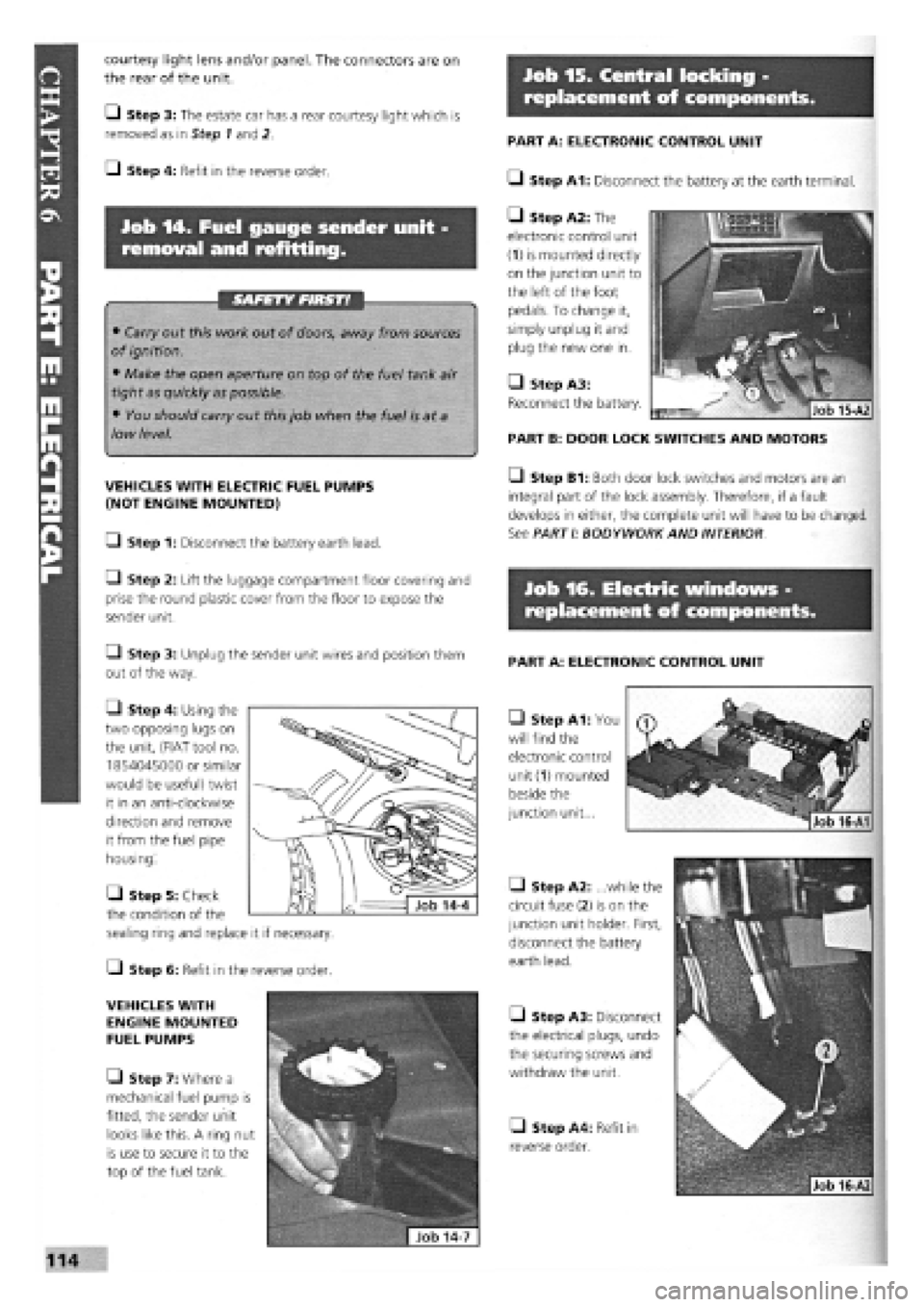
Job 15. Central locking -
replacement off components.
Job 14. Fuel gauge sender unit
removal and refitting.
SAFETY FIRST!
• Carry out this work out of doors, away from sources
of ignition.
• Make the open aperture on top of the fuel tank air
tight as quickly as possible.
• You should carry out this job when the fuel is at a
low level.
VEHICLES WITH ELECTRIC FUEL PUMPS
(NOT ENGINE MOUNTED)
Job 16. Electric windows -
replacement of components.
courtesy light lens and/or panel. The connectors are on
the rear of the unit.
• Step 3: The estate car has a rear courtesy light which is
removed as in Step 1 and 2
LJ Step 4: Refit in the reverse order.
PART A: ELECTRONIC CONTROL UNIT
• Step A1: You
will find the
electronic control
unit
(1)
mounted
beside the
junction unit...
PART A: ELECTRONIC CONTROL UNIT
• Step A1: Disconnect the battery at the earth terminal.
• Step A2: The
electronic control unit
(1) is mounted directly
on the junction unit to
the left of the foot
pedals. To change it,
simply unplug it and
plug the new one in.
• Step A3:
Reconnect the battery.
PART B: DOOR LOCK SWITCHES AND MOTORS
• Step B1: Both door lock switches and motors are an
integral part of the lock assembly. Therefore, if a fault
develops in either, the complete unit will have to be changed.
See PARTI: BODYWORK AND INTERIOR
• Step A2: ...while the
circuit fuse (2) is on the
junction unit holder. First,
disconnect the battery
earth lead.
• Step A3: Disconnect
the electrical plugs, undo
the securing screws and
withdraw the unit.
• Step A4: Refit in
reverse order.
Q Step 1: Disconnect the battery earth lead.
Q Step 2: Lift the luggage compartment floor covering and
prise the round plastic cover from the floor to expose the
sender unit.
Q Step 3: Unplug the sender unit wires and position them
out of the way.
• Step 4: Using the
two opposing lugs on
the unit, (FIAT tool no.
1854045000 or similar
would be useful) twist
it in an anti-clockwise
direction and remove
it from the fuel pipe
housing.
C-) Step 6: Refit in the reverse order.
VEHICLES WITH
ENGINE MOUNTED
FUEL PUMPS
• Step 7: Where a
mechanical fuel pump is
fitted, the sender unit
looks like this. A ring nut
is use to secure it to the
top of the fuel tank.
• Step 5: Check
the condition of the
sealing ring and replace it if necessary.
Job 16-A1
Page 111 of 171
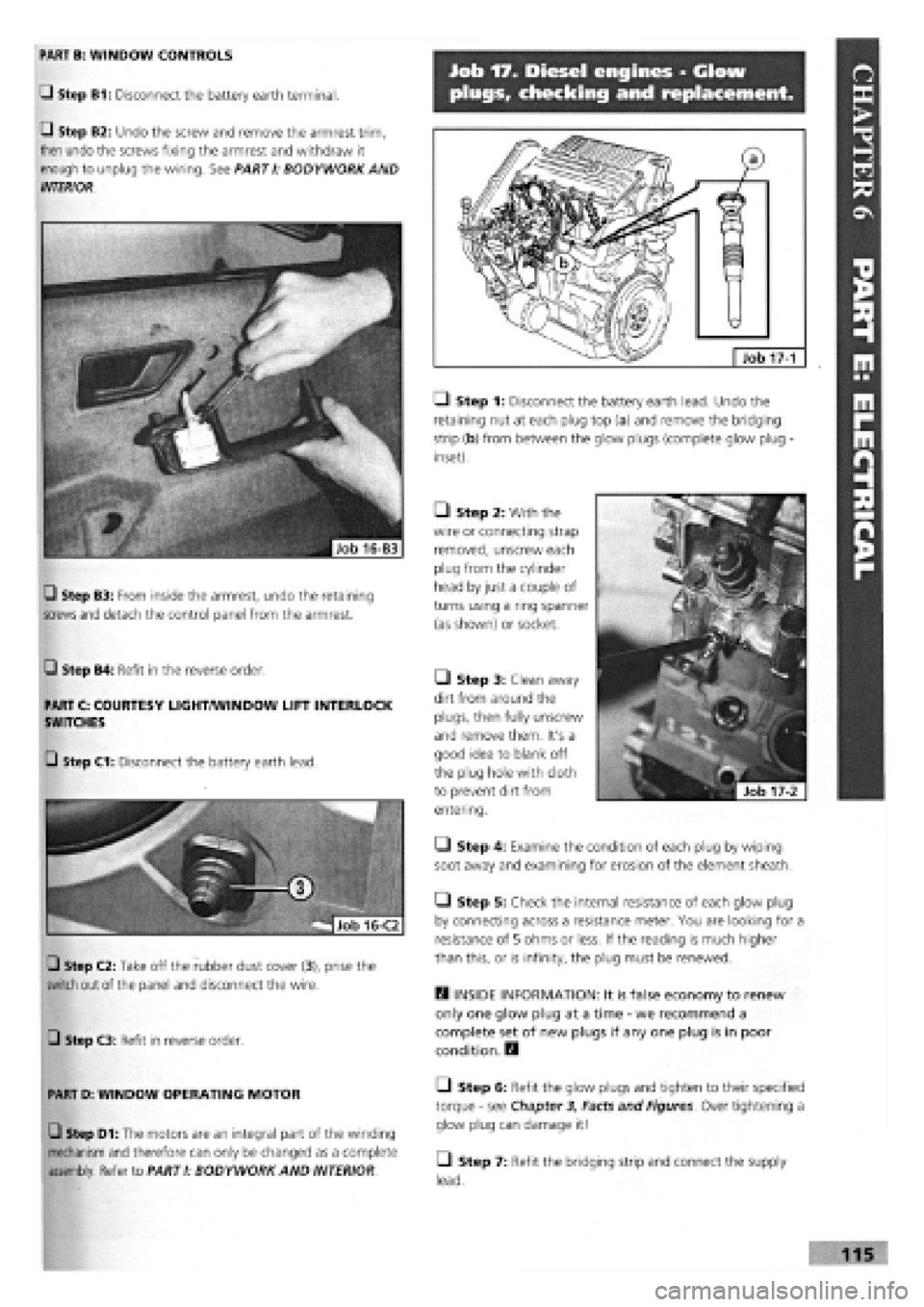
Job 17. Diesel engines - Glow
plugs, checking and replacement.
LI Step 1: Disconnect the battery earth lead. Undo the
retaining nut at each plug top (a) and remove the bridging
strip (b) from between the glow plugs (complete glow plug -
inset).
• Step 2: With the
wire or connecting strap
removed, unscrew each
plug from the cylinder
head by just a couple of
turns using a ring spanner
(as shown) or socket.
H INSIDE INFORMATION: It is false economy to renew
only one glow plug at a time
-
we recommend a
complete set of new plugs if any one plug is in poor
condition. E9
• Step 6: Refit the glow plugs and tighten to their specified
torque
-
see Chapter 3, Facts and Figures. Over tightening a
glow plug can damage it!
• Step 7: Refit the bridging strip and connect the supply
lead.
17-1
PART B: WINDOW CONTROLS
Q Step B1: Disconnect the battery earth terminal.
Q Step B2: Undo the screw and remove the armrest trim,
then undo the screws fixing the armrest and withdraw it
enough to unplug the wiring. See PARTI: BODYWORK AND
INTERIOR.
• Step 3: Clean away
dirt from around the
plugs, then fully unscrew
and remove them. It's a
good idea to blank off
the plug hole with cloth
to prevent dirt from
entering.
• Step 4: Examine the condition of each plug by wiping
soot away and examining for erosion of the element sheath.
• Step 5: Check the internal resistance of each glow plug
by connecting across a resistance meter. You are looking for a
resistance of 5 ohms or less. If the reading is much higher
than this, or is infinity, the plug must be renewed.
Q Step B4: Refit in the reverse order.
PART C: COURTESY LIGHT/WINDOW LIFT INTERLOCK
SWITCHES
Q Step C3: Refit in reverse order.
PART D: WINDOW OPERATING MOTOR
Q Step D1: The motors are an integral part of the winding
mechanism and therefore can only be changed as a complete
assembly. Refer to PART I: BODYWORK AND INTERIOR
Q Step B3: From inside the armrest, undo the retaining
screws and
detach the control panel from the armrest.
G Step C1: Disconnect the battery earth lead.
Q Step C2: Take off the rubber dust cover (3), prise the
switch out of the panel and disconnect the wire.
Page 112 of 171
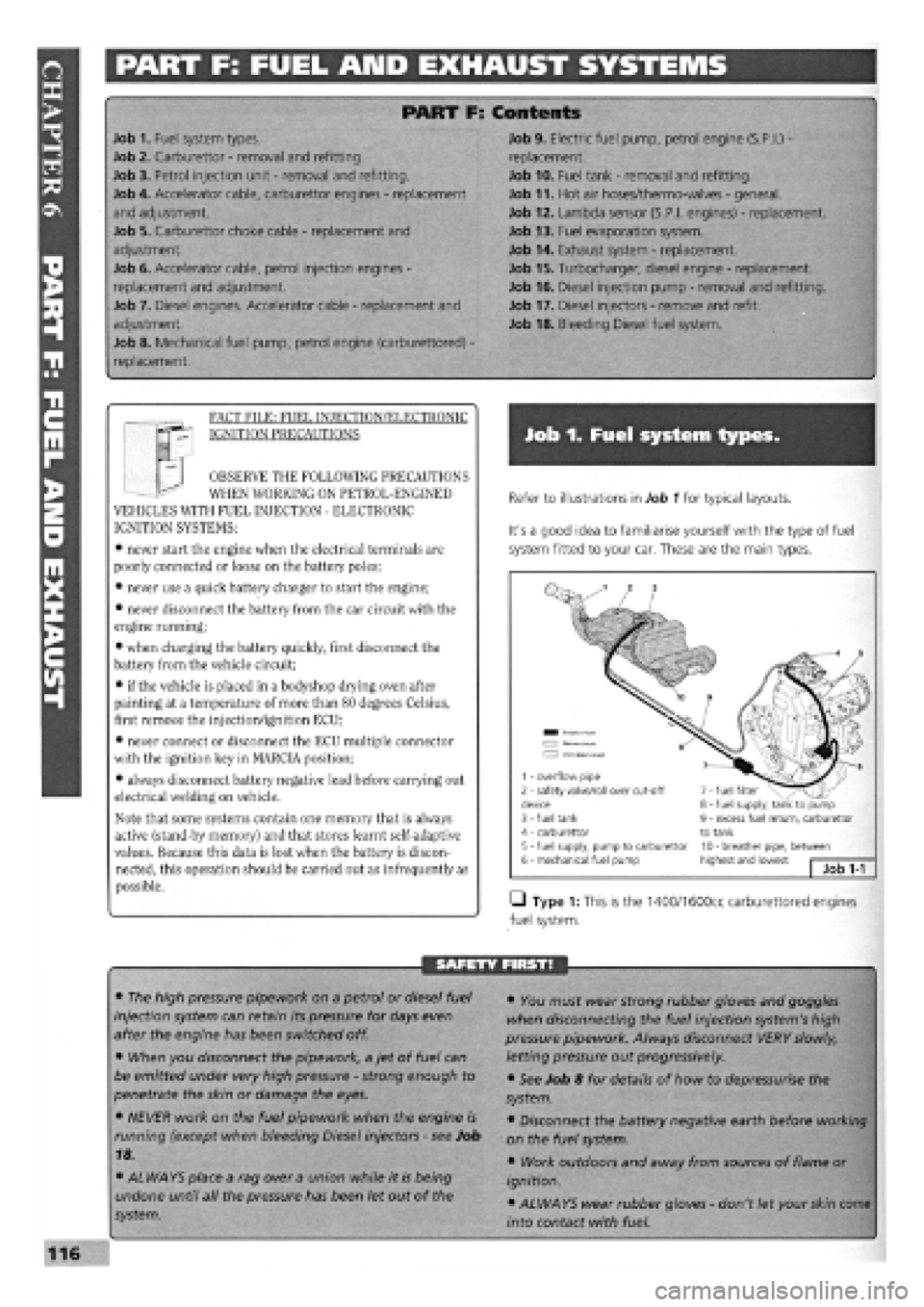
PART F: FUEL AMD EXHAUST SYSTEMS
PART F: Contents
Job 1. Fuel system types. Job 9. Electric fuel pump, petrol engine (S.P.I.)
-
Job 2. Carburettor
-
removal and refitting. replacement.
Job 3. Petrol injection unit
-
removal and refitting. Job 10. Fuel tank
-
removal and refitting.
Job 4. Accelerator cable, carburettor engines
-
replacement Job 11. Hot air hoses/thermo-valves
-
general.
and adjustment. Job 12. Lambda sensor (S.P.I, engines)
-
replacement.
Job 5. Carburettor choke cable
-
replacement and Job 13. Fuel evaporation system.
adjustment. Job 14. Exhaust system
-
replacement.
Job 6. Accelerator cable, petrol injection engines -Job 15. Turbocharger, diesel engine
-
replacement.
replacement and adjustment. Job 16. Diesel injection pump
-
removal and refitting.
Job 7. Diesel engines. Accelerator cable
-
replacement and Job 17. Diesel injectors
-
remove and refit.
adjustment. Job 18. Bleeding Diesel fuel system.
Job 8. Mechanical fuel pump, petrol engine (carburettored) -
replacement.
Job 1. Fuel system types.
FACT FILE: FUEL INJECTION/ELECTRONIC
IGNITION PRECAUTIONS
OBSERVE THE FOLLOWING PRECAUTIONS
WHEN WORKING ON PETROL-ENGINED
VEHICLES WITH FUEL INJECTION - ELECTRONIC
IGNITION SYSTEMS:
• never start the engine when the electrical terminals are
poorly connected or loose on the battery poles;
• never use a quick battery charger to start the engine;
• never disconnect the battery from the car circuit with the
engine running;
• when charging the battery quickly, first disconnect the
battery from the vehicle circuit;
• if the vehicle is placed in a bodyshop drying oven after
painting at a temperature of more than 80 degrees Celsius,
first remove the injection/ignition ECU;
• never connect or disconnect the ECU multiple connector
with the ignition key in MARCIA position;
• always disconnect battery negative lead before carrying out
electrical welding on vehicle.
Note that some systems contain one memory that is always
active (stand-by memory) and that stores learnt self-adaptive
values. Because this data is lost when the battery is discon-
nected, this operation should be carried out as infrequently as
possible.
Refer to illustrations in Job 1 for typical layouts.
It's a good idea to familiarise yourself with the type of fuel
system fitted to your car. These are the main types.
• Type 1: This is the 1400/1600cc carburettored engines
fuel system.
SAFETY FIRST!
• The high pressure pipework on a petrol or diesel fuel
injection system can retain its pressure for days even
after the engine has been switched off.
• When you disconnect the pipework, a jet of fuel can
be emitted under very high pressure
-
strong enough to
penetrate the skin or damage the eyes.
• NEVER work on the fuel pipework when the engine is
running (except when bleeding Diesel injectors
-
see Job
18.
• ALWAYS place a rag over a union while it is being
undone until all the pressure has been let out of the
system.
• You must wear strong rubber gloves and goggles
when disconnecting the fuel injection system's high
pressure pipework. Always disconnect VERY slowly,
letting pressure out progressively.
• See Job 8 for details of how to depressurise the
system.
• Disconnect the battery negative earth before working
on the fuel system.
• Work outdoors and away from sources of flame or
ignition.
• ALWAYS wear rubber gloves
-
don't let your skin come
into contact with fuel.
1 - overflow pipe 2 - safety valve/roll over cut-off device 3 - fuel tank 4 - carburettor 5 - fuel supply, pump to carburettor 6 - mechanical fuel pump
7 - fuel filter 8 - fuel supply, tank to pump 9 - excess fuel return, carburettor to tank 10 - breather pipe, between highest and lowest Job
1-1
Page 113 of 171
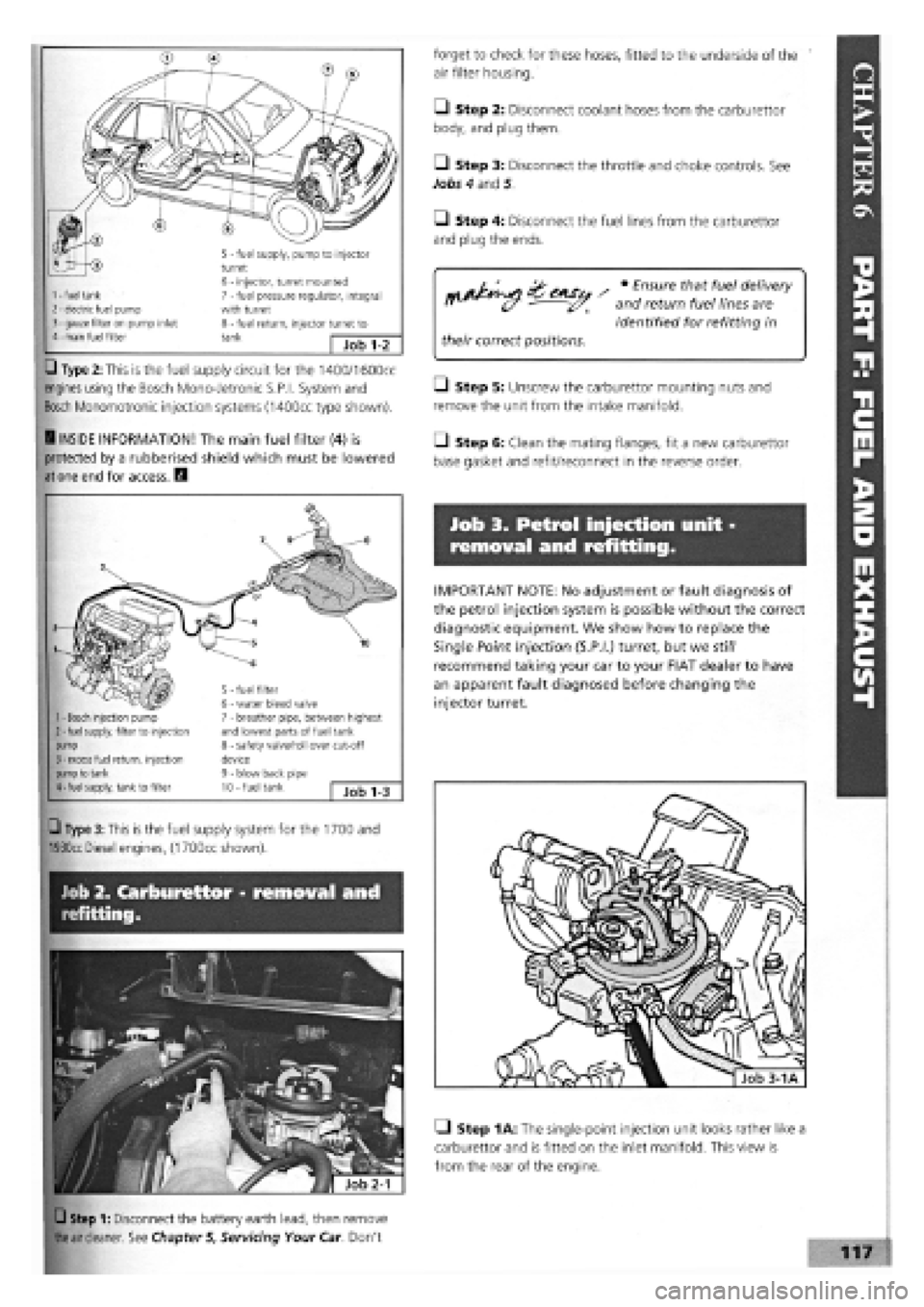
• Type 2: This is the fuel supply circuit for the 1400/1600cc
engines using the Bosch Mono-Jetronic S.P.I. System and
Bosch Monomotronic injection systems (1400cc type shown).
5 - fuel supply, pump to injector turret 6 - injector, turret mounted 7 - fuel pressure regulator, integral with turret 8 - fuel return, injector turret to tank — Job 1-2
1
-
fuel tank 2
-
electric fuel pump 3
-
gauze filter on pump inlet 4
-
main fuel filter
H INSIDE INFORMATION! The main fuel filter (4) is
protected by a rubberised shield which must be lowered
at one end for access. H
5 - fuel filter 6 - water bleed valve 7 - breather pipe, between highest and lowest parts of fuel tank 8 - safety valve/roll over cut-off device 9 - blow back pipe 10 - fuel tank Job 1-3
1
-
Bosch injection pump 2
-
fuel supply, filter to injection pump 3
-
excess fuel return, injection pump to tank 4
-
fuel supply, tank to filter
forget to check for these hoses, fitted to the underside of the
air filter housing.
• Step 2: Disconnect coolant hoses from the carburettor
body, and plug them.
Q Step 3: Disconnect the throttle and choke controls. See
Jobs 4 and 5.
Q Step 4: Disconnect the fuel lines from the carburettor
and plug the ends.
/ • E"sure thf ™ delivery
" (/ and return fuel lines are
identified for refitting in
their correct positions.
• Step 5: Unscrew the carburettor mounting nuts and
remove the unit from the intake manifold.
LI Step 6: Clean the mating flanges, fit a new carburettor
base gasket and refit/reconnect in the reverse order.
Job 3. Petrol injection unit -
removal and refitting.
IMPORTANT NOTE: No adjustment or fault diagnosis of
the petrol injection system is possible without the correct
diagnostic equipment. We show how to replace the
Single Point Injection (S.P.I.) turret, but we still
recommend taking your car to your FIAT dealer to have
an apparent fault diagnosed before changing the
injector turret.
Job 2. Carburettor - removal and
refitting.
Q Type 3: This is the fuel supply system for the 1700 and
1930cc
Diesel engines, (1700cc shown).
Q Step 1: Disconnect the battery earth lead, then remove
the air cleaner.
See Chapter 5, Servicing Your Car. Don't
Q Step 1A: The single-point injection unit looks rather like a
carburettor and is fitted on the inlet manifold. This view is
from the rear of the engine.
Page 114 of 171
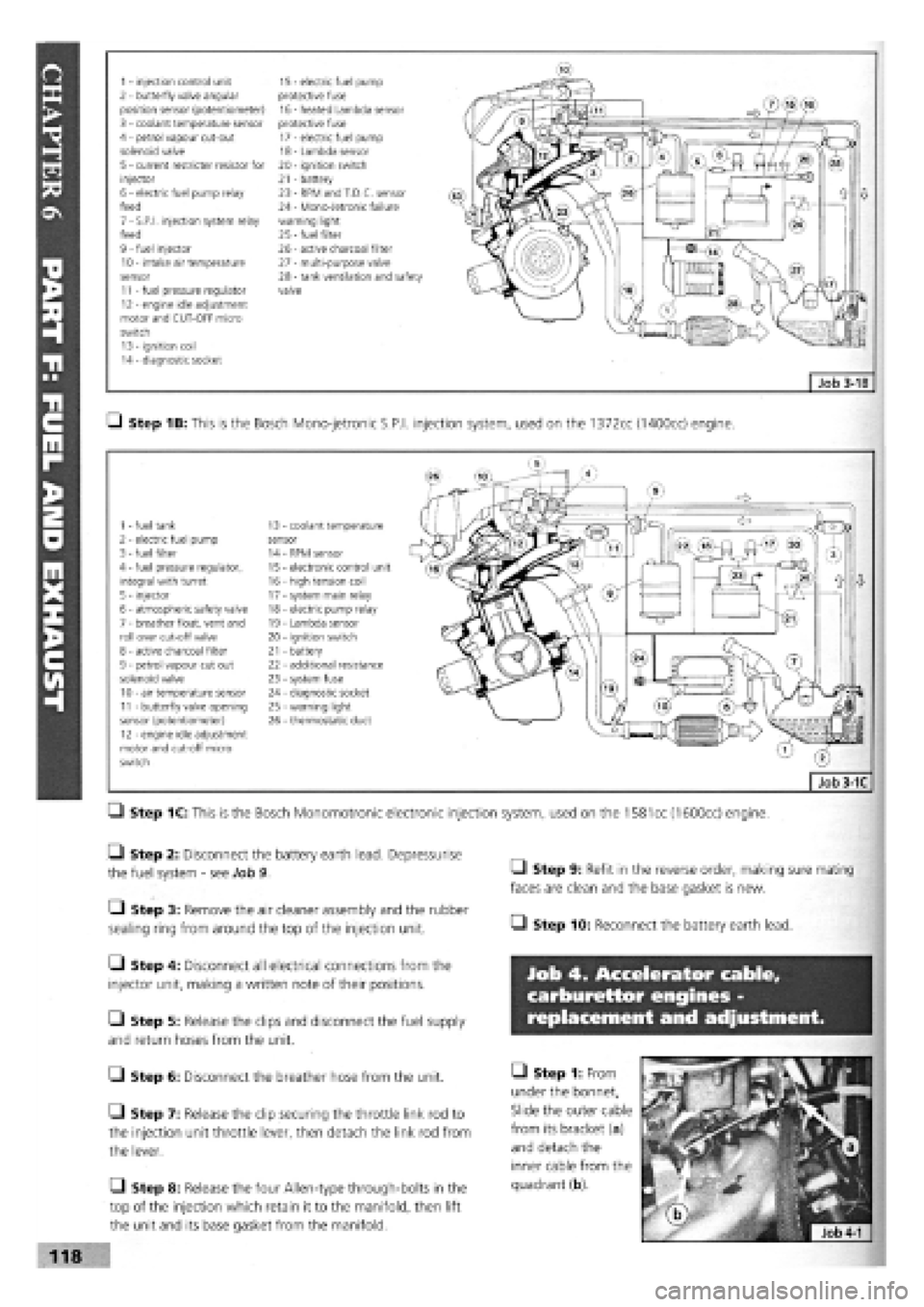
1 - injection control unit 15 - electric fuel pump 2 - butterfly valve angular protective fuse position sensor (potentiometer) 16 - heated Lambda sensor 3 - coolant temperature sensor protective fuse 4 - petrol vapour cut-out 17 - electric fuel pump solenoid valve 18 - Lambda sensor 5 - current restricter resistor for 20 - ignition switch injector 21 - battery 6 - electric fuel pump relay 23 - RPM and T.D.C. sensor feed 24 - Mono-Jetronic failure 7 - S.P.I, injection system relay warning light feed 25
-
fuel filter 9 - fuel injector 26 - active charcoal filter 10 - intake air temperature 27 - multi-purpose valve sensor 28 - tank ventilation and safety 11 - fuel pressure regulator valve 12 - engine idle adjustment motor and CUT-OFF micro switch 13 - ignition coil 14 - diagnostic socket
Q Step 1B: This is the Bosch Mono-jetronic S.P.I, injection system, used on the 1372cc (1400cc) engine.
1 - fuel tank 13 coolant temperature 2 - electric fuel pump sensor 3 - fuel filter 14 RPM sensor 4 - fuel pressure regulator, 15 electronic control unit integral with turret 16 - high tension coil 5 - injector 17 - system main relay 6 - atmospheric safety valve 18 - electric pump relay 7 - breather float, vent and 19 - Lambda sensor roll over cut-off valve 20 - ignition switch 8 - active charcoal filter 21 - battery 9 - petrol vapour cut out 22 - additional resistance solenoid valve 23 - system fuse 10 - air temperature sensor 24 - diagnostic socket 11 - butterfly valve opening 25 - warning light sensor (potentiometer) 26 - thermostatic duct 12 - engine idle adjustment motor and cut-off micro switch
Q Step 1C: This is the Bosch Monomotronic electronic injection system, used on the
1581
cc (1600cc) engine.
• Step 2: Disconnect the battery earth lead. Depressurise
the fuel system
-
see Job 9.
• Step 3: Remove the air cleaner assembly and the rubber
sealing ring from around the top of the injection unit.
Q Step 4: Disconnect all electrical connections from the
injector unit, making a written note of their positions.
Q Step 5: Release the clips and disconnect the fuel supply
and return hoses from the unit.
G Step 6: Disconnect the breather hose from the unit.
• Step 7: Release the clip securing the throttle link rod to
the injection unit throttle lever, then detach the link rod from
the lever.
Q Step 8: Release the four Allen-type through-bolts in the
top of the injection which retain it to the manifold, then lift
the unit and its base gasket from the manifold.
• Step 9: Refit in the reverse order, making sure mating
faces are clean and the base gasket is new.
• Step 10: Reconnect the battery earth lead.
Job 4. Accelerator cable,
carburettor engines -
replacement and adjustment.
• Step 1: From
under the bonnet,
Slide the outer cable
from its bracket (a)
and detach the
inner cable from the
quadrant (b).
118