tow FIAT TIPO 5DOORS STATION WAGON 2018 Owner handbook (in English)
[x] Cancel search | Manufacturer: FIAT, Model Year: 2018, Model line: TIPO 5DOORS STATION WAGON, Model: FIAT TIPO 5DOORS STATION WAGON 2018Pages: 292, PDF Size: 7.74 MB
Page 152 of 292

at the same time slowly rotate the
screw clockwise, until resistance is
encountered (do not overtighten);
slowly release the screw;
closure is indicated by the securing
of the entire screw head in its housing.
DASHBOARD FUSE BOX
Left-hand drive version
The fuse box fig. 164 is located to the
left side of the steering column. To
access the fuses, remove the snap
cover showed in fig. 163, pulling
towards yourself.
Right hand drive version
The control unit fig. 164 is located to
the left side under the dashboard.
To access the control unit, remove the
glove compartment using device 1
fig. 165.
UNDER DASHBOARD
CONTROL UNIT
The control unit fig. 166 is located to
the left side under the dashboard.
16306106J0005EM
16408036J0009EM
165P2000138
166P2000083-000-000
150
IN AN EMERGENCY
Page 158 of 292
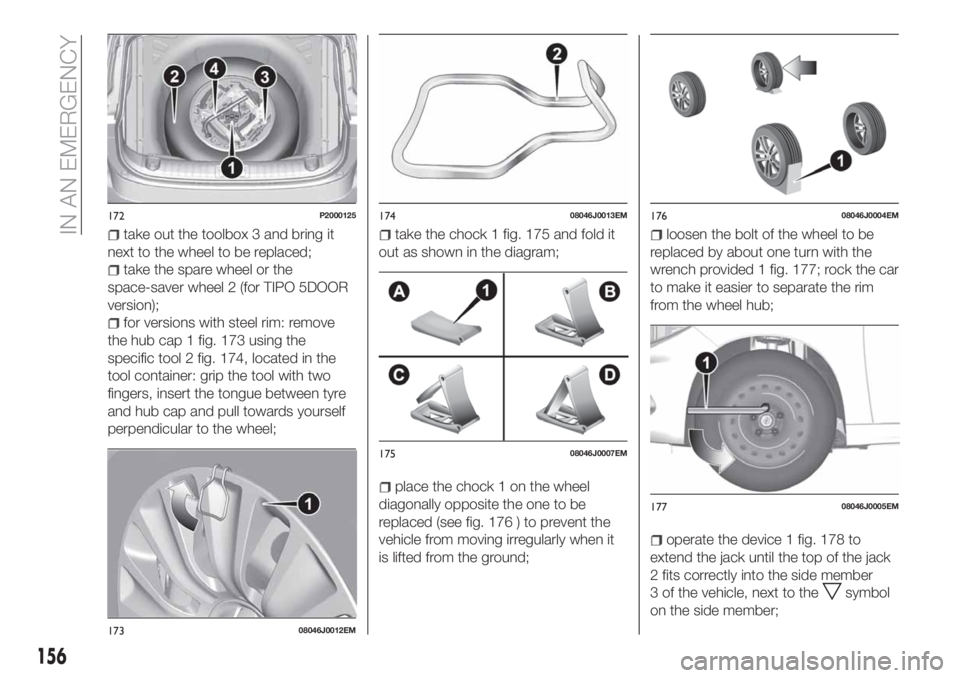
take out the toolbox 3 and bring it
next to the wheel to be replaced;
take the spare wheel or the
space-saver wheel 2 (for TIPO 5DOOR
version);
for versions with steel rim: remove
the hub cap 1 fig. 173 using the
specific tool 2 fig. 174, located in the
tool container: grip the tool with two
fingers, insert the tongue between tyre
and hub cap and pull towards yourself
perpendicular to the wheel;
take the chock 1 fig. 175 and fold it
out as shown in the diagram;
place the chock 1 on the wheel
diagonally opposite the one to be
replaced (see fig. 176 ) to prevent the
vehicle from moving irregularly when it
is lifted from the ground;
loosen the bolt of the wheel to be
replaced by about one turn with the
wrench provided 1 fig. 177; rock the car
to make it easier to separate the rim
from the wheel hub;
operate the device 1 fig. 178 to
extend the jack until the top of the jack
2 fits correctly into the side member
3 of the vehicle, next to the
symbol
on the side member;
172P2000125
17308046J0012EM
17408046J0013EM
17508046J0007EM
17608046J0004EM
17708046J0005EM
156
IN AN EMERGENCY
Page 165 of 292
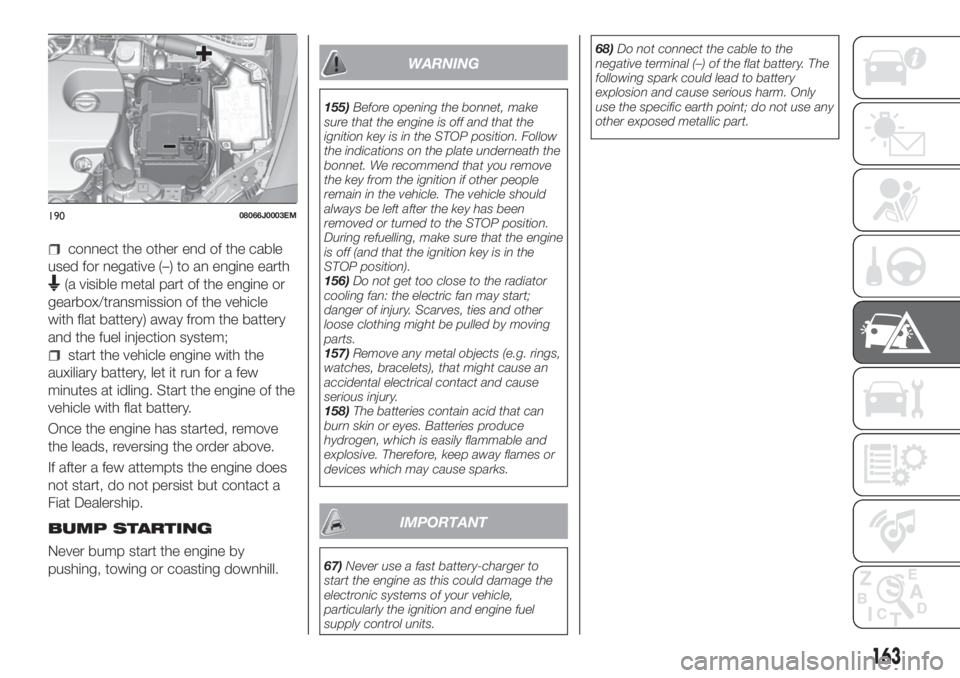
connect the other end of the cable
used for negative (–) to an engine earth
(a visible metal part of the engine or
gearbox/transmission of the vehicle
with flat battery) away from the battery
and the fuel injection system;
start the vehicle engine with the
auxiliary battery, let it run for a few
minutes at idling. Start the engine of the
vehicle with flat battery.
Once the engine has started, remove
the leads, reversing the order above.
If after a few attempts the engine does
not start, do not persist but contact a
Fiat Dealership.
BUMP STARTING
Never bump start the engine by
pushing, towing or coasting downhill.
WARNING
155)Before opening the bonnet, make
sure that the engine is off and that the
ignition key is in the STOP position. Follow
the indications on the plate underneath the
bonnet. We recommend that you remove
the key from the ignition if other people
remain in the vehicle. The vehicle should
always be left after the key has been
removed or turned to the STOP position.
During refuelling, make sure that the engine
is off (and that the ignition key is in the
STOP position).
156)Do not get too close to the radiator
cooling fan: the electric fan may start;
danger of injury. Scarves, ties and other
loose clothing might be pulled by moving
parts.
157)Remove any metal objects (e.g. rings,
watches, bracelets), that might cause an
accidental electrical contact and cause
serious injury.
158)The batteries contain acid that can
burn skin or eyes. Batteries produce
hydrogen, which is easily flammable and
explosive. Therefore, keep away flames or
devices which may cause sparks.
IMPORTANT
67)Never use a fast battery-charger to
start the engine as this could damage the
electronic systems of your vehicle,
particularly the ignition and engine fuel
supply control units.68)Do not connect the cable to the
negative terminal (–) of the flat battery. The
following spark could lead to battery
explosion and cause serious harm. Only
use the specific earth point; do not use any
other exposed metallic part.
19008066J0003EM
163
Page 171 of 292
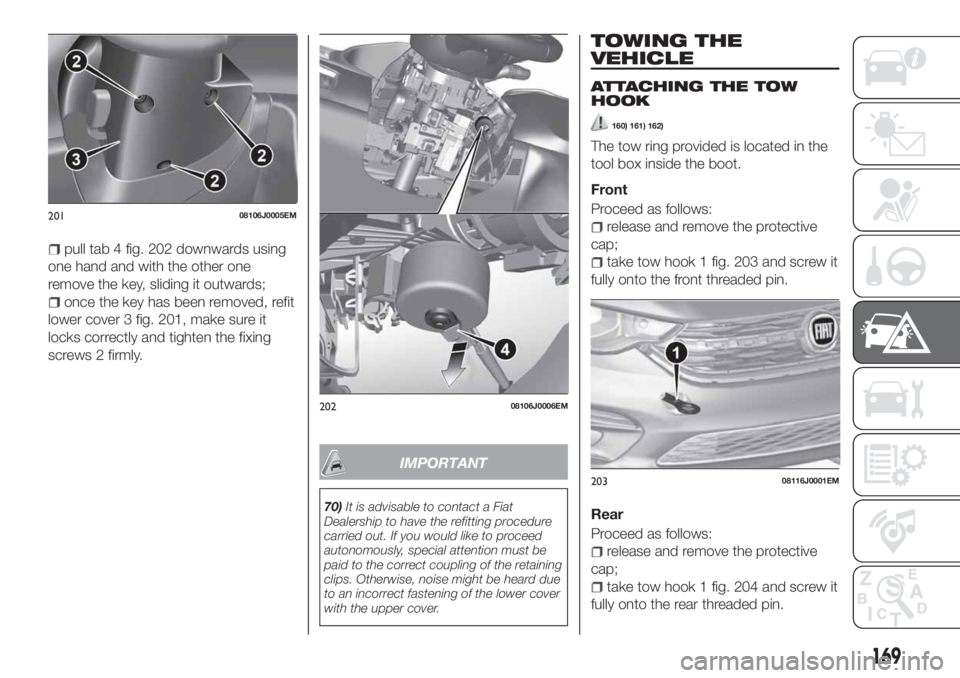
pull tab 4 fig. 202 downwards using
one hand and with the other one
remove the key, sliding it outwards;
once the key has been removed, refit
lower cover 3 fig. 201, make sure it
locks correctly and tighten the fixing
screws 2 firmly.
IMPORTANT
70)It is advisable to contact a Fiat
Dealership to have the refitting procedure
carried out. If you would like to proceed
autonomously, special attention must be
paid to the correct coupling of the retaining
clips. Otherwise, noise might be heard due
to an incorrect fastening of the lower cover
with the upper cover.
TOWING THE
VEHICLE
ATTACHING THE TOW
HOOK
160) 161) 162)
The tow ring provided is located in the
tool box inside the boot.
Front
Proceed as follows:
release and remove the protective
cap;
take tow hook 1 fig. 203 and screw it
fully onto the front threaded pin.
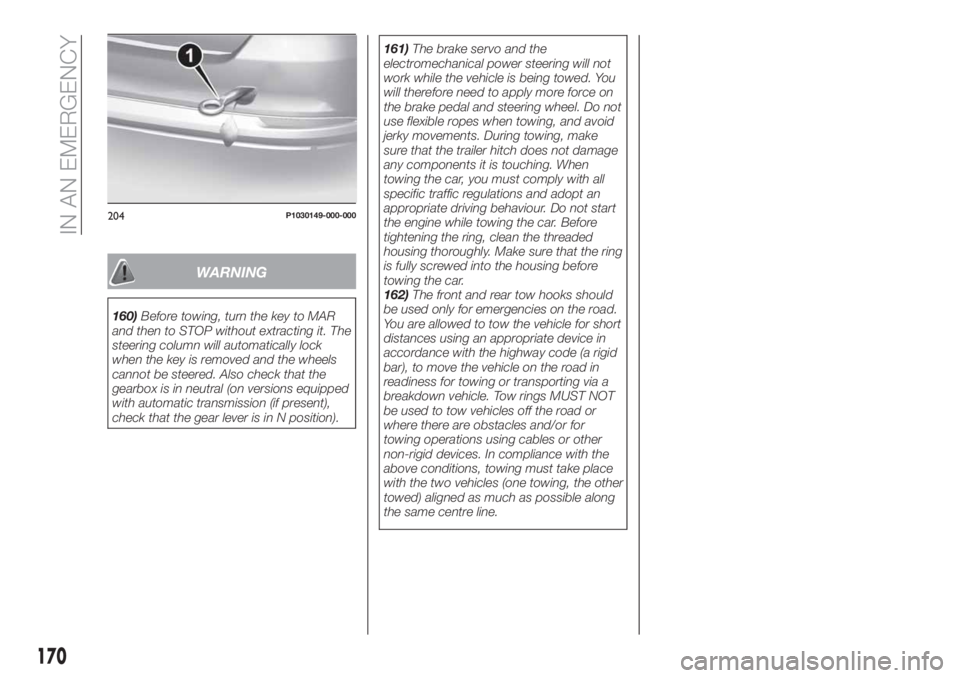
Rear
Proceed as follows:
release and remove the protective
cap;
take tow hook 1 fig. 204 and screw it
fully onto the rear threaded pin.
20108106J0005EM
20208106J0006EM
20308116J0001EM
169
Page 172 of 292
WARNING
160)Before towing, turn the key to MAR
and then to STOP without extracting it. The
steering column will automatically lock
when the key is removed and the wheels
cannot be steered. Also check that the
gearbox is in neutral (on versions equipped
with automatic transmission (if present),
check that the gear lever is in N position).161)The brake servo and the
electromechanical power steering will not
work while the vehicle is being towed. You
will therefore need to apply more force on
the brake pedal and steering wheel. Do not
use flexible ropes when towing, and avoid
jerky movements. During towing, make
sure that the trailer hitch does not damage
any components it is touching. When
towing the car, you must comply with all
specific traffic regulations and adopt an
appropriate driving behaviour. Do not start
the engine while towing the car. Before
tightening the ring, clean the threaded
housing thoroughly. Make sure that the ring
is fully screwed into the housing before
towing the car.
162)The front and rear tow hooks should
be used only for emergencies on the road.
You are allowed to tow the vehicle for short
distances using an appropriate device in
accordance with the highway code (a rigid
bar), to move the vehicle on the road in
readiness for towing or transporting via a
breakdown vehicle. Tow rings MUST NOT
be used to tow vehicles off the road or
where there are obstacles and/or for
towing operations using cables or other
non-rigid devices. In compliance with the
above conditions, towing must take place
with the two vehicles (one towing, the other
towed) aligned as much as possible along
the same centre line.
204P1030149-000-000
170
IN AN EMERGENCY
Page 174 of 292
SCHEDULED
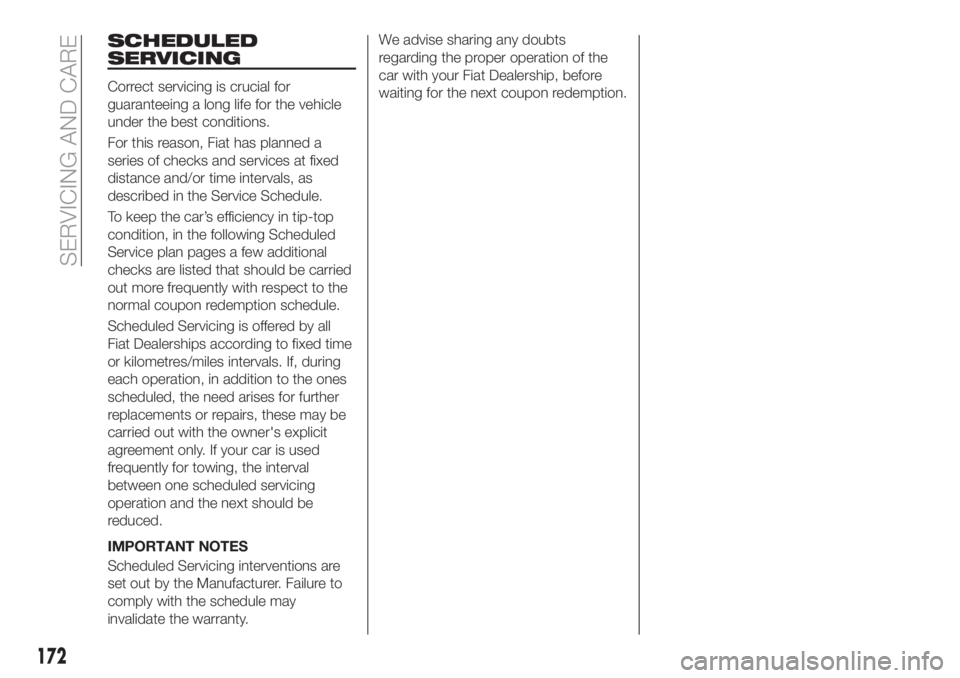
SERVICING
Correct servicing is crucial for
guaranteeing a long life for the vehicle
under the best conditions.
For this reason, Fiat has planned a
series of checks and services at fixed
distance and/or time intervals, as
described in the Service Schedule.
To keep the car’s efficiency in tip-top
condition, in the following Scheduled
Service plan pages a few additional
checks are listed that should be carried
out more frequently with respect to the
normal coupon redemption schedule.
Scheduled Servicing is offered by all
Fiat Dealerships according to fixed time
or kilometres/miles intervals. If, during
each operation, in addition to the ones
scheduled, the need arises for further
replacements or repairs, these may be
carried out with the owner's explicit
agreement only. If your car is used
frequently for towing, the interval
between one scheduled servicing
operation and the next should be
reduced.
IMPORTANT NOTES
Scheduled Servicing interventions are
set out by the Manufacturer. Failure to
comply with the schedule may
invalidate the warranty.We advise sharing any doubts
regarding the proper operation of the
car with your Fiat Dealership, before
waiting for the next coupon redemption.
172
SERVICING AND CARE
Page 220 of 292
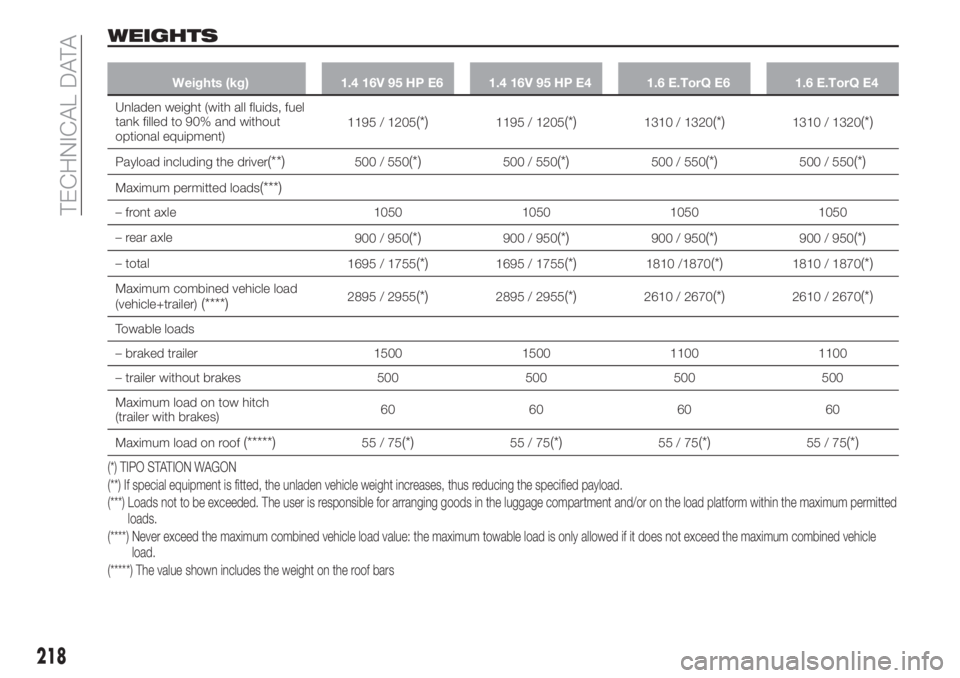
WEIGHTS
Weights (kg) 1.4 16V 95 HP E6 1.4 16V 95 HP E4 1.6 E.TorQ E6 1.6 E.TorQ E4
Unladen weight (with all fluids, fuel
tank filled to 90% and without
optional equipment)1195 / 1205(*)1195 / 1205(*)1310 / 1320(*)1310 / 1320(*)
Payload including the driver(**)500 / 550(*)500 / 550(*)500 / 550(*)500 / 550(*)
Maximum permitted loads(***)
– front axle 1050 1050 1050 1050
– rear axle
900 / 950
(*)900 / 950(*)900 / 950(*)900 / 950(*)
– total
1695 / 1755(*)1695 / 1755(*)1810 /1870(*)1810 / 1870(*)
Maximum combined vehicle load
(vehicle+trailer)(****)2895 / 2955(*)2895 / 2955(*)2610 / 2670(*)2610 / 2670(*)
Towable loads
– braked trailer 1500 1500 1100 1100
– trailer without brakes 500 500 500 500
Maximum load on tow hitch
(trailer with brakes)60 60 60 60
Maximum load on roof
(*****)55/75(*)55/75(*)55/75(*)55/75(*)
(*) TIPO STATION WAGON
(**) If special equipment is fitted, the unladen vehicle weight increases, thus reducing the specified payload.
(***) Loads not to be exceeded. The user is responsible for arranging goods in the luggage compartment and/or on the load platform within the maximum permitted
loads.
(****) Never exceed the maximum combined vehicle load value: the maximum towable load is only allowed if it does not exceed the maximum combined vehicle
load.
(*****) The value shown includes the weight on the roof bars
218
TECHNICAL DATA
Page 221 of 292
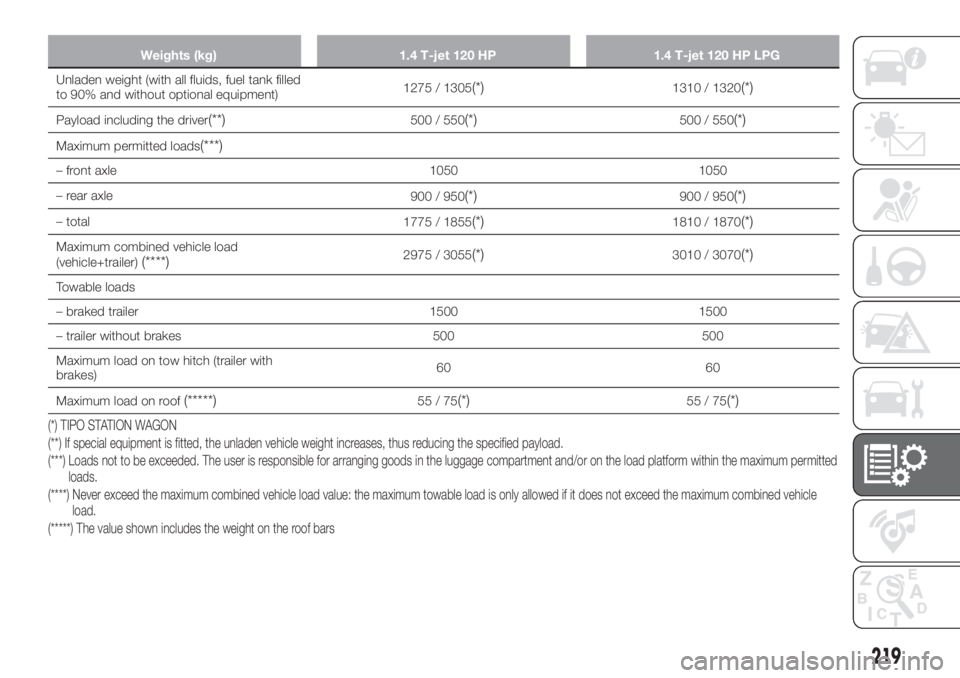
Weights (kg) 1.4 T-jet 120 HP 1.4 T-jet 120 HP LPG
Unladen weight (with all fluids, fuel tank filled
to 90% and without optional equipment)1275 / 1305(*)1310 / 1320(*)
Payload including the driver(**)500 / 550(*)500 / 550(*)
Maximum permitted loads(***)
– front axle 1050 1050
– rear axle
900 / 950
(*)900 / 950(*)
– total
1775 / 1855(*)1810 / 1870(*)
Maximum combined vehicle load
(vehicle+trailer)(****)2975 / 3055(*)3010 / 3070(*)
Towable loads
– braked trailer 1500 1500
– trailer without brakes 500 500
Maximum load on tow hitch (trailer with
brakes)60 60
Maximum load on roof
(*****)55/75(*)55/75(*)
(*) TIPO STATION WAGON
(**) If special equipment is fitted, the unladen vehicle weight increases, thus reducing the specified payload.
(***) Loads not to be exceeded. The user is responsible for arranging goods in the luggage compartment and/or on the load platform within the maximum permitted
loads.
(****) Never exceed the maximum combined vehicle load value: the maximum towable load is only allowed if it does not exceed the maximum combined vehicle
load.
(*****) The value shown includes the weight on the roof bars
219
Page 222 of 292
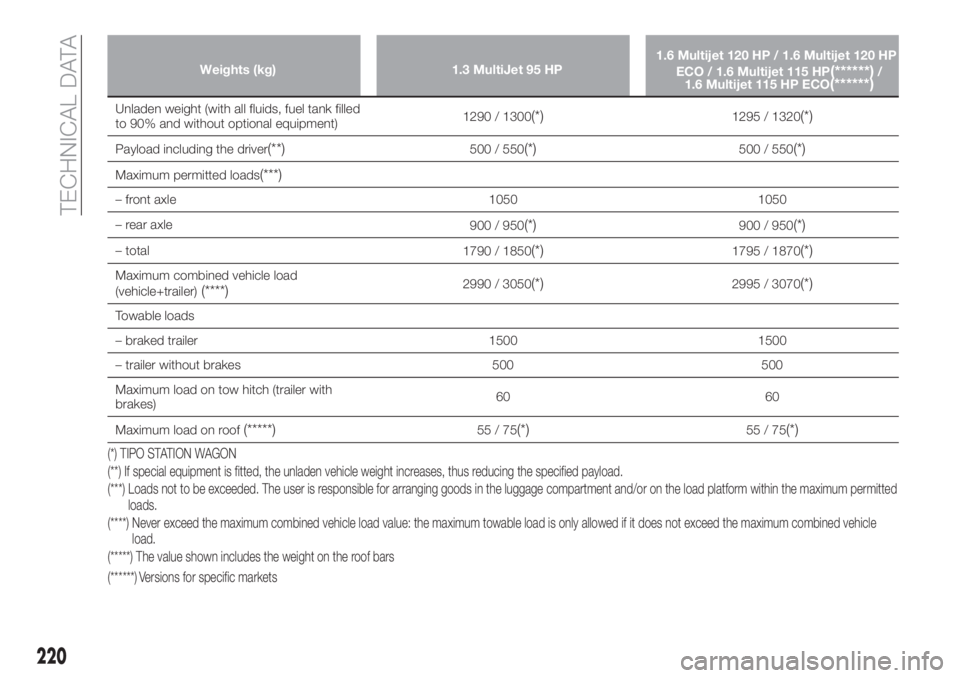
Weights (kg) 1.3 MultiJet 95 HP1.6 Multijet 120 HP / 1.6 Multijet 120 HP
ECO / 1.6 Multijet 115 HP(******)/
1.6 Multijet 115 HP ECO(******)
Unladen weight (with all fluids, fuel tank filled
to 90% and without optional equipment)1290 / 1300(*)1295 / 1320(*)
Payload including the driver(**)500 / 550(*)500 / 550(*)
Maximum permitted loads(***)
– front axle 1050 1050
– rear axle
900 / 950
(*)900 / 950(*)
– total
1790 / 1850(*)1795 / 1870(*)
Maximum combined vehicle load
(vehicle+trailer)(****)2990 / 3050(*)2995 / 3070(*)
Towable loads
– braked trailer 1500 1500
– trailer without brakes 500 500
Maximum load on tow hitch (trailer with
brakes)60 60
Maximum load on roof
(*****)55/75(*)55/75(*)
220
TECHNICAL DATA
(******) Versions for specific markets (*) TIPO STATION WAGON
(**) If special equipment is fitted, the unladen vehicle weight increases, thus reducing the specified payload.
(***) Loads not to be exceeded. The user is responsible for arranging goods in the luggage compartment and/or on the load platform within the maximum permitted
loads.
(****) Never exceed the maximum combined vehicle load value: the maximum towable load is only allowed if it does not exceed the maximum combined vehicle
load.
(*****) The value shown includes the weight on the roof bars
Page 223 of 292
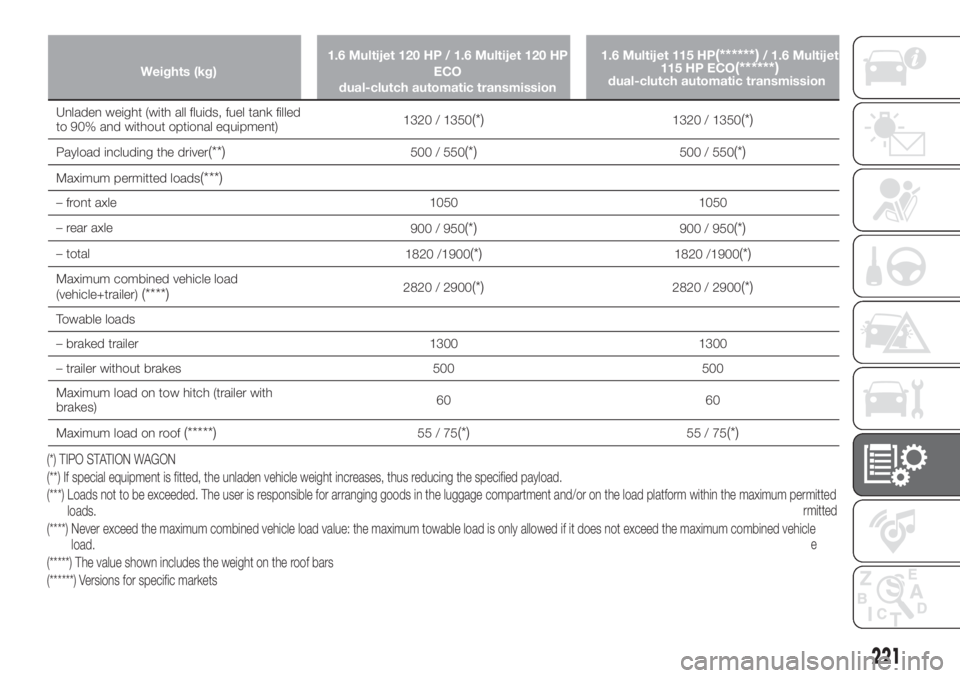
Weights (kg)1.6 Multijet 120 HP / 1.6 Multijet 120 HP
ECO
dual-clutch automatic transmission1.6 Multijet 115 HP(******)/ 1.6 Multijet
115 HP ECO(******)dual-clutch automatic transmission
Unladen weight (with all fluids, fuel tank filled
to 90% and without optional equipment)1320 / 1350(*)1320 / 1350(*)
Payload including the driver(**)500 / 550(*)500 / 550(*)
Maximum permitted loads(***)
– front axle 1050 1050
– rear axle
900 / 950
(*)900 / 950(*)
– total
1820 /1900(*)1820 /1900(*)
Maximum combined vehicle load
(vehicle+trailer)(****)2820 / 2900(*)2820 / 2900(*)
Towable loads
– braked trailer 1300 1300
– trailer without brakes 500 500
Maximum load on tow hitch (trailer with
brakes)60 60
Maximum load on roof
(*****)55/75(*)55/75(*)
rmitted
e
221
(******) Versions for specific markets (*) TIPO STATION WAGON
(**) If special equipment is fitted, the unladen vehicle weight increases, thus reducing the specified payload.
(***) Loads not to be exceeded. The user is responsible for arranging goods in the luggage compartment and/or on the load platform within the maximum permitted
loads.
(****) Never exceed the maximum combined vehicle load value: the maximum towable load is only allowed if it does not exceed the maximum combined vehicle
load.
(*****) The value shown includes the weight on the roof bars