battery FIAT ULYSSE 2007 2.G User Guide
[x] Cancel search | Manufacturer: FIAT, Model Year: 2007, Model line: ULYSSE, Model: FIAT ULYSSE 2007 2.GPages: 254, PDF Size: 3.42 MB
Page 106 of 254
GETTING TO KNOW YOUR CAR
105
ELECTRIC WINDOWS
Electric windows are fitted with safe-
ty anti-crushing gaskets. The system
control unit can feel the presence of
an obstacle when winding up the win-
dow: in this case it stops the window
winding up and reverses it immedi-
ately.
IMPORTANTWith the ignition
key at Sor removed, electric windows
work for 1 minute.
IMPORTANTIf, after disconnect-
ing the battery, the electric window
winder does not work, initialize the
system; release the control and oper-
ate it again until the window is com-
pletely closed and keep it pressed for
one second after the limit switch. The
system will start working properly
again.Incorrect use of the elec-
tric windows could be
dangerous. Before and
when pressing the switches, al-
ways make sure that passengers
cannot be injured either directly
by moving glass or by personal ef-
fects being dragged along or hit
by the glass. Always remove the
ignition key when getting out of
the vehicle to make sure that the
electric windows cannot be acci-
dentally operated and constitute
a hazard for passengers remain-
ing in the vehicle.VERSIONS WITH FRONT
DOOR ELECTRIC WINDOWS
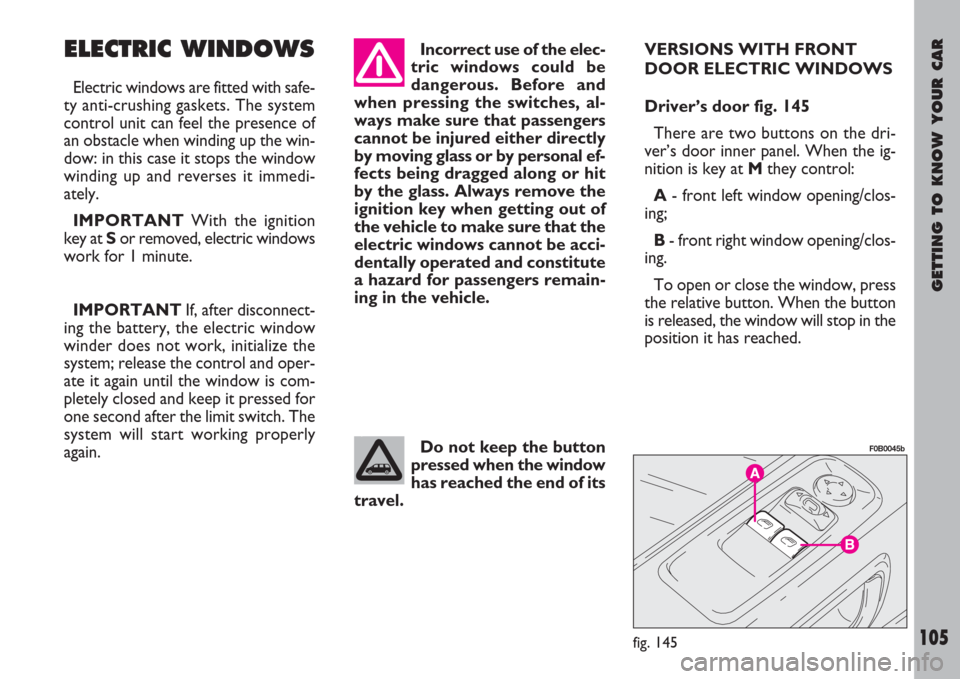
Driver’s door fig. 145
There are two buttons on the dri-
ver’s door inner panel. When the ig-
nition is key at M they control:
A- front left window opening/clos-
ing;
B- front right window opening/clos-
ing.
To open or close the window, press
the relative button. When the button
is released, the window will stop in the
position it has reached.
Do not keep the button
pressed when the window
has reached the end of its
travel.
fig. 145
F0B0045b
Page 109 of 254
GETTING TO KNOW YOUR CAR
108
Incorrect use of the sun-
roof could be dangerous.
Before and when pressing
the switches, always make sure
that passengers cannot be injured
either directly by moving sunroof
or by personal effects being
dragged along or hit by the sun-
roof.IMPORTANTIf, after disconnect-
ing the battery, the sunroof closing
control does not work, initialize the
system; release the control and oper-
ate it again until the sunroof is com-
pletely closed and keep it pressed for
one second after the limit switch. The
system will start working properly
again.
FIRST ROW CONTROLS
Front sunroof
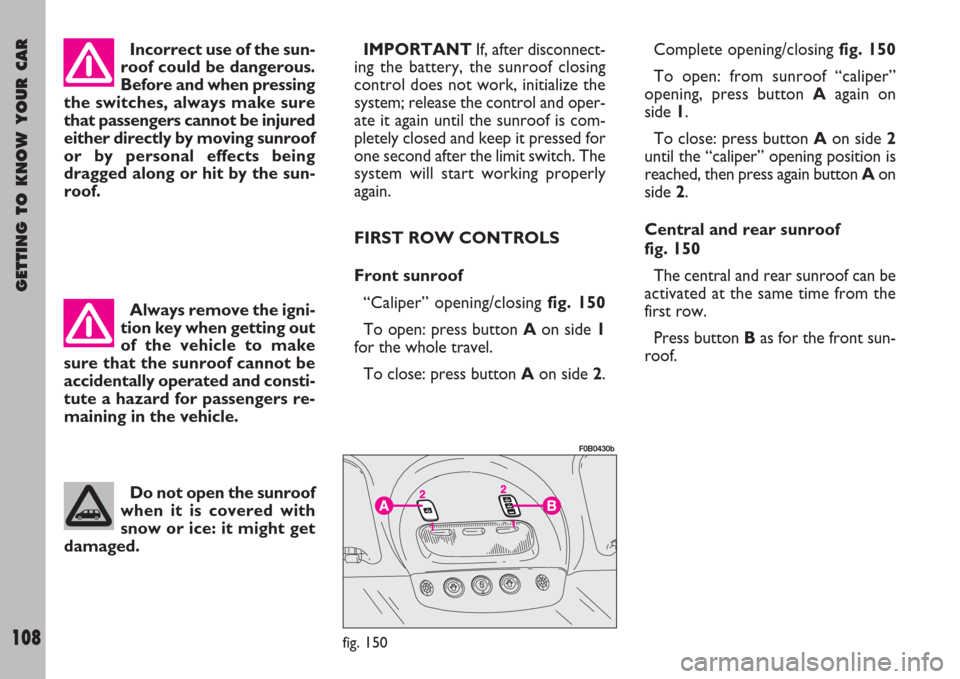
“Caliper” opening/closing fig. 150
To open: press button Aon side 1
for the whole travel.
To close: press button Aon side 2.Complete opening/closing fig. 150
To open: from sunroof “caliper”
opening, press button Aagain on
side 1.
To close: press button Aon side 2
until the “caliper” opening position is
reached, then press again button Aon
side 2.
Central and rear sunroof
fig. 150
The central and rear sunroof can be
activated at the same time from the
first row.
Press button Bas for the front sun-
roof.
Do not open the sunroof
when it is covered with
snow or ice: it might get
damaged.
Always remove the igni-
tion key when getting out
of the vehicle to make
sure that the sunroof cannot be
accidentally operated and consti-
tute a hazard for passengers re-
maining in the vehicle.
fig. 150
F0B0430b
Page 133 of 254
GETTING TO KNOW YOUR CAR
132
GENERAL NOTES
While parking, pay attention to ob-
stacles above or below the sensors. In
fact certain objects very close to the
vehicle rear part are not detected by
the system and so the car or the sen-
sors might get damaged.
Warnings coming from the damaged
sensors may be altered and no longer
reliable, also when they are covered
with dirt, mud, snow or ice, or con-
founded by nearby ultrasound systems
(e.g. air brakes of trucks or rivetting
hammers).SOUND SYSTEM
For the sound system, see the
“Sound system” handbook enclosed
to this “Owner handbook”.
ACCESSORIES
PURCHASED
BY THE OWNER
If, after purchasing your car, you wish
to add electric accessories (alarm,
satellite antitheft device, etc.) that re-
quire permanent power supply or high
feed accessories, visit a Fiat Dealer-
ship. The staff of experts, beside sug-
gesting the most suitable accessories
in the Lineaccessori Fiat range, will al-
so check whether the car electrical
system can support the the required
load or if a larger size battery needs to
be installed.Take care when fitting
additional spoilers, alloy
rims and non-standard
wheel caps: they might reduce
ventilation of the brakes, thus
their efficiency, during abrupt
and repeated braking, or long
downhill slopes. Make sure that
nothing (mats, etc.) gets in the
way of the pedals when they are
pushed down.
Page 140 of 254
DRIVING YOUR CAR
139
PARKING
Proceed as follows:
– turn the engine off;
– pull up the handbrake;
– put the vehicle in gear (1
stif the ve-
hicle is pointing uphill, reverse if down-
hill);
– leave the wheels steered to block
the vehicle in the event the handbrake
is released.
For vehicles with automatic elec-
tronic gearbox refer to “Getting to
know your car” chapter.
SAFE DRIVING
In designing the Ulysse, Fiat has made
every effort to come up with a vehicle
able to provide driver and passengers
with top-class levels of safety. Never-
theless it is always the behaviour of the
person at the wheel that determines
road safety.
Below you will find some simple tips
to help you travel in safety under dif-
ferent conditions. You will no doubt
be already familiar with many of them
but it will be useful to read them all
carefully. Do not leave the ignition
key at M to prevent drain-
ing the battery.
Never leave children un-
attended in the car. Al-
ways remove the ignition
key when leaving the car and take
it out with you.
Page 148 of 254
DRIVING YOUR CAR
147
CHEAP RUNNING THAT RESPECTS
THE ENVIRONMENT
LOOKING AFTER EMISSION
CONTROL DEVICES
The correct use of pollution control
devices not only ensures respect for
the environment but also has an effect
on the car’s performance. Keeping
these devices in good condition is
therefore a fundamental rule for dri-
ving that is easy on your pocket and
on the environment too.
The first step to take is to follow the
Service Schedule to the letter.
Only use diesel for motor vehicles
(EN590 specification). Environmental protection has been
one of the guiding principles in the
production of the Ulysse. It is no ac-
cident that its pollution control equip-
ment is much more effective than that
required by current legislation.
Nonetheless, the environment can-
not get by without a concerted effort
from everyone.
By following a few simple rules the
motorist can avoid harming the envi-
ronment and often cut down fuel con-
sumption at the same time.
On this subject, a number of useful
tips have been given below to supple-
ment those marked by symbol
#, at
various points of the manual.
You are asked to read both the for-
mer and latter carefully.If you have trouble starting, do not
turn the ignition key for long periods.
Be especially careful to avoid bump
starting the vehicle by pushing, towing
or rolling downhill: these are all ma-
noeuvres that can damage the catalyt-
ic exhaust.
For emergency starts only use an
auxiliary battery.
If the engine begins to “lose its
smoothness” when travelling, contin-
ue your journey but reduce the de-
mands you are making on the engine
and have the vehicle checked at a Fi-
at Dealership.
When the instrument panel fuel re-
serve warning light comes on, fill up as
soon as possible. A fuel level that is
too low can cause an uneven supply of
fuel with the inevitable increase in ex-
haust temperature; this would seri-
ously damage the catalytic converter.
Page 152 of 254
DRIVING YOUR CAR
151
STORING THE CAR
The following precautions should be
taken if the car will not be used for
several months:
– park the vehicle in covered, dry and
if possible well-ventilated premises;
– engage a gear (Pfor versions with
automatic electronic gear);
– make sure the handbrake is not en-
gaged;
– clean and protect the painted parts
using protective wax;
– sprinkle talcum powder on the rub-
ber windscreen and rear window
wiper blades and lift them off the glass;
– slightly open the windows;
– inflate the tyres to 0.5 bar above
the normal specified pressure and
check it at intervals;– switch off the electronic car alarm;
– disconnect the terminals (–) from
the battery poles (negative pole first)
and check the battery charge. When
the vehicle is in storage, this check
should be carried out once a month.
If no-load voltage is less than 12.5V,
recharge the battery;
– do not drain the engine cooling sys-
tem;
– cover the vehicle with a cloth or
perforated plastic sheet. Do not use
sheets of non-perforated plastic as
they do not allow moisture on the car
body to evaporate.RESTARTING THE CAR
AFTER STORAGE
Before restarting the vehicle after a
long storage, make the following op-
erations:
– do not take dust off the bodywork
without water;
– check if there are fluid leakages (oil,
brake and clutch fluid, engine coolant,
etc.);
– have the engine oil and the filter re-
placed;
– check the level of: brake and clutch
fluid, engine coolant;
Page 153 of 254
DRIVING YOUR CAR
152
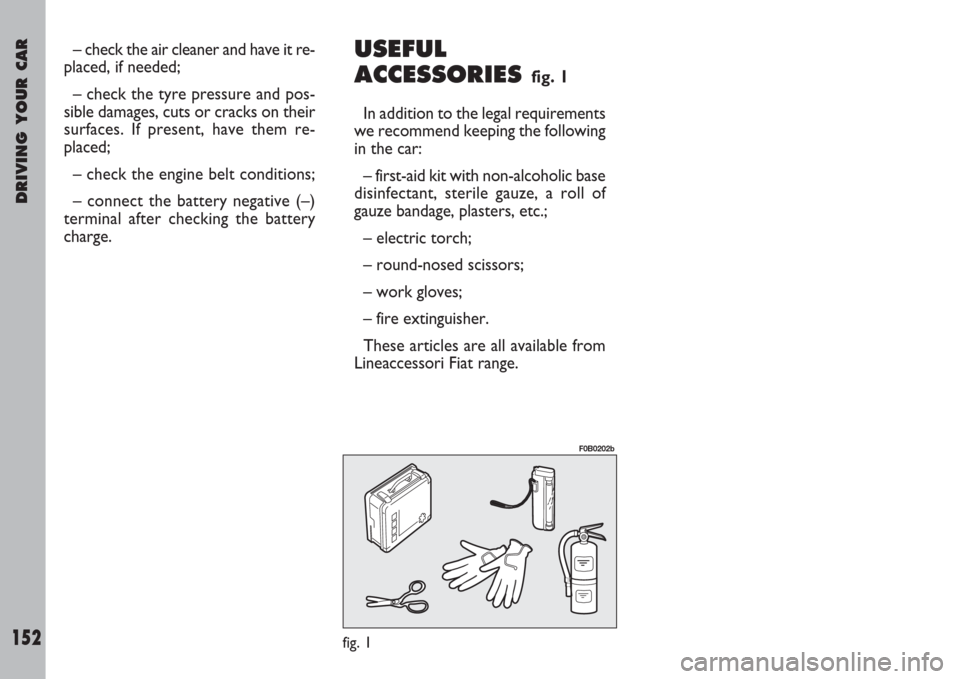
USEFUL
ACCESSORIES
fig. 1
In addition to the legal requirements
we recommend keeping the following
in the car:
– first-aid kit with non-alcoholic base
disinfectant, sterile gauze, a roll of
gauze bandage, plasters, etc.;
– electric torch;
– round-nosed scissors;
– work gloves;
– fire extinguisher.
These articles are all available from
Lineaccessori Fiat range.
fig. 1
F0B0202b
– check the air cleaner and have it re-
placed, if needed;
– check the tyre pressure and pos-
sible damages, cuts or cracks on their
surfaces. If present, have them re-
placed;
– check the engine belt conditions;
– connect the battery negative (–)
terminal after checking the battery
charge.
Page 154 of 254
IN AN EMERGENCY
153
I I
N N
A A
N N
E E
M M
E E
R R
G G
E E
N N
C C
Y Y
JUMP STARTING
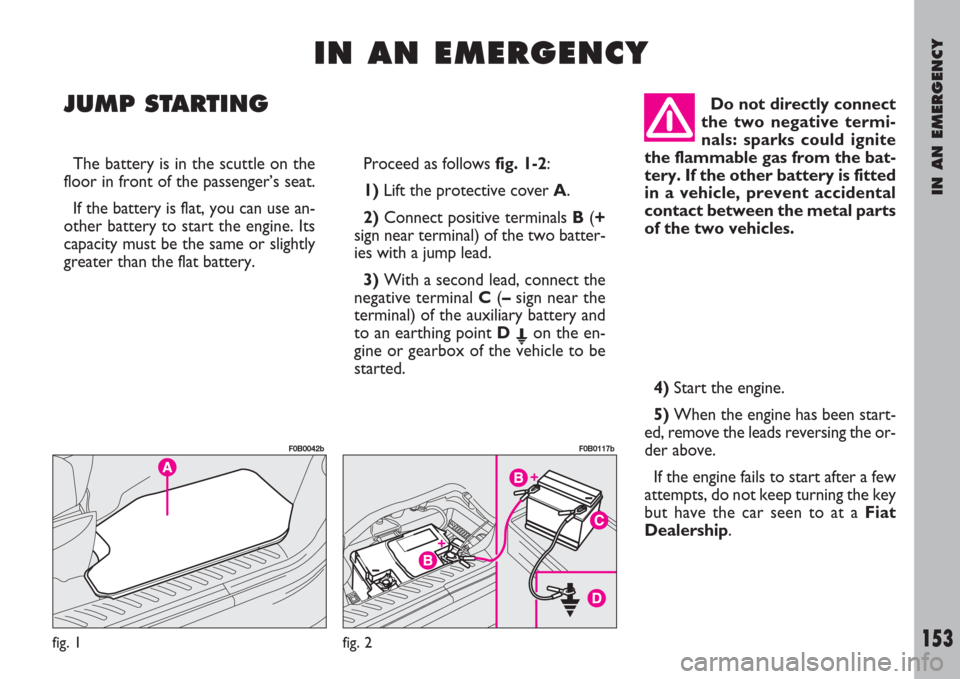
Proceed as follows fig. 1-2:
1)Lift the protective cover A.
2)Connect positive terminals B(+
sign near terminal) of the two batter-
ies with a jump lead.
3)With a second lead, connect the
negative terminal C(–sign near the
terminal) of the auxiliary battery and
to an earthing point DEon the en-
gine or gearbox of the vehicle to be
started. The battery is in the scuttle on the
floor in front of the passenger’s seat.
If the battery is flat, you can use an-
other battery to start the engine. Its
capacity must be the same or slightly
greater than the flat battery.Do not directly connect
the two negative termi-
nals: sparks could ignite
the flammable gas from the bat-
tery. If the other battery is fitted
in a vehicle, prevent accidental
contact between the metal parts
of the two vehicles.
4)Start the engine.
5)When the engine has been start-
ed, remove the leads reversing the or-
der above.
If the engine fails to start after a few
attempts, do not keep turning the key
but have the car seen to at a Fiat
Dealership.
fig. 1
F0B0042b
fig. 2
F0B0117b
Page 155 of 254
IN AN EMERGENCY
154
Do not carry out this
procedure if you lack ex-
perience; if it is not done
correctly it can cause very in-
tense electrical discharges. In ad-
dition, the fluid contained in the
battery is poisonous and corro-
sive. Avoid contact with skin and
eyes. You are also advised not to
put naked flames or lighted cig-
arettes near the battery and not
to cause sparks.
Remember that until
the engine has started the
brake booster and elec-
trical power steering systems will
not work and a greater effort will
therefore be required to press
the brake pedal or turn the steer-
ing wheel.IF A TYRE
IS PUNCTURED
Certain versions (where provided)
are fitted with wheel identification and
tyre inflation sensors; pressure loss is
signalled to the driver in the follow-
ing way:
pressure loss- the infotelematic
CONNECT system displays the relat-
ed message and a “gong” is emitted by
the system. Contact a Fiat Dealer-
ship;
punctured tyre- warning light
“STOP” comes on and the in-
fotelematic CONNECT system dis-
plays the related message together
with 3 consecutive “gong” sounds.
Change the wheel in the following
way.
The system can also display a dedi-
cated message in the event it should
not be able to detect the tyre pres-
sure. Under no circumstances
should a battery charger
be used to start the en-
gine: it could damage the elec-
tronic systems and in particular
the ignition and injection control
units.
BUMP STARTING
Do not bump start by
pushing, towing or coast-
ing downhill. This way of
starting could cause a rush of fu-
el into the catalytic converter and
damage it beyond repair.
Page 172 of 254
IN AN EMERGENCY
171
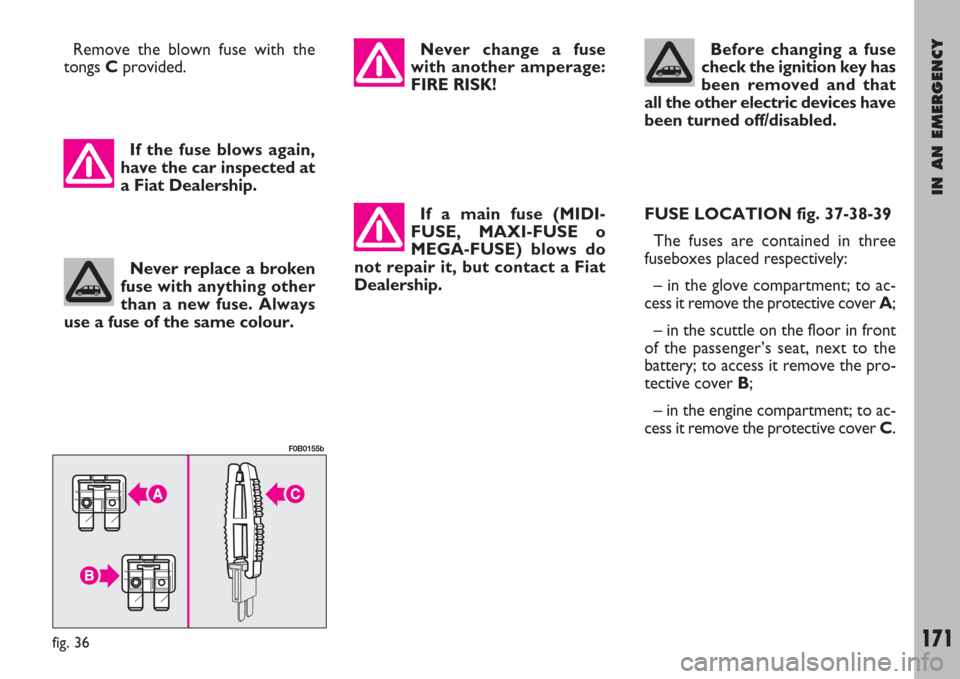
Remove the blown fuse with the
tongs Cprovided.
If a main fuse (MIDI-
FUSE, MAXI-FUSE o
MEGA-FUSE) blows do
not repair it, but contact a Fiat
Dealership.FUSE LOCATION fig. 37-38-39
The fuses are contained in three
fuseboxes placed respectively:
– in the glove compartment; to ac-
cess it remove the protective cover A;
– in the scuttle on the floor in front
of the passenger’s seat, next to the
battery; to access it remove the pro-
tective cover B;
– in the engine compartment; to ac-
cess it remove the protective cover C. Never replace a broken
fuse with anything other
than a new fuse. Always
use a fuse of the same colour.Before changing a fuse
check the ignition key has
been removed and that
all the other electric devices have
been turned off/disabled.Never change a fuse
with another amperage:
FIRE RISK!
fig. 36
F0B0155b
If the fuse blows again,
have the car inspected at
a Fiat Dealership.