brake light FIAT ULYSSE 2007 2.G User Guide
[x] Cancel search | Manufacturer: FIAT, Model Year: 2007, Model line: ULYSSE, Model: FIAT ULYSSE 2007 2.GPages: 254, PDF Size: 3.42 MB
Page 138 of 254
DRIVING YOUR CAR
137
5)Wait for the warning light mto
go out. The hotter the engine is, the
quicker this will happen.
6)Turn the ignition key to Dimme-
diately after the mwarning light
goes out. If you wait too long, you will
lose the benefit of the work done by
the glow plugs. PROCEDURE FOR STARTING
1)Make sure the handbrake is up.
2)Put the gear lever in neutral.
3) Press down the clutch pedal.
4)Turn the ignition key to Mand in-
strument panel warning light mwill
come on.High current absorption electric de-
vices (climate control system, rear
heated window, etc.) are automatical-
ly deactivated during start-up.
If the engine does not start at the
first attempt, return the ignition key
to Sand then again to M. If it is still
impossible to start the engine, try with
the other key provided with the car.
If you are still unable to start the en-
gine, contact a Fiat Dealership.
Page 141 of 254
DRIVING YOUR CAR
140
BEFORE GETTING BEHIND
THE WHEEL
The main suggestions are the fol-
lowing:
– make sure all lights including the
headlights are working properly;
– adjust the position of the seat,
steering wheel, driving and door mir-
rors properly for the best driving po-
sition;
– adjust the head restraints careful-
ly so that they support the head and
not the neck;
– make sure that nothing (mats, etc.)
gets in the way of the pedals when
they are pushed down;
– make sure that any child restraint
systems (child seats, carriers, etc.) are
properly fixed, preferably on the back
seat as this is the safest place in the
event of an accident;– make sure that objects being trans-
ported are carefully arranged so they
will not fly forward if you have to
brake sharply;
– do not eat a heavy meal before
travelling. Light eating will help keep
your reflexes prompt. Above all, do
not have anything alcoholic to drink.
Using certain prescription drugs can
reduce your ability to drive: read in-
structions for use carefully.
Periodically, remember to check:
– tyre pressure and conditions;
– engine oil level;
– coolant level and conditions of the
system;
– brake fluid level;
– power steering fluid level;
– windscreen washer liquid level.WHEN TRAVELLING
The main suggestions are the fol-
lowing:
– the first rule of safe driving is pru-
dence. Prudence also means putting
yourself into a position where you can
predict wrong or imprudent behaviour
from other drivers;
– stick closely to the rules of the
road in the particular country where
the vehicle is being driven and, above
all, do not exceed speed limits;
– ensure that, besides yourself, all the
other passengers in the vehicle have
their seat belts fastened, that children
are sitting in the appropriate child
seats and any animals in the car are
placed in suitable compartments;
– you should be physically fit and
mentally alert before setting out on
long journeys;
Page 142 of 254
DRIVING YOUR CAR
141
Be careful when fitting
additional spoilers, light
alloy rims and optional
wheel caps: these devices could
reduce brake ventilation and ef-
ficiency in the event of repeated
and sudden braking or long
downhill drives.Never drive with objects
on the floor in front of the
driver’s seat. The objects
could get jammed under the ped-
als making braking or accelerat-
ing impossible.
Driving while drunk or
under the influence of
drugs or certain medi-
cines is dangerous for both you
and other road users.Pay attention to mats: if
you note even a small
problem in braking, the
pedal stroke may need to be ad-
justed.
Always fasten both front
and back seat belts, in-
cluding child restraint sys-
tems. Travelling with the seat
belts unfastened increases the
risk of injury or death if you are
in a collision.
Water, ice and road salt
may deposit on brake
discs making it difficult to
brake the first time this is neces-
sary.– do not drive too many hours at a
time but stop at intervals to stretch
your legs and recoup your energies;
– make sure the air in the vehicle is
being changed continuously;
– never coast downhill (i.e. with the
engine off): if you do, you lose the aid
of the engine brake, power brakes and
power steering, so that braking and
steering require greater effort.
Page 144 of 254
DRIVING YOUR CAR
143
Remember that fog also means the
tarmac is wet and therefore manoeu-
vres of all kinds are more difficult and
stopping distances are longer:
– keep a good distance from the cars
in front of you;
– when possible, avoid spurts of
speed or sudden deceleration;
– do not overtake other vehicles if
you can help it;
– if you are forced to stop your ve-
hicle (breakdown, limited visibility,
etc.), first try to stop off the road.
Then turn on the hazard lights and, if
possible, the dipped headlights;
– rhythmically sound the horn if you
realise another vehicle is approaching.DRIVING IN
THE MOUNTAINS
The main suggestions are the fol-
lowing:
– when driving downhill use the en-
gine brake by engaging a low gear so
as not to overheat the brakes;
– under no circumstances should you
drive downhill with the engine off or
with the vehicle in neutral, let alone
with the ignition key out;
– drive at moderate speed without
“cutting” corners;
– remember that overtaking while
going uphill is slower and therefore re-
quires more clear road. If you are be-
ing overtaken while driving uphill,
make it easier for the other vehicle
to pass. DRIVING IN FOG
If the fog is thick, do not start out on
a journey unless you absolutely have to.
If driving in mist, blanket fog or when
there is the danger of fog patches:
– keep your speed down;
– turn on the dipped headlights, rear
fog lights and front fog lights, if fitted,
even during the day. Do not drive with
your headlights at full-beam.
IMPORTANTOn stretches of
road with good visibility, switch off
your rear foglights; the brightness of
these lights could annoy the people
travelling in the cars behind.
Page 145 of 254
DRIVING YOUR CAR
144
DRIVING WITH ABS
ABS is a part of the braking system
offering 2 advantages:
1)it prevents wheel lock-up and
consequent skidding in emergency
stops, particularly when the road does
not offer much grip;
2)it makes it possible to brake and
steer at the same time so you can
avoid sudden objects on the road and
direct the vehicle where you want
while braking; this compatibly with the
physical limits of overall tyre grip.To get the most out of ABS:
– during emergency stops or when
grip conditions are poor, you will feel
a slight pulsation on the brake pedal.
This is the sign that the ABS is in ac-
tion. Do not release the brake pedal
but continue to press so as not to in-
terrupt the braking action;
– ABS prevents the wheels from
locking but it does not increase actu-
al grip conditions between tyre and
road. Therefore, even if your vehicle
is fitted with ABS, respect the safety
distance from the vehicle in front of
you and keep your speed down when
driving into bends.
ABS serves to increase the control-
lability of the vehicle, not to enable you
to go faster. DRIVING ON SNOW AND ICE
The main suggestions are the fol-
lowing:
– keep you speed down;
– keep a good distance from the cars
in front of you;
– use chains if the roads are covered
in snow. See “Snow chains” in this
chapter;
– do not keep the engine running for
long periods in deep snow as the snow
could push exhaust gases into the pas-
senger compartment;
– mainly use the engine brake and un-
der all circumstances avoid braking
sharply;
– do not accelerate suddenly and
avoid swerving;
– in the winter, even apparently dry
roads may have icy patches. Be care-
ful therefore when driving over
stretches that do not get much expo-
sure to the sun or that are lined by
trees and rocks, where ice might not
have melted.
Page 152 of 254
DRIVING YOUR CAR
151
STORING THE CAR
The following precautions should be
taken if the car will not be used for
several months:
– park the vehicle in covered, dry and
if possible well-ventilated premises;
– engage a gear (Pfor versions with
automatic electronic gear);
– make sure the handbrake is not en-
gaged;
– clean and protect the painted parts
using protective wax;
– sprinkle talcum powder on the rub-
ber windscreen and rear window
wiper blades and lift them off the glass;
– slightly open the windows;
– inflate the tyres to 0.5 bar above
the normal specified pressure and
check it at intervals;– switch off the electronic car alarm;
– disconnect the terminals (–) from
the battery poles (negative pole first)
and check the battery charge. When
the vehicle is in storage, this check
should be carried out once a month.
If no-load voltage is less than 12.5V,
recharge the battery;
– do not drain the engine cooling sys-
tem;
– cover the vehicle with a cloth or
perforated plastic sheet. Do not use
sheets of non-perforated plastic as
they do not allow moisture on the car
body to evaporate.RESTARTING THE CAR
AFTER STORAGE
Before restarting the vehicle after a
long storage, make the following op-
erations:
– do not take dust off the bodywork
without water;
– check if there are fluid leakages (oil,
brake and clutch fluid, engine coolant,
etc.);
– have the engine oil and the filter re-
placed;
– check the level of: brake and clutch
fluid, engine coolant;
Page 155 of 254
IN AN EMERGENCY
154
Do not carry out this
procedure if you lack ex-
perience; if it is not done
correctly it can cause very in-
tense electrical discharges. In ad-
dition, the fluid contained in the
battery is poisonous and corro-
sive. Avoid contact with skin and
eyes. You are also advised not to
put naked flames or lighted cig-
arettes near the battery and not
to cause sparks.
Remember that until
the engine has started the
brake booster and elec-
trical power steering systems will
not work and a greater effort will
therefore be required to press
the brake pedal or turn the steer-
ing wheel.IF A TYRE
IS PUNCTURED
Certain versions (where provided)
are fitted with wheel identification and
tyre inflation sensors; pressure loss is
signalled to the driver in the follow-
ing way:
pressure loss- the infotelematic
CONNECT system displays the relat-
ed message and a “gong” is emitted by
the system. Contact a Fiat Dealer-
ship;
punctured tyre- warning light
“STOP” comes on and the in-
fotelematic CONNECT system dis-
plays the related message together
with 3 consecutive “gong” sounds.
Change the wheel in the following
way.
The system can also display a dedi-
cated message in the event it should
not be able to detect the tyre pres-
sure. Under no circumstances
should a battery charger
be used to start the en-
gine: it could damage the elec-
tronic systems and in particular
the ignition and injection control
units.
BUMP STARTING
Do not bump start by
pushing, towing or coast-
ing downhill. This way of
starting could cause a rush of fu-
el into the catalytic converter and
damage it beyond repair.
Page 162 of 254
IN AN EMERGENCY
161
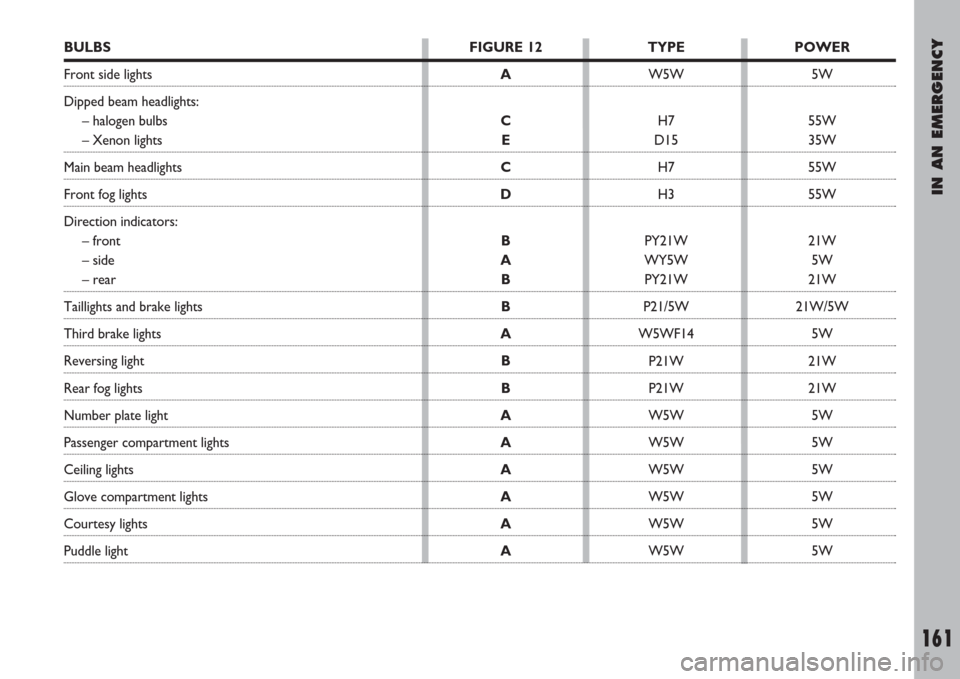
BULBS
Front side lights
Dipped beam headlights:
– halogen bulbs
– Xenon lights
Main beam headlights
Front fog lights
Direction indicators:
– front
– side
– rear
Taillights and brake lights
Third brake lights
Reversing light
Rear fog lights
Number plate light
Passenger compartment lights
Ceiling lights
Glove compartment lights
Courtesy lights
Puddle lightFIGURE 12
A
C
E
C
D
B
A
B
B
A
B
B
A
A
A
A
A
ATYPE
W5W
H7
D15
H7
H3
PY21W
WY5W
PY21W
P21/5W
W5WF14
P21W
P21W
W5W
W5W
W5W
W5W
W5W
W5WPOWER
5W
55W
35W
55W
55W
21W
5W
21W
21W/5W
5W
21W
21W
5W
5W
5W
5W
5W
5W
Page 167 of 254
IN AN EMERGENCY
166
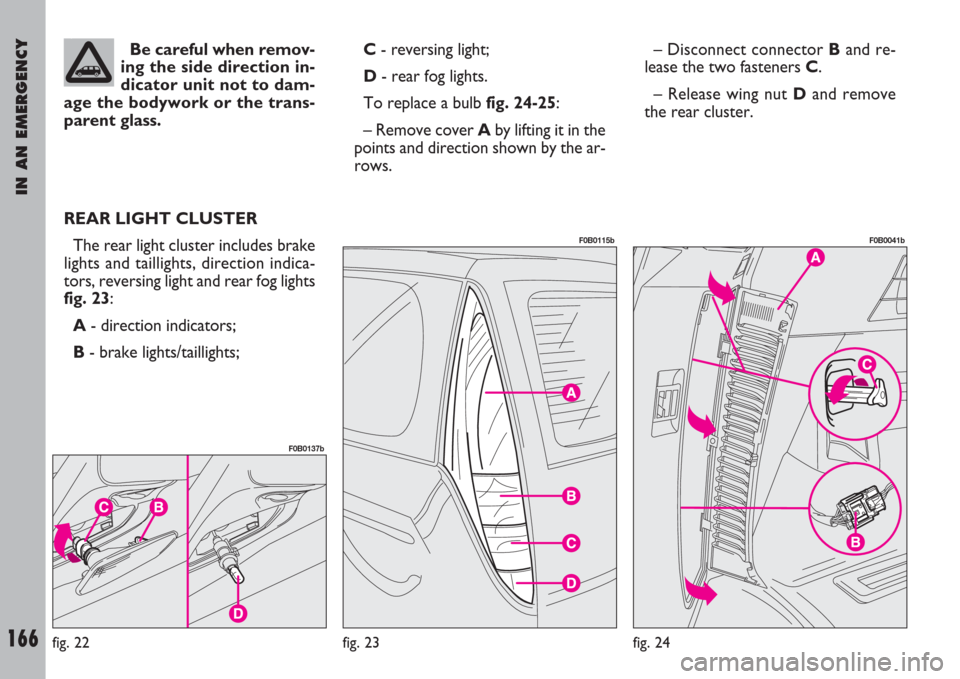
Be careful when remov-
ing the side direction in-
dicator unit not to dam-
age the bodywork or the trans-
parent glass.
REAR LIGHT CLUSTER
The rear light cluster includes brake
lights and taillights, direction indica-
tors, reversing light and rear fog lights
fig. 23:
A- direction indicators;
B- brake lights/taillights;C- reversing light;
D- rear fog lights.
To replace a bulb fig. 24-25:
– Remove cover Aby lifting it in the
points and direction shown by the ar-
rows.– Disconnect connector Band re-
lease the two fasteners C.
– Release wing nut Dand remove
the rear cluster.
fig. 22
F0B0137b
fig. 24
F0B0041b
fig. 23
F0B0115b
Page 168 of 254
IN AN EMERGENCY
167
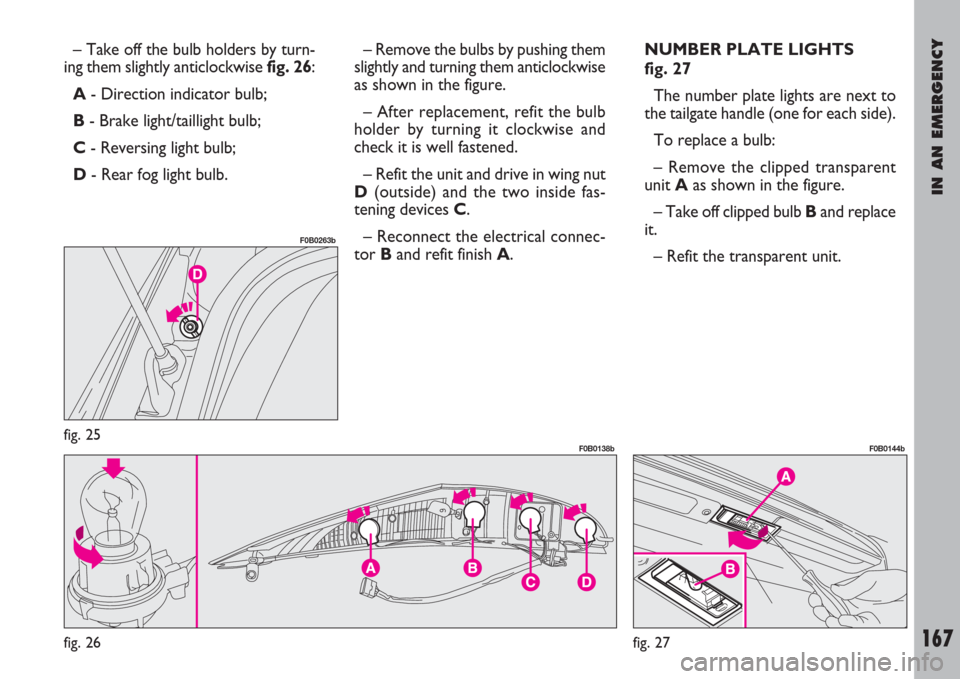
– Take off the bulb holders by turn-
ing them slightly anticlockwise fig. 26:
A- Direction indicator bulb;
B- Brake light/taillight bulb;
C- Reversing light bulb;
D- Rear fog light bulb.– Remove the bulbs by pushing them
slightly and turning them anticlockwise
as shown in the figure.
– After replacement, refit the bulb
holder by turning it clockwise and
check it is well fastened.
– Refit the unit and drive in wing nut
D(outside) and the two inside fas-
tening devices C.
– Reconnect the electrical connec-
tor Band refit finish A.NUMBER PLATE LIGHTS
fig. 27
The number plate lights are next to
the tailgate handle (one for each side).
To replace a bulb:
– Remove the clipped transparent
unit Aas shown in the figure.
– Take off clipped bulb Band replace
it.
– Refit the transparent unit.
fig. 26
F0B0138b
fig. 27
F0B0144bfig. 25
F0B0263b