Door FIAT ULYSSE 2007 2.G Owner's Manual
[x] Cancel search | Manufacturer: FIAT, Model Year: 2007, Model line: ULYSSE, Model: FIAT ULYSSE 2007 2.GPages: 254, PDF Size: 3.42 MB
Page 106 of 254
GETTING TO KNOW YOUR CAR
105
ELECTRIC WINDOWS
Electric windows are fitted with safe-
ty anti-crushing gaskets. The system
control unit can feel the presence of
an obstacle when winding up the win-
dow: in this case it stops the window
winding up and reverses it immedi-
ately.
IMPORTANTWith the ignition
key at Sor removed, electric windows
work for 1 minute.
IMPORTANTIf, after disconnect-
ing the battery, the electric window
winder does not work, initialize the
system; release the control and oper-
ate it again until the window is com-
pletely closed and keep it pressed for
one second after the limit switch. The
system will start working properly
again.Incorrect use of the elec-
tric windows could be
dangerous. Before and
when pressing the switches, al-
ways make sure that passengers
cannot be injured either directly
by moving glass or by personal ef-
fects being dragged along or hit
by the glass. Always remove the
ignition key when getting out of
the vehicle to make sure that the
electric windows cannot be acci-
dentally operated and constitute
a hazard for passengers remain-
ing in the vehicle.VERSIONS WITH FRONT
DOOR ELECTRIC WINDOWS
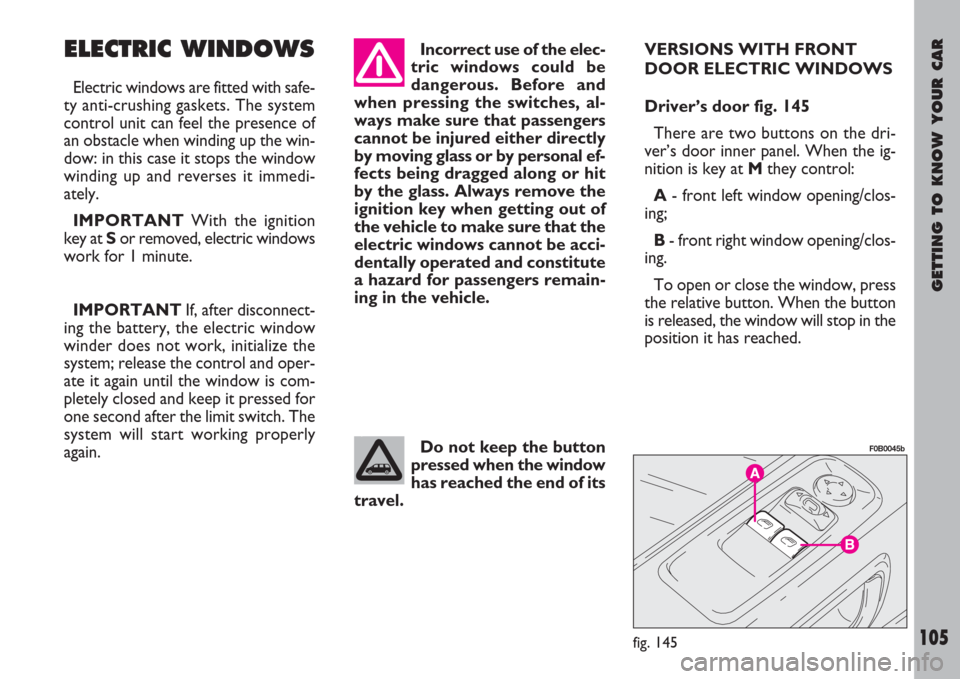
Driver’s door fig. 145
There are two buttons on the dri-
ver’s door inner panel. When the ig-
nition is key at M they control:
A- front left window opening/clos-
ing;
B- front right window opening/clos-
ing.
To open or close the window, press
the relative button. When the button
is released, the window will stop in the
position it has reached.
Do not keep the button
pressed when the window
has reached the end of its
travel.
fig. 145
F0B0045b
Page 107 of 254
GETTING TO KNOW YOUR CAR
106
The driver’s window winder is fitted
with an “automatic continuous oper-
ation” (working only when the engine
is started) to wind up or lower the
window. Press Abriefly and the win-
dow will automatically reach its trav-
el end. If you press the button a sec-
ond time, the window will stop in the
required position.
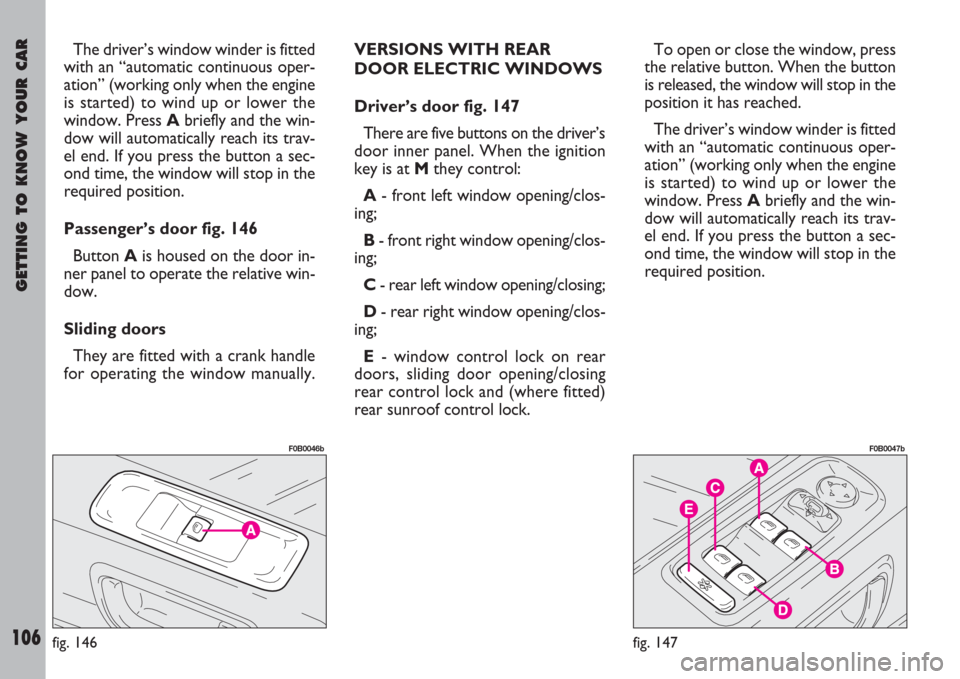
Passenger’s door fig. 146
Button Ais housed on the door in-
ner panel to operate the relative win-
dow.
Sliding doors
They are fitted with a crank handle
for operating the window manually.VERSIONS WITH REAR
DOOR ELECTRIC WINDOWS
Driver’s door fig. 147
There are five buttons on the driver’s
door inner panel. When the ignition
key is at Mthey control:
A- front left window opening/clos-
ing;
B- front right window opening/clos-
ing;
C- rear left window opening/closing;
D- rear right window opening/clos-
ing;
E- window control lock on rear
doors, sliding door opening/closing
rear control lock and (where fitted)
rear sunroof control lock.To open or close the window, press
the relative button. When the button
is released, the window will stop in the
position it has reached.
The driver’s window winder is fitted
with an “automatic continuous oper-
ation” (working only when the engine
is started) to wind up or lower the
window. Press Abriefly and the win-
dow will automatically reach its trav-
el end. If you press the button a sec-
ond time, the window will stop in the
required position.
fig. 146
F0B0046b
fig. 147
F0B0047b
Page 108 of 254
GETTING TO KNOW YOUR CAR
107
Passenger’s door fig. 146
Button Ais housed on the door in-
ner panel to operate the relative win-
dow.
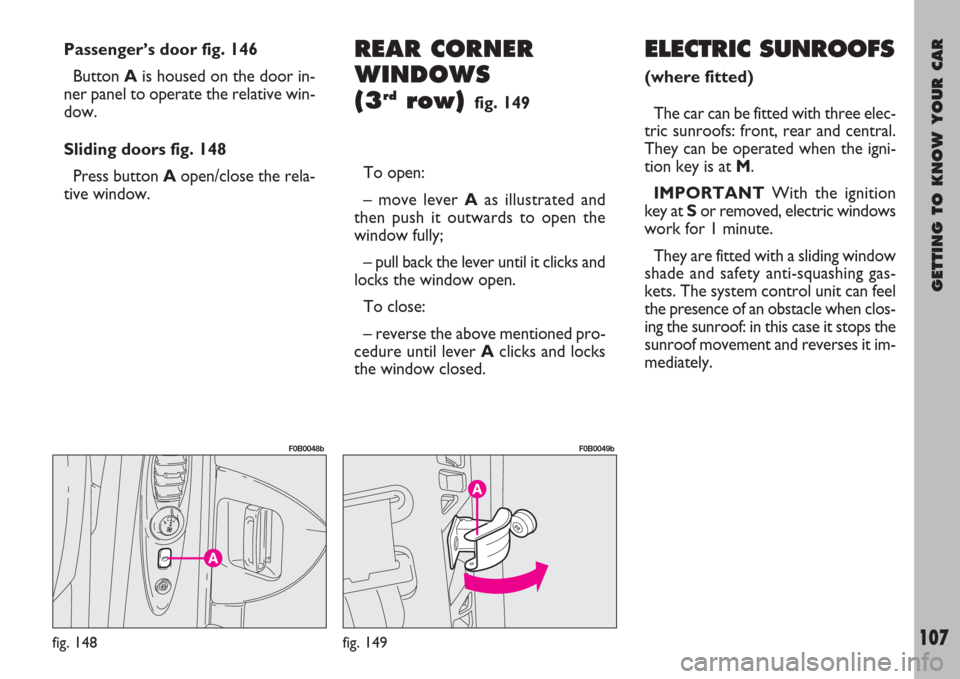
Sliding doors fig. 148
Press button Aopen/close the rela-
tive window.REAR CORNER
WINDOWS
(3
rdrow)fig. 149
To open:
– move lever Aas illustrated and
then push it outwards to open the
window fully;
– pull back the lever until it clicks and
locks the window open.
To close:
– reverse the above mentioned pro-
cedure until lever Aclicks and locks
the window closed.
ELECTRIC SUNROOFS
(where fitted)
The car can be fitted with three elec-
tric sunroofs: front, rear and central.
They can be operated when the igni-
tion key is at M.
IMPORTANTWith the ignition
key at Sor removed, electric windows
work for 1 minute.
They are fitted with a sliding window
shade and safety anti-squashing gas-
kets. The system control unit can feel
the presence of an obstacle when clos-
ing the sunroof: in this case it stops the
sunroof movement and reverses it im-
mediately.
fig. 148
F0B0048b
fig. 149
F0B0049b
Page 110 of 254
GETTING TO KNOW YOUR CAR
109
SECOND AND THIRD ROW
CONTROLS
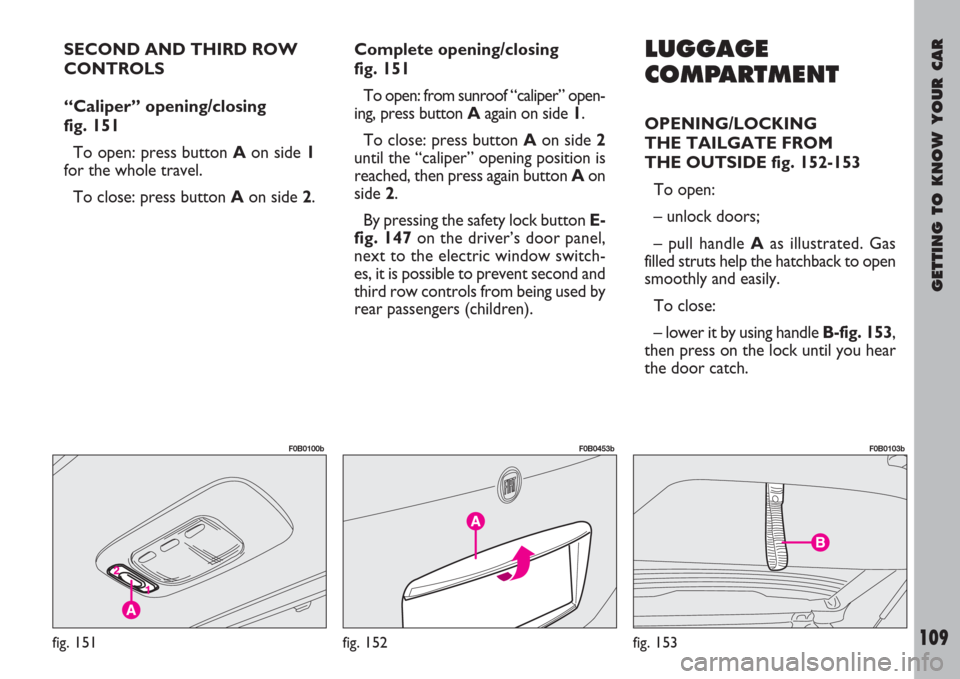
“Caliper” opening/closing
fig. 151
To open: press button Aon side 1
for the whole travel.
To close: press button Aon side 2.Complete opening/closing
fig. 151
To open: from sunroof “caliper” open-
ing, press button Aagain on side1.
To close: press button Aon side 2
until the “caliper” opening position is
reached, then press again button Aon
side 2.
By pressing the safety lock button E-
fig. 147on the driver’s door panel,
next to the electric window switch-
es, it is possible to prevent second and
third row controls from being used by
rear passengers (children).LUGGAGE
COMPARTMENT
OPENING/LOCKING
THE TAILGATE FROM
THE OUTSIDE fig. 152-153
To open:
– unlock doors;
– pull handle Aas illustrated. Gas
filled struts help the hatchback to open
smoothly and easily.
To close:
– lower it by using handle B-fig. 153,
then press on the lock until you hear
the door catch.
fig. 151
F0B0100b
fig. 153
F0B0103b
fig. 152
F0B0453b
Page 127 of 254
GETTING TO KNOW YOUR CAR
126
Deactivating the passenger’s
front air bag manually
The passenger’s front airbag can be
deactivated if it is absolutely necessary
to carry a child in the front passenger
seat.
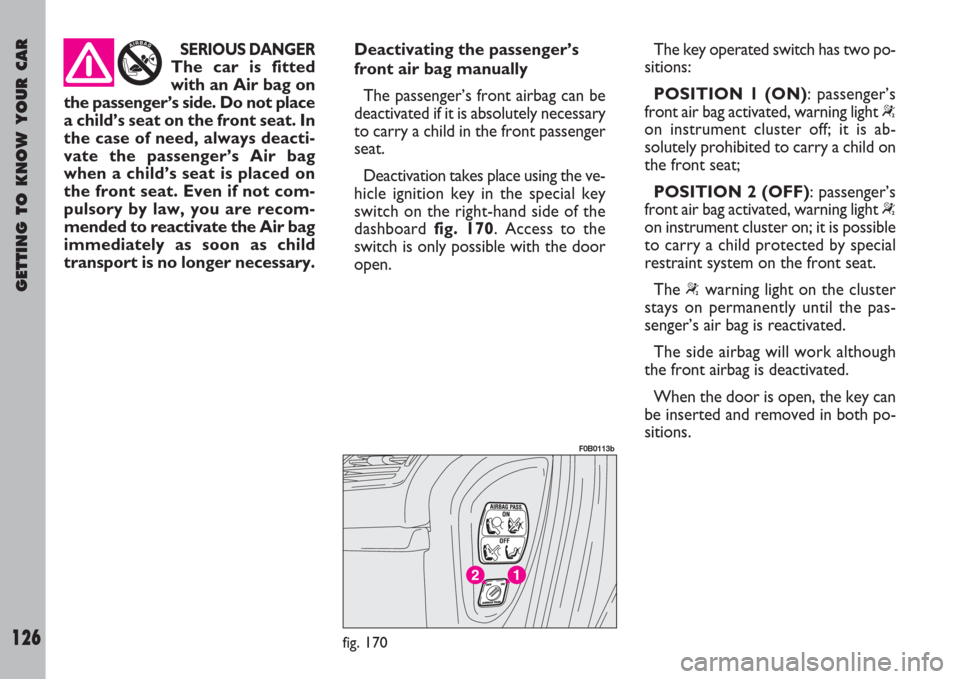
Deactivation takes place using the ve-
hicle ignition key in the special key
switch on the right-hand side of the
dashboard fig. 170. Access to the
switch is only possible with the door
open.The key operated switch has two po-
sitions:
POSITION 1 (ON): passenger’s
front air bag activated, warning light
“
on instrument cluster off; it is ab-
solutely prohibited to carry a child on
the front seat;
POSITION 2 (OFF): passenger’s
front air bag activated, warning light
“
on instrument cluster on; it is possible
to carry a child protected by special
restraint system on the front seat.
The
“warning light on the cluster
stays on permanently until the pas-
senger’s air bag is reactivated.
The side airbag will work although
the front airbag is deactivated.
When the door is open, the key can
be inserted and removed in both po-
sitions.
fig. 170
F0B0113b
SERIOUS DANGER
The car is fitted
with an Air bag on
the passenger’s side. Do not place
a child’s seat on the front seat. In
the case of need, always deacti-
vate the passenger’s Air bag
when a child’s seat is placed on
the front seat. Even if not com-
pulsory by law, you are recom-
mended to reactivate the Air bag
immediately as soon as child
transport is no longer necessary.
Page 128 of 254
GETTING TO KNOW YOUR CAR
127
SIDE AIR BAGS
(SIDE BAG - WINDOW BAG)
Purpose of the side airbags is to in-
crease passenger protection in the
event of a side impact of medium to
high severity.
They consist of two instantly inflat-
able bag types:
– side bags are housed in the back
rest of the front seats; this solution
makes it possible to always have the
cushion in the optimum position with
respect to the passenger, regardless of
the seat position;
– window bags, being a “curtain” sys-
tem, are housed in the side roof lin-
ing and are covered by a special trim
that enables bag deflation downwards.
This solution, designed to protect the
head, offers the occupants the highest
degree of protection in the case of aside crash due to the wide deflation
surface of the bags.
In the event of a side collision the
electronic control unit processes the
signals coming from a deceleration
sensor and, if required, triggers the in-
flation of the bags.
The bags inflate immediately, setting
as a protective barrier between the
passengers and the car door. The bags
deflate immediately afterwards.
In minor side crashes (for which the
restraining action of the seat belts is
sufficient), the air bags are not de-
ployed.Therefore the side air bags are not
a replacement of but complementary
to the belts, which you are recom-
mended to always wear, as specified
by law in Europe and most non-Euro-
pean countries.
Operation of the side air bags is not
disabled by the passenger’s front air
bag deactivation switch, as described
in the previous paragraph.
IMPORTANTThe front and/or
side air bags may be deployed if the car
is subject to heavy knocks or accidents
involving the underbody area, such as
for example violent shocks against
steps, kerbs or low obstacles, falling of
the car in big holes or sags in the road.
Page 141 of 254
DRIVING YOUR CAR
140
BEFORE GETTING BEHIND
THE WHEEL
The main suggestions are the fol-
lowing:
– make sure all lights including the
headlights are working properly;
– adjust the position of the seat,
steering wheel, driving and door mir-
rors properly for the best driving po-
sition;
– adjust the head restraints careful-
ly so that they support the head and
not the neck;
– make sure that nothing (mats, etc.)
gets in the way of the pedals when
they are pushed down;
– make sure that any child restraint
systems (child seats, carriers, etc.) are
properly fixed, preferably on the back
seat as this is the safest place in the
event of an accident;– make sure that objects being trans-
ported are carefully arranged so they
will not fly forward if you have to
brake sharply;
– do not eat a heavy meal before
travelling. Light eating will help keep
your reflexes prompt. Above all, do
not have anything alcoholic to drink.
Using certain prescription drugs can
reduce your ability to drive: read in-
structions for use carefully.
Periodically, remember to check:
– tyre pressure and conditions;
– engine oil level;
– coolant level and conditions of the
system;
– brake fluid level;
– power steering fluid level;
– windscreen washer liquid level.WHEN TRAVELLING
The main suggestions are the fol-
lowing:
– the first rule of safe driving is pru-
dence. Prudence also means putting
yourself into a position where you can
predict wrong or imprudent behaviour
from other drivers;
– stick closely to the rules of the
road in the particular country where
the vehicle is being driven and, above
all, do not exceed speed limits;
– ensure that, besides yourself, all the
other passengers in the vehicle have
their seat belts fastened, that children
are sitting in the appropriate child
seats and any animals in the car are
placed in suitable compartments;
– you should be physically fit and
mentally alert before setting out on
long journeys;
Page 175 of 254
IN AN EMERGENCY
174
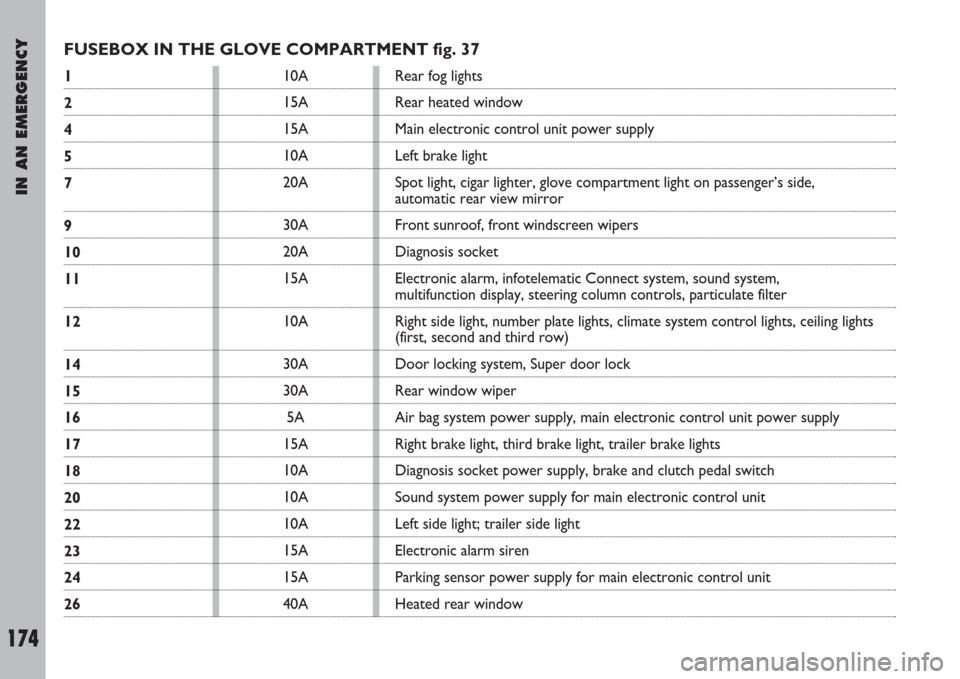
FUSEBOX IN THE GLOVE COMPARTMENT fig. 37
1
2
4
5
7
9
10
11
12
14
15
16
17
18
20
22
23
24
2610A
15A
15A
10A
20A
30A
20A
15A
10A
30A
30A
5A
15A
10A
10A
10A
15A
15A
40ARear fog lights
Rear heated window
Main electronic control unit power supply
Left brake light
Spot light, cigar lighter, glove compartment light on passenger’s side,
automatic rear view mirror
Front sunroof, front windscreen wipers
Diagnosis socket
Electronic alarm, infotelematic Connect system, sound system,
multifunction display, steering column controls, particulate filter
Right side light, number plate lights, climate system control lights, ceiling lights
(first, second and third row)
Door locking system, Super door lock
Rear window wiper
Air bag system power supply, main electronic control unit power supply
Right brake light, third brake light, trailer brake lights
Diagnosis socket power supply, brake and clutch pedal switch
Sound system power supply for main electronic control unit
Left side light; trailer side light
Electronic alarm siren
Parking sensor power supply for main electronic control unit
Heated rear window
Page 176 of 254
IN AN EMERGENCY
175
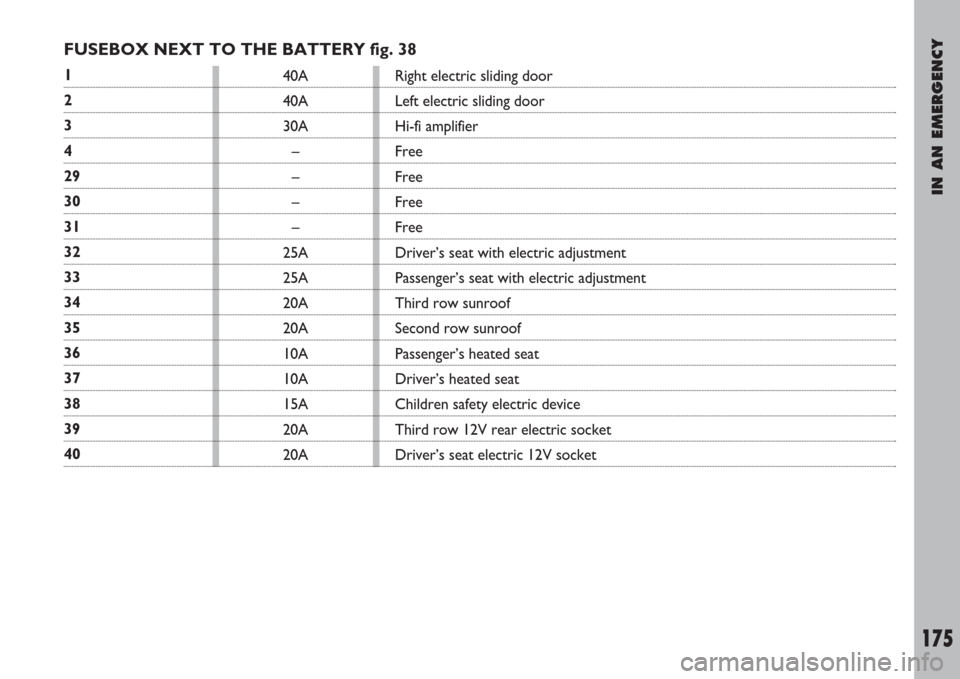
FUSEBOX NEXT TO THE BATTERY fig. 38
1
2
3
4
29
30
31
32
33
34
35
36
37
38
39
4040A
40A
30A
–
–
–
–
25A
25A
20A
20A
10A
10A
15A
20A
20ARight electric sliding door
Left electric sliding door
Hi-fi amplifier
Free
Free
Free
Free
Driver’s seat with electric adjustment
Passenger’s seat with electric adjustment
Third row sunroof
Second row sunroof
Passenger’s heated seat
Driver’s heated seat
Children safety electric device
Third row 12V rear electric socket
Driver’s seat electric 12V socket
Page 183 of 254
IN AN EMERGENCY
182
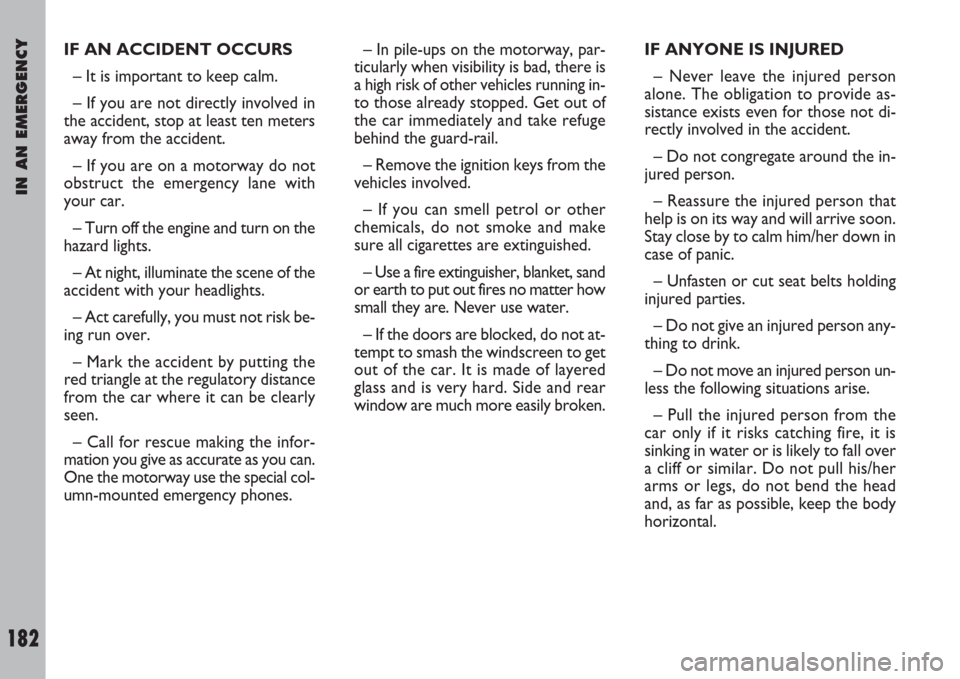
IF AN ACCIDENT OCCURS
– It is important to keep calm.
– If you are not directly involved in
the accident, stop at least ten meters
away from the accident.
– If you are on a motorway do not
obstruct the emergency lane with
your car.
– Turn off the engine and turn on the
hazard lights.
– At night, illuminate the scene of the
accident with your headlights.
– Act carefully, you must not risk be-
ing run over.
– Mark the accident by putting the
red triangle at the regulatory distance
from the car where it can be clearly
seen.
– Call for rescue making the infor-
mation you give as accurate as you can.
One the motorway use the special col-
umn-mounted emergency phones.– In pile-ups on the motorway, par-
ticularly when visibility is bad, there is
a high risk of other vehicles running in-
to those already stopped. Get out of
the car immediately and take refuge
behind the guard-rail.
– Remove the ignition keys from the
vehicles involved.
– If you can smell petrol or other
chemicals, do not smoke and make
sure all cigarettes are extinguished.
– Use a fire extinguisher, blanket, sand
or earth to put out fires no matter how
small they are. Never use water.
– If the doors are blocked, do not at-
tempt to smash the windscreen to get
out of the car. It is made of layered
glass and is very hard. Side and rear
window are much more easily broken.IF ANYONE IS INJURED
– Never leave the injured person
alone. The obligation to provide as-
sistance exists even for those not di-
rectly involved in the accident.
– Do not congregate around the in-
jured person.
– Reassure the injured person that
help is on its way and will arrive soon.
Stay close by to calm him/her down in
case of panic.
– Unfasten or cut seat belts holding
injured parties.
– Do not give an injured person any-
thing to drink.
– Do not move an injured person un-
less the following situations arise.
– Pull the injured person from the
car only if it risks catching fire, it is
sinking in water or is likely to fall over
a cliff or similar. Do not pull his/her
arms or legs, do not bend the head
and, as far as possible, keep the body
horizontal.