lock FIAT ULYSSE 2007 2.G Workshop Manual
[x] Cancel search | Manufacturer: FIAT, Model Year: 2007, Model line: ULYSSE, Model: FIAT ULYSSE 2007 2.GPages: 254, PDF Size: 3.42 MB
Page 163 of 254
IN AN EMERGENCY
162
IF AN EXTERIOR
LIGHT BURNS OUT
Modifications or repairs
to the electrical system
carried out incorrectly
and without bearing the features
of the system in mind can cause
malfunctions with the risk of fire.
IMPORTANTSee “If a bulb burns
out” for information on bulb types and
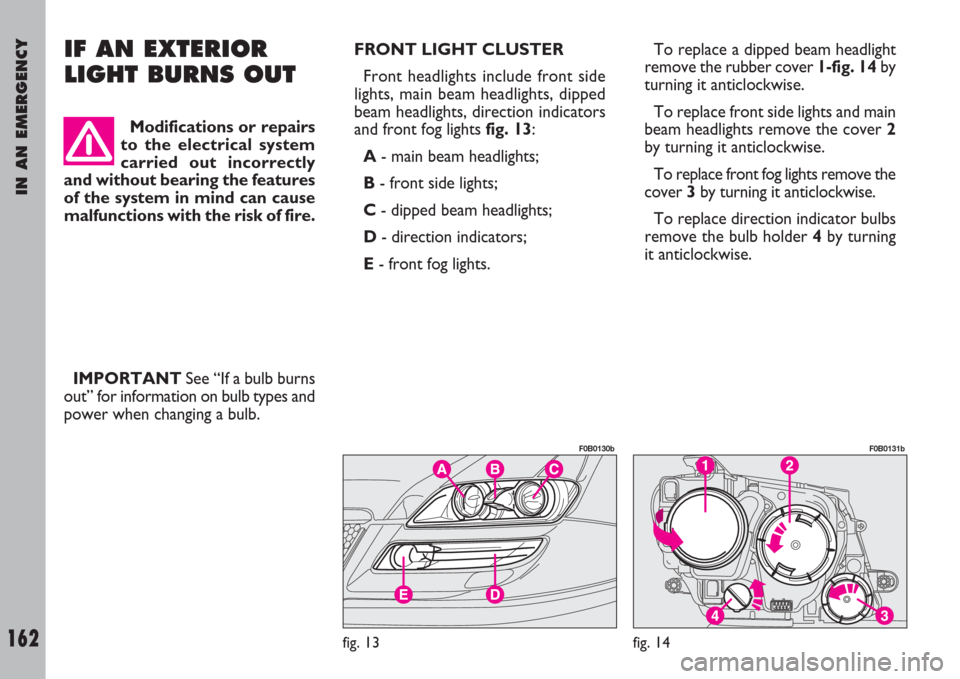
power when changing a bulb.FRONT LIGHT CLUSTER
Front headlights include front side
lights, main beam headlights, dipped
beam headlights, direction indicators
and front fog lights fig. 13:
A- main beam headlights;
B- front side lights;
C- dipped beam headlights;
D- direction indicators;
E- front fog lights.To replace a dipped beam headlight
remove the rubber cover 1-fig. 14by
turning it anticlockwise.
To replace front side lights and main
beam headlights remove the cover 2
by turning it anticlockwise.
To replace front fog lights remove the
cover 3by turning it anticlockwise.
To replace direction indicator bulbs
remove the bulb holder 4by turning
it anticlockwise.
fig. 13
F0B0130b
fig. 14
F0B0131b
Page 164 of 254
IN AN EMERGENCY
163
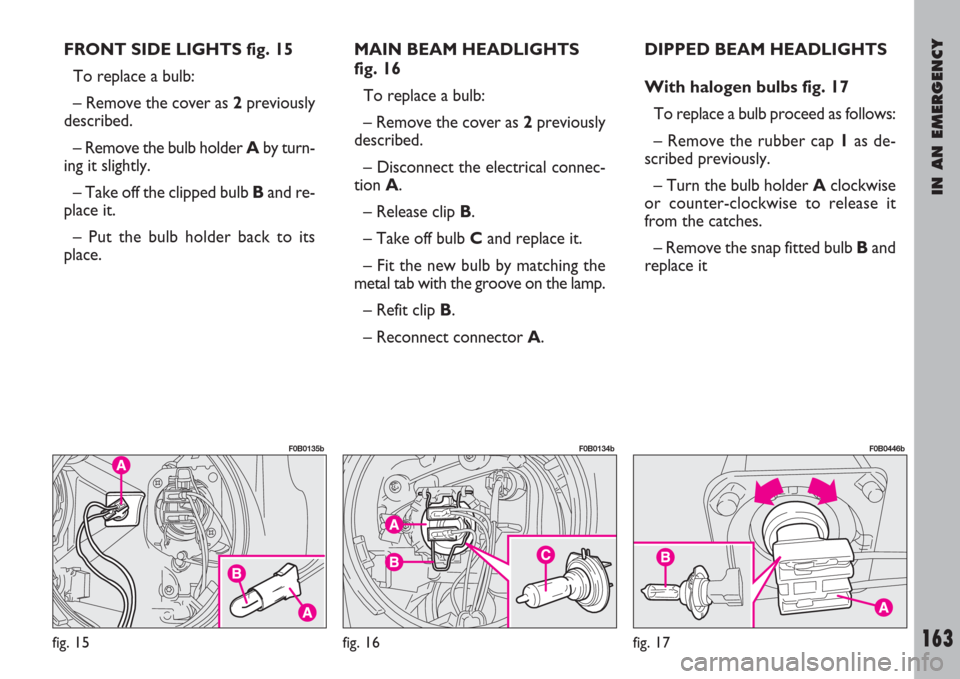
FRONT SIDE LIGHTS fig. 15
To replace a bulb:
– Remove the cover as 2previously
described.
– Remove the bulb holder Aby turn-
ing it slightly.
– Take off the clipped bulb Band re-
place it.
– Put the bulb holder back to its
place.MAIN BEAM HEADLIGHTS
fig. 16
To replace a bulb:
– Remove the cover as 2previously
described.
– Disconnect the electrical connec-
tion A.
– Release clip B.
– Take off bulb Cand replace it.
– Fit the new bulb by matching the
metal tab with the groove on the lamp.
– Refit clip B.
– Reconnect connector A.DIPPED BEAM HEADLIGHTS
With halogen bulbs fig. 17
To replace a bulb proceed as follows:
– Remove the rubber cap 1as de-
scribed previously.
– Turn the bulb holder Aclockwise
or counter-clockwise to release it
from the catches.
– Remove the snap fitted bulb Band
replace it
fig. 15
F0B0135b
fig. 16
F0B0134b
fig. 17
F0B0446b
Page 165 of 254
IN AN EMERGENCY
164
– Fit the new bulb into the bulb hold-
er (with protrusion facing upwards),
push the bulb forwards along the ve-
hicle axis until hearing the locking click
that indicates proper bulb securing.
– Refit the bulb holder into its seat
turning it clockwise or counter-clock-
wise to lock it to catches.
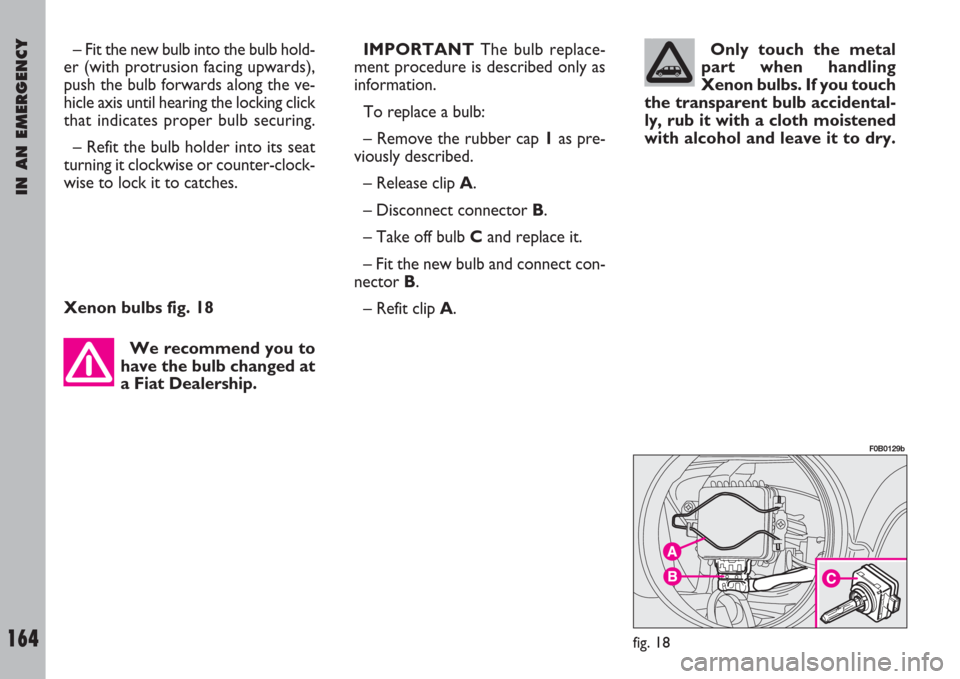
Xenon bulbs fig. 18
We recommend you to
have the bulb changed at
a Fiat Dealership.IMPORTANT The bulb replace-
ment procedure is described only as
information.
To replace a bulb:
– Remove the rubber cap 1as pre-
viously described.
– Release clip A.
– Disconnect connector B.
– Take off bulb Cand replace it.
– Fit the new bulb and connect con-
nector B.
– Refit clip A.Only touch the metal
part when handling
Xenon bulbs. If you touch
the transparent bulb accidental-
ly, rub it with a cloth moistened
with alcohol and leave it to dry.
fig. 18
F0B0129b
Page 166 of 254
IN AN EMERGENCY
165
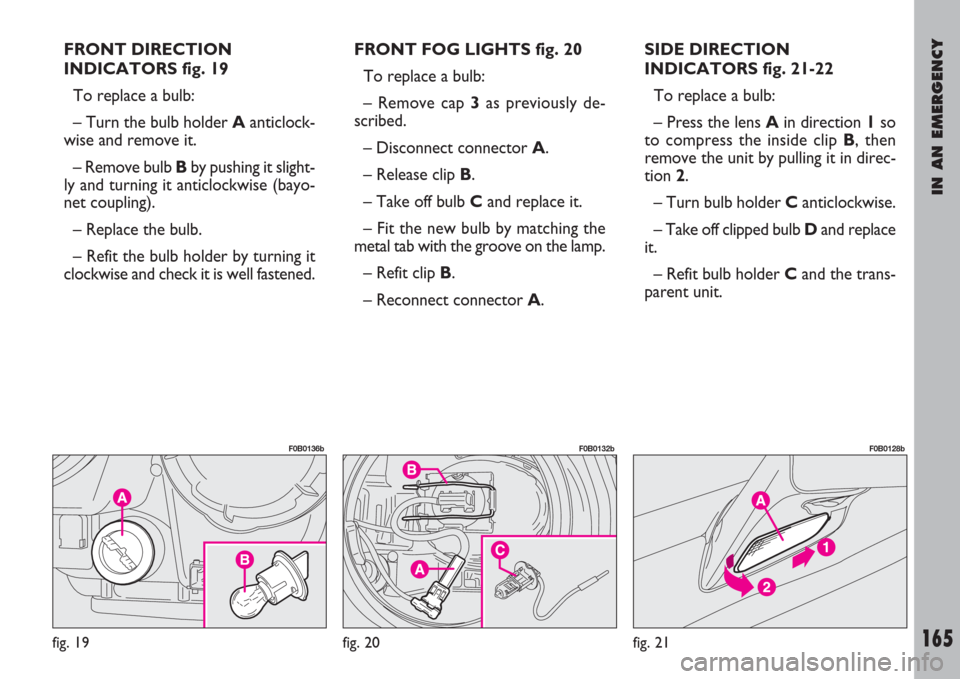
FRONT DIRECTION
INDICATORS fig. 19
To replace a bulb:
– Turn the bulb holder Aanticlock-
wise and remove it.
– Remove bulb Bby pushing it slight-
ly and turning it anticlockwise (bayo-
net coupling).
– Replace the bulb.
– Refit the bulb holder by turning it
clockwise and check it is well fastened.FRONT FOG LIGHTS fig. 20
To replace a bulb:
– Remove cap 3as previously de-
scribed.
– Disconnect connector A.
– Release clip B.
– Take off bulb Cand replace it.
– Fit the new bulb by matching the
metal tab with the groove on the lamp.
– Refit clip B.
– Reconnect connector A.SIDE DIRECTION
INDICATORS fig. 21-22
To replace a bulb:
– Press the lens Ain direction 1so
to compress the inside clip B, then
remove the unit by pulling it in direc-
tion 2.
– Turn bulb holder C anticlockwise.
– Take off clipped bulb Dand replace
it.
– Refit bulb holder Cand the trans-
parent unit.
fig. 19
F0B0136b
fig. 20
F0B0132b
fig. 21
F0B0128b
Page 168 of 254
IN AN EMERGENCY
167
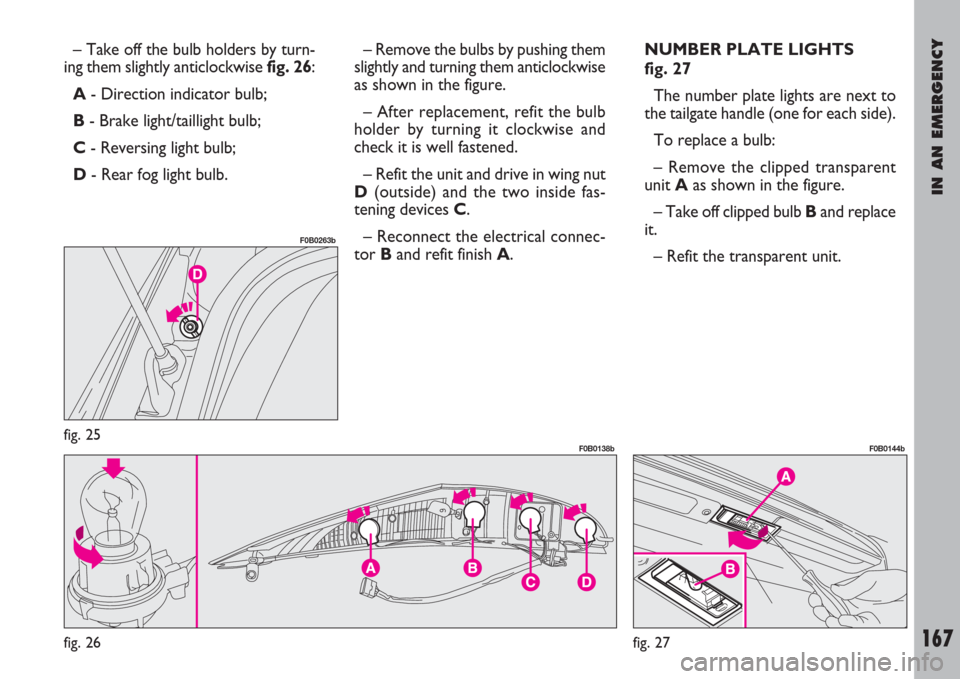
– Take off the bulb holders by turn-
ing them slightly anticlockwise fig. 26:
A- Direction indicator bulb;
B- Brake light/taillight bulb;
C- Reversing light bulb;
D- Rear fog light bulb.– Remove the bulbs by pushing them
slightly and turning them anticlockwise
as shown in the figure.
– After replacement, refit the bulb
holder by turning it clockwise and
check it is well fastened.
– Refit the unit and drive in wing nut
D(outside) and the two inside fas-
tening devices C.
– Reconnect the electrical connec-
tor Band refit finish A.NUMBER PLATE LIGHTS
fig. 27
The number plate lights are next to
the tailgate handle (one for each side).
To replace a bulb:
– Remove the clipped transparent
unit Aas shown in the figure.
– Take off clipped bulb Band replace
it.
– Refit the transparent unit.
fig. 26
F0B0138b
fig. 27
F0B0144bfig. 25
F0B0263b
Page 175 of 254
IN AN EMERGENCY
174
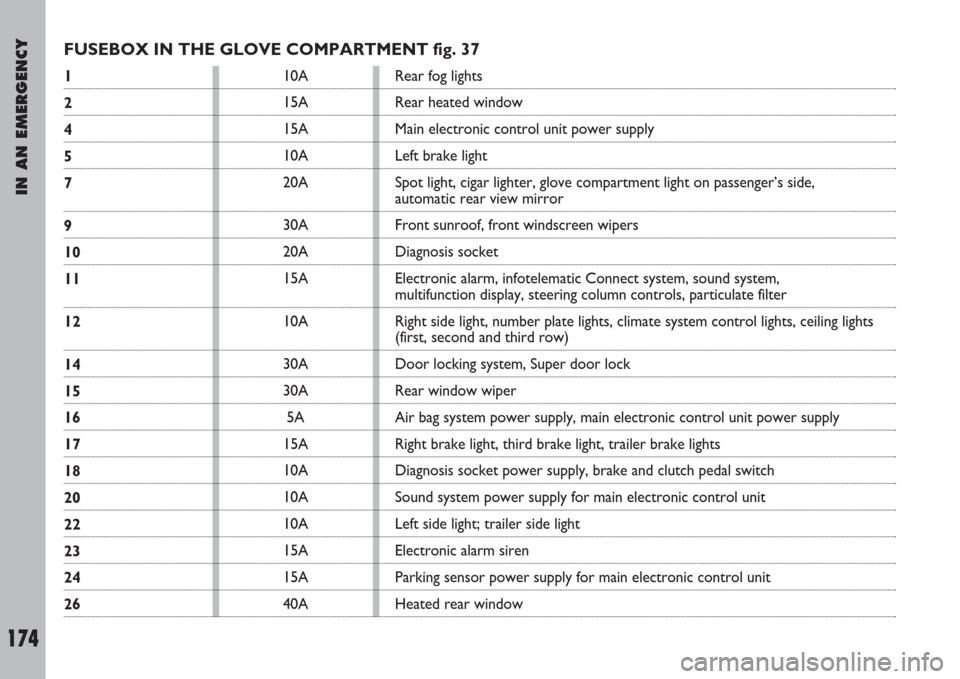
FUSEBOX IN THE GLOVE COMPARTMENT fig. 37
1
2
4
5
7
9
10
11
12
14
15
16
17
18
20
22
23
24
2610A
15A
15A
10A
20A
30A
20A
15A
10A
30A
30A
5A
15A
10A
10A
10A
15A
15A
40ARear fog lights
Rear heated window
Main electronic control unit power supply
Left brake light
Spot light, cigar lighter, glove compartment light on passenger’s side,
automatic rear view mirror
Front sunroof, front windscreen wipers
Diagnosis socket
Electronic alarm, infotelematic Connect system, sound system,
multifunction display, steering column controls, particulate filter
Right side light, number plate lights, climate system control lights, ceiling lights
(first, second and third row)
Door locking system, Super door lock
Rear window wiper
Air bag system power supply, main electronic control unit power supply
Right brake light, third brake light, trailer brake lights
Diagnosis socket power supply, brake and clutch pedal switch
Sound system power supply for main electronic control unit
Left side light; trailer side light
Electronic alarm siren
Parking sensor power supply for main electronic control unit
Heated rear window
Page 182 of 254
IN AN EMERGENCY
181
Before fastening the tow
hitch clean the threaded
housing accurately. Be-
fore starting to tow, make sure
the tow hitch is well fastened on
the threaded pin.While the vehicle is be-
ing towed with the engine
off, remember that the
brake pedal and steering will re-
quire more effort as you no
longer have the benefit of the
power brakes and power steer-
ing. Do not use flexible cables to
tow. Avoid jerking. Whilst tow-
ing, ensure that the coupling to
the vehicle does not damage the
surrounding components.IMPORTANTFor versions with
automatic gearbox, make sure the
gear is in neutral position (N) and pro-
ceed as described for vehicles with
mechanical gearbox. If the gear cannot
be put in neutral position (N) do not
tow the vehicle and contact a Fiat
Dealership.
Before starting to tow,
turn the ignition key to M
and then to S. Do not re-
move the key. If the key is re-
moved, the steering lock engages
automatically which prevents the
wheels being turned.
When towing the vehi-
cle, you must comply
with the specific traffic
regulations regarding the tow
hitch and how to tow on the
road.
Do not start the engine
when being towed.
Page 183 of 254
IN AN EMERGENCY
182
IF AN ACCIDENT OCCURS
– It is important to keep calm.
– If you are not directly involved in
the accident, stop at least ten meters
away from the accident.
– If you are on a motorway do not
obstruct the emergency lane with
your car.
– Turn off the engine and turn on the
hazard lights.
– At night, illuminate the scene of the
accident with your headlights.
– Act carefully, you must not risk be-
ing run over.
– Mark the accident by putting the
red triangle at the regulatory distance
from the car where it can be clearly
seen.
– Call for rescue making the infor-
mation you give as accurate as you can.
One the motorway use the special col-
umn-mounted emergency phones.– In pile-ups on the motorway, par-
ticularly when visibility is bad, there is
a high risk of other vehicles running in-
to those already stopped. Get out of
the car immediately and take refuge
behind the guard-rail.
– Remove the ignition keys from the
vehicles involved.
– If you can smell petrol or other
chemicals, do not smoke and make
sure all cigarettes are extinguished.
– Use a fire extinguisher, blanket, sand
or earth to put out fires no matter how
small they are. Never use water.
– If the doors are blocked, do not at-
tempt to smash the windscreen to get
out of the car. It is made of layered
glass and is very hard. Side and rear
window are much more easily broken.IF ANYONE IS INJURED
– Never leave the injured person
alone. The obligation to provide as-
sistance exists even for those not di-
rectly involved in the accident.
– Do not congregate around the in-
jured person.
– Reassure the injured person that
help is on its way and will arrive soon.
Stay close by to calm him/her down in
case of panic.
– Unfasten or cut seat belts holding
injured parties.
– Do not give an injured person any-
thing to drink.
– Do not move an injured person un-
less the following situations arise.
– Pull the injured person from the
car only if it risks catching fire, it is
sinking in water or is likely to fall over
a cliff or similar. Do not pull his/her
arms or legs, do not bend the head
and, as far as possible, keep the body
horizontal.
Page 186 of 254
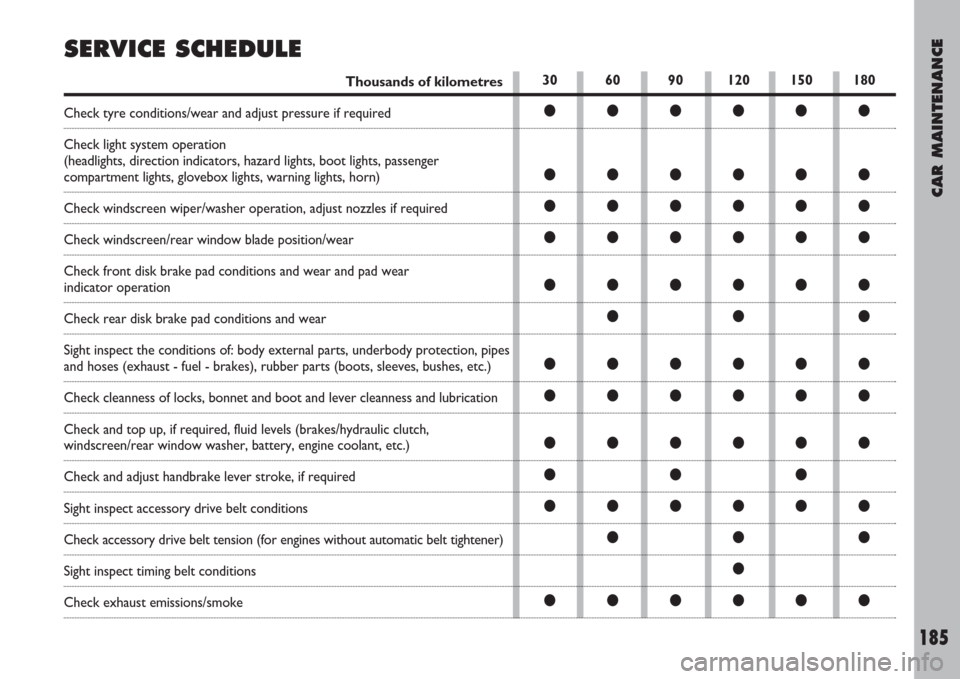
SERVICE SCHEDULE
30 60 90 120 150 180
●●●●●●
●●●●●●
●●●●●●
●●●●●●
●●●●●●
●●●
●●●●●●
●●●●●●
●●●●●●
●●●
●●●●●●
●●●
●
●●●●●●
CAR MAINTENANCE
185
Thousands of kilometres
Check tyre conditions/wear and adjust pressure if required
Check light system operation
(headlights, direction indicators, hazard lights, boot lights, passenger
compartment lights, glovebox lights, warning lights, horn)
Check windscreen wiper/washer operation, adjust nozzles if required
Check windscreen/rear window blade position/wear
Check front disk brake pad conditions and wear and pad wear
indicator operation
Check rear disk brake pad conditions and wear
Sight inspect the conditions of: body external parts, underbody protection, pipes
and hoses (exhaust - fuel - brakes), rubber parts (boots, sleeves, bushes, etc.)
Check cleanness of locks, bonnet and boot and lever cleanness and lubrication
Check and top up, if required, fluid levels (brakes/hydraulic clutch,
windscreen/rear window washer, battery, engine coolant, etc.)
Check and adjust handbrake lever stroke, if required
Sight inspect accessory drive belt conditions
Check accessory drive belt tension (for engines without automatic belt tightener)
Sight inspect timing belt conditions
Check exhaust emissions/smoke
Page 189 of 254
CAR MAINTENANCE
188
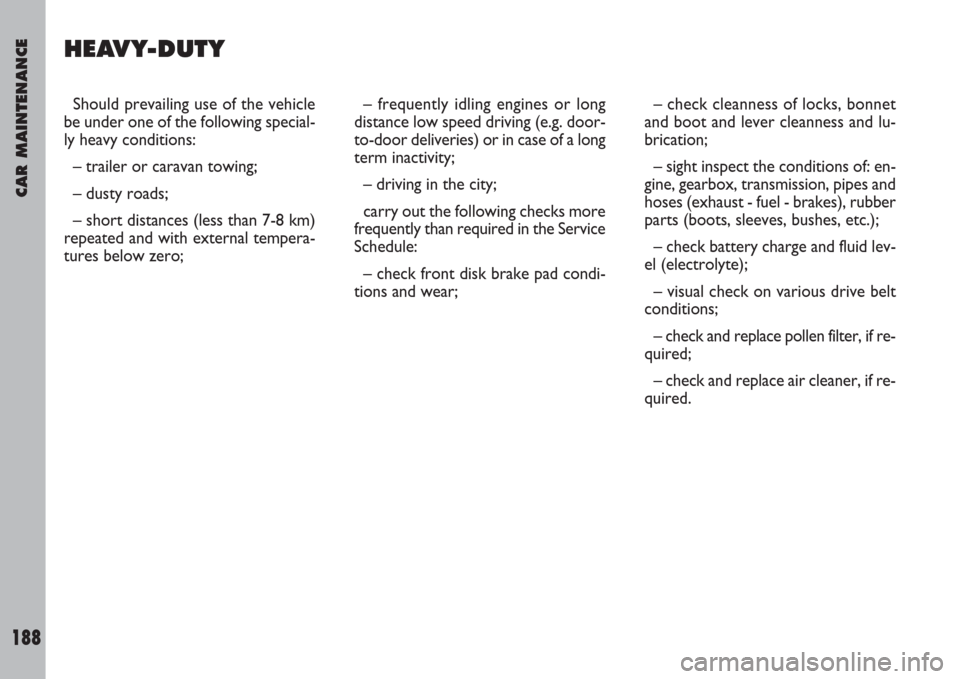
Should prevailing use of the vehicle
be under one of the following special-
ly heavy conditions:
– trailer or caravan towing;
– dusty roads;
– short distances (less than 7-8 km)
repeated and with external tempera-
tures below zero;– frequently idling engines or long
distance low speed driving (e.g. door-
to-door deliveries) or in case of a long
term inactivity;
– driving in the city;
carry out the following checks more
frequently than required in the Service
Schedule:
– check front disk brake pad condi-
tions and wear;– check cleanness of locks, bonnet
and boot and lever cleanness and lu-
brication;
– sight inspect the conditions of: en-
gine, gearbox, transmission, pipes and
hoses (exhaust - fuel - brakes), rubber
parts (boots, sleeves, bushes, etc.);
– check battery charge and fluid lev-
el (electrolyte);
– visual check on various drive belt
conditions;
– check and replace pollen filter, if re-
quired;
– check and replace air cleaner, if re-
quired.
HEAVY-DUTY