lock FIAT ULYSSE 2008 2.G User Guide
[x] Cancel search | Manufacturer: FIAT, Model Year: 2008, Model line: ULYSSE, Model: FIAT ULYSSE 2008 2.GPages: 254, PDF Size: 3.46 MB
Page 24 of 254
GETTING TO KNOW YOUR CAR
23
CHILD SAFETY LOCK
There can be 2 types of “Children
safety”: electric safety or mechanical
safety.
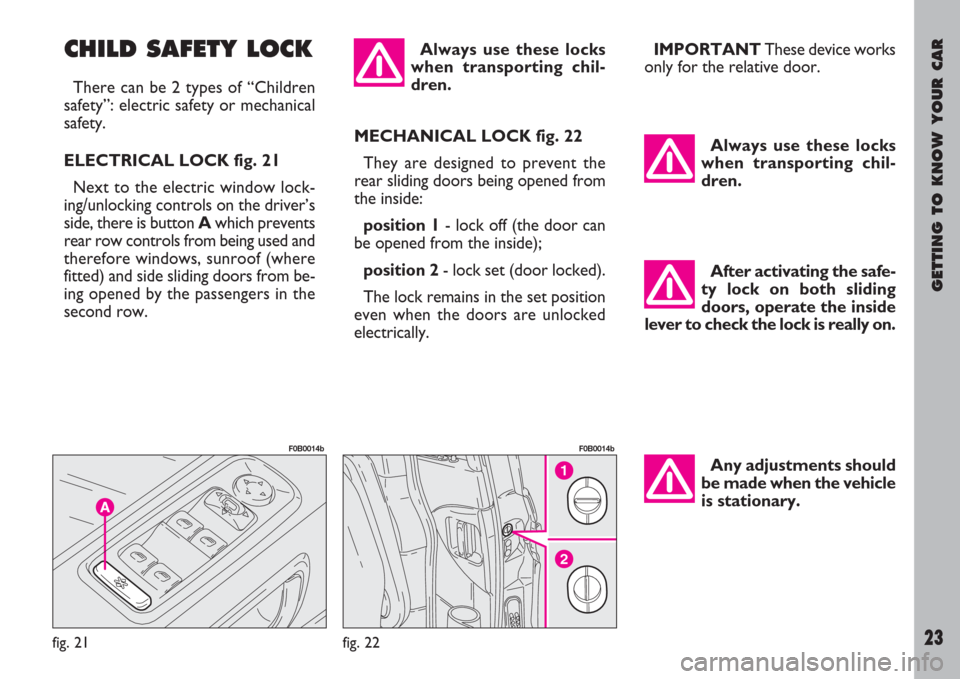
ELECTRICAL LOCK fig. 21
Next to the electric window lock-
ing/unlocking controls on the driver’s
side, there is button Awhich prevents
rear row controls from being used and
therefore windows, sunroof (where
fitted) and side sliding doors from be-
ing opened by the passengers in the
second row.
Any adjustments should
be made when the vehicle
is stationary.Always use these locks
when transporting chil-
dren.
2
1
fig. 22
F0B0014b
fig. 21
F0B0014b
MECHANICAL LOCK fig. 22
They are designed to prevent the
rear sliding doors being opened from
the inside:
position 1- lock off (the door can
be opened from the inside);
position 2- lock set (door locked).
The lock remains in the set position
even when the doors are unlocked
electrically.After activating the safe-
ty lock on both sliding
doors, operate the inside
lever to check the lock is really on. Always use these locks
when transporting chil-
dren.
IMPORTANTThese device works
only for the relative door.
Page 25 of 254
GETTING TO KNOW YOUR CAR
24
Once you have released
the lever, check that the
seat is firmly locked in the
runners by trying to move it back
and forth. Failure to lock the seat
in place could result in the seat
moving suddenly and the driver
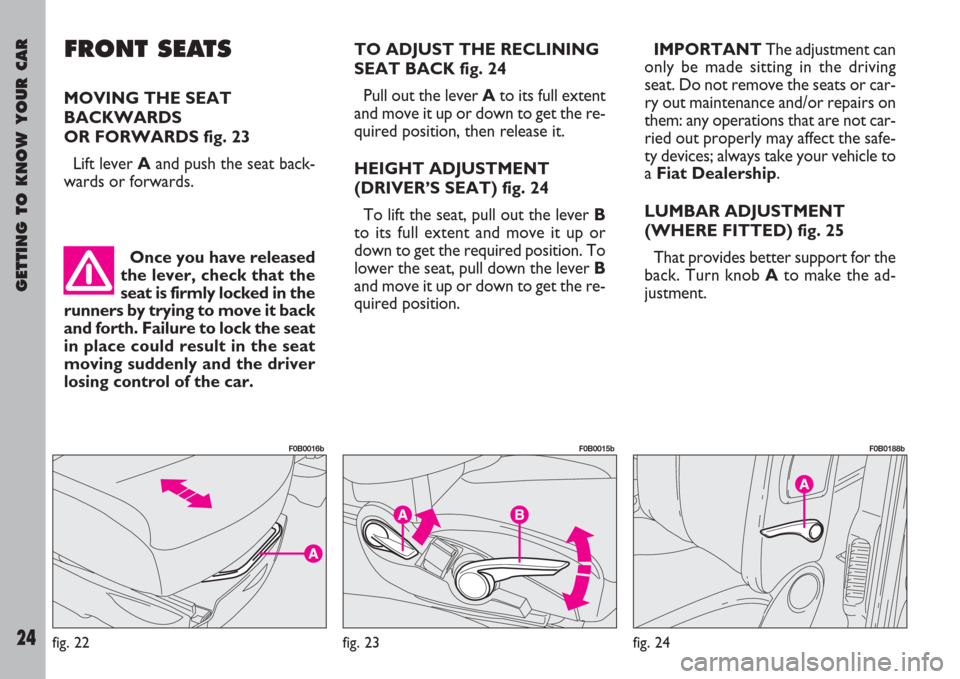
losing control of the car.TO ADJUST THE RECLINING
SEAT BACK fig. 24
Pull out the lever Ato its full extent
and move it up or down to get the re-
quired position, then release it.
HEIGHT ADJUSTMENT
(DRIVER’S SEAT) fig. 24
To lift the seat, pull out the lever B
to its full extent and move it up or
down to get the required position. To
lower the seat, pull down the lever B
and move it up or down to get the re-
quired position.IMPORTANTThe adjustment can
only be made sitting in the driving
seat. Do not remove the seats or car-
ry out maintenance and/or repairs on
them: any operations that are not car-
ried out properly may affect the safe-
ty devices; always take your vehicle to
a Fiat Dealership.
LUMBAR ADJUSTMENT
(WHERE FITTED) fig. 25
That provides better support for the
back. Turn knob Ato make the ad-
justment.
FRONT SEATS
MOVING THE SEAT
BACKWARDS
OR FORWARDS fig. 23
Lift lever Aand push the seat back-
wards or forwards.
fig. 23
F0B0015b
fig. 24
F0B0188b
fig. 22
F0B0016b
Page 27 of 254
GETTING TO KNOW YOUR CAR
26
IMPORTANTAfter 5 unsuccess-
ful recalls, the system locks the rela-
tive control which will be restored
when the engine is started.
When the engine is on: press and
keep button 1or 2pressed until the
stored position is reached.
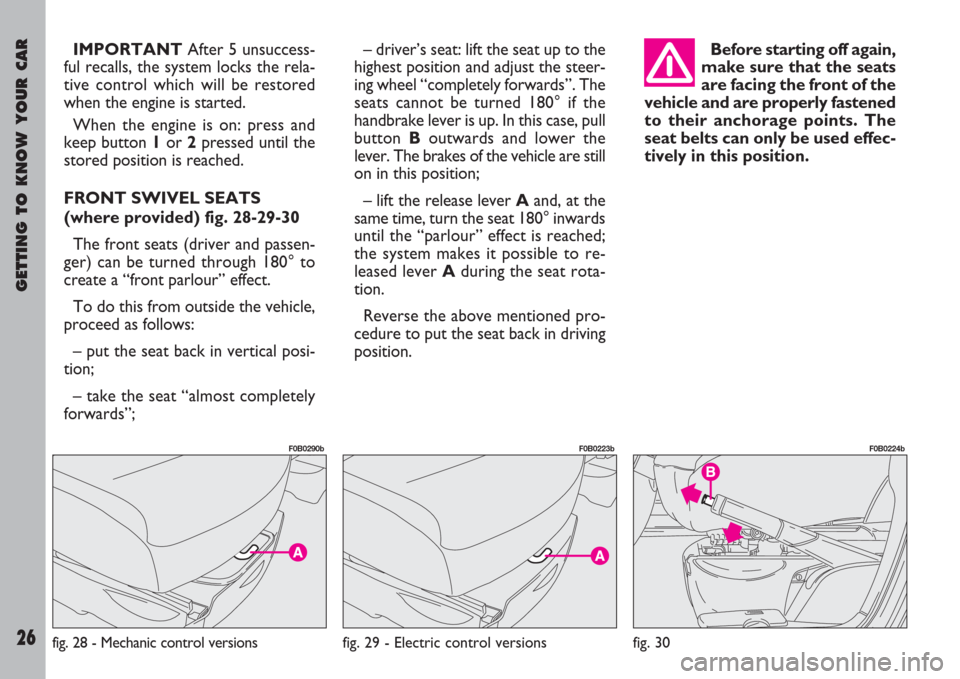
FRONT SWIVEL SEATS
(where provided) fig. 28-29-30
The front seats (driver and passen-
ger) can be turned through 180° to
create a “front parlour” effect.
To do this from outside the vehicle,
proceed as follows:
– put the seat back in vertical posi-
tion;
– take the seat “almost completely
forwards”;– driver’s seat: lift the seat up to the
highest position and adjust the steer-
ing wheel “completely forwards”. The
seats cannot be turned 180° if the
handbrake lever is up. In this case, pull
button Boutwards and lower the
lever. The brakes of the vehicle are still
on in this position;
– lift the release lever Aand, at the
same time, turn the seat 180° inwards
until the “parlour” effect is reached;
the system makes it possible to re-
leased lever Aduring the seat rota-
tion.
Reverse the above mentioned pro-
cedure to put the seat back in driving
position.Before starting off again,
make sure that the seats
are facing the front of the
vehicle and are properly fastened
to their anchorage points. The
seat belts can only be used effec-
tively in this position.
fig. 29 - Electric control versions
F0B0223b
fig. 28 - Mechanic control versions
F0B0290b
fig. 30
F0B0224b
Page 29 of 254
GETTING TO KNOW YOUR CAR
28
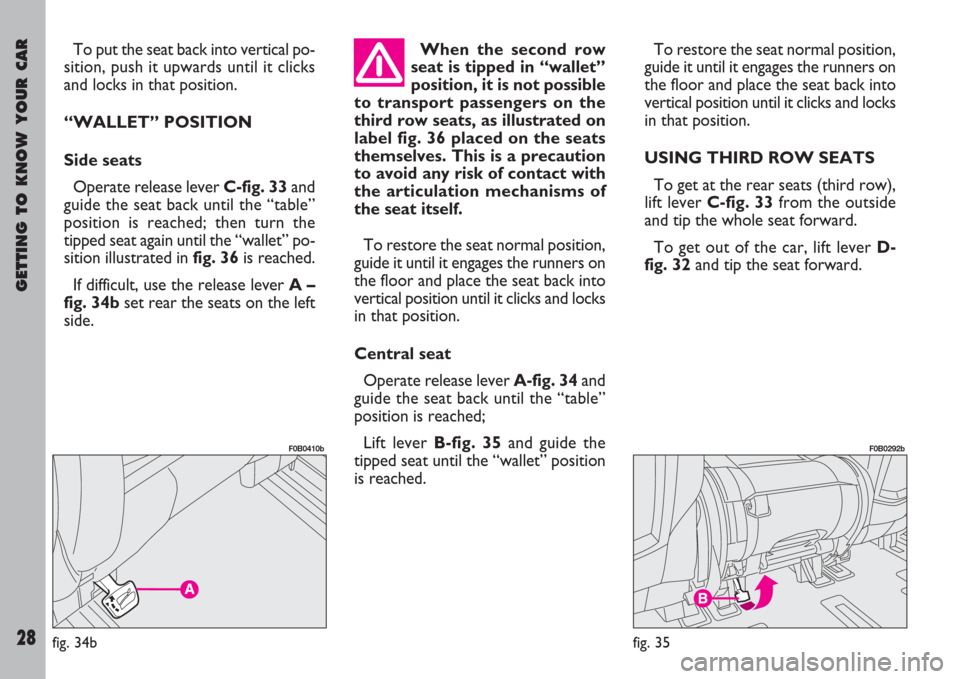
To put the seat back into vertical po-
sition, push it upwards until it clicks
and locks in that position.
“WALLET” POSITION
Side seats
Operate release lever C-fig. 33and
guide the seat back until the “table”
position is reached; then turn the
tipped seat again until the “wallet” po-
sition illustrated in fig. 36 is reached.
If difficult, use the release lever A –
fig. 34bset rear the seats on the left
side.To restore the seat normal position,
guide it until it engages the runners on
the floor and place the seat back into
vertical position until it clicks and locks
in that position.
USING THIRD ROW SEATS
To get at the rear seats (third row),
lift lever C-fig. 33from the outside
and tip the whole seat forward.
To get out of the car, lift lever D-
fig. 32and tip the seat forward. When the second row
seat is tipped in “wallet”
position, it is not possible
to transport passengers on the
third row seats, as illustrated on
label fig. 36 placed on the seats
themselves. This is a precaution
to avoid any risk of contact with
the articulation mechanisms of
the seat itself.
To restore the seat normal position,
guide it until it engages the runners on
the floor and place the seat back into
vertical position until it clicks and locks
in that position.
Central seat
Operate release lever A-fig. 34and
guide the seat back until the “table”
position is reached;
Lift lever B-fig. 35and guide the
tipped seat until the “wallet” position
is reached.
fig. 35
F0B0292b
fig. 34b
F0B0410b
Page 30 of 254
GETTING TO KNOW YOUR CAR
29
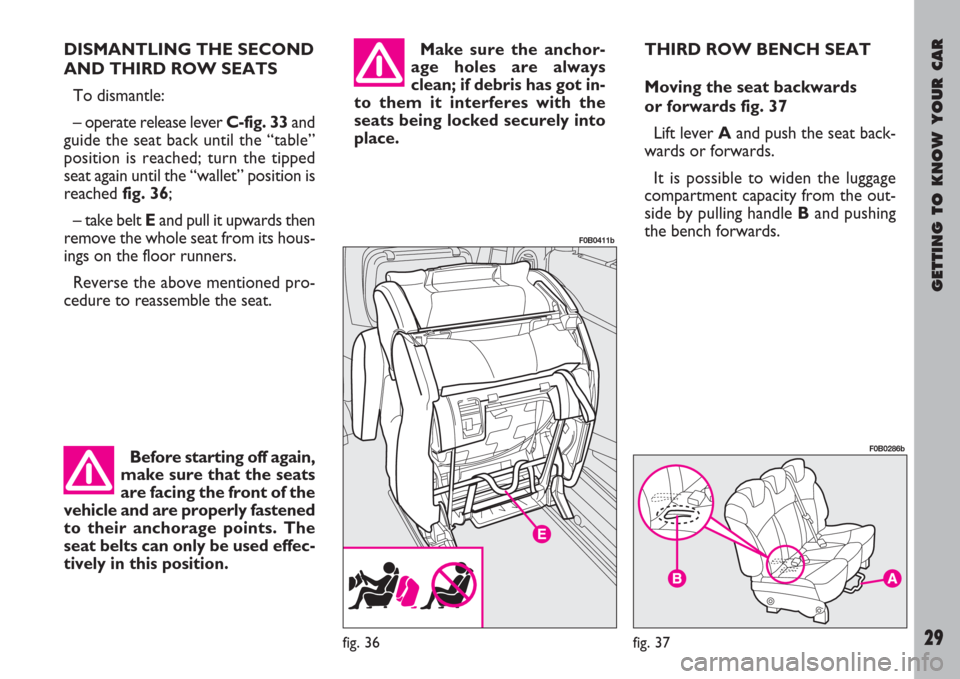
DISMANTLING THE SECOND
AND THIRD ROW SEATS
To dismantle:
– operate release lever C-fig. 33and
guide the seat back until the “table”
position is reached; turn the tipped
seat again until the “wallet” position is
reached fig. 36;
– take belt Eand pull it upwards then
remove the whole seat from its hous-
ings on the floor runners.
Reverse the above mentioned pro-
cedure to reassemble the seat.Make sure the anchor-
age holes are always
clean; if debris has got in-
to them it interferes with the
seats being locked securely into
place.THIRD ROW BENCH SEAT
Moving the seat backwards
or forwards fig. 37
Lift lever Aand push the seat back-
wards or forwards.
It is possible to widen the luggage
compartment capacity from the out-
side by pulling handle Band pushing
the bench forwards.
fig. 36
F0B0411b
Before starting off again,
make sure that the seats
are facing the front of the
vehicle and are properly fastened
to their anchorage points. The
seat belts can only be used effec-
tively in this position.
fig. 37
F0B0286b
Page 31 of 254
GETTING TO KNOW YOUR CAR
30
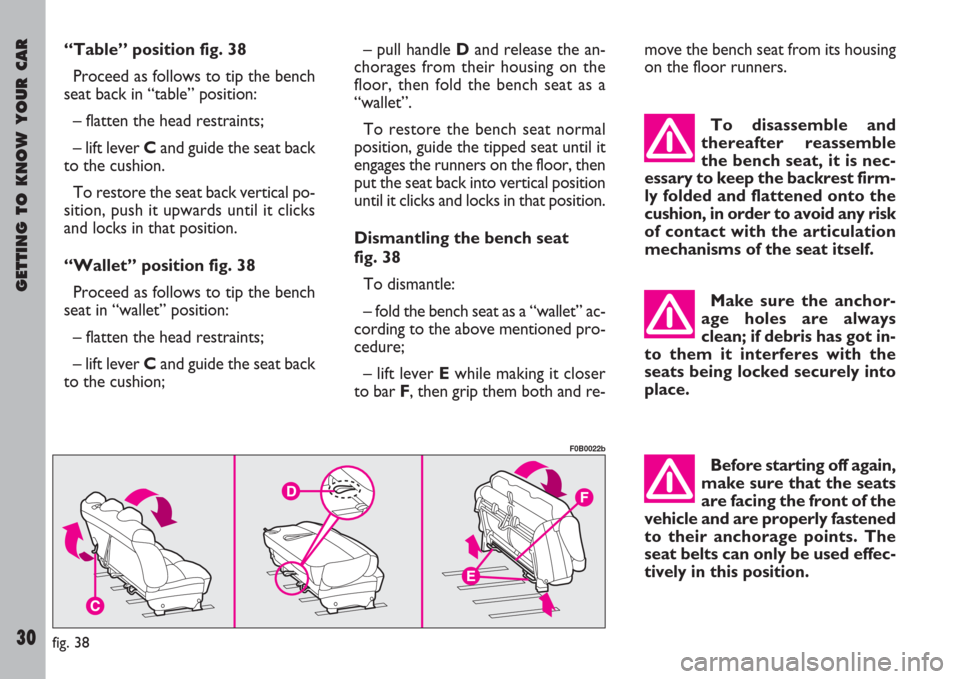
– pull handle Dand release the an-
chorages from their housing on the
floor, then fold the bench seat as a
“wallet”.
To restore the bench seat normal
position, guide the tipped seat until it
engages the runners on the floor, then
put the seat back into vertical position
until it clicks and locks in that position.
Dismantling the bench seat
fig. 38
To dismantle:
– fold the bench seat as a “wallet” ac-
cording to the above mentioned pro-
cedure;
– lift lever E while making it closer
to bar F, then grip them both and re-move the bench seat from its housing
on the floor runners.
fig. 38
“Table” position fig. 38
Proceed as follows to tip the bench
seat back in “table” position:
– flatten the head restraints;
– lift lever Cand guide the seat back
to the cushion.
To restore the seat back vertical po-
sition, push it upwards until it clicks
and locks in that position.
“Wallet” position fig. 38
Proceed as follows to tip the bench
seat in “wallet” position:
– flatten the head restraints;
– lift lever Cand guide the seat back
to the cushion;
F0B0022b
Before starting off again,
make sure that the seats
are facing the front of the
vehicle and are properly fastened
to their anchorage points. The
seat belts can only be used effec-
tively in this position.
To disassemble and
thereafter reassemble
the bench seat, it is nec-
essary to keep the backrest firm-
ly folded and flattened onto the
cushion, in order to avoid any risk
of contact with the articulation
mechanisms of the seat itself.
Make sure the anchor-
age holes are always
clean; if debris has got in-
to them it interferes with the
seats being locked securely into
place.
Page 33 of 254
GETTING TO KNOW YOUR CAR
32
Make sure the anchor-
age holes are always
clean; if debris has got in-
to them it interferes with the
seats being locked securely into
place.
Before starting off again,
make sure that the seats
are facing the front of the
vehicle and are properly fastened
to their anchorage points. The
seat belts can only be used effec-
tively in this position.
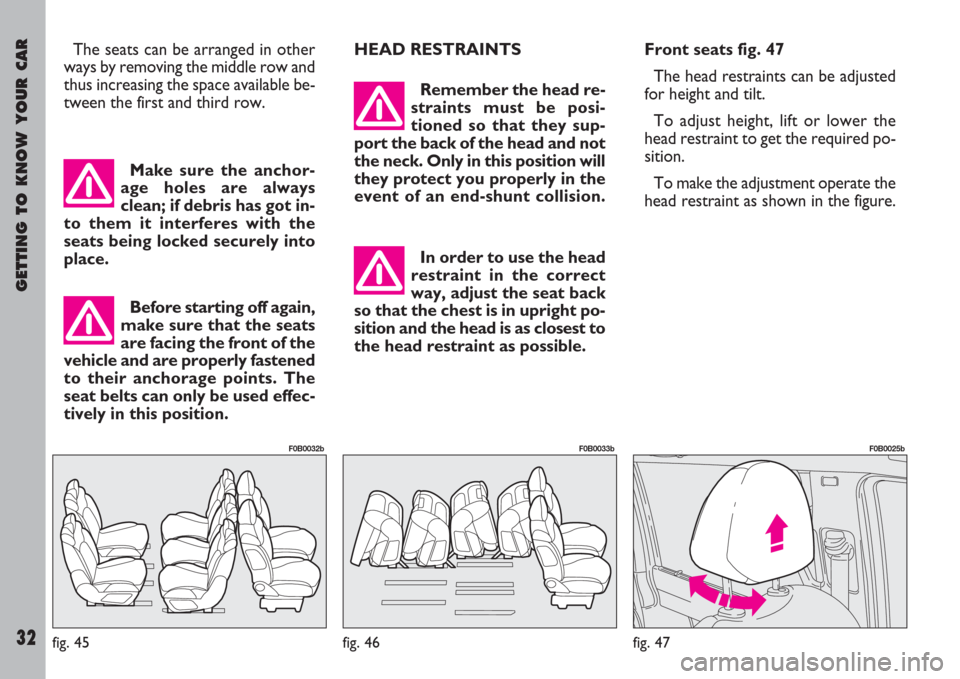
The seats can be arranged in other
ways by removing the middle row and
thus increasing the space available be-
tween the first and third row.
fig. 47
F0B0025b
fig. 45
F0B0032b
fig. 46
F0B0033b
HEAD RESTRAINTS
Remember the head re-
straints must be posi-
tioned so that they sup-
port the back of the head and not
the neck. Only in this position will
they protect you properly in the
event of an end-shunt collision.Front seats fig. 47
The head restraints can be adjusted
for height and tilt.
To adjust height, lift or lower the
head restraint to get the required po-
sition.
To make the adjustment operate the
head restraint as shown in the figure.
In order to use the head
restraint in the correct
way, adjust the seat back
so that the chest is in upright po-
sition and the head is as closest to
the head restraint as possible.
Page 35 of 254
GETTING TO KNOW YOUR CAR
34
INDIVIDUAL
SETTINGS
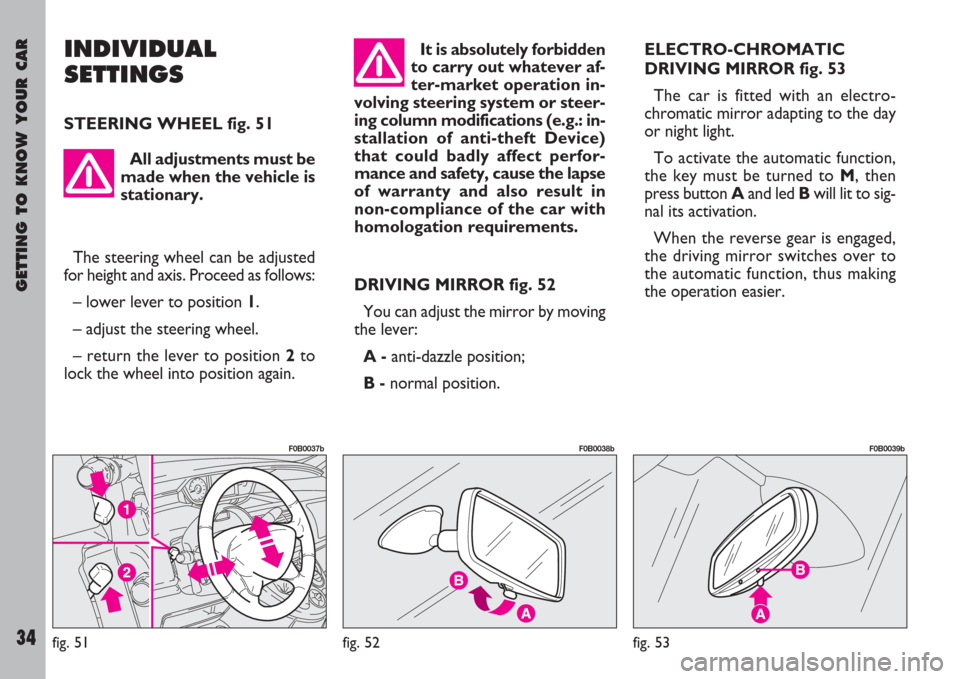
STEERING WHEEL fig. 51
DRIVING MIRROR fig. 52
You can adjust the mirror by moving
the lever:
A -anti-dazzle position;
B -normal position.ELECTRO-CHROMATIC
DRIVING MIRROR fig. 53
The car is fitted with an electro-
chromatic mirror adapting to the day
or night light.
To activate the automatic function,
the key must be turned to M, then
press button Aand led Bwill lit to sig-
nal its activation.
When the reverse gear is engaged,
the driving mirror switches over to
the automatic function, thus making
the operation easier.
fig. 51
F0B0037b
fig. 52
F0B0038b
fig. 53
F0B0039b
All adjustments must be
made when the vehicle is
stationary.
The steering wheel can be adjusted
for height and axis. Proceed as follows:
– lower lever to position 1.
– adjust the steering wheel.
– return the lever to position 2to
lock the wheel into position again.
It is absolutely forbidden
to carry out whatever af-
ter-market operation in-
volving steering system or steer-
ing column modifications (e.g.: in-
stallation of anti-theft Device)
that could badly affect perfor-
mance and safety, cause the lapse
of warranty and also result in
non-compliance of the car with
homologation requirements.
Page 37 of 254
GETTING TO KNOW YOUR CAR
36
Adjustment by hand fig. 55
If the mirror makes it difficult to get
through narrow gaps, fold it from po-
sition 1to position 2.
Electric folding (where fitted)
fig. 55
Folding is possible only when the ig-
nition key is at M.
To tilt the mirrors use button Bnext
to arrow O.
Locking the doors, door mirrors will
set automatically to locking position;
unlocking the doors, door mirrors will
set automatically to opening position.
If door mirrors were folded by press-
ing button Bbefore locking the doors,
next time doors are unlocked the mir-
rors will not set automatically to open-
ing position but you will have to press
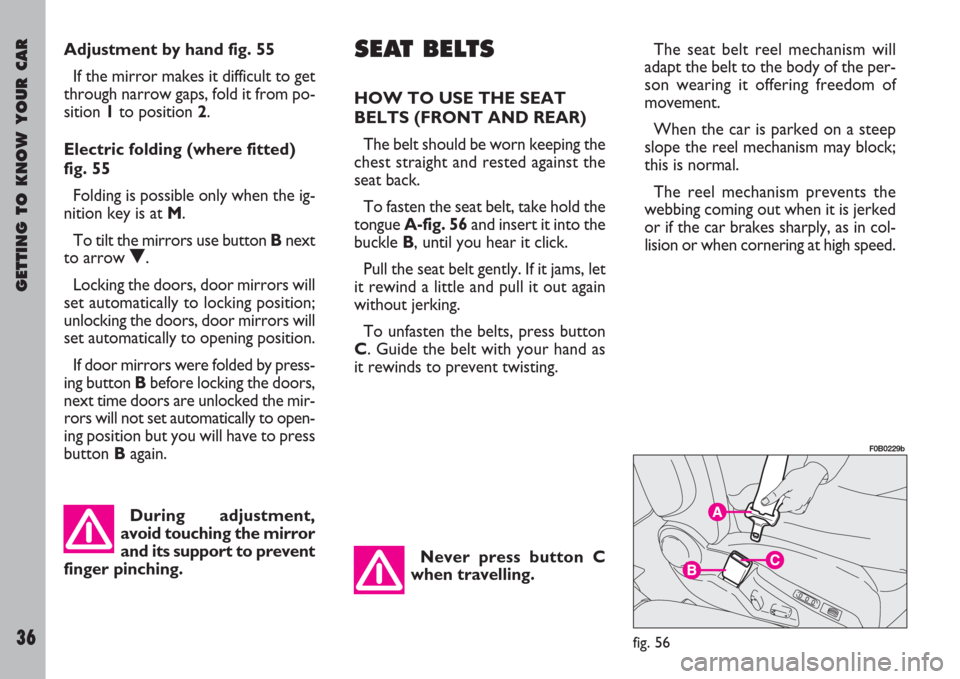
button Bagain.SEAT BELTS
HOW TO USE THE SEAT
BELTS (FRONT AND REAR)
The belt should be worn keeping the
chest straight and rested against the
seat back.
To fasten the seat belt, take hold the
tongue A-fig. 56and insert it into the
buckle B, until you hear it click.
Pull the seat belt gently. If it jams, let
it rewind a little and pull it out again
without jerking.
To unfasten the belts, press button
C. Guide the belt with your hand as
it rewinds to prevent twisting.
Never press button C
when travelling.The seat belt reel mechanism will
adapt the belt to the body of the per-
son wearing it offering freedom of
movement.
When the car is parked on a steep
slope the reel mechanism may block;
this is normal.
The reel mechanism prevents the
webbing coming out when it is jerked
or if the car brakes sharply, as in col-
lision or when cornering at high speed.
fig. 56
F0B0229b
During adjustment,
avoid touching the mirror
and its support to prevent
finger pinching.
Page 39 of 254
GETTING TO KNOW YOUR CAR
38
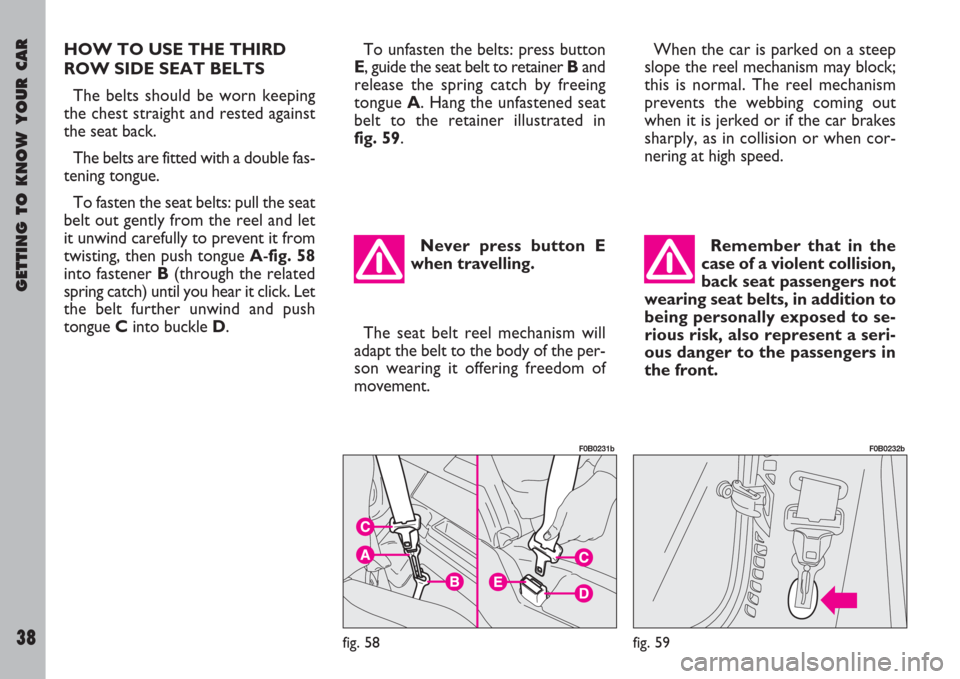
HOW TO USE THE THIRD
ROW SIDE SEAT BELTS
The belts should be worn keeping
the chest straight and rested against
the seat back.
The belts are fitted with a double fas-
tening tongue.
To fasten the seat belts: pull the seat
belt out gently from the reel and let
it unwind carefully to prevent it from
twisting, then push tongue A-fig. 58
into fastener B(through the related
spring catch) until you hear it click. Let
the belt further unwind and push
tongue Cinto buckle D.To unfasten the belts: press button
E, guide the seat belt to retainer Band
release the spring catch by freeing
tongue A. Hang the unfastened seat
belt to the retainer illustrated in
fig. 59.When the car is parked on a steep
slope the reel mechanism may block;
this is normal. The reel mechanism
prevents the webbing coming out
when it is jerked or if the car brakes
sharply, as in collision or when cor-
nering at high speed.
Never press button E
when travelling.
The seat belt reel mechanism will
adapt the belt to the body of the per-
son wearing it offering freedom of
movement.Remember that in the
case of a violent collision,
back seat passengers not
wearing seat belts, in addition to
being personally exposed to se-
rious risk, also represent a seri-
ous danger to the passengers in
the front.
fig. 58
F0B0231b
fig. 59
F0B0232b