lock FIAT ULYSSE 2008 2.G Service Manual
[x] Cancel search | Manufacturer: FIAT, Model Year: 2008, Model line: ULYSSE, Model: FIAT ULYSSE 2008 2.GPages: 254, PDF Size: 3.46 MB
Page 118 of 254
GETTING TO KNOW YOUR CAR
117
In the event of a failure, the braking
capacity of the car will not be pe-
nalised in any way although the an-
tilocking effect cannot be relied upon.
If this is the first time you are dri-
ving a car with ABS, we recommend
you learn how to use it by testing the
brakes on slippery ground - obvious-
ly in conditions of safety and respect-
ing the highway code enforced in the
country you are driving in - and read
the following notes carefully.
The advantage of ABS with respect
to the traditional braking system is the
fact that maximum drivability is en-
sured even when braking to the grip
limit and wheel locking is prevented.
You should, however, not always ex-
pect the braking distance to decrease.
For example, on soft surfaces - i.e.
gravel or fresh snow on a slippery
road - the braking distance could, in
fact, increase.To make the most of the possibilities
offered by the anti-locking system
when it is required, attain to the fol-
lowing advice.If there is a fault, the in-
strument panel warning
light >will come on. At
this point, reduce speed and go to
a Fiat Dealership to have your car
checked and full system opera-
tion restored.
When the ABS inter-
venes and you feel the
brake pedal pushing, do
not release the pressure on the
pedal but hold it down without
hesitation. This will ensure the
car stops in the shortest time
compatibly to the road surface
conditions.In any case, always pay the utmost
care when braking and cornering even
with ABS.
The most important piece of advice
is, however, the following: The ABS makes the
most of the available grip
but cannot increase it.
Consequently, drive very care-
fully on slippery roads without
taking unnecessary risks.
When the ABS inter-
venes, you have reached
the grip limit between
tyres and road surface: slow
down to suit speed to the avail-
able grip.
Page 119 of 254
GETTING TO KNOW YOUR CAR
118
MBA AND HBA
SYSTEMS
(where fitted)
The MBA (Mechanic Brake Assis-
tance) and HBA (Hydraulic Brake As-
sistance) systems increase braking
pressure in emergency braking. When
the driver is forced by the critical dri-
ving conditions to press violently the
brake pedal, the system increases the
braking pressure to assure the quick-
est vehicle stop.
These two systems behave in the
same way, the only difference is that
one increases braking pressure
through the ESP control unit and the
other with a mechanic action. By following these indications you
will be able to brake in the best con-
ditions in all events.
IMPORTANTVehicles fitted with
ABS may only be fitted with wheel
rims, tyres and brake pads of the make
and model approved by the vehicle
manufacturer.
The system is completed with an
Electronic Brake Distributor EBD
which increases the brake system per-
formance and employs the ABS con-
trol unit and sensors.
If the xbrake fluid low
warning light comes on,
stop the vehicle immedi-
ately and contact the nearest Fi-
at Dealership. Fluid leaks from
the hydraulic system, in fact, can
compromise brake system oper-
ation, both traditional systems
and systems with ABS. The car is fitted with an
electronic braking device
(EBD). The xand >
warning lights will come on at the
same time when the engine is
running to indicate that there is
an EBD system failure. In this
case violent braking may be ac-
companied by early rear wheel
locking with the possibility of
skidding. Drive the car extreme-
ly carefully to the nearest Fiat
Dealership to have the system
checked.Warning light >alone,
with the engine running,
normally indicates a fault
in the ABS system. In this case,
the braking system is still effi-
cient, though without the an-
tilocking device. Under these
conditions, performance of the
EBD system may be reduced. Al-
so in this case, you are advised to
go immediately to the nearest Fi-
at Dealership, driving in such a
way to avoid sharp braking to
have the system checked.
Page 122 of 254
GETTING TO KNOW YOUR CAR
121
TC and ASR FUNCTIONS
The TC (Traction Control) and ASR
(Anti Slip Regulation), integrated in the
ESP system, prevent drive wheel slip
in poor grip conditions.
Two different control systems inter-
vene:
– if both drive wheels slip because of
excessive power, the ASR system re-
duces the engine power;
– if only one drive wheel slips, the TC
function brakes the slipping wheel as
a self-locking differential would do.
The TC and ASR functions are par-
ticularly useful in the following condi-
tions:
– inside wheel slipping due to load
variations and excessive acceleration;too much power to the wheels de-
pending also on the road conditions;
– acceleration on snowy or icy roads;
– wet road grip loss.
The TC and ASR system
performance, in terms of
active safety, should not
make the driver run useless risks.
Driving must suit road condi-
tions, visibility and traffic. Never-
theless it is always the behaviour
of the driver that determines
road safety.
Cars with TC and ASR
functions may only be fit-
ted with tyres of the same
make, model and size and be in
good conditions.IMPORTANTWhen travelling on
snowy roads with the snow chains ap-
plied, we suggest turning the ESP sys-
tem off and switching on the TC and
ASR functions, so that the drive action
is increased in the event the drive
wheels slip.
MSR FUNCTION
The MSR (Motor Schleppmoment
Regelung) function controls automat-
ically the engine braking torque while
shifting the gears. In the event of sud-
den gear shifting, this function prevents
the drive wheel dragging, especially in
poor grip conditions, and restores the
vehicle stability.
Page 135 of 254
GETTING TO KNOW YOUR CAR
134
REFUELLING
To guarantee full tank filling, carry
out two refuelling operations after the
first click of the fuel delivery gun.
Avoid further topping up operations
that could cause damages to the fuel
system.
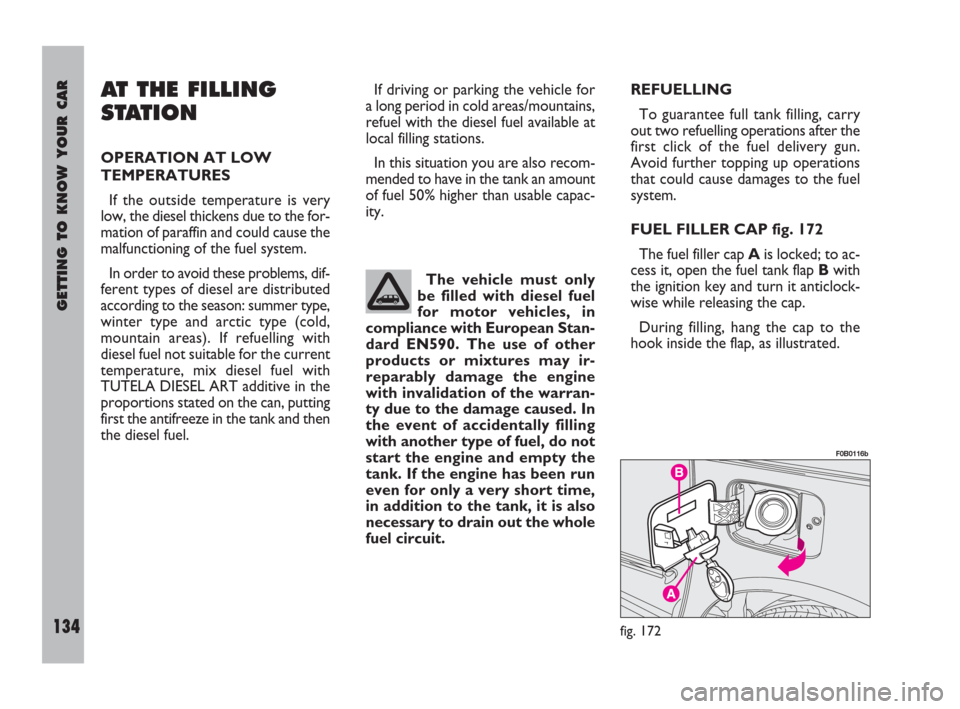
FUEL FILLER CAP fig. 172
The fuel filler cap Ais locked; to ac-
cess it, open the fuel tank flap Bwith
the ignition key and turn it anticlock-
wise while releasing the cap.
During filling, hang the cap to the
hook inside the flap, as illustrated.
fig. 172
F0B0116b
The vehicle must only
be filled with diesel fuel
for motor vehicles, in
compliance with European Stan-
dard EN590. The use of other
products or mixtures may ir-
reparably damage the engine
with invalidation of the warran-
ty due to the damage caused. In
the event of accidentally filling
with another type of fuel, do not
start the engine and empty the
tank. If the engine has been run
even for only a very short time,
in addition to the tank, it is also
necessary to drain out the whole
fuel circuit.
If driving or parking the vehicle for
a long period in cold areas/mountains,
refuel with the diesel fuel available at
local filling stations.
In this situation you are also recom-
mended to have in the tank an amount
of fuel 50% higher than usable capac-
ity.AT THE FILLING
STATION
OPERATION AT LOW
TEMPERATURES
If the outside temperature is very
low, the diesel thickens due to the for-
mation of paraffin and could cause the
malfunctioning of the fuel system.
In order to avoid these problems, dif-
ferent types of diesel are distributed
according to the season: summer type,
winter type and arctic type (cold,
mountain areas). If refuelling with
diesel fuel not suitable for the current
temperature, mix diesel fuel with
TUTELA DIESEL ART additive in the
proportions stated on the can, putting
first the antifreeze in the tank and then
the diesel fuel.
Page 136 of 254
GETTING TO KNOW YOUR CAR
135
PROTECTING THE
ENVIRONMENT
Protecting the environment has been
a constant guiding factor of the
Ulysse’s design and manufacture at
every stage. The result of this atten-
tion is to be seen in the choice of ma-
terials and installation of devices able
to drastically limit or reduce harmful
influences on the environment.
Devices for reducing emissions from
JTD engines are:
– oxidising catalytic converter;
– exhaust gas recirculation system
(E.G.R.);
– particulate filter (where fitted): its
purpose is to trap and burn particulate
(unburnt particles) to reduce harmful
exhaust emissions.
The vehicle, therefore, has great ad-
vantages with respect to the strictest
international anti-pollution directives. Do not put open flames
or lighted cigarettes near
the fuel filler hole as there
is a danger of fire. Do not lean out
too close to the hole either so as
not to breathe in harmful
vapours.
Where necessary, to
avoid compromising the
efficiency of the fuel
vapour recovery system, replace
the fuel cap with another genuine
spare part.
IMPORTANTThe waterproof fu-
el filler cap lock may be slightly pres-
surised. Therefore, do not worry if
some air comes out when the cap is
released.
After filling, drive in the cap by turn-
ing it clockwise until it clicks twice or
thrice, then turn the key clockwise and
remove it. Close the flap.
Page 137 of 254
DRIVING YOUR CAR
136
It is dangerous to let the
engine run in a garage or
other closed area. The
engine consumes oxygen and
gives off dioxide, carbon monox-
ide and other poisonous fumes.
IMPORTANTThe ignition switch
is fitted with a safety device which
obliges the driver to return the key to
Sbefore repeating the starting oper-
ation if the engine does not start im-
mediately.
D D
R R
I I
V V
I I
N N
G G
Y Y
O O
U U
R R
C C
A A
R R
STARTING
THE ENGINE
IMPORTANTThe vehicle is fitted
with an electronic engine locking de-
vice. If the engine cannot be started,
see the “Fiat CODE system” in “Get-
ting to know your car” chapter.
We recommend that
during the initial period
you do not drive to full ve-
hicle performance (e.g.: excessive
acceleration, long journeys at top
speed, hard braking, etc.).When the engine is
switched off never leave
the ignition key at M to
prevent pointless current ab-
sorption from draining the bat-
tery.
Page 140 of 254
DRIVING YOUR CAR
139
PARKING
Proceed as follows:
– turn the engine off;
– pull up the handbrake;
– put the vehicle in gear (1
stif the ve-
hicle is pointing uphill, reverse if down-
hill);
– leave the wheels steered to block
the vehicle in the event the handbrake
is released.
For vehicles with automatic elec-
tronic gearbox refer to “Getting to
know your car” chapter.
SAFE DRIVING
In designing the Ulysse, Fiat has made
every effort to come up with a vehicle
able to provide driver and passengers
with top-class levels of safety. Never-
theless it is always the behaviour of the
person at the wheel that determines
road safety.
Below you will find some simple tips
to help you travel in safety under dif-
ferent conditions. You will no doubt
be already familiar with many of them
but it will be useful to read them all
carefully. Do not leave the ignition
key at M to prevent drain-
ing the battery.
Never leave children un-
attended in the car. Al-
ways remove the ignition
key when leaving the car and take
it out with you.
Page 145 of 254
DRIVING YOUR CAR
144
DRIVING WITH ABS
ABS is a part of the braking system
offering 2 advantages:
1)it prevents wheel lock-up and
consequent skidding in emergency
stops, particularly when the road does
not offer much grip;
2)it makes it possible to brake and
steer at the same time so you can
avoid sudden objects on the road and
direct the vehicle where you want
while braking; this compatibly with the
physical limits of overall tyre grip.To get the most out of ABS:
– during emergency stops or when
grip conditions are poor, you will feel
a slight pulsation on the brake pedal.
This is the sign that the ABS is in ac-
tion. Do not release the brake pedal
but continue to press so as not to in-
terrupt the braking action;
– ABS prevents the wheels from
locking but it does not increase actu-
al grip conditions between tyre and
road. Therefore, even if your vehicle
is fitted with ABS, respect the safety
distance from the vehicle in front of
you and keep your speed down when
driving into bends.
ABS serves to increase the control-
lability of the vehicle, not to enable you
to go faster. DRIVING ON SNOW AND ICE
The main suggestions are the fol-
lowing:
– keep you speed down;
– keep a good distance from the cars
in front of you;
– use chains if the roads are covered
in snow. See “Snow chains” in this
chapter;
– do not keep the engine running for
long periods in deep snow as the snow
could push exhaust gases into the pas-
senger compartment;
– mainly use the engine brake and un-
der all circumstances avoid braking
sharply;
– do not accelerate suddenly and
avoid swerving;
– in the winter, even apparently dry
roads may have icy patches. Be care-
ful therefore when driving over
stretches that do not get much expo-
sure to the sun or that are lined by
trees and rocks, where ice might not
have melted.
Page 157 of 254
IN AN EMERGENCY
156
CHANGING A WHEEL
Please note:
– the jack weighs 3.4 kg;
– the jack requires no adjustments;
– the jack cannot be repaired. If it
breaks it must be replaced with a new
jack;
– no tool with the exception of the
handle can be fitted on the jack.
Proceed as follows:
1) Stop the car in a position that is
not dangerous for oncoming traffic
where you can change the wheel safe-
ly. The ground should be flat and ad-
equately firm. 2) Turn the engine off and pull up the
handbrake.
3) Engage first gear or reverse or, for
versions with automatic electronic
gear, select P.
4) Lift the boot mat (see the relative
instructions in the “Bonnet” paragraph
of “Getting to know your car” chap-
ter).
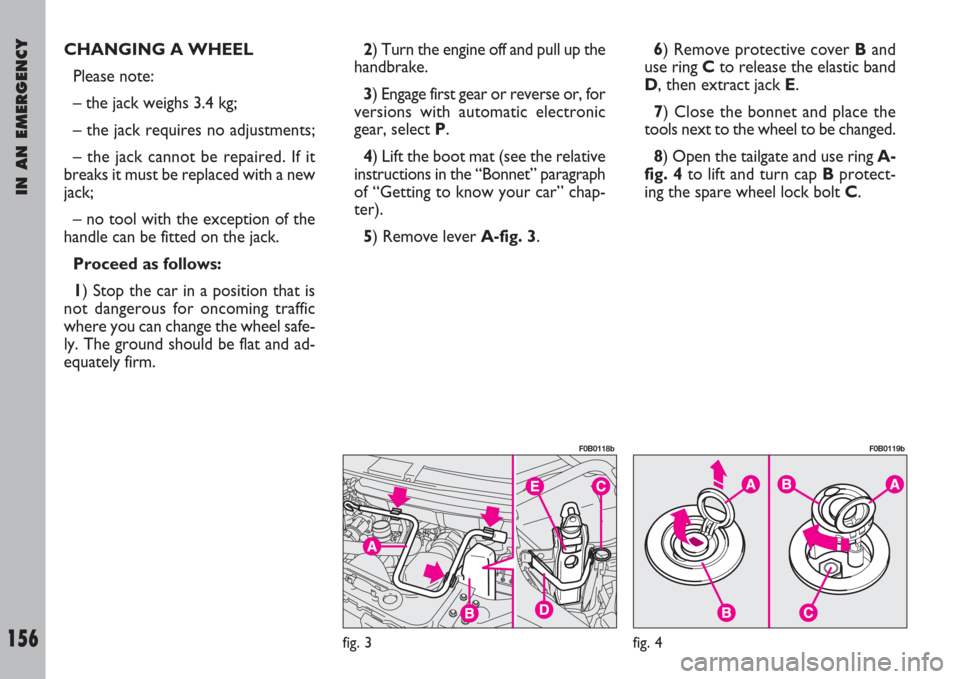
5) Remove lever A-fig. 3.6) Remove protective cover Band
use ring Cto release the elastic band
D, then extract jack E.
7) Close the bonnet and place the
tools next to the wheel to be changed.
8) Open the tailgate and use ringA-
fig. 4to lift and turn cap Bprotect-
ing the spare wheel lock bolt C.
fig. 3
F0B0118b
fig. 4
F0B0119b
Page 161 of 254
IN AN EMERGENCY
160
GENERAL INSTRUCTIONS
– When a light is not working, check
that it has not fused before changing
the bulb.
– For the location of the fuses, refer
to “If a fuse blows” in this chapter.
– Before replacing a bulb that does
not work, check that the contacts are
not oxidised.
– Burnt-out bulbs must be replaced
with ones of the same type and pow-
er.
– Always check the height of the
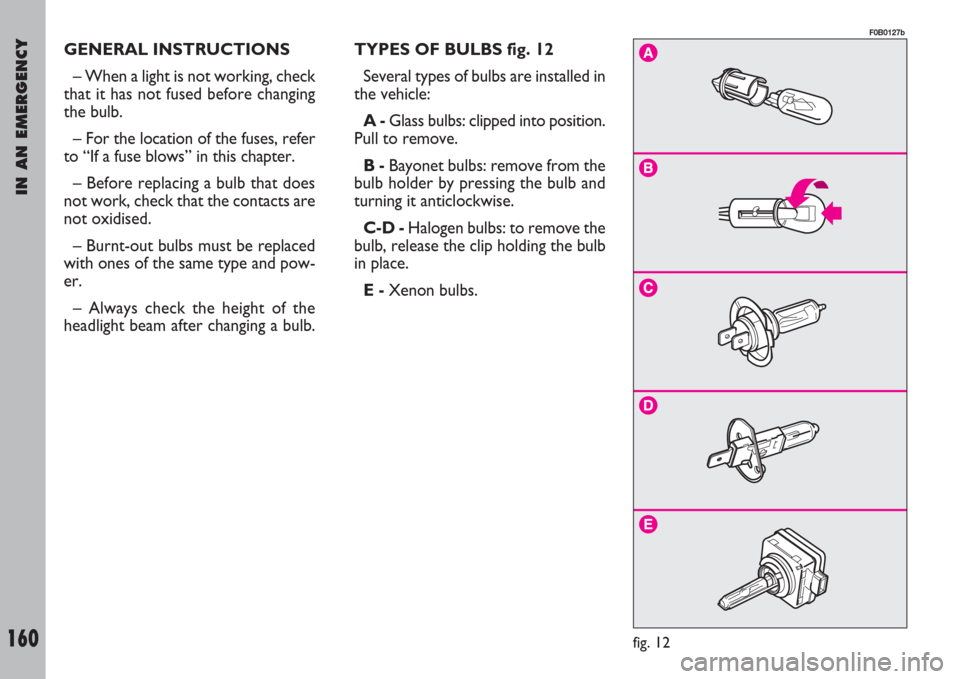
headlight beam after changing a bulb.TYPES OF BULBS fig. 12
Several types of bulbs are installed in
the vehicle:
A -Glass bulbs: clipped into position.
Pull to remove.
B -Bayonet bulbs: remove from the
bulb holder by pressing the bulb and
turning it anticlockwise.
C-D -Halogen bulbs: to remove the
bulb, release the clip holding the bulb
in place.
E -Xenon bulbs.
fig. 12
F0B0127b