max FIAT ULYSSE 2008 2.G Owner's Manual
[x] Cancel search | Manufacturer: FIAT, Model Year: 2008, Model line: ULYSSE, Model: FIAT ULYSSE 2008 2.GPages: 254, PDF Size: 3.46 MB
Page 115 of 254
GETTING TO KNOW YOUR CAR
114
HEADLAMPS
XENON LAMPS (where fitted)
Xenon lamps work with a voltaic arc
in a pressure Xenon saturated envi-
ronment, in place of the traditional fil-
ament.
The produced light is far greater than
that of traditional lamps, both for its
quality (lighter) and its lighting range.
The advantages in using such lamps
are the following: less eyes fatigue, im-
proved driver’s orientation and driving
safety, especially with the bad weath-
er, with fog and/or inadequate road
signs, illumination of side bands usu-
ally in the shadow.Illumination of side bands consider-
ably improves driving safety because
the driver is able to identify other road
users on the road margins (pedestri-
ans, bikers and motor-bikers).
When the lights come on, the volta-
ic arc tension is very high, but then it
falls.
The maximum light is obtained after
0.5 seconds after turning the head-
lamps on.
The great light produced by this type
of headlamps requires an automatic
system for maintaining the headlight
beam constant and preventing dazzling
other vehicles in the event of sudden
braking, acceleration or while carrying
heavy loads. Never load the rack with
more than the weight al-
lowed (see the “Technical
specifications” section).
Be careful not to knock
the tailgate into objects
on the roof rack.
After travelling a few
miles, check that the an-
chorage bolts of the at-
tachments are still fully tight.
Page 117 of 254
GETTING TO KNOW YOUR CAR
116
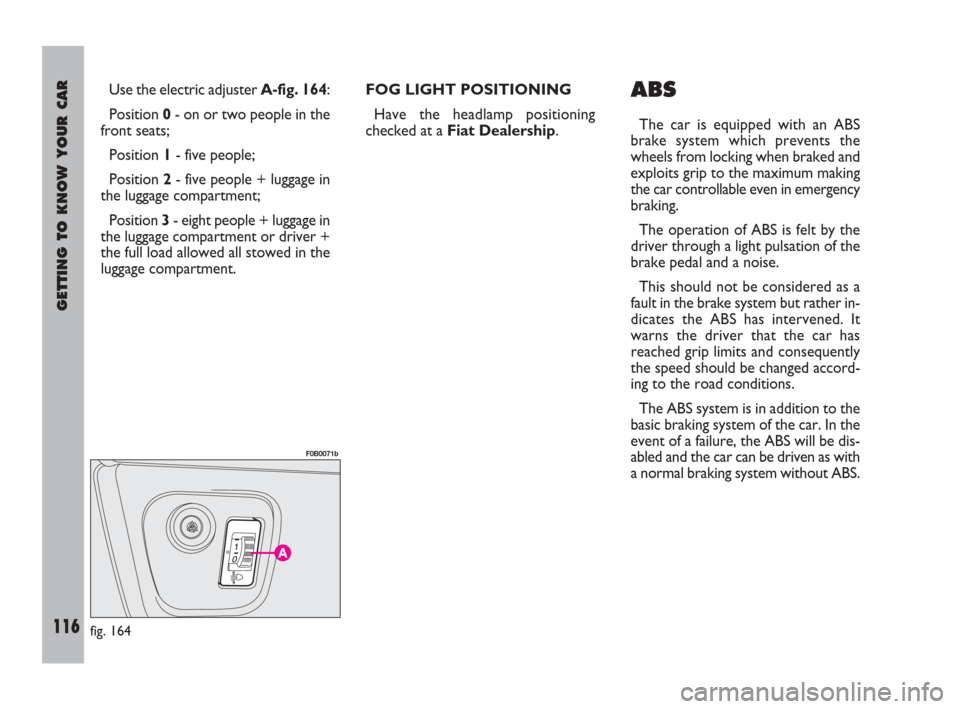
Use the electric adjuster A-fig. 164:
Position 0- on or two people in the
front seats;
Position 1- five people;
Position 2- five people + luggage in
the luggage compartment;
Position 3- eight people + luggage in
the luggage compartment or driver +
the full load allowed all stowed in the
luggage compartment.FOG LIGHT POSITIONING
Have the headlamp positioning
checked at a Fiat Dealership.ABS
The car is equipped with an ABS
brake system which prevents the
wheels from locking when braked and
exploits grip to the maximum making
the car controllable even in emergency
braking.
The operation of ABS is felt by the
driver through a light pulsation of the
brake pedal and a noise.
This should not be considered as a
fault in the brake system but rather in-
dicates the ABS has intervened. It
warns the driver that the car has
reached grip limits and consequently
the speed should be changed accord-
ing to the road conditions.
The ABS system is in addition to the
basic braking system of the car. In the
event of a failure, the ABS will be dis-
abled and the car can be driven as with
a normal braking system without ABS.
fig. 164
F0B0071b
Page 118 of 254
GETTING TO KNOW YOUR CAR
117
In the event of a failure, the braking
capacity of the car will not be pe-
nalised in any way although the an-
tilocking effect cannot be relied upon.
If this is the first time you are dri-
ving a car with ABS, we recommend
you learn how to use it by testing the
brakes on slippery ground - obvious-
ly in conditions of safety and respect-
ing the highway code enforced in the
country you are driving in - and read
the following notes carefully.
The advantage of ABS with respect
to the traditional braking system is the
fact that maximum drivability is en-
sured even when braking to the grip
limit and wheel locking is prevented.
You should, however, not always ex-
pect the braking distance to decrease.
For example, on soft surfaces - i.e.
gravel or fresh snow on a slippery
road - the braking distance could, in
fact, increase.To make the most of the possibilities
offered by the anti-locking system
when it is required, attain to the fol-
lowing advice.If there is a fault, the in-
strument panel warning
light >will come on. At
this point, reduce speed and go to
a Fiat Dealership to have your car
checked and full system opera-
tion restored.
When the ABS inter-
venes and you feel the
brake pedal pushing, do
not release the pressure on the
pedal but hold it down without
hesitation. This will ensure the
car stops in the shortest time
compatibly to the road surface
conditions.In any case, always pay the utmost
care when braking and cornering even
with ABS.
The most important piece of advice
is, however, the following: The ABS makes the
most of the available grip
but cannot increase it.
Consequently, drive very care-
fully on slippery roads without
taking unnecessary risks.
When the ABS inter-
venes, you have reached
the grip limit between
tyres and road surface: slow
down to suit speed to the avail-
able grip.
Page 147 of 254
DRIVING YOUR CAR
146
DRIVING STYLE
Starting
Do not warm the engine when the
vehicle is stationary or at high or low
revs: in this way the engine will warm
up gradually increasing consumption
and emissions. You should drive off
slowly straight away avoiding high revs
so that the engine will warm up more
quickly.
Unnecessary actions
Avoid revving the engine when
stopped at traffic lights or before
switching off the engine and avoid dou-
ble-clutching as these actions have no
purpose on modern vehicles and serve
only to increase consumption and pol-
lution.
Gear selections
As soon as the traffic and road con-
ditions allow it, shift to a higher gear.
Using a lower gear to liven up accel-
eration greatly increases consumption.
In the same way, improper use of the
higher gears will increase consump-
tion, emissions and wear and tear on
the engine.Top speeds
Fuel consumption increases consid-
erably as speed increases. For exam-
ple, when accelerating from 90 to
120 Kph, fuel consumption increases
by about +30%. Your speed should be
kept as even as possible and superflu-
ous braking and acceleration avoided
as this increases both consumption
and emissions. A “soft” way of driving
should be adopted by attempting to
anticipate manoeuvres to avoid immi-
nent danger and to keep a safe dis-
tance from the vehicle in front to
avoid braking sharply.
Acceleration
Accelerating violently increasing the
revs will greatly effect consumption
and emission: acceleration should be
gradual and not exceed the maximum
torque.CONDITIONS OF USE
Cold starting
Short trips and frequent cold start-
ing will not enable the engine to reach
optimal running temperature (from
+15 to +30% in built up areas) as will
the production of toxic emissions.
Traffic and road conditions
Heavy traffic and higher consumption
are synonymous: for example, when
driving slowly with frequent use of
lower gears or in large towns where
there are numerous traffic lights.
Winding roads, mountain roads and
bumpy roads also have a negative ef-
fect on consumption.
Enforced halts
During prolonged stops (traffic lights,
level crossings, etc.) the engine should
be switched off.
Page 149 of 254
DRIVING YOUR CAR
148
Do not warm up the engine by let-
ting it idle for a while before moving
off unless the outside temperature is
very low and, even in this case, only
do so for less than thirty seconds.
Do not install other heat shields and
do not remove those already fitted to
the catalytic converter and exhaust
pipe.Do not spray anything
on the Lambda sensor
and exhaust pipe.TOWING A TRAILER
IMPORTANT
The car must be fitted with a ho-
mologated tow hitch and suitable elec-
trical system for towing a caravan or
trailer.
To prevent damages to the electric
system of the car, it is recommended
to install a dedicated trailer electron-
ic control unit.
Have the tow hitch fitted by an ex-
pert who will issue specific documen-
tation for use on roads.
Fit special and/or additional rearview
mirrors in accordance with the High-
way Code.
Remember that towing a trailer
makes it harder for the car to climb
the maximum gradients specified, in-
creases braking and overtaking dis-
tance, proportionally to the overall
weight of the trailer.
Engage a low gear when driving down-
hill rather than constantly braking. When functioning nor-
mally the catalytic con-
verter develops high tem-
peratures. For this reason, do not
park the vehicle over inflamma-
ble material (grass, dry leaves,
pine needles, etc.): fire hazard.Failure to heed these
precautions could cause a
fire.
Page 150 of 254
DRIVING YOUR CAR
149
The weight the trailer exerts on the
vehicle’s tow hitch coupling reduces
the vehicle’s payload capacity by the
same amount.
In order to be sure you are not ex-
ceeding the maximum towing weight
(shown in the vehicle’s registration pa-
pers) you have to take into account the
trailer’s weight fully laden including the
accessories and personal luggage.
Do not exceed the speed limits for
towing a trailer either abroad or at
home. In any case, do not exceed the
top speed of 100 km/h.WINTER TYRES
These tyres have been specifically de-
signed for use on snow and ice and
should be fitted in place of the exist-
ing tyres.
Use winter tyres of the same size as
the tyres provided with the car.
Fiat Dealershipwill be glad to of-
fer advice on the right type of tyres ac-
cording to your needs.
The performance of winter tyres is
greatly reduced when the depth of the
tread is less than 4 mm. In this situa-
tion it would be safer to have them re-
placed.
The ABS system does
not control the trailer
braking system. Particu-
lar care must therefore be taken
on slippery road surfaces.Under no circumstances
modify the vehicle’s brak-
ing system for trailer
braking control. The trailer’s
braking system must be com-
pletely independent of the vehi-
cle’s hydraulic system.
Page 151 of 254
DRIVING YOUR CAR
150
The specific characteristics of the
winter tyres mean that under normal
driving conditions or when driving long
distances on motorways, their perfor-
mance is greatly reduced in compari-
son to those normally fitted to the car.
The use of these tyres should there-
fore be limited to the conditions for
which they were designed and certified.
IMPORTANTWhen using winter
tyres with a maximum speed rating
lower than the speed which can be
reached by the car (plus 5%), place a
suitable notice in the passenger com-
partment to inform the driver of the
top speed which the winter tyre can
run at (as per Directive CE).
All four tyres should be the same
(brand and track) to ensure greater
safety when driving, braking and cor-
nering.SNOW CHAINS
The use of snow chains is regulated
by the legislation in force in the coun-
try the car is driven in.
The chains may only be applied to
the front wheel (drive wheel) tyres.
Use only low profile chains (maxi-
mum 12 mm off the tyre).
We recommend using Lineaccessori
Fiat snow chains.
Check the tautness of the chains af-
ter driving some ten meters. The max speed for snow
tyres with “Q” marking is
160 km/h, 190 Km/h for
tyres with “T” marking and
210 Km/h for tyres with “H”
marking. The Road Traffic Code
speed limits must however be al-
ways strictly observed.
Remember not to invert the tyre di-
rection of rotation.
Page 172 of 254
IN AN EMERGENCY
171
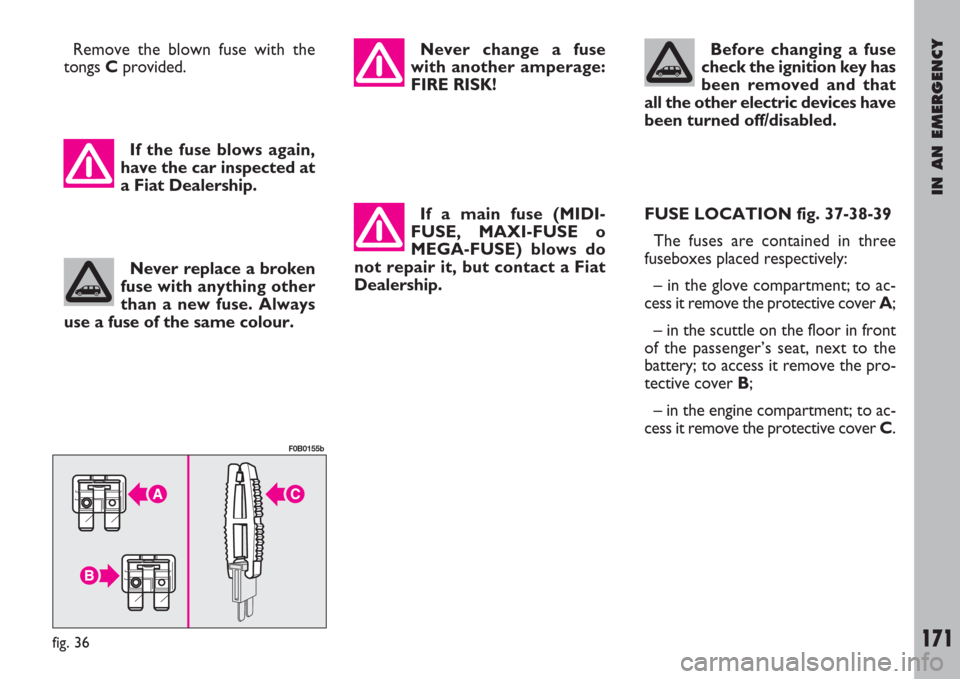
Remove the blown fuse with the
tongs Cprovided.
If a main fuse (MIDI-
FUSE, MAXI-FUSE o
MEGA-FUSE) blows do
not repair it, but contact a Fiat
Dealership.FUSE LOCATION fig. 37-38-39
The fuses are contained in three
fuseboxes placed respectively:
– in the glove compartment; to ac-
cess it remove the protective cover A;
– in the scuttle on the floor in front
of the passenger’s seat, next to the
battery; to access it remove the pro-
tective cover B;
– in the engine compartment; to ac-
cess it remove the protective cover C. Never replace a broken
fuse with anything other
than a new fuse. Always
use a fuse of the same colour.Before changing a fuse
check the ignition key has
been removed and that
all the other electric devices have
been turned off/disabled.Never change a fuse
with another amperage:
FIRE RISK!
fig. 36
F0B0155b
If the fuse blows again,
have the car inspected at
a Fiat Dealership.
Page 178 of 254
IN AN EMERGENCY
177
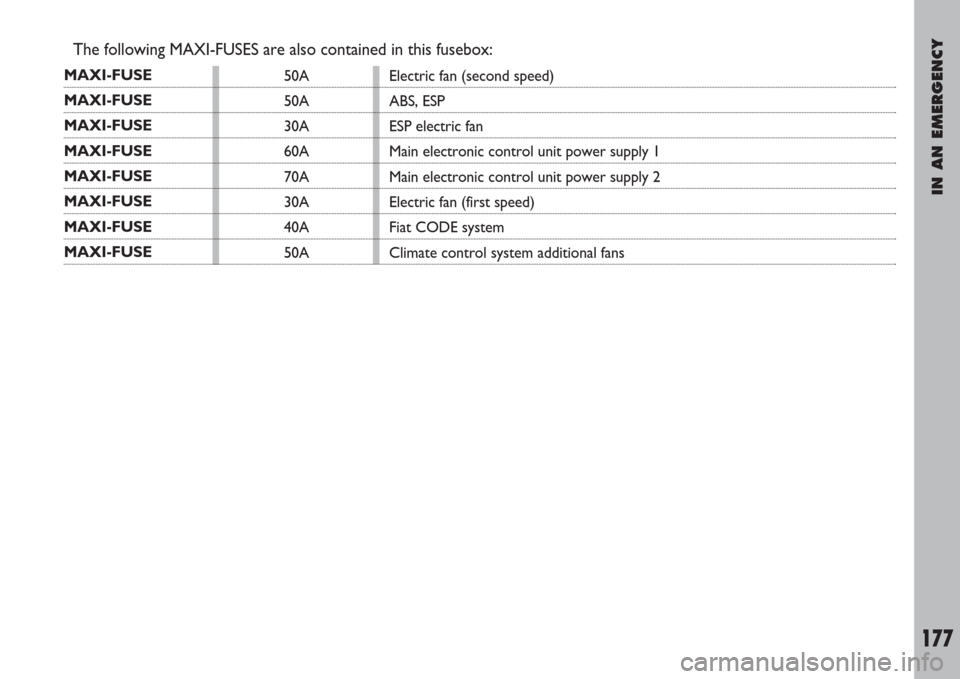
The following MAXI-FUSES are also contained in this fusebox:
MAXI-FUSE
MAXI-FUSE
MAXI-FUSE
MAXI-FUSE
MAXI-FUSE
MAXI-FUSE
MAXI-FUSE
MAXI-FUSE 50A
50A
30A
60A
70A
30A
40A
50AElectric fan (second speed)
ABS, ESP
ESP electric fan
Main electronic control unit power supply 1
Main electronic control unit power supply 2
Electric fan (first speed)
Fiat CODE system
Climate control system additional fans
Page 193 of 254
CAR MAINTENANCE
192
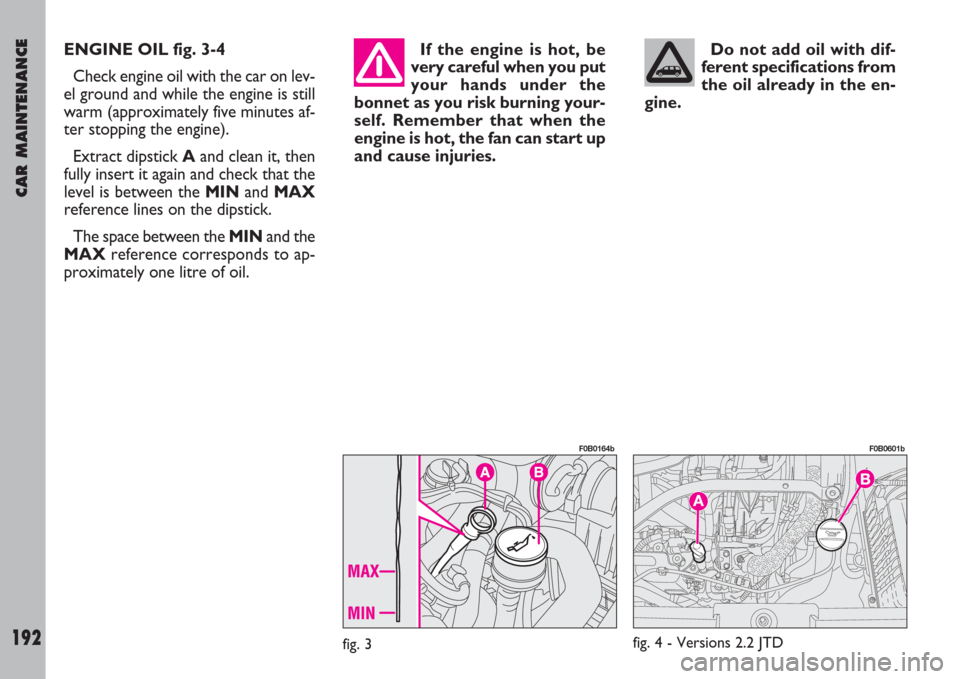
ENGINE OIL fig. 3-4
Check engine oil with the car on lev-
el ground and while the engine is still
warm (approximately five minutes af-
ter stopping the engine).
Extract dipstick Aand clean it, then
fully insert it again and check that the
level is between the MINand MAX
reference lines on the dipstick.
The space between the MINand the
MAXreference corresponds to ap-
proximately one litre of oil.Do not add oil with dif-
ferent specifications from
the oil already in the en-
gine.If the engine is hot, be
very careful when you put
your hands under the
bonnet as you risk burning your-
self. Remember that when the
engine is hot, the fan can start up
and cause injuries.
fig. 3
F0B0164b
fig. 4 - Versions 2.2 JTD
F0B0601b