low beam FIAT UNO 1983 Service User Guide
[x] Cancel search | Manufacturer: FIAT, Model Year: 1983, Model line: UNO, Model: FIAT UNO 1983Pages: 303, PDF Size: 10.36 MB
Page 222 of 303
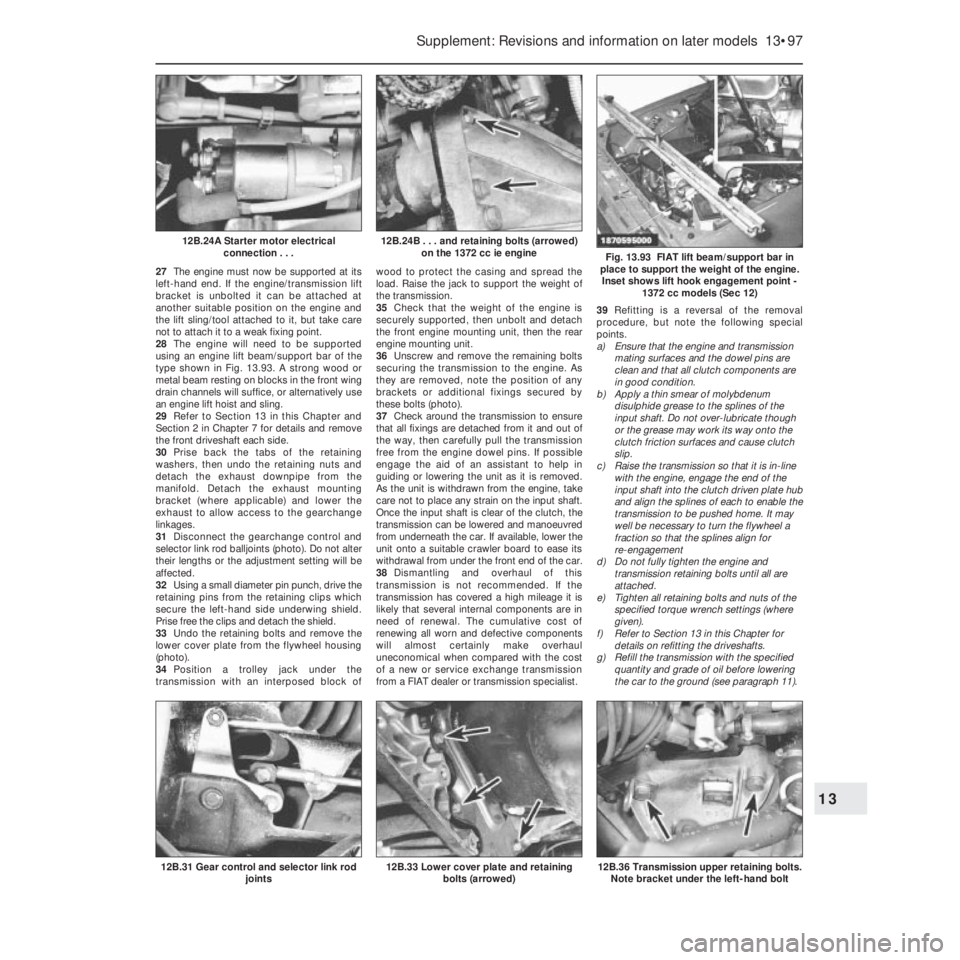
27The engine must now be supported at its
left-hand end. If the engine/transmission lift
bracket is unbolted it can be attached at
another suitable position on the engine and
the lift sling/tool attached to it, but take care
not to attach it to a weak fixing point.
28The engine will need to be supported
using an engine lift beam/support bar of the
type shown in Fig. 13.93. A strong wood or
metal beam resting on blocks in the front wing
drain channels will suffice, or alternatively use
an engine lift hoist and sling.
29Refer to Section 13 in this Chapter and
Section 2 in Chapter 7 for details and remove
the front driveshaft each side.
30Prise back the tabs of the retaining
washers, then undo the retaining nuts and
detach the exhaust downpipe from the
manifold. Detach the exhaust mounting
bracket (where applicable) and lower the
exhaust to allow access to the gearchange
linkages.
31Disconnect the gearchange control and
selector link rod balljoints (photo). Do not alter
their lengths or the adjustment setting will be
affected.
32Using a small diameter pin punch, drive the
retaining pins from the retaining clips which
secure the left-hand side underwing shield.
Prise free the clips and detach the shield.
33Undo the retaining bolts and remove the
lower cover plate from the flywheel housing
(photo).
34Position a trolley jack under the
transmission with an interposed block ofwood to protect the casing and spread the
load. Raise the jack to support the weight of
the transmission.
35Check that the weight of the engine is
securely supported, then unbolt and detach
the front engine mounting unit, then the rear
engine mounting unit.
36Unscrew and remove the remaining bolts
securing the transmission to the engine. As
they are removed, note the position of any
brackets or additional fixings secured by
these bolts (photo).
37Check around the transmission to ensure
that all fixings are detached from it and out of
the way, then carefully pull the transmission
free from the engine dowel pins. If possible
engage the aid of an assistant to help in
guiding or lowering the unit as it is removed.
As the unit is withdrawn from the engine, take
care not to place any strain on the input shaft.
Once the input shaft is clear of the clutch, the
transmission can be lowered and manoeuvred
from underneath the car. If available, lower the
unit onto a suitable crawler board to ease its
withdrawal from under the front end of the car.
38Dismantling and overhaul of this
transmission is not recommended. If the
transmission has covered a high mileage it is
likely that several internal components are in
need of renewal. The cumulative cost of
renewing all worn and defective components
will almost certainly make overhaul
uneconomical when compared with the cost
of a new or service exchange transmission
from a FIAT dealer or transmission specialist.39Refitting is a reversal of the removal
procedure, but note the following special
points.
a) Ensure that the engine and transmission
mating surfaces and the dowel pins are
clean and that all clutch components are
in good condition.
b) Apply a thin smear of molybdenum
disulphide grease to the splines of the
input shaft. Do not over-lubricate though
or the grease may work its way onto the
clutch friction surfaces and cause clutch
slip.
c) Raise the transmission so that it is in-line
with the engine, engage the end of the
input shaft into the clutch driven plate hub
and align the splines of each to enable the
transmission to be pushed home. It may
well be necessary to turn the flywheel a
fraction so that the splines align for
re-engagement
d) Do not fully tighten the engine and
transmission retaining bolts until all are
attached.
e) Tighten all retaining bolts and nuts of the
specified torque wrench settings (where
given).
f) Refer to Section 13 in this Chapter for
details on refitting the driveshafts.
g) Refill the transmission with the specified
quantity and grade of oil before lowering
the car to the ground (see paragraph 11).
Supplement: Revisions and information on later models 13•97
Fig. 13.93 FIAT lift beam/support bar in
place to support the weight of the engine.
Inset shows lift hook engagement point -
1372 cc models (Sec 12)
12B.24B . . . and retaining bolts (arrowed)
on the 1372 cc ie engine12B.24A Starter motor electrical
connection . . .
12B.36 Transmission upper retaining bolts.
Note bracket under the left-hand bolt12B.33 Lower cover plate and retaining
bolts (arrowed)12B.31 Gear control and selector link rod
joints
13
Page 230 of 303
Starter motor brushes
(later models) - renewal#
25When renewing the starter motor brushes
on later models, the old brushes will need to
be crushed (in a vice or with a hammer) and
their leads then soldered to the new brushes.
Fuses - later models
26The fuse arrangement is slightly different
on later models, but the circuits protected are
still identified by a symbol. Refer to the
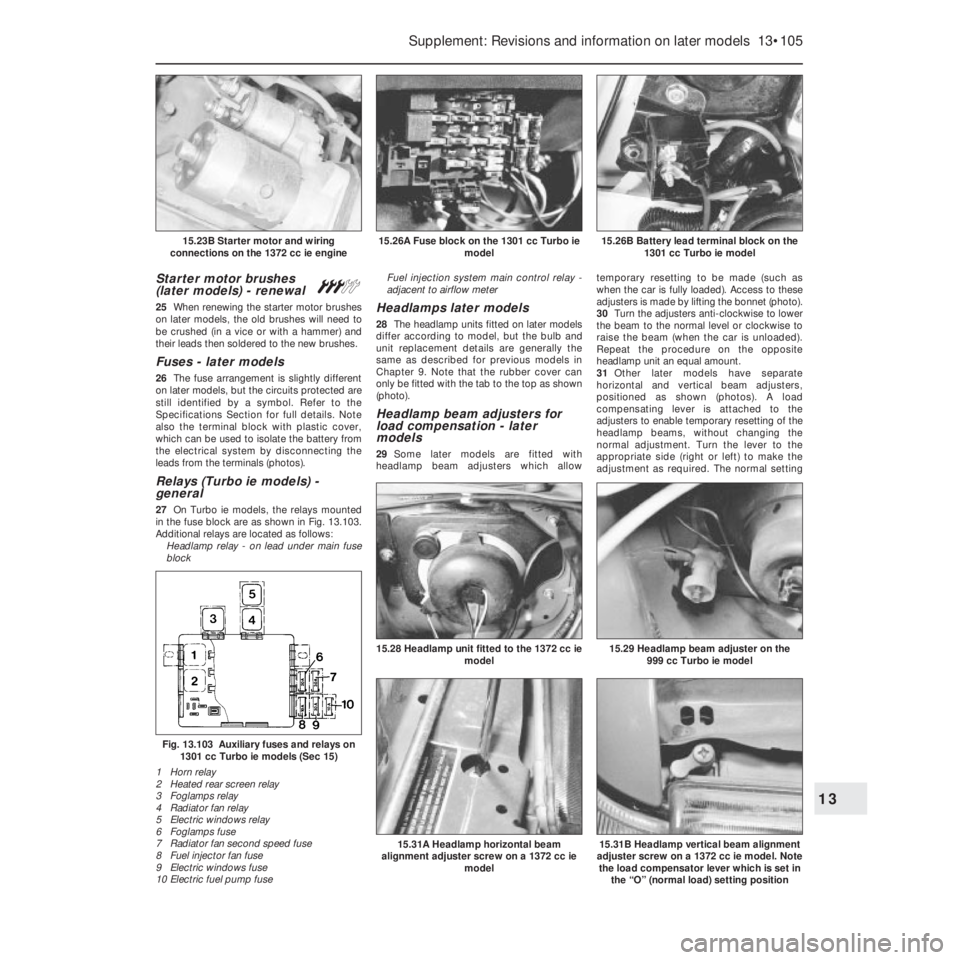
Specifications Section for full details. Note
also the terminal block with plastic cover,
which can be used to isolate the battery from
the electrical system by disconnecting the
leads from the terminals (photos).
Relays (Turbo ie models) -
general
27On Turbo ie models, the relays mounted
in the fuse block are as shown in Fig. 13.103.
Additional relays are located as follows:
Headlamp relay - on lead under main fuse
blockFuel injection system main control relay -
adjacent to airflow meter
Headlamps later models
28The headlamp units fitted on later models
differ according to model, but the bulb and
unit replacement details are generally the
same as described for previous models in
Chapter 9. Note that the rubber cover can
only be fitted with the tab to the top as shown
(photo).
Headlamp beam adjusters for
load compensation - later
models
29Some later models are fitted with
headlamp beam adjusters which allowtemporary resetting to be made (such as
when the car is fully loaded). Access to these
adjusters is made by lifting the bonnet (photo).
30Turn the adjusters anti-clockwise to lower
the beam to the normal level or clockwise to
raise the beam (when the car is unloaded).
Repeat the procedure on the opposite
headlamp unit an equal amount.
31Other later models have separate
horizontal and vertical beam adjusters,
positioned as shown (photos). A load
compensating lever is attached to the
adjusters to enable temporary resetting of the
headlamp beams, without changing the
normal adjustment. Turn the lever to the
appropriate side (right or left) to make the
adjustment as required. The normal setting
Supplement: Revisions and information on later models 13•105
15.26B Battery lead terminal block on the
1301 cc Turbo ie model15.23B Starter motor and wiring
connections on the 1372 cc ie engine
15.31B Headlamp vertical beam alignment
adjuster screw on a 1372 cc ie model. Note
the load compensator lever which is set in
the “O” (normal load) setting position15.31A Headlamp horizontal beam
alignment adjuster screw on a 1372 cc ie
model
15.29 Headlamp beam adjuster on the
999 cc Turbo ie model15.28 Headlamp unit fitted to the 1372 cc ie
model
15.26A Fuse block on the 1301 cc Turbo ie
model
13
Fig. 13.103 Auxiliary fuses and relays on
1301 cc Turbo ie models (Sec 15)
1 Horn relay
2 Heated rear screen relay
3 Foglamps relay
4 Radiator fan relay
5 Electric windows relay
6 Foglamps fuse
7 Radiator fan second speed fuse
8 Fuel injector fan fuse
9 Electric windows fuse
10 Electric fuel pump fuse
Page 231 of 303
adjustment procedures are the same as those
outlined for the previous model units in
Chapter 9, but ensure that the load
compensation lever is turned to the “O”
(normal load setting) position before making
any adjustments.
Headlamp unit removal - later
models
32The removal and refitting procedures
described in Chapter 9 also apply to the later
headlamp type, but note that later units are
secured in position by three retaining screws.
Headlamp dim-dip system -
description
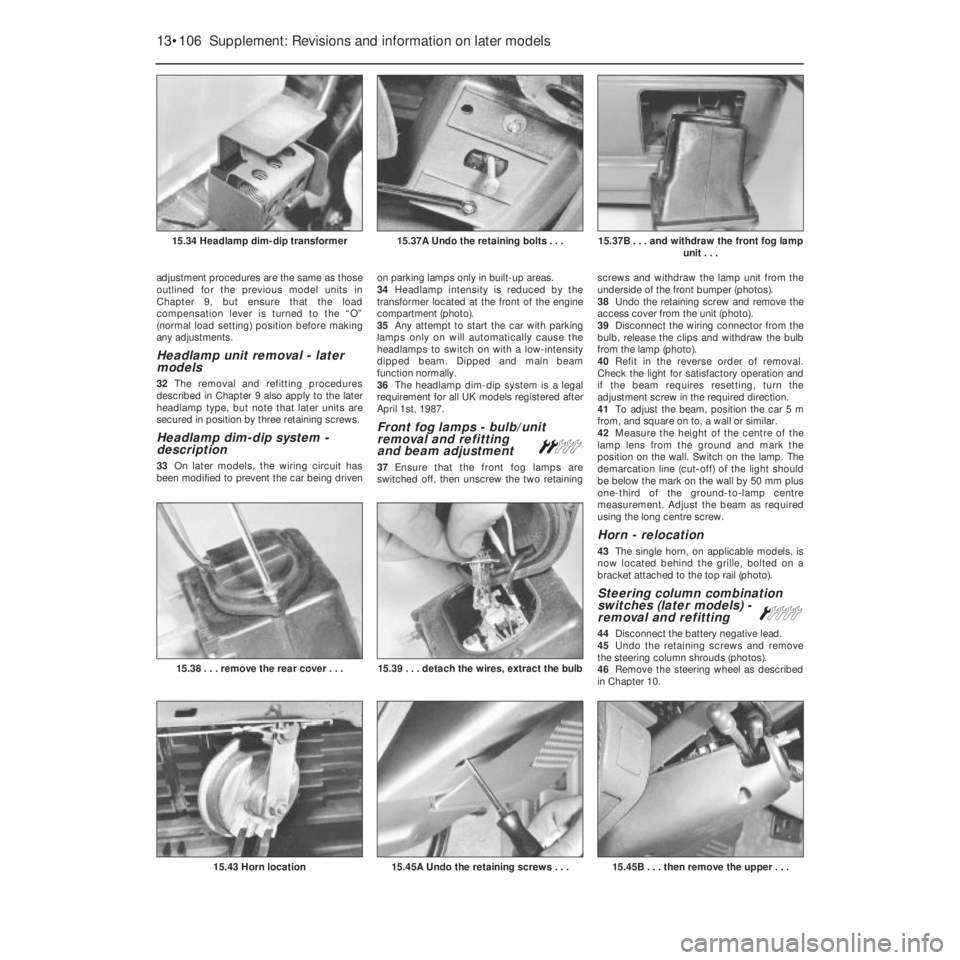
33On later models, the wiring circuit has
been modified to prevent the car being drivenon parking lamps only in built-up areas.
34Headlamp intensity is reduced by the
transformer located at the front of the engine
compartment (photo).
35Any attempt to start the car with parking
lamps only on will automatically cause the
headlamps to switch on with a low-intensity
dipped beam. Dipped and main beam
function normally.
36The headlamp dim-dip system is a legal
requirement for all UK models registered after
April 1st, 1987.
Front fog lamps - bulb/unit
removal and refitting
and beam adjustment
ª
37Ensure that the front fog lamps are
switched off, then unscrew the two retainingscrews and withdraw the lamp unit from the
underside of the front bumper (photos).
38Undo the retaining screw and remove the
access cover from the unit (photo).
39Disconnect the wiring connector from the
bulb, release the clips and withdraw the bulb
from the lamp (photo).
40Refit in the reverse order of removal.
Check the light for satisfactory operation and
if the beam requires resetting, turn the
adjustment screw in the required direction.
41To adjust the beam, position the car 5 m
from, and square on to, a wall or similar.
42Measure the height of the centre of the
lamp lens from the ground and mark the
position on the wall. Switch on the lamp. The
demarcation line (cut-off) of the light should
be below the mark on the wall by 50 mm plus
one-third of the ground-to-lamp centre
measurement. Adjust the beam as required
using the long centre screw.
Horn - relocation
43The single horn, on applicable models, is
now located behind the grille, bolted on a
bracket attached to the top rail (photo).
Steering column combination
switches (later models) -
removal and refitting
Á
44Disconnect the battery negative lead.
45Undo the retaining screws and remove
the steering column shrouds (photos).
46Remove the steering wheel as described
in Chapter 10.
13•106 Supplement: Revisions and information on later models
15.45B . . . then remove the upper . . .15.45A Undo the retaining screws . . .15.43 Horn location
15.39 . . . detach the wires, extract the bulb15.38 . . . remove the rear cover . . .
15.37B . . . and withdraw the front fog lamp
unit . . .15.37A Undo the retaining bolts . . .15.34 Headlamp dim-dip transformer
Page 255 of 303
14•16 Wiring diagrams
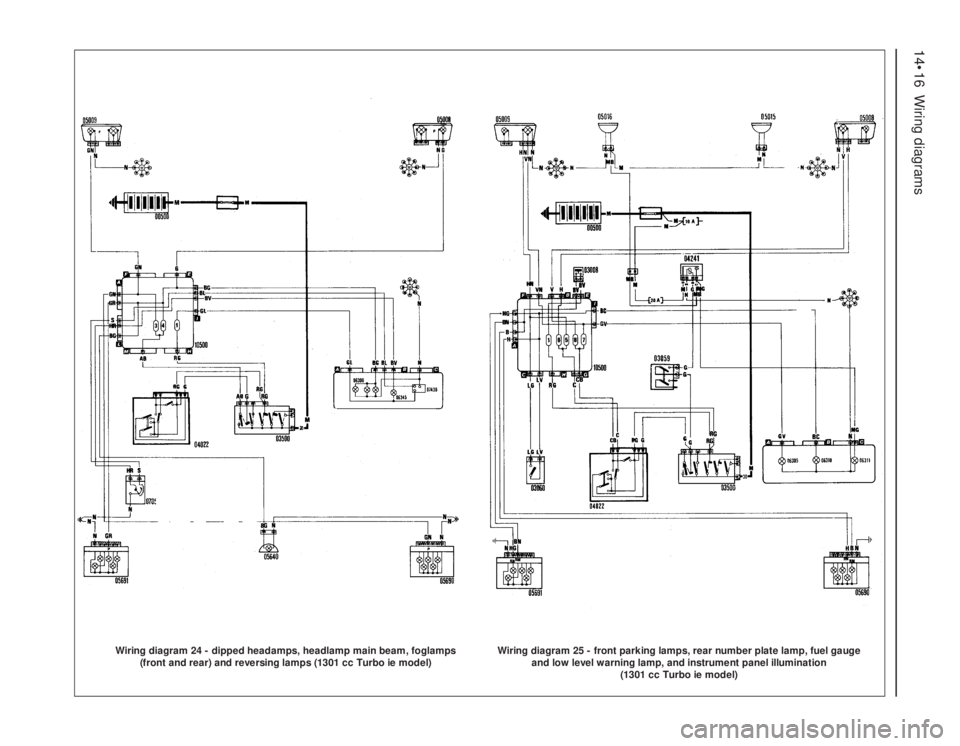
Wiring diagram 24 - dipped headamps, headlamp main beam, foglamps
(front and rear) and reversing lamps (1301 cc Turbo ie model)
Wiring diagram 25 - front parking lamps, rear number plate lamp, fuel gauge
and low level warning lamp, and instrument panel illumination
(1301 cc Turbo ie model)
Page 260 of 303
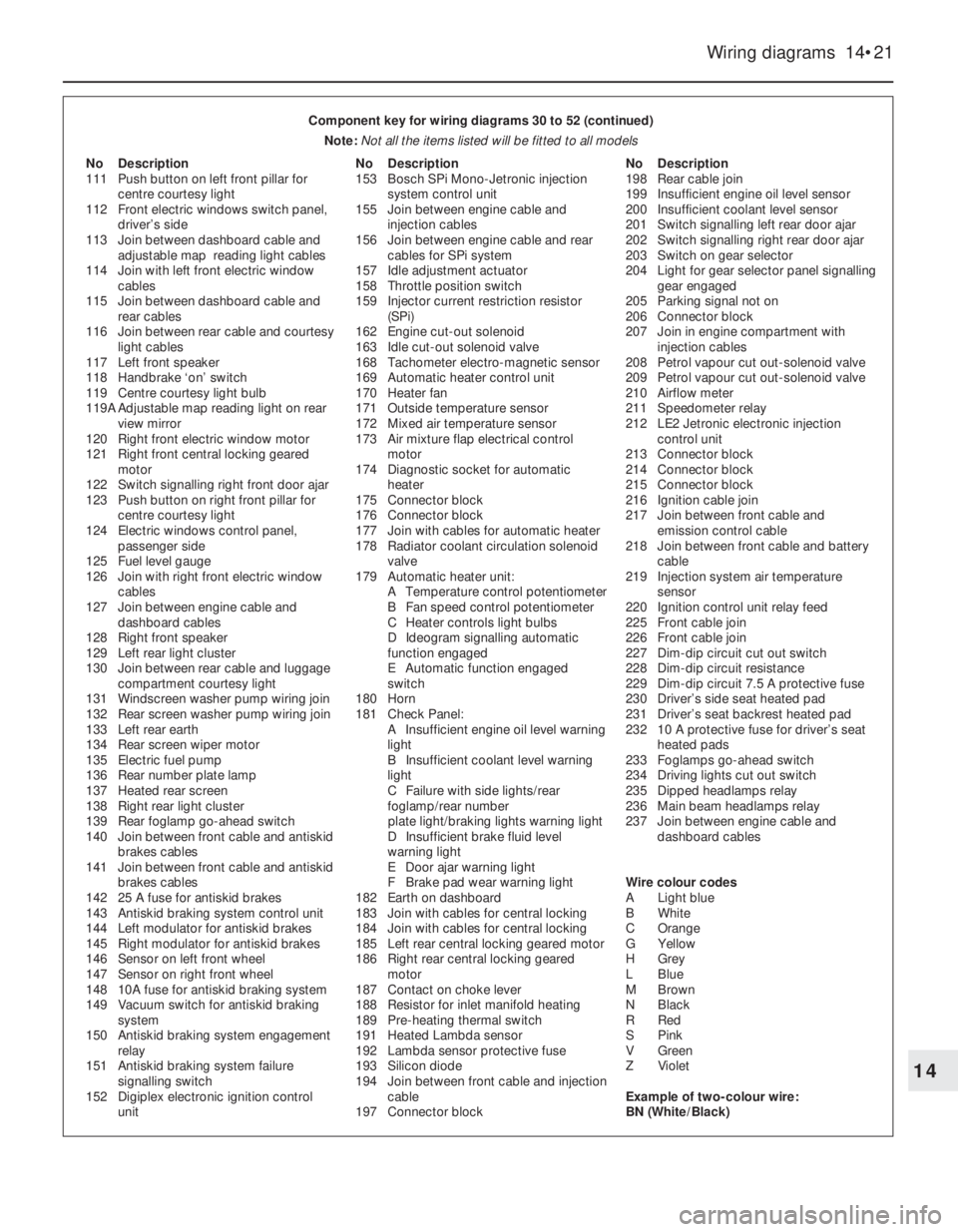
Wiring diagrams 14•21
14
Component key for wiring diagrams 30 to 52 (continued)
Note: Not all the items listed will be fitted to all models
No Description
111 Push button on left front pillar for
centre courtesy light
112 Front electric windows switch panel,
driver’s side
113 Join between dashboard cable and
adjustable map reading light cables
114 Join with left front electric window
cables
115 Join between dashboard cable and
rear cables
116 Join between rear cable and courtesy
light cables
117 Left front speaker
118 Handbrake ‘on’ switch
119 Centre courtesy light bulb
119A Adjustable map reading light on rear
view mirror
120 Right front electric window motor
121 Right front central locking geared
motor
122 Switch signalling right front door ajar
123 Push button on right front pillar for
centre courtesy light
124 Electric windows control panel,
passenger side
125 Fuel level gauge
126 Join with right front electric window
cables
127 Join between engine cable and
dashboard cables
128 Right front speaker
129 Left rear light cluster
130 Join between rear cable and luggage
compartment courtesy light
131 Windscreen washer pump wiring join
132 Rear screen washer pump wiring join
133 Left rear earth
134 Rear screen wiper motor
135 Electric fuel pump
136 Rear number plate lamp
137 Heated rear screen
138 Right rear light cluster
139 Rear foglamp go-ahead switch
140 Join between front cable and antiskid
brakes cables
141 Join between front cable and antiskid
brakes cables
142 25 A fuse for antiskid brakes
143 Antiskid braking system control unit
144 Left modulator for antiskid brakes
145 Right modulator for antiskid brakes
146 Sensor on left front wheel
147 Sensor on right front wheel
148 10A fuse for antiskid braking system
149 Vacuum switch for antiskid braking
system
150 Antiskid braking system engagement
relay
151 Antiskid braking system failure
signalling switch
152 Digiplex electronic ignition control
unitNo Description
153 Bosch SPi Mono-Jetronic injection
system control unit
155 Join between engine cable and
injection cables
156 Join between engine cable and rear
cables for SPi system
157 Idle adjustment actuator
158 Throttle position switch
159 Injector current restriction resistor
(SPi)
162 Engine cut-out solenoid
163 Idle cut-out solenoid valve
168 Tachometer electro-magnetic sensor
169 Automatic heater control unit
170 Heater fan
171 Outside temperature sensor
172 Mixed air temperature sensor
173 Air mixture flap electrical control
motor
174 Diagnostic socket for automatic
heater
175 Connector block
176 Connector block
177 Join with cables for automatic heater
178 Radiator coolant circulation solenoid
valve
179 Automatic heater unit:
A Temperature control potentiometer
B Fan speed control potentiometer
C Heater controls light bulbs
D Ideogram signalling automatic
function engaged
E Automatic function engaged
switch
180 Horn
181 Check Panel:
A Insufficient engine oil level warning
light
B Insufficient coolant level warning
light
C Failure with side lights/rear
foglamp/rear number
plate light/braking lights warning light
D Insufficient brake fluid level
warning light
E Door ajar warning light
F Brake pad wear warning light
182 Earth on dashboard
183 Join with cables for central locking
184 Join with cables for central locking
185 Left rear central locking geared motor
186 Right rear central locking geared
motor
187 Contact on choke lever
188 Resistor for inlet manifold heating
189 Pre-heating thermal switch
191 Heated Lambda sensor
192 Lambda sensor protective fuse
193 Silicon diode
194 Join between front cable and injection
cable
197 Connector blockNo Description
198 Rear cable join
199 Insufficient engine oil level sensor
200 Insufficient coolant level sensor
201 Switch signalling left rear door ajar
202 Switch signalling right rear door ajar
203 Switch on gear selector
204 Light for gear selector panel signalling
gear engaged
205 Parking signal not on
206 Connector block
207 Join in engine compartment with
injection cables
208 Petrol vapour cut out-solenoid valve
209 Petrol vapour cut out-solenoid valve
210 Airflow meter
211 Speedometer relay
212 LE2 Jetronic electronic injection
control unit
213 Connector block
214 Connector block
215 Connector block
216 Ignition cable join
217 Join between front cable and
emission control cable
218 Join between front cable and battery
cable
219 Injection system air temperature
sensor
220 Ignition control unit relay feed
225 Front cable join
226 Front cable join
227 Dim-dip circuit cut out switch
228 Dim-dip circuit resistance
229 Dim-dip circuit 7.5 A protective fuse
230 Driver’s side seat heated pad
231 Driver’s seat backrest heated pad
232 10 A protective fuse for driver’s seat
heated pads
233 Foglamps go-ahead switch
234 Driving lights cut out switch
235 Dipped headlamps relay
236 Main beam headlamps relay
237 Join between engine cable and
dashboard cables
Wire colour codes
A Light blue
B White
C Orange
G Yellow
H Grey
L Blue
M Brown
N Black
R Red
S Pink
V Green
Z Violet
Example of two-colour wire:
BN (White/Black)
Page 296 of 303
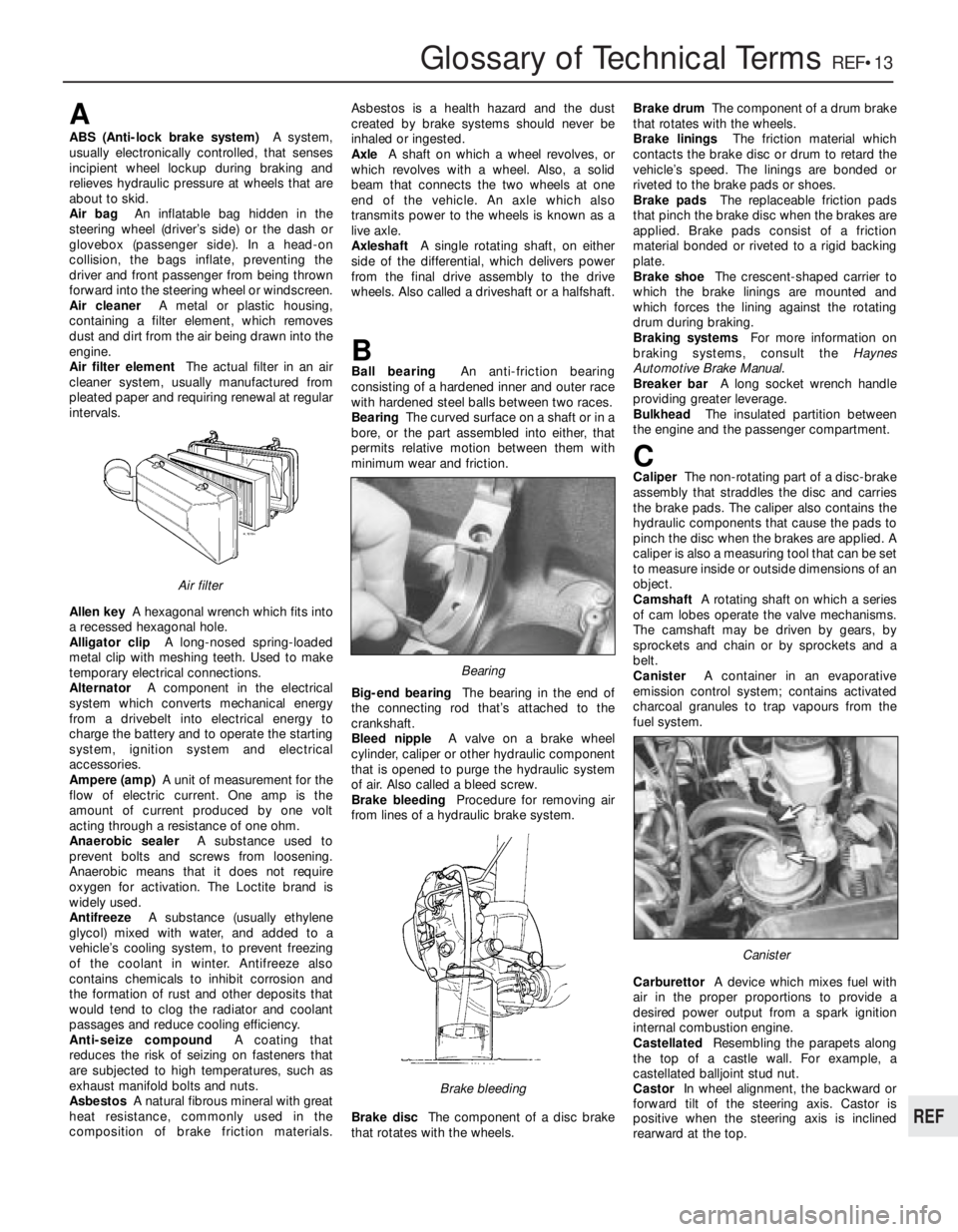
Glossary of Technical TermsREF•13
REF
A
ABS (Anti-lock brake system)A system,
usually electronically controlled, that senses
incipient wheel lockup during braking and
relieves hydraulic pressure at wheels that are
about to skid.
Air bag An inflatable bag hidden in the
steering wheel (driver’s side) or the dash or
glovebox (passenger side). In a head-on
collision, the bags inflate, preventing the
driver and front passenger from being thrown
forward into the steering wheel or windscreen.
Air cleanerA metal or plastic housing,
containing a filter element, which removes
dust and dirt from the air being drawn into the
engine.
Air filter elementThe actual filter in an air
cleaner system, usually manufactured from
pleated paper and requiring renewal at regular
intervals.
Allen keyA hexagonal wrench which fits into
a recessed hexagonal hole.
Alligator clipA long-nosed spring-loaded
metal clip with meshing teeth. Used to make
temporary electrical connections.
AlternatorA component in the electrical
system which converts mechanical energy
from a drivebelt into electrical energy to
charge the battery and to operate the starting
system, ignition system and electrical
accessories.
Ampere (amp)A unit of measurement for the
flow of electric current. One amp is the
amount of current produced by one volt
acting through a resistance of one ohm.
Anaerobic sealerA substance used to
prevent bolts and screws from loosening.
Anaerobic means that it does not require
oxygen for activation. The Loctite brand is
widely used.
AntifreezeA substance (usually ethylene
glycol) mixed with water, and added to a
vehicle’s cooling system, to prevent freezing
of the coolant in winter. Antifreeze also
contains chemicals to inhibit corrosion and
the formation of rust and other deposits that
would tend to clog the radiator and coolant
passages and reduce cooling efficiency.
Anti-seize compoundA coating that
reduces the risk of seizing on fasteners that
are subjected to high temperatures, such as
exhaust manifold bolts and nuts.
AsbestosA natural fibrous mineral with great
heat resistance, commonly used in the
composition of brake friction materials.Asbestos is a health hazard and the dust
created by brake systems should never be
inhaled or ingested.
AxleA shaft on which a wheel revolves, or
which revolves with a wheel. Also, a solid
beam that connects the two wheels at one
end of the vehicle. An axle which also
transmits power to the wheels is known as a
live axle.
AxleshaftA single rotating shaft, on either
side of the differential, which delivers power
from the final drive assembly to the drive
wheels. Also called a driveshaft or a halfshaft.
BBall bearingAn anti-friction bearing
consisting of a hardened inner and outer race
with hardened steel balls between two races.
BearingThe curved surface on a shaft or in a
bore, or the part assembled into either, that
permits relative motion between them with
minimum wear and friction.
Big-end bearingThe bearing in the end of
the connecting rod that’s attached to the
crankshaft.
Bleed nippleA valve on a brake wheel
cylinder, caliper or other hydraulic component
that is opened to purge the hydraulic system
of air. Also called a bleed screw.
Brake bleedingProcedure for removing air
from lines of a hydraulic brake system.
Brake discThe component of a disc brake
that rotates with the wheels.Brake drumThe component of a drum brake
that rotates with the wheels.
Brake liningsThe friction material which
contacts the brake disc or drum to retard the
vehicle’s speed. The linings are bonded or
riveted to the brake pads or shoes.
Brake padsThe replaceable friction pads
that pinch the brake disc when the brakes are
applied. Brake pads consist of a friction
material bonded or riveted to a rigid backing
plate.
Brake shoeThe crescent-shaped carrier to
which the brake linings are mounted and
which forces the lining against the rotating
drum during braking.
Braking systemsFor more information on
braking systems, consult the Haynes
Automotive Brake Manual.
Breaker barA long socket wrench handle
providing greater leverage.
BulkheadThe insulated partition between
the engine and the passenger compartment.
CCaliperThe non-rotating part of a disc-brake
assembly that straddles the disc and carries
the brake pads. The caliper also contains the
hydraulic components that cause the pads to
pinch the disc when the brakes are applied. A
caliper is also a measuring tool that can be set
to measure inside or outside dimensions of an
object.
CamshaftA rotating shaft on which a series
of cam lobes operate the valve mechanisms.
The camshaft may be driven by gears, by
sprockets and chain or by sprockets and a
belt.
CanisterA container in an evaporative
emission control system; contains activated
charcoal granules to trap vapours from the
fuel system.
CarburettorA device which mixes fuel with
air in the proper proportions to provide a
desired power output from a spark ignition
internal combustion engine.
CastellatedResembling the parapets along
the top of a castle wall. For example, a
castellated balljoint stud nut.
CastorIn wheel alignment, the backward or
forward tilt of the steering axis. Castor is
positive when the steering axis is inclined
rearward at the top.
Canister
Brake bleeding
Bearing
Air filter
Page 299 of 303

REF•16Glossary of Technical Terms
RotorIn a distributor, the rotating device
inside the cap that connects the centre
electrode and the outer terminals as it turns,
distributing the high voltage from the coil
secondary winding to the proper spark plug.
Also, that part of an alternator which rotates
inside the stator. Also, the rotating assembly
of a turbocharger, including the compressor
wheel, shaft and turbine wheel.
RunoutThe amount of wobble (in-and-out
movement) of a gear or wheel as it’s rotated.
The amount a shaft rotates “out-of-true.” The
out-of-round condition of a rotating part.
SSealantA liquid or paste used to prevent
leakage at a joint. Sometimes used in
conjunction with a gasket.
Sealed beam lampAn older headlight design
which integrates the reflector, lens and
filaments into a hermetically-sealed one-piece
unit. When a filament burns out or the lens
cracks, the entire unit is simply replaced.
Serpentine drivebeltA single, long, wide
accessory drivebelt that’s used on some
newer vehicles to drive all the accessories,
instead of a series of smaller, shorter belts.
Serpentine drivebelts are usually tensioned by
an automatic tensioner.
ShimThin spacer, commonly used to adjust
the clearance or relative positions between
two parts. For example, shims inserted into or
under bucket tappets control valve
clearances. Clearance is adjusted by
changing the thickness of the shim.
Slide hammerA special puller that screws
into or hooks onto a component such as a
shaft or bearing; a heavy sliding handle on the
shaft bottoms against the end of the shaft to
knock the component free.SprocketA tooth or projection on the
periphery of a wheel, shaped to engage with a
chain or drivebelt. Commonly used to refer to
the sprocket wheel itself.
Starter inhibitor switchOn vehicles with an
automatic transmission, a switch that
prevents starting if the vehicle is not in Neutral
or Park.
StrutSee MacPherson strut.
TTappetA cylindrical component which
transmits motion from the cam to the valve
stem, either directly or via a pushrod and
rocker arm. Also called a cam follower.
ThermostatA heat-controlled valve that
regulates the flow of coolant between the
cylinder block and the radiator, so maintaining
optimum engine operating temperature. A
thermostat is also used in some air cleaners in
which the temperature is regulated.
Thrust bearingThe bearing in the clutch
assembly that is moved in to the release
levers by clutch pedal action to disengage the
clutch. Also referred to as a release bearing.
Timing beltA toothed belt which drives the
camshaft. Serious engine damage may result
if it breaks in service.
Timing chainA chain which drives the
camshaft.
Toe-inThe amount the front wheels are
closer together at the front than at the rear. On
rear wheel drive vehicles, a slight amount of
toe-in is usually specified to keep the front
wheels running parallel on the road by
offsetting other forces that tend to spread the
wheels apart.
Toe-outThe amount the front wheels are
closer together at the rear than at the front. On
front wheel drive vehicles, a slight amount of
toe-out is usually specified.
ToolsFor full information on choosing and
using tools, refer to the Haynes Automotive
Tools Manual.
TracerA stripe of a second colour applied to
a wire insulator to distinguish that wire from
another one with the same colour insulator.
Tune-upA process of accurate and careful
adjustments and parts replacement to obtain
the best possible engine performance.TurbochargerA centrifugal device, driven by
exhaust gases, that pressurises the intake air.
Normally used to increase the power output
from a given engine displacement, but can
also be used primarily to reduce exhaust
emissions (as on VW’s “Umwelt” Diesel
engine).
UUniversal joint or U-jointA double-pivoted
connection for transmitting power from a
driving to a driven shaft through an angle. A
U-joint consists of two Y-shaped yokes and a
cross-shaped member called the spider.
VValveA device through which the flow of
liquid, gas, vacuum, or loose material in bulk
may be started, stopped, or regulated by a
movable part that opens, shuts, or partially
obstructs one or more ports or passageways.
A valve is also the movable part of such a
device.
Valve clearanceThe clearance between the
valve tip (the end of the valve stem) and the
rocker arm or tappet. The valve clearance is
measured when the valve is closed.
Vernier caliperA precision measuring
instrument that measures inside and outside
dimensions. Not quite as accurate as a
micrometer, but more convenient.
ViscosityThe thickness of a liquid or its
resistance to flow.
VoltA unit for expressing electrical
“pressure” in a circuit. One volt that will
produce a current of one ampere through a
resistance of one ohm.
WWeldingVarious processes used to join metal
items by heating the areas to be joined to a
molten state and fusing them together. For
more information refer to the Haynes
Automotive Welding Manual.
Wiring diagramA drawing portraying the
components and wires in a vehicle’s electrical
system, using standardised symbols. For
more information refer to the Haynes
Automotive Electrical and Electronic Systems
Manual.
Serpentine drivebelt