weight FIAT UNO 1983 Service Owner's Manual
[x] Cancel search | Manufacturer: FIAT, Model Year: 1983, Model line: UNO, Model: FIAT UNO 1983Pages: 303, PDF Size: 10.36 MB
Page 86 of 303
their originally fitted sequence and note in
which direction the seal lips are located.
11Inspect the surfaces of the piston and
cylinder bore. If scoring, corrosion or
metal-to-metal rubbing areas are evident,
renew the master cylinder complete.
12If the components are in good condition,
discard the oil seals and manipulate the new
ones into position, using the fingers only.
13Refit by reversing the removal operations;
apply pressure to the piston ends so that the
stop bolts can be fitted, then tighten the end
plug. Make sure that the grooves in the
pistons engage in the stop bolts.
14Before refitting the master cylinder to the
servo, measure the projection of the servo
piston pushrod. When the master cylinder is
fitted, there must be a clearance (see A in
Fig. 8.7) between the end of the pushrod and
the primary piston end face of between 0.825
and 1.025 mm (0.03 and 0.04 in). A depth
gauge will be required for these
measurements, the reference point being the
mating surfaces of the master cylinder and the
vacuum servo.
15Alter the adjusting screw on the servo as
necessary and lock it by applying locking fluid
to the threads on completion.16Bolt the master cylinder to the vacuum
servo or bulkhead, then reconnect the
pipelines and reservoir cap leads.
17Bleed the complete hydraulic system, as
described in Section 12.
10 Pressure regulating valve
3
1The pressure regulating valve is a load
proportioning valve which restricts the
hydraulic pressure to the rear brakes
according to car weight during heavy
applications of the brake pedal. This prevents
the rear wheels locking.
2A faulty or non-operational valve should be
renewed complete, no repair being possible.
3To remove the valve, unscrew the pipe
unions and disconnect the hydraulic pipes
from the valve. Cap the ends of the pipes to
prevent loss of fluid.
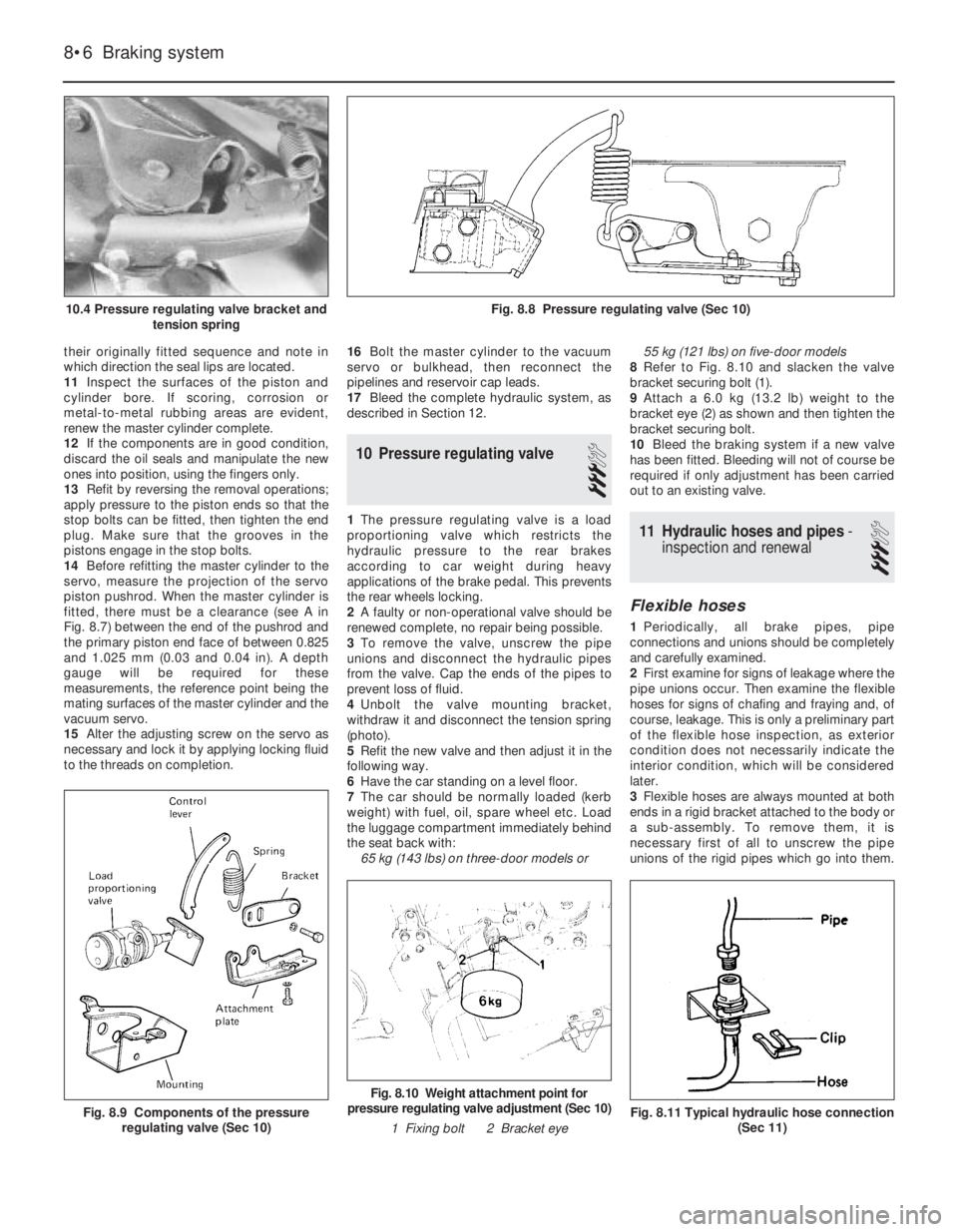
4Unbolt the valve mounting bracket,
withdraw it and disconnect the tension spring
(photo).
5Refit the new valve and then adjust it in the
following way.
6Have the car standing on a level floor.
7The car should be normally loaded (kerb
weight) with fuel, oil, spare wheel etc. Load
the luggage compartment immediately behind
the seat back with:
65 kg (143 lbs) on three-door models or 55 kg (121 lbs) on five-door models
8Refer to Fig. 8.10 and slacken the valve
bracket securing bolt (1).
9Attach a 6.0 kg (13.2 lb) weight to the
bracket eye (2) as shown and then tighten the
bracket securing bolt.
10Bleed the braking system if a new valve
has been fitted. Bleeding will not of course be
required if only adjustment has been carried
out to an existing valve.11 Hydraulic hoses and pipes-
inspection and renewal
3
Flexible hoses
1Periodically, all brake pipes, pipe
connections and unions should be completely
and carefully examined.
2First examine for signs of leakage where the
pipe unions occur. Then examine the flexible
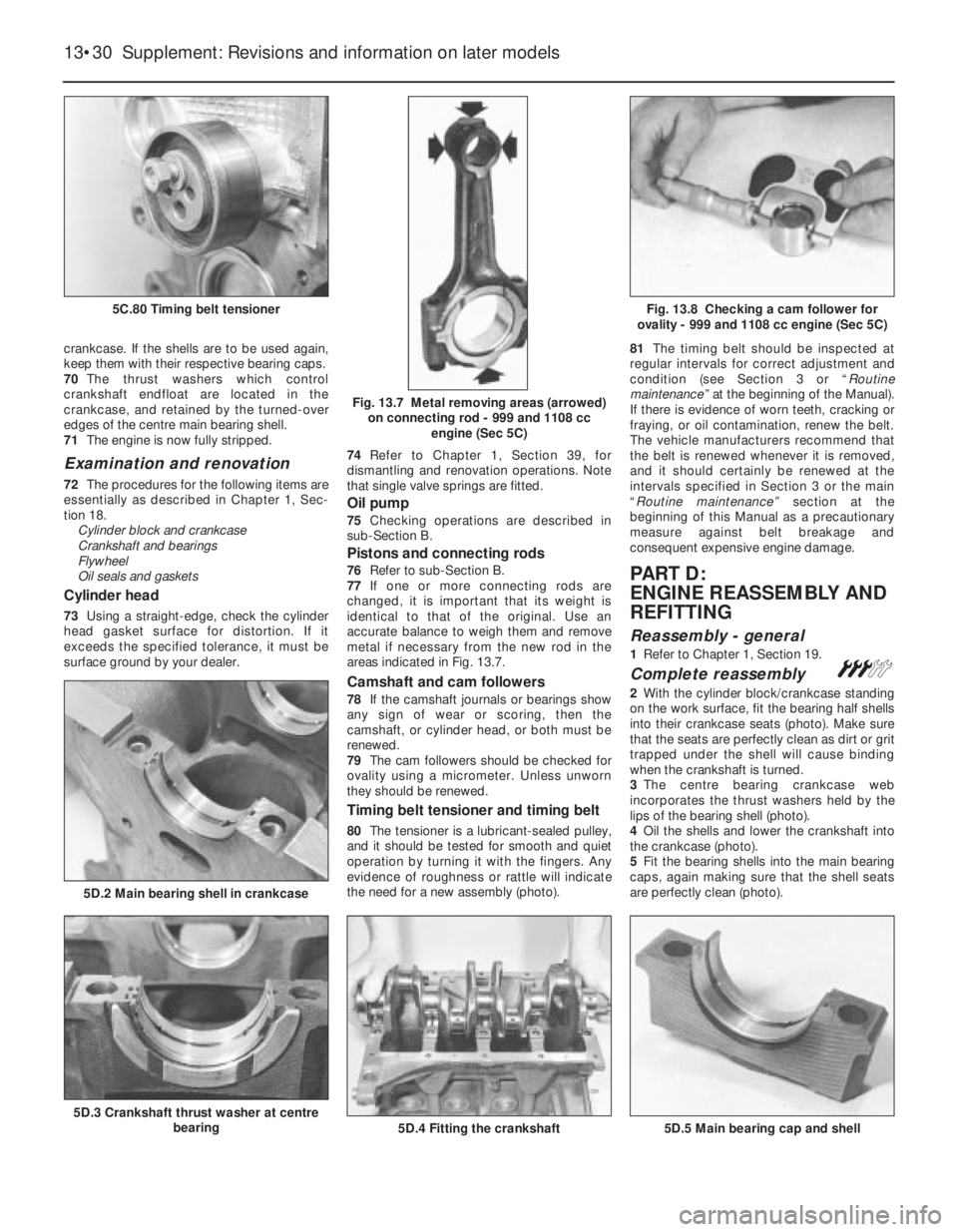
hoses for signs of chafing and fraying and, of
course, leakage. This is only a preliminary part
of the flexible hose inspection, as exterior
condition does not necessarily indicate the
interior condition, which will be considered
later.
3Flexible hoses are always mounted at both
ends in a rigid bracket attached to the body or
a sub-assembly. To remove them, it is
necessary first of all to unscrew the pipe
unions of the rigid pipes which go into them.
8•6 Braking system
Fig. 8.11 Typical hydraulic hose connection
(Sec 11)
Fig. 8.10 Weight attachment point for
pressure regulating valve adjustment (Sec 10)
1 Fixing bolt 2 Bracket eye
Fig. 8.9 Components of the pressure
regulating valve (Sec 10)
Fig. 8.8 Pressure regulating valve (Sec 10)10.4 Pressure regulating valve bracket and
tension spring
Page 87 of 303
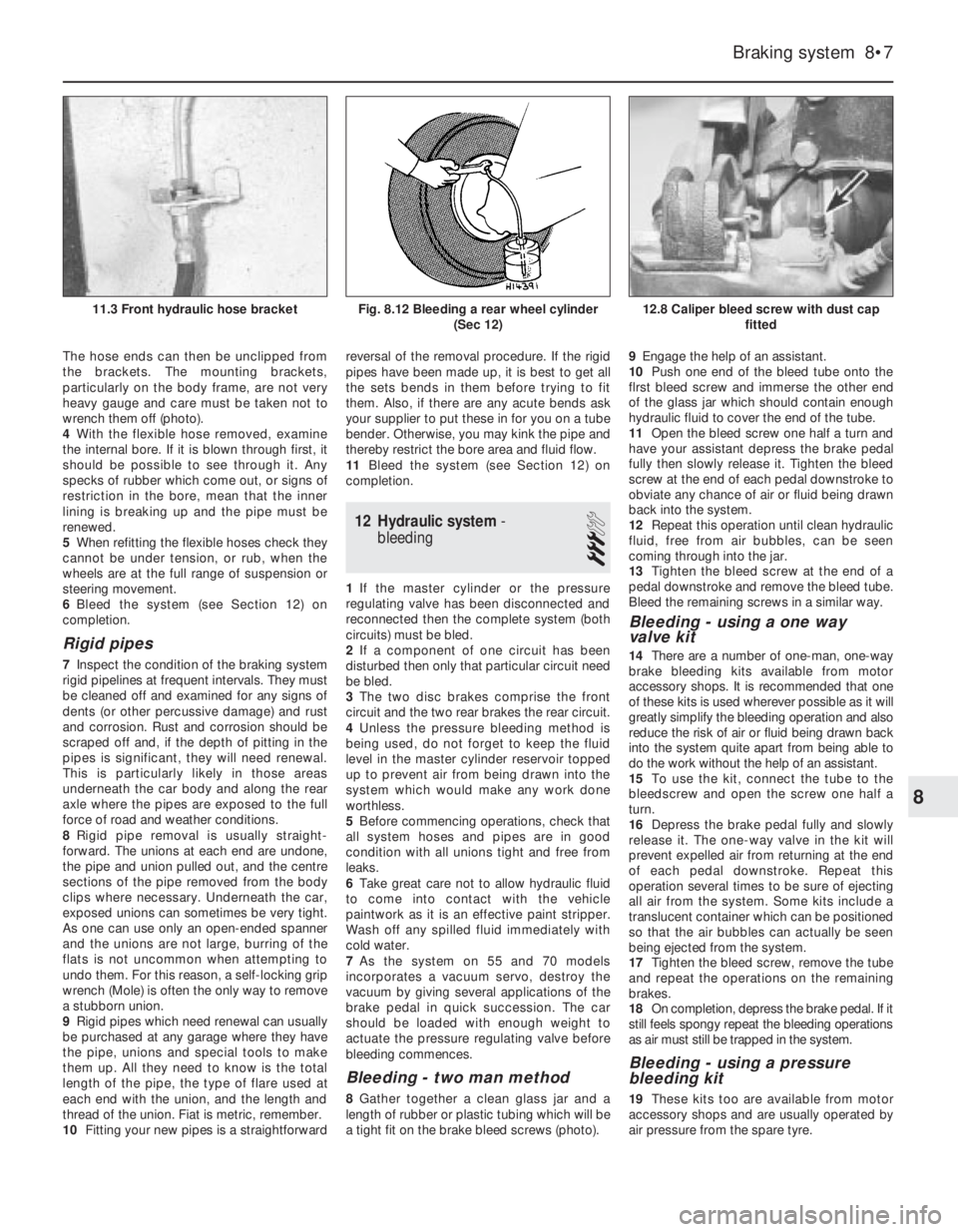
The hose ends can then be unclipped from
the brackets. The mounting brackets,
particularly on the body frame, are not very
heavy gauge and care must be taken not to
wrench them off (photo).
4With the flexible hose removed, examine
the internal bore. If it is blown through first, it
should be possible to see through it. Any
specks of rubber which come out, or signs of
restriction in the bore, mean that the inner
lining is breaking up and the pipe must be
renewed.
5When refitting the flexible hoses check they
cannot be under tension, or rub, when the
wheels are at the full range of suspension or
steering movement.
6Bleed the system (see Section 12) on
completion.
Rigid pipes
7Inspect the condition of the braking system
rigid pipelines at frequent intervals. They must
be cleaned off and examined for any signs of
dents (or other percussive damage) and rust
and corrosion. Rust and corrosion should be
scraped off and, if the depth of pitting in the
pipes is significant, they will need renewal.
This is particularly likely in those areas
underneath the car body and along the rear
axle where the pipes are exposed to the full
force of road and weather conditions.
8Rigid pipe removal is usually straight-
forward. The unions at each end are undone,
the pipe and union pulled out, and the centre
sections of the pipe removed from the body
clips where necessary. Underneath the car,
exposed unions can sometimes be very tight.
As one can use only an open-ended spanner
and the unions are not large, burring of the
flats is not uncommon when attempting to
undo them. For this reason, a self-locking grip
wrench (Mole) is often the only way to remove
a stubborn union.
9Rigid pipes which need renewal can usually
be purchased at any garage where they have
the pipe, unions and special tools to make
them up. All they need to know is the total
length of the pipe, the type of flare used at
each end with the union, and the length and
thread of the union. Fiat is metric, remember.
10Fitting your new pipes is a straightforwardreversal of the removal procedure. If the rigid
pipes have been made up, it is best to get all
the sets bends in them before trying to fit
them. Also, if there are any acute bends ask
your supplier to put these in for you on a tube
bender. Otherwise, you may kink the pipe and
thereby restrict the bore area and fluid flow.
11Bleed the system (see Section 12) on
completion.
12 Hydraulic system-
bleeding
3
1If the master cylinder or the pressure
regulating valve has been disconnected and
reconnected then the complete system (both
circuits) must be bled.
2If a component of one circuit has been
disturbed then only that particular circuit need
be bled.
3The two disc brakes comprise the front
circuit and the two rear brakes the rear circuit.
4Unless the pressure bleeding method is
being used, do not forget to keep the fluid
level in the master cylinder reservoir topped
up to prevent air from being drawn into the
system which would make any work done
worthless.
5Before commencing operations, check that
all system hoses and pipes are in good
condition with all unions tight and free from
leaks.
6Take great care not to allow hydraulic fluid
to come into contact with the vehicle
paintwork as it is an effective paint stripper.
Wash off any spilled fluid immediately with
cold water.
7As the system on 55 and 70 models
incorporates a vacuum servo, destroy the
vacuum by giving several applications of the
brake pedal in quick succession. The car
should be loaded with enough weight to
actuate the pressure regulating valve before
bleeding commences.
Bleeding - two man method
8Gather together a clean glass jar and a
length of rubber or plastic tubing which will be
a tight fit on the brake bleed screws (photo).9Engage the help of an assistant.
10Push one end of the bleed tube onto the
flrst bleed screw and immerse the other end
of the glass jar which should contain enough
hydraulic fluid to cover the end of the tube.
11Open the bleed screw one half a turn and
have your assistant depress the brake pedal
fully then slowly release it. Tighten the bleed
screw at the end of each pedal downstroke to
obviate any chance of air or fluid being drawn
back into the system.
12Repeat this operation until clean hydraulic
fluid, free from air bubbles, can be seen
coming through into the jar.
13Tighten the bleed screw at the end of a
pedal downstroke and remove the bleed tube.
Bleed the remaining screws in a similar way.
Bleeding - using a one way
valve kit
14There are a number of one-man, one-way
brake bleeding kits available from motor
accessory shops. It is recommended that one
of these kits is used wherever possible as it will
greatly simplify the bleeding operation and also
reduce the risk of air or fluid being drawn back
into the system quite apart from being able to
do the work without the help of an assistant.
15To use the kit, connect the tube to the
bleedscrew and open the screw one half a
turn.
16Depress the brake pedal fully and slowly
release it. The one-way valve in the kit will
prevent expelled air from returning at the end
of each pedal downstroke. Repeat this
operation several times to be sure of ejecting
all air from the system. Some kits include a
translucent container which can be positioned
so that the air bubbles can actually be seen
being ejected from the system.
17Tighten the bleed screw, remove the tube
and repeat the operations on the remaining
brakes.
18On completion, depress the brake pedal. If it
still feels spongy repeat the bleeding operations
as air must still be trapped in the system.
Bleeding - using a pressure
bleeding kit
19These kits too are available from motor
accessory shops and are usually operated by
air pressure from the spare tyre.
Braking system 8•7
12.8 Caliper bleed screw with dust cap
fittedFig. 8.12 Bleeding a rear wheel cylinder
(Sec 12)11.3 Front hydraulic hose bracket
8
Page 111 of 303
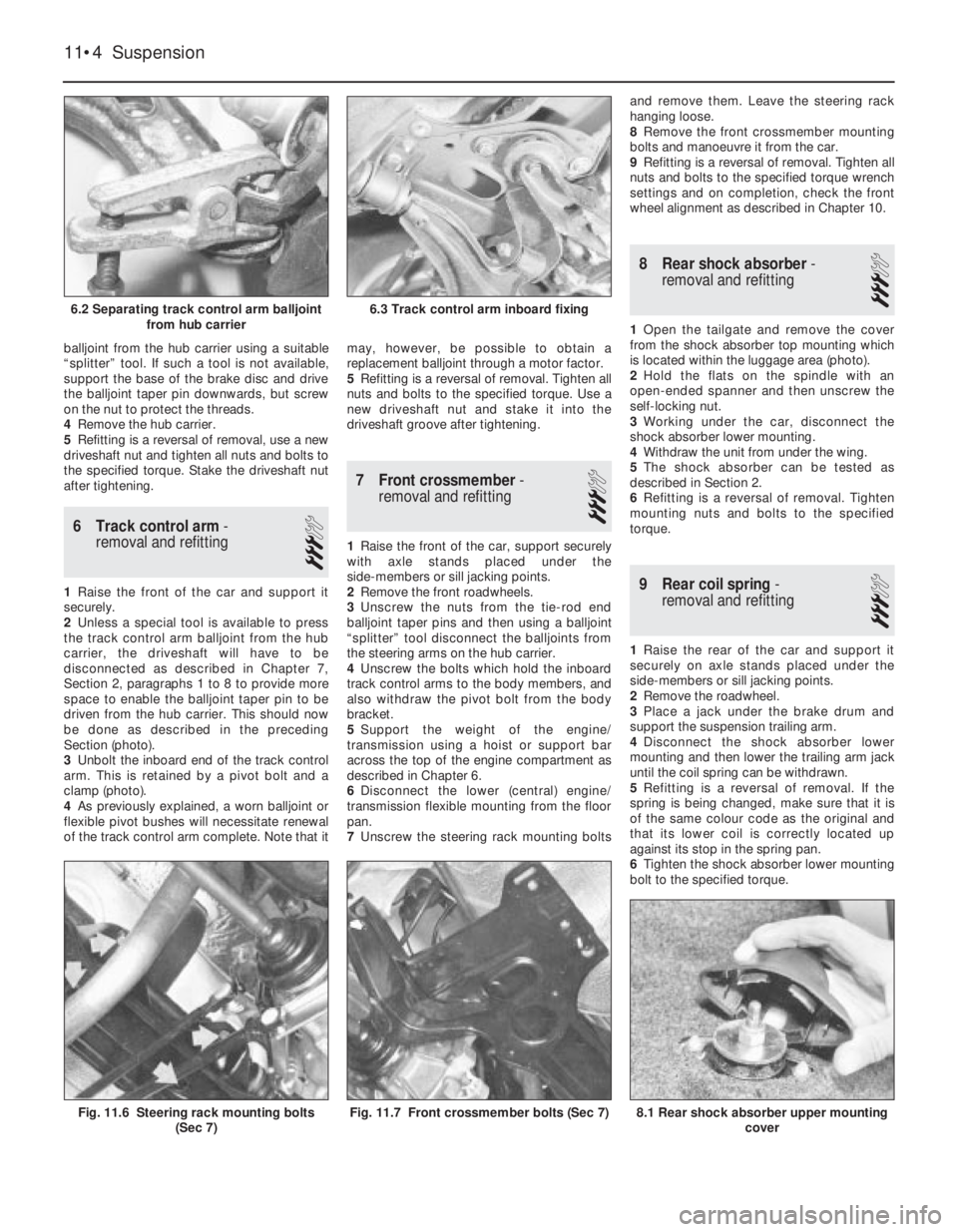
balljoint from the hub carrier using a suitable
“splitter” tool. If such a tool is not available,
support the base of the brake disc and drive
the balljoint taper pin downwards, but screw
on the nut to protect the threads.
4Remove the hub carrier.
5Refitting is a reversal of removal, use a new
driveshaft nut and tighten all nuts and bolts to
the specified torque. Stake the driveshaft nut
after tightening.
6 Track control arm-
removal and refitting
3
1Raise the front of the car and support it
securely.
2Unless a special tool is available to press
the track control arm balljoint from the hub
carrier, the driveshaft will have to be
disconnected as described in Chapter 7,
Section 2, paragraphs 1 to 8 to provide more
space to enable the balljoint taper pin to be
driven from the hub carrier. This should now
be done as described in the preceding
Section (photo).
3Unbolt the inboard end of the track control
arm. This is retained by a pivot bolt and a
clamp (photo).
4As previously explained, a worn balljoint or
flexible pivot bushes will necessitate renewal
of the track control arm complete. Note that itmay, however, be possible to obtain a
replacement balljoint through a motor factor.
5Refitting is a reversal of removal. Tighten all
nuts and bolts to the specified torque. Use a
new driveshaft nut and stake it into the
driveshaft groove after tightening.
7 Front crossmember-
removal and refitting
3
1Raise the front of the car, support securely
with axle stands placed under the
side-members or sill jacking points.
2Remove the front roadwheels.
3Unscrew the nuts from the tie-rod end
balljoint taper pins and then using a balljoint
“splitter” tool disconnect the balljoints from
the steering arms on the hub carrier.
4Unscrew the bolts which hold the inboard
track control arms to the body members, and
also withdraw the pivot bolt from the body
bracket.
5Support the weight of the engine/
transmission using a hoist or support bar
across the top of the engine compartment as
described in Chapter 6.
6Disconnect the lower (central) engine/
transmission flexible mounting from the floor
pan.
7Unscrew the steering rack mounting boltsand remove them. Leave the steering rack
hanging loose.
8Remove the front crossmember mounting
bolts and manoeuvre it from the car.
9Refitting is a reversal of removal. Tighten all
nuts and bolts to the specified torque wrench
settings and on completion, check the front
wheel alignment as described in Chapter 10.
8 Rear shock absorber-
removal and refitting
3
1Open the tailgate and remove the cover
from the shock absorber top mounting which
is located within the luggage area (photo).
2Hold the flats on the spindle with an
open-ended spanner and then unscrew the
self-locking nut.
3Working under the car, disconnect the
shock absorber lower mounting.
4Withdraw the unit from under the wing.
5The shock absorber can be tested as
described in Section 2.
6Refitting is a reversal of removal. Tighten
mounting nuts and bolts to the specified
torque.
9 Rear coil spring-
removal and refitting
3
1Raise the rear of the car and support it
securely on axle stands placed under the
side-members or sill jacking points.
2Remove the roadwheel.
3Place a jack under the brake drum and
support the suspension trailing arm.
4Disconnect the shock absorber lower
mounting and then lower the trailing arm jack
until the coil spring can be withdrawn.
5Refitting is a reversal of removal. If the
spring is being changed, make sure that it is
of the same colour code as the original and
that its lower coil is correctly located up
against its stop in the spring pan.
6Tighten the shock absorber lower mounting
bolt to the specified torque.
11•4 Suspension
8.1 Rear shock absorber upper mounting
coverFig. 11.7 Front crossmember bolts (Sec 7)Fig. 11.6 Steering rack mounting bolts
(Sec 7)
6.3 Track control arm inboard fixing6.2 Separating track control arm balljoint
from hub carrier
Page 114 of 303
12
For dimensions, weights etc. refer to the Introductory Section of this Manual.
Chapter 12 Bodywork
For modifications, and information applicable to later models, see Supplement at end of manual
Bonnet - removal and refitting . . . . . . . . . . . . . . . . . . . . . . . . . . . . . 7
Bonnet - lock and release . . . . . . . . . . . . . . . . . . . . . . . . . . . . . . . . . 8
Centre console - removal and refitting . . . . . . . . . . . . . . . . . . . . . . . 21
Door - dismantling . . . . . . . . . . . . . . . . . . . . . . . . . . . . . . . . . . . . . . . 12
Door - removal and refitting . . . . . . . . . . . . . . . . . . . . . . . . . . . . . . . 13
Door trim panel - removal and refitting . . . . . . . . . . . . . . . . . . . . . . . 11
Facia panel - removal and refitting . . . . . . . . . . . . . . . . . . . . . . . . . . 22
Fixed side window (five-door) - removal and refitting . . . . . . . . . . . . 17
Front bumpers - removal and refitting . . . . . . . . . . . . . . . . . . . . . . . 9
Front seat - removal and refitting . . . . . . . . . . . . . . . . . . . . . . . . . . . 19
Front wing - removal and refitting . . . . . . . . . . . . . . . . . . . . . . . . . . . 10
General description . . . . . . . . . . . . . . . . . . . . . . . . . . . . . . . . . . . . . . 1
Grab handles . . . . . . . . . . . . . . . . . . . . . . . . . . . . . . . . . . . . . . . . . . . 25
Maintenance - bodywork and underframe . . . . . . . . . . . . . . . . . . . . 2Maintenance - upholstery and carpets . . . . . . . . . . . . . . . . . . . . . . . 3
Major body damage - repair . . . . . . . . . . . . . . . . . . . . . . . . . . . . . . . 5
Minor body damage - repair . . . . . . . . . . . . . . . . . . . . . . . . . . . . . . . 4
Opening side window (three-door) - removal and refitting . . . . . . . . 18
Radiator grille - removal and refitting . . . . . . . . . . . . . . . . . . . . . . . . 6
Rear bumpers - removal and refitting . . . . . . . . . . . . . . . . . . . . . . . . 26
Rear seat - removal and refitting . . . . . . . . . . . . . . . . . . . . . . . . . . . . 20
Rear view mirrors . . . . . . . . . . . . . . . . . . . . . . . . . . . . . . . . . . . . . . . 24
Roof rack . . . . . . . . . . . . . . . . . . . . . . . . . . . . . . . . . . . . . . . . . . . . . . 27
Seat belts . . . . . . . . . . . . . . . . . . . . . . . . . . . . . . . . . . . . . . . . . . . . . 23
Sunroof - operation and maintenance . . . . . . . . . . . . . . . . . . . . . . . 28
Tailgate - removal and refitting . . . . . . . . . . . . . . . . . . . . . . . . . . . . . 14
Tailgate glass - removal and refitting . . . . . . . . . . . . . . . . . . . . . . . . 16
Windscreen glass - removal and refitting . . . . . . . . . . . . . . . . . . . . . 15
12•1
Specifications Contents
Easy,suitable for
novice with little
experienceFairly easy,suitable
for beginner with
some experienceFairly difficult,
suitable for competent
DIY mechanic
Difficult,suitable for
experienced DIY
mechanicVery difficult,
suitable for expert DIY
or professional
Degrees of difficulty
54321
1 General description
The Uno is an all steel, welded Hatchback
of unitary construction available in three- or
five-door versions.
Various levels of trim and equipment are
available depending upon model.
Factory fitted options include a sunroof,
central door locking and electrically-operated
front windows.
2 Maintenance-
bodywork and underframe
1
The general condition of a vehicle’s
bodywork is the one thing that significantly
affects its value. Maintenance is easy, but
needs to be regular. Neglect, particularly after
minor damage, can lead quickly to further
deterioration and costly repair bills. It is
important also to keep watch on those parts
of the vehicle not immediately visible, for
instance the underside, inside all the wheel
arches, and the lower part of the engine
compartment.The basic maintenance routine for the
bodywork is washing - preferably with a lot of
water, from a hose. This will remove all the
loose solids which may have stuck to the
vehicle. It is important to flush these off in
such a way as to prevent grit from scratching
the finish. The wheel arches and underframe
need washing in the same way, to remove any
accumulated mud, which will retain moisture
and tend to encourage rust. Paradoxically
enough, the best time to clean the underframe
and wheel arches is in wet weather, when the
mud is thoroughly wet and soft. In very wet
weather, the underframe is usually cleaned of
large accumulations automatically, and this is
a good time for inspection.
Periodically, except on vehicles with a wax-
based underbody protective coating, it is a
good idea to have the whole of the
underframe of the vehicle steam-cleaned,
engine compartment included, so that a
thorough inspection can be carried out to see
what minor repairs and renovations are
necessary. Steam-cleaning is available at
many garages, and is necessary for the
removal of the accumulation of oily grime,
which sometimes is allowed to become thick
in certain areas. If steam-cleaning facilities are
not available, there are some excellent grease
solvents available which can be brush-applied; the dirt can then be simply hosed off.
Note that these methods should not be used
on vehicles with wax-based underbody
protective coating, or the coating will be
removed. Such vehicles should be inspected
annually, preferably just prior to Winter, when
the underbody should be washed down, and
any damage to the wax coating repaired.
Ideally, a completely fresh coat should be
applied. It would also be worth considering
the use of such wax-based protection for
injection into door panels, sills, box sections,
etc, as an additional safeguard against rust
damage, where such protection is not
provided by the vehicle manufacturer.
After washing paintwork, wipe off with a
chamois leather to give an unspotted clear
finish. A coat of clear protective wax polish
will give added protection against chemical
pollutants in the air. If the paintwork sheen
has dulled or oxidised, use a cleaner/polisher
combination to restore the brilliance of the
shine. This requires a little effort, but such
dulling is usually caused because regular
washing has been neglected. Care needs to
be taken with metallic paintwork, as special
non-abrasive cleaner/polisher is required to
avoid damage to the finish. Always check that
the door and ventilator opening drain holes
and pipes are completely clear, so that water
Page 117 of 303
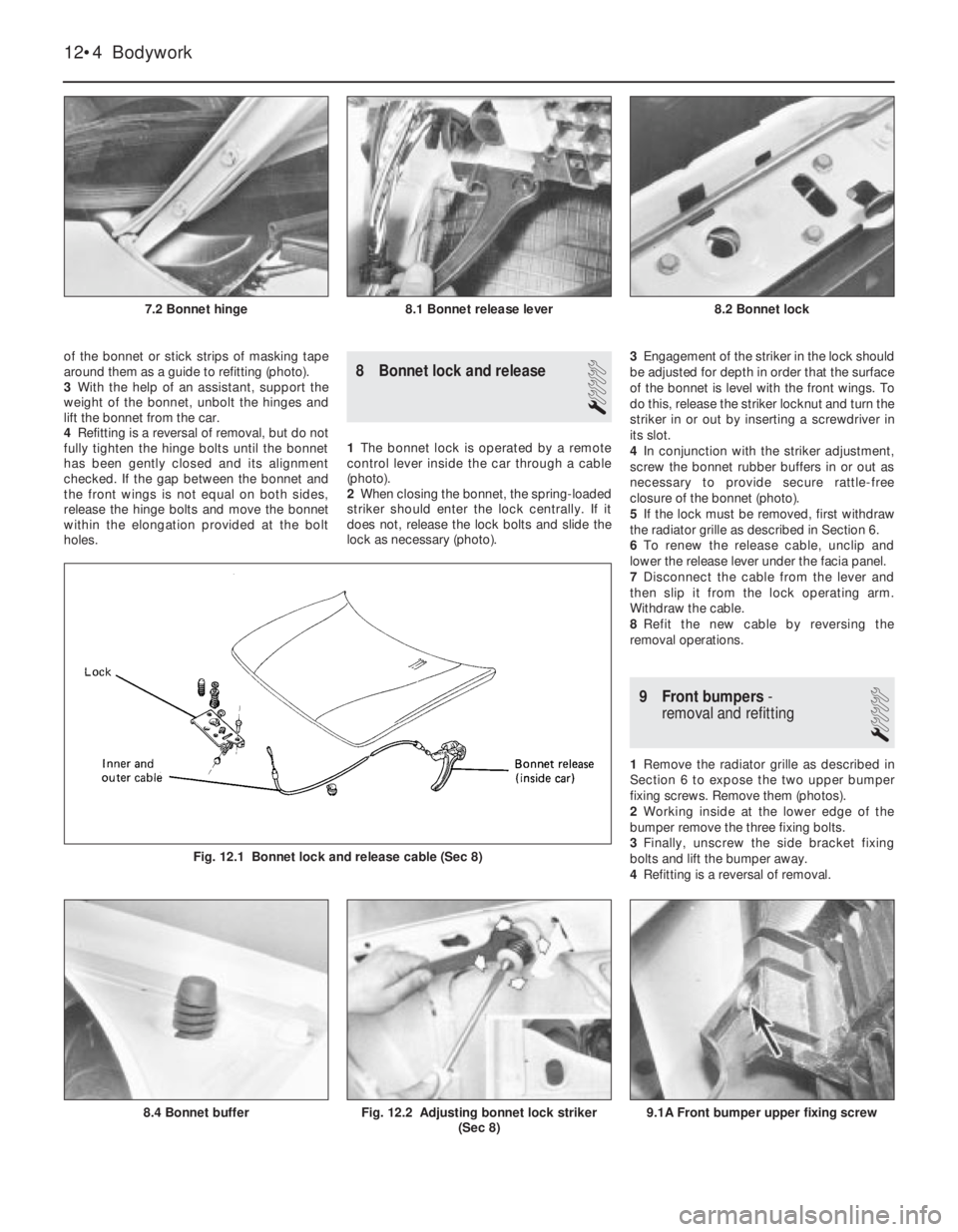
9.1A Front bumper upper fixing screw
of the bonnet or stick strips of masking tape
around them as a guide to refitting (photo).
3With the help of an assistant, support the
weight of the bonnet, unbolt the hinges and
lift the bonnet from the car.
4Refitting is a reversal of removal, but do not
fully tighten the hinge bolts until the bonnet
has been gently closed and its alignment
checked. If the gap between the bonnet and
the front wings is not equal on both sides,
release the hinge bolts and move the bonnet
within the elongation provided at the bolt
holes.8 Bonnet lock and release
1
1The bonnet lock is operated by a remote
control lever inside the car through a cable
(photo).
2When closing the bonnet, the spring-loaded
striker should enter the lock centrally. If it
does not, release the lock bolts and slide the
lock as necessary (photo).3Engagement of the striker in the lock should
be adjusted for depth in order that the surface
of the bonnet is level with the front wings. To
do this, release the striker locknut and turn the
striker in or out by inserting a screwdriver in
its slot.
4In conjunction with the striker adjustment,
screw the bonnet rubber buffers in or out as
necessary to provide secure rattle-free
closure of the bonnet (photo).
5If the lock must be removed, first withdraw
the radiator grille as described in Section 6.
6To renew the release cable, unclip and
lower the release lever under the facia panel.
7Disconnect the cable from the lever and
then slip it from the lock operating arm.
Withdraw the cable.
8Refit the new cable by reversing the
removal operations.
9 Front bumpers-
removal and refitting
1
1Remove the radiator grille as described in
Section 6 to expose the two upper bumper
fixing screws. Remove them (photos).
2Working inside at the lower edge of the
bumper remove the three fixing bolts.
3Finally, unscrew the side bracket fixing
bolts and lift the bumper away.
4Refitting is a reversal of removal.
12•4 Bodywork
Fig. 12.2 Adjusting bonnet lock striker
(Sec 8)
Fig. 12.1 Bonnet lock and release cable (Sec 8)
8.4 Bonnet buffer
8.2 Bonnet lock8.1 Bonnet release lever7.2 Bonnet hinge
Page 127 of 303
Cooling system................................................................................. 8
Part A: 999 cc engine
Description
Maintenance
Thermostat - removal and refitting
Coolant pump - removal and refitting
Part B: 1301 cc Turbo ie engine
Description
Part C: 1372 cc ie and 1372 cc Turbo ie engines
Description
Maintenance
Cooling system - draining, flushing and refilling
Radiator (and cooling fan) - removal and refitting
Thermostat - removal and refitting
Coolant pump - removal and refitting
Coolant pump/alternator drivebelt - checking, renewal and
tensioning
Part D: Heater unit later models
Heater unit - removal and refitting
Heater unit - dismantling and reassembly
Fuel and exhaust systems............................................................... 9
Part A: General
Unleaded fuel
Air cleaner modified types
Fuel pump (999 cc engine) - description, removal and
refitting
Fuel tank (999 cc engine)
Part B: Carburettor models
Carburettor (Weber 32 TLF) - description
Carburettor (Weber 32 TLF) - idle speed and mixture
Carburettor (Weber 32 TLF) - removal and refitting
Carburettor (Weber 32 TLF) - overhaul
Carburettor (Weber 30/32 DMTE) - general
Carburettor (Weber 30/32 DMTE) - overhaul
Carburettor (Weber 32 ICEV 61/250 and DMTE 30/32,
DMTE 30/150) - general
Carburettor (Solex C 30/32-CIC 8) - description
Part C: Bosch LE-2 Jetronic fuel injection system
Description
Maintenance
Fuel filter - renewal
Air cleaner element - renewal
Idle speed and mixture - adjustment
Fuel injection system - electrical tests
Fuel injection system - mechanical tests
Fuel injection system components - removal and
refitting
Throttle control linkage - general
Fuel tank - general
Part D: Bosch Mono-Jetronic fuel injection system
Description
Maintenance
Fuel filter - renewal
Air cleaner element - renewal
Idle speed and mixture adjustment
Accelerator control system - check and adjustment
Fuel system - depressurisation
Fuel pump and supply - system checks
Fuel pump - removal and refitting
Injector unit - removal and refitting
Intake air temperature sensor - removal and refitting
Fuel injector - removal and refitting
Electronic control unit (ECU) - removal and refitting
Inlet manifold - removal and refitting
Exhaust manifold - removal and refitting
Catalytic converter - general information
Fuel evaporation control system - generalPart E: Bosch L3.1/2 Jetronic fuel injection systems
Description
Fuel system - depressurisation
Maintenance
Fuel filter - renewal
Air cleaner element - renewal
Checks and adjustments
Injection system components - removal and refitting
Part G: Turbocharger system
Description
Precautions
Turbocharger (1301 cc ie engine) - removal and refitting
Turbocharger (1372 cc ie engine) - removal and refitting
Intercooler - removal and refitting
Injector cooling fan - removal and refitting
Fault finding - fuel injection system
Fault finding - turbocharger system
Ignition system................................................................................. 10
General
Ignition timing (all later models)
Breakerless ignition system - description
Distributor (breakerless type) - removal and refitting
Distributor (breakerless type) - overhaul
Breakerless ignition system components - testing
Microplex ignition system - description
Distributor (Microplex) - removal and refitting
Microplex ignition system components - testing
Digiplex 2 ignition system - description
Distributor (Digiplex 2) - removal and refitting
Spark plugs and HT leads - general
Fault finding - Microplex ignition system
Clutch................................................................................................ 11
Clutch pedal adjustment (cable clutch)
Hydraulic clutch - description
Maintenance (hydraulic clutch)
Clutch master cylinder - removal, overhaul and
refitting
Clutch operating cylinder - removal, overhaul and
refitting
Clutch hydraulic system - bleeding
Transmission.................................................................................... 12
Part A: 1301 cc Turbo ie engine
Description
Gearchange linkage - removal and refitting
Gearchange linkage (Antiskid models) - general
Final drive output shafts - description and oil seal
renewal
Part B: 1372 cc ie and 1372 cc Turbo ie engines
Description
Maintenance
Oil level - checking
Oil - renewal
Gearlever and linkages - general
Transmission - removal and refitting
Part C: 999 and 1108 cc with C514 type transmission
Description
Maintenance
Driveshafts........................................................................................ 13
Inboard joint boots (non-Turbo models, September 1987 on) -
modification
Intermediate driveshaft (Turbo ie models)
Inboard CV joints (Turbo ie models - overhaul
Right-hand driveshaft damper weight (1108 and 1372 cc
models) - removal and refitting
13•2 Supplement: Revisions and information on later models
Page 142 of 303
General dimensions, weights and capacities
Dimensions
Overall length . . . . . . . . . . . . . . . . . . . . . . . . . . . . . . . . . . . . . . . . . . . . . 3689 mm
Overall width:
Base and Super models . . . . . . . . . . . . . . . . . . . . . . . . . . . . . . . . . . . 1558 mm
SX and Turbo models . . . . . . . . . . . . . . . . . . . . . . . . . . . . . . . . . . . . . 1562 mm
Height (unladen):
1372 cc (except Turbo) . . . . . . . . . . . . . . . . . . . . . . . . . . . . . . . . . . . . 1425 mm
1299/1301 cc (except Turbo) . . . . . . . . . . . . . . . . . . . . . . . . . . . . . . . 1420 mm
Turbo . . . . . . . . . . . . . . . . . . . . . . . . . . . . . . . . . . . . . . . . . . . . . . . . . . 1405 mm
All other models . . . . . . . . . . . . . . . . . . . . . . . . . . . . . . . . . . . . . . . . . 1415 mm
Weights (kerb)
Note: 3-door model weights are given. Add 15 kg to the following for 5-door models. Weight will also vary according to the model version.
903 cc . . . . . . . . . . . . . . . . . . . . . . . . . . . . . . . . . . . . . . . . . . . . . . . . . . . 740 kg
999 cc (45, 45 S and 45 SX) . . . . . . . . . . . . . . . . . . . . . . . . . . . . . . . . . . 740 to 775 kg
1108 cc (60 S and 60 SX) . . . . . . . . . . . . . . . . . . . . . . . . . . . . . . . . . . . . 760 to 795 kg
1299/1301 cc (70 SX) . . . . . . . . . . . . . . . . . . . . . . . . . . . . . . . . . . . . . . . 770 kg
1301 cc Turbo ie . . . . . . . . . . . . . . . . . . . . . . . . . . . . . . . . . . . . . . . . . . . 845 kg
1372 cc (1.4 ie S catalyst) . . . . . . . . . . . . . . . . . . . . . . . . . . . . . . . . . . . . 830 kg
1372 cc ie (70 SX) . . . . . . . . . . . . . . . . . . . . . . . . . . . . . . . . . . . . . . . . . . 795 to 845 kg
1732 cc Turbo ie . . . . . . . . . . . . . . . . . . . . . . . . . . . . . . . . . . . . . . . . . . . 925 kg
Capacities
Fuel tank:
1372 cc Turbo ie . . . . . . . . . . . . . . . . . . . . . . . . . . . . . . . . . . . . . . . . . 50 litres
All other models . . . . . . . . . . . . . . . . . . . . . . . . . . . . . . . . . . . . . . . . . 42 litres
Engine oil (with filter change):
903, 999 and 1108 cc . . . . . . . . . . . . . . . . . . . . . . . . . . . . . . . . . . . . . 3.8 litres
1116, 1299/1301 and 1372 cc . . . . . . . . . . . . . . . . . . . . . . . . . . . . . . 4.1 litres
Transmission:
1301 cc Turbo ie . . . . . . . . . . . . . . . . . . . . . . . . . . . . . . . . . . . . . . . . . 2.9 litres
1372 cc Turbo ie . . . . . . . . . . . . . . . . . . . . . . . . . . . . . . . . . . . . . . . . . 2.0 litres
All other engines . . . . . . . . . . . . . . . . . . . . . . . . . . . . . . . . . . . . . . . . . 2.4 litres
Cooling system:
903, 999 and 1108 cc . . . . . . . . . . . . . . . . . . . . . . . . . . . . . . . . . . . . . 4.6 litres
1116 and 1299/1301 cc, non-catalyst 1372 cc ie . . . . . . . . . . . . . . . 6.2 litres
1372 cc ie with catalyst . . . . . . . . . . . . . . . . . . . . . . . . . . . . . . . . . . . 6.5 litres
1301 cc Turbo ie . . . . . . . . . . . . . . . . . . . . . . . . . . . . . . . . . . . . . . . . . 6.9 litres
1372 cc Turbo ie . . . . . . . . . . . . . . . . . . . . . . . . . . . . . . . . . . . . . . . . . 7.7 litres
Supplement: Revisions and information on later models 13•17
13
Page 153 of 303
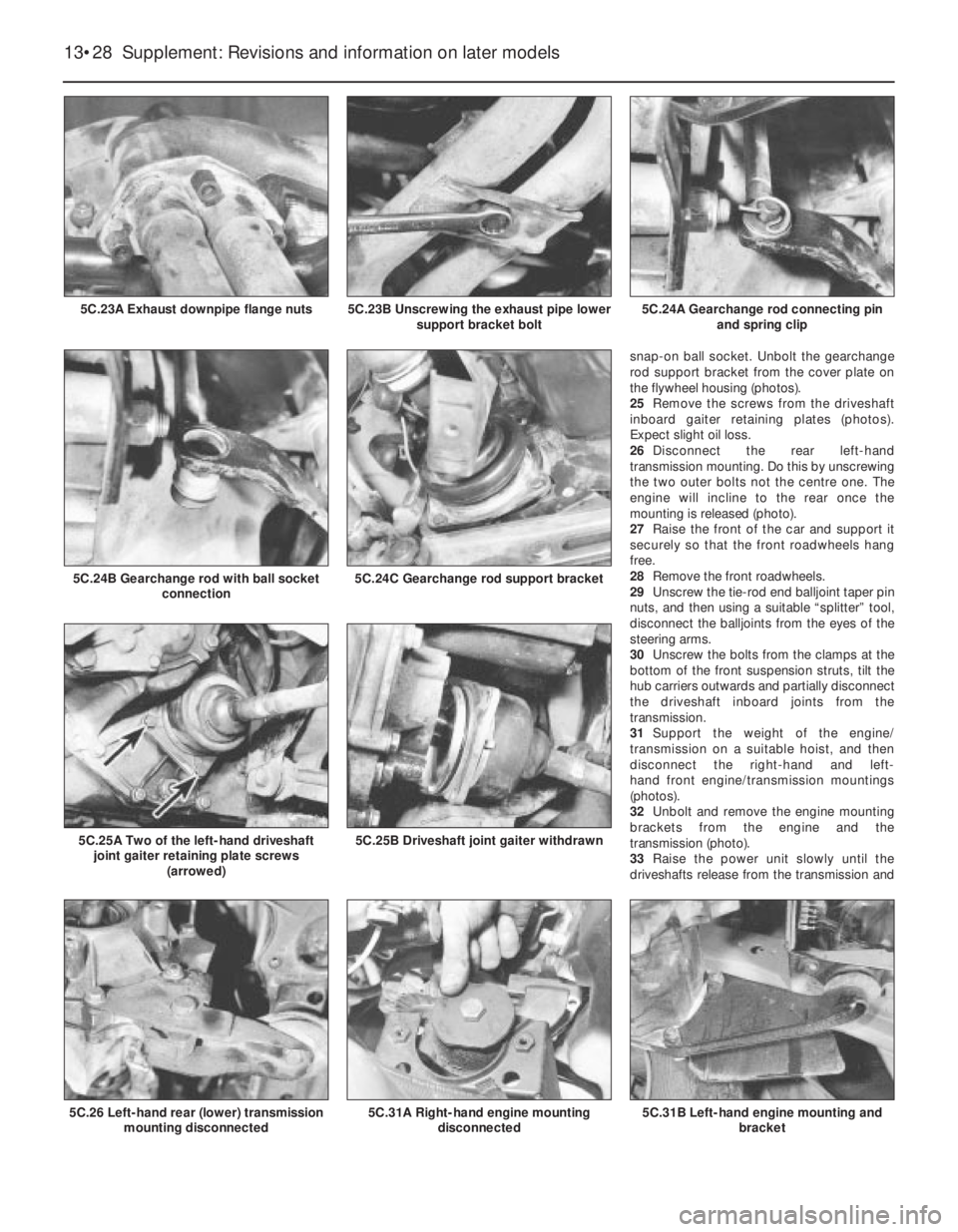
snap-on ball socket. Unbolt the gearchange
rod support bracket from the cover plate on
the flywheel housing (photos).
25Remove the screws from the driveshaft
inboard gaiter retaining plates (photos).
Expect slight oil loss.
26Disconnect the rear left-hand
transmission mounting. Do this by unscrewing
the two outer bolts not the centre one. The
engine will incline to the rear once the
mounting is released (photo).
27Raise the front of the car and support it
securely so that the front roadwheels hang
free.
28Remove the front roadwheels.
29Unscrew the tie-rod end balljoint taper pin
nuts, and then using a suitable “splitter” tool,
disconnect the balljoints from the eyes of the
steering arms.
30Unscrew the bolts from the clamps at the
bottom of the front suspension struts, tilt the
hub carriers outwards and partially disconnect
the driveshaft inboard joints from the
transmission.
31Support the weight of the engine/
transmission on a suitable hoist, and then
disconnect the right-hand and left-
hand front engine/transmission mountings
(photos).
32Unbolt and remove the engine mounting
brackets from the engine and the
transmission (photo).
33Raise the power unit slowly until the
driveshafts release from the transmission and
13•28 Supplement: Revisions and information on later models
5C.31B Left-hand engine mounting and
bracket5C.31A Right-hand engine mounting
disconnected5C.26 Left-hand rear (lower) transmission
mounting disconnected
5C.25B Driveshaft joint gaiter withdrawn5C.25A Two of the left-hand driveshaft
joint gaiter retaining plate screws
(arrowed)
5C.24C Gearchange rod support bracket5C.24B Gearchange rod with ball socket
connection
5C.24A Gearchange rod connecting pin
and spring clip5C.23B Unscrewing the exhaust pipe lower
support bracket bolt5C.23A Exhaust downpipe flange nuts
Page 155 of 303
crankcase. If the shells are to be used again,
keep them with their respective bearing caps.
70The thrust washers which control
crankshaft endfloat are located in the
crankcase, and retained by the turned-over
edges of the centre main bearing shell.
71The engine is now fully stripped.
Examination and renovation
72The procedures for the following items are
essentially as described in Chapter 1, Sec-
tion 18.
Cylinder block and crankcase
Crankshaft and bearings
Flywheel
Oil seals and gaskets
Cylinder head
73Using a straight-edge, check the cylinder
head gasket surface for distortion. If it
exceeds the specified tolerance, it must be
surface ground by your dealer.74Refer to Chapter 1, Section 39, for
dismantling and renovation operations. Note
that single valve springs are fitted.
Oil pump
75Checking operations are described in
sub-Section B.
Pistons and connecting rods
76Refer to sub-Section B.
77If one or more connecting rods are
changed, it is important that its weight is
identical to that of the original. Use an
accurate balance to weigh them and remove
metal if necessary from the new rod in the
areas indicated in Fig. 13.7.
Camshaft and cam followers
78If the camshaft journals or bearings show
any sign of wear or scoring, then the
camshaft, or cylinder head, or both must be
renewed.
79The cam followers should be checked for
ovality using a micrometer. Unless unworn
they should be renewed.
Timing belt tensioner and timing belt
80The tensioner is a lubricant-sealed pulley,
and it should be tested for smooth and quiet
operation by turning it with the fingers. Any
evidence of roughness or rattle will indicate
the need for a new assembly (photo).81The timing belt should be inspected at
regular intervals for correct adjustment and
condition (see Section 3 or “Routine
maintenance” at the beginning of the Manual).
If there is evidence of worn teeth, cracking or
fraying, or oil contamination, renew the belt.
The vehicle manufacturers recommend that
the belt is renewed whenever it is removed,
and it should certainly be renewed at the
intervals specified in Section 3 or the main
“Routine maintenance” section at the
beginning of this Manual as a precautionary
measure against belt breakage and
consequent expensive engine damage.
PART D:
ENGINE REASSEMBLY AND
REFITTING
Reassembly - general
1Refer to Chapter 1, Section 19.
Complete reassembly#
2With the cylinder block/crankcase standing
on the work surface, fit the bearing half shells
into their crankcase seats (photo). Make sure
that the seats are perfectly clean as dirt or grit
trapped under the shell will cause binding
when the crankshaft is turned.
3The centre bearing crankcase web
incorporates the thrust washers held by the
lips of the bearing shell (photo).
4Oil the shells and lower the crankshaft into
the crankcase (photo).
5Fit the bearing shells into the main bearing
caps, again making sure that the shell seats
are perfectly clean (photo).
13•30 Supplement: Revisions and information on later models
5D.5 Main bearing cap and shell5D.4 Fitting the crankshaft5D.3 Crankshaft thrust washer at centre
bearing
5D.2 Main bearing shell in crankcase
Fig. 13.8 Checking a cam follower for
ovality - 999 and 1108 cc engine (Sec 5C)
Fig. 13.7 Metal removing areas (arrowed)
on connecting rod - 999 and 1108 cc
engine (Sec 5C)
5C.80 Timing belt tensioner
Page 161 of 303
Engine oil cooler -
removal and refittingÁ
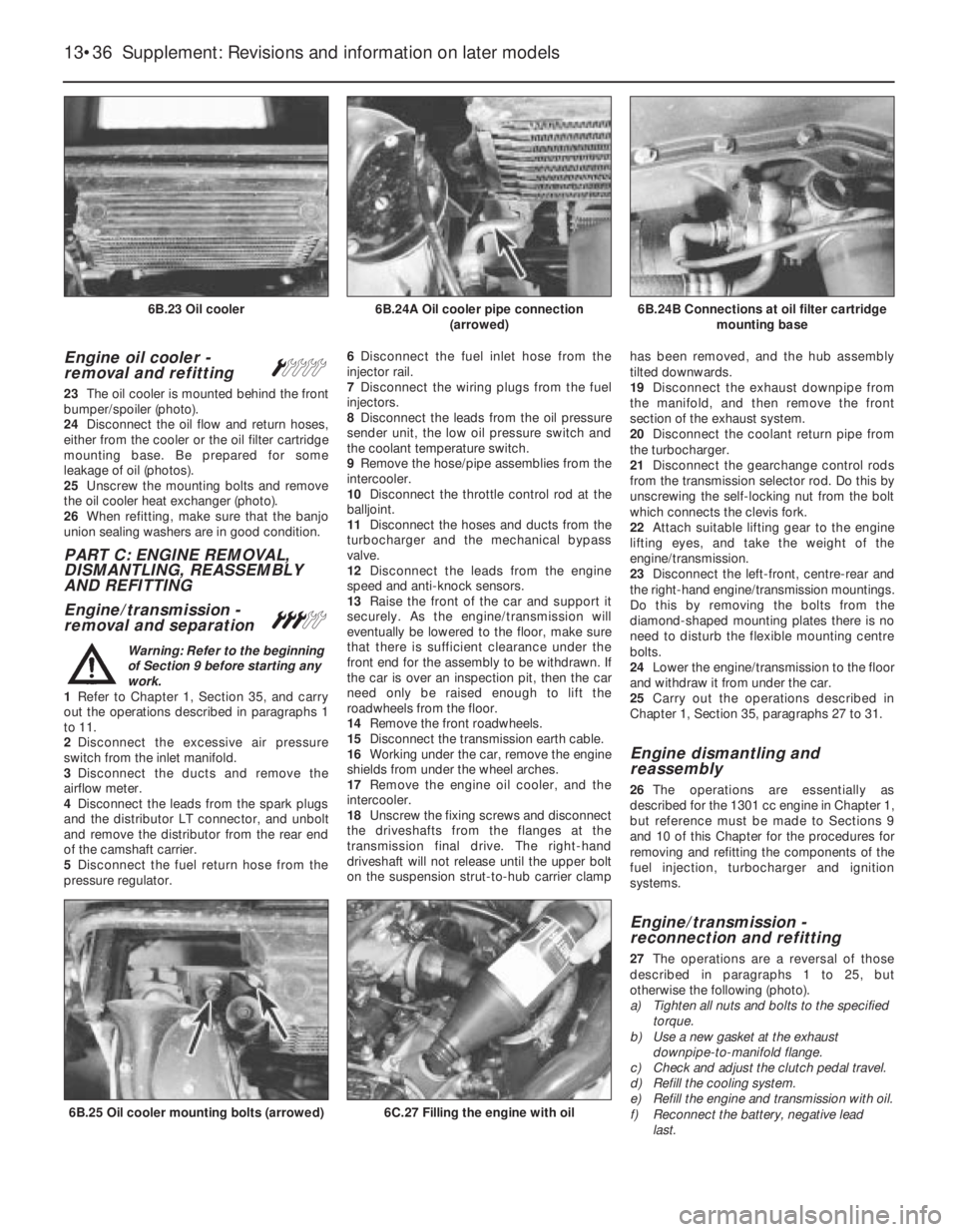
23The oil cooler is mounted behind the front
bumper/spoiler (photo).
24Disconnect the oil flow and return hoses,
either from the cooler or the oil filter cartridge
mounting base. Be prepared for some
leakage of oil (photos).
25Unscrew the mounting bolts and remove
the oil cooler heat exchanger (photo).
26When refitting, make sure that the banjo
union sealing washers are in good condition.
PART C: ENGINE REMOVAL,
DISMANTLING, REASSEMBLY
AND REFITTING
Engine/transmission -
removal and separation
#
Warning: Refer to the beginning
of Section 9 before starting any
work.
1Refer to Chapter 1, Section 35, and carry
out the operations described in paragraphs 1
to 11.
2Disconnect the excessive air pressure
switch from the inlet manifold.
3Disconnect the ducts and remove the
airflow meter.
4Disconnect the leads from the spark plugs
and the distributor LT connector, and unbolt
and remove the distributor from the rear end
of the camshaft carrier.
5Disconnect the fuel return hose from the
pressure regulator. 6Disconnect the fuel inlet hose from the
injector rail.
7Disconnect the wiring plugs from the fuel
injectors.
8Disconnect the leads from the oil pressure
sender unit, the low oil pressure switch and
the coolant temperature switch.
9Remove the hose/pipe assemblies from the
intercooler.
10Disconnect the throttle control rod at the
balljoint.
11Disconnect the hoses and ducts from the
turbocharger and the mechanical bypass
valve.
12Disconnect the leads from the engine
speed and anti-knock sensors.
13Raise the front of the car and support it
securely. As the engine/transmission will
eventually be lowered to the floor, make sure
that there is sufficient clearance under the
front end for the assembly to be withdrawn. If
the car is over an inspection pit, then the car
need only be raised enough to lift the
roadwheels from the floor.
14Remove the front roadwheels.
15Disconnect the transmission earth cable.
16Working under the car, remove the engine
shields from under the wheel arches.
17Remove the engine oil cooler, and the
intercooler.
18Unscrew the fixing screws and disconnect
the driveshafts from the flanges at the
transmission final drive. The right-hand
driveshaft will not release until the upper bolt
on the suspension strut-to-hub carrier clamphas been removed, and the hub assembly
tilted downwards.
19Disconnect the exhaust downpipe from
the manifold, and then remove the front
section of the exhaust system.
20Disconnect the coolant return pipe from
the turbocharger.
21Disconnect the gearchange control rods
from the transmission selector rod. Do this by
unscrewing the self-locking nut from the bolt
which connects the clevis fork.
22Attach suitable lifting gear to the engine
lifting eyes, and take the weight of the
engine/transmission.
23Disconnect the left-front, centre-rear and
the right-hand engine/transmission mountings.
Do this by removing the bolts from the
diamond-shaped mounting plates there is no
need to disturb the flexible mounting centre
bolts.
24Lower the engine/transmission to the floor
and withdraw it from under the car.
25Carry out the operations described in
Chapter 1, Section 35, paragraphs 27 to 31.
Engine dismantling and
reassembly
26The operations are essentially as
described for the 1301 cc engine in Chapter 1,
but reference must be made to Sections 9
and 10 of this Chapter for the procedures for
removing and refitting the components of the
fuel injection, turbocharger and ignition
systems.
Engine/transmission -
reconnection and refitting
27The operations are a reversal of those
described in paragraphs 1 to 25, but
otherwise the following (photo).
a) Tighten all nuts and bolts to the specified
torque.
b) Use a new gasket at the exhaust
downpipe-to-manifold flange.
c) Check and adjust the clutch pedal travel.
d) Refill the cooling system.
e) Refill the engine and transmission with oil.
f) Reconnect the battery, negative lead
last.
13•36 Supplement: Revisions and information on later models
6C.27 Filling the engine with oil6B.25 Oil cooler mounting bolts (arrowed)
6B.24B Connections at oil filter cartridge
mounting base6B.24A Oil cooler pipe connection
(arrowed)6B.23 Oil cooler