height FIAT UNO 1983 Service Repair Manual
[x] Cancel search | Manufacturer: FIAT, Model Year: 1983, Model line: UNO, Model: FIAT UNO 1983Pages: 303, PDF Size: 10.36 MB
Page 6 of 303
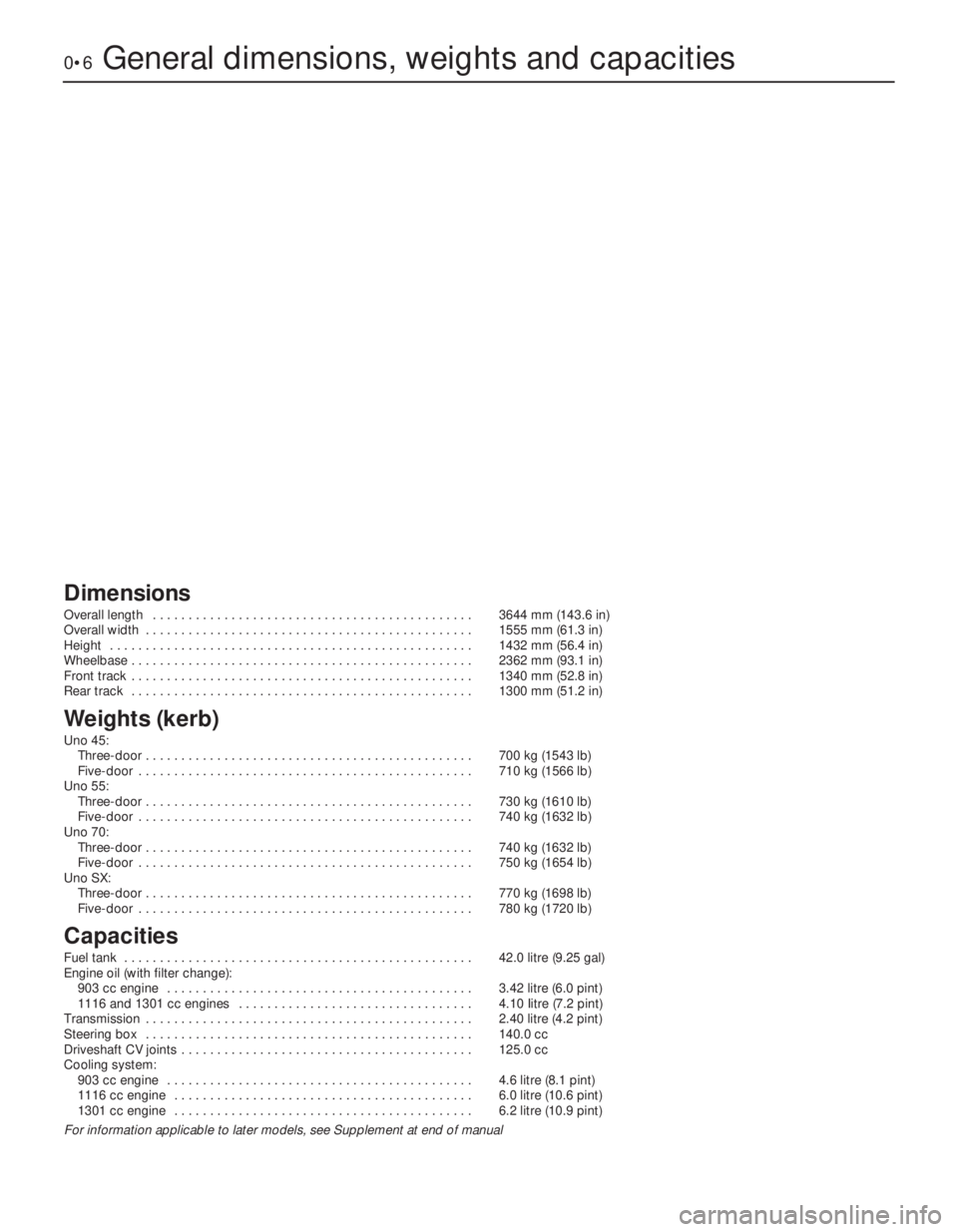
0•6General dimensions, weights and capacities
Dimensions
Overall length . . . . . . . . . . . . . . . . . . . . . . . . . . . . . . . . . . . . . . . . . . . . . 3644 mm (143.6 in)
Overall width . . . . . . . . . . . . . . . . . . . . . . . . . . . . . . . . . . . . . . . . . . . . . . 1555 mm (61.3 in)
Height . . . . . . . . . . . . . . . . . . . . . . . . . . . . . . . . . . . . . . . . . . . . . . . . . . . 1432 mm (56.4 in)
Wheelbase . . . . . . . . . . . . . . . . . . . . . . . . . . . . . . . . . . . . . . . . . . . . . . . . 2362 mm (93.1 in)
Front track . . . . . . . . . . . . . . . . . . . . . . . . . . . . . . . . . . . . . . . . . . . . . . . . 1340 mm (52.8 in)
Rear track . . . . . . . . . . . . . . . . . . . . . . . . . . . . . . . . . . . . . . . . . . . . . . . . 1300 mm (51.2 in)
Weights (kerb)
Uno 45:
Three-door . . . . . . . . . . . . . . . . . . . . . . . . . . . . . . . . . . . . . . . . . . . . . . 700 kg (1543 lb)
Five-door . . . . . . . . . . . . . . . . . . . . . . . . . . . . . . . . . . . . . . . . . . . . . . . 710 kg (1566 lb)
Uno 55:
Three-door . . . . . . . . . . . . . . . . . . . . . . . . . . . . . . . . . . . . . . . . . . . . . . 730 kg (1610 lb)
Five-door . . . . . . . . . . . . . . . . . . . . . . . . . . . . . . . . . . . . . . . . . . . . . . . 740 kg (1632 lb)
Uno 70:
Three-door . . . . . . . . . . . . . . . . . . . . . . . . . . . . . . . . . . . . . . . . . . . . . . 740 kg (1632 lb)
Five-door . . . . . . . . . . . . . . . . . . . . . . . . . . . . . . . . . . . . . . . . . . . . . . . 750 kg (1654 lb)
Uno SX:
Three-door . . . . . . . . . . . . . . . . . . . . . . . . . . . . . . . . . . . . . . . . . . . . . . 770 kg (1698 lb)
Five-door . . . . . . . . . . . . . . . . . . . . . . . . . . . . . . . . . . . . . . . . . . . . . . . 780 kg (1720 lb)
Capacities
Fuel tank . . . . . . . . . . . . . . . . . . . . . . . . . . . . . . . . . . . . . . . . . . . . . . . . . 42.0 litre (9.25 gal)
Engine oil (with filter change):
903 cc engine . . . . . . . . . . . . . . . . . . . . . . . . . . . . . . . . . . . . . . . . . . . 3.42 litre (6.0 pint)
1116 and 1301 cc engines . . . . . . . . . . . . . . . . . . . . . . . . . . . . . . . . . 4.10 Iitre (7.2 pint)
Transmission . . . . . . . . . . . . . . . . . . . . . . . . . . . . . . . . . . . . . . . . . . . . . . 2.40 litre (4.2 pint)
Steering box . . . . . . . . . . . . . . . . . . . . . . . . . . . . . . . . . . . . . . . . . . . . . . 140.0 cc
Driveshaft CV joints . . . . . . . . . . . . . . . . . . . . . . . . . . . . . . . . . . . . . . . . . 125.0 cc
Cooling system:
903 cc engine . . . . . . . . . . . . . . . . . . . . . . . . . . . . . . . . . . . . . . . . . . . 4.6 litre (8.1 pint)
1116 cc engine . . . . . . . . . . . . . . . . . . . . . . . . . . . . . . . . . . . . . . . . . . 6.0 litre (10.6 pint)
1301 cc engine . . . . . . . . . . . . . . . . . . . . . . . . . . . . . . . . . . . . . . . . . . 6.2 litre (10.9 pint)
For information applicable to later models, see Supplement at end of manual
Page 29 of 303
31Support the weight of the transmission
and withdraw it in a straight line from the
engine.
14 Engine- dismantling (general)
1Stand the engine on a strong bench at a
suitable working height. Failing this, it can be
dismantled on the floor, but at least stand it
on a sheet of hardboard.
2During the dismantling process, the
greatest care should be taken to keep the
exposed parts free from dirt. As the engine is
stripped, clean each part in a bath of paraffin.
3Never immerse parts with oilways in
paraffin, e.g. the crankshaft, but to clean,
wipe down carefully with a paraffin dampened
rag. Oilways can be cleaned out with a piece
of wire. If an air line is available, all parts can
be blown dry and the oilways blown through
as an added precaution.
4Re-use of old gaskets is false economy and
can give rise to oil and water leaks, if nothing
worse. To avoid the possibility of trouble after
the engine has been reassembled always use
new gaskets throughout.
5To strip the engine, it is best to work from
the top downwards. The engine oil sump
provides a firm base on which the engine can
be supported in an upright position. When the
stage is reached where the pistons are to be
removed, turn the engine on its side. Turn the
block upside down to remove the crankshaft.
6Wherever possible, replace nuts, bolts and
washers finger-tight from wherever they were
removed. This helps avoid later loss and
muddle. If they cannot be replaced then lay
them out in such a fashion that it is clear from
where they came.
15 Engine- removing ancillary
components
1Before dismantling the engine, remove the
engine ancillary components.
Carburettor (Chapter 3)
Thermostat housing (Chapter 2)
Alternator (Chapter 9)
Coolant pump (Chapter 2)
Distributor (Chapter 4)
Exhaust manifold (Chapter 3)
Fuel pump (Chapter 3)
Oil filter cartridge (Section 2 this Chapter)
Clutch (Chapter 5)
903 cc engine 1•15
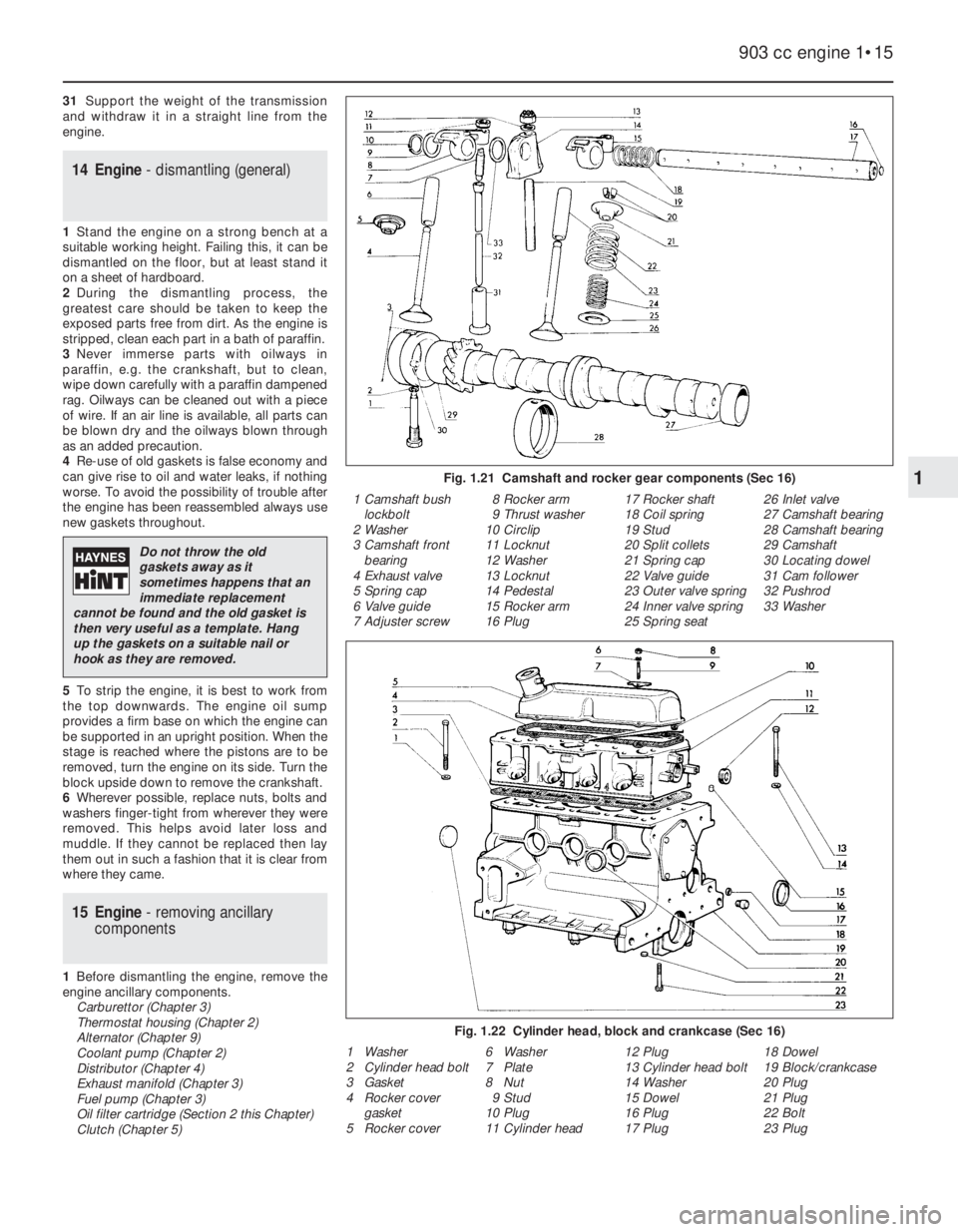
Fig. 1.21 Camshaft and rocker gear components (Sec 16)
Fig. 1.22 Cylinder head, block and crankcase (Sec 16)
1 Camshaft bush
lockbolt
2 Washer
3 Camshaft front
bearing
4 Exhaust valve
5 Spring cap
6 Valve guide
7 Adjuster screw8 Rocker arm
9 Thrust washer
10 Circlip
11 Locknut
12 Washer
13 Locknut
14 Pedestal
15 Rocker arm
16 Plug17 Rocker shaft
18 Coil spring
19 Stud
20 Split collets
21 Spring cap
22 Valve guide
23 Outer valve spring
24 Inner valve spring
25 Spring seat26 Inlet valve
27 Camshaft bearing
28 Camshaft bearing
29 Camshaft
30 Locating dowel
31 Cam follower
32 Pushrod
33 Washer
1 Washer
2 Cylinder head bolt
3 Gasket
4 Rocker cover
gasket
5 Rocker cover6 Washer
7 Plate
8 Nut
9 Stud
10 Plug
11 Cylinder head12 Plug
13 Cylinder head bolt
14 Washer
15 Dowel
16 Plug
17 Plug18 Dowel
19 Block/crankcase
20 Plug
21 Plug
22 Bolt
23 Plug
1
Do not throw the old
gaskets away as it
sometimes happens that an
immediate replacement
cannot be found and the old gasket is
then very useful as a template. Hang
up the gaskets on a suitable nail or
hook as they are removed.
Page 31 of 303
light alloy construction and is easily damaged
use a blunt scraper or rotary wire brush to
clean all traces of carbon deposits from the
combustion spaces and the ports. The valve
head stems and valve guides should also be
freed from any carbon deposits. Wash the
combustion spaces and ports down with
paraffin and scrape the cylinder head surface
free of any foreign matter with the side of a
steel rule, or a similar article.
8If the engine is installed in the car, clean the
pistons and the top of the cylinder bores. If
the pistons are still in the block, then it is
essential that great care is taken to ensure
that no carbon gets into the cylinder bores as
this could scratch the cylinder walls or cause
damage to the piston and rings. To ensure
this does not happen, first turn the crankshaft
so that two of the pistons are at the top of
their bores. Stuff rag into the other two bores
or seal them off with paper and masking tape.
The waterways should also be covered with
small pieces of masking tape to prevent
particles of carbon entering the cooling
system and damaging the coolant pump.
9With a blunt scraper carefully scrape away
the carbon from the piston crown, taking care
not to scratch the aluminium. Also scrape
away the carbon from the surrounding lip of
the cylinder wall. When all carbon has been
removed, scrape away the grease which will
now be contaminated with carbon particles,
taking care not to press any into the bores. To
assist prevention of carbon build-up the
piston crown can be polished with a metal
polish. Remove the rags or masking tape from
the other two cylinders and turn the
crankshaft so that the two pistons which were
at the bottom are now at the top. Place rag in
the cylinders which have been decarbonised,
and proceed as just described.
10Examine the head of the valves for pitting
and burning, especially the heads of the
exhaust valves. The valve seatings should be
examined at the same time. If the pitting on
the valve and seat is very slight, the markscan be removed by grinding the seats and
valves together with coarse, and then fine,
valve grinding paste.
11Where bad pitting has occurred to the
valve seats it will be necessary to recut them
and fit new valves. This latter job should be
entrusted to the local agent or engineering
works. In practice it is very seldom that the
seats are so badly worn. Normally it is the
valve that is too badly worn for refitting, and
the owner can easily purchase a new set of
valves and match them to the seats by valve
grinding.
12Valve grinding is carried out as follows.
Smear a trace of coarse carborundum paste
on the seat face and apply a suction grinder
tool to the valve head. With a semi-rotary
motion, grind the valve head to its seat, lifting
the valve occasionally to redistribute the
grinding paste. When a dull matt even surface
is produced on both the valve seat and the
valve, wipe off the paste and repeat the
process with fine carborundum paste, lifting
and turning the valve to redistribute the paste
as before. A light spring placed under the
valve head will greatly ease this operation.
When a smooth unbroken ring of light grey
matt finish is produced, on both valve and
valve seat faces, the grinding operation is
complete. Carefully clean away every trace of
grinding compound, take great care to leave
none in the ports or in the valve guides. Clean
the valve seats with a paraffin soaked rag,
then with a clean rag, and finally, if an air line
is available, blow the valves, valve guides and
valve ports clean.
13Check that all valve springs are intact. If
any one is broken, all should be renewed.
Check the free height of the springs against
new ones. If some springs are not within
specifications, replace them all. Springs suffer
from fatigue and it is a good idea to renew
them even if they look serviceable.
14Check that the oil supply holes in the
rocker arms are clear.
15The cylinder head can be checked for
warping either by placing it on a piece of plate
glass or using a straight-edge and feeler
blades. If there is any doubt or if its block face
is corroded, have it re-faced by your dealer or
motor engineering works.
16Test the valves in their guides for side toside rock. If this is any more than almost
imperceptible, new guides must be fitted.
Again this is a job for your dealer as a special
tool is required to ensure the correct
installation depth and the cylinder head must
be warmed to 80ºC (176ºF) before fitting the
guides.
17Commence reassembly by oiling the stem
of the first valve and pushing it into its guide
which should have been fitted with a new oil
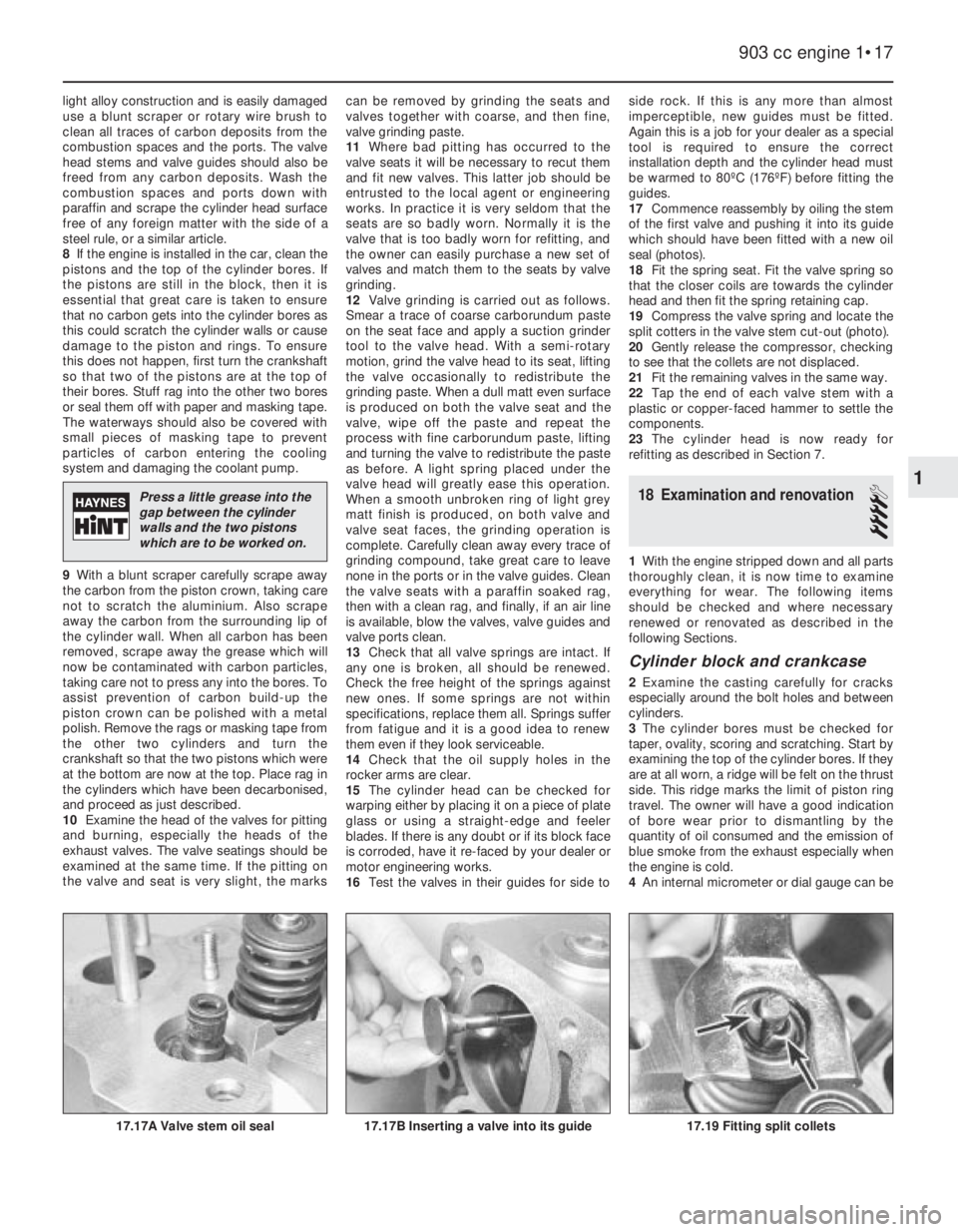
seal (photos).
18Fit the spring seat. Fit the valve spring so
that the closer coils are towards the cylinder
head and then fit the spring retaining cap.
19Compress the valve spring and locate the
split cotters in the valve stem cut-out (photo).
20Gently release the compressor, checking
to see that the collets are not displaced.
21Fit the remaining valves in the same way.
22Tap the end of each valve stem with a
plastic or copper-faced hammer to settle the
components.
23The cylinder head is now ready for
refitting as described in Section 7.
18 Examination and renovation
4
1With the engine stripped down and all parts
thoroughly clean, it is now time to examine
everything for wear. The following items
should be checked and where necessary
renewed or renovated as described in the
following Sections.
Cylinder block and crankcase
2Examine the casting carefully for cracks
especially around the bolt holes and between
cylinders.
3The cylinder bores must be checked for
taper, ovality, scoring and scratching. Start by
examining the top of the cylinder bores. If they
are at all worn, a ridge will be felt on the thrust
side. This ridge marks the limit of piston ring
travel. The owner will have a good indication
of bore wear prior to dismantling by the
quantity of oil consumed and the emission of
blue smoke from the exhaust especially when
the engine is cold.
4An internal micrometer or dial gauge can be
903 cc engine 1•17
17.19 Fitting split collets17.17B Inserting a valve into its guide17.17A Valve stem oil seal
1
Press a little grease into the
gap between the cylinder
walls and the two pistons
which are to be worked on.
Page 75 of 303
Note the washers above and below the
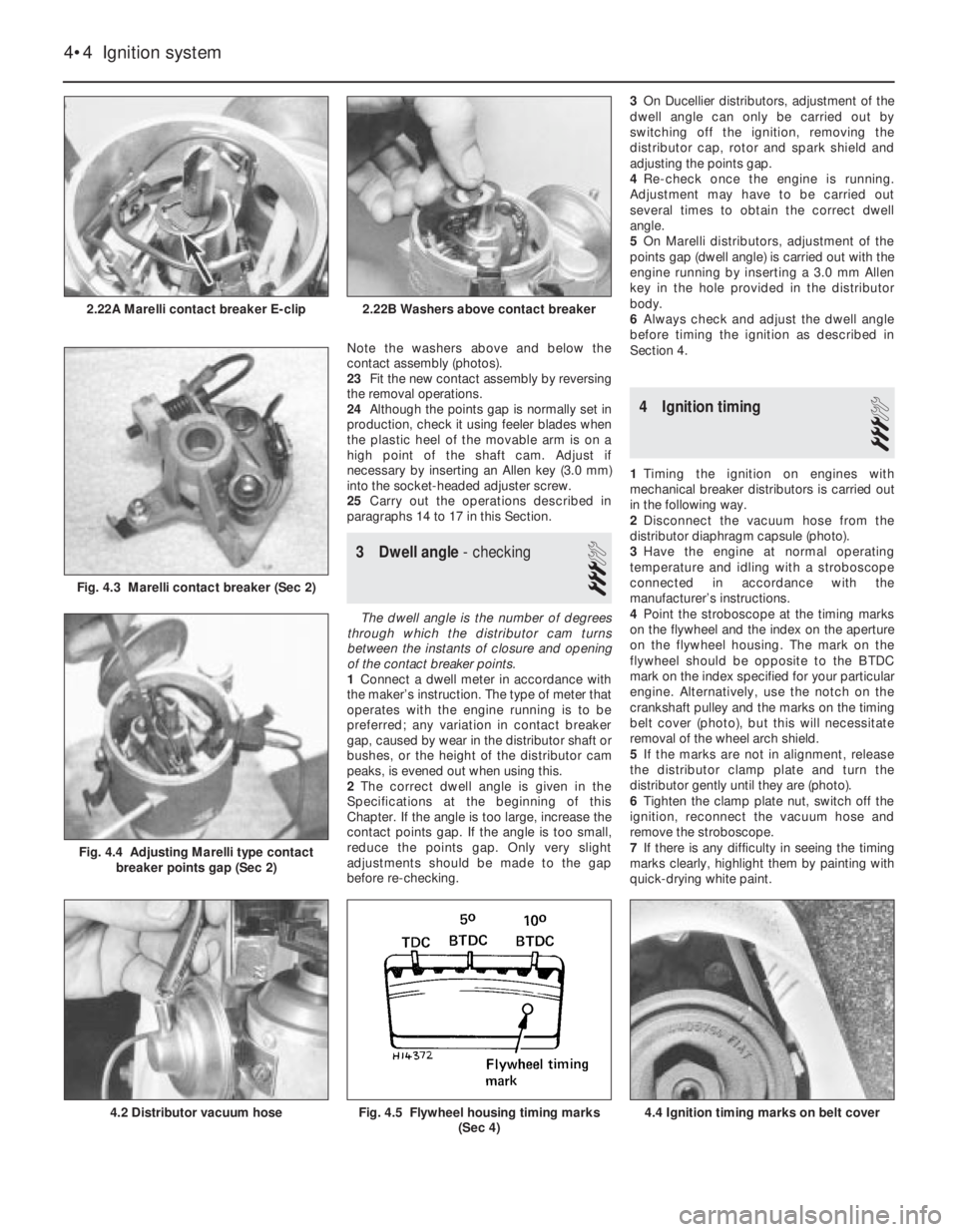
contact assembly (photos).
23Fit the new contact assembly by reversing
the removal operations.
24Although the points gap is normally set in
production, check it using feeler blades when
the plastic heel of the movable arm is on a
high point of the shaft cam. Adjust if
necessary by inserting an Allen key (3.0 mm)
into the socket-headed adjuster screw.
25Carry out the operations described in
paragraphs 14 to 17 in this Section.
3 Dwell angle- checking
3
The dwell angle is the number of degrees
through which the distributor cam turns
between the instants of closure and opening
of the contact breaker points.
1Connect a dwell meter in accordance with
the maker’s instruction. The type of meter that
operates with the engine running is to be
preferred; any variation in contact breaker
gap, caused by wear in the distributor shaft or
bushes, or the height of the distributor cam
peaks, is evened out when using this.
2The correct dwell angle is given in the
Specifications at the beginning of this
Chapter. If the angle is too large, increase the
contact points gap. If the angle is too small,
reduce the points gap. Only very slight
adjustments should be made to the gap
before re-checking.3On Ducellier distributors, adjustment of the
dwell angle can only be carried out by
switching off the ignition, removing the
distributor cap, rotor and spark shield and
adjusting the points gap.
4Re-check once the engine is running.
Adjustment may have to be carried out
several times to obtain the correct dwell
angle.
5On Marelli distributors, adjustment of the
points gap (dwell angle) is carried out with the
engine running by inserting a 3.0 mm Allen
key in the hole provided in the distributor
body.
6Always check and adjust the dwell angle
before timing the ignition as described in
Section 4.
4 Ignition timing
3
1Timing the ignition on engines with
mechanical breaker distributors is carried out
in the following way.
2Disconnect the vacuum hose from the
distributor diaphragm capsule (photo).
3Have the engine at normal operating
temperature and idling with a stroboscope
connected in accordance with the
manufacturer’s instructions.
4Point the stroboscope at the timing marks
on the flywheel and the index on the aperture
on the flywheel housing. The mark on the
flywheel should be opposite to the BTDC
mark on the index specified for your particular
engine. Alternatively, use the notch on the
crankshaft pulley and the marks on the timing
belt cover (photo), but this will necessitate
removal of the wheel arch shield.
5If the marks are not in alignment, release
the distributor clamp plate and turn the
distributor gently until they are (photo).
6Tighten the clamp plate nut, switch off the
ignition, reconnect the vacuum hose and
remove the stroboscope.
7If there is any difficulty in seeing the timing
marks clearly, highlight them by painting with
quick-drying white paint.
4•4 Ignition system
4.4 Ignition timing marks on belt coverFig. 4.5 Flywheel housing timing marks
(Sec 4)4.2 Distributor vacuum hose
Fig. 4.4 Adjusting Marelli type contact
breaker points gap (Sec 2)
Fig. 4.3 Marelli contact breaker (Sec 2)
2.22B Washers above contact breaker2.22A Marelli contact breaker E-clip
Page 107 of 303
Note: Before diagnosing steering faults, be
sure that trouble is not due to incorrect or
uneven tyre pressures, inappropriate tyre
combinations, or braking system or
suspension defects.
Car pulls to one side
m mIncorrect steering geometry
m mCollision damage
Vibration at steering wheel
m
mRoadwheels out of balance or loose
m mTyre damage
m mLoose driveshaft-to-hub nuts
Car wanders
m
mPlay in steering gear
m mWear in steering balljoints
Heavy or stiff steering
m
mLack of lubricant in steering gear or balljoints
m mIncorrect steering geometry
m mCollision damage
Play at steering wheel
m
mWear in steering rack or balljoints
m mLoose steering shaft coupling pinch-bolt or
worn splines
m mWorn steering column/shaft universal joints
Rattles from steering
m
mSteering damper defective or in need of
adjustment
m mLoose steering column mounting bolts
m mLoose steering column/shaft coupling
pinch-bolts
m mLoose steering rack housing mounting bolts
m mWorn steering shaft bushes
Excessive or uneven tyre wear
m
mIncorrect steering geometry
m mWorn steering components
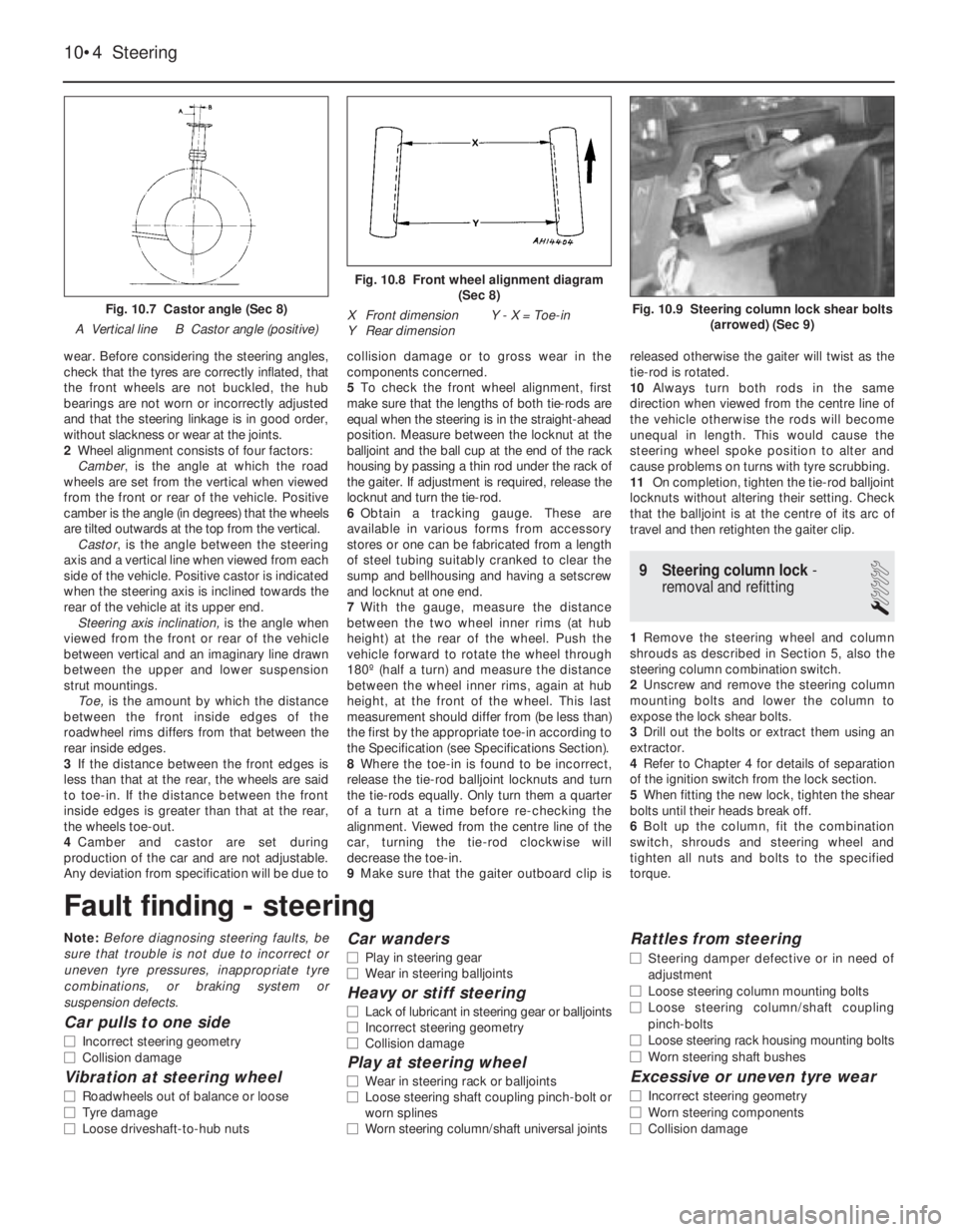
m mCollision damage wear. Before considering the steering angles,
check that the tyres are correctly inflated, that
the front wheels are not buckled, the hub
bearings are not worn or incorrectly adjusted
and that the steering linkage is in good order,
without slackness or wear at the joints.
2Wheel alignment consists of four factors:
Camber, is the angle at which the road
wheels are set from the vertical when viewed
from the front or rear of the vehicle. Positive
camber is the angle (in degrees) that the wheels
are tilted outwards at the top from the vertical.
Castor, is the angle between the steering
axis and a vertical line when viewed from each
side of the vehicle. Positive castor is indicated
when the steering axis is inclined towards the
rear of the vehicle at its upper end.
Steering axis inclination, is the angle when
viewed from the front or rear of the vehicle
between vertical and an imaginary line drawn
between the upper and lower suspension
strut mountings.
Toe,is the amount by which the distance
between the front inside edges of the
roadwheel rims differs from that between the
rear inside edges.
3If the distance between the front edges is
less than that at the rear, the wheels are said
to toe-in. If the distance between the front
inside edges is greater than that at the rear,
the wheels toe-out.
4Camber and castor are set during
production of the car and are not adjustable.
Any deviation from specification will be due tocollision damage or to gross wear in the
components concerned.
5To check the front wheel alignment, first
make sure that the lengths of both tie-rods are
equal when the steering is in the straight-ahead
position. Measure between the locknut at the
balljoint and the ball cup at the end of the rack
housing by passing a thin rod under the rack of
the gaiter. If adjustment is required, release the
locknut and turn the tie-rod.
6Obtain a tracking gauge. These are
available in various forms from accessory
stores or one can be fabricated from a length
of steel tubing suitably cranked to clear the
sump and bellhousing and having a setscrew
and locknut at one end.
7With the gauge, measure the distance
between the two wheel inner rims (at hub
height) at the rear of the wheel. Push the
vehicle forward to rotate the wheel through
180º (half a turn) and measure the distance
between the wheel inner rims, again at hub
height, at the front of the wheel. This last
measurement should differ from (be less than)
the first by the appropriate toe-in according to
the Specification (see Specifications Section).
8Where the toe-in is found to be incorrect,
release the tie-rod balljoint locknuts and turn
the tie-rods equally. Only turn them a quarter
of a turn at a time before re-checking the
alignment. Viewed from the centre line of the
car, turning the tie-rod clockwise will
decrease the toe-in.
9Make sure that the gaiter outboard clip isreleased otherwise the gaiter will twist as the
tie-rod is rotated.
10Always turn both rods in the same
direction when viewed from the centre line of
the vehicle otherwise the rods will become
unequal in length. This would cause the
steering wheel spoke position to alter and
cause problems on turns with tyre scrubbing.
11On completion, tighten the tie-rod balljoint
locknuts without altering their setting. Check
that the balljoint is at the centre of its arc of
travel and then retighten the gaiter clip.
9 Steering column lock-
removal and refitting
1
1Remove the steering wheel and column
shrouds as described in Section 5, also the
steering column combination switch.
2Unscrew and remove the steering column
mounting bolts and lower the column to
expose the lock shear bolts.
3Drill out the bolts or extract them using an
extractor.
4Refer to Chapter 4 for details of separation
of the ignition switch from the lock section.
5When fitting the new lock, tighten the shear
bolts until their heads break off.
6Bolt up the column, fit the combination
switch, shrouds and steering wheel and
tighten all nuts and bolts to the specified
torque.
10•4 Steering
Fig. 10.9 Steering column lock shear bolts
(arrowed) (Sec 9)
Fig. 10.8 Front wheel alignment diagram
(Sec 8)
X Front dimension Y - X = Toe-in
Y Rear dimension
Fig. 10.7 Castor angle (Sec 8)
A Vertical line B Castor angle (positive)
Fault finding - steering
Page 108 of 303
11
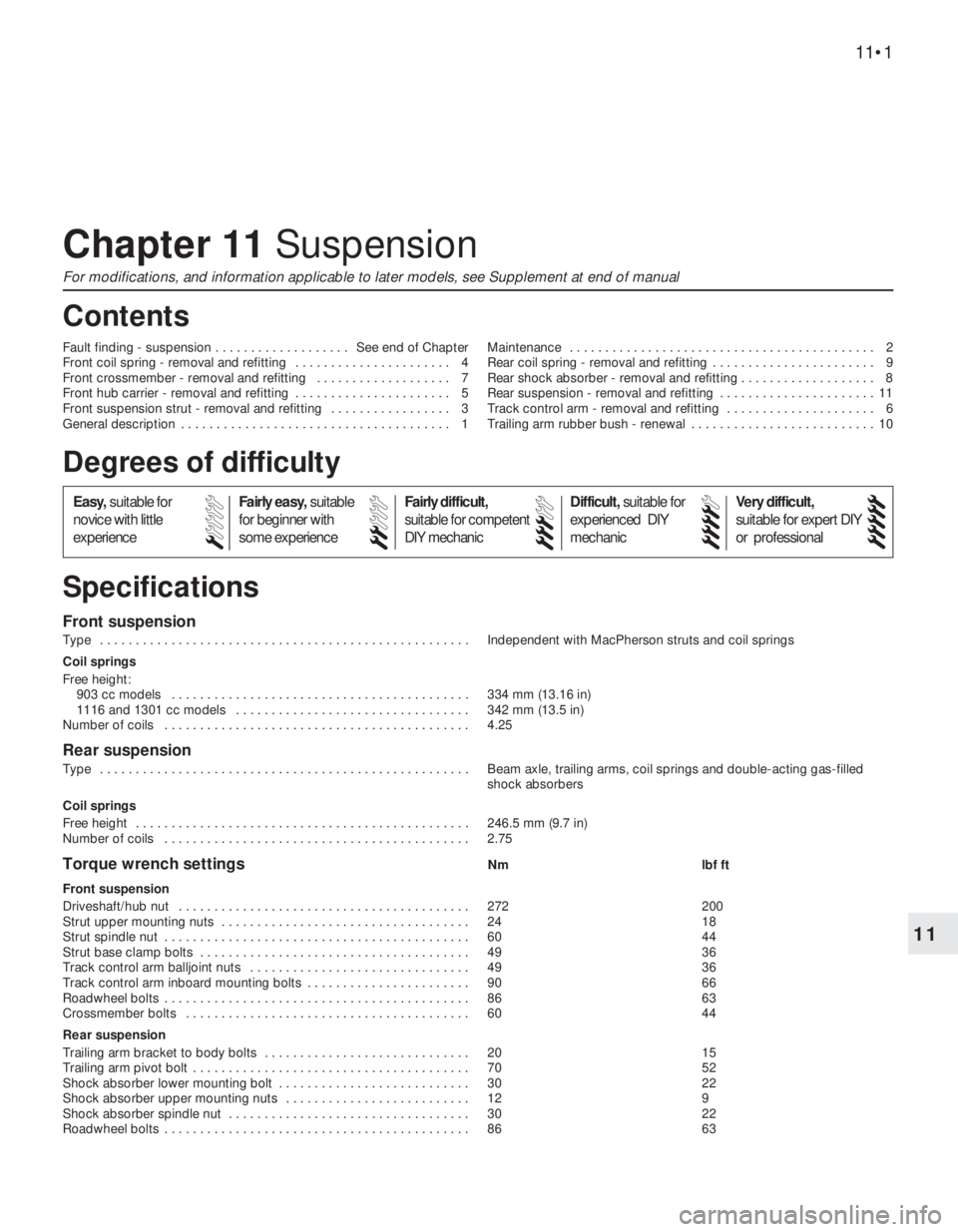
Front suspension
Type . . . . . . . . . . . . . . . . . . . . . . . . . . . . . . . . . . . . . . . . . . . . . . . . . . . . Independent with MacPherson struts and coil springs
Coil springs
Free height:
903 cc models . . . . . . . . . . . . . . . . . . . . . . . . . . . . . . . . . . . . . . . . . . 334 mm (13.16 in)
1116 and 1301 cc models . . . . . . . . . . . . . . . . . . . . . . . . . . . . . . . . . 342 mm (13.5 in)
Number of coils . . . . . . . . . . . . . . . . . . . . . . . . . . . . . . . . . . . . . . . . . . . 4.25
Rear suspension
Type . . . . . . . . . . . . . . . . . . . . . . . . . . . . . . . . . . . . . . . . . . . . . . . . . . . . Beam axle, trailing arms, coil springs and double-acting gas-filled
shock absorbers
Coil springs
Free height . . . . . . . . . . . . . . . . . . . . . . . . . . . . . . . . . . . . . . . . . . . . . . . 246.5 mm (9.7 in)
Number of coils . . . . . . . . . . . . . . . . . . . . . . . . . . . . . . . . . . . . . . . . . . . 2.75
Torque wrench settingsNm lbf ft
Front suspension
Driveshaft/hub nut . . . . . . . . . . . . . . . . . . . . . . . . . . . . . . . . . . . . . . . . . 272 200
Strut upper mounting nuts . . . . . . . . . . . . . . . . . . . . . . . . . . . . . . . . . . . 24 18
Strut spindle nut . . . . . . . . . . . . . . . . . . . . . . . . . . . . . . . . . . . . . . . . . . . 60 44
Strut base clamp bolts . . . . . . . . . . . . . . . . . . . . . . . . . . . . . . . . . . . . . . 49 36
Track control arm balljoint nuts . . . . . . . . . . . . . . . . . . . . . . . . . . . . . . . 49 36
Track control arm inboard mounting bolts . . . . . . . . . . . . . . . . . . . . . . . 90 66
Roadwheel bolts . . . . . . . . . . . . . . . . . . . . . . . . . . . . . . . . . . . . . . . . . . . 86 63
Crossmember bolts . . . . . . . . . . . . . . . . . . . . . . . . . . . . . . . . . . . . . . . . 60 44
Rear suspension
Trailing arm bracket to body bolts . . . . . . . . . . . . . . . . . . . . . . . . . . . . . 20 15
Trailing arm pivot bolt . . . . . . . . . . . . . . . . . . . . . . . . . . . . . . . . . . . . . . . 70 52
Shock absorber lower mounting bolt . . . . . . . . . . . . . . . . . . . . . . . . . . . 30 22
Shock absorber upper mounting nuts . . . . . . . . . . . . . . . . . . . . . . . . . . 12 9
Shock absorber spindle nut . . . . . . . . . . . . . . . . . . . . . . . . . . . . . . . . . . 30 22
Roadwheel bolts . . . . . . . . . . . . . . . . . . . . . . . . . . . . . . . . . . . . . . . . . . . 86 63
Chapter 11 Suspension
For modifications, and information applicable to later models, see Supplement at end of manual
Fault finding - suspension . . . . . . . . . . . . . . . . . . . See end of Chapter
Front coil spring - removal and refitting . . . . . . . . . . . . . . . . . . . . . . 4
Front crossmember - removal and refitting . . . . . . . . . . . . . . . . . . . 7
Front hub carrier - removal and refitting . . . . . . . . . . . . . . . . . . . . . . 5
Front suspension strut - removal and refitting . . . . . . . . . . . . . . . . . 3
General description . . . . . . . . . . . . . . . . . . . . . . . . . . . . . . . . . . . . . . 1Maintenance . . . . . . . . . . . . . . . . . . . . . . . . . . . . . . . . . . . . . . . . . . . 2
Rear coil spring - removal and refitting . . . . . . . . . . . . . . . . . . . . . . . 9
Rear shock absorber - removal and refitting . . . . . . . . . . . . . . . . . . . 8
Rear suspension - removal and refitting . . . . . . . . . . . . . . . . . . . . . . 11
Track control arm - removal and refitting . . . . . . . . . . . . . . . . . . . . . 6
Trailing arm rubber bush - renewal . . . . . . . . . . . . . . . . . . . . . . . . . . 10
11•1
Specifications Contents
Easy,suitable for
novice with little
experienceFairly easy,suitable
for beginner with
some experienceFairly difficult,
suitable for competent
DIY mechanic
Difficult,suitable for
experienced DIY
mechanicVery difficult,
suitable for expert DIY
or professional
Degrees of difficulty
54321
Page 139 of 303
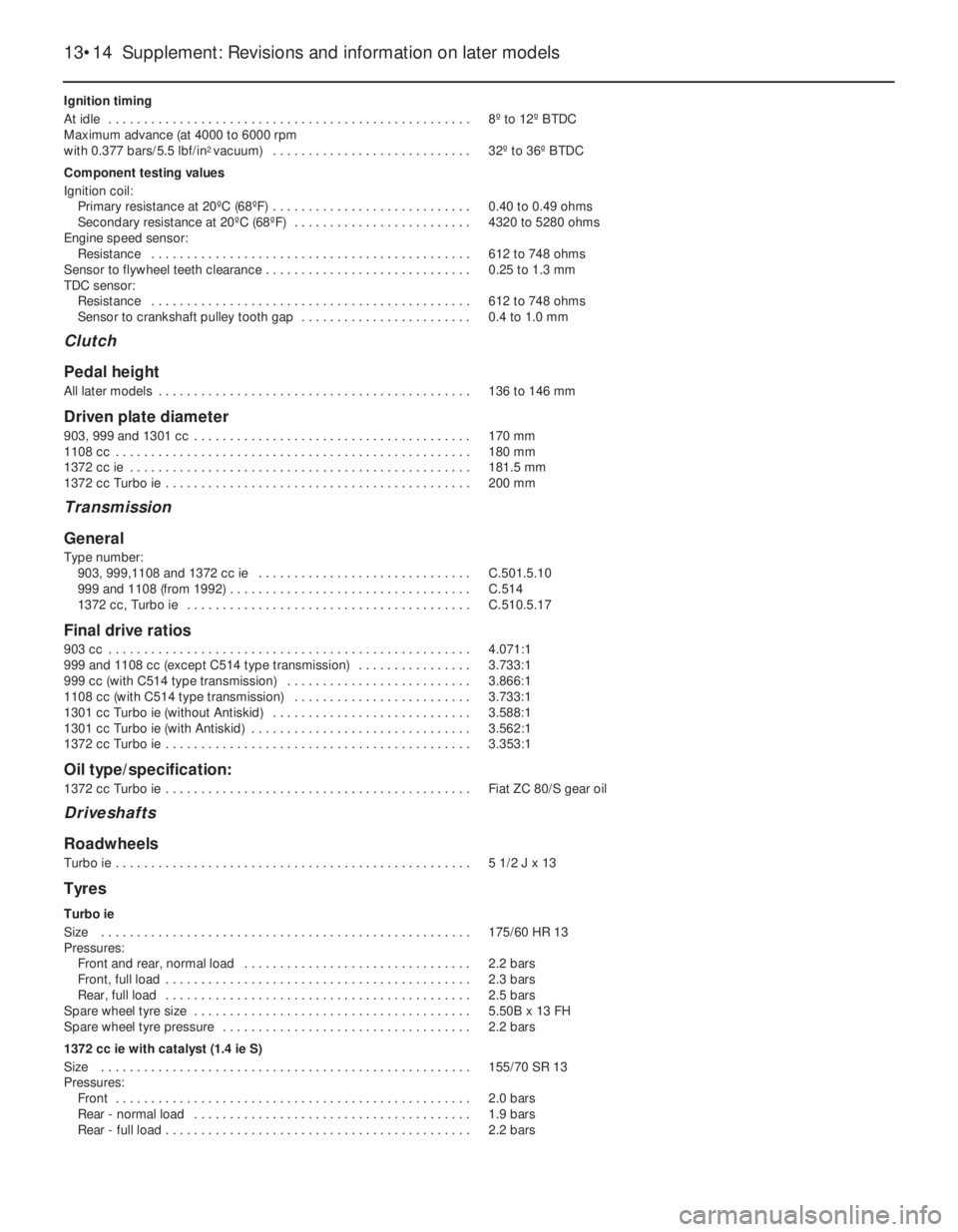
Ignition timing
At idle . . . . . . . . . . . . . . . . . . . . . . . . . . . . . . . . . . . . . . . . . . . . . . . . . . . 8º to 12º BTDC
Maximum advance (at 4000 to 6000 rpm
with 0.377 bars/5.5 lbf/in
2 vacuum) . . . . . . . . . . . . . . . . . . . . . . . . . . . . 32º to 36º BTDC
Component testing values
Ignition coil:
Primary resistance at 20ºC (68ºF) . . . . . . . . . . . . . . . . . . . . . . . . . . . . 0.40 to 0.49 ohms
Secondary resistance at 20ºC (68ºF) . . . . . . . . . . . . . . . . . . . . . . . . . 4320 to 5280 ohms
Engine speed sensor:
Resistance . . . . . . . . . . . . . . . . . . . . . . . . . . . . . . . . . . . . . . . . . . . . . 612 to 748 ohms
Sensor to flywheel teeth clearance . . . . . . . . . . . . . . . . . . . . . . . . . . . . . 0.25 to 1.3 mm
TDC sensor:
Resistance . . . . . . . . . . . . . . . . . . . . . . . . . . . . . . . . . . . . . . . . . . . . . 612 to 748 ohms
Sensor to crankshaft pulley tooth gap . . . . . . . . . . . . . . . . . . . . . . . . 0.4 to 1.0 mm
Clutch
Pedal height
All later models . . . . . . . . . . . . . . . . . . . . . . . . . . . . . . . . . . . . . . . . . . . . 136 to 146 mm
Driven plate diameter
903, 999 and 1301 cc . . . . . . . . . . . . . . . . . . . . . . . . . . . . . . . . . . . . . . . 170 mm
1108 cc . . . . . . . . . . . . . . . . . . . . . . . . . . . . . . . . . . . . . . . . . . . . . . . . . . 180 mm
1372 cc ie . . . . . . . . . . . . . . . . . . . . . . . . . . . . . . . . . . . . . . . . . . . . . . . . 181.5 mm
1372 cc Turbo ie . . . . . . . . . . . . . . . . . . . . . . . . . . . . . . . . . . . . . . . . . . . 200 mm
Transmission
General
Type number:
903, 999,1108 and 1372 cc ie . . . . . . . . . . . . . . . . . . . . . . . . . . . . . . C.501.5.10
999 and 1108 (from 1992) . . . . . . . . . . . . . . . . . . . . . . . . . . . . . . . . . . C.514
1372 cc, Turbo ie . . . . . . . . . . . . . . . . . . . . . . . . . . . . . . . . . . . . . . . . C.510.5.17
Final drive ratios
903 cc . . . . . . . . . . . . . . . . . . . . . . . . . . . . . . . . . . . . . . . . . . . . . . . . . . . 4.071:1
999 and 1108 cc (except C514 type transmission) . . . . . . . . . . . . . . . . 3.733:1
999 cc (with C514 type transmission) . . . . . . . . . . . . . . . . . . . . . . . . . . 3.866:1
1108 cc (with C514 type transmission) . . . . . . . . . . . . . . . . . . . . . . . . . 3.733:1
1301 cc Turbo ie (without Antiskid) . . . . . . . . . . . . . . . . . . . . . . . . . . . . 3.588:1
1301 cc Turbo ie (with Antiskid) . . . . . . . . . . . . . . . . . . . . . . . . . . . . . . . 3.562:1
1372 cc Turbo ie . . . . . . . . . . . . . . . . . . . . . . . . . . . . . . . . . . . . . . . . . . . 3.353:1
Oil type/specification:
1372 cc Turbo ie . . . . . . . . . . . . . . . . . . . . . . . . . . . . . . . . . . . . . . . . . . . Fiat ZC 80/S gear oil
Driveshafts
Roadwheels
Turbo ie . . . . . . . . . . . . . . . . . . . . . . . . . . . . . . . . . . . . . . . . . . . . . . . . . . 5 1/2 J x 13
Tyres
Turbo ie
Size . . . . . . . . . . . . . . . . . . . . . . . . . . . . . . . . . . . . . . . . . . . . . . . . . . . . 175/60 HR 13
Pressures:
Front and rear, normal load . . . . . . . . . . . . . . . . . . . . . . . . . . . . . . . . 2.2 bars
Front, full load . . . . . . . . . . . . . . . . . . . . . . . . . . . . . . . . . . . . . . . . . . . 2.3 bars
Rear, full load . . . . . . . . . . . . . . . . . . . . . . . . . . . . . . . . . . . . . . . . . . . 2.5 bars
Spare wheel tyre size . . . . . . . . . . . . . . . . . . . . . . . . . . . . . . . . . . . . . . . 5.50B x 13 FH
Spare wheel tyre pressure . . . . . . . . . . . . . . . . . . . . . . . . . . . . . . . . . . . 2.2 bars
1372 cc ie with catalyst (1.4 ie S)
Size . . . . . . . . . . . . . . . . . . . . . . . . . . . . . . . . . . . . . . . . . . . . . . . . . . . . 155/70 SR 13
Pressures:
Front . . . . . . . . . . . . . . . . . . . . . . . . . . . . . . . . . . . . . . . . . . . . . . . . . . 2.0 bars
Rear - normal load . . . . . . . . . . . . . . . . . . . . . . . . . . . . . . . . . . . . . . . 1.9 bars
Rear - full load . . . . . . . . . . . . . . . . . . . . . . . . . . . . . . . . . . . . . . . . . . . 2.2 bars
13•14 Supplement: Revisions and information on later models
Page 142 of 303
General dimensions, weights and capacities
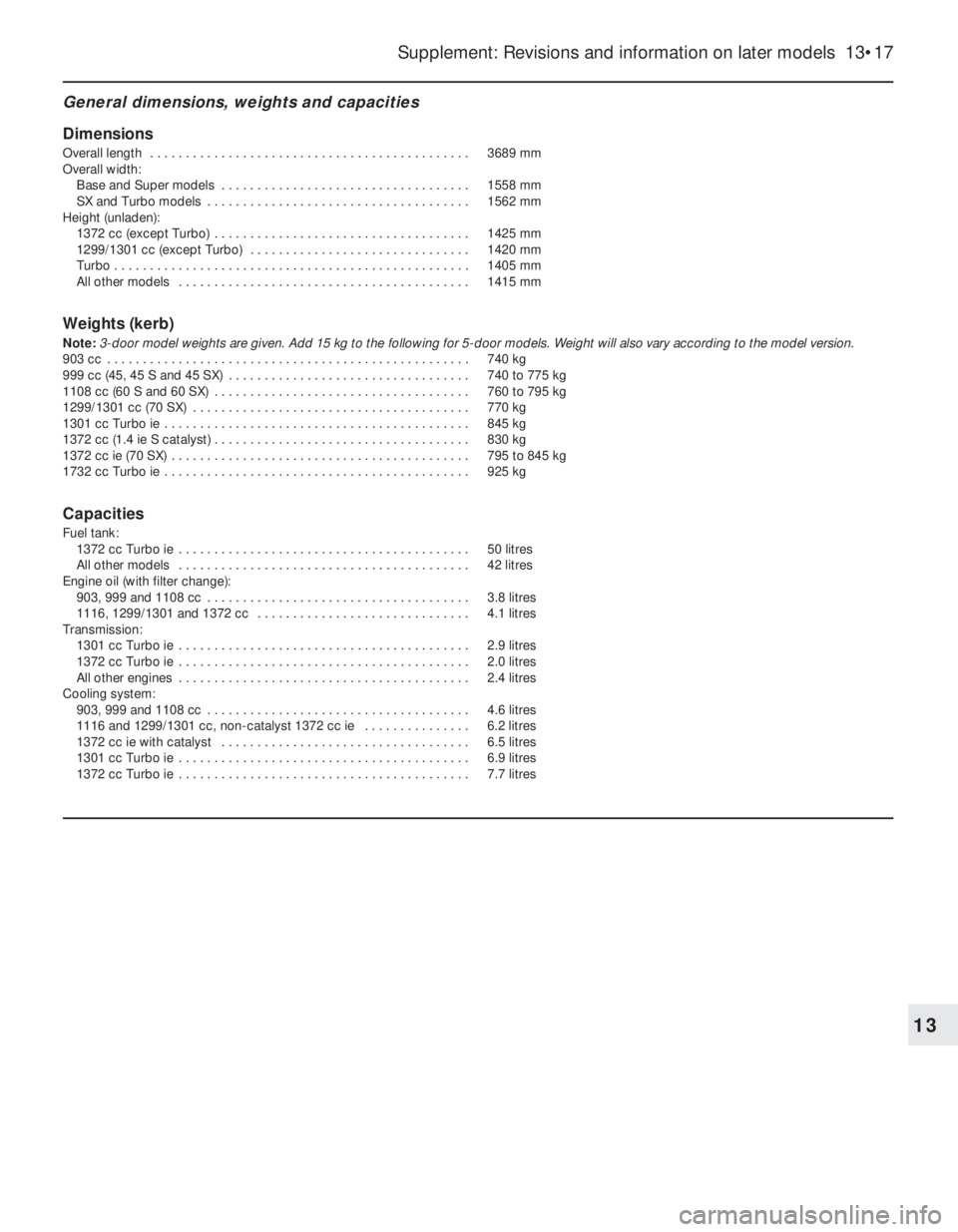
Dimensions
Overall length . . . . . . . . . . . . . . . . . . . . . . . . . . . . . . . . . . . . . . . . . . . . . 3689 mm
Overall width:
Base and Super models . . . . . . . . . . . . . . . . . . . . . . . . . . . . . . . . . . . 1558 mm
SX and Turbo models . . . . . . . . . . . . . . . . . . . . . . . . . . . . . . . . . . . . . 1562 mm
Height (unladen):
1372 cc (except Turbo) . . . . . . . . . . . . . . . . . . . . . . . . . . . . . . . . . . . . 1425 mm
1299/1301 cc (except Turbo) . . . . . . . . . . . . . . . . . . . . . . . . . . . . . . . 1420 mm
Turbo . . . . . . . . . . . . . . . . . . . . . . . . . . . . . . . . . . . . . . . . . . . . . . . . . . 1405 mm
All other models . . . . . . . . . . . . . . . . . . . . . . . . . . . . . . . . . . . . . . . . . 1415 mm
Weights (kerb)
Note: 3-door model weights are given. Add 15 kg to the following for 5-door models. Weight will also vary according to the model version.
903 cc . . . . . . . . . . . . . . . . . . . . . . . . . . . . . . . . . . . . . . . . . . . . . . . . . . . 740 kg
999 cc (45, 45 S and 45 SX) . . . . . . . . . . . . . . . . . . . . . . . . . . . . . . . . . . 740 to 775 kg
1108 cc (60 S and 60 SX) . . . . . . . . . . . . . . . . . . . . . . . . . . . . . . . . . . . . 760 to 795 kg
1299/1301 cc (70 SX) . . . . . . . . . . . . . . . . . . . . . . . . . . . . . . . . . . . . . . . 770 kg
1301 cc Turbo ie . . . . . . . . . . . . . . . . . . . . . . . . . . . . . . . . . . . . . . . . . . . 845 kg
1372 cc (1.4 ie S catalyst) . . . . . . . . . . . . . . . . . . . . . . . . . . . . . . . . . . . . 830 kg
1372 cc ie (70 SX) . . . . . . . . . . . . . . . . . . . . . . . . . . . . . . . . . . . . . . . . . . 795 to 845 kg
1732 cc Turbo ie . . . . . . . . . . . . . . . . . . . . . . . . . . . . . . . . . . . . . . . . . . . 925 kg
Capacities
Fuel tank:
1372 cc Turbo ie . . . . . . . . . . . . . . . . . . . . . . . . . . . . . . . . . . . . . . . . . 50 litres
All other models . . . . . . . . . . . . . . . . . . . . . . . . . . . . . . . . . . . . . . . . . 42 litres
Engine oil (with filter change):
903, 999 and 1108 cc . . . . . . . . . . . . . . . . . . . . . . . . . . . . . . . . . . . . . 3.8 litres
1116, 1299/1301 and 1372 cc . . . . . . . . . . . . . . . . . . . . . . . . . . . . . . 4.1 litres
Transmission:
1301 cc Turbo ie . . . . . . . . . . . . . . . . . . . . . . . . . . . . . . . . . . . . . . . . . 2.9 litres
1372 cc Turbo ie . . . . . . . . . . . . . . . . . . . . . . . . . . . . . . . . . . . . . . . . . 2.0 litres
All other engines . . . . . . . . . . . . . . . . . . . . . . . . . . . . . . . . . . . . . . . . . 2.4 litres
Cooling system:
903, 999 and 1108 cc . . . . . . . . . . . . . . . . . . . . . . . . . . . . . . . . . . . . . 4.6 litres
1116 and 1299/1301 cc, non-catalyst 1372 cc ie . . . . . . . . . . . . . . . 6.2 litres
1372 cc ie with catalyst . . . . . . . . . . . . . . . . . . . . . . . . . . . . . . . . . . . 6.5 litres
1301 cc Turbo ie . . . . . . . . . . . . . . . . . . . . . . . . . . . . . . . . . . . . . . . . . 6.9 litres
1372 cc Turbo ie . . . . . . . . . . . . . . . . . . . . . . . . . . . . . . . . . . . . . . . . . 7.7 litres
Supplement: Revisions and information on later models 13•17
13
Page 175 of 303
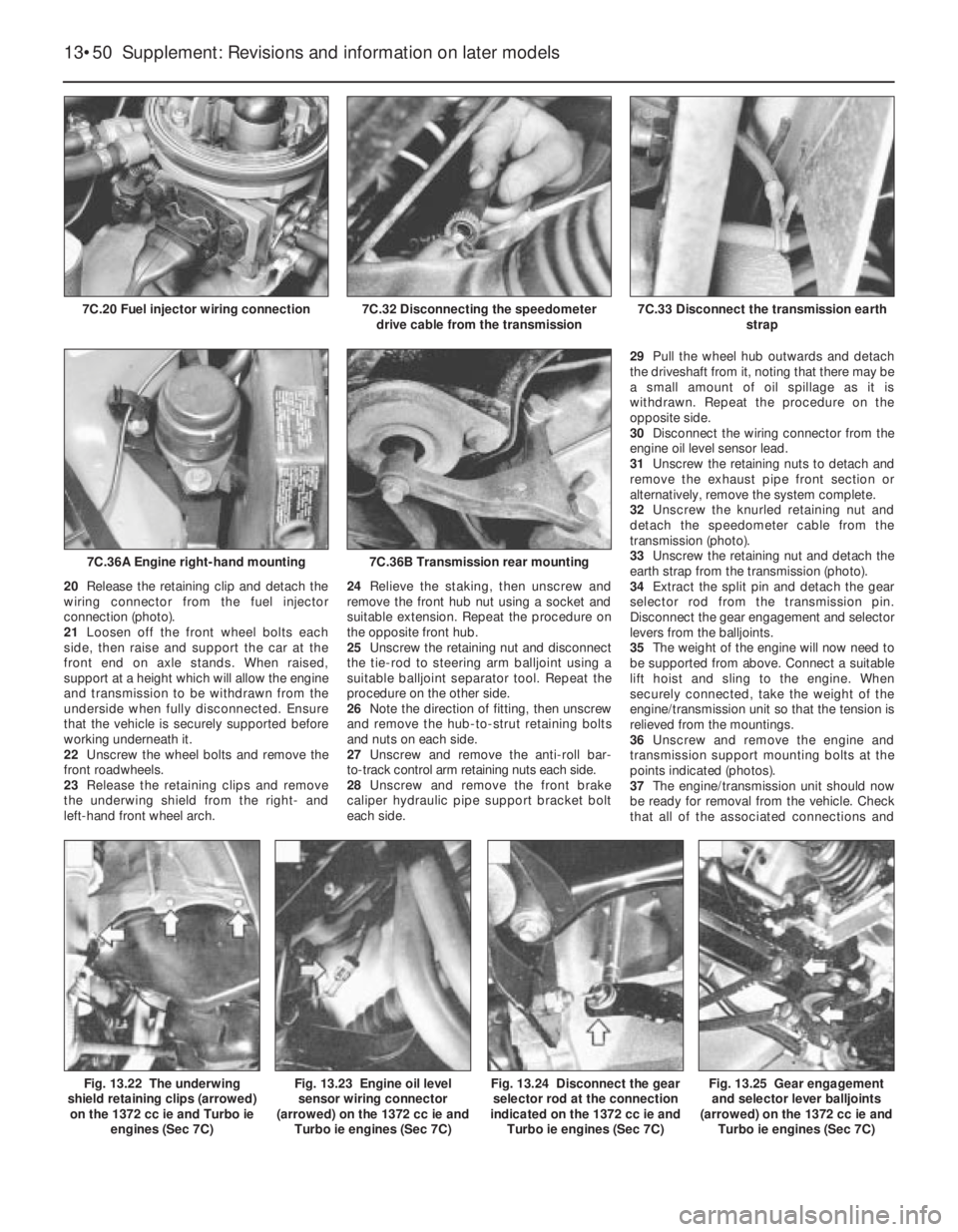
20Release the retaining clip and detach the
wiring connector from the fuel injector
connection (photo).
21Loosen off the front wheel bolts each
side, then raise and support the car at the
front end on axle stands. When raised,
support at a height which will allow the engine
and transmission to be withdrawn from the
underside when fully disconnected. Ensure
that the vehicle is securely supported before
working underneath it.
22Unscrew the wheel bolts and remove the
front roadwheels.
23Release the retaining clips and remove
the underwing shield from the right- and
left-hand front wheel arch.24Relieve the staking, then unscrew and
remove the front hub nut using a socket and
suitable extension. Repeat the procedure on
the opposite front hub.
25Unscrew the retaining nut and disconnect
the tie-rod to steering arm balljoint using a
suitable balljoint separator tool. Repeat the
procedure on the other side.
26Note the direction of fitting, then unscrew
and remove the hub-to-strut retaining bolts
and nuts on each side.
27Unscrew and remove the anti-roll bar-
to-track control arm retaining nuts each side.
28Unscrew and remove the front brake
caliper hydraulic pipe support bracket bolt
each side.29Pull the wheel hub outwards and detach
the driveshaft from it, noting that there may be
a small amount of oil spillage as it is
withdrawn. Repeat the procedure on the
opposite side.
30Disconnect the wiring connector from the
engine oil level sensor lead.
31Unscrew the retaining nuts to detach and
remove the exhaust pipe front section or
alternatively, remove the system complete.
32Unscrew the knurled retaining nut and
detach the speedometer cable from the
transmission (photo).
33Unscrew the retaining nut and detach the
earth strap from the transmission (photo).
34Extract the split pin and detach the gear
selector rod from the transmission pin.
Disconnect the gear engagement and selector
levers from the balljoints.
35The weight of the engine will now need to
be supported from above. Connect a suitable
lift hoist and sling to the engine. When
securely connected, take the weight of the
engine/transmission unit so that the tension is
relieved from the mountings.
36Unscrew and remove the engine and
transmission support mounting bolts at the
points indicated (photos).
37The engine/transmission unit should now
be ready for removal from the vehicle. Check
that all of the associated connections and
13•50 Supplement: Revisions and information on later models
Fig. 13.22 The underwing
shield retaining clips (arrowed)
on the 1372 cc ie and Turbo ie
engines (Sec 7C)Fig. 13.25 Gear engagement
and selector lever balljoints
(arrowed) on the 1372 cc ie and
Turbo ie engines (Sec 7C)Fig. 13.23 Engine oil level
sensor wiring connector
(arrowed) on the 1372 cc ie and
Turbo ie engines (Sec 7C)Fig. 13.24 Disconnect the gear
selector rod at the connection
indicated on the 1372 cc ie and
Turbo ie engines (Sec 7C)
7C.33 Disconnect the transmission earth
strap7C.32 Disconnecting the speedometer
drive cable from the transmission7C.20 Fuel injector wiring connection
7C.36B Transmission rear mounting7C.36A Engine right-hand mounting
Page 221 of 303
require maintenance other than general
inspection for wear in the linkage joints. If
excessive wear is found in any of the joints, they
can be individually detached and renewed.
13Access to the control rods is eased by
detaching and lowering the exhaust system
from the exhaust manifold.
14If a new adjustable control rod is to be
fitted, remove the original rod as a unit, but do
not alter its adjustment for length. The new
rod can then (if required) be set to the same
length as the original in order to maintain the
original setting. Do so by loosening off the
locknut and turning the balljoint as required;
ensure that the angle of the joint is correct
before tightening the locknut.
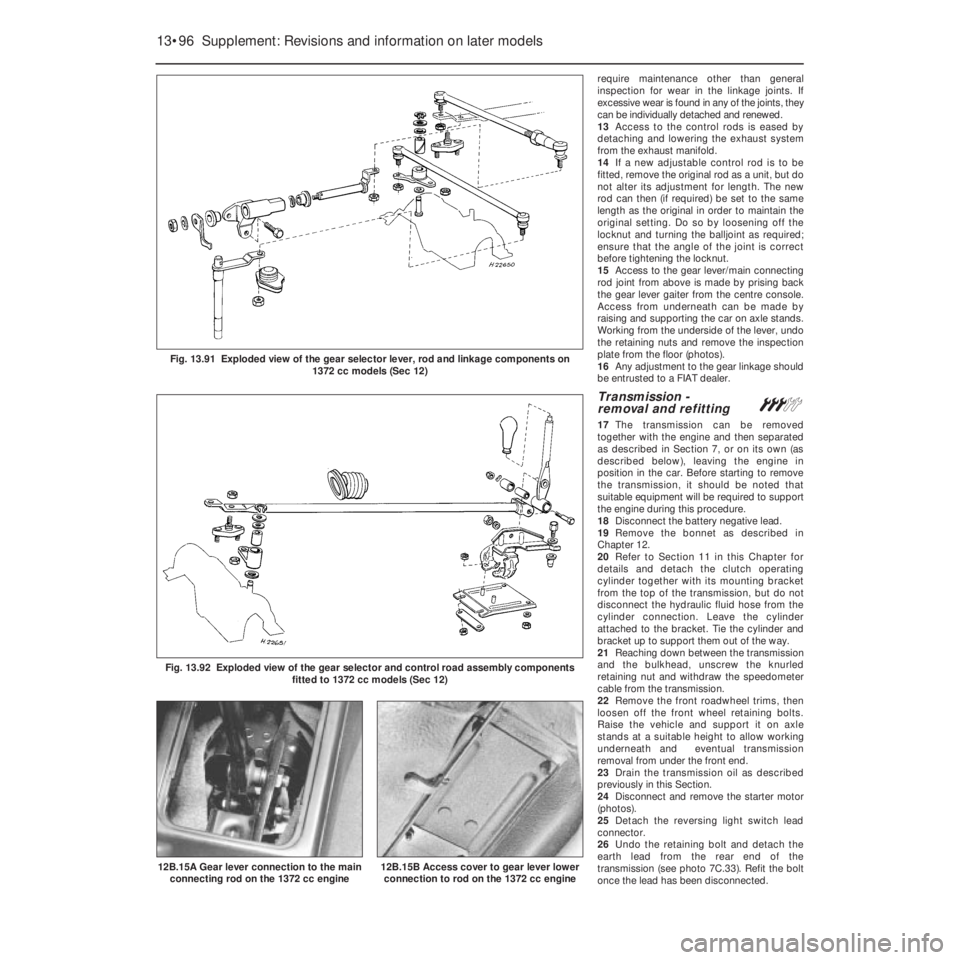
15Access to the gear lever/main connecting
rod joint from above is made by prising back
the gear lever gaiter from the centre console.
Access from underneath can be made by
raising and supporting the car on axle stands.
Working from the underside of the lever, undo
the retaining nuts and remove the inspection
plate from the floor (photos).
16Any adjustment to the gear linkage should
be entrusted to a FIAT dealer.
Transmission -
removal and refitting#
17The transmission can be removed
together with the engine and then separated
as described in Section 7, or on its own (as
described below), leaving the engine in
position in the car. Before starting to remove
the transmission, it should be noted that
suitable equipment will be required to support
the engine during this procedure.
18Disconnect the battery negative lead.
19Remove the bonnet as described in
Chapter 12.
20Refer to Section 11 in this Chapter for
details and detach the clutch operating
cylinder together with its mounting bracket
from the top of the transmission, but do not
disconnect the hydraulic fluid hose from the
cylinder connection. Leave the cylinder
attached to the bracket. Tie the cylinder and
bracket up to support them out of the way.
21Reaching down between the transmission
and the bulkhead, unscrew the knurled
retaining nut and withdraw the speedometer
cable from the transmission.
22Remove the front roadwheel trims, then
loosen off the front wheel retaining bolts.
Raise the vehicle and support it on axle
stands at a suitable height to allow working
underneath and eventual transmission
removal from under the front end.
23Drain the transmission oil as described
previously in this Section.
24Disconnect and remove the starter motor
(photos).
25Detach the reversing light switch lead
connector.
26Undo the retaining bolt and detach the
earth lead from the rear end of the
transmission (see photo 7C.33). Refit the bolt
once the lead has been disconnected.
13•96 Supplement: Revisions and information on later models
12B.15B Access cover to gear lever lower
connection to rod on the 1372 cc engine
Fig. 13.92 Exploded view of the gear selector and control road assembly components
fitted to 1372 cc models (Sec 12)
12B.15A Gear lever connection to the main
connecting rod on the 1372 cc engine
Fig. 13.91 Exploded view of the gear selector lever, rod and linkage components on
1372 cc models (Sec 12)