recommended oil FIAT UNO 1983 Service Repair Manual
[x] Cancel search | Manufacturer: FIAT, Model Year: 1983, Model line: UNO, Model: FIAT UNO 1983Pages: 303, PDF Size: 10.36 MB
Page 8 of 303
0•8Roadside Repairs
To avoid repetition, the procedure for
raising the vehicle, in order to carry out work
under it, is not included before each relevant
operation described in this Manual.
It is to be preferred, and it is certainly
recommended, that the vehicle is positioned
over an inspection pit or raised on a lift. Where
these facilities are not available, use ramps or
jack up the vehicle strictly in accordance with
the following guide. Once the vehicle is raised,
supplement the jack with axle stands.
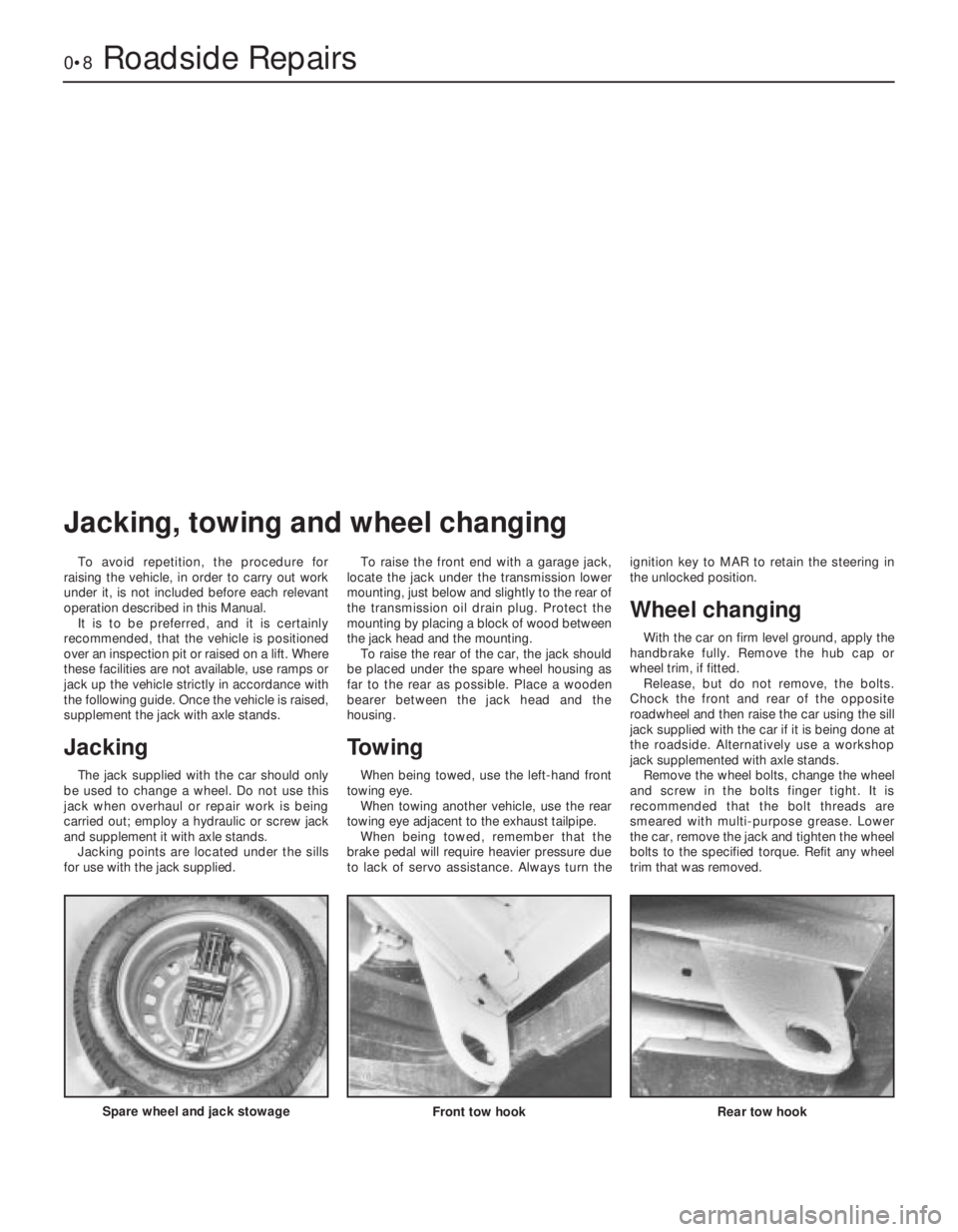
Jacking
The jack supplied with the car should only
be used to change a wheel. Do not use this
jack when overhaul or repair work is being
carried out; employ a hydraulic or screw jack
and supplement it with axle stands.
Jacking points are located under the sills
for use with the jack supplied.To raise the front end with a garage jack,
locate the jack under the transmission lower
mounting, just below and slightly to the rear of
the transmission oil drain plug. Protect the
mounting by placing a block of wood between
the jack head and the mounting.
To raise the rear of the car, the jack should
be placed under the spare wheel housing as
far to the rear as possible. Place a wooden
bearer between the jack head and the
housing.
Towing
When being towed, use the left-hand front
towing eye.
When towing another vehicle, use the rear
towing eye adjacent to the exhaust tailpipe.
When being towed, remember that the
brake pedal will require heavier pressure due
to lack of servo assistance. Always turn theignition key to MAR to retain the steering in
the unlocked position.
Wheel changing
With the car on firm level ground, apply the
handbrake fully. Remove the hub cap or
wheel trim, if fitted.
Release, but do not remove, the bolts.
Chock the front and rear of the opposite
roadwheel and then raise the car using the sill
jack supplied with the car if it is being done at
the roadside. Alternatively use a workshop
jack supplemented with axle stands.
Remove the wheel bolts, change the wheel
and screw in the bolts finger tight. It is
recommended that the bolt threads are
smeared with multi-purpose grease. Lower
the car, remove the jack and tighten the wheel
bolts to the specified torque. Refit any wheel
trim that was removed.
Spare wheel and jack stowage
Front tow hook Rear tow hook
Jacking, towing and wheel changing
Page 33 of 303
clearance and end gap. Both clearances
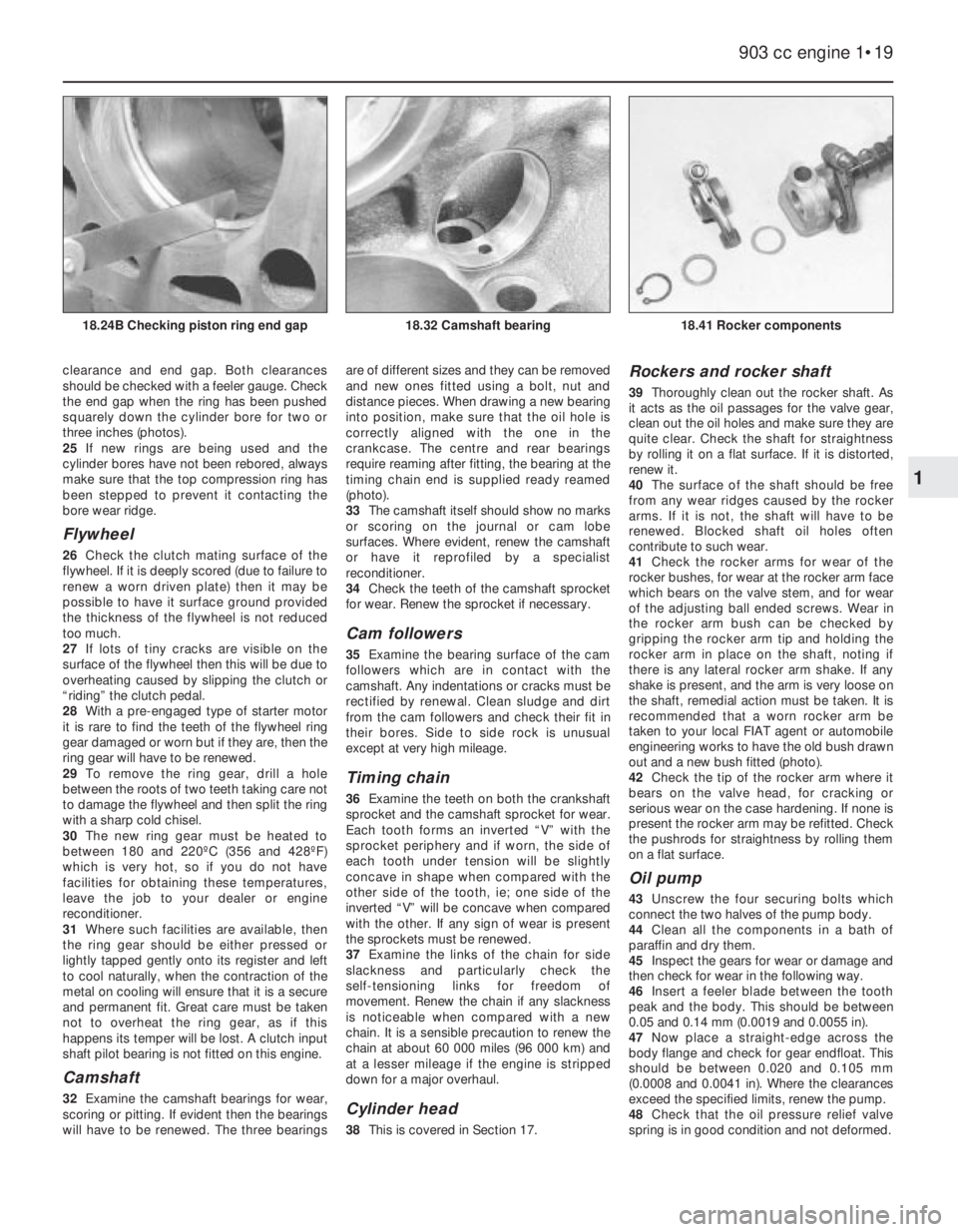
should be checked with a feeler gauge. Check
the end gap when the ring has been pushed
squarely down the cylinder bore for two or
three inches (photos).
25If new rings are being used and the
cylinder bores have not been rebored, always
make sure that the top compression ring has
been stepped to prevent it contacting the
bore wear ridge.
Flywheel
26Check the clutch mating surface of the
flywheel. If it is deeply scored (due to failure to
renew a worn driven plate) then it may be
possible to have it surface ground provided
the thickness of the flywheel is not reduced
too much.
27If lots of tiny cracks are visible on the
surface of the flywheel then this will be due to
overheating caused by slipping the clutch or
“riding” the clutch pedal.
28With a pre-engaged type of starter motor
it is rare to find the teeth of the flywheel ring
gear damaged or worn but if they are, then the
ring gear will have to be renewed.
29To remove the ring gear, drill a hole
between the roots of two teeth taking care not
to damage the flywheel and then split the ring
with a sharp cold chisel.
30The new ring gear must be heated to
between 180 and 220ºC (356 and 428ºF)
which is very hot, so if you do not have
facilities for obtaining these temperatures,
leave the job to your dealer or engine
reconditioner.
31Where such facilities are available, then
the ring gear should be either pressed or
lightly tapped gently onto its register and left
to cool naturally, when the contraction of the
metal on cooling will ensure that it is a secure
and permanent fit. Great care must be taken
not to overheat the ring gear, as if this
happens its temper will be lost. A clutch input
shaft pilot bearing is not fitted on this engine.
Camshaft
32Examine the camshaft bearings for wear,
scoring or pitting. If evident then the bearings
will have to be renewed. The three bearingsare of different sizes and they can be removed
and new ones fitted using a bolt, nut and
distance pieces. When drawing a new bearing
into position, make sure that the oil hole is
correctly aligned with the one in the
crankcase. The centre and rear bearings
require reaming after fitting, the bearing at the
timing chain end is supplied ready reamed
(photo).
33The camshaft itself should show no marks
or scoring on the journal or cam lobe
surfaces. Where evident, renew the camshaft
or have it reprofiled by a specialist
reconditioner.
34Check the teeth of the camshaft sprocket
for wear. Renew the sprocket if necessary.
Cam followers
35Examine the bearing surface of the cam
followers which are in contact with the
camshaft. Any indentations or cracks must be
rectified by renewal. Clean sludge and dirt
from the cam followers and check their fit in
their bores. Side to side rock is unusual
except at very high mileage.
Timing chain
36Examine the teeth on both the crankshaft
sprocket and the camshaft sprocket for wear.
Each tooth forms an inverted “V” with the
sprocket periphery and if worn, the side of
each tooth under tension will be slightly
concave in shape when compared with the
other side of the tooth, ie; one side of the
inverted “V” will be concave when compared
with the other. If any sign of wear is present
the sprockets must be renewed.
37Examine the links of the chain for side
slackness and particularly check the
self-tensioning links for freedom of
movement. Renew the chain if any slackness
is noticeable when compared with a new
chain. It is a sensible precaution to renew the
chain at about 60 000 miles (96 000 km) and
at a lesser mileage if the engine is stripped
down for a major overhaul.
Cylinder head
38This is covered in Section 17.
Rockers and rocker shaft
39Thoroughly clean out the rocker shaft. As
it acts as the oil passages for the valve gear,
clean out the oil holes and make sure they are
quite clear. Check the shaft for straightness
by rolling it on a flat surface. If it is distorted,
renew it.
40The surface of the shaft should be free
from any wear ridges caused by the rocker
arms. If it is not, the shaft will have to be
renewed. Blocked shaft oil holes often
contribute to such wear.
41Check the rocker arms for wear of the
rocker bushes, for wear at the rocker arm face
which bears on the valve stem, and for wear
of the adjusting ball ended screws. Wear in
the rocker arm bush can be checked by
gripping the rocker arm tip and holding the
rocker arm in place on the shaft, noting if
there is any lateral rocker arm shake. If any
shake is present, and the arm is very loose on
the shaft, remedial action must be taken. It is
recommended that a worn rocker arm be
taken to your local FIAT agent or automobile
engineering works to have the old bush drawn
out and a new bush fitted (photo).
42Check the tip of the rocker arm where it
bears on the valve head, for cracking or
serious wear on the case hardening. If none is
present the rocker arm may be refitted. Check
the pushrods for straightness by rolling them
on a flat surface.
Oil pump
43Unscrew the four securing bolts which
connect the two halves of the pump body.
44Clean all the components in a bath of
paraffin and dry them.
45Inspect the gears for wear or damage and
then check for wear in the following way.
46Insert a feeler blade between the tooth
peak and the body. This should be between
0.05 and 0.14 mm (0.0019 and 0.0055 in).
47Now place a straight-edge across the
body flange and check for gear endfloat. This
should be between 0.020 and 0.105 mm
(0.0008 and 0.0041 in). Where the clearances
exceed the specified limits, renew the pump.
48Check that the oil pressure relief valve
spring is in good condition and not deformed.
903 cc engine 1•19
18.41 Rocker components18.32 Camshaft bearing18.24B Checking piston ring end gap
1
Page 34 of 303
Oil seals and gaskets
49It is recommended that all gaskets and oil
seals are renewed at major engine overhaul.
Sockets are useful for removing or refitting oil
seals. An arrow is moulded onto some seals
to indicate the rotational direction of the
component which it serves. Make sure that
the seal is fitted the correct way round to
comply with the arrow.
19 Engine- reassembly (general)
1To ensure maximum life with minimum
trouble from a rebuilt engine, not only must
every part be correctly assembled, but
everything must be spotlessly clean, all the
oilways must be clear, locking washers and
spring washers must always be fitted where
indicated and all bearing and other working
surfaces must be thoroughly lubricated during
assembly. Before assembly begins renew any
bolts or studs whose threads are in any way
damaged; whenever possible use new spring
washers.
2Apart from your normal tools, a supply of
non-fluffy rag, an oil can filled with engine oil,
a supply of new spring washers, a set of new
gaskets and a torque wrench should be
gathered together.
20 Engine-
complete reassembly
4
Crankshaft and main bearings
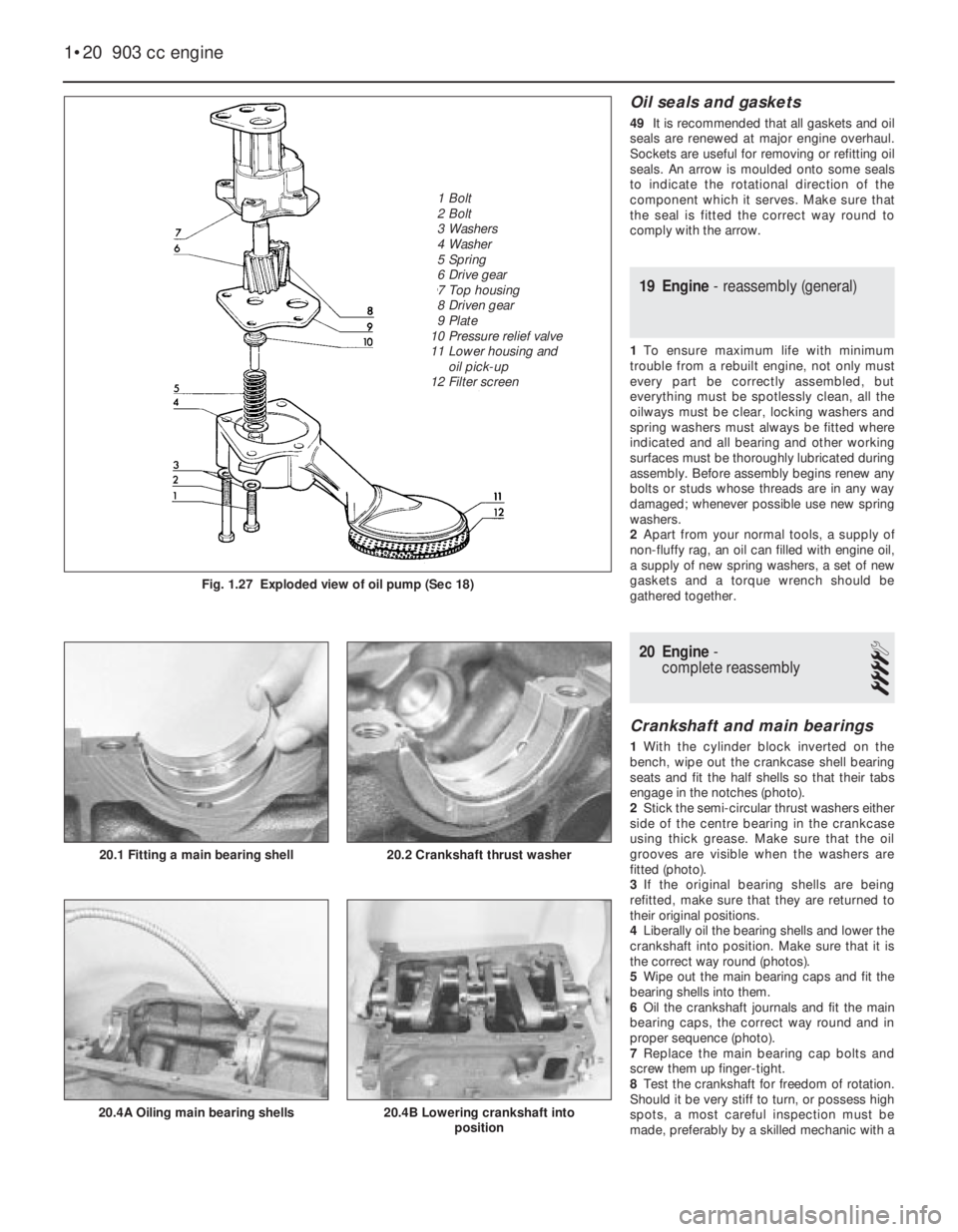
1With the cylinder block inverted on the
bench, wipe out the crankcase shell bearing
seats and fit the half shells so that their tabs
engage in the notches (photo).
2Stick the semi-circular thrust washers either
side of the centre bearing in the crankcase
using thick grease. Make sure that the oil
grooves are visible when the washers are
fitted (photo).
3If the original bearing shells are being
refitted, make sure that they are returned to
their original positions.
4Liberally oil the bearing shells and lower the
crankshaft into position. Make sure that it is
the correct way round (photos).
5Wipe out the main bearing caps and fit the
bearing shells into them.
6Oil the crankshaft journals and fit the main
bearing caps, the correct way round and in
proper sequence (photo).
7Replace the main bearing cap bolts and
screw them up finger-tight.
8Test the crankshaft for freedom of rotation.
Should it be very stiff to turn, or possess high
spots, a most careful inspection must be
made, preferably by a skilled mechanic with a
1•20 903 cc engine
20.4B Lowering crankshaft into
position20.4A Oiling main bearing shells
20.2 Crankshaft thrust washer20.1 Fitting a main bearing shell
Fig. 1.27 Exploded view of oil pump (Sec 18)
1 Bolt
2 Bolt
3 Washers
4 Washer
5 Spring
6 Drive gear
7 Top housing
8 Driven gear
9 Plate
10 Pressure relief valve
11 Lower housing and
oil pick-up
12 Filter screen
Page 39 of 303
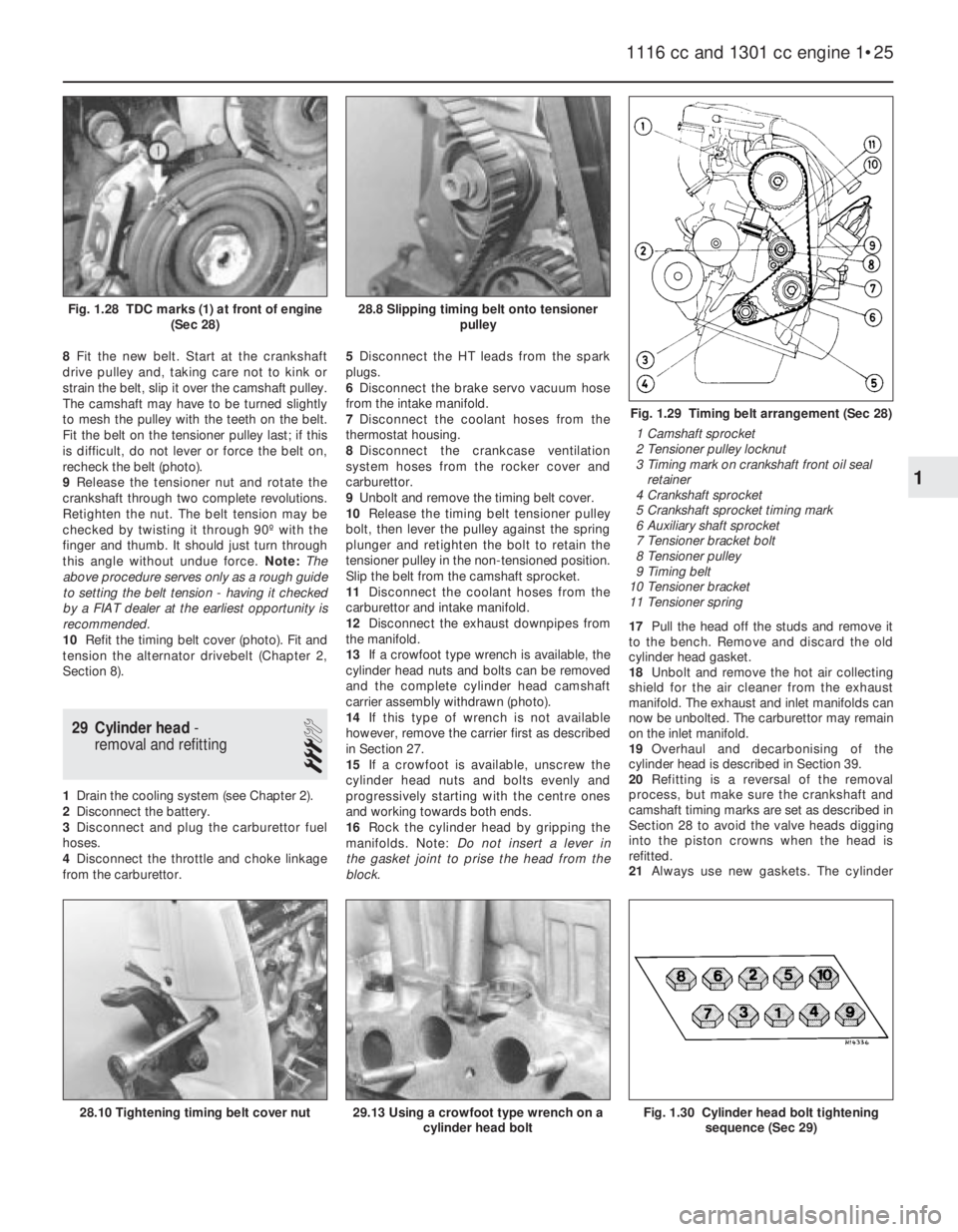
8Fit the new belt. Start at the crankshaft
drive pulley and, taking care not to kink or
strain the belt, slip it over the camshaft pulley.
The camshaft may have to be turned slightly
to mesh the pulley with the teeth on the belt.
Fit the belt on the tensioner pulley last; if this
is difficult, do not lever or force the belt on,
recheck the belt (photo).
9Release the tensioner nut and rotate the
crankshaft through two complete revolutions.
Retighten the nut. The belt tension may be
checked by twisting it through 90º with the
finger and thumb. It should just turn through
this angle without undue force. Note: The
above procedure serves only as a rough guide
to setting the belt tension - having it checked
by a FIAT dealer at the earliest opportunity is
recommended.
10Refit the timing belt cover (photo). Fit and
tension the alternator drivebelt (Chapter 2,
Section 8).
29 Cylinder head-
removal and refitting
3
1Drain the cooling system (see Chapter 2).
2Disconnect the battery.
3Disconnect and plug the carburettor fuel
hoses.
4Disconnect the throttle and choke linkage
from the carburettor. 5Disconnect the HT leads from the spark
plugs.
6Disconnect the brake servo vacuum hose
from the intake manifold.
7Disconnect the coolant hoses from the
thermostat housing.
8Disconnect the crankcase ventilation
system hoses from the rocker cover and
carburettor.
9Unbolt and remove the timing belt cover.
10Release the timing belt tensioner pulley
bolt, then lever the pulley against the spring
plunger and retighten the bolt to retain the
tensioner pulley in the non-tensioned position.
Slip the belt from the camshaft sprocket.
11Disconnect the coolant hoses from the
carburettor and intake manifold.
12Disconnect the exhaust downpipes from
the manifold.
13If a crowfoot type wrench is available, the
cylinder head nuts and bolts can be removed
and the complete cylinder head camshaft
carrier assembly withdrawn (photo).
14If this type of wrench is not available
however, remove the carrier first as described
in Section 27.
15If a crowfoot is available, unscrew the
cylinder head nuts and bolts evenly and
progressively starting with the centre ones
and working towards both ends.
16Rock the cylinder head by gripping the
manifolds. Note: Do not insert a lever in
the gasket joint to prise the head from the
block.17Pull the head off the studs and remove it
to the bench. Remove and discard the old
cylinder head gasket.
18Unbolt and remove the hot air collecting
shield for the air cleaner from the exhaust
manifold. The exhaust and inlet manifolds can
now be unbolted. The carburettor may remain
on the inlet manifold.
19Overhaul and decarbonising of the
cylinder head is described in Section 39.
20Refitting is a reversal of the removal
process, but make sure the crankshaft and
camshaft timing marks are set as described in
Section 28 to avoid the valve heads digging
into the piston crowns when the head is
refitted.
21Always use new gaskets. The cylinder
1116 cc and 1301 cc engine 1•25
Fig. 1.29 Timing belt arrangement (Sec 28)
1 Camshaft sprocket
2 Tensioner pulley locknut
3 Timing mark on crankshaft front oil seal
retainer
4 Crankshaft sprocket
5 Crankshaft sprocket timing mark
6 Auxiliary shaft sprocket
7 Tensioner bracket bolt
8 Tensioner pulley
9 Timing belt
10 Tensioner bracket
11 Tensioner spring
28.8 Slipping timing belt onto tensioner
pulleyFig. 1.28 TDC marks (1) at front of engine
(Sec 28)
Fig. 1.30 Cylinder head bolt tightening
sequence (Sec 29)28.10 Tightening timing belt cover nut29.13 Using a crowfoot type wrench on a
cylinder head bolt
1
Page 43 of 303
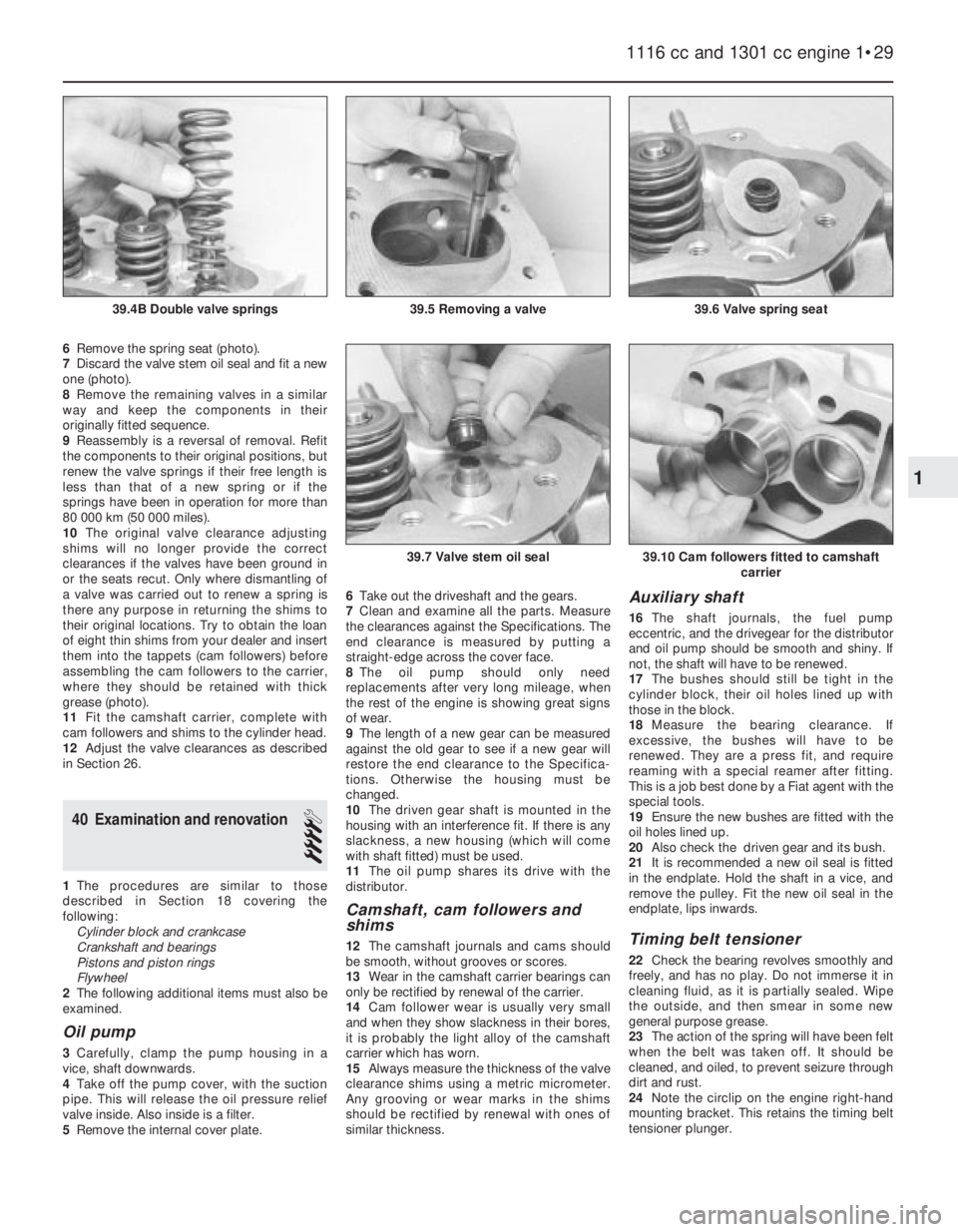
6Remove the spring seat (photo).
7Discard the valve stem oil seal and fit a new
one (photo).
8Remove the remaining valves in a similar
way and keep the components in their
originally fitted sequence.
9Reassembly is a reversal of removal. Refit
the components to their original positions, but
renew the valve springs if their free length is
less than that of a new spring or if the
springs have been in operation for more than
80 000 km (50 000 miles).
10The original valve clearance adjusting
shims will no longer provide the correct
clearances if the valves have been ground in
or the seats recut. Only where dismantling of
a valve was carried out to renew a spring is
there any purpose in returning the shims to
their original locations. Try to obtain the loan
of eight thin shims from your dealer and insert
them into the tappets (cam followers) before
assembling the cam followers to the carrier,
where they should be retained with thick
grease (photo).
11Fit the camshaft carrier, complete with
cam followers and shims to the cylinder head.
12Adjust the valve clearances as described
in Section 26.
40 Examination and renovation
4
1The procedures are similar to those
described in Section 18 covering the
following:
Cylinder block and crankcase
Crankshaft and bearings
Pistons and piston rings
Flywheel
2The following additional items must also be
examined.
Oil pump
3Carefully, clamp the pump housing in a
vice, shaft downwards.
4Take off the pump cover, with the suction
pipe. This will release the oil pressure relief
valve inside. Also inside is a filter.
5Remove the internal cover plate.6Take out the driveshaft and the gears.
7Clean and examine all the parts. Measure
the clearances against the Specifications. The
end clearance is measured by putting a
straight-edge across the cover face.
8The oil pump should only need
replacements after very long mileage, when
the rest of the engine is showing great signs
of wear.
9The length of a new gear can be measured
against the old gear to see if a new gear will
restore the end clearance to the Specifica-
tions. Otherwise the housing must be
changed.
10The driven gear shaft is mounted in the
housing with an interference fit. If there is any
slackness, a new housing (which will come
with shaft fitted) must be used.
11The oil pump shares its drive with the
distributor.
Camshaft, cam followers and
shims
12The camshaft journals and cams should
be smooth, without grooves or scores.
13Wear in the camshaft carrier bearings can
only be rectified by renewal of the carrier.
14Cam follower wear is usually very small
and when they show slackness in their bores,
it is probably the light alloy of the camshaft
carrier which has worn.
15Always measure the thickness of the valve
clearance shims using a metric micrometer.
Any grooving or wear marks in the shims
should be rectified by renewal with ones of
similar thickness.
Auxiliary shaft
16The shaft journals, the fuel pump
eccentric, and the drivegear for the distributor
and oil pump should be smooth and shiny. If
not, the shaft will have to be renewed.
17The bushes should still be tight in the
cylinder block, their oil holes lined up with
those in the block.
18Measure the bearing clearance. If
excessive, the bushes will have to be
renewed. They are a press fit, and require
reaming with a special reamer after fitting.
This is a job best done by a Fiat agent with the
special tools.
19Ensure the new bushes are fitted with the
oil holes lined up.
20Also check the driven gear and its bush.
21It is recommended a new oil seal is fitted
in the endplate. Hold the shaft in a vice, and
remove the pulley. Fit the new oil seal in the
endplate, lips inwards.
Timing belt tensioner
22Check the bearing revolves smoothly and
freely, and has no play. Do not immerse it in
cleaning fluid, as it is partially sealed. Wipe
the outside, and then smear in some new
general purpose grease.
23The action of the spring will have been felt
when the belt was taken off. It should be
cleaned, and oiled, to prevent seizure through
dirt and rust.
24Note the circlip on the engine right-hand
mounting bracket. This retains the timing belt
tensioner plunger.
1116 cc and 1301 cc engine 1•29
39.6 Valve spring seat39.5 Removing a valve39.4B Double valve springs
39.10 Cam followers fitted to camshaft
carrier39.7 Valve stem oil seal
1
Page 84 of 303
assembly and the flexible pipe, particularly the
fixing bracket and union at the car end of the
flexible pipe.
3Have ready a container suitable to catch
the brake fluid, and sheets of clean
newspaper on which to put parts.
4Take out the spring clips and locking
blocks, and take the caliper off the support
bracket.
5Disconnect the hydraulic flexible pipe at the
under wing support bracket and cap both
pipe ends. It may help to prevent loss of fluid
if the vent in the reservoir cap is sealed with
adhesive tape, to create a vacuum.
6Remove the caliper to the bench or other
work surface, and clean it thoroughly with
hydraulic fluid or methylated spirit.
7Depress the piston until the dust excluding
boot can be removed.
8Now apply air pressure to the flexible hose
and eject the piston. Quite a low pressure is
required for this, such as can be generated
with a hand or foot operated pump.
9Pick out the piston seal from its groove in
the cylinder. Use a sharp probe, but take care
to avoid scratching the cylinder bore.
10Examine the surface of the piston and
cylinder bore. If either is corroded, scored or
shows metal-to-metal rubbed areas, the
complete assembly should be renewed.
11If the components are in good condition,
discard the oil seals, clean the piston and
cylinder and fit the new seal for the piston.
This is included in the repair kit. Use the
fingers only to manipulate it into its groove.
12Lubricate the piston with clean hydraulic
fluid and insert it partially into the cylinder.
13Fit the new dust excluding boot to its
projecting end, push the piston fully into the
cylinder and engage the dust excluder with
the rim of the cylinder.
14Refit the caliper, reconnect the flexible
hose, then bleed the front hydraulic circuit
(refer to Section 12).
6 Brake disc- inspection,
renovation or renewal
2
1Whenever the front disc pads are being
checked for wear, take the opportunity to
inspect the discs for deep scoring or
grooving. After a high mileage the disc may
become reduced in thickness away from the
extreme outer edge of the disc. lf this wear is
rapid, it is possible that the friction pads are of
too hard a type.
2If the disc has evidence of many tiny cracks,
these may be caused by overheating due to a
seized caliper piston in the “applied” position.
3The foregoing conditions may be corrected
by regrinding the disc provided that the
thickness of the disc is not reduced below
that specified by such action. Alternatively, fit
a new disc.
4To remove a disc, take off the caliper andpads as described in Sections 3 and 5. Tie the
caliper up, out of the way.
5Knock back the tabs of the lockplates and
unbolt the caliper support bracket from the
hub carrier.
6Unscrew and remove the two bolts which
hold the disc assembly to the hub. One of
these bolts is for wheel locating purposes.
7Pull the disc from the hub.
8Refitting is a reversal of the removal
process. If the disc has excessive run-out,
repositioning it in relation to the hub may
bring it within tolerance by cancelling out the
run-out characteristics in the hub and disc,
once the most suitable fitted position has
been found.
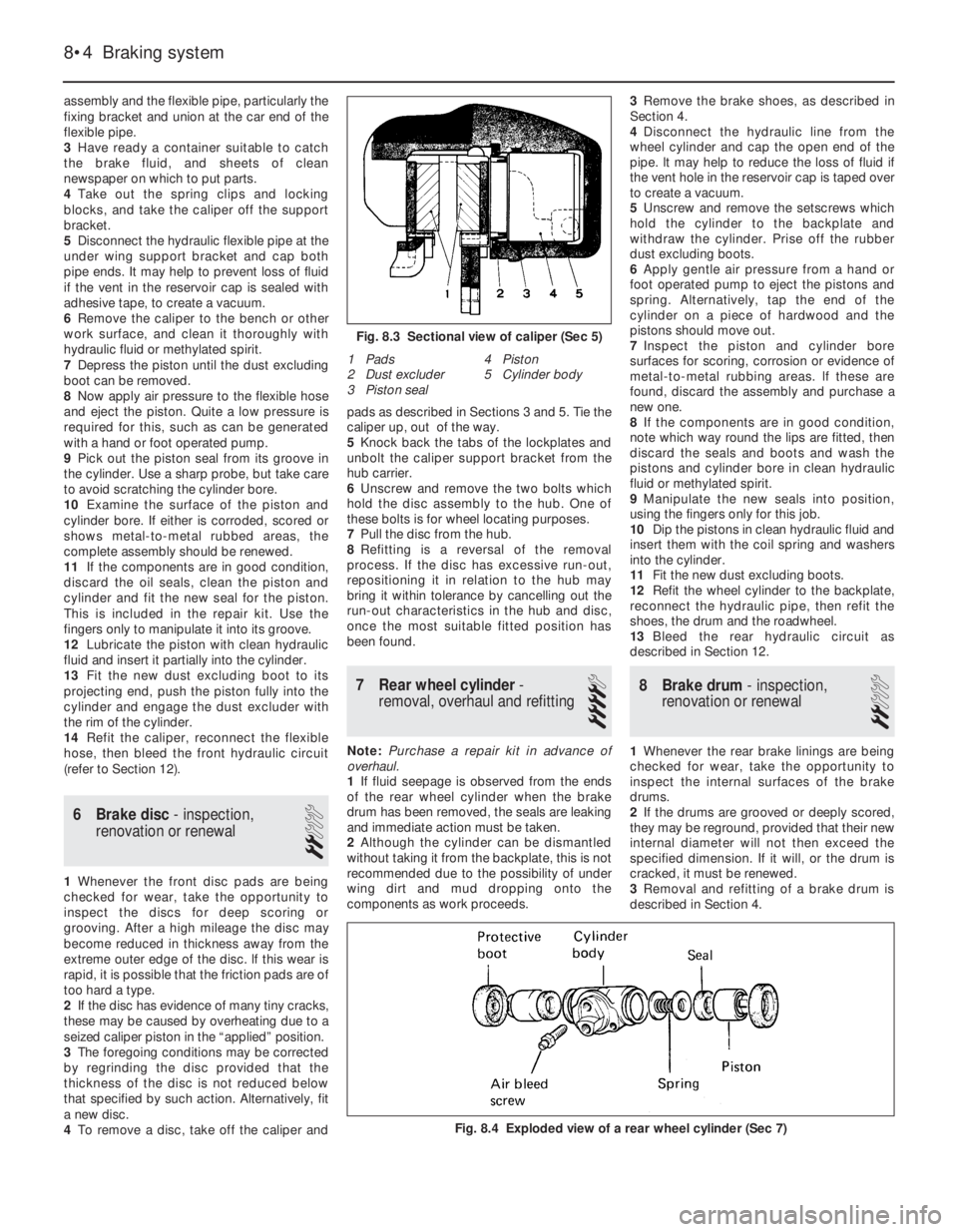
7 Rear wheel cylinder-
removal, overhaul and refitting
4
Note: Purchase a repair kit in advance of
overhaul.
1If fluid seepage is observed from the ends
of the rear wheel cylinder when the brake
drum has been removed, the seals are leaking
and immediate action must be taken.
2Although the cylinder can be dismantled
without taking it from the backplate, this is not
recommended due to the possibility of under
wing dirt and mud dropping onto the
components as work proceeds. 3Remove the brake shoes, as described in
Section 4.
4Disconnect the hydraulic line from the
wheel cylinder and cap the open end of the
pipe. lt may help to reduce the loss of fluid if
the vent hole in the reservoir cap is taped over
to create a vacuum.
5Unscrew and remove the setscrews which
hold the cylinder to the backplate and
withdraw the cylinder. Prise off the rubber
dust excluding boots.
6Apply gentle air pressure from a hand or
foot operated pump to eject the pistons and
spring. Alternatively, tap the end of the
cylinder on a piece of hardwood and the
pistons should move out.
7Inspect the piston and cylinder bore
surfaces for scoring, corrosion or evidence of
metal-to-metal rubbing areas. lf these are
found, discard the assembly and purchase a
new one.
8If the components are in good condition,
note which way round the lips are fitted, then
discard the seals and boots and wash the
pistons and cylinder bore in clean hydraulic
fluid or methylated spirit.
9Manipulate the new seals into position,
using the fingers only for this job.
10Dip the pistons in clean hydraulic fluid and
insert them with the coil spring and washers
into the cylinder.
11Fit the new dust excluding boots.
12Refit the wheel cylinder to the backplate,
reconnect the hydraulic pipe, then refit the
shoes, the drum and the roadwheel.
13Bleed the rear hydraulic circuit as
described in Section 12.
8 Brake drum- inspection,
renovation or renewal
2
1Whenever the rear brake linings are being
checked for wear, take the opportunity to
inspect the internal surfaces of the brake
drums.
2If the drums are grooved or deeply scored,
they may be reground, provided that their new
internal diameter will not then exceed the
specified dimension. If it will, or the drum is
cracked, it must be renewed.
3Removal and refitting of a brake drum is
described in Section 4.
8•4 Braking system
Fig. 8.4 Exploded view of a rear wheel cylinder (Sec 7)
1 Pads
2 Dust excluder
3 Piston seal4 Piston
5 Cylinder body
Fig. 8.3 Sectional view of caliper (Sec 5)
Page 109 of 303
1 General description
The front suspension is of independent
MacPherson strut type.
The rear suspension consists of a beam
axle with trailing arms, coil springs and double
acting gas-filled telescopic shock absorbers.
Operations covering the hubs, roadwheels
and tyres are described in Chapter 7.
2 Maintenance
4
1Periodically check the tightness of all
suspension nuts and bolts using a torque
wrench.
2At the intervals specified in “Routine
Maintenance” inspect all suspension rubber
bushes for deterioration or wear. Renew
where necessary.
3Check for wear in the track control arm to
hub carrier balljoint. Do this by raising the
roadwheel and prising the control arm down.
If the hub carrier is pulled outwards, any up
and down movement or slackness will
necessitate renewal of the track control arm,
although it may be possible to obtain a
balljoint repair kit from a motor factor.
4A defective strut or shock absorber can
usually be detected by the tendency of the car
to pitch badly when braking or cornering.
However the component can be tested more
thoroughly in the following way.
5Remove the strut and take off the coil
spring or withdraw the rear shock absorber as
described later in this Chapter.
6Grip the strut or shock absorber lower
mounting in the jaws of a vice and then fully
extend and contract the unit five or six times,
with the unit held in a vertical attitude. If there is
any lack of resistance, jerkiness or seizure, then
the unit will have to be renewed, no repair being
possible. It is recommended that struts orshock absorbers are renewed in pairs as axle
sets, in order to maintain similar suspension
characteristics on both sides of the car.
7Check for signs of hydraulic fluid leakage
from around the front strut spindle gland and
also the condition of the dust excluding boot.
Oil leakage will mean a new unit, a split boot
can be renewed after having withdrawn the
coil spring.
3 Front suspension strut-
removal and refitting
4
1Raise the front of the car, support it
securely and remove the roadwheel.2Release the brake hydraulic hose
from the strut by unscrewing the retaining clip
bolt.
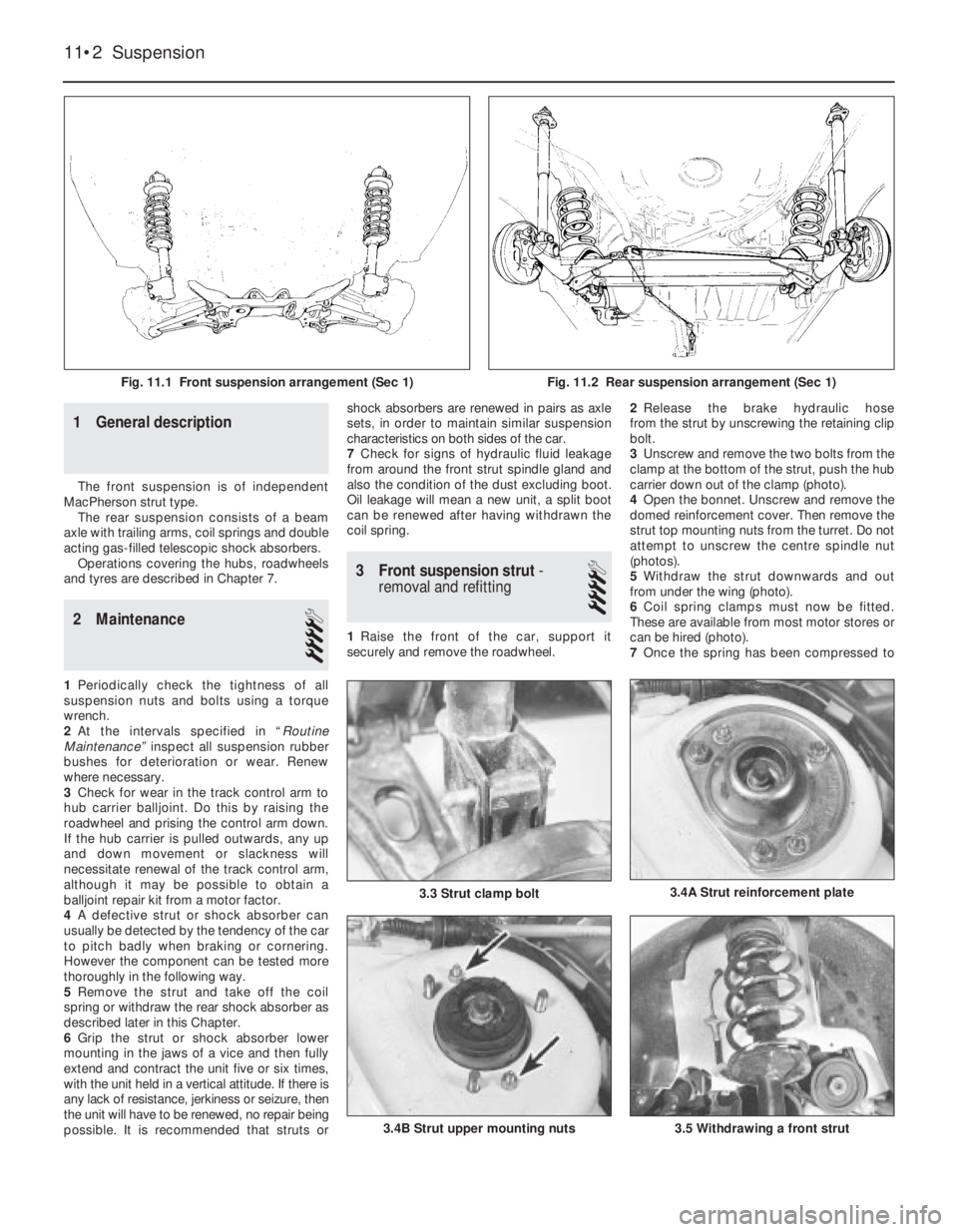
3Unscrew and remove the two bolts from the
clamp at the bottom of the strut, push the hub
carrier down out of the clamp (photo).
4Open the bonnet. Unscrew and remove the
domed reinforcement cover. Then remove the
strut top mounting nuts from the turret. Do not
attempt to unscrew the centre spindle nut
(photos).
5Withdraw the strut downwards and out
from under the wing (photo).
6Coil spring clamps must now be fitted.
These are available from most motor stores or
can be hired (photo).
7Once the spring has been compressed to
11•2 Suspension
3.5 Withdrawing a front strut3.4B Strut upper mounting nuts
3.4A Strut reinforcement plate3.3 Strut clamp bolt
Fig. 11.1 Front suspension arrangement (Sec 1)Fig. 11.2 Rear suspension arrangement (Sec 1)
Page 143 of 303
13•18 Supplement: Revisions and information on later models
Every 9000 miles (15 000 km) or
12 months (whichever comes first)
m mCheck the tyre pressures and their condition
(including the spare)
m mWhere a pad wear warning light is fitted, check its
operation
m mCheck the front brake disc pads for excessive wear
m mCheck the underbody condition (fuel and brakes
pipes, exhaust system, hoses, bushes and gaiters)
m mCheck the condition and tension of drivebelts
m mCheck the engine idle speed and CO emissions
m mCheck the EGR system (If fitted)
m mCheck fluid levels (coolant, brake fluid and
windscreen washer)
m mRenew spark plugs (1372 cc Turbo models)
m mRenew the engine oil and oil filter (non-Turbo
models)
m mCheck the HT leads and connections
m mCheck the condition of all coolant, fuel and
hydraulic hoses and connections
Every 18 000 miles (30 000 km) or
24 months (whichever comes first)
In addition to the items listed for 9000 mile (15 000 km) or 12 months
service
m mCheck the rear brake disc pads for wear (where
applicable)
m mCheck/adjust the valve clearances
m mCheck and tighten (if necessary), inlet and exhaust
manifolds
m mCheck the clutch adjustment (cable operated
models)
m mRenew the fuel filter (where applicable)
m mRenew the air cleaner element
m mRenew the spark plugs and check the HT leads
and connections (all models)
m mWhere applicable, have the ignition and injection
systems checked (special equipment needed)
m mRenew coolant
m mRenew brake fluid
Every 28 000 miles (45 000 km) or
36 months (whichever comes first)
In addition to the items listed for 9000 mile (15 000 km) or 12 months
service
m mCheck Lambda (oxygen) sensors operation (special
equipment needed)
m mCheck fuel evaporation system (where fitted)
m mCheck the transmission oil level
m mCheck the condition crankcase ventilation system
Every 37 000 miles (60 000 km) or
48 months (whichever comes first)
In addition to the items listed for 18 000 mile (30 000 km) or
24 months service
m mCheck the condition of the rear brake shoe linings
m mCheck the condition of the timing belt
Every 65 000 miles (105 000 km)
m
mRenew the timing belt
Every 74 500 miles (120 000 km)
m
mRenew the manual transmission oil
Every 250 miles (400 km), weekly or
before a long journey
m mProceed as described for the earlier models at the
start of this manual
Every 6000 miles (10 000 km) or
12 months (whichever comes first)
m mRenew the engine oil and oil filter (Turbo models
only)
3 Routine maintenance- all models from June 1991
The maintenance intervals in this manual are provided with the
assumption that you, not the dealer, will be carrying out the work.
These are the minimum maintenance intervals recommended by us, for
vehicles driven daily. If you wish to keep your vehicle in peak condition
at all times, you may wish to perform some of these procedures more
often. We encourage frequent maintenance, since it enhances the
efficiency, performance and resale value of your vehicle.
If the vehicle is driven in dusty areas, used to tow a trailer, or driven
frequently at slow speeds (idling in traffic) or on short journeys, more
frequent maintenance intervals are recommended.
When the vehicle is new, it should be serviced by an authorised
dealer to preserve the factory warranty.
Page 146 of 303
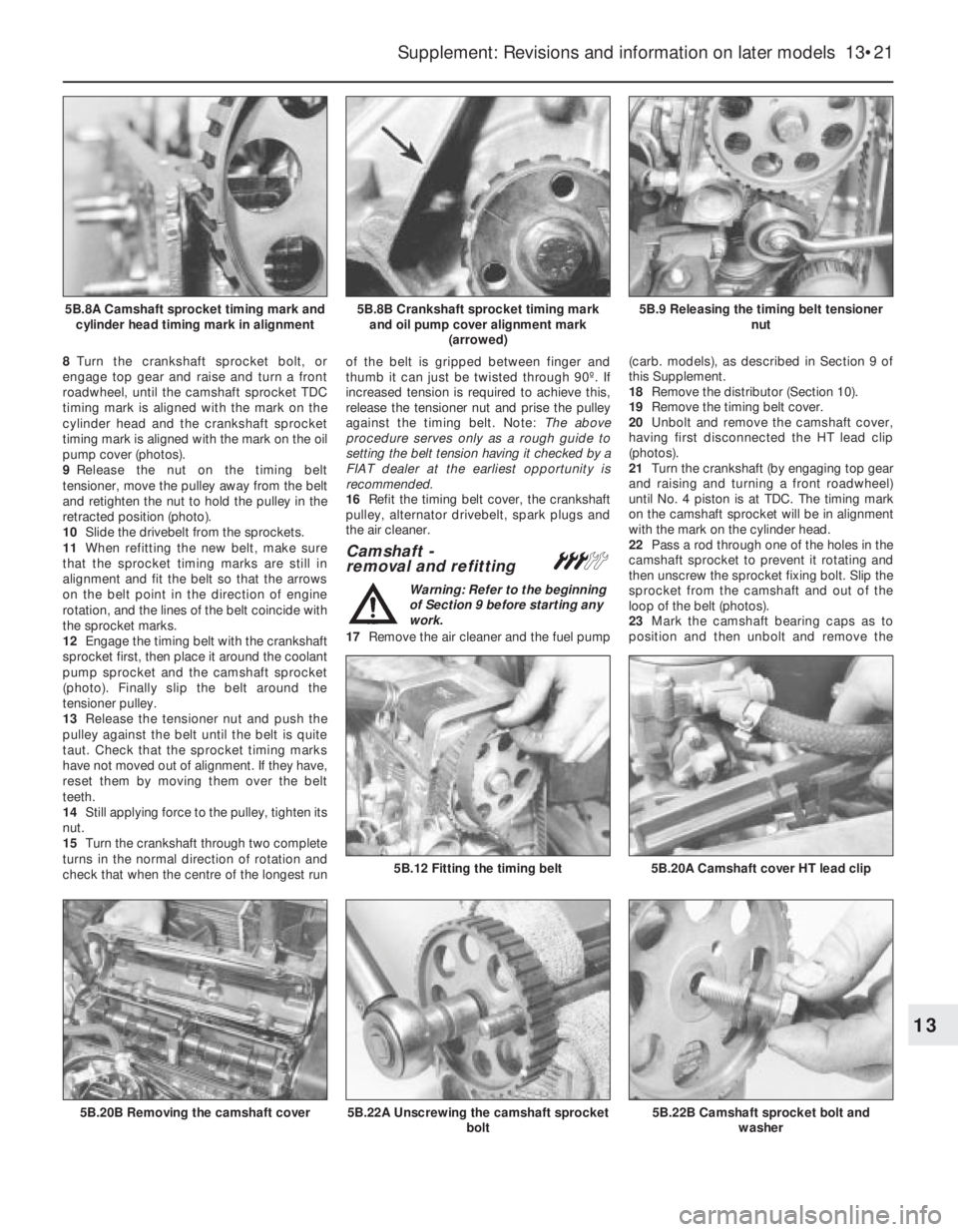
8Turn the crankshaft sprocket bolt, or
engage top gear and raise and turn a front
roadwheel, until the camshaft sprocket TDC
timing mark is aligned with the mark on the
cylinder head and the crankshaft sprocket
timing mark is aligned with the mark on the oil
pump cover (photos).
9Release the nut on the timing belt
tensioner, move the pulley away from the belt
and retighten the nut to hold the pulley in the
retracted position (photo).
10Slide the drivebelt from the sprockets.
11When refitting the new belt, make sure
that the sprocket timing marks are still in
alignment and fit the belt so that the arrows
on the belt point in the direction of engine
rotation, and the lines of the belt coincide with
the sprocket marks.
12Engage the timing belt with the crankshaft
sprocket first, then place it around the coolant
pump sprocket and the camshaft sprocket
(photo). Finally slip the belt around the
tensioner pulley.
13Release the tensioner nut and push the
pulley against the belt until the belt is quite
taut. Check that the sprocket timing marks
have not moved out of alignment. If they have,
reset them by moving them over the belt
teeth.
14Still applying force to the pulley, tighten its
nut.
15Turn the crankshaft through two complete
turns in the normal direction of rotation and
check that when the centre of the longest runof the belt is gripped between finger and
thumb it can just be twisted through 90º. If
increased tension is required to achieve this,
release the tensioner nut and prise the pulley
against the timing belt. Note: The above
procedure serves only as a rough guide to
setting the belt tension having it checked by a
FIAT dealer at the earliest opportunity is
recommended.
16Refit the timing belt cover, the crankshaft
pulley, alternator drivebelt, spark plugs and
the air cleaner.
Camshaft -
removal and refitting#
Warning: Refer to the beginning
of Section 9 before starting any
work.
17Remove the air cleaner and the fuel pump(carb. models), as described in Section 9 of
this Supplement.
18Remove the distributor (Section 10).
19Remove the timing belt cover.
20Unbolt and remove the camshaft cover,
having first disconnected the HT lead clip
(photos).
21Turn the crankshaft (by engaging top gear
and raising and turning a front roadwheel)
until No. 4 piston is at TDC. The timing mark
on the camshaft sprocket will be in alignment
with the mark on the cylinder head.
22Pass a rod through one of the holes in the
camshaft sprocket to prevent it rotating and
then unscrew the sprocket fixing bolt. Slip the
sprocket from the camshaft and out of the
loop of the belt (photos).
23Mark the camshaft bearing caps as to
position and then unbolt and remove the
Supplement: Revisions and information on later models 13•21
5B.9 Releasing the timing belt tensioner
nut5B.8B Crankshaft sprocket timing mark
and oil pump cover alignment mark
(arrowed)5B.8A Camshaft sprocket timing mark and
cylinder head timing mark in alignment
5B.22B Camshaft sprocket bolt and
washer5B.22A Unscrewing the camshaft sprocket
bolt
5B.20A Camshaft cover HT lead clip5B.12 Fitting the timing belt
5B.20B Removing the camshaft cover
13
Page 151 of 303
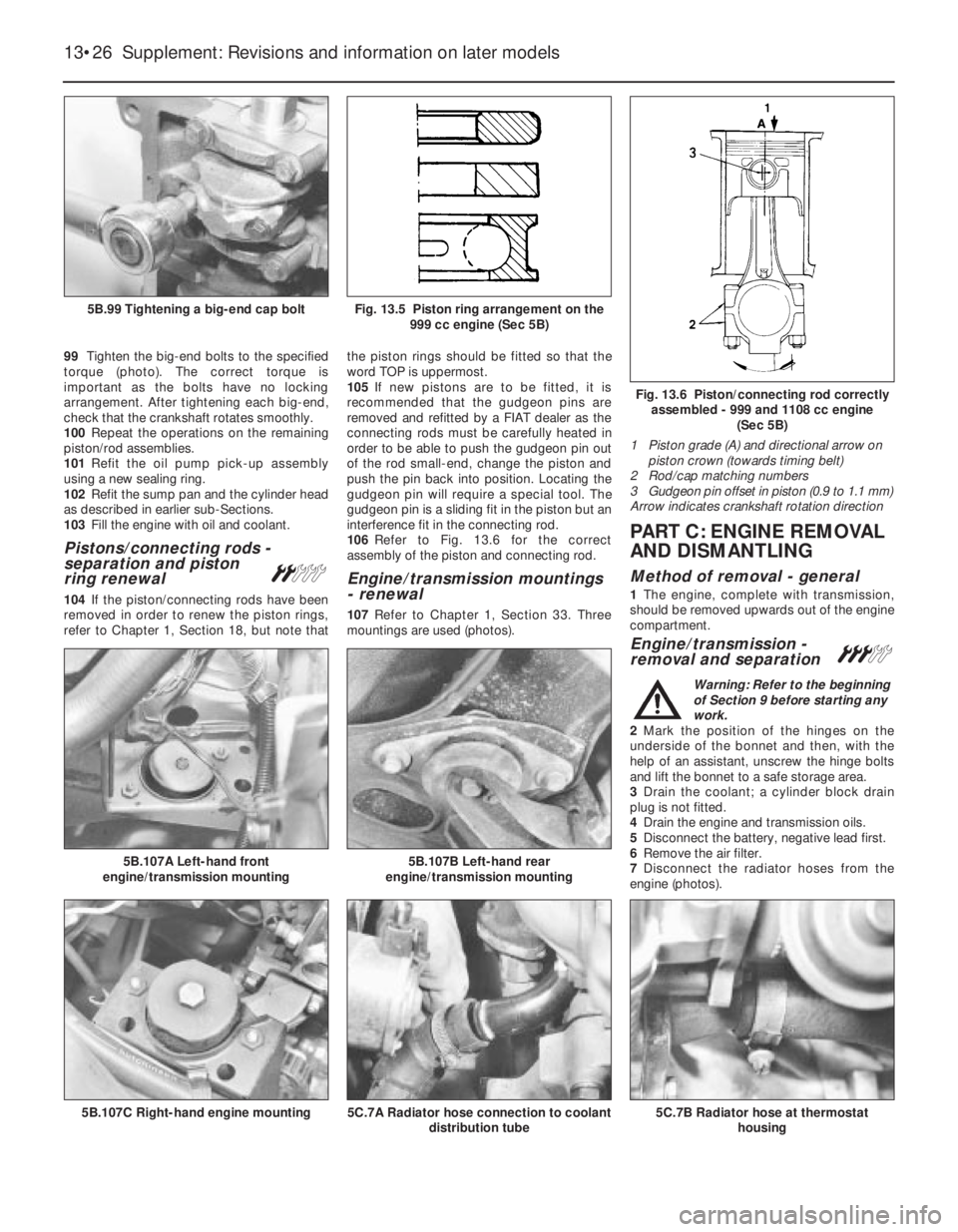
99Tighten the big-end bolts to the specified
torque (photo). The correct torque is
important as the bolts have no locking
arrangement. After tightening each big-end,
check that the crankshaft rotates smoothly.
100Repeat the operations on the remaining
piston/rod assemblies.
101Refit the oil pump pick-up assembly
using a new sealing ring.
102Refit the sump pan and the cylinder head
as described in earlier sub-Sections.
103Fill the engine with oil and coolant.
Pistons/connecting rods -
separation and piston
ring renewal
ª
104If the piston/connecting rods have been
removed in order to renew the piston rings,
refer to Chapter 1, Section 18, but note thatthe piston rings should be fitted so that the
word TOP is uppermost.
105If new pistons are to be fitted, it is
recommended that the gudgeon pins are
removed and refitted by a FIAT dealer as the
connecting rods must be carefully heated in
order to be able to push the gudgeon pin out
of the rod small-end, change the piston and
push the pin back into position. Locating the
gudgeon pin will require a special tool. The
gudgeon pin is a sliding fit in the piston but an
interference fit in the connecting rod.
106Refer to Fig. 13.6 for the correct
assembly of the piston and connecting rod.
Engine/transmission mountings
- renewal
107Refer to Chapter 1, Section 33. Three
mountings are used (photos).
PART C: ENGINE REMOVAL
AND DISMANTLING
Method of removal - general
1The engine, complete with transmission,
should be removed upwards out of the engine
compartment.
Engine/transmission -
removal and separation #
Warning: Refer to the beginning
of Section 9 before starting any
work.
2Mark the position of the hinges on the
underside of the bonnet and then, with the
help of an assistant, unscrew the hinge bolts
and lift the bonnet to a safe storage area.
3Drain the coolant; a cylinder block drain
plug is not fitted.
4Drain the engine and transmission oils.
5Disconnect the battery, negative lead first.
6Remove the air filter.
7Disconnect the radiator hoses from the
engine (photos).
13•26 Supplement: Revisions and information on later models
5C.7B Radiator hose at thermostat
housing5C.7A Radiator hose connection to coolant
distribution tube5B.107C Right-hand engine mounting
5B.107B Left-hand rear
engine/transmission mounting5B.107A Left-hand front
engine/transmission mounting
Fig. 13.6 Piston/connecting rod correctly
assembled - 999 and 1108 cc engine
(Sec 5B)
1 Piston grade (A) and directional arrow on
piston crown (towards timing belt)
2 Rod/cap matching numbers
3 Gudgeon pin offset in piston (0.9 to 1.1 mm)
Arrow indicates crankshaft rotation direction
Fig. 13.5 Piston ring arrangement on the
999 cc engine (Sec 5B)5B.99 Tightening a big-end cap bolt