AUX FIAT UNO 1983 Service Owner's Guide
[x] Cancel search | Manufacturer: FIAT, Model Year: 1983, Model line: UNO, Model: FIAT UNO 1983Pages: 303, PDF Size: 10.36 MB
Page 230 of 303
Starter motor brushes
(later models) - renewal#
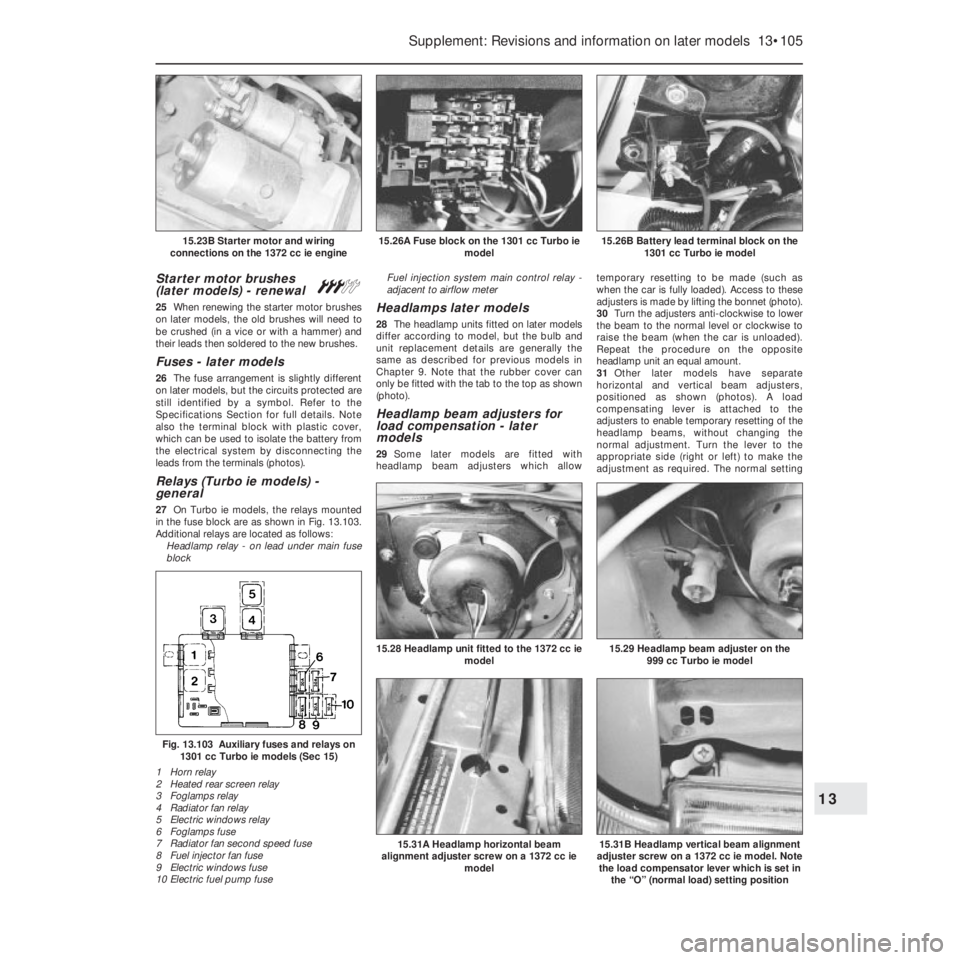
25When renewing the starter motor brushes
on later models, the old brushes will need to
be crushed (in a vice or with a hammer) and
their leads then soldered to the new brushes.
Fuses - later models
26The fuse arrangement is slightly different
on later models, but the circuits protected are
still identified by a symbol. Refer to the
Specifications Section for full details. Note
also the terminal block with plastic cover,
which can be used to isolate the battery from
the electrical system by disconnecting the
leads from the terminals (photos).
Relays (Turbo ie models) -
general
27On Turbo ie models, the relays mounted
in the fuse block are as shown in Fig. 13.103.
Additional relays are located as follows:
Headlamp relay - on lead under main fuse
blockFuel injection system main control relay -
adjacent to airflow meter
Headlamps later models
28The headlamp units fitted on later models
differ according to model, but the bulb and
unit replacement details are generally the
same as described for previous models in
Chapter 9. Note that the rubber cover can
only be fitted with the tab to the top as shown
(photo).
Headlamp beam adjusters for
load compensation - later
models
29Some later models are fitted with
headlamp beam adjusters which allowtemporary resetting to be made (such as
when the car is fully loaded). Access to these
adjusters is made by lifting the bonnet (photo).
30Turn the adjusters anti-clockwise to lower
the beam to the normal level or clockwise to
raise the beam (when the car is unloaded).
Repeat the procedure on the opposite
headlamp unit an equal amount.
31Other later models have separate
horizontal and vertical beam adjusters,
positioned as shown (photos). A load
compensating lever is attached to the
adjusters to enable temporary resetting of the
headlamp beams, without changing the
normal adjustment. Turn the lever to the
appropriate side (right or left) to make the
adjustment as required. The normal setting
Supplement: Revisions and information on later models 13•105
15.26B Battery lead terminal block on the
1301 cc Turbo ie model15.23B Starter motor and wiring
connections on the 1372 cc ie engine
15.31B Headlamp vertical beam alignment
adjuster screw on a 1372 cc ie model. Note
the load compensator lever which is set in
the “O” (normal load) setting position15.31A Headlamp horizontal beam
alignment adjuster screw on a 1372 cc ie
model
15.29 Headlamp beam adjuster on the
999 cc Turbo ie model15.28 Headlamp unit fitted to the 1372 cc ie
model
15.26A Fuse block on the 1301 cc Turbo ie
model
13
Fig. 13.103 Auxiliary fuses and relays on
1301 cc Turbo ie models (Sec 15)
1 Horn relay
2 Heated rear screen relay
3 Foglamps relay
4 Radiator fan relay
5 Electric windows relay
6 Foglamps fuse
7 Radiator fan second speed fuse
8 Fuel injector fan fuse
9 Electric windows fuse
10 Electric fuel pump fuse
Page 233 of 303
Auxiliary control panel
(later models) -
removal and refitting
Á
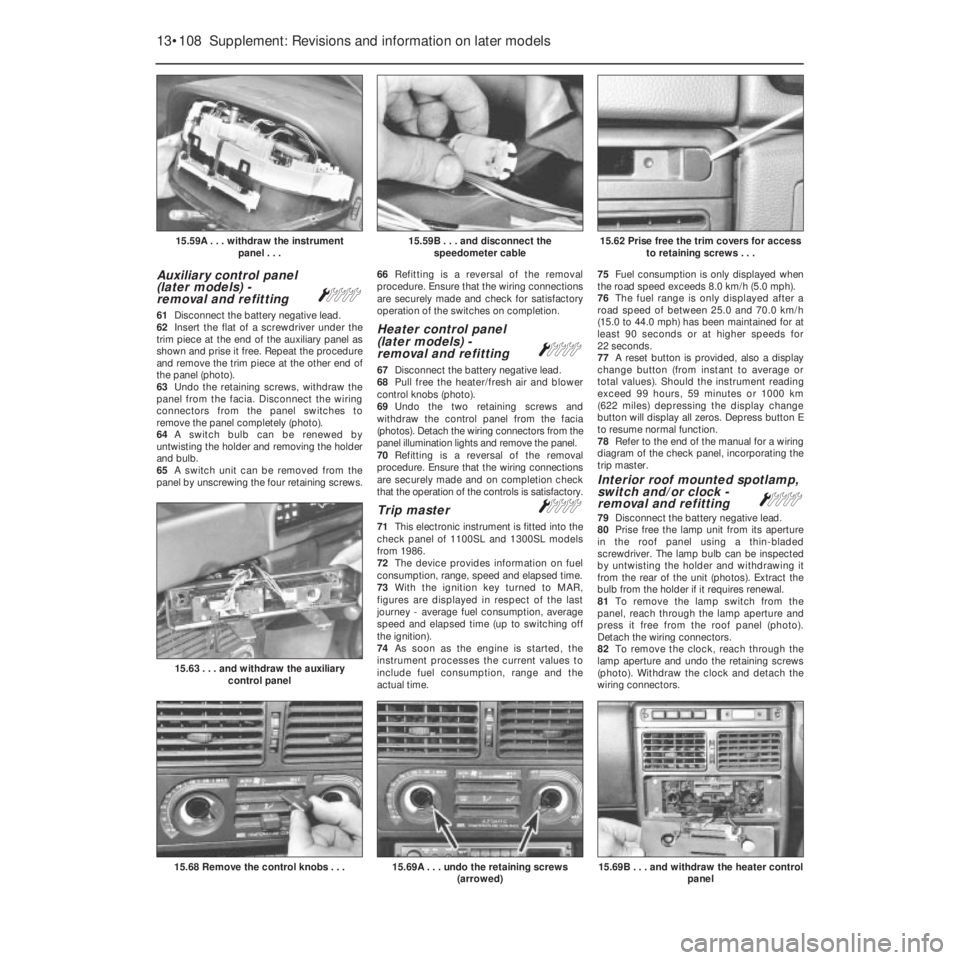
61Disconnect the battery negative lead.
62Insert the flat of a screwdriver under the
trim piece at the end of the auxiliary panel as
shown and prise it free. Repeat the procedure
and remove the trim piece at the other end of
the panel (photo).
63Undo the retaining screws, withdraw the
panel from the facia. Disconnect the wiring
connectors from the panel switches to
remove the panel completely (photo).
64A switch bulb can be renewed by
untwisting the holder and removing the holder
and bulb.
65A switch unit can be removed from the
panel by unscrewing the four retaining screws.66Refitting is a reversal of the removal
procedure. Ensure that the wiring connections
are securely made and check for satisfactory
operation of the switches on completion.
Heater control panel
(later models) -
removal and refitting
Á
67Disconnect the battery negative lead.
68Pull free the heater/fresh air and blower
control knobs (photo).
69Undo the two retaining screws and
withdraw the control panel from the facia
(photos). Detach the wiring connectors from the
panel illumination lights and remove the panel.
70Refitting is a reversal of the removal
procedure. Ensure that the wiring connections
are securely made and on completion check
that the operation of the controls is satisfactory.
Trip master Á
71This electronic instrument is fitted into the
check panel of 1100SL and 1300SL models
from 1986.
72The device provides information on fuel
consumption, range, speed and elapsed time.
73With the ignition key turned to MAR,
figures are displayed in respect of the last
journey - average fuel consumption, average
speed and elapsed time (up to switching off
the ignition).
74As soon as the engine is started, the
instrument processes the current values to
include fuel consumption, range and the
actual time. 75Fuel consumption is only displayed when
the road speed exceeds 8.0 km/h (5.0 mph).
76The fuel range is only displayed after a
road speed of between 25.0 and 70.0 km/h
(15.0 to 44.0 mph) has been maintained for at
least 90 seconds or at higher speeds for
22 seconds.
77A reset button is provided, also a display
change button (from instant to average or
total values). Should the instrument reading
exceed 99 hours, 59 minutes or 1000 km
(622 miles) depressing the display change
button will display all zeros. Depress button E
to resume normal function.
78Refer to the end of the manual for a wiring
diagram of the check panel, incorporating the
trip master.
Interior roof mounted spotlamp,
switch and/or clock -
removal and refitting
Á
79Disconnect the battery negative lead.
80Prise free the lamp unit from its aperture
in the roof panel using a thin-bladed
screwdriver. The lamp bulb can be inspected
by untwisting the holder and withdrawing it
from the rear of the unit (photos). Extract the
bulb from the holder if it requires renewal.
81To remove the lamp switch from the
panel, reach through the lamp aperture and
press it free from the roof panel (photo).
Detach the wiring connectors.
82To remove the clock, reach through the
lamp aperture and undo the retaining screws
(photo). Withdraw the clock and detach the
wiring connectors.
13•108 Supplement: Revisions and information on later models
15.69B . . . and withdraw the heater control
panel15.69A . . . undo the retaining screws
(arrowed)15.68 Remove the control knobs . . .
15.63 . . . and withdraw the auxiliary
control panel
15.62 Prise free the trim covers for access
to retaining screws . . .15.59B . . . and disconnect the
speedometer cable15.59A . . . withdraw the instrument
panel . . .
Page 238 of 303
18Refitting of all components is a reversal of
removal.
Radiator grille (1301 cc
Turbo ie model) -
removal and refitting
Á
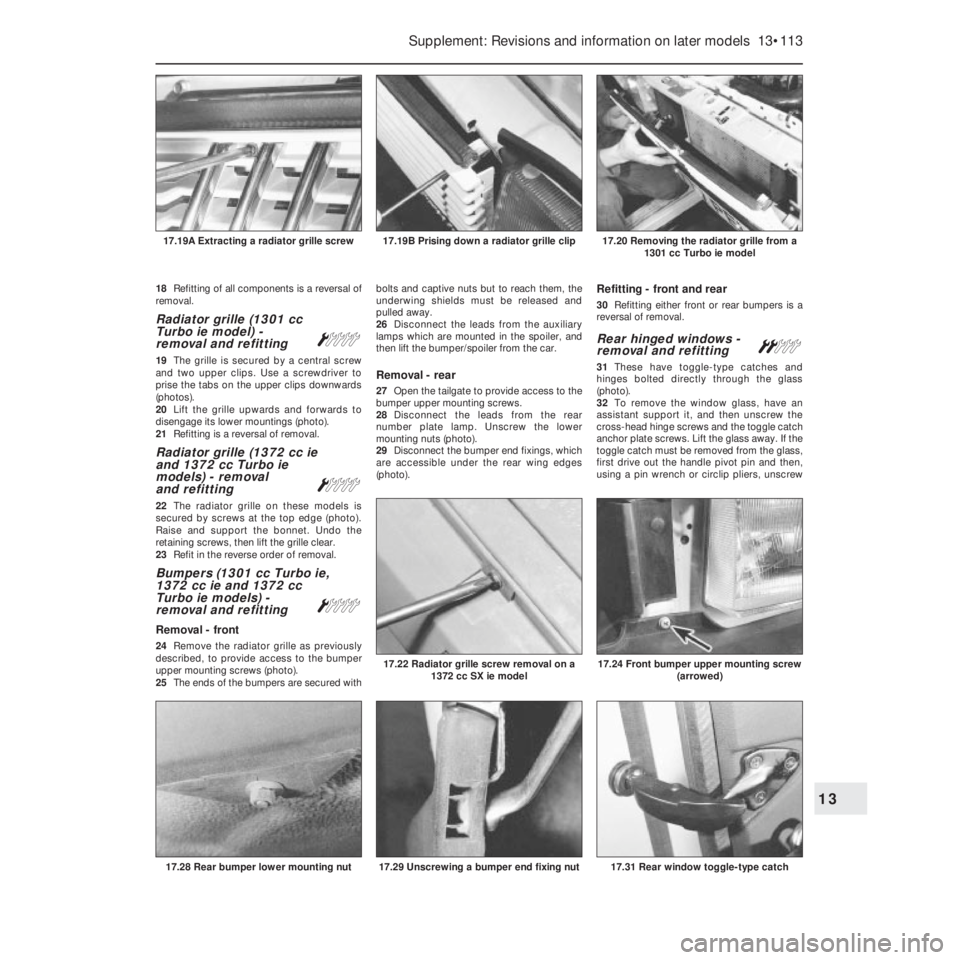
19The grille is secured by a central screw
and two upper clips. Use a screwdriver to
prise the tabs on the upper clips downwards
(photos).
20Lift the grille upwards and forwards to
disengage its lower mountings (photo).
21Refitting is a reversal of removal.
Radiator grille (1372 cc ie
and 1372 cc Turbo ie
models) - removal
and refitting
Á
22The radiator grille on these models is
secured by screws at the top edge (photo).
Raise and support the bonnet. Undo the
retaining screws, then lift the grille clear.
23Refit in the reverse order of removal.
Bumpers (1301 cc Turbo ie,
1372 cc ie and 1372 cc
Turbo ie models) -
removal and refitting
Á
Removal - front
24Remove the radiator grille as previously
described, to provide access to the bumper
upper mounting screws (photo).
25The ends of the bumpers are secured withbolts and captive nuts but to reach them, the
underwing shields must be released and
pulled away.
26Disconnect the leads from the auxiliary
lamps which are mounted in the spoiler, and
then lift the bumper/spoiler from the car.
Removal - rear
27Open the tailgate to provide access to the
bumper upper mounting screws.
28Disconnect the leads from the rear
number plate lamp. Unscrew the lower
mounting nuts (photo).
29Disconnect the bumper end fixings, which
are accessible under the rear wing edges
(photo).
Refitting - front and rear
30Refitting either front or rear bumpers is a
reversal of removal.
Rear hinged windows -
removal and refittingª
31These have toggle-type catches and
hinges bolted directly through the glass
(photo).
32To remove the window glass, have an
assistant support it, and then unscrew the
cross-head hinge screws and the toggle catch
anchor plate screws. Lift the glass away. If the
toggle catch must be removed from the glass,
first drive out the handle pivot pin and then,
using a pin wrench or circlip pliers, unscrew
Supplement: Revisions and information on later models 13•113
17.20 Removing the radiator grille from a
1301 cc Turbo ie model17.19B Prising down a radiator grille clip17.19A Extracting a radiator grille screw
17.31 Rear window toggle-type catch17.29 Unscrewing a bumper end fixing nut
17.24 Front bumper upper mounting screw
(arrowed)17.22 Radiator grille screw removal on a
1372 cc SX ie model
17.28 Rear bumper lower mounting nut
13
Page 300 of 303
A
Accelerator cable - 3•12, 13•80
Accelerator control system - 13•75
Accelerator pump -3•7, 3•8, 3•11, 13•66
Acknowledgements - 0•4
Aerial -9•10
Air bags - 0•5
Air cleaner -3•4, 13•60, 13•69, 13•67,
13•75, 13•79
Air pressure switch - 13•70
Air temperature sensor - 13•76
Airflow meter - 13•67, 13•69, 13•80
Alternator -9•3, 13•58, 13•103, 13•104
Alternator fault -9•14
Anti-flooding device -3•8, 3•9, 3•10, 3•11,
13•64
Anti-knock sensor - 13•86, 13•90
Anti-roll bar - 13•111
Antifreeze - 0•6, 0•13, 2•1, 2•2
Antiskid system - 13•103
Armrest - 13•112
Asbestos - 0•5
Auxiliary shaft -1•29, 1•30, 13•51, 13•53
B
Battery -0•5, 9•2
Battery fault -9•14
Bleeding brakes -8•7
Bleeding clutch - 13•94
Bodywork- 12•1et seq, 13•111, REF•4
Bonnet - 12•3, 12•4
Boots -7•2, 10•2, 13•98
Brake fluid -0•13, 8•1, 13•110, 13•111
Braking system-8•1et seq, 13•100,
REF•1, REF•2, REF•3
Braking system fault finding -8•9
Breakerless ignition system - 13•85, 13•86
Bumpers - 12•4, 12•11, 13•113
Burning -0•5
C
Cables -3•12, 5•1, 8•9, 9•8, 13•80
Calipers -8•3, 13•101, 13•102Camshaft -1•19, 1•21, 1•24, 1•29, 1•32,
13•21, 13•30, 13•34, 13•41, 13•42
Capacities -0•6, 13•17
Carburettors -3•6 to 3•11, 13•62 to 13•66
Carpets - 12•2
Cassette player-9•10
Catalytic converter - 13•77
Central door locking -9•11, 13•109
Centre console - 12•9
Check control (warning module) system -
9•12, 9•13, 13•110, 13•111
Choke -3•11, 3•12
Cigar lighter -9•13, 13•109
Clock -9•13, 13•108
Clutch-5•1et seq, 13•83, 13•92, 13•94
Clutch fault finding -5•3
Clutch fluid -0•13
CO emissions (mixture) - REF•4
Coil -4•6, 13•86, 13•90, 13•91
Coil spring - 11•3, 11•4
Condenser -4•5
Connecting rods -1•12, 1•18, 1•22, 1•26,
1•30, 13•25, 13•26, 13•30, 13•35,
13•47, 13•48, 13•53
Console - 12•9
Constant velocity joint -0•13, 7•3, 13•98,
13•99
Contact breaker points -4•2, 4•3
Contents -0•2
Control panel - 13•108
Conversion factors -0•14
Coolant -0•6, 0•13, 2•1, 2•2, 13•69, 13•70,
13•110, 13•111
Coolant pump -2•4, 13•55, 13•58
Cooling and heating systems-2•1et seq,
13•54, 13•55
Cooling and heating systems fault finding -
2•8
Courtesy lamp -9•5, 9•8
Crankcase -1•17
Crankcase ventilation system -1•8
Crankshaft -1•18, 1•20, 1•30, 1•31, 13•44,
13•45, 13•52
Crossmember - 11•4
Crushing -0•5
CV joints -0•13, 7•3, 13•98, 13•99
Cylinder block -1•17Cylinder head -1•10, 1•16, 1•19, 1•22,
1•25, 1•28, 1•32, 13•19, 13•22, 13•30,
13•34, 13•43, 13•44, 13•53
D
Dents in bodywork - 12•2
Depressurisation (fuel system) - 13•75
Digiplex 2 ignition system - 13•90
Dim-dip system - 13•106
Dimensions -0•6, 13•17
Direction indicators -9•7
Discs -8•4, 13•101, 13•102
Distributor -4•3, 4•5, 13•86, 13•89, 13•90,
13•92
Doors -9•11, 12•5, 12•6, 12•7, 13•111,
13•112, 13•114, REF•2
Drivebelts -2•3, 13•58
Driveshaft
Driveshafts and hubs fault finding -7•6
Driveshafts,hubs,roadwheels and tyres-
0•13, 7•1et seq, 10•4, 11•3, 11•6,
13•98, 13•99, REF•3, REF•4
Drums -8•4
Dwell angle -4•4
E
Economy gauge (Econometer) -3•11, 9•12
Electric shock -0•5
Electric windows -9•11, 13•109
Electrical control circuit (ECU) - 13•67,
13•71, 13•81, 13•86, 13•90
Electrical system-9•1et seq,13•103,
REF•2
Electrical system fault finding -9•14,
REF•9
Electronic ignition -4•3, 4•6, 4•7
Engine-1•1et seq, 13•19, 13•33, 13•37
Engine fault finding -1•35, 1•36, 2•8, 3•13,
4•9, 13•92, REF•10, REF•11
Engine oil -0•6, 0•13, 1•3, 1•4, 1•8
Engine speed sensor -4•7, 13•89, 13•91
Environmental considerations - REF•8
Exhaust emission checks - REF•4
Exhaust manifold - 13•77
Exhaust system -3•12, REF•3
IndexREF•17
REF
Note: References throughout this index relate to Chapter•page number