ECU FIAT UNO 1983 Service Owner's Guide
[x] Cancel search | Manufacturer: FIAT, Model Year: 1983, Model line: UNO, Model: FIAT UNO 1983Pages: 303, PDF Size: 10.36 MB
Page 111 of 303
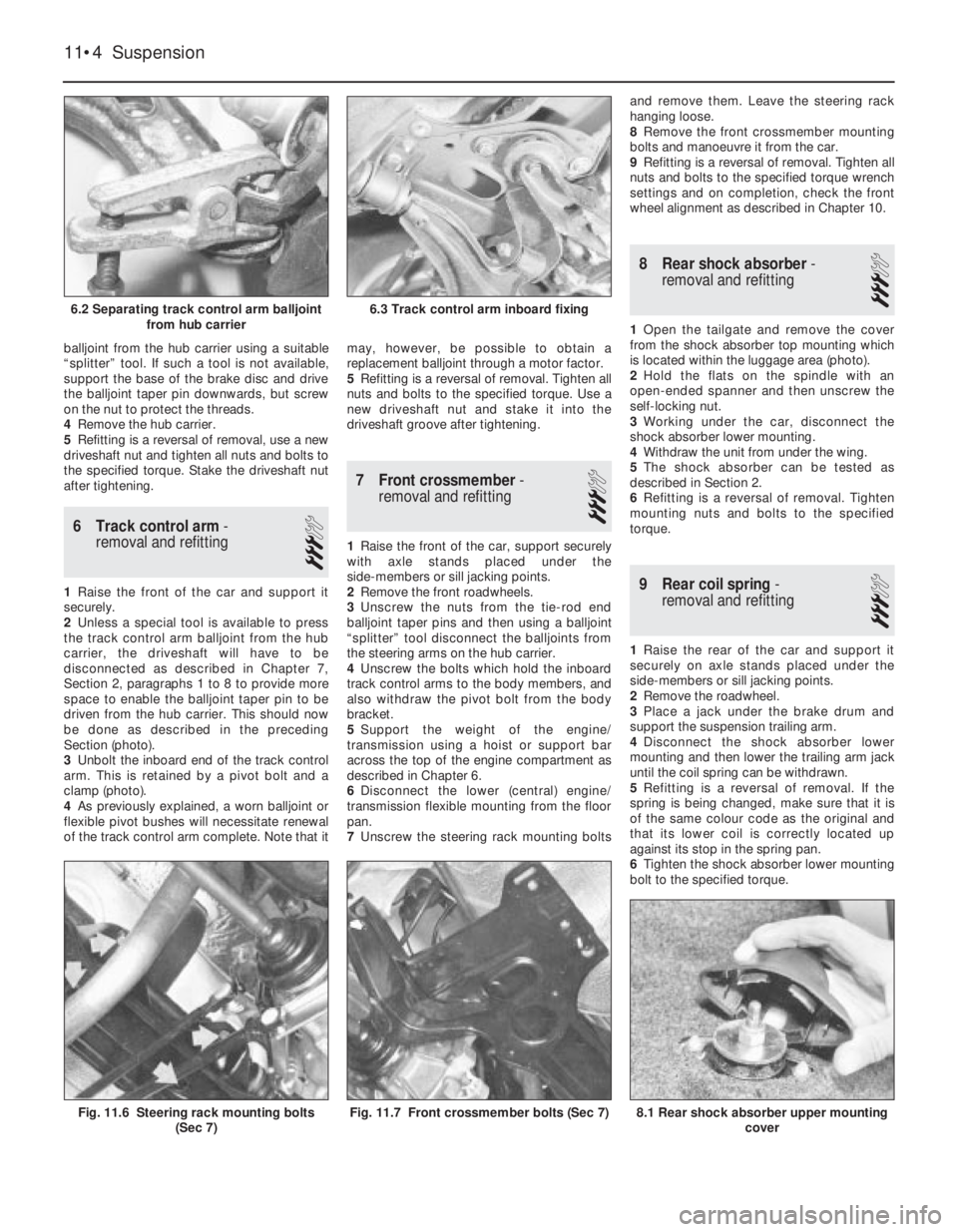
balljoint from the hub carrier using a suitable
“splitter” tool. If such a tool is not available,
support the base of the brake disc and drive
the balljoint taper pin downwards, but screw
on the nut to protect the threads.
4Remove the hub carrier.
5Refitting is a reversal of removal, use a new
driveshaft nut and tighten all nuts and bolts to
the specified torque. Stake the driveshaft nut
after tightening.
6 Track control arm-
removal and refitting
3
1Raise the front of the car and support it
securely.
2Unless a special tool is available to press
the track control arm balljoint from the hub
carrier, the driveshaft will have to be
disconnected as described in Chapter 7,
Section 2, paragraphs 1 to 8 to provide more
space to enable the balljoint taper pin to be
driven from the hub carrier. This should now
be done as described in the preceding
Section (photo).
3Unbolt the inboard end of the track control
arm. This is retained by a pivot bolt and a
clamp (photo).
4As previously explained, a worn balljoint or
flexible pivot bushes will necessitate renewal
of the track control arm complete. Note that itmay, however, be possible to obtain a
replacement balljoint through a motor factor.
5Refitting is a reversal of removal. Tighten all
nuts and bolts to the specified torque. Use a
new driveshaft nut and stake it into the
driveshaft groove after tightening.
7 Front crossmember-
removal and refitting
3
1Raise the front of the car, support securely
with axle stands placed under the
side-members or sill jacking points.
2Remove the front roadwheels.
3Unscrew the nuts from the tie-rod end
balljoint taper pins and then using a balljoint
“splitter” tool disconnect the balljoints from
the steering arms on the hub carrier.
4Unscrew the bolts which hold the inboard
track control arms to the body members, and
also withdraw the pivot bolt from the body
bracket.
5Support the weight of the engine/
transmission using a hoist or support bar
across the top of the engine compartment as
described in Chapter 6.
6Disconnect the lower (central) engine/
transmission flexible mounting from the floor
pan.
7Unscrew the steering rack mounting boltsand remove them. Leave the steering rack
hanging loose.
8Remove the front crossmember mounting
bolts and manoeuvre it from the car.
9Refitting is a reversal of removal. Tighten all
nuts and bolts to the specified torque wrench
settings and on completion, check the front
wheel alignment as described in Chapter 10.
8 Rear shock absorber-
removal and refitting
3
1Open the tailgate and remove the cover
from the shock absorber top mounting which
is located within the luggage area (photo).
2Hold the flats on the spindle with an
open-ended spanner and then unscrew the
self-locking nut.
3Working under the car, disconnect the
shock absorber lower mounting.
4Withdraw the unit from under the wing.
5The shock absorber can be tested as
described in Section 2.
6Refitting is a reversal of removal. Tighten
mounting nuts and bolts to the specified
torque.
9 Rear coil spring-
removal and refitting
3
1Raise the rear of the car and support it
securely on axle stands placed under the
side-members or sill jacking points.
2Remove the roadwheel.
3Place a jack under the brake drum and
support the suspension trailing arm.
4Disconnect the shock absorber lower
mounting and then lower the trailing arm jack
until the coil spring can be withdrawn.
5Refitting is a reversal of removal. If the
spring is being changed, make sure that it is
of the same colour code as the original and
that its lower coil is correctly located up
against its stop in the spring pan.
6Tighten the shock absorber lower mounting
bolt to the specified torque.
11•4 Suspension
8.1 Rear shock absorber upper mounting
coverFig. 11.7 Front crossmember bolts (Sec 7)Fig. 11.6 Steering rack mounting bolts
(Sec 7)
6.3 Track control arm inboard fixing6.2 Separating track control arm balljoint
from hub carrier
Page 112 of 303
10 Trailing arm rubber bush-
renewal
3
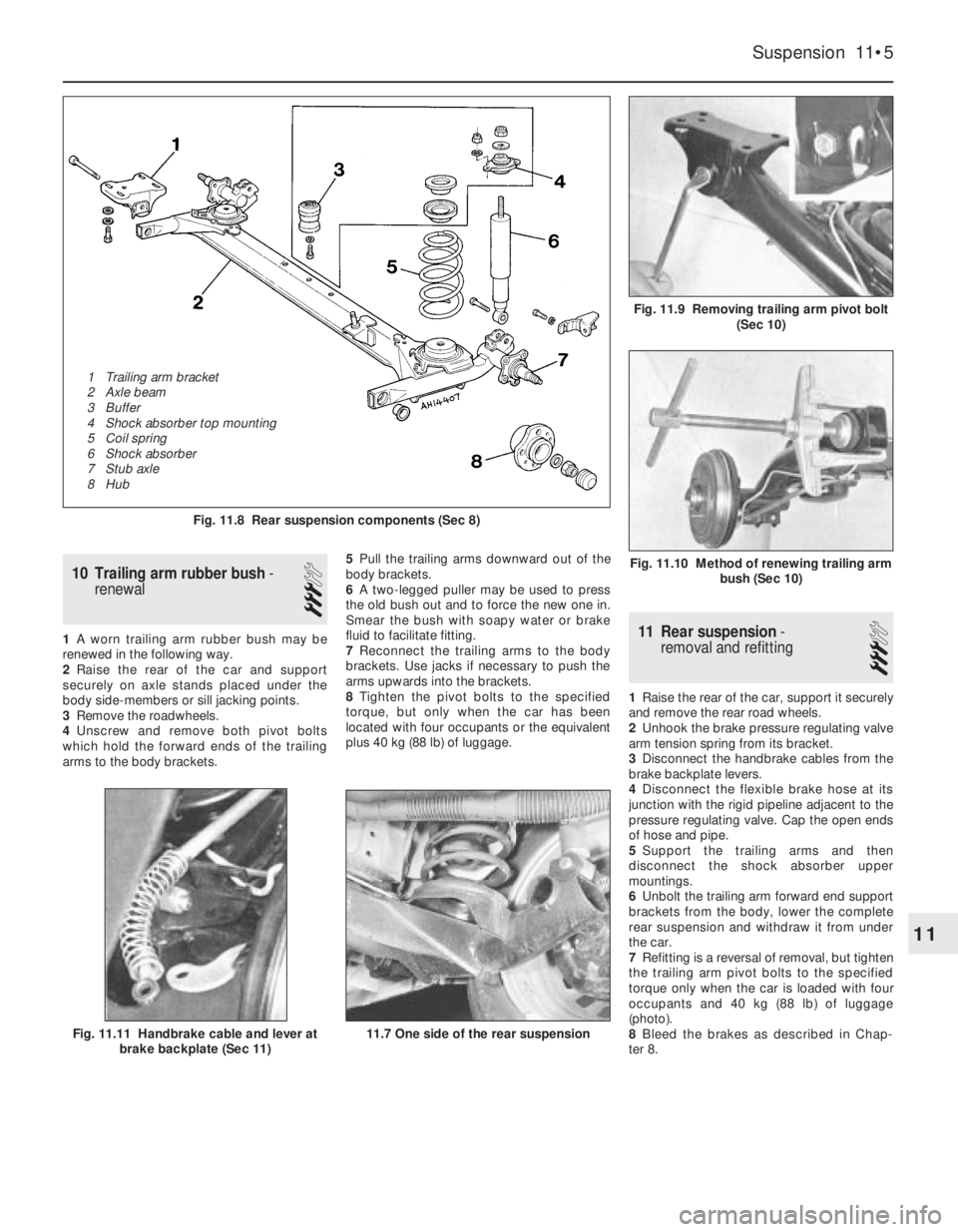
1A worn trailing arm rubber bush may be
renewed in the following way.
2Raise the rear of the car and support
securely on axle stands placed under the
body side-members or sill jacking points.
3Remove the roadwheels.
4Unscrew and remove both pivot bolts
which hold the forward ends of the trailing
arms to the body brackets.5Pull the trailing arms downward out of the
body brackets.
6A two-legged puller may be used to press
the old bush out and to force the new one in.
Smear the bush with soapy water or brake
fluid to facilitate fitting.
7Reconnect the trailing arms to the body
brackets. Use jacks if necessary to push the
arms upwards into the brackets.
8Tighten the pivot bolts to the specified
torque, but only when the car has been
located with four occupants or the equivalent
plus 40 kg (88 lb) of luggage.11 Rear suspension-
removal and refitting
3
1Raise the rear of the car, support it securely
and remove the rear road wheels.
2Unhook the brake pressure regulating valve
arm tension spring from its bracket.
3Disconnect the handbrake cables from the
brake backplate levers.
4Disconnect the flexible brake hose at its
junction with the rigid pipeline adjacent to the
pressure regulating valve. Cap the open ends
of hose and pipe.
5Support the trailing arms and then
disconnect the shock absorber upper
mountings.
6Unbolt the trailing arm forward end support
brackets from the body, lower the complete
rear suspension and withdraw it from under
the car.
7Refitting is a reversal of removal, but tighten
the trailing arm pivot bolts to the specified
torque only when the car is loaded with four
occupants and 40 kg (88 lb) of luggage
(photo).
8Bleed the brakes as described in Chap-
ter 8.
Suspension 11•5
Fig. 11.9 Removing trailing arm pivot bolt
(Sec 10)
Fig. 11.8 Rear suspension components (Sec 8)
11.7 One side of the rear suspensionFig. 11.11 Handbrake cable and lever at
brake backplate (Sec 11)
Fig. 11.10 Method of renewing trailing arm
bush (Sec 10)
11
1 Trailing arm bracket
2 Axle beam
3 Buffer
4 Shock absorber top mounting
5 Coil spring
6 Shock absorber
7 Stub axle
8 Hub
Page 116 of 303
affected area with rust-inhibiting paint, if the
back of the rusted area is accessible, treat
this also.
Before filling can take place, it will be
necessary to block the hole in some way. This
can be achieved by the use of aluminium or
plastic mesh, or aluminium tape.
Aluminium or plastic mesh, or glass-fibre
matting, is probably the best material to use
for a large hole. Cut a piece to the
approximate size and shape of the hole to be
filled, then position it in the hole so that its
edges are below the level of the surrounding
bodywork. It can be retained in position by
several blobs of filler paste around its
periphery.
Aluminium tape should be used for small or
very narrow holes. Pull a piece off the roll, trim
it to the approximate size and shape required,
then pull off the backing paper (if used) and
stick the tape over the hole; it can be
overlapped if the thickness of one piece is
insufficient. Burnish down the edges of the
tape with the handle of a screwdriver or
similar, to ensure that the tape is securely
attached to the metal underneath.
Bodywork repairs - filling and
respraying
Before using this Section, see the Sections
on dent, deep scratch, rust holes and gash
repairs.
Many types of bodyfiller are available, but
generally speaking, those proprietary kits
which contain a tin of filler paste and a tube of
resin hardener are best for this type of repair. A
wide, flexible plastic or nylon applicator will be
found invaluable for imparting a smooth and
well-contoured finish to the surface of the filler.
Mix up a little filler on a clean piece of card
or board - measure the hardener carefully
(follow the maker’s instructions on the pack),
otherwise the filler will set too rapidly or too
slowly. Using the applicator, apply the filler
paste to the prepared area; draw the
applicator across the surface of the filler to
achieve the correct contour and to level the
surface. As soon as a contour that
approximates to the correct one is achieved,
stop working the paste - if you carry on too
long, the paste will become sticky and begin
to “pick-up” on the applicator. Continue to
add thin layers of filler paste at 20-minute
intervals, until the level of the filler is just
proud of the surrounding bodywork.
Once the filler has hardened, the excess
can be removed using a metal plane or file.
From then on, progressively-finer grades of
abrasive paper should be used, starting with a
40-grade production paper, and finishing with
a 400-grade wet-and-dry paper. Always wrap
the abrasive paper around a flat rubber, cork,
or wooden block - otherwise the surface of
the filler will not be completely flat. During the
smoothing of the filler surface, the wet-and-
dry paper should be periodically rinsed in
water. This will ensure that a very smooth
finish is imparted to the filler at the final stage.At this stage, the “dent” should be
surrounded by a ring of bare metal, which in
turn should be encircled by the finely
“feathered” edge of the good paintwork.
Rinse the repair area with clean water, until all
of the dust produced by the rubbing-down
operation has gone.
Spray the whole area with a light coat of
primer - this will show up any imperfections in
the surface of the filler. Repair these
imperfections with fresh filler paste or
bodystopper, and once more smooth the
surface with abrasive paper. Repeat this
spray-and-repair procedure until you are
satisfied that the surface of the filler, and the
feathered edge of the paintwork, are perfect.
Clean the repair area with clean water, and
allow to dry fully.
The repair area is now ready for final
spraying. Paint spraying must be carried out
in a warm, dry, windless and dust-free
atmosphere. This condition can be created
artificially if you have access to a large indoor
working area, but if you are forced to work in
the open, you will have to pick your day very
carefully. If you are working indoors, dousing
the floor in the work area with water will help
to settle the dust which would otherwise be in
the atmosphere. If the repair area is confined
to one body panel, mask off the surrounding
panels; this will help to minimise the effects of
a slight mis-match in paint colours. Bodywork
fittings (eg chrome strips, door handles etc)
will also need to be masked off. Use genuine
masking tape, and several thicknesses of
newspaper, for the masking operations.
Before commencing to spray, agitate the
aerosol can thoroughly, then spray a test area
(an old tin, or similar) until the technique is
mastered. Cover the repair area with a thick
coat of primer; the thickness should be built
up using several thin layers of paint, rather
than one thick one. Using 400-grade wet-and-
dry paper, rub down the surface of the primer
until it is really smooth. While doing this, the
work area should be thoroughly doused withwater, and the wet-and-dry paper periodically
rinsed in water. Allow to dry before spraying
on more paint.
Spray on the top coat, again building up the
thickness by using several thin layers of paint.
Start spraying at one edge of the repair area,
and then, using a side-to-side motion, work
until the whole repair area and about 2 inches
of the surrounding original paintwork is
covered. Remove all masking material 10 to 15
minutes after spraying on the final coat of
paint.
Allow the new paint at least two weeks to
harden, then, using a paintwork renovator, or
a very fine cutting paste, blend the edges of
the paint into the existing paintwork. Finally,
apply wax polish.
5 Major body damage-
repair
5
1Major repair to the body should be left to
your Fiat dealer or specialist body repairer.
2Special jigs and alignment gauges are
required without which steering and
suspension characteristics may be incorrect
after the repairs are completed.
6 Radiator grille-
removal and refitting
1
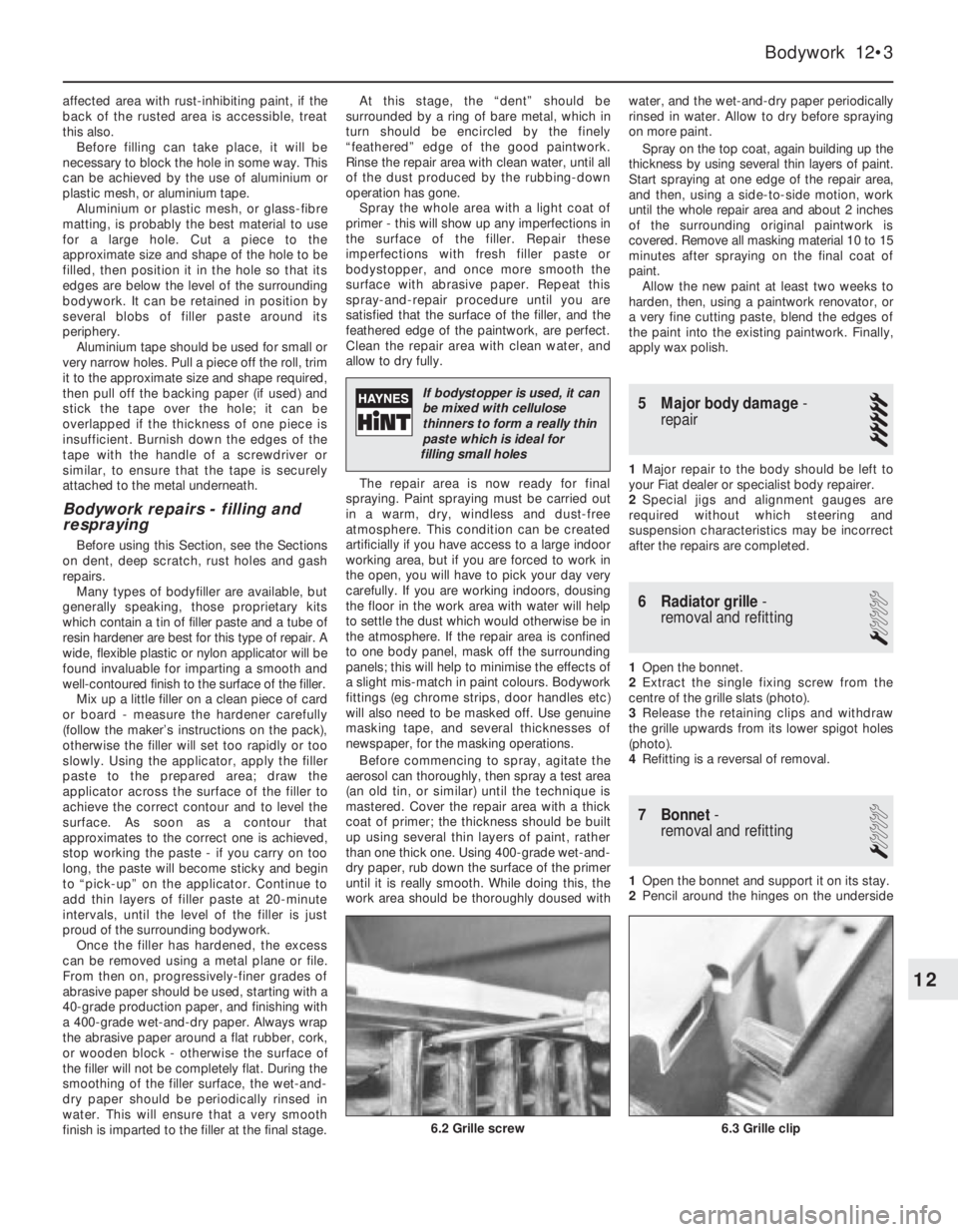
1Open the bonnet.
2Extract the single fixing screw from the
centre of the grille slats (photo).
3Release the retaining clips and withdraw
the grille upwards from its lower spigot holes
(photo).
4Refitting is a reversal of removal.
7 Bonnet-
removal and refitting
1
1Open the bonnet and support it on its stay.
2Pencil around the hinges on the underside
Bodywork 12•3
12
If bodystopper is used, it can
be mixed with cellulose
thinners to form a really thin
paste which is ideal for
filling small holes
6.3 Grille clip6.2 Grille screw
Page 117 of 303
9.1A Front bumper upper fixing screw
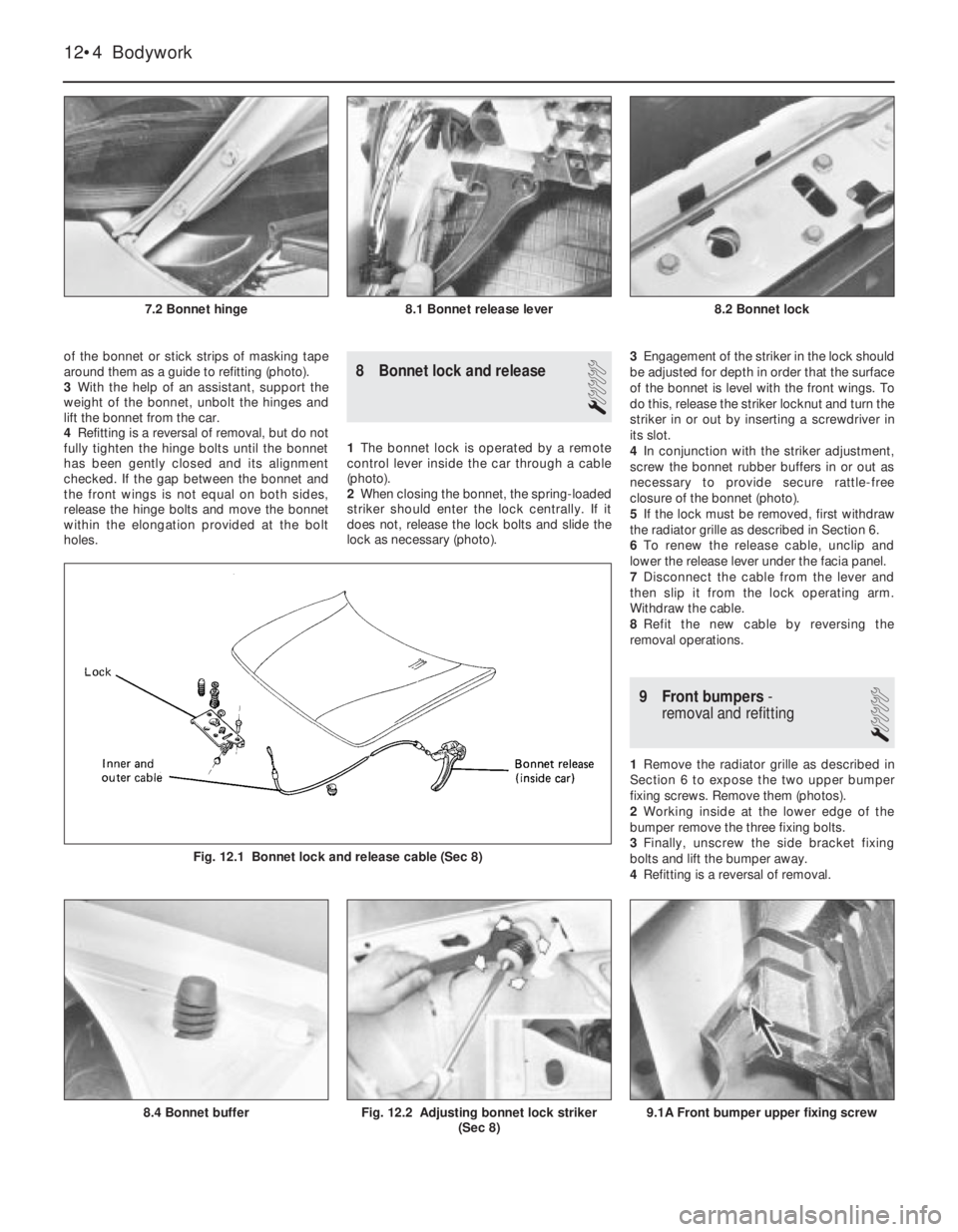
of the bonnet or stick strips of masking tape
around them as a guide to refitting (photo).
3With the help of an assistant, support the
weight of the bonnet, unbolt the hinges and
lift the bonnet from the car.
4Refitting is a reversal of removal, but do not
fully tighten the hinge bolts until the bonnet
has been gently closed and its alignment
checked. If the gap between the bonnet and
the front wings is not equal on both sides,
release the hinge bolts and move the bonnet
within the elongation provided at the bolt
holes.8 Bonnet lock and release
1
1The bonnet lock is operated by a remote
control lever inside the car through a cable
(photo).
2When closing the bonnet, the spring-loaded
striker should enter the lock centrally. If it
does not, release the lock bolts and slide the
lock as necessary (photo).3Engagement of the striker in the lock should
be adjusted for depth in order that the surface
of the bonnet is level with the front wings. To
do this, release the striker locknut and turn the
striker in or out by inserting a screwdriver in
its slot.
4In conjunction with the striker adjustment,
screw the bonnet rubber buffers in or out as
necessary to provide secure rattle-free
closure of the bonnet (photo).
5If the lock must be removed, first withdraw
the radiator grille as described in Section 6.
6To renew the release cable, unclip and
lower the release lever under the facia panel.
7Disconnect the cable from the lever and
then slip it from the lock operating arm.
Withdraw the cable.
8Refit the new cable by reversing the
removal operations.
9 Front bumpers-
removal and refitting
1
1Remove the radiator grille as described in
Section 6 to expose the two upper bumper
fixing screws. Remove them (photos).
2Working inside at the lower edge of the
bumper remove the three fixing bolts.
3Finally, unscrew the side bracket fixing
bolts and lift the bumper away.
4Refitting is a reversal of removal.
12•4 Bodywork
Fig. 12.2 Adjusting bonnet lock striker
(Sec 8)
Fig. 12.1 Bonnet lock and release cable (Sec 8)
8.4 Bonnet buffer
8.2 Bonnet lock8.1 Bonnet release lever7.2 Bonnet hinge
Page 127 of 303
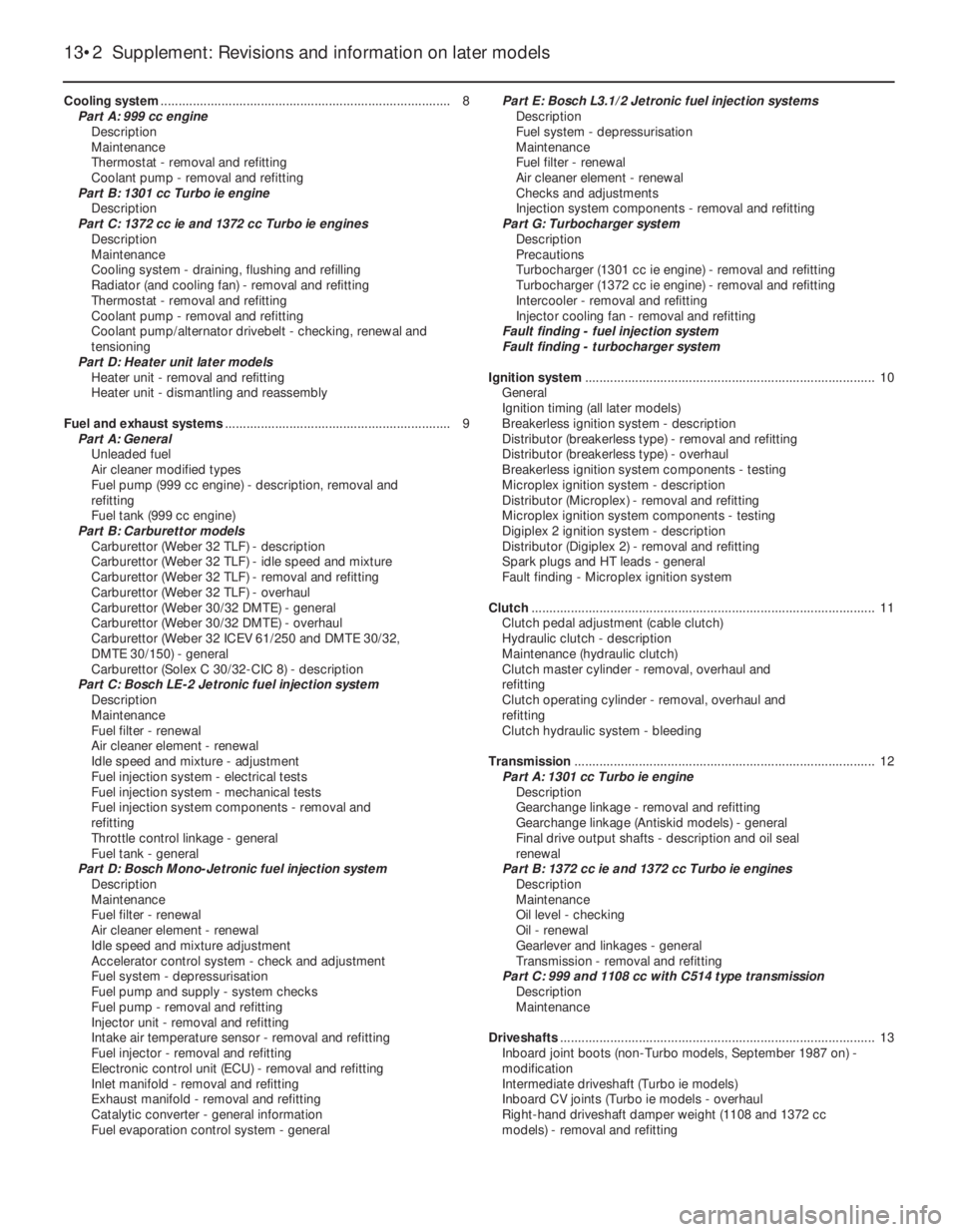
Cooling system................................................................................. 8
Part A: 999 cc engine
Description
Maintenance
Thermostat - removal and refitting
Coolant pump - removal and refitting
Part B: 1301 cc Turbo ie engine
Description
Part C: 1372 cc ie and 1372 cc Turbo ie engines
Description
Maintenance
Cooling system - draining, flushing and refilling
Radiator (and cooling fan) - removal and refitting
Thermostat - removal and refitting
Coolant pump - removal and refitting
Coolant pump/alternator drivebelt - checking, renewal and
tensioning
Part D: Heater unit later models
Heater unit - removal and refitting
Heater unit - dismantling and reassembly
Fuel and exhaust systems............................................................... 9
Part A: General
Unleaded fuel
Air cleaner modified types
Fuel pump (999 cc engine) - description, removal and
refitting
Fuel tank (999 cc engine)
Part B: Carburettor models
Carburettor (Weber 32 TLF) - description
Carburettor (Weber 32 TLF) - idle speed and mixture
Carburettor (Weber 32 TLF) - removal and refitting
Carburettor (Weber 32 TLF) - overhaul
Carburettor (Weber 30/32 DMTE) - general
Carburettor (Weber 30/32 DMTE) - overhaul
Carburettor (Weber 32 ICEV 61/250 and DMTE 30/32,
DMTE 30/150) - general
Carburettor (Solex C 30/32-CIC 8) - description
Part C: Bosch LE-2 Jetronic fuel injection system
Description
Maintenance
Fuel filter - renewal
Air cleaner element - renewal
Idle speed and mixture - adjustment
Fuel injection system - electrical tests
Fuel injection system - mechanical tests
Fuel injection system components - removal and
refitting
Throttle control linkage - general
Fuel tank - general
Part D: Bosch Mono-Jetronic fuel injection system
Description
Maintenance
Fuel filter - renewal
Air cleaner element - renewal
Idle speed and mixture adjustment
Accelerator control system - check and adjustment
Fuel system - depressurisation
Fuel pump and supply - system checks
Fuel pump - removal and refitting
Injector unit - removal and refitting
Intake air temperature sensor - removal and refitting
Fuel injector - removal and refitting
Electronic control unit (ECU) - removal and refitting
Inlet manifold - removal and refitting
Exhaust manifold - removal and refitting
Catalytic converter - general information
Fuel evaporation control system - generalPart E: Bosch L3.1/2 Jetronic fuel injection systems
Description
Fuel system - depressurisation
Maintenance
Fuel filter - renewal
Air cleaner element - renewal
Checks and adjustments
Injection system components - removal and refitting
Part G: Turbocharger system
Description
Precautions
Turbocharger (1301 cc ie engine) - removal and refitting
Turbocharger (1372 cc ie engine) - removal and refitting
Intercooler - removal and refitting
Injector cooling fan - removal and refitting
Fault finding - fuel injection system
Fault finding - turbocharger system
Ignition system................................................................................. 10
General
Ignition timing (all later models)
Breakerless ignition system - description
Distributor (breakerless type) - removal and refitting
Distributor (breakerless type) - overhaul
Breakerless ignition system components - testing
Microplex ignition system - description
Distributor (Microplex) - removal and refitting
Microplex ignition system components - testing
Digiplex 2 ignition system - description
Distributor (Digiplex 2) - removal and refitting
Spark plugs and HT leads - general
Fault finding - Microplex ignition system
Clutch................................................................................................ 11
Clutch pedal adjustment (cable clutch)
Hydraulic clutch - description
Maintenance (hydraulic clutch)
Clutch master cylinder - removal, overhaul and
refitting
Clutch operating cylinder - removal, overhaul and
refitting
Clutch hydraulic system - bleeding
Transmission.................................................................................... 12
Part A: 1301 cc Turbo ie engine
Description
Gearchange linkage - removal and refitting
Gearchange linkage (Antiskid models) - general
Final drive output shafts - description and oil seal
renewal
Part B: 1372 cc ie and 1372 cc Turbo ie engines
Description
Maintenance
Oil level - checking
Oil - renewal
Gearlever and linkages - general
Transmission - removal and refitting
Part C: 999 and 1108 cc with C514 type transmission
Description
Maintenance
Driveshafts........................................................................................ 13
Inboard joint boots (non-Turbo models, September 1987 on) -
modification
Intermediate driveshaft (Turbo ie models)
Inboard CV joints (Turbo ie models - overhaul
Right-hand driveshaft damper weight (1108 and 1372 cc
models) - removal and refitting
13•2 Supplement: Revisions and information on later models
Page 131 of 303
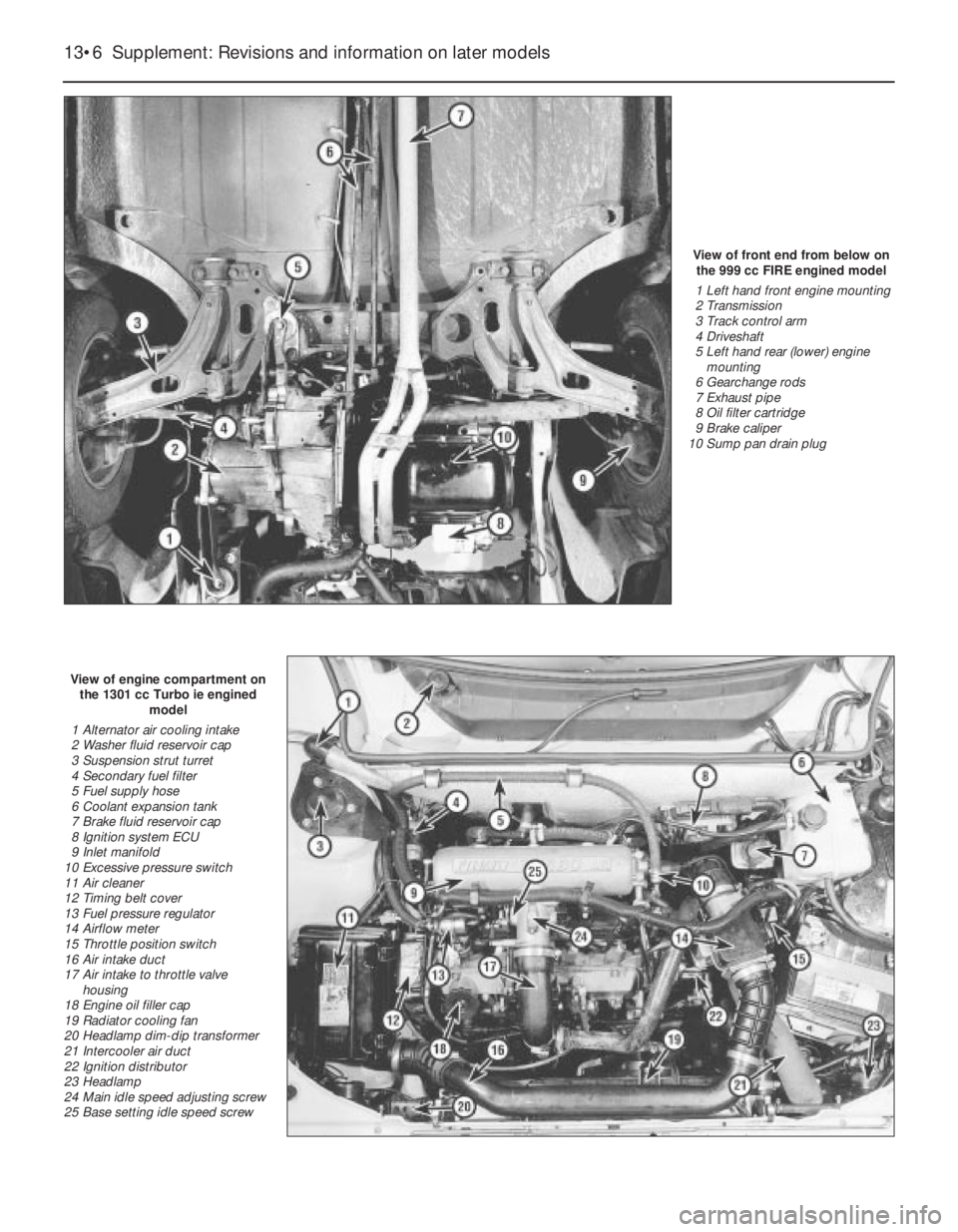
View of front end from below on
the 999 cc FIRE engined model
1 Left hand front engine mounting
2 Transmission
3 Track control arm
4 Driveshaft
5 Left hand rear (lower) engine
mounting
6 Gearchange rods
7 Exhaust pipe
8 Oil filter cartridge
9 Brake caliper
10 Sump pan drain plug
View of engine compartment on
the 1301 cc Turbo ie engined
model
1 Alternator air cooling intake
2 Washer fluid reservoir cap
3 Suspension strut turret
4 Secondary fuel filter
5 Fuel supply hose
6 Coolant expansion tank
7 Brake fluid reservoir cap
8 Ignition system ECU
9 Inlet manifold
10 Excessive pressure switch
11 Air cleaner
12 Timing belt cover
13 Fuel pressure regulator
14 Airflow meter
15 Throttle position switch
16 Air intake duct
17 Air intake to throttle valve
housing
18 Engine oil filler cap
19 Radiator cooling fan
20 Headlamp dim-dip transformer
21 Intercooler air duct
22 Ignition distributor
23 Headlamp
24 Main idle speed adjusting screw
25 Base setting idle speed screw
13•6 Supplement: Revisions and information on later models
Page 132 of 303
Supplement: Revisions and information on later models 13•7
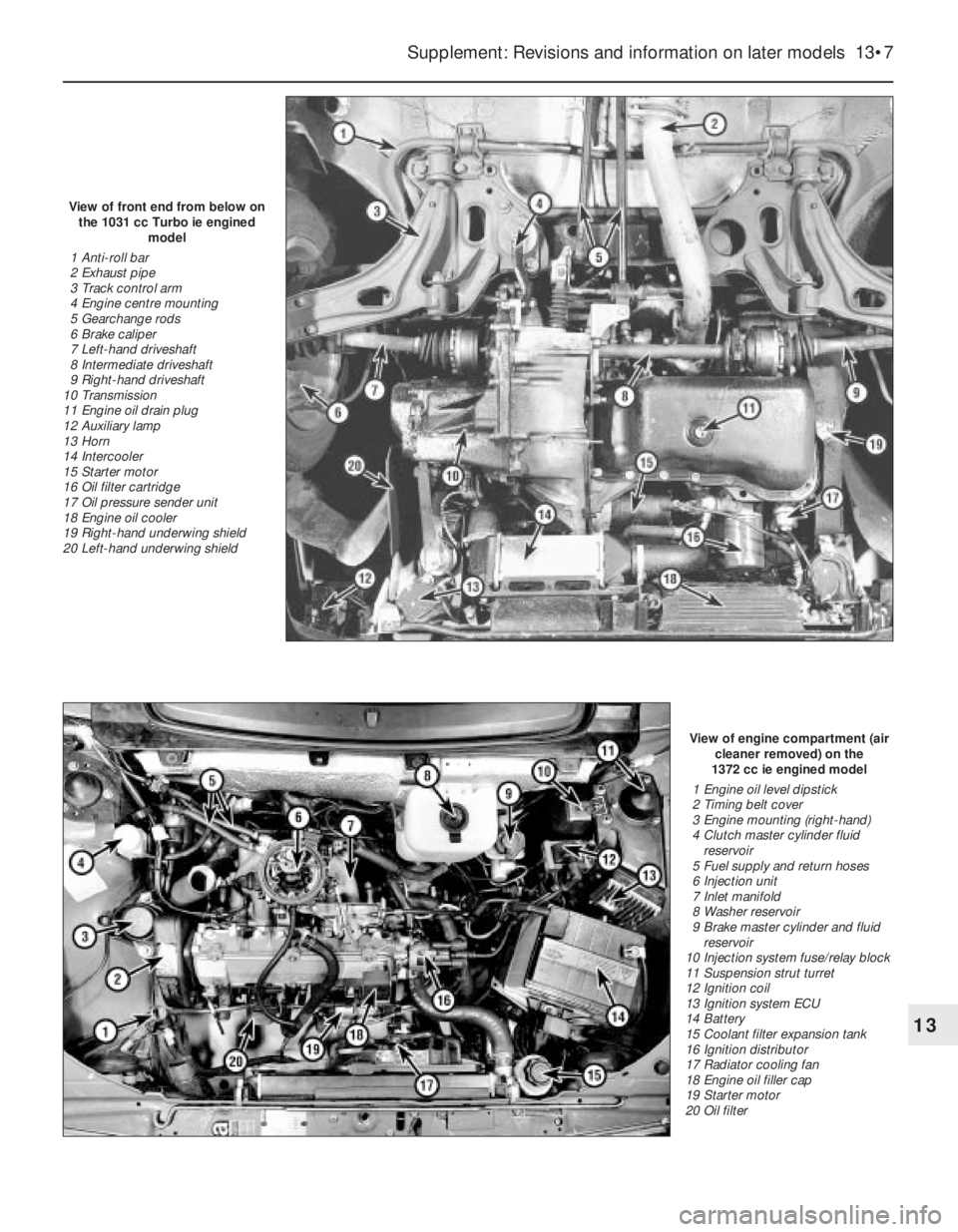
View of engine compartment (air
cleaner removed) on the
1372 cc ie engined model
1 Engine oil level dipstick
2 Timing belt cover
3 Engine mounting (right-hand)
4 Clutch master cylinder fluid
reservoir
5 Fuel supply and return hoses
6 Injection unit
7 Inlet manifold
8 Washer reservoir
9 Brake master cylinder and fluid
reservoir
10 Injection system fuse/relay block
11 Suspension strut turret
12 Ignition coil
13 Ignition system ECU
14 Battery
15 Coolant filter expansion tank
16 Ignition distributor
17 Radiator cooling fan
18 Engine oil filler cap
19 Starter motor
20 Oil filter
View of front end from below on
the 1031 cc Turbo ie engined
model
1 Anti-roll bar
2 Exhaust pipe
3 Track control arm
4 Engine centre mounting
5 Gearchange rods
6 Brake caliper
7 Left-hand driveshaft
8 Intermediate driveshaft
9 Right-hand driveshaft
10 Transmission
11 Engine oil drain plug
12 Auxiliary lamp
13 Horn
14 Intercooler
15 Starter motor
16 Oil filter cartridge
17 Oil pressure sender unit
18 Engine oil cooler
19 Right-hand underwing shield
20 Left-hand underwing shield
13
Page 133 of 303
Lubrication system
Oil pump type:
999/1108 cc . . . . . . . . . . . . . . . . . . . . . . . . . . . . . . . . . . . . . . . . . . . . Gear driven from front of crankshaft.
1372 cc . . . . . . . . . . . . . . . . . . . . . . . . . . . . . . . . . . . . . . . . . . . . . . . . Pump operated from front of crankshaft. Oil pressure relief valve in
front cover.
Tooth tip-to-body clearance (999/1108 cc) . . . . . . . . . . . . . . . . . . . . . . 0.080 to 0.186 mm
Gear endfloat:
999/1108 cc . . . . . . . . . . . . . . . . . . . . . . . . . . . . . . . . . . . . . . . . . . . . 0.025 to 0.056 mm
1372 cc . . . . . . . . . . . . . . . . . . . . . . . . . . . . . . . . . . . . . . . . . . . . . . . . 0.040 to 0.106 mm
Oil pressure (at normal operating temperature) . . . . . . . . . . . . . . . . . . . 3.4 to 4.9 bars
Oil filter:
999/1108 cc . . . . . . . . . . . . . . . . . . . . . . . . . . . . . . . . . . . . . . . . . . . . Champion F107
1372 cc . . . . . . . . . . . . . . . . . . . . . . . . . . . . . . . . . . . . . . . . . . . . . . . . Champion C106
Torque wrench settingsNm lbf ft
Auxiliary shaft sprocket bolt (1372 cc) . . . . . . . . . . . . . . . . . . . . . . . . . . 83 62
Big-end cap bolts:
999/1108 cc . . . . . . . . . . . . . . . . . . . . . . . . . . . . . . . . . . . . . . . . . . . . 41 30
1372 cc . . . . . . . . . . . . . . . . . . . . . . . . . . . . . . . . . . . . . . . . . . . . . . . . 51 38
Camshaft bearing cap bolts:
M8 . . . . . . . . . . . . . . . . . . . . . . . . . . . . . . . . . . . . . . . . . . . . . . . . . . . . 19 14
M6 . . . . . . . . . . . . . . . . . . . . . . . . . . . . . . . . . . . . . . . . . . . . . . . . . . . . 10 7
Camshaft cover screws . . . . . . . . . . . . . . . . . . . . . . . . . . . . . . . . . . . . . 8 6
Camshaft housing to lower cylinder head securing bolt (1372 cc) . . . . . 20 15
Camshaft housing to inlet manifold bracket bolt (1372 cc) . . . . . . . . . . 25 18
Camshaft sprocket bolt
999/1108 cc . . . . . . . . . . . . . . . . . . . . . . . . . . . . . . . . . . . . . . . . . . . . 68 50
1372 cc . . . . . . . . . . . . . . . . . . . . . . . . . . . . . . . . . . . . . . . . . . . . . . . . 83 62
Centre mounting to final drive casing bracket (1201/1301 cc) . . . . . . . . 23 17
Coolant temperature switch . . . . . . . . . . . . . . . . . . . . . . . . . . . . . . . . . . 25 18
Crankshaft pulley bolts . . . . . . . . . . . . . . . . . . . . . . . . . . . . . . . . . . . . . . 25 18
Crankshaft pulley nut (1372 cc) . . . . . . . . . . . . . . . . . . . . . . . . . . . . . . . 197 145
Crankshaft rear oil seal retainer bolts . . . . . . . . . . . . . . . . . . . . . . . . . . . 10 7
Crankshaft sprocket bolt . . . . . . . . . . . . . . . . . . . . . . . . . . . . . . . . . . . . 79 58
13•8 Supplement: Revisions and information on later models
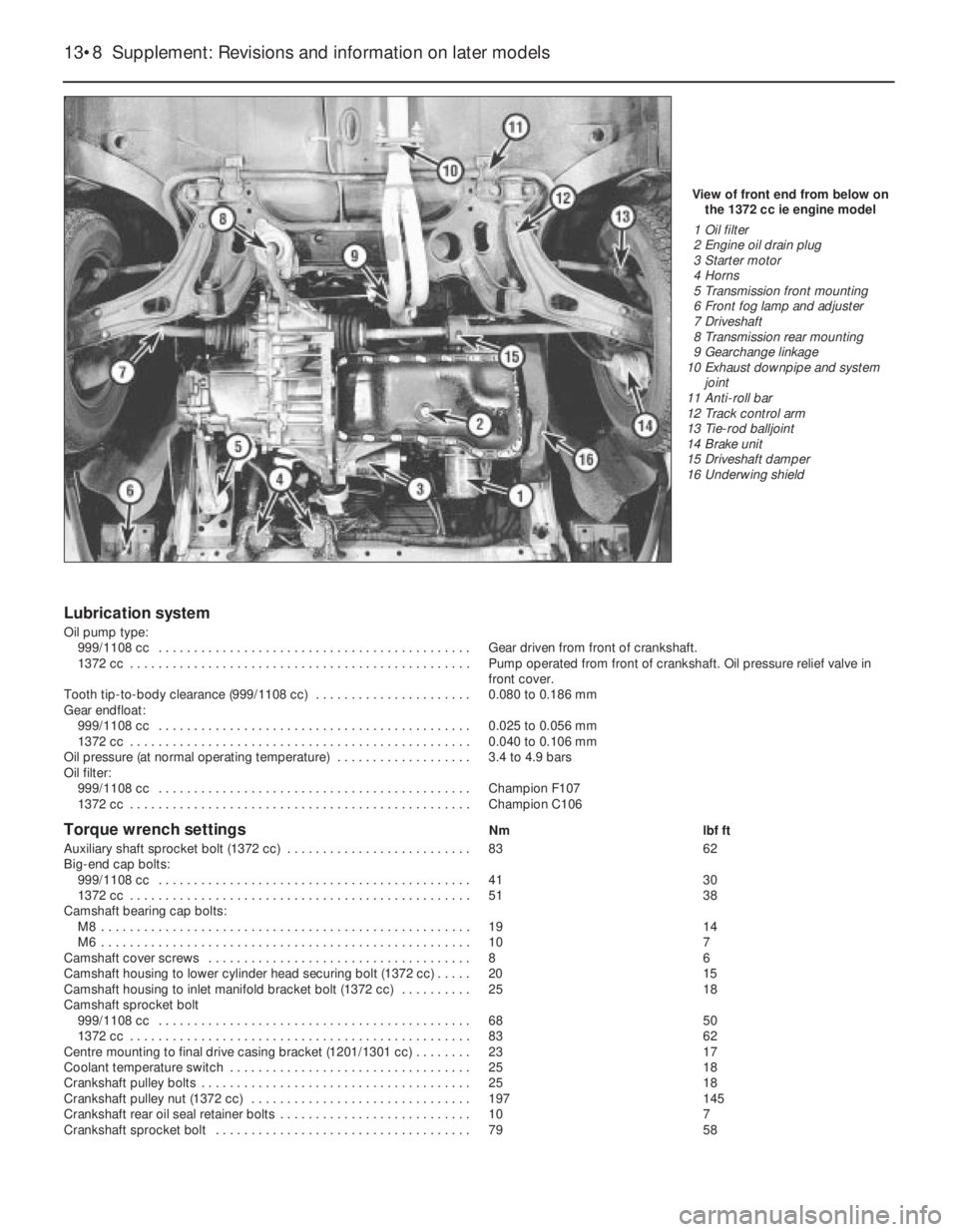
View of front end from below on
the 1372 cc ie engine model
1 Oil filter
2 Engine oil drain plug
3 Starter motor
4 Horns
5 Transmission front mounting
6 Front fog lamp and adjuster
7 Driveshaft
8 Transmission rear mounting
9 Gearchange linkage
10 Exhaust downpipe and system
joint
11 Anti-roll bar
12 Track control arm
13 Tie-rod balljoint
14 Brake unit
15 Driveshaft damper
16 Underwing shield
Page 149 of 303
Sump pan -
removal and refitting Á
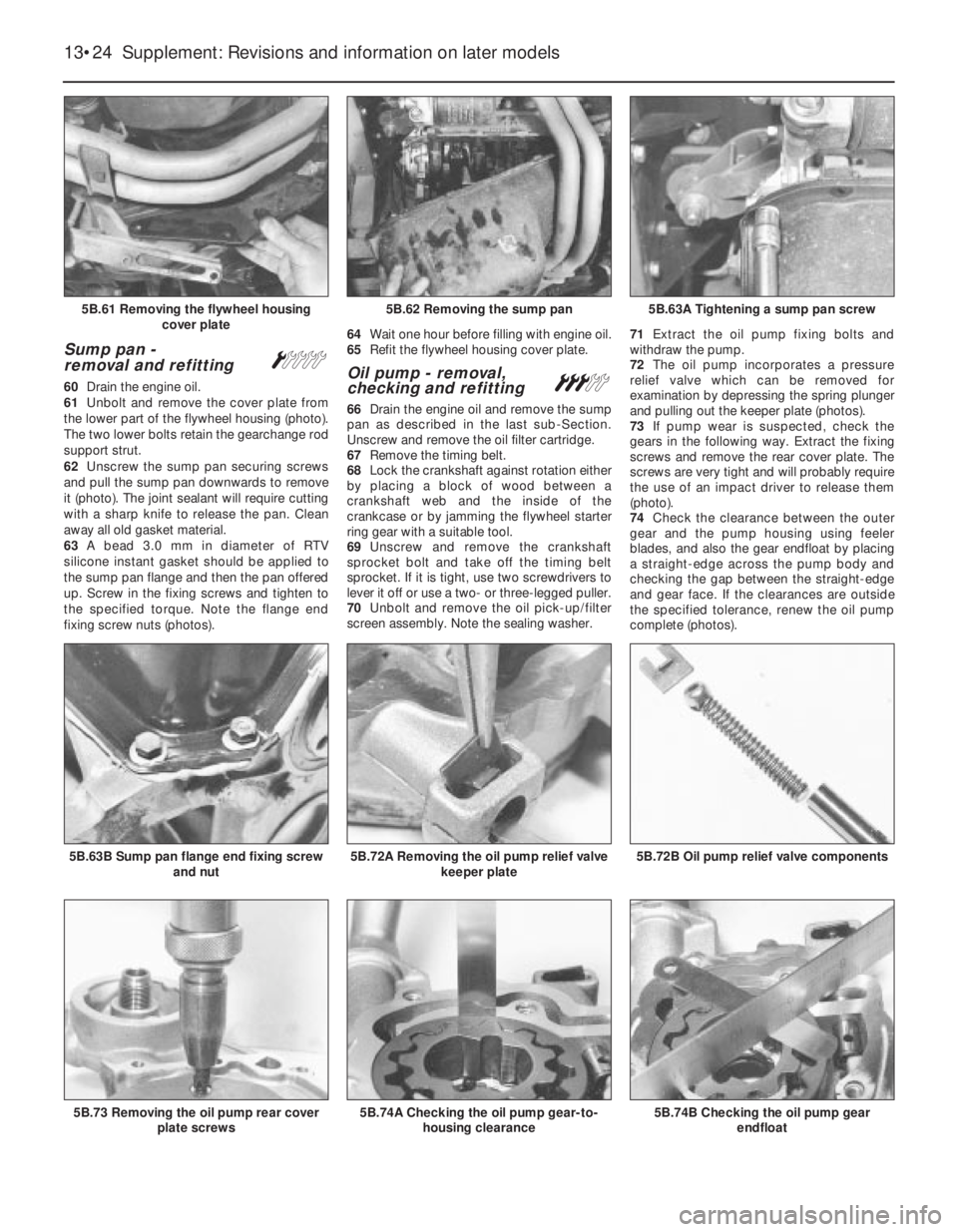
60Drain the engine oil.
61Unbolt and remove the cover plate from
the lower part of the flywheel housing (photo).
The two lower bolts retain the gearchange rod
support strut.
62Unscrew the sump pan securing screws
and pull the sump pan downwards to remove
it (photo). The joint sealant will require cutting
with a sharp knife to release the pan. Clean
away all old gasket material.
63A bead 3.0 mm in diameter of RTV
silicone instant gasket should be applied to
the sump pan flange and then the pan offered
up. Screw in the fixing screws and tighten to
the specified torque. Note the flange end
fixing screw nuts (photos).64Wait one hour before filling with engine oil.
65Refit the flywheel housing cover plate.Oil pump - removal,
checking and refitting#
66Drain the engine oil and remove the sump
pan as described in the last sub-Section.
Unscrew and remove the oil filter cartridge.
67Remove the timing belt.
68Lock the crankshaft against rotation either
by placing a block of wood between a
crankshaft web and the inside of the
crankcase or by jamming the flywheel starter
ring gear with a suitable tool.
69Unscrew and remove the crankshaft
sprocket bolt and take off the timing belt
sprocket. If it is tight, use two screwdrivers to
lever it off or use a two- or three-legged puller.
70Unbolt and remove the oil pick-up/filter
screen assembly. Note the sealing washer.71Extract the oil pump fixing bolts and
withdraw the pump.
72The oil pump incorporates a pressure
relief valve which can be removed for
examination by depressing the spring plunger
and pulling out the keeper plate (photos).
73If pump wear is suspected, check the
gears in the following way. Extract the fixing
screws and remove the rear cover plate. The
screws are very tight and will probably require
the use of an impact driver to release them
(photo).
74Check the clearance between the outer
gear and the pump housing using feeler
blades, and also the gear endfloat by placing
a straight-edge across the pump body and
checking the gap between the straight-edge
and gear face. If the clearances are outside
the specified tolerance, renew the oil pump
complete (photos).
13•24 Supplement: Revisions and information on later models
5B.74B Checking the oil pump gear
endfloat5B.74A Checking the oil pump gear-to-
housing clearance5B.73 Removing the oil pump rear cover
plate screws
5B.72B Oil pump relief valve components5B.72A Removing the oil pump relief valve
keeper plate5B.63B Sump pan flange end fixing screw
and nut
5B.63A Tightening a sump pan screw5B.62 Removing the sump pan5B.61 Removing the flywheel housing
cover plate
Page 153 of 303
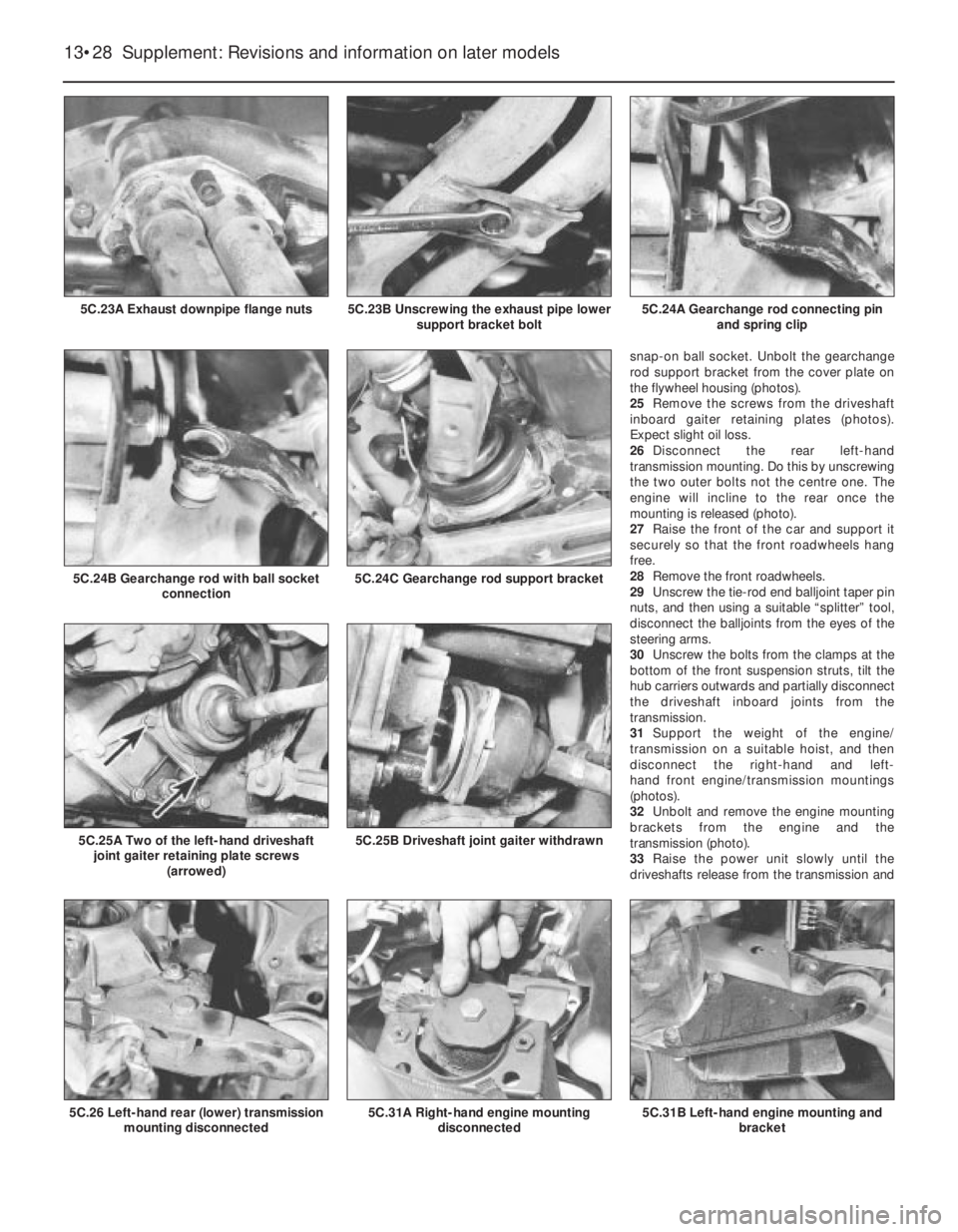
snap-on ball socket. Unbolt the gearchange
rod support bracket from the cover plate on
the flywheel housing (photos).
25Remove the screws from the driveshaft
inboard gaiter retaining plates (photos).
Expect slight oil loss.
26Disconnect the rear left-hand
transmission mounting. Do this by unscrewing
the two outer bolts not the centre one. The
engine will incline to the rear once the
mounting is released (photo).
27Raise the front of the car and support it
securely so that the front roadwheels hang
free.
28Remove the front roadwheels.
29Unscrew the tie-rod end balljoint taper pin
nuts, and then using a suitable “splitter” tool,
disconnect the balljoints from the eyes of the
steering arms.
30Unscrew the bolts from the clamps at the
bottom of the front suspension struts, tilt the
hub carriers outwards and partially disconnect
the driveshaft inboard joints from the
transmission.
31Support the weight of the engine/
transmission on a suitable hoist, and then
disconnect the right-hand and left-
hand front engine/transmission mountings
(photos).
32Unbolt and remove the engine mounting
brackets from the engine and the
transmission (photo).
33Raise the power unit slowly until the
driveshafts release from the transmission and
13•28 Supplement: Revisions and information on later models
5C.31B Left-hand engine mounting and
bracket5C.31A Right-hand engine mounting
disconnected5C.26 Left-hand rear (lower) transmission
mounting disconnected
5C.25B Driveshaft joint gaiter withdrawn5C.25A Two of the left-hand driveshaft
joint gaiter retaining plate screws
(arrowed)
5C.24C Gearchange rod support bracket5C.24B Gearchange rod with ball socket
connection
5C.24A Gearchange rod connecting pin
and spring clip5C.23B Unscrewing the exhaust pipe lower
support bracket bolt5C.23A Exhaust downpipe flange nuts