maintenance FIAT UNO 1983 Service Owner's Guide
[x] Cancel search | Manufacturer: FIAT, Model Year: 1983, Model line: UNO, Model: FIAT UNO 1983Pages: 303, PDF Size: 10.36 MB
Page 199 of 303
necessary processing (photo). A conventional
paper type air filter element is used and this
must be renewed at the specified intervals.
9The ECU is specific to the model type, its
function being to control the fuel system
under all operating conditions, including
starting from cold - it richens the fuel mixture
as required but at the same time prevents
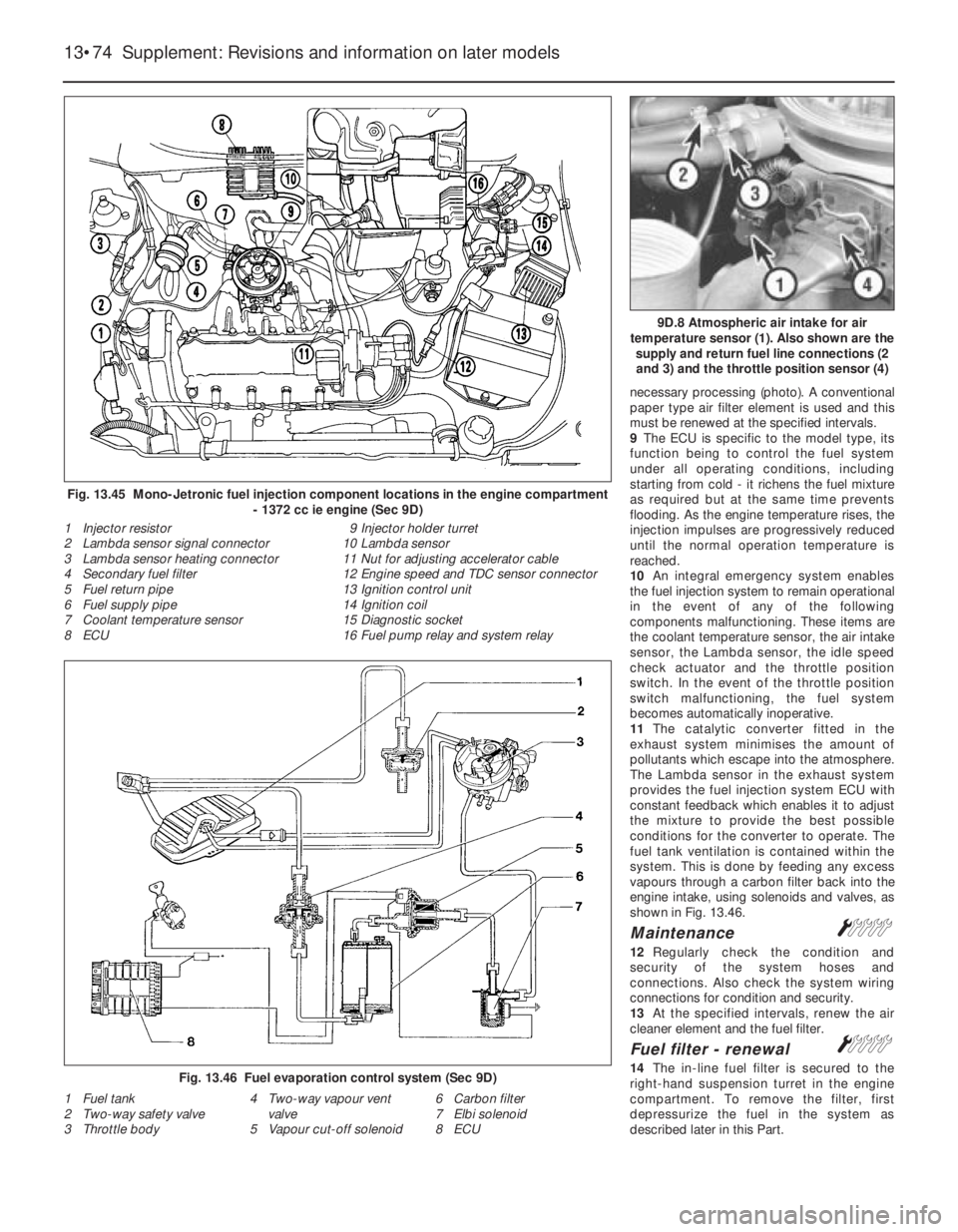
flooding. As the engine temperature rises, the
injection impulses are progressively reduced
until the normal operation temperature is
reached.
10An integral emergency system enables
the fuel injection system to remain operational
in the event of any of the following
components malfunctioning. These items are
the coolant temperature sensor, the air intake
sensor, the Lambda sensor, the idle speed
check actuator and the throttle position
switch. In the event of the throttle position
switch malfunctioning, the fuel system
becomes automatically inoperative.
11The catalytic converter fitted in the
exhaust system minimises the amount of
pollutants which escape into the atmosphere.
The Lambda sensor in the exhaust system
provides the fuel injection system ECU with
constant feedback which enables it to adjust
the mixture to provide the best possible
conditions for the converter to operate. The
fuel tank ventilation is contained within the
system. This is done by feeding any excess
vapours through a carbon filter back into the
engine intake, using solenoids and valves, as
shown in Fig. 13.46.
MaintenanceÁ
12Regularly check the condition and
security of the system hoses and
connections. Also check the system wiring
connections for condition and security.
13At the specified intervals, renew the air
cleaner element and the fuel filter.
Fuel filter - renewalÁ
14The in-line fuel filter is secured to the
right-hand suspension turret in the engine
compartment. To remove the filter, first
depressurize the fuel in the system as
described later in this Part.
13•74 Supplement: Revisions and information on later models
Fig. 13.46 Fuel evaporation control system (Sec 9D)
1 Fuel tank
2 Two-way safety valve
3 Throttle body4 Two-way vapour vent
valve
5 Vapour cut-off solenoid6 Carbon filter
7 Elbi solenoid
8 ECU
9D.8 Atmospheric air intake for air
temperature sensor (1). Also shown are the
supply and return fuel line connections (2
and 3) and the throttle position sensor (4)
Fig. 13.45 Mono-Jetronic fuel injection component locations in the engine compartment
- 1372 cc ie engine (Sec 9D)
1 Injector resistor
2 Lambda sensor signal connector
3 Lambda sensor heating connector
4 Secondary fuel filter
5 Fuel return pipe
6 Fuel supply pipe
7 Coolant temperature sensor
8 ECU9 Injector holder turret
10 Lambda sensor
11 Nut for adjusting accelerator cable
12 Engine speed and TDC sensor connector
13 Ignition control unit
14 Ignition coil
15 Diagnostic socket
16 Fuel pump relay and system relay
Page 202 of 303
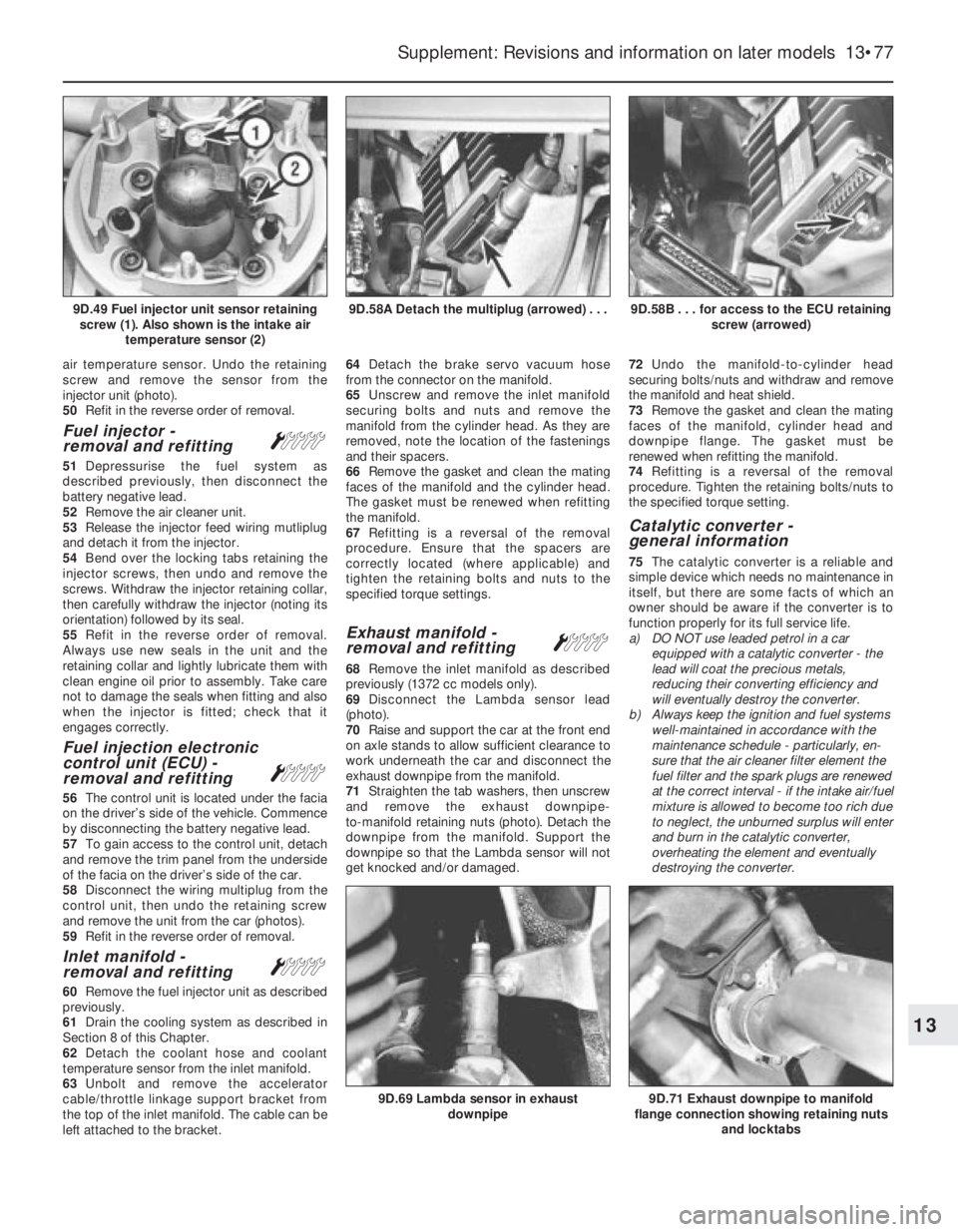
air temperature sensor. Undo the retaining
screw and remove the sensor from the
injector unit (photo).
50Refit in the reverse order of removal.
Fuel injector -
removal and refittingÁ
51Depressurise the fuel system as
described previously, then disconnect the
battery negative lead.
52Remove the air cleaner unit.
53Release the injector feed wiring mutliplug
and detach it from the injector.
54Bend over the locking tabs retaining the
injector screws, then undo and remove the
screws. Withdraw the injector retaining collar,
then carefully withdraw the injector (noting its
orientation) followed by its seal.
55Refit in the reverse order of removal.
Always use new seals in the unit and the
retaining collar and lightly lubricate them with
clean engine oil prior to assembly. Take care
not to damage the seals when fitting and also
when the injector is fitted; check that it
engages correctly.
Fuel injection electronic
control unit (ECU) -
removal and refitting
Á
56The control unit is located under the facia
on the driver’s side of the vehicle. Commence
by disconnecting the battery negative lead.
57To gain access to the control unit, detach
and remove the trim panel from the underside
of the facia on the driver’s side of the car.
58Disconnect the wiring multiplug from the
control unit, then undo the retaining screw
and remove the unit from the car (photos).
59Refit in the reverse order of removal.
Inlet manifold -
removal and refittingÁ
60Remove the fuel injector unit as described
previously.
61Drain the cooling system as described in
Section 8 of this Chapter.
62Detach the coolant hose and coolant
temperature sensor from the inlet manifold.
63Unbolt and remove the accelerator
cable/throttle linkage support bracket from
the top of the inlet manifold. The cable can be
left attached to the bracket.64Detach the brake servo vacuum hose
from the connector on the manifold.
65Unscrew and remove the inlet manifold
securing bolts and nuts and remove the
manifold from the cylinder head. As they are
removed, note the location of the fastenings
and their spacers.
66Remove the gasket and clean the mating
faces of the manifold and the cylinder head.
The gasket must be renewed when refitting
the manifold.
67Refitting is a reversal of the removal
procedure. Ensure that the spacers are
correctly located (where applicable) and
tighten the retaining bolts and nuts to the
specified torque settings.
Exhaust manifold -
removal and refittingÁ
68Remove the inlet manifold as described
previously (1372 cc models only).
69Disconnect the Lambda sensor lead
(photo).
70Raise and support the car at the front end
on axle stands to allow sufficient clearance to
work underneath the car and disconnect the
exhaust downpipe from the manifold.
71Straighten the tab washers, then unscrew
and remove the exhaust downpipe-
to-manifold retaining nuts (photo). Detach the
downpipe from the manifold. Support the
downpipe so that the Lambda sensor will not
get knocked and/or damaged.72Undo the manifold-to-cylinder head
securing bolts/nuts and withdraw and remove
the manifold and heat shield.
73Remove the gasket and clean the mating
faces of the manifold, cylinder head and
downpipe flange. The gasket must be
renewed when refitting the manifold.
74Refitting is a reversal of the removal
procedure. Tighten the retaining bolts/nuts to
the specified torque setting.
Catalytic converter -
general information
75The catalytic converter is a reliable and
simple device which needs no maintenance in
itself, but there are some facts of which an
owner should be aware if the converter is to
function properly for its full service life.
a) DO NOT use leaded petrol in a car
equipped with a catalytic converter - the
lead will coat the precious metals,
reducing their converting efficiency and
will eventually destroy the converter.
b) Always keep the ignition and fuel systems
well-maintained in accordance with the
maintenance schedule - particularly, en-
sure that the air cleaner filter element the
fuel filter and the spark plugs are renewed
at the correct interval - if the intake air/fuel
mixture is allowed to become too rich due
to neglect, the unburned surplus will enter
and burn in the catalytic converter,
overheating the element and eventually
destroying the converter.
Supplement: Revisions and information on later models 13•77
9D.58B . . . for access to the ECU retaining
screw (arrowed)9D.58A Detach the multiplug (arrowed) . . .9D.49 Fuel injector unit sensor retaining
screw (1). Also shown is the intake air
temperature sensor (2)
9D.71 Exhaust downpipe to manifold
flange connection showing retaining nuts
and locktabs9D.69 Lambda sensor in exhaust
downpipe
13
Page 204 of 303
optimum engine operating efficiency. In the
event of a system sensor malfunction, errors
in data passed to the ECU are overcome by
an emergency operation, whereby the ECU
supplies the injectors with one of two set
injection periods independent of the sensors.
One period (2.2 ms) is for idle speed and the
other (2.5 ms) is for speeds above idle
(actuated when the idle speed contact is
opened).
4An injection system relay and a fuel pump
relay are fitted and are located in the engine
compartment, adjacent to the ECU on the left-
hand inner wing panel. In the event of the
engine not being started within two seconds of
the ignition being switched to the “ON”
position, the fuel pump relay is deactivated.
The fuel pump circuit fuse is located in the
main fuse block located under the facia within
the car. Note: To avoid possible damage to the
ECU, it is essential that the ignition is switched
off before disconnecting (or connecting) the
wiring multi-plug from the ECU.A Lambda (or
oxygen) sensor is fitted to L3.2 equipped
models, to measure exhaust gas oxygen
content. In sending signals to the ECU,
optimum catalyst operation is maintained.
Fuel system -
depressurisationÁ
5The fuel system should always be
depressurised whenever any fuel hoses
and/or system components are disconnected
and/or removed. This can easily be achieved
as follows.
6The fuel pump relay is located next to the
ECU and airflow meter in the engine
compartment. Carefully pull free the fuel
pump relay, then start the engine and run it
until it stops. The fuel system is now
depressurised. Turn the ignition off before
removing/dismantling any components.
7Do not refit the fuel pump relay or turn the
ignition on until the system is fully
reconnected. When the engine is ready to be
restarted, refit the relay and its cover, then
restart the engine in the normal manner.
MaintenanceÁ
8Regularly check the condition and security
of the system hoses and connections. Also
check the system wiring connections for
condition and security.9At the specified intervals, renew the air
cleaner element and the fuel filter.
Fuel filter - renewalÁ
10This is located in the engine compartment
on the right-hand side. Disconnect the fuel
inlet and outlet hoses, but be prepared for the
loss of fuel. Loosen off the clamp and remove
the filter.
11Reverse the removal procedure to fit the
new filter, but ensure that the arrow indicating
fuel flow is pointing towards the fuel injector rail.
Air cleaner element -
renewalÁ
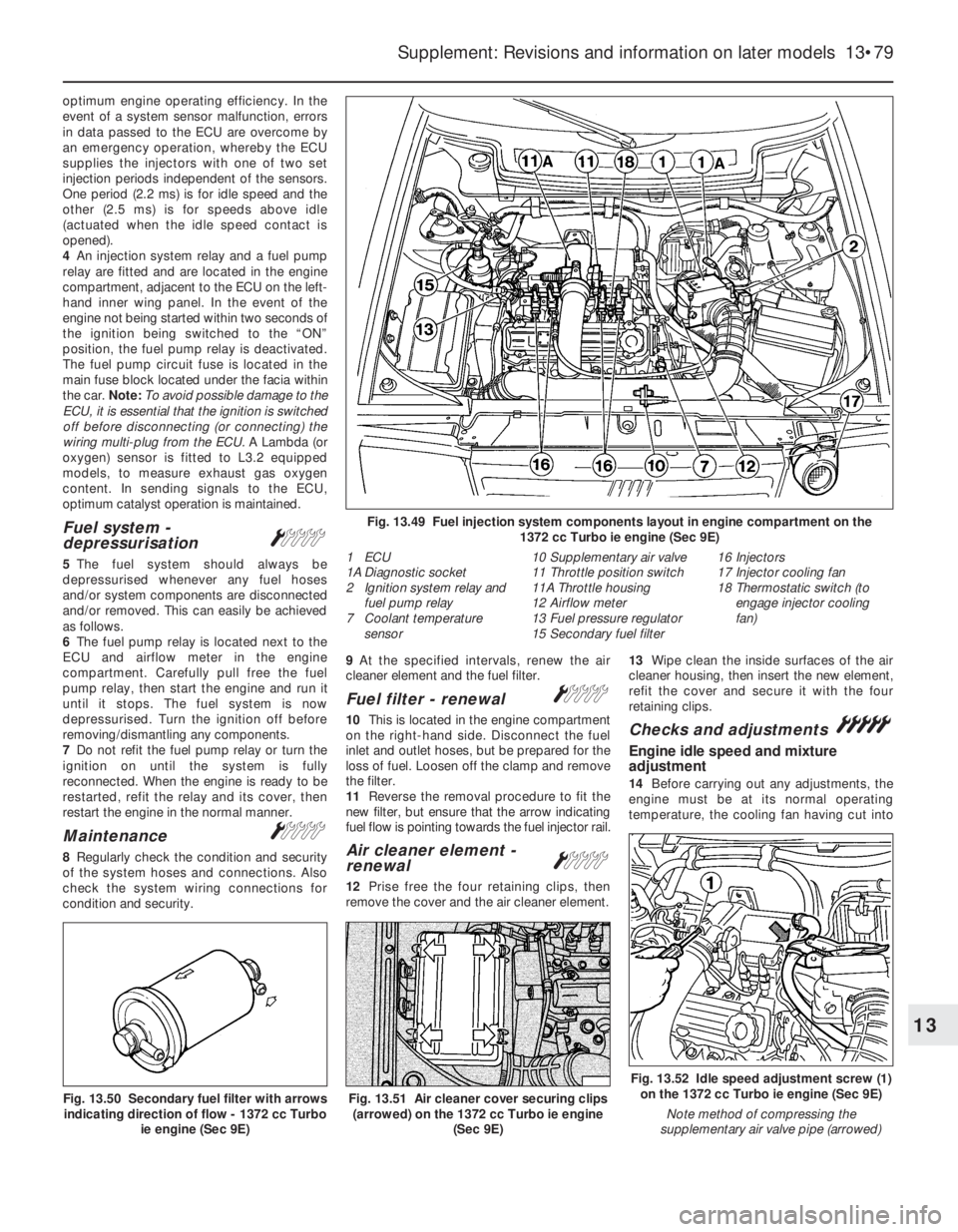
12Prise free the four retaining clips, then
remove the cover and the air cleaner element.13Wipe clean the inside surfaces of the air
cleaner housing, then insert the new element,
refit the cover and secure it with the four
retaining clips.
Checks and adjustments°
Engine idle speed and mixture
adjustment
14Before carrying out any adjustments, the
engine must be at its normal operating
temperature, the cooling fan having cut into
Supplement: Revisions and information on later models 13•79
Fig. 13.49 Fuel injection system components layout in engine compartment on the
1372 cc Turbo ie engine (Sec 9E)
1 ECU
1A Diagnostic socket
2 Ignition system relay and
fuel pump relay
7 Coolant temperature
sensor10 Supplementary air valve
11 Throttle position switch
11A Throttle housing
12 Airflow meter
13 Fuel pressure regulator
15 Secondary fuel filter16 Injectors
17 Injector cooling fan
18 Thermostatic switch (to
engage injector cooling
fan)
Fig. 13.52 Idle speed adjustment screw (1)
on the 1372 cc Turbo ie engine (Sec 9E)
Note method of compressing the
supplementary air valve pipe (arrowed)
Fig. 13.51 Air cleaner cover securing clips
(arrowed) on the 1372 cc Turbo ie engine
(Sec 9E)Fig. 13.50 Secondary fuel filter with arrows
indicating direction of flow - 1372 cc Turbo
ie engine (Sec 9E)
13
Page 207 of 303
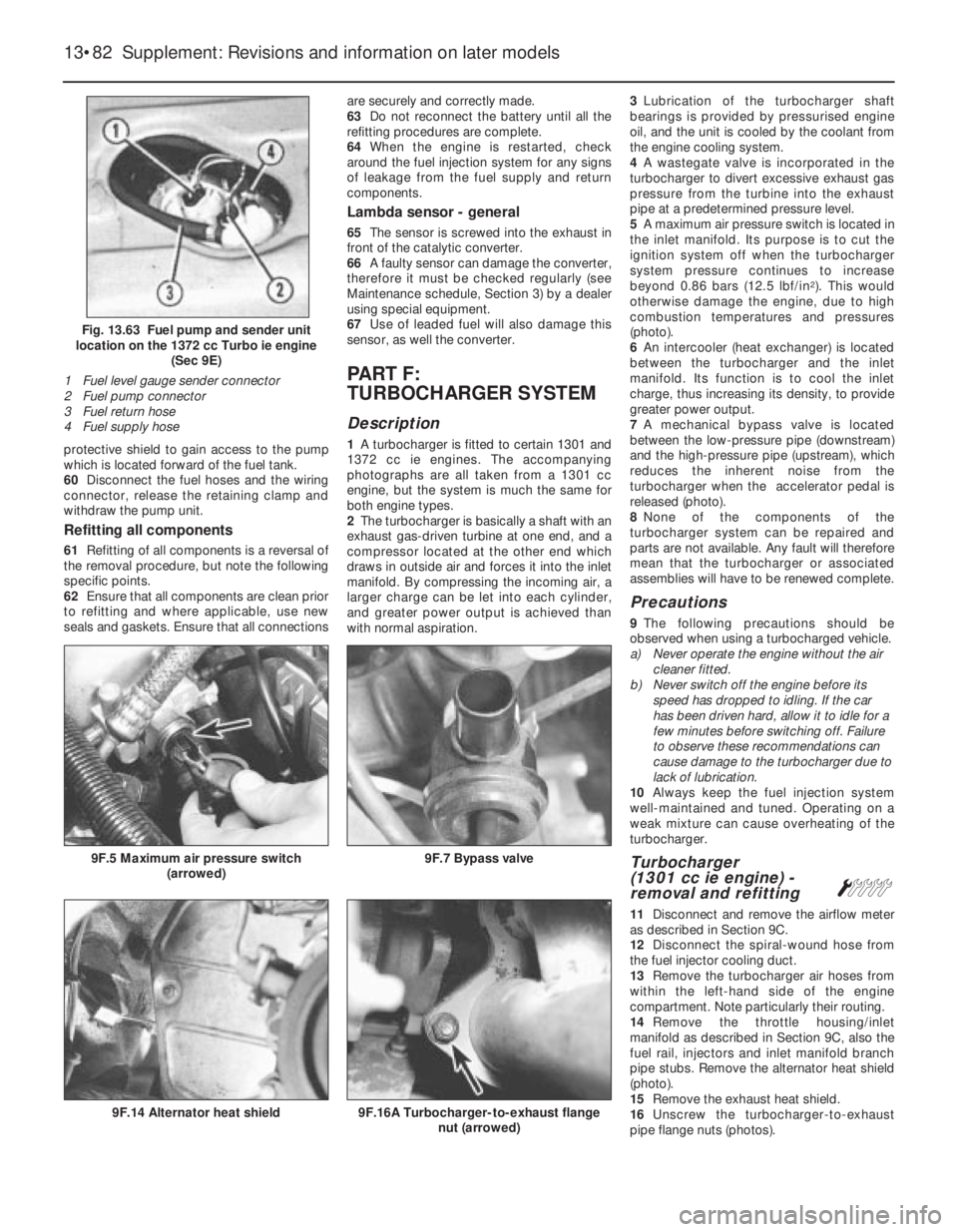
protective shield to gain access to the pump
which is located forward of the fuel tank.
60Disconnect the fuel hoses and the wiring
connector, release the retaining clamp and
withdraw the pump unit.
Refitting all components
61Refitting of all components is a reversal of
the removal procedure, but note the following
specific points.
62Ensure that all components are clean prior
to refitting and where applicable, use new
seals and gaskets. Ensure that all connectionsare securely and correctly made.
63Do not reconnect the battery until all the
refitting procedures are complete.
64When the engine is restarted, check
around the fuel injection system for any signs
of leakage from the fuel supply and return
components.
Lambda sensor - general
65The sensor is screwed into the exhaust in
front of the catalytic converter.
66A faulty sensor can damage the converter,
therefore it must be checked regularly (see
Maintenance schedule, Section 3) by a dealer
using special equipment.
67Use of leaded fuel will also damage this
sensor, as well the converter.
PART F:
TURBOCHARGER SYSTEM
Description
1A turbocharger is fitted to certain 1301 and
1372 cc ie engines. The accompanying
photographs are all taken from a 1301 cc
engine, but the system is much the same for
both engine types.
2The turbocharger is basically a shaft with an
exhaust gas-driven turbine at one end, and a
compressor located at the other end which
draws in outside air and forces it into the inlet
manifold. By compressing the incoming air, a
larger charge can be let into each cylinder,
and greater power output is achieved than
with normal aspiration.3Lubrication of the turbocharger shaft
bearings is provided by pressurised engine
oil, and the unit is cooled by the coolant from
the engine cooling system.
4A wastegate valve is incorporated in the
turbocharger to divert excessive exhaust gas
pressure from the turbine into the exhaust
pipe at a predetermined pressure level.
5A maximum air pressure switch is located in
the inlet manifold. Its purpose is to cut the
ignition system off when the turbocharger
system pressure continues to increase
beyond 0.86 bars (12.5 lbf/in
2). This would
otherwise damage the engine, due to high
combustion temperatures and pressures
(photo).
6An intercooler (heat exchanger) is located
between the turbocharger and the inlet
manifold. Its function is to cool the inlet
charge, thus increasing its density, to provide
greater power output.
7A mechanical bypass valve is located
between the low-pressure pipe (downstream)
and the high-pressure pipe (upstream), which
reduces the inherent noise from the
turbocharger when the accelerator pedal is
released (photo).
8None of the components of the
turbocharger system can be repaired and
parts are not available. Any fault will therefore
mean that the turbocharger or associated
assemblies will have to be renewed complete.
Precautions
9The following precautions should be
observed when using a turbocharged vehicle.
a) Never operate the engine without the air
cleaner fitted.
b) Never switch off the engine before its
speed has dropped to idling. If the car
has been driven hard, allow it to idle for a
few minutes before switching off. Failure
to observe these recommendations can
cause damage to the turbocharger due to
lack of lubrication.
10Always keep the fuel injection system
well-maintained and tuned. Operating on a
weak mixture can cause overheating of the
turbocharger.
Turbocharger
(1301 cc ie engine) -
removal and refitting
Á
11Disconnect and remove the airflow meter
as described in Section 9C.
12Disconnect the spiral-wound hose from
the fuel injector cooling duct.
13Remove the turbocharger air hoses from
within the left-hand side of the engine
compartment. Note particularly their routing.
14Remove the throttle housing/inlet
manifold as described in Section 9C, also the
fuel rail, injectors and inlet manifold branch
pipe stubs. Remove the alternator heat shield
(photo).
15Remove the exhaust heat shield.
16Unscrew the turbocharger-to-exhaust
pipe flange nuts (photos).
13•82 Supplement: Revisions and information on later models
9F.16A Turbocharger-to-exhaust flange
nut (arrowed)9F.14 Alternator heat shield
9F.7 Bypass valve9F.5 Maximum air pressure switch
(arrowed)
Fig. 13.63 Fuel pump and sender unit
location on the 1372 cc Turbo ie engine
(Sec 9E)
1 Fuel level gauge sender connector
2 Fuel pump connector
3 Fuel return hose
4 Fuel supply hose
Page 218 of 303
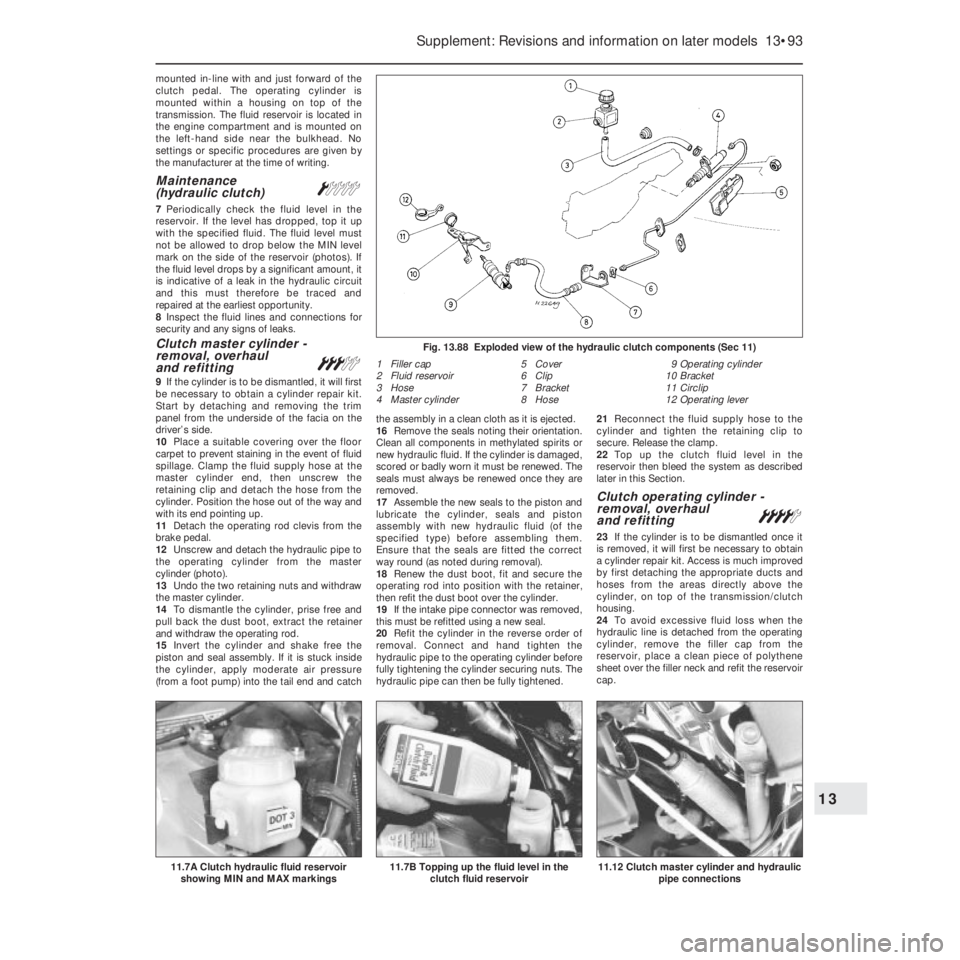
mounted in-line with and just forward of the
clutch pedal. The operating cylinder is
mounted within a housing on top of the
transmission. The fluid reservoir is located in
the engine compartment and is mounted on
the left-hand side near the bulkhead. No
settings or specific procedures are given by
the manufacturer at the time of writing.
Maintenance
(hydraulic clutch)Á
7Periodically check the fluid level in the
reservoir. If the level has dropped, top it up
with the specified fluid. The fluid level must
not be allowed to drop below the MIN level
mark on the side of the reservoir (photos). If
the fluid level drops by a significant amount, it
is indicative of a leak in the hydraulic circuit
and this must therefore be traced and
repaired at the earliest opportunity.
8Inspect the fluid lines and connections for
security and any signs of leaks.
Clutch master cylinder -
removal, overhaul
and refitting
#
9If the cylinder is to be dismantled, it will first
be necessary to obtain a cylinder repair kit.
Start by detaching and removing the trim
panel from the underside of the facia on the
driver’s side.
10Place a suitable covering over the floor
carpet to prevent staining in the event of fluid
spillage. Clamp the fluid supply hose at the
master cylinder end, then unscrew the
retaining clip and detach the hose from the
cylinder. Position the hose out of the way and
with its end pointing up.
11Detach the operating rod clevis from the
brake pedal.
12Unscrew and detach the hydraulic pipe to
the operating cylinder from the master
cylinder (photo).
13Undo the two retaining nuts and withdraw
the master cylinder.
14To dismantle the cylinder, prise free and
pull back the dust boot, extract the retainer
and withdraw the operating rod.
15Invert the cylinder and shake free the
piston and seal assembly. If it is stuck inside
the cylinder, apply moderate air pressure
(from a foot pump) into the tail end and catchthe assembly in a clean cloth as it is ejected.
16Remove the seals noting their orientation.
Clean all components in methylated spirits or
new hydraulic fluid. If the cylinder is damaged,
scored or badly worn it must be renewed. The
seals must always be renewed once they are
removed.
17Assemble the new seals to the piston and
lubricate the cylinder, seals and piston
assembly with new hydraulic fluid (of the
specified type) before assembling them.
Ensure that the seals are fitted the correct
way round (as noted during removal).
18Renew the dust boot, fit and secure the
operating rod into position with the retainer,
then refit the dust boot over the cylinder.
19If the intake pipe connector was removed,
this must be refitted using a new seal.
20Refit the cylinder in the reverse order of
removal. Connect and hand tighten the
hydraulic pipe to the operating cylinder before
fully tightening the cylinder securing nuts. The
hydraulic pipe can then be fully tightened.21Reconnect the fluid supply hose to the
cylinder and tighten the retaining clip to
secure. Release the clamp.
22Top up the clutch fluid level in the
reservoir then bleed the system as described
later in this Section.
Clutch operating cylinder -
removal, overhaul
and refitting
¢
23If the cylinder is to be dismantled once it
is removed, it will first be necessary to obtain
a cylinder repair kit. Access is much improved
by first detaching the appropriate ducts and
hoses from the areas directly above the
cylinder, on top of the transmission/clutch
housing.
24To avoid excessive fluid loss when the
hydraulic line is detached from the operating
cylinder, remove the filler cap from the
reservoir, place a clean piece of polythene
sheet over the filler neck and refit the reservoir
cap.
Supplement: Revisions and information on later models 13•93
Fig. 13.88 Exploded view of the hydraulic clutch components (Sec 11)
1 Filler cap
2 Fluid reservoir
3 Hose
4 Master cylinder5 Cover
6 Clip
7 Bracket
8 Hose9 Operating cylinder
10 Bracket
11 Circlip
12 Operating lever
11.12 Clutch master cylinder and hydraulic
pipe connections11.7B Topping up the fluid level in the
clutch fluid reservoir11.7A Clutch hydraulic fluid reservoir
showing MIN and MAX markings
13
Page 220 of 303
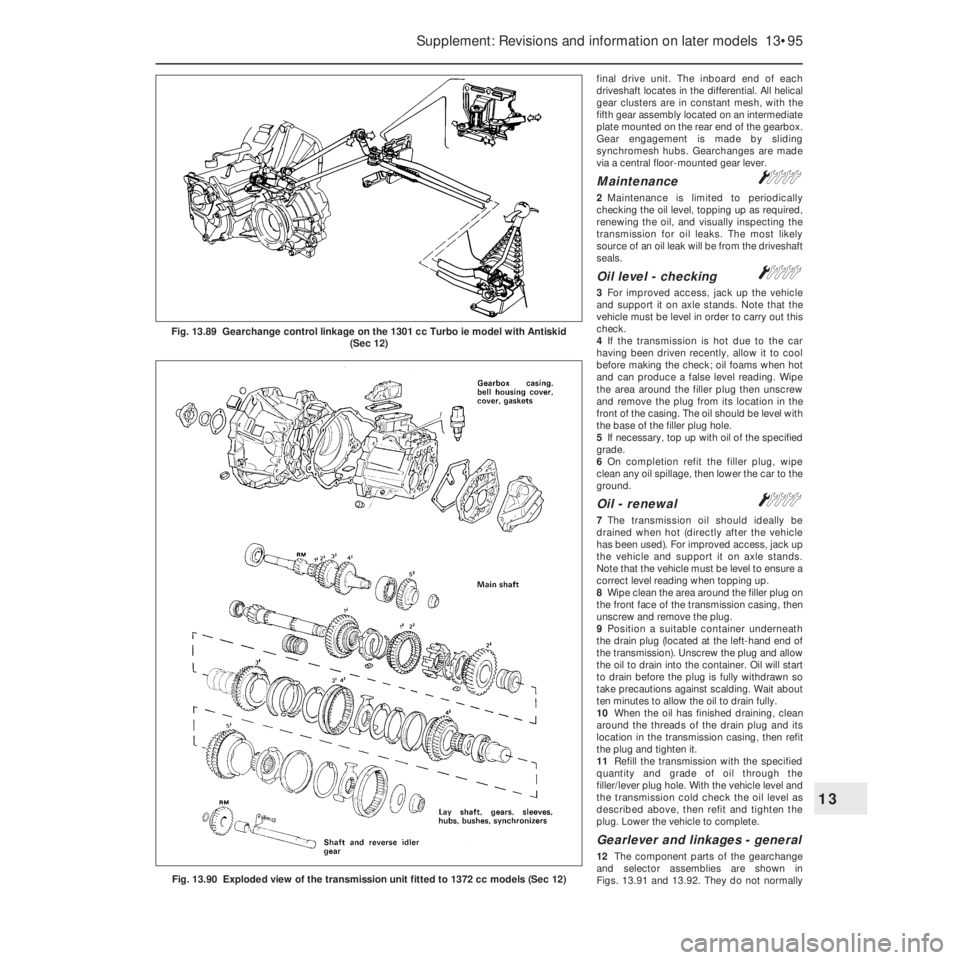
final drive unit. The inboard end of each
driveshaft locates in the differential. All helical
gear clusters are in constant mesh, with the
fifth gear assembly located on an intermediate
plate mounted on the rear end of the gearbox.
Gear engagement is made by sliding
synchromesh hubs. Gearchanges are made
via a central floor-mounted gear lever.
MaintenanceÁ
2Maintenance is limited to periodically
checking the oil level, topping up as required,
renewing the oil, and visually inspecting the
transmission for oil leaks. The most likely
source of an oil leak will be from the driveshaft
seals.
Oil level - checkingÁ
3For improved access, jack up the vehicle
and support it on axle stands. Note that the
vehicle must be level in order to carry out this
check.
4If the transmission is hot due to the car
having been driven recently, allow it to cool
before making the check; oil foams when hot
and can produce a false level reading. Wipe
the area around the filler plug then unscrew
and remove the plug from its location in the
front of the casing. The oil should be level with
the base of the filler plug hole.
5If necessary, top up with oil of the specified
grade.
6On completion refit the filler plug, wipe
clean any oil spillage, then lower the car to the
ground.
Oil - renewalÁ
7The transmission oil should ideally be
drained when hot (directly after the vehicle
has been used). For improved access, jack up
the vehicle and support it on axle stands.
Note that the vehicle must be level to ensure a
correct level reading when topping up.
8Wipe clean the area around the filler plug on
the front face of the transmission casing, then
unscrew and remove the plug.
9Position a suitable container underneath
the drain plug (located at the left-hand end of
the transmission). Unscrew the plug and allow
the oil to drain into the container. Oil will start
to drain before the plug is fully withdrawn so
take precautions against scalding. Wait about
ten minutes to allow the oil to drain fully.
10When the oil has finished draining, clean
around the threads of the drain plug and its
location in the transmission casing, then refit
the plug and tighten it.
11Refill the transmission with the specified
quantity and grade of oil through the
filler/lever plug hole. With the vehicle level and
the transmission cold check the oil level as
described above, then refit and tighten the
plug. Lower the vehicle to complete.
Gearlever and linkages - general
12The component parts of the gearchange
and selector assemblies are shown in
Figs. 13.91 and 13.92. They do not normally
Supplement: Revisions and information on later models 13•95
Fig. 13.90 Exploded view of the transmission unit fitted to 1372 cc models (Sec 12)
13
Fig. 13.89 Gearchange control linkage on the 1301 cc Turbo ie model with Antiskid
(Sec 12)
Page 221 of 303
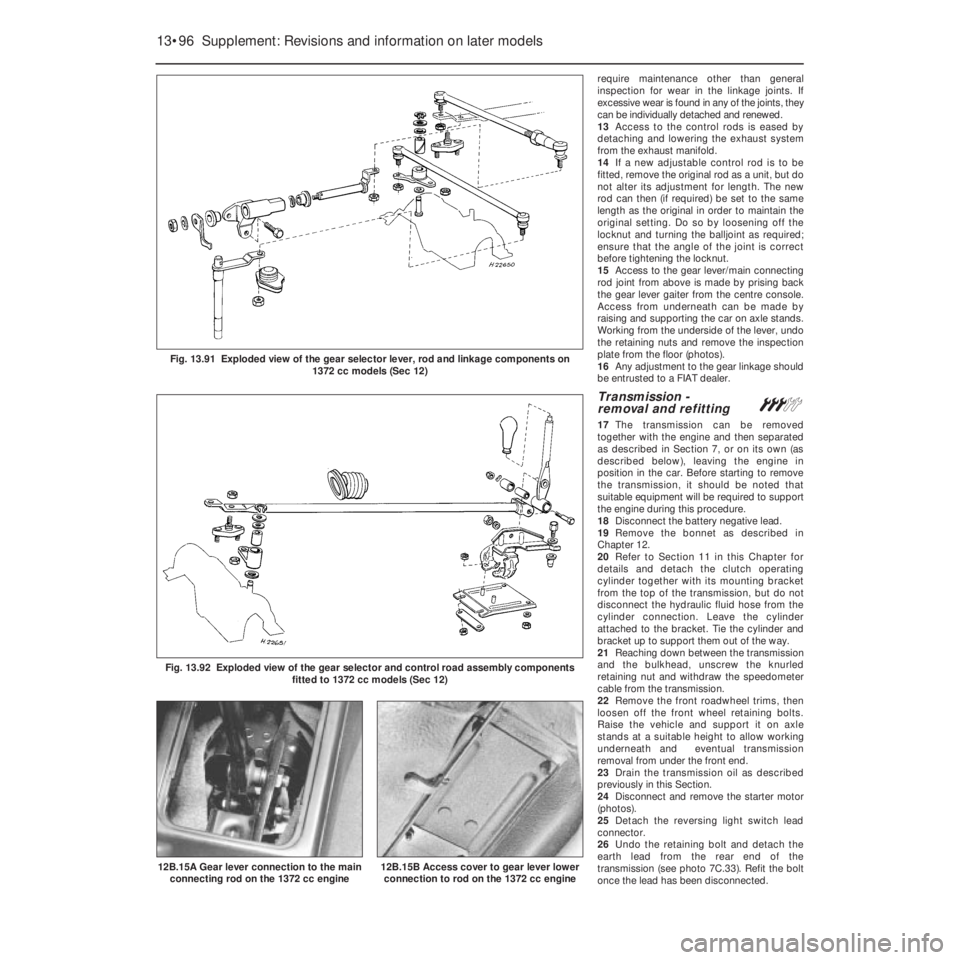
require maintenance other than general
inspection for wear in the linkage joints. If
excessive wear is found in any of the joints, they
can be individually detached and renewed.
13Access to the control rods is eased by
detaching and lowering the exhaust system
from the exhaust manifold.
14If a new adjustable control rod is to be
fitted, remove the original rod as a unit, but do
not alter its adjustment for length. The new
rod can then (if required) be set to the same
length as the original in order to maintain the
original setting. Do so by loosening off the
locknut and turning the balljoint as required;
ensure that the angle of the joint is correct
before tightening the locknut.
15Access to the gear lever/main connecting
rod joint from above is made by prising back
the gear lever gaiter from the centre console.
Access from underneath can be made by
raising and supporting the car on axle stands.
Working from the underside of the lever, undo
the retaining nuts and remove the inspection
plate from the floor (photos).
16Any adjustment to the gear linkage should
be entrusted to a FIAT dealer.
Transmission -
removal and refitting#
17The transmission can be removed
together with the engine and then separated
as described in Section 7, or on its own (as
described below), leaving the engine in
position in the car. Before starting to remove
the transmission, it should be noted that
suitable equipment will be required to support
the engine during this procedure.
18Disconnect the battery negative lead.
19Remove the bonnet as described in
Chapter 12.
20Refer to Section 11 in this Chapter for
details and detach the clutch operating
cylinder together with its mounting bracket
from the top of the transmission, but do not
disconnect the hydraulic fluid hose from the
cylinder connection. Leave the cylinder
attached to the bracket. Tie the cylinder and
bracket up to support them out of the way.
21Reaching down between the transmission
and the bulkhead, unscrew the knurled
retaining nut and withdraw the speedometer
cable from the transmission.
22Remove the front roadwheel trims, then
loosen off the front wheel retaining bolts.
Raise the vehicle and support it on axle
stands at a suitable height to allow working
underneath and eventual transmission
removal from under the front end.
23Drain the transmission oil as described
previously in this Section.
24Disconnect and remove the starter motor
(photos).
25Detach the reversing light switch lead
connector.
26Undo the retaining bolt and detach the
earth lead from the rear end of the
transmission (see photo 7C.33). Refit the bolt
once the lead has been disconnected.
13•96 Supplement: Revisions and information on later models
12B.15B Access cover to gear lever lower
connection to rod on the 1372 cc engine
Fig. 13.92 Exploded view of the gear selector and control road assembly components
fitted to 1372 cc models (Sec 12)
12B.15A Gear lever connection to the main
connecting rod on the 1372 cc engine
Fig. 13.91 Exploded view of the gear selector lever, rod and linkage components on
1372 cc models (Sec 12)
Page 223 of 303
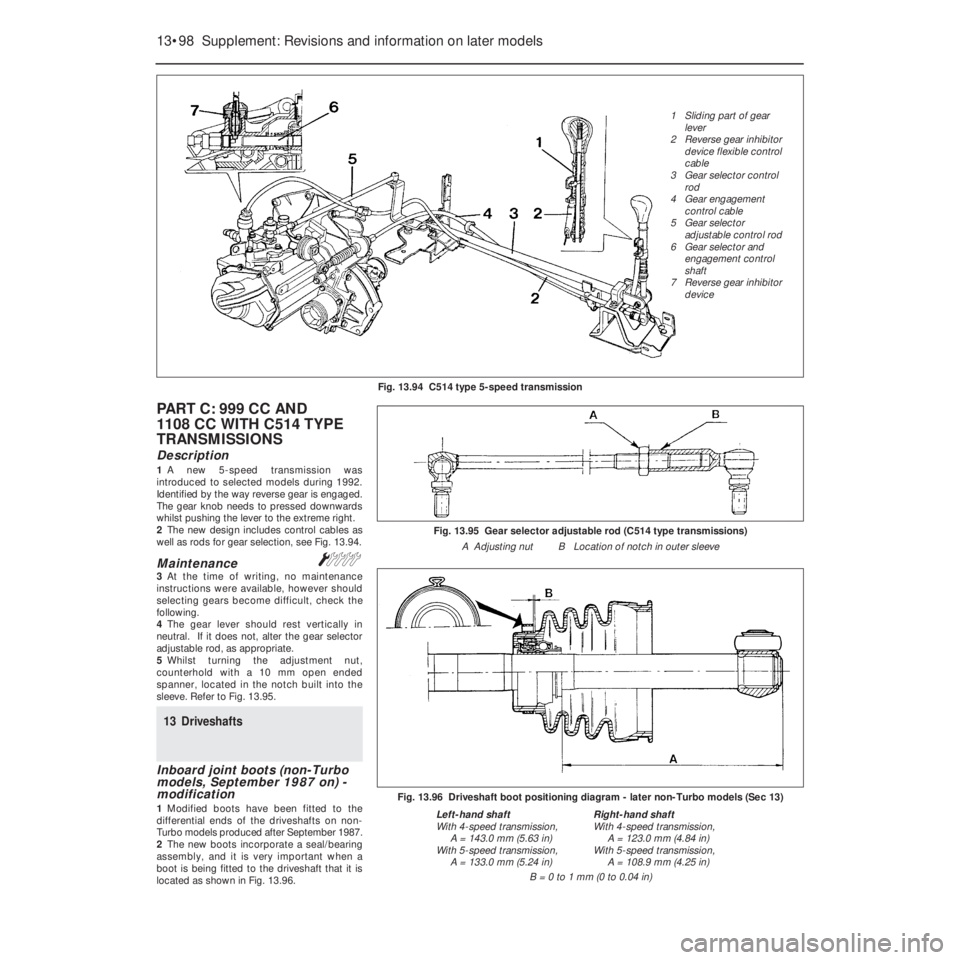
PART C: 999 CC AND
1108 CC WITH C514 TYPE
TRANSMISSIONS
Description
1A new 5-speed transmission was
introduced to selected models during 1992.
Identified by the way reverse gear is engaged.
The gear knob needs to pressed downwards
whilst pushing the lever to the extreme right.
2The new design includes control cables as
well as rods for gear selection, see Fig. 13.94.
MaintenanceÁ3At the time of writing, no maintenance
instructions were available, however should
selecting gears become difficult, check the
following.
4The gear lever should rest vertically in
neutral. If it does not, alter the gear selector
adjustable rod, as appropriate.
5Whilst turning the adjustment nut,
counterhold with a 10 mm open ended
spanner, located in the notch built into the
sleeve. Refer to Fig. 13.95.
13 Driveshafts
Inboard joint boots (non-Turbo
models, September 1987 on) -
modification
1Modified boots have been fitted to the
differential ends of the driveshafts on non-
Turbo models produced after September 1987.
2The new boots incorporate a seal/bearing
assembly, and it is very important when a
boot is being fitted to the driveshaft that it is
located as shown in Fig. 13.96.
13•98 Supplement: Revisions and information on later models
Fig. 13.96 Driveshaft boot positioning diagram - later non-Turbo models (Sec 13)
Left-hand shaft
With 4-speed transmission,
A = 143.0 mm (5.63 in)
With 5-speed transmission,
A = 133.0 mm (5.24 in)Right-hand shaft
With 4-speed transmission,
A = 123.0 mm (4.84 in)
With 5-speed transmission,
A = 108.9 mm (4.25 in)
Fig. 13.94 C514 type 5-speed transmission
1 Sliding part of gear
lever
2 Reverse gear inhibitor
device flexible control
cable
3 Gear selector control
rod
4 Gear engagement
control cable
5 Gear selector
adjustable control rod
6 Gear selector and
engagement control
shaft
7 Reverse gear inhibitor
device
B = 0 to 1 mm (0 to 0.04 in)
Fig. 13.95 Gear selector adjustable rod (C514 type transmissions)
A Adjusting nut B Location of notch in outer sleeve
Page 228 of 303
Vacuum servo unit and master
cylinder - general
54Access to the vacuum servo unit and the
master cylinder can only be obtained after the
cooling system expansion tank has been
released and moved aside (photo).
Antiskid system - description
55This system is available as an option on
the Turbo ie models only.
56The purpose of the system is to prevent
the wheel(s) locking during heavy brake
applications. This is achieved by automatic
release of the brake on a roadwheel which is
about to lock up, after which the brake is
re-applied. This cycle is carried out many
times per second under heavy braking,
retaining full steering control to avoid any
hazards.
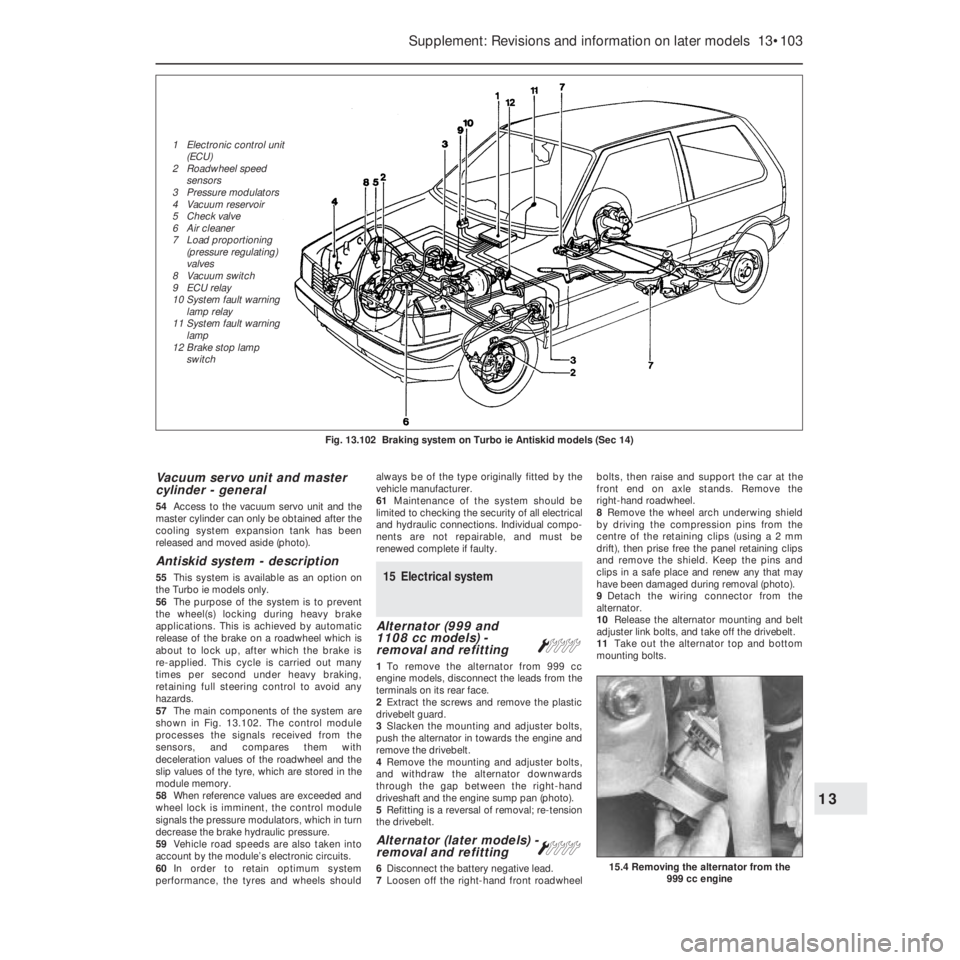
57The main components of the system are
shown in Fig. 13.102. The control module
processes the signals received from the
sensors, and compares them with
deceleration values of the roadwheel and the
slip values of the tyre, which are stored in the
module memory.
58When reference values are exceeded and
wheel lock is imminent, the control module
signals the pressure modulators, which in turn
decrease the brake hydraulic pressure.
59Vehicle road speeds are also taken into
account by the module’s electronic circuits.
60In order to retain optimum system
performance, the tyres and wheels shouldalways be of the type originally fitted by the
vehicle manufacturer.
61Maintenance of the system should be
limited to checking the security of all electrical
and hydraulic connections. Individual compo-
nents are not repairable, and must be
renewed complete if faulty.15 Electrical system
Alternator (999 and
1108 cc models) -
removal and refitting
Á
1To remove the alternator from 999 cc
engine models, disconnect the leads from the
terminals on its rear face.
2Extract the screws and remove the plastic
drivebelt guard.
3Slacken the mounting and adjuster bolts,
push the alternator in towards the engine and
remove the drivebelt.
4Remove the mounting and adjuster bolts,
and withdraw the alternator downwards
through the gap between the right-hand
driveshaft and the engine sump pan (photo).
5Refitting is a reversal of removal; re-tension
the drivebelt.
Alternator (later models) -
removal and refitting Á
6Disconnect the battery negative lead.
7Loosen off the right-hand front roadwheelbolts, then raise and support the car at the
front end on axle stands. Remove the
right-hand roadwheel.
8Remove the wheel arch underwing shield
by driving the compression pins from the
centre of the retaining clips (using a 2 mm
drift), then prise free the panel retaining clips
and remove the shield. Keep the pins and
clips in a safe place and renew any that may
have been damaged during removal (photo).
9Detach the wiring connector from the
alternator.
10Release the alternator mounting and belt
adjuster link bolts, and take off the drivebelt.
11Take out the alternator top and bottom
mounting bolts.
Supplement: Revisions and information on later models 13•103
15.4 Removing the alternator from the
999 cc engine
Fig. 13.102 Braking system on Turbo ie Antiskid models (Sec 14)
13
1 Electronic control unit
(ECU)
2 Roadwheel speed
sensors
3 Pressure modulators
4 Vacuum reservoir
5 Check valve
6 Air cleaner
7 Load proportioning
(pressure regulating)
valves
8 Vacuum switch
9 ECU relay
10 System fault warning
lamp relay
11 System fault warning
lamp
12 Brake stop lamp
switch
Page 288 of 303
Introduction
A selection of good tools is a fundamental
requirement for anyone contemplating the
maintenance and repair of a motor vehicle.
For the owner who does not possess any,
their purchase will prove a considerable
expense, offsetting some of the savings made
by doing-it-yourself. However, provided that
the tools purchased meet the relevant national
safety standards and are of good quality, they
will last for many years and prove an
extremely worthwhile investment.
To help the average owner to decide which
tools are needed to carry out the various tasks
detailed in this manual, we have compiled
three lists of tools under the following
headings: Maintenance and minor repair,
Repair and overhaul, and Special. Newcomers
to practical mechanics should start off with
the Maintenance and minor repairtool kit, and
confine themselves to the simpler jobs around
the vehicle. Then, as confidence and
experience grow, more difficult tasks can be
undertaken, with extra tools being purchased
as, and when, they are needed. In this way, a
Maintenance and minor repairtool kit can be
built up into a Repair and overhaultool kit over
a considerable period of time, without any
major cash outlays. The experienced do-it-
yourselfer will have a tool kit good enough for
most repair and overhaul procedures, and will
add tools from the Specialcategory when it is
felt that the expense is justified by the amount
of use to which these tools will be put.
Maintenance and minor repair
tool kit
The tools given in this list should be
considered as a minimum requirement if
routine maintenance, servicing and minor
repair operations are to be undertaken. We
recommend the purchase of combination
spanners (ring one end, open-ended the
other); although more expensive than open-
ended ones, they do give the advantages of
both types of spanner.
MCombination spanners: 8, 9, 10, 11, 12, 13,
14, 15, 16, 17, 19, 21, 22, 24 & 26 mm
MAdjustable spanner - 35 mm jaw (approx)
MSet of feeler gauges
MSpark plug spanner (with rubber insert)
MSpark plug gap adjustment tool
MBrake bleed nipple spannerMScrewdrivers: Flat blade and cross blade –
approx 100 mm long x 6 mm dia
MCombination pliers
MHacksaw (junior)
MTyre pump
MTyre pressure gauge
MOil can
MOil filter removal tool
MFine emery cloth
MWire brush (small)
MFunnel (medium size)
Repair and overhaul tool kit
These tools are virtually essential for
anyone undertaking any major repairs to a
motor vehicle, and are additional to those
given in the Maintenance and minor repairlist.
Included in this list is a comprehensive set of
sockets. Although these are expensive, they
will be found invaluable as they are so
versatile - particularly if various drives are
included in the set. We recommend the half-
inch square-drive type, as this can be used
with most proprietary torque wrenches. If you
cannot afford a socket set, even bought
piecemeal, then inexpensive tubular box
spanners are a useful alternative.
The tools in this list will occasionally need
to be supplemented by tools from the Special
list:
MSockets (or box spanners) to cover range in
previous list
MReversible ratchet drive (for use with
sockets) (see illustration)
MExtension piece, 250 mm (for use with
sockets)
MUniversal joint (for use with sockets)
MTorque wrench (for use with sockets)
MSelf-locking grips
MBall pein hammer
MSoft-faced mallet (plastic/aluminium or
rubber)
MScrewdrivers:
Flat blade - long & sturdy, short (chubby),
and narrow (electrician’s) types
Cross blade - Long & sturdy, and short
(chubby) types
MPliers:
Long-nosed
Side cutters (electrician’s)
Circlip (internal and external)
MCold chisel - 25 mm
MScriber
MScraperMCentre-punch
MPin punch
MHacksaw
MBrake hose clamp
MBrake bleeding kit
MSelection of twist drills
MSteel rule/straight-edge
MAllen keys
MSelection of files
MWire brush
MAxle stands
MJack (strong trolley or hydraulic type)
MLight with extension lead
Special tools
The tools in this list are those which are not
used regularly, are expensive to buy, or which
need to be used in accordance with their
manufacturers’ instructions. Unless relatively
difficult mechanical jobs are undertaken
frequently, it will not be economic to buy
many of these tools. Where this is the case,
you could consider clubbing together with
friends (or joining a motorists’ club) to make a
joint purchase, or borrowing the tools against
a deposit from a local garage or tool hire
specialist. It is worth noting that many of the
larger DIY superstores now carry a large
range of special tools for hire at modest rates.
The following list contains only those tools
and instruments freely available to the public,
and not those special tools produced by the
vehicle manufacturer specifically for its dealer
network. You will find occasional references
to these manufacturers’ special tools in the
text of this manual. Generally, an alternative
method of doing the job without the vehicle
manufacturers’ special tool is given. However,
sometimes there is no alternative to using
them. Where this is the case and the relevant
tool cannot be bought or borrowed, you will
have to entrust the work to a franchised
garage.
MValve spring compressor (see illustration)
MValve grinding tool
MPiston ring compressor (see illustration)
MPiston ring removal/installation tool (see
illustration)
MCylinder bore hone (see illustration)
MBalljoint separator
MCoil spring compressors (where applicable)
MTwo/three-legged hub and bearing puller
(see illustration)
Tools and Working FacilitiesREF•5
REF