chapter 13 FIAT UNO 1983 Service Service Manual
[x] Cancel search | Manufacturer: FIAT, Model Year: 1983, Model line: UNO, Model: FIAT UNO 1983Pages: 303, PDF Size: 10.36 MB
Page 118 of 303
10 Front wing-
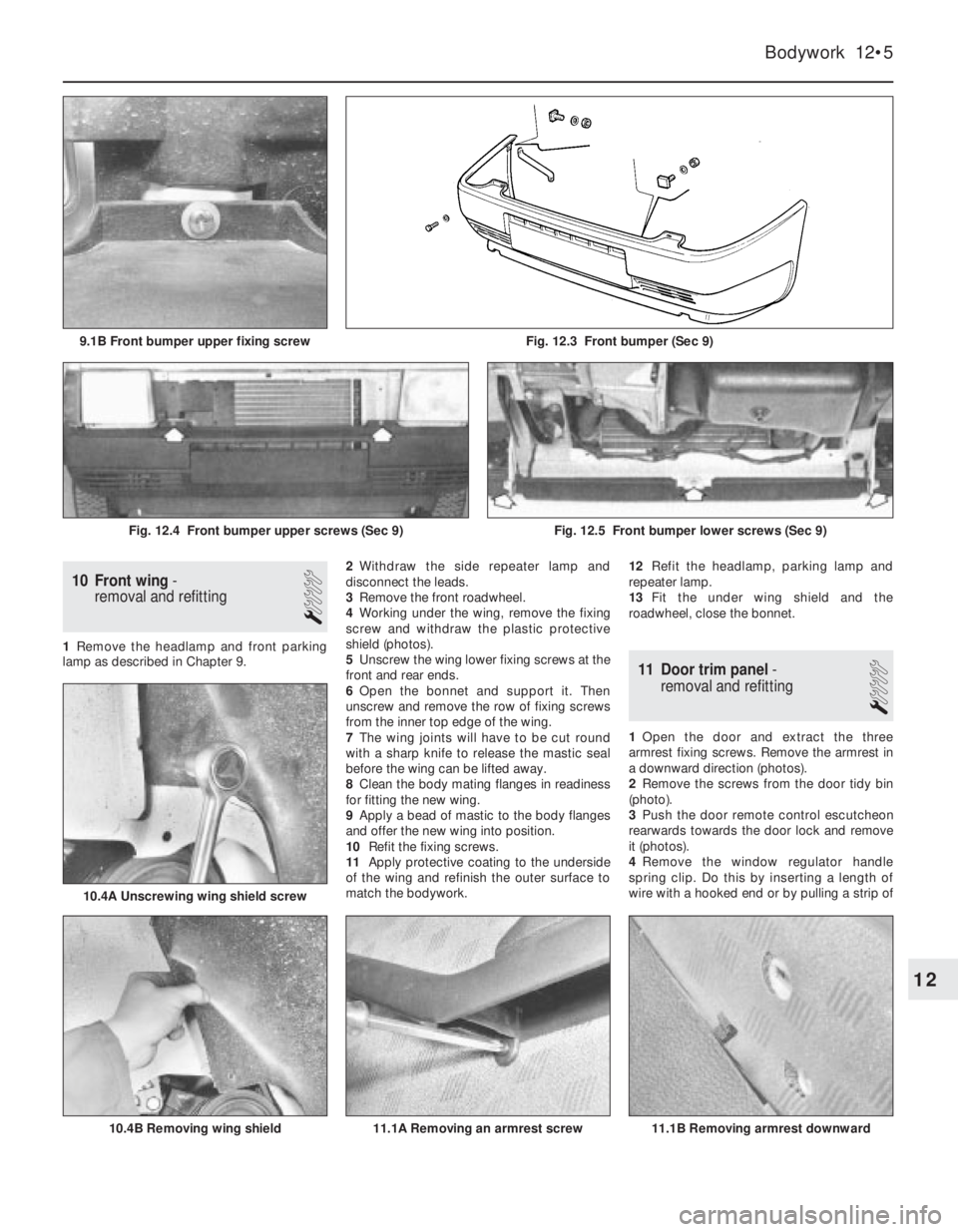
removal and refitting
1
1Remove the headlamp and front parking
lamp as described in Chapter 9. 2Withdraw the side repeater lamp and
disconnect the leads.
3Remove the front roadwheel.
4Working under the wing, remove the fixing
screw and withdraw the plastic protective
shield (photos).
5Unscrew the wing lower fixing screws at the
front and rear ends.
6Open the bonnet and support it. Then
unscrew and remove the row of fixing screws
from the inner top edge of the wing.
7The wing joints will have to be cut round
with a sharp knife to release the mastic seal
before the wing can be lifted away.
8Clean the body mating flanges in readiness
for fitting the new wing.
9Apply a bead of mastic to the body flanges
and offer the new wing into position.
10Refit the fixing screws.
11Apply protective coating to the underside
of the wing and refinish the outer surface to
match the bodywork. 12Refit the headlamp, parking lamp and
repeater lamp.
13Fit the under wing shield and the
roadwheel, close the bonnet.
11 Door trim panel-
removal and refitting
1
1Open the door and extract the three
armrest fixing screws. Remove the armrest in
a downward direction (photos).
2Remove the screws from the door tidy bin
(photo).
3Push the door remote control escutcheon
rearwards towards the door lock and remove
it (photos).
4Remove the window regulator handle
spring clip. Do this by inserting a length of
wire with a hooked end or by pulling a strip of
Bodywork 12•5
Fig. 12.3 Front bumper (Sec 9)9.1B Front bumper upper fixing screw
11.1B Removing armrest downward11.1A Removing an armrest screw
10.4A Unscrewing wing shield screw
10.4B Removing wing shield
Fig. 12.4 Front bumper upper screws (Sec 9)Fig. 12.5 Front bumper lower screws (Sec 9)
12
Page 123 of 303
4Reach up behind the facia panel on the side
opposite to the glove box and unscrew the
remaining console fixing screw.
5Withdraw the console downwards and
disconnect the fibre optics from their source.
6Refitting is a reversal of removal.
22 Facia panel-
removal and refitting
1
1Remove the instrument panel as described
in Chapter 9.
2Remove the steering wheel (Chapter 10). 3Disconnect the choke control lever and
cable from the facia panel as described in
Chapter 3.
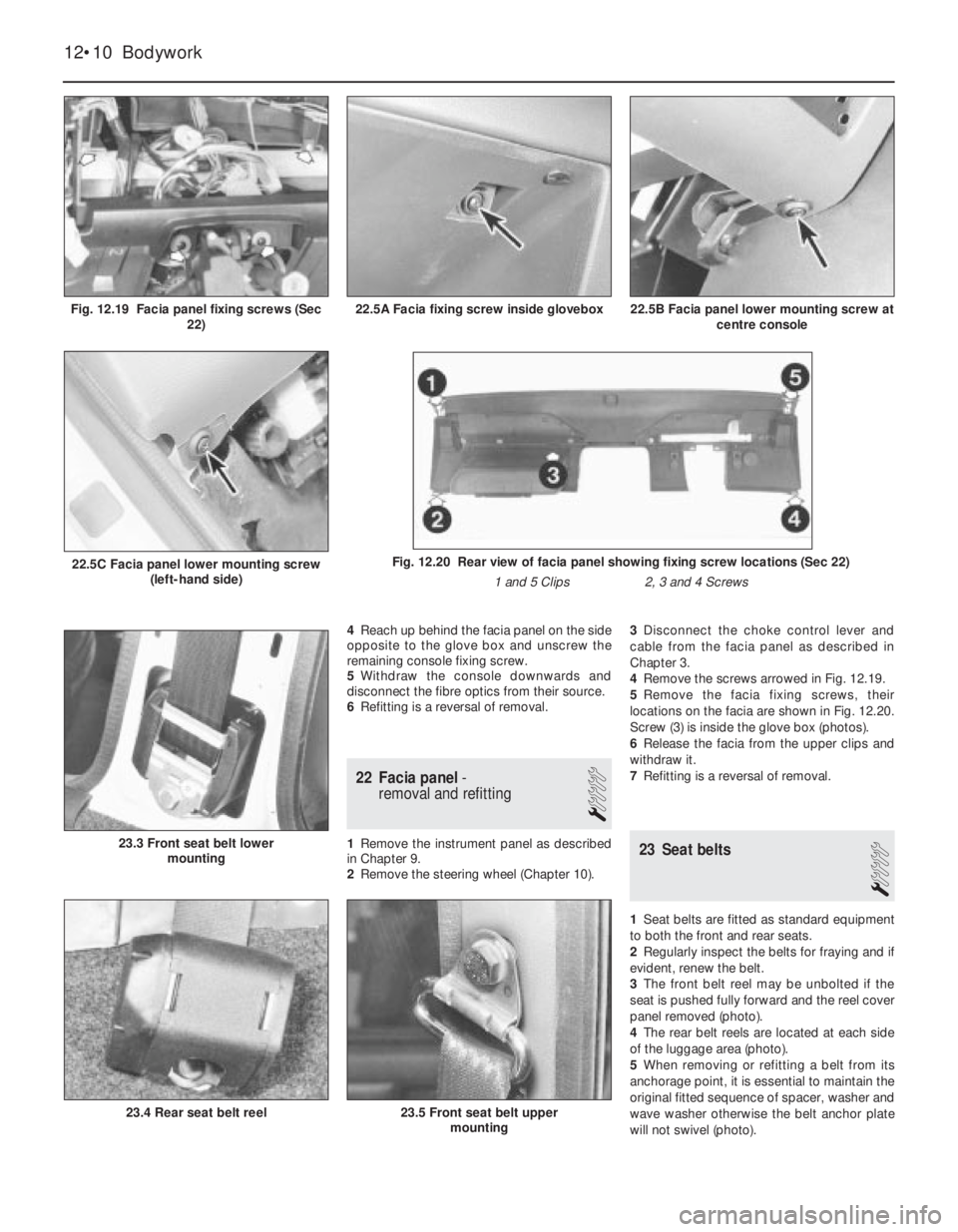
4Remove the screws arrowed in Fig. 12.19.
5Remove the facia fixing screws, their
locations on the facia are shown in Fig. 12.20.
Screw (3) is inside the glove box (photos).
6Release the facia from the upper clips and
withdraw it.
7Refitting is a reversal of removal.23 Seat belts
1
1Seat belts are fitted as standard equipment
to both the front and rear seats.
2Regularly inspect the belts for fraying and if
evident, renew the belt.
3The front belt reel may be unbolted if the
seat is pushed fully forward and the reel cover
panel removed (photo).
4The rear belt reels are located at each side
of the luggage area (photo).
5When removing or refitting a belt from its
anchorage point, it is essential to maintain the
original fitted sequence of spacer, washer and
wave washer otherwise the belt anchor plate
will not swivel (photo).
23.4 Rear seat belt reel
23.3 Front seat belt lower
mounting
12•10 Bodywork
23.5 Front seat belt upper
mounting
Fig. 12.20 Rear view of facia panel showing fixing screw locations (Sec 22)
1 and 5 Clips 2, 3 and 4 Screws22.5C Facia panel lower mounting screw
(left-hand side)
22.5B Facia panel lower mounting screw at
centre console22.5A Facia fixing screw inside gloveboxFig. 12.19 Facia panel fixing screws (Sec
22)
Page 124 of 303
24 Rear view mirrors
1
Interior
1The mirror may be removed after extracting
the fixing screws. The mirror is designed to
break off if struck.
Exterior
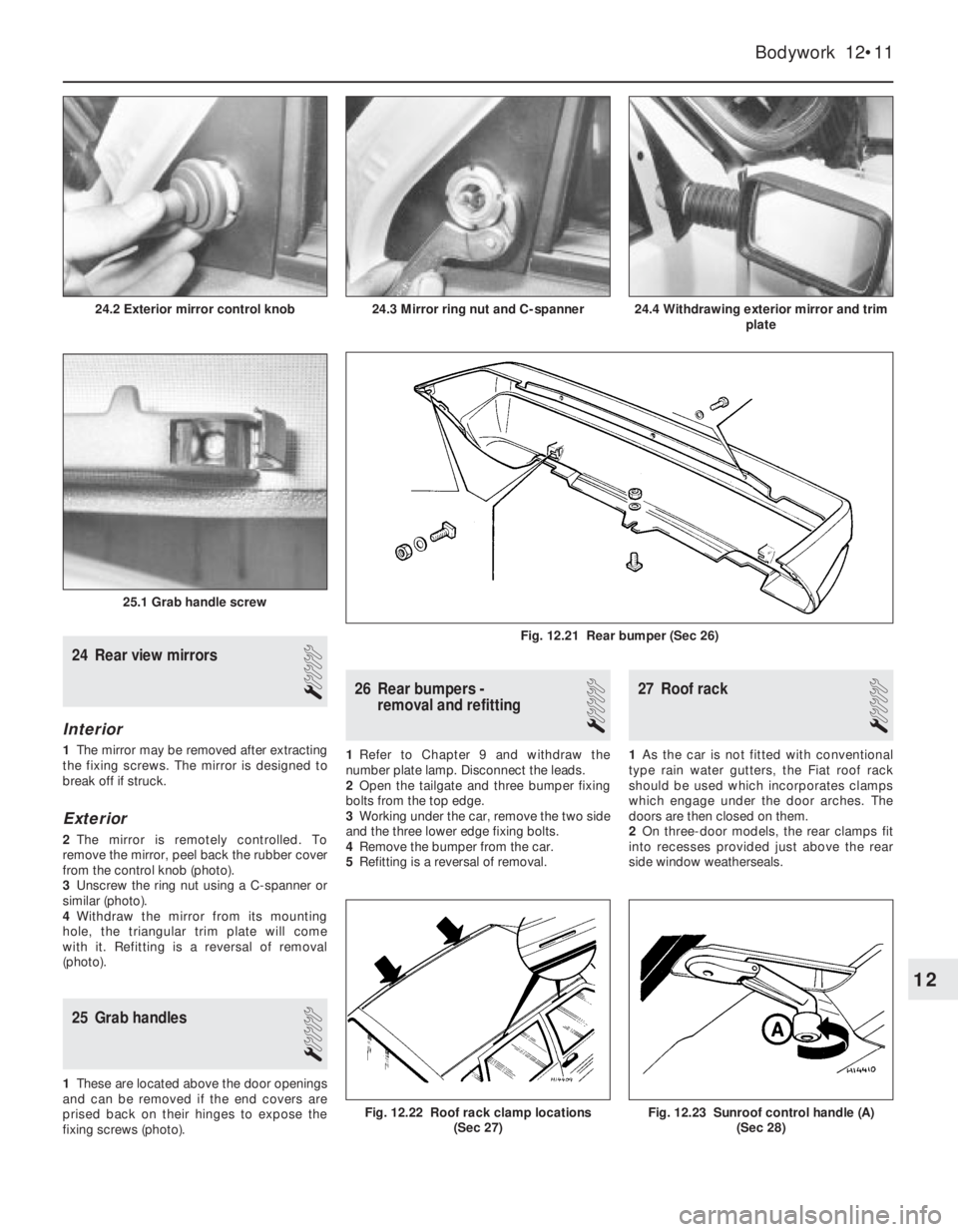
2The mirror is remotely controlled. To
remove the mirror, peel back the rubber cover
from the control knob (photo).
3Unscrew the ring nut using a C-spanner or
similar (photo).
4Withdraw the mirror from its mounting
hole, the triangular trim plate will come
with it. Refitting is a reversal of removal
(photo).
25 Grab handles
1
1These are located above the door openings
and can be removed if the end covers are
prised back on their hinges to expose the
fixing screws (photo).
26 Rear bumpers -
removal and refitting
1
1Refer to Chapter 9 and withdraw the
number plate lamp. Disconnect the leads.
2Open the tailgate and three bumper fixing
bolts from the top edge.
3Working under the car, remove the two side
and the three lower edge fixing bolts.
4Remove the bumper from the car.
5Refitting is a reversal of removal.
27 Roof rack
1
1As the car is not fitted with conventional
type rain water gutters, the Fiat roof rack
should be used which incorporates clamps
which engage under the door arches. The
doors are then closed on them.
2On three-door models, the rear clamps fit
into recesses provided just above the rear
side window weatherseals.
Bodywork 12•11
24.4 Withdrawing exterior mirror and trim
plate
25.1 Grab handle screw
24.3 Mirror ring nut and C-spanner24.2 Exterior mirror control knob
Fig. 12.23 Sunroof control handle (A)
(Sec 28)Fig. 12.22 Roof rack clamp locations
(Sec 27)
Fig. 12.21 Rear bumper (Sec 26)
12
Page 126 of 303
13
Chapter 13 Supplement:
Revisions and information on later models
Introduction . . . . . . . . . . . . . . . . . . . . . . . . . . . . . . . . . . . . . . . . . . . 1
Specifications . . . . . . . . . . . . . . . . . . . . . . . . . . . . . . . . . . . . . . . . . 2
Routine maintenance - all models from June 1991 . . . . . . . . . . . 3
Engine 903 and 1299/1301 cc . . . . . . . . . . . . . . . . . . . . . . . . . . . . . 4
Sump pan sealing strips (903 cc engine) - modification
1299 cc engine - description
Rocker cover (903 cc engine) - removal
Cylinder head (903 cc engine) - refitting
Engine - 999 and 1108 cc (FIRE) . . . . . . . . . . . . . . . . . . . . . . . . . . 5
Part A: General
Description
Part B: Operations possible with engine in car
Valve clearances - adjustment
Timing belt - renewal
Camshaft - removal and refitting
Cylinder head - removal and refitting
Sump pan - removal and refitting
Oil pump - removal, checking and refitting
Pistons/connecting rods - removal and refitting
Pistons/connecting rods - separation and piston ring renewal
Engine/transmission mountings - renewal
Part C: Engine removal and dismantling
Method of removal - general
Engine/transmission - removal and separation
Dismantling - general
Complete dismantling
Examination and renovation
Part D: Engine reassembly and refitting
Reassembly - general
Complete reassembly
Engine/transmission - reconnection and refitting
Initial start-up after major overhaul
Engine 1301 cc Turbo ie.................................................................. 6
Part A: General
Description
Lubrication system - description
Part B: Operations possible with engine in car
Camshaft and camshaft carrier - removal and refitting
Cylinder head - removal and refitting
Piston rings
Engine mountings - renewal
Timing belt - renewal
Oil pump drivegear cover plate
Engine oil cooler - removal and refittingPart C: Engine removal, dismantling, reassembly and refitting
Engine/transmission - removal and separation
Engine - dismantling and reassembly
Engine/transmission - reconnection and refitting
Initial start-up after major overhaul
Engine 1372 cc ie and 1372 cc Turbo ie......................................... 7
Part A: General
Description
Maintenance
Part B: Operations possible with the engine in car
Valve clearances - checking and adjustment
Timing belt, tensioner and sprockets - removal and refitting
Camshaft front oil seal - renewal
Camshaft, housing and followers - removal and refitting
Camshaft housing, camshaft and cam followers - dismantling,
inspection and reassembly
Cylinder head (1372 cc ie engine) - removal and refitting
Cylinder head (1372 cc Turbo ie engine) - removal and refitting
Cylinder head - inspection and renovation
Crankshaft front oil seal - removal and renewal
Crankshaft rear oil seal - removal and renewal
Flywheel - removal, inspection and refitting
Sump - removal and refitting
Oil pump - removal, checking and refitting
Pistons/connecting rods - removal and refitting
Pistons/connecting rods - examination and renovation
Engine/transmission mountings - renewal
Part C: Engine removal and dismantling
Method of removal - general
1372 cc ie engine/transmission - removal and separation
1372 cc Turbo ie engine/transmission - removal and separation
Engine dismantling - general
Auxiliary shaft - removal, inspection and refitting
Engine - complete dismantling
Crankshaft and main bearings - removal
Engine components - examination and renovation
Part D: Engine reassembly
Reassembly - general
Crankshaft and main bearings - refitting
Pistons and connecting rods - refitting
Oil pump - refitting
Sump - refitting
Flywheel - refitting
Auxiliary shaft - refitting
Cylinder head - refitting
Timing belt and covers - refitting
Engine/transmission - reconnection and refitting
Initial start-up after major overhaul
13•1
Contents
Page 128 of 303
Braking system................................................................................. 14
Part A: Braking system general
Front brake pads all later models
Part B: Braking system - Turbo ie models
Description
Front disc pads - renewal
Front disc caliper - removal and refitting
Front disc caliper - overhaul
Front brake disc - inspection, renovation or renewal
Rear disc pads - renewal
Rear disc caliper - removal, overhaul and refitting
Rear brake disc - inspection, renovation and renewal
Pressure regulating valve
Brake pedal - removal and refitting
Vacuum servo unit and master cylinder - general
Antiskid system - description
Electrical system.............................................................................. 15
Alternator (999 cc models) - removal and refitting
Alternator (later models) - removal and refitting
Alternator brushes - renewal
Starter motor (999 cc models) - removal and refitting
Starter motor (1301 cc Turbo ie, 1372 cc ie, 1372 cc Turbo ie)
- removal and refitting
Starter motor brushes (later models) - renewal
Fuses - later models
Relays (Turbo ie models) - general
Headlamps - later models
Headlamp beam adjusters for load compensation - later models
Headlamp unit removal - later models
Headlamp dim-dip system - description
Front fog lamps bulb/unit - removal and refitting and beam
adjustment
Horn - relocation
Steering column combination switches (later models) - removal
and refittingInstrument panel (Turbo ie models) - removal and refitting
Facia-mounted switches (1301 cc Turbo ie model) - removal
and refitting
Instrument panel (later models) - removal and refitting
Auxiliary control panel (later models) - removal and refitting
Heater control panel (later models) - removal and refitting
Trip master
Interior roof mounted spotlamp, switch and/or clock - removal
and refitting
Central door locking system
Cigar lighter (later models) - removal and refitting
Electrically operated window switches - removal and refitting
Windscreen wiper motor (later models) - removal and refitting
Windscreen washer reservoir (Turbo) - removal and refitting
Tailgate wiper motor (later models) - removal and refitting
Radio Check control system sensors - description
Check control system sensors - testing
Suspension....................................................................................... 16
Front anti-roll bar - removal and refitting
Suspension strut later models
Bodywork.......................................................................................... 17
Plastic components
Rear view mirrors
Door armrest
Tailgate (Turbo ie model) - component removal and refitting
Radiator grille (1301 cc Turbo ie model) - removal and
refitting
Radiator grille (1372 cc ie and 1372 cc Turbo ie models) -
removal and refitting
Bumpers (1301 cc Turbo ie, 1372 cc ie and 1372 cc Turbo ie
models) - removal and refitting
Rear hinged windows - removal and refitting
Door trim panel (Turbo ie model) - removal and refitting
Supplement: Revisions and information on later models 13•3
13
1 Introduction
Since its introduction in 1983, the FIAT Uno
has had a number of modifications and
improvements including the fitting of a twin
choke carburettor, low profile tyres, tinted
windows and remotely-controlled central door
locking.
The major mechanical change was the
introduction of the FIRE (Fully Integrated
Robotised Engine) on 45 and 45S models to
be followed by a new 1108 cc “FIRE” engine
on the 60S model from 1989 on.
A 1301 cc Turbo ie engine model wasavailable for a short period. This model had a
Bosch LE2 Jetronic electronic fuel injection
(ie) and a turbocharger to give added
performance. To uprate the braking to suit,
disc brakes were fitted to the rear in place of
the original drum type brakes.
A 1372 cc engine model was introduced in
1989. Two versions were initially available. A
Bosch Mono-Jetronic single-point fuel
injection (SPi) system, as found on the 70 SX
model and Bosch L3.1 or L3.2 Jetronic
multi-point fuel injection (MPi) systems were
fitted to Turbo models. L3.2 MPi system
models were equipped with catalytic
converters, to improve exhaust emission. All
fuel injection engines are fitted with electroni-
cally controlled engine management systems.
A new style instrument panel, switchgearand a revised facia layout was introduced in
1989.
During 1992, SPi fuel systems were fitted to
the 999 cc and 1108 cc engines, along with
catalytic converters for improved exhaust
emissions.
Five speed transmissions were introduced
to 999 cc models in 1993.
It is recommended that this Supplement is
always referred to before the main Chapters
of the Manual.
Project vehicles
The vehicles used in the preparation of this
supplement, and appearing in many of the
photographic sequences were a 1986 Uno
45S FIRE, a 1988 1301 cc Uno Turbo ie and a
1991 1372 cc Uno SXie.
Easy,suitable for
novice with little
experienceFairly easy,suitable
for beginner with
some experienceFairly difficult,
suitable for competent
DIY mechanic
Difficult,suitable for
experienced DIY
mechanicVery difficult,
suitable for expert DIY
or professional
Degrees of difficulty
54321
Page 129 of 303
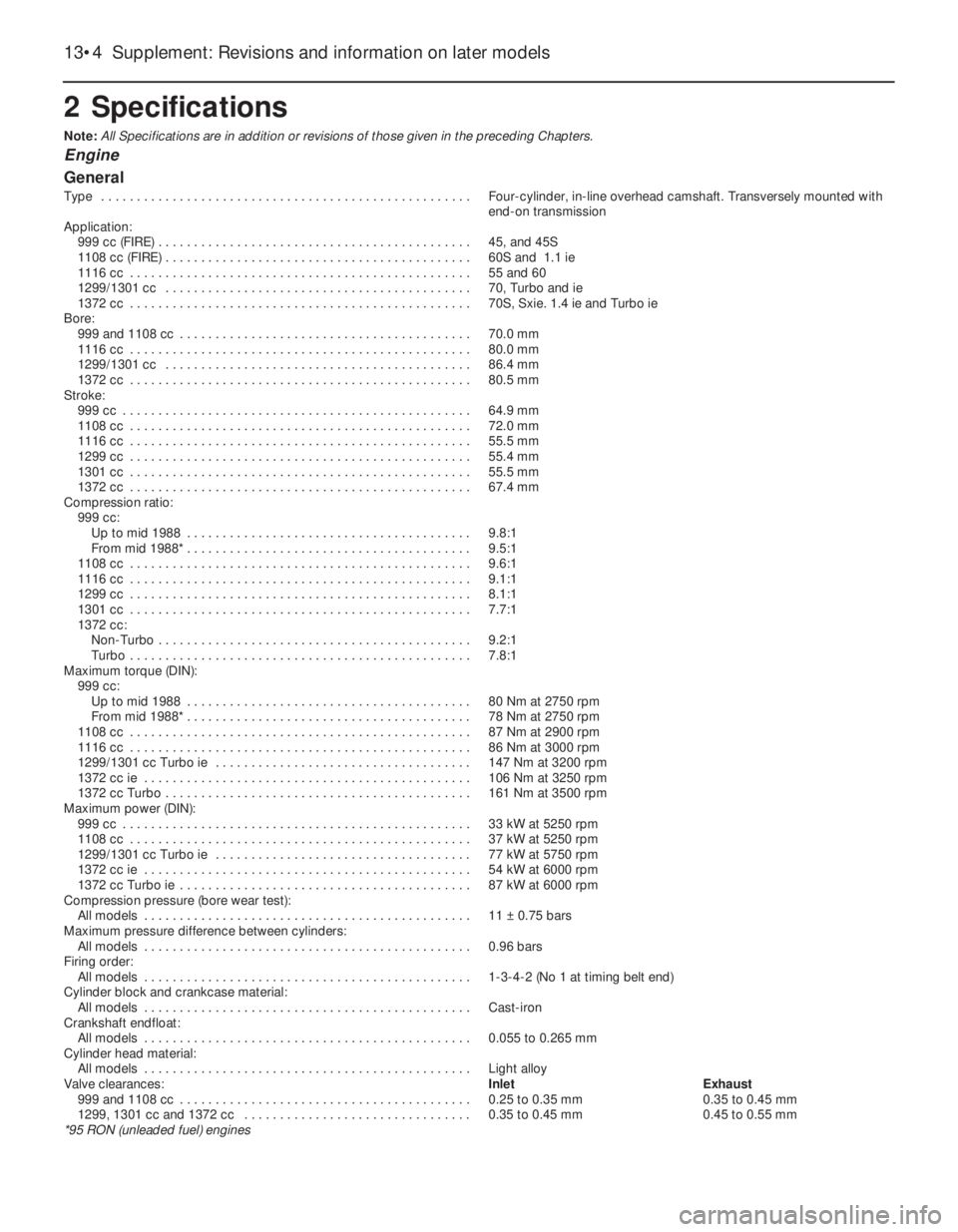
2 Specifications
Note: All Specifications are in addition or revisions of those given in the preceding Chapters.
Engine
General
Type . . . . . . . . . . . . . . . . . . . . . . . . . . . . . . . . . . . . . . . . . . . . . . . . . . . . Four-cylinder, in-line overhead camshaft. Transversely mounted with
end-on transmission
Application:
999 cc (FIRE) . . . . . . . . . . . . . . . . . . . . . . . . . . . . . . . . . . . . . . . . . . . . 45, and 45S
1108 cc (FIRE) . . . . . . . . . . . . . . . . . . . . . . . . . . . . . . . . . . . . . . . . . . . 60S and 1.1 ie
1116 cc . . . . . . . . . . . . . . . . . . . . . . . . . . . . . . . . . . . . . . . . . . . . . . . . 55 and 60
1299/1301 cc . . . . . . . . . . . . . . . . . . . . . . . . . . . . . . . . . . . . . . . . . . . 70, Turbo and ie
1372 cc . . . . . . . . . . . . . . . . . . . . . . . . . . . . . . . . . . . . . . . . . . . . . . . . 70S, Sxie. 1.4 ie and Turbo ie
Bore:
999 and 1108 cc . . . . . . . . . . . . . . . . . . . . . . . . . . . . . . . . . . . . . . . . . 70.0 mm
1116 cc . . . . . . . . . . . . . . . . . . . . . . . . . . . . . . . . . . . . . . . . . . . . . . . . 80.0 mm
1299/1301 cc . . . . . . . . . . . . . . . . . . . . . . . . . . . . . . . . . . . . . . . . . . . 86.4 mm
1372 cc . . . . . . . . . . . . . . . . . . . . . . . . . . . . . . . . . . . . . . . . . . . . . . . . 80.5 mm
Stroke:
999 cc . . . . . . . . . . . . . . . . . . . . . . . . . . . . . . . . . . . . . . . . . . . . . . . . . 64.9 mm
1108 cc . . . . . . . . . . . . . . . . . . . . . . . . . . . . . . . . . . . . . . . . . . . . . . . . 72.0 mm
1116 cc . . . . . . . . . . . . . . . . . . . . . . . . . . . . . . . . . . . . . . . . . . . . . . . . 55.5 mm
1299 cc . . . . . . . . . . . . . . . . . . . . . . . . . . . . . . . . . . . . . . . . . . . . . . . . 55.4 mm
1301 cc . . . . . . . . . . . . . . . . . . . . . . . . . . . . . . . . . . . . . . . . . . . . . . . . 55.5 mm
1372 cc . . . . . . . . . . . . . . . . . . . . . . . . . . . . . . . . . . . . . . . . . . . . . . . . 67.4 mm
Compression ratio:
999 cc:
Up to mid 1988 . . . . . . . . . . . . . . . . . . . . . . . . . . . . . . . . . . . . . . . . 9.8:1
From mid 1988* . . . . . . . . . . . . . . . . . . . . . . . . . . . . . . . . . . . . . . . . 9.5:1
1108 cc . . . . . . . . . . . . . . . . . . . . . . . . . . . . . . . . . . . . . . . . . . . . . . . . 9.6:1
1116 cc . . . . . . . . . . . . . . . . . . . . . . . . . . . . . . . . . . . . . . . . . . . . . . . . 9.1:1
1299 cc . . . . . . . . . . . . . . . . . . . . . . . . . . . . . . . . . . . . . . . . . . . . . . . . 8.1:1
1301 cc . . . . . . . . . . . . . . . . . . . . . . . . . . . . . . . . . . . . . . . . . . . . . . . . 7.7:1
1372 cc:
Non-Turbo . . . . . . . . . . . . . . . . . . . . . . . . . . . . . . . . . . . . . . . . . . . . 9.2:1
Turbo . . . . . . . . . . . . . . . . . . . . . . . . . . . . . . . . . . . . . . . . . . . . . . . . 7.8:1
Maximum torque (DIN):
999 cc:
Up to mid 1988 . . . . . . . . . . . . . . . . . . . . . . . . . . . . . . . . . . . . . . . . 80 Nm at 2750 rpm
From mid 1988* . . . . . . . . . . . . . . . . . . . . . . . . . . . . . . . . . . . . . . . . 78 Nm at 2750 rpm
1108 cc . . . . . . . . . . . . . . . . . . . . . . . . . . . . . . . . . . . . . . . . . . . . . . . . 87 Nm at 2900 rpm
1116 cc . . . . . . . . . . . . . . . . . . . . . . . . . . . . . . . . . . . . . . . . . . . . . . . . 86 Nm at 3000 rpm
1299/1301 cc Turbo ie . . . . . . . . . . . . . . . . . . . . . . . . . . . . . . . . . . . . 147 Nm at 3200 rpm
1372 cc ie . . . . . . . . . . . . . . . . . . . . . . . . . . . . . . . . . . . . . . . . . . . . . . 106 Nm at 3250 rpm
1372 cc Turbo . . . . . . . . . . . . . . . . . . . . . . . . . . . . . . . . . . . . . . . . . . . 161 Nm at 3500 rpm
Maximum power (DIN):
999 cc . . . . . . . . . . . . . . . . . . . . . . . . . . . . . . . . . . . . . . . . . . . . . . . . . 33 kW at 5250 rpm
1108 cc . . . . . . . . . . . . . . . . . . . . . . . . . . . . . . . . . . . . . . . . . . . . . . . . 37 kW at 5250 rpm
1299/1301 cc Turbo ie . . . . . . . . . . . . . . . . . . . . . . . . . . . . . . . . . . . . 77 kW at 5750 rpm
1372 cc ie . . . . . . . . . . . . . . . . . . . . . . . . . . . . . . . . . . . . . . . . . . . . . . 54 kW at 6000 rpm
1372 cc Turbo ie . . . . . . . . . . . . . . . . . . . . . . . . . . . . . . . . . . . . . . . . . 87 kW at 6000 rpm
Compression pressure (bore wear test):
All models . . . . . . . . . . . . . . . . . . . . . . . . . . . . . . . . . . . . . . . . . . . . . . 11 ± 0.75 bars
Maximum pressure difference between cylinders:
All models . . . . . . . . . . . . . . . . . . . . . . . . . . . . . . . . . . . . . . . . . . . . . . 0.96 bars
Firing order:
All models . . . . . . . . . . . . . . . . . . . . . . . . . . . . . . . . . . . . . . . . . . . . . . 1-3-4-2 (No 1 at timing belt end)
Cylinder block and crankcase material:
All models . . . . . . . . . . . . . . . . . . . . . . . . . . . . . . . . . . . . . . . . . . . . . . Cast-iron
Crankshaft endfloat:
All models . . . . . . . . . . . . . . . . . . . . . . . . . . . . . . . . . . . . . . . . . . . . . . 0.055 to 0.265 mm
Cylinder head material:
All models . . . . . . . . . . . . . . . . . . . . . . . . . . . . . . . . . . . . . . . . . . . . . . Light alloy
Valve clearances:Inlet Exhaust
999 and 1108 cc . . . . . . . . . . . . . . . . . . . . . . . . . . . . . . . . . . . . . . . . . 0.25 to 0.35 mm 0.35 to 0.45 mm
1299, 1301 cc and 1372 cc . . . . . . . . . . . . . . . . . . . . . . . . . . . . . . . . 0.35 to 0.45 mm 0.45 to 0.55 mm
*95 RON (unleaded fuel) engines
13•4 Supplement: Revisions and information on later models
Page 140 of 303
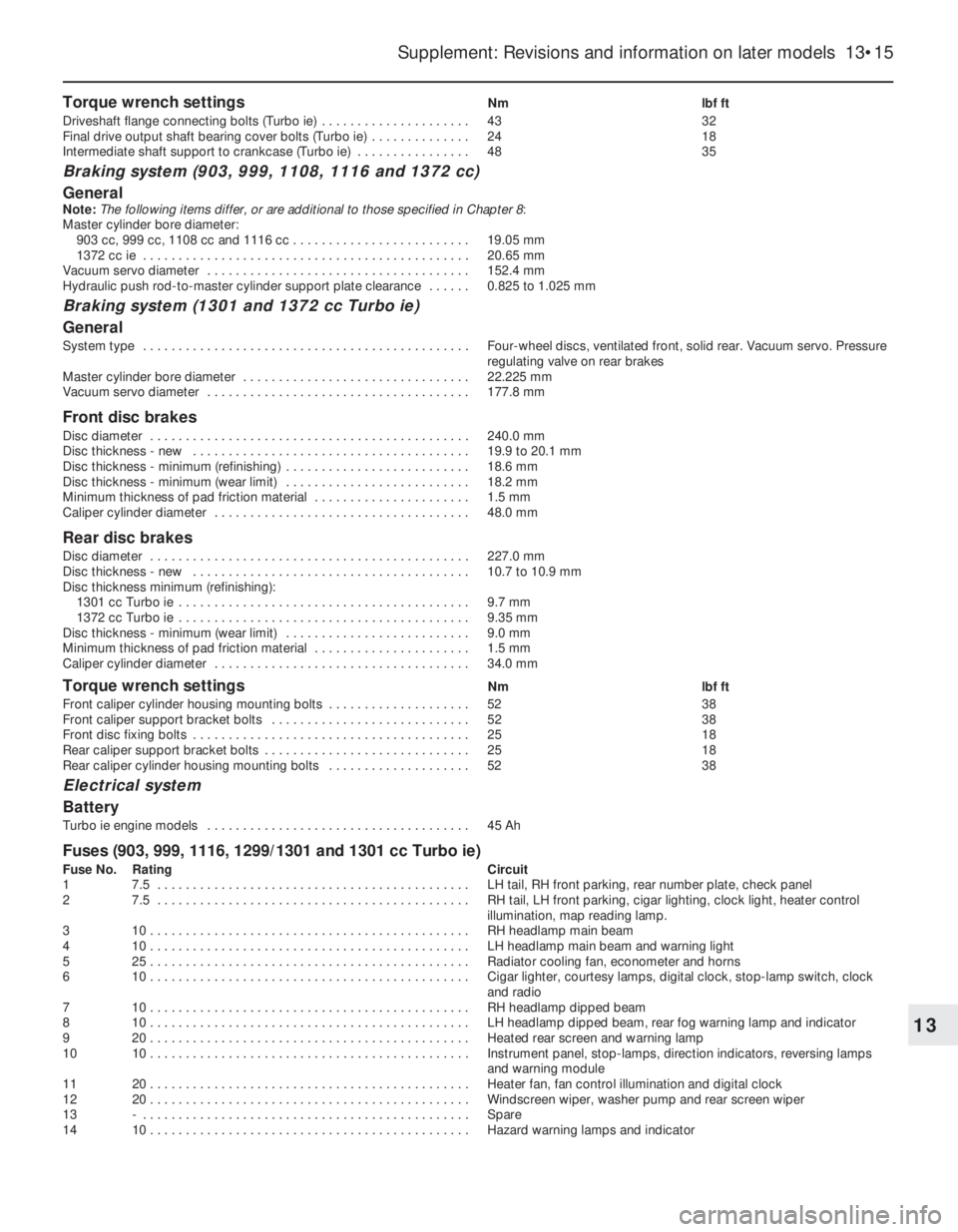
Torque wrench settingsNm lbf ft
Driveshaft flange connecting bolts (Turbo ie) . . . . . . . . . . . . . . . . . . . . . 43 32
Final drive output shaft bearing cover bolts (Turbo ie) . . . . . . . . . . . . . . 24 18
Intermediate shaft support to crankcase (Turbo ie) . . . . . . . . . . . . . . . . 48 35
Braking system (903, 999, 1108, 1116 and 1372 cc)
General
Note:The following items differ, or are additional to those specified in Chapter 8:
Master cylinder bore diameter:
903 cc, 999 cc, 1108 cc and 1116 cc . . . . . . . . . . . . . . . . . . . . . . . . . 19.05 mm
1372 cc ie . . . . . . . . . . . . . . . . . . . . . . . . . . . . . . . . . . . . . . . . . . . . . . 20.65 mm
Vacuum servo diameter . . . . . . . . . . . . . . . . . . . . . . . . . . . . . . . . . . . . . 152.4 mm
Hydraulic push rod-to-master cylinder support plate clearance . . . . . . 0.825 to 1.025 mm
Braking system (1301 and 1372 cc Turbo ie)
General
System type . . . . . . . . . . . . . . . . . . . . . . . . . . . . . . . . . . . . . . . . . . . . . . Four-wheel discs, ventilated front, solid rear. Vacuum servo. Pressure
regulating valve on rear brakes
Master cylinder bore diameter . . . . . . . . . . . . . . . . . . . . . . . . . . . . . . . . 22.225 mm
Vacuum servo diameter . . . . . . . . . . . . . . . . . . . . . . . . . . . . . . . . . . . . . 177.8 mm
Front disc brakes
Disc diameter . . . . . . . . . . . . . . . . . . . . . . . . . . . . . . . . . . . . . . . . . . . . . 240.0 mm
Disc thickness - new . . . . . . . . . . . . . . . . . . . . . . . . . . . . . . . . . . . . . . . 19.9 to 20.1 mm
Disc thickness - minimum (refinishing) . . . . . . . . . . . . . . . . . . . . . . . . . . 18.6 mm
Disc thickness - minimum (wear limit) . . . . . . . . . . . . . . . . . . . . . . . . . . 18.2 mm
Minimum thickness of pad friction material . . . . . . . . . . . . . . . . . . . . . . 1.5 mm
Caliper cylinder diameter . . . . . . . . . . . . . . . . . . . . . . . . . . . . . . . . . . . . 48.0 mm
Rear disc brakes
Disc diameter . . . . . . . . . . . . . . . . . . . . . . . . . . . . . . . . . . . . . . . . . . . . . 227.0 mm
Disc thickness - new . . . . . . . . . . . . . . . . . . . . . . . . . . . . . . . . . . . . . . . 10.7 to 10.9 mm
Disc thickness minimum (refinishing):
1301 cc Turbo ie . . . . . . . . . . . . . . . . . . . . . . . . . . . . . . . . . . . . . . . . . 9.7 mm
1372 cc Turbo ie . . . . . . . . . . . . . . . . . . . . . . . . . . . . . . . . . . . . . . . . . 9.35 mm
Disc thickness - minimum (wear limit) . . . . . . . . . . . . . . . . . . . . . . . . . . 9.0 mm
Minimum thickness of pad friction material . . . . . . . . . . . . . . . . . . . . . . 1.5 mm
Caliper cylinder diameter . . . . . . . . . . . . . . . . . . . . . . . . . . . . . . . . . . . . 34.0 mm
Torque wrench settingsNm lbf ft
Front caliper cylinder housing mounting bolts . . . . . . . . . . . . . . . . . . . . 52 38
Front caliper support bracket bolts . . . . . . . . . . . . . . . . . . . . . . . . . . . . 52 38
Front disc fixing bolts . . . . . . . . . . . . . . . . . . . . . . . . . . . . . . . . . . . . . . . 25 18
Rear caliper support bracket bolts . . . . . . . . . . . . . . . . . . . . . . . . . . . . . 25 18
Rear caliper cylinder housing mounting bolts . . . . . . . . . . . . . . . . . . . . 52 38
Electrical system
Battery
Turbo ie engine models . . . . . . . . . . . . . . . . . . . . . . . . . . . . . . . . . . . . . 45 Ah
Fuses (903, 999, 1116, 1299/1301 and 1301 cc Turbo ie)
Fuse No. Rating Circuit
1 7.5 . . . . . . . . . . . . . . . . . . . . . . . . . . . . . . . . . . . . . . . . . . . . LH tail, RH front parking, rear number plate, check panel
2 7.5 . . . . . . . . . . . . . . . . . . . . . . . . . . . . . . . . . . . . . . . . . . . . RH tail, LH front parking, cigar lighting, clock light, heater control
illumination, map reading lamp.
3 10 . . . . . . . . . . . . . . . . . . . . . . . . . . . . . . . . . . . . . . . . . . . . . RH headlamp main beam
4 10 . . . . . . . . . . . . . . . . . . . . . . . . . . . . . . . . . . . . . . . . . . . . . LH headlamp main beam and warning light
5 25 . . . . . . . . . . . . . . . . . . . . . . . . . . . . . . . . . . . . . . . . . . . . . Radiator cooling fan, econometer and horns
6 10 . . . . . . . . . . . . . . . . . . . . . . . . . . . . . . . . . . . . . . . . . . . . . Cigar lighter, courtesy lamps, digital clock, stop-lamp switch, clock
and radio
7 10 . . . . . . . . . . . . . . . . . . . . . . . . . . . . . . . . . . . . . . . . . . . . . RH headlamp dipped beam
8 10 . . . . . . . . . . . . . . . . . . . . . . . . . . . . . . . . . . . . . . . . . . . . . LH headlamp dipped beam, rear fog warning lamp and indicator
9 20 . . . . . . . . . . . . . . . . . . . . . . . . . . . . . . . . . . . . . . . . . . . . . Heated rear screen and warning lamp
10 10 . . . . . . . . . . . . . . . . . . . . . . . . . . . . . . . . . . . . . . . . . . . . . Instrument panel, stop-lamps, direction indicators, reversing lamps
and warning module
11 20 . . . . . . . . . . . . . . . . . . . . . . . . . . . . . . . . . . . . . . . . . . . . . Heater fan, fan control illumination and digital clock
12 20 . . . . . . . . . . . . . . . . . . . . . . . . . . . . . . . . . . . . . . . . . . . . . Windscreen wiper, washer pump and rear screen wiper
13 - . . . . . . . . . . . . . . . . . . . . . . . . . . . . . . . . . . . . . . . . . . . . . . Spare
14 10 . . . . . . . . . . . . . . . . . . . . . . . . . . . . . . . . . . . . . . . . . . . . . Hazard warning lamps and indicator
Supplement: Revisions and information on later models 13•15
13
Page 144 of 303
4 Engine-
903 and 1299/1301 cc
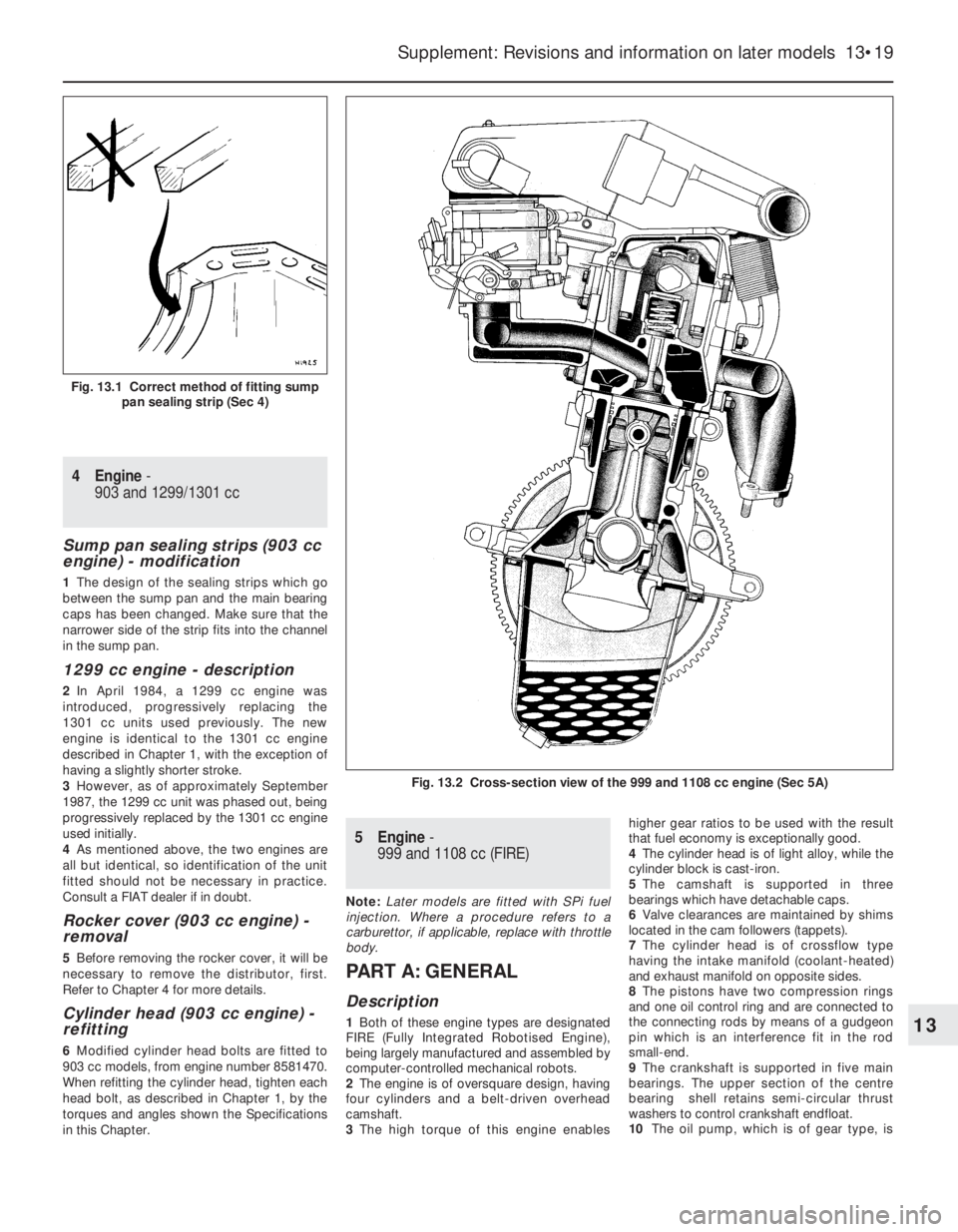
Sump pan sealing strips (903 cc
engine) - modification
1The design of the sealing strips which go
between the sump pan and the main bearing
caps has been changed. Make sure that the
narrower side of the strip fits into the channel
in the sump pan.
1299 cc engine - description
2In April 1984, a 1299 cc engine was
introduced, progressively replacing the
1301 cc units used previously. The new
engine is identical to the 1301 cc engine
described in Chapter 1, with the exception of
having a slightly shorter stroke.
3However, as of approximately September
1987, the 1299 cc unit was phased out, being
progressively replaced by the 1301 cc engine
used initially.
4As mentioned above, the two engines are
all but identical, so identification of the unit
fitted should not be necessary in practice.
Consult a FIAT dealer if in doubt.
Rocker cover (903 cc engine) -
removal
5Before removing the rocker cover, it will be
necessary to remove the distributor, first.
Refer to Chapter 4 for more details.
Cylinder head (903 cc engine) -
refitting
6Modified cylinder head bolts are fitted to
903 cc models, from engine number 8581470.
When refitting the cylinder head, tighten each
head bolt, as described in Chapter 1, by the
torques and angles shown the Specifications
in this Chapter.
5 Engine-
999 and 1108 cc (FIRE)
Note:Later models are fitted with SPi fuel
injection. Where a procedure refers to a
carburettor, if applicable, replace with throttle
body.
PART A: GENERAL
Description
1Both of these engine types are designated
FIRE (Fully Integrated Robotised Engine),
being largely manufactured and assembled by
computer-controlled mechanical robots.
2The engine is of oversquare design, having
four cylinders and a belt-driven overhead
camshaft.
3The high torque of this engine enableshigher gear ratios to be used with the result
that fuel economy is exceptionally good.
4The cylinder head is of light alloy, while the
cylinder block is cast-iron.
5The camshaft is supported in three
bearings which have detachable caps.
6Valve clearances are maintained by shims
located in the cam followers (tappets).
7The cylinder head is of crossflow type
having the intake manifold (coolant-heated)
and exhaust manifold on opposite sides.
8The pistons have two compression rings
and one oil control ring and are connected to
the connecting rods by means of a gudgeon
pin which is an interference fit in the rod
small-end.
9The crankshaft is supported in five main
bearings. The upper section of the centre
bearing shell retains semi-circular thrust
washers to control crankshaft endfloat.
10The oil pump, which is of gear type, is
Supplement: Revisions and information on later models 13•19
Fig. 13.2 Cross-section view of the 999 and 1108 cc engine (Sec 5A)
Fig. 13.1 Correct method of fitting sump
pan sealing strip (Sec 4)
13
Page 145 of 303
mounted on the front end of the crankshaft
and driven by it.
11The flexible toothed timing belt drives thecamshaft and the coolant pump from a
sprocket on the front end of the crankshaft.
The belt is tensioned by an
eccentrically-mounted pulley.
12The distributor and the fuel pump
(carburettor models) are driven from the
flywheel end of the camshaft. The fuel pump
on fuel injection models is an integral unit
combined with the fuel gauge sender unit and
immersed in the fuel tank.
PART B:
OPERATIONS POSSIBLE
WITH ENGINE IN CAR
Valve clearances - adjustment
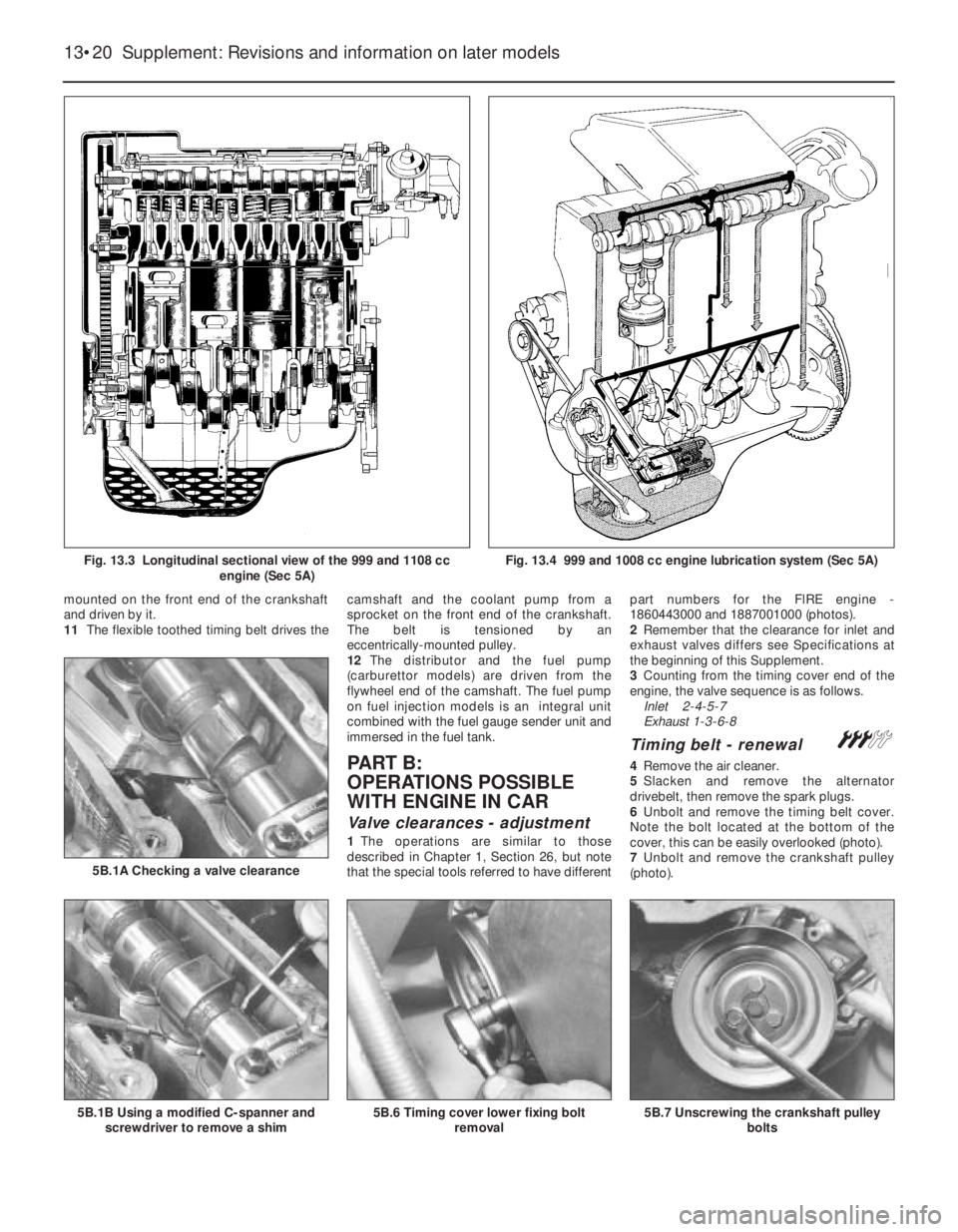
1The operations are similar to those
described in Chapter 1, Section 26, but note
that the special tools referred to have differentpart numbers for the FlRE engine -
1860443000 and 1887001000 (photos).
2Remember that the clearance for inlet and
exhaust valves differs see Specifications at
the beginning of this Supplement.
3Counting from the timing cover end of the
engine, the valve sequence is as follows.
Inlet 2-4-5-7
Exhaust 1-3-6-8
Timing belt - renewal #
4Remove the air cleaner.
5Slacken and remove the alternator
drivebelt, then remove the spark plugs.
6Unbolt and remove the timing belt cover.
Note the bolt located at the bottom of the
cover, this can be easily overlooked (photo).
7Unbolt and remove the crankshaft pulley
(photo).
13•20 Supplement: Revisions and information on later models
5B.7 Unscrewing the crankshaft pulley
bolts5B.6 Timing cover lower fixing bolt
removal5B.1B Using a modified C-spanner and
screwdriver to remove a shim
5B.1A Checking a valve clearance
Fig. 13.3 Longitudinal sectional view of the 999 and 1108 cc
engine (Sec 5A)Fig. 13.4 999 and 1008 cc engine lubrication system (Sec 5A)
Page 148 of 303
depressurize the fuel system, before
disconnecting the fuel pipes and removing the
throttle body, as described in Section 9D.
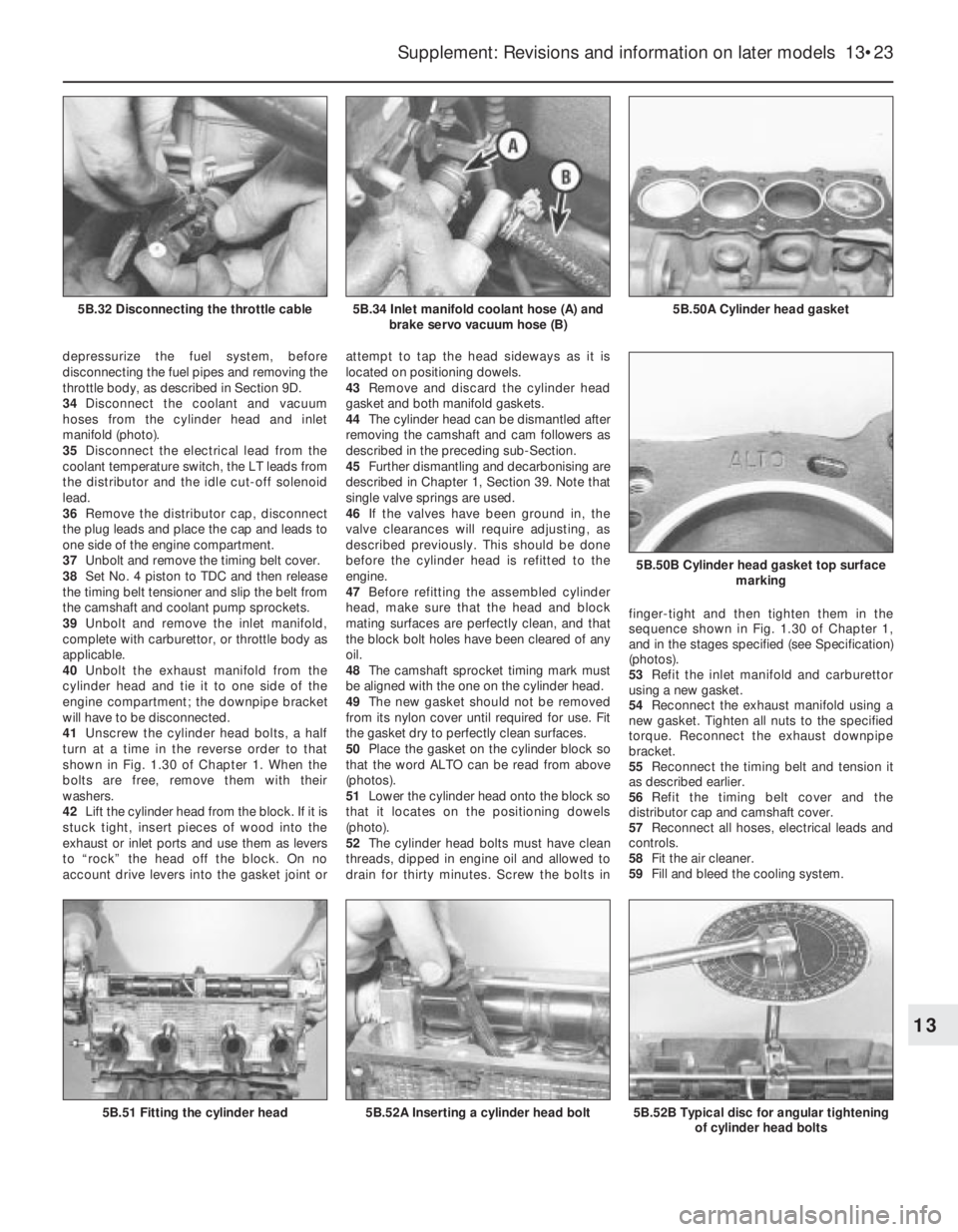
34Disconnect the coolant and vacuum
hoses from the cylinder head and inlet
manifold (photo).
35Disconnect the electrical lead from the
coolant temperature switch, the LT leads from
the distributor and the idle cut-off solenoid
lead.
36Remove the distributor cap, disconnect
the plug leads and place the cap and leads to
one side of the engine compartment.
37Unbolt and remove the timing belt cover.
38Set No. 4 piston to TDC and then release
the timing belt tensioner and slip the belt from
the camshaft and coolant pump sprockets.
39Unbolt and remove the inlet manifold,
complete with carburettor, or throttle body as
applicable.
40Unbolt the exhaust manifold from the
cylinder head and tie it to one side of the
engine compartment; the downpipe bracket
will have to be disconnected.
41Unscrew the cylinder head bolts, a half
turn at a time in the reverse order to that
shown in Fig. 1.30 of Chapter 1. When the
bolts are free, remove them with their
washers.
42Lift the cylinder head from the block. If it is
stuck tight, insert pieces of wood into the
exhaust or inlet ports and use them as levers
to “rock” the head off the block. On no
account drive levers into the gasket joint orattempt to tap the head sideways as it is
located on positioning dowels.
43Remove and discard the cylinder head
gasket and both manifold gaskets.
44The cylinder head can be dismantled after
removing the camshaft and cam followers as
described in the preceding sub-Section.
45Further dismantling and decarbonising are
described in Chapter 1, Section 39. Note that
single valve springs are used.
46If the valves have been ground in, the
valve clearances will require adjusting, as
described previously. This should be done
before the cylinder head is refitted to the
engine.
47Before refitting the assembled cylinder
head, make sure that the head and block
mating surfaces are perfectly clean, and that
the block bolt holes have been cleared of any
oil.
48The camshaft sprocket timing mark must
be aligned with the one on the cylinder head.
49The new gasket should not be removed
from its nylon cover until required for use. Fit
the gasket dry to perfectly clean surfaces.
50Place the gasket on the cylinder block so
that the word ALTO can be read from above
(photos).
51Lower the cylinder head onto the block so
that it locates on the positioning dowels
(photo).
52The cylinder head bolts must have clean
threads, dipped in engine oil and allowed to
drain for thirty minutes. Screw the bolts infinger-tight and then tighten them in the
sequence shown in Fig. 1.30 of Chapter 1,
and in the stages specified (see Specification)
(photos).
53Refit the inlet manifold and carburettor
using a new gasket.
54Reconnect the exhaust manifold using a
new gasket. Tighten all nuts to the specified
torque. Reconnect the exhaust downpipe
bracket.
55Reconnect the timing belt and tension it
as described earlier.
56Refit the timing belt cover and the
distributor cap and camshaft cover.
57Reconnect all hoses, electrical leads and
controls.
58Fit the air cleaner.
59Fill and bleed the cooling system.
Supplement: Revisions and information on later models 13•23
5B.50A Cylinder head gasket5B.34 Inlet manifold coolant hose (A) and
brake servo vacuum hose (B)5B.32 Disconnecting the throttle cable
5B.52B Typical disc for angular tightening
of cylinder head bolts
5B.50B Cylinder head gasket top surface
marking
5B.52A Inserting a cylinder head bolt5B.51 Fitting the cylinder head
13